Is My Claim Eligible for Federal IDR? Self-funded ERISA vs Fully Insured Plans and When State Law Applies
Is your claim eligible for federal IDR? For many out-of-network claims under private-employer plans, yes, including claims under self-funded ERISA plans, provided the No Surprises Act protects the service. The route changes when a federal exclusion applies, a state law or All-Payer Model Agreement sets the payment amount, or a self-funded plan has opted into a state process.
Funding type alone does not settle eligibility. The exact service, the plan's opt-in status, and the negotiation clock decide which forum can pay the claim. File in the wrong one and the balance keeps aging in A/R while staff time goes toward a dispute that cannot resolve the underpayment.
Happy Billing is headquartered in Texas and provides full-cycle revenue cycle management, including recovery of underpaid out-of-network claims.
When a Claim Can Enter Federal IDR
A covered out-of-network claim can enter federal IDR when the No Surprises Act protects the service, no state payment method or All-Payer Model Agreement controls the amount, and the required negotiation steps have been completed on time. Federal IDR isn't a general route for every low payment: CMS explains that the process excludes Medicare, Medicaid, CHIP, and TRICARE claims, as well as disputes whose payment is set by a specified state law or All-Payer Model Agreement.
The service has to qualify, too. The federal protections generally address emergency services, certain nonemergency services from out-of-network providers at in-network facilities, and out-of-network air ambulance services. A routine office visit doesn't become IDR-eligible just because the payer paid less than the practice expected. See our guide to whether the No Surprises Act applies to physician offices before treating an office-based underpayment as an IDR case.
Funding status alone doesn't settle the forum. A self-funded plan can still land in a state process if it opted in, and a fully insured claim stays federal when no state law covers that service. The opt-in election, the exact service, and where the claim sits on the cooling-off clock decide the route. Run all five tests below before filing, and keep the proof for each answer: the plan document or employer confirmation of funding status, the payer's opt-in election, and the negotiation dates that show the clock ran correctly.
| Test | Stays in federal IDR when | Do not file federal IDR when |
|---|---|---|
| Item or service | Emergency care, qualifying nonemergency care at an in-network facility, or air ambulance is covered by the No Surprises Act | The service is outside those protections, such as a routine office visit without an applicable NSA balance-billing rule |
| Payer program | The claim is under a private-employer fully insured or self-funded plan | Medicare, Medicaid, CHIP, or TRICARE is responsible for the claim |
| State or model payment rule | No specified state law or All-Payer Model Agreement sets the out-of-network amount | A specified state law or All-Payer Model Agreement determines the payment |
| Self-funded opt-in | The plan hasn't opted into an applicable state process | The plan opted into a process in Georgia, Maine, Nevada, New Jersey, Virginia, or Washington, and that process covers this dispute |
| Timing | Open negotiation ended without agreement and the federal initiation window remains open | Open negotiation was skipped, the initiation window closed, or the 90-calendar-day cooling-off period is still running |
A "yes" in one row doesn't settle eligibility by itself. A claim that passes the service test can still fail on opt-in or timing, and a filing in the wrong forum costs the window it was meant to use.
For a practice owner, the practical point is cash control: don't let a short payment sit in the wrong queue as an ordinary denial while the applicable dispute window passes. Our No Surprises Act compliance checklist and federal IDR step-by-step guide can help your team separate rate disputes from other claim problems. Happy Billing's compliance workflows route every claim through the correct pathway, including IDR filings when payment disputes arise.
Book a call with a billing specialist
US practices only.
Self-Funded ERISA Versus Fully Insured Plans
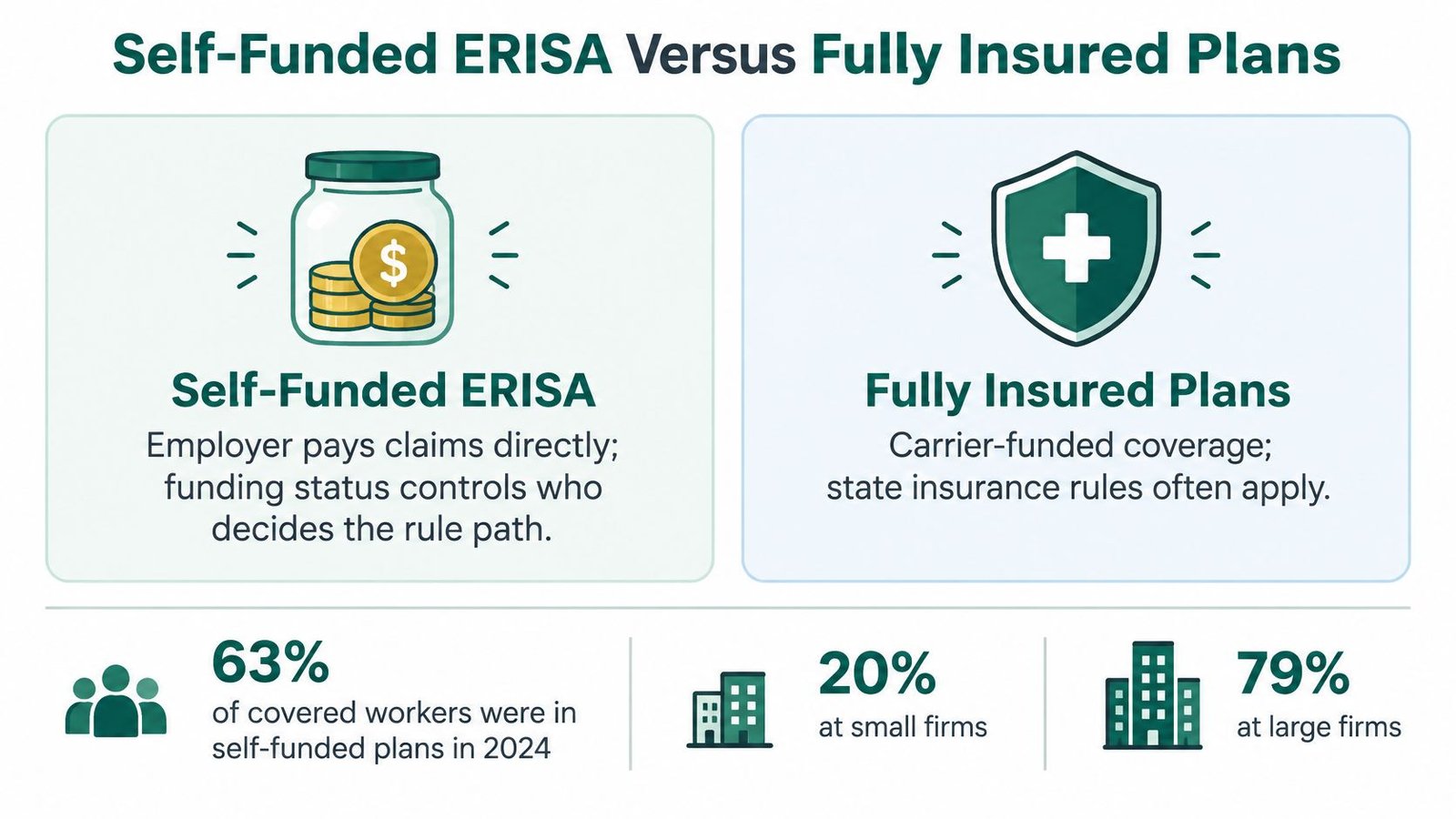
Funding status is a revenue-cycle control, not a technical detail. KFF reported that 63% of covered U.S. workers were enrolled in self-funded health plans in 2024, including 20% of workers at small firms and 79% at large firms, according to its 2024 Employer Health Benefits Survey. That makes it risky to infer the dispute route from a familiar payer name on an ID card.
A fully insured policy is ordinarily subject to the insurance laws of the state regulating the product. If a qualifying state law sets the payment for the specific service, that state's process may apply; otherwise, federal IDR can remain available. A private-employer self-funded ERISA plan is generally outside state insurance regulation, so federal IDR is ordinarily the default unless the plan opted into a permitted state process or another applicable payment agreement controls.
| Decision point | Self-funded ERISA | Fully insured |
|---|---|---|
| Who regulates the plan | ERISA generally limits state regulation of plan funding and benefit administration | State insurance law applies to the approved product |
| Default forum | Federal IDR in all states | State process when a specified law covers the item; otherwise federal IDR |
| Opt-in | Possible in Georgia, Maine, Nevada, New Jersey, Virginia, and Washington, but only if the plan elected it | No opt-in; the state statute applies when the product and service are covered |
| Proof to capture | Funding status, ERISA sponsor, and written answer about any opt-in | Policy state and whether its law covers this provider and service |
| Level-funded or partial | Don't assume it's fully insured; confirm the arrangement before filing | Classify as fully insured only when the insurer bears the claims risk |
| Cost of a wrong guess | Federal initiation may be rejected while the underpayment ages | A state deadline may be missed while the federal portal won't accept the case |
The distinction can change the filing deadline, notice requirements, negotiation period, and evidence the practice needs. An ID card alone may not show who bears claims risk. CMS intake materials distinguish fully insured ERISA plans from partially or fully self-insured ERISA plans and ask whether a self-funded plan opted into a specified state law.
Before committing staff time, ask the plan administrator for the funding status, the ERISA plan sponsor, and written confirmation of any state-law election. A label such as “level-funded” or “partially self-insured” needs review rather than guesswork. If the payment is a routine denial or a separate appeal issue rather than an NSA rate dispute, start with our medical billing denial-management guide. For more on plan protections, see ERISA appeal rights for out-of-network healthcare providers.
When State Surprise Billing Law Takes the Case
State law can control the payment for one service and not another under the same plan. The state where the practice is located, the patient's home state, or the payer logo alone doesn't decide the forum. CMS describes state-law applicability as specific to the item or service, and identifies Georgia, Maine, Nevada, New Jersey, Virginia, and Washington as states where self-funded plans may opt into specified state laws. The plan's actual election must be verified, not assumed, as the CMS applicability chart explains.
New York, New Jersey, and Texas are examples practice owners commonly need to assess. A fully insured policy may be routed to a state process for services covered by the applicable statute, while a different service can remain federally eligible. New York's DFS process, New Jersey's out-of-network process, and Texas's state arbitration aren't universal alternatives for every underpayment in those states. Confirm the policy type, service, and law applicable to the claim.
Self-funded ERISA plans generally remain in federal IDR. New York isn't among the six states CMS identifies for self-funded plan opt-ins, so a private-employer self-funded New York claim doesn't go to DFS by default. New Jersey is on the list, but that doesn't mean every self-funded plan there has elected a state process. The election must exist, and the relevant state process must cover the provider, service, and dispute.
Practical rule: Keep the administrator's written opt-in answer with the EOB and the eligibility record. If a payment dispute is routed incorrectly, the balance can continue aging while staff has to correct the filing path.
For New York disputes, our denial and appeals team is trained on NY DFS IDR filing requirements, documentation standards, and aggregation strategies for disputed out-of-network claims. State rules remain claim-specific, so use the actual policy and service details rather than the payer brand to decide where to file. Our Florida No Surprises Act guide illustrates why state-specific processes warrant their own review.
The Eligibility Checklist Before Anyone Files
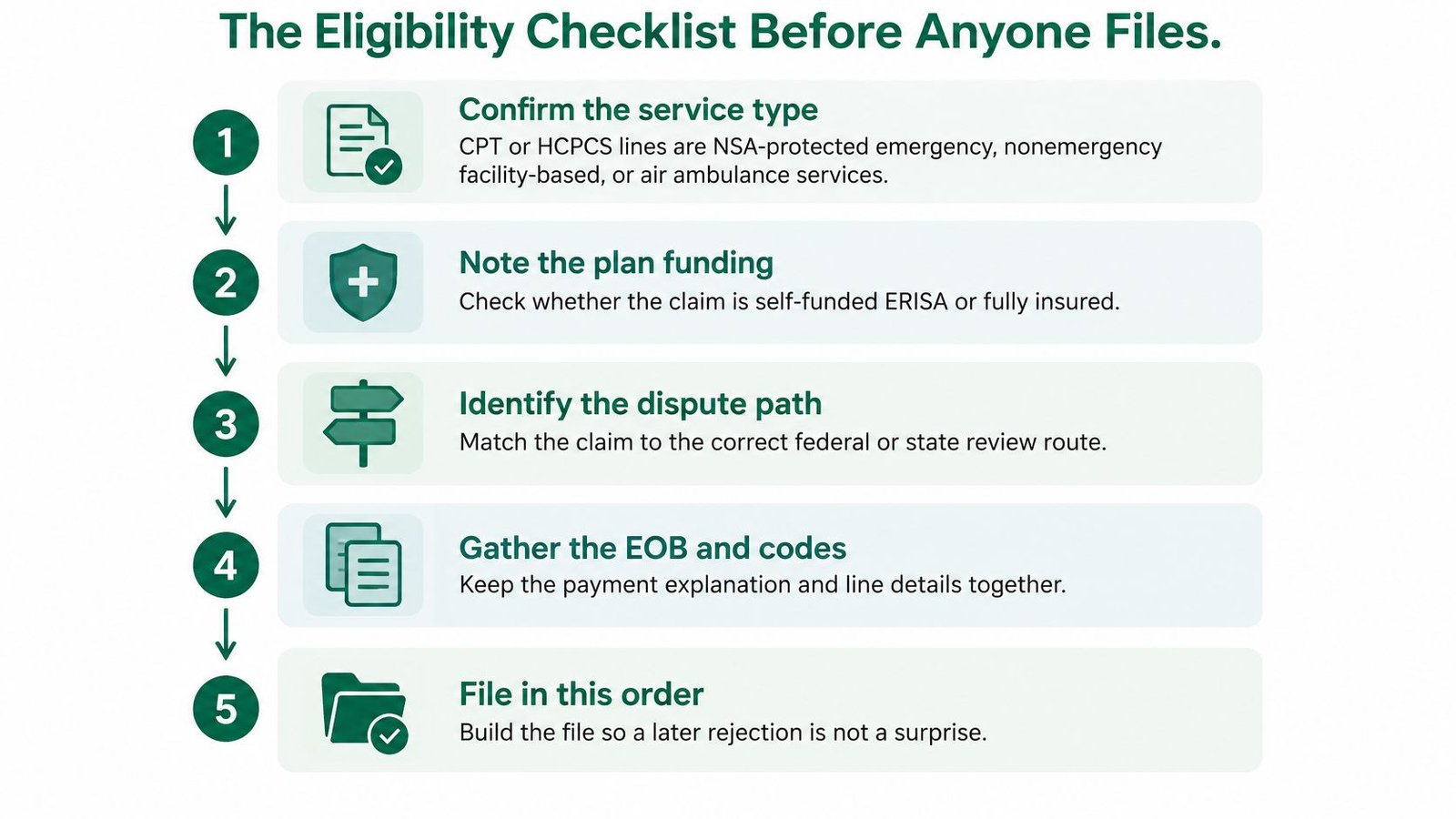
Build the eligibility record in order. A missing answer is a reason to pause, not to guess. The CMS Independent Dispute Resolution overview describes the federal process and the need to identify whether a self-funded plan opted into a relevant state law.
Confirm the service. Match each CPT or HCPCS line to a potentially protected emergency, qualifying nonemergency facility-based, or air ambulance service. Codes such as 97140 and 97110 don't establish eligibility on their own; the setting and protections applicable to the service matter.
Record the service state and facility status. Note where the service occurred and whether the facility was in network. Save the facility and provider details that support that determination.
Classify the funding. Mark the plan as fully insured, self-funded ERISA, level-funded, partially self-insured, or unknown. Don't force an unclear plan into a category based on its card.
Verify the self-funded sponsor and election. Record the ERISA plan sponsor and get a clear yes-or-no answer about an opt-in in Georgia, Maine, Nevada, New Jersey, Virginia, or Washington. Save the administrator's written reply.
Exclude other payer programs. Screen out Medicare, Medicaid, CHIP, and TRICARE from the federal IDR route. Don't assume Medicare Advantage belongs in the federal portal; confirm the program's applicable appeal path.
Document open negotiation. Confirm it began from the initial payment or notice of denial of payment and ended without agreement. Track the applicable negotiation period using current CMS instructions.
Check the initiation window. Confirm the federal IDR filing window is still open and the required cooling-off period has ended. CMS identifies a 90-calendar-day cooling-off period as a procedural gate, so track the relevant dates rather than treating each EOB as a fresh appeal.
Save the evidence packet. Attach the EOB, the qualifying payment amount if shown, the open-negotiation notice and proof of delivery, the opt-in reply, and the plan and service records. Keep the packet linked to the claim so A/R follow-up doesn't reopen a closed deadline.
A plan-level record matters because the same payer brand can represent different funding arrangements. For facility-based specialties such as anesthesiology, emergency medicine, and radiology, keep the service classification and facility-network evidence together with the plan determination. That makes it easier to catch an incorrect route before a filing consumes more staff time.
Batching Rules and the Ineligibility Traps
A claim can carry a strong payment case and still get rejected from federal IDR. The common reasons are procedural: the filing went in before the required 90-calendar-day cooling-off period ended, or the dispute already belongs to a specified state law or an All-Payer Model Agreement. Federal IDR is a gated escalation, and a skipped gate ends the case no matter how underpaid the claim is.
Forum decisions get expensive here. A plan that looks self-funded may still have opted into a state process, and the service classification alone can move a claim out of federal scope. Run the opt-in and service checks before anyone drafts a filing. A submission in the wrong forum burns the initiation window, and the recovery window closes with it.
Batching raises the stakes on the same tests. Claims can be grouped only when they share the applicable CMS criteria for provider or facility, payer or plan, service relationship, and timing. Combining state-law claims with federal ones, or commercial claims with Medicare claims, to inflate the dollar total invites a challenge to the whole batch instead of a payment. Check current batching instructions before grouping, especially when claims span different settings or service lines.
A larger batch can focus negotiation effort, but it can't make an ineligible claim eligible.
High-volume practices lose recovery time when the dispute timeline isn't preserved at the line level. A tracking record that ties each claim to its plan, service, forum decision, notice date, negotiation end date, and filing status keeps a deadline from expiring inside A/R. Follow a documented process for batching underpaid out-of-network claims for payer negotiation rather than grouping claims just because the same payer name appears on the EOB.
How Underpaid Visits Move From EOB to Dispute
Consider an anonymized Manhattan physical therapy example: the practice billed $540 for a visit with 97140 x2 and 97110 x2. Cigna paid $60 after Data iSight repricing, compared with prior payments of $300 to $400 per visit. In another anonymized example, a multi-location New Jersey sports medicine practice saw Cigna and Horizon reprice claims of about $300 to about $100.
Those payment patterns raise a recovery question. They do not settle eligibility. The New Jersey claim still needs a forum test: funding status, any actual plan opt-in, whether the state process covers the service, and whether the open-negotiation clock is still running. A self-funded label alone does not answer any of that. Start by separating potentially eligible rate disputes from ordinary coverage denials, then work the short payments together.
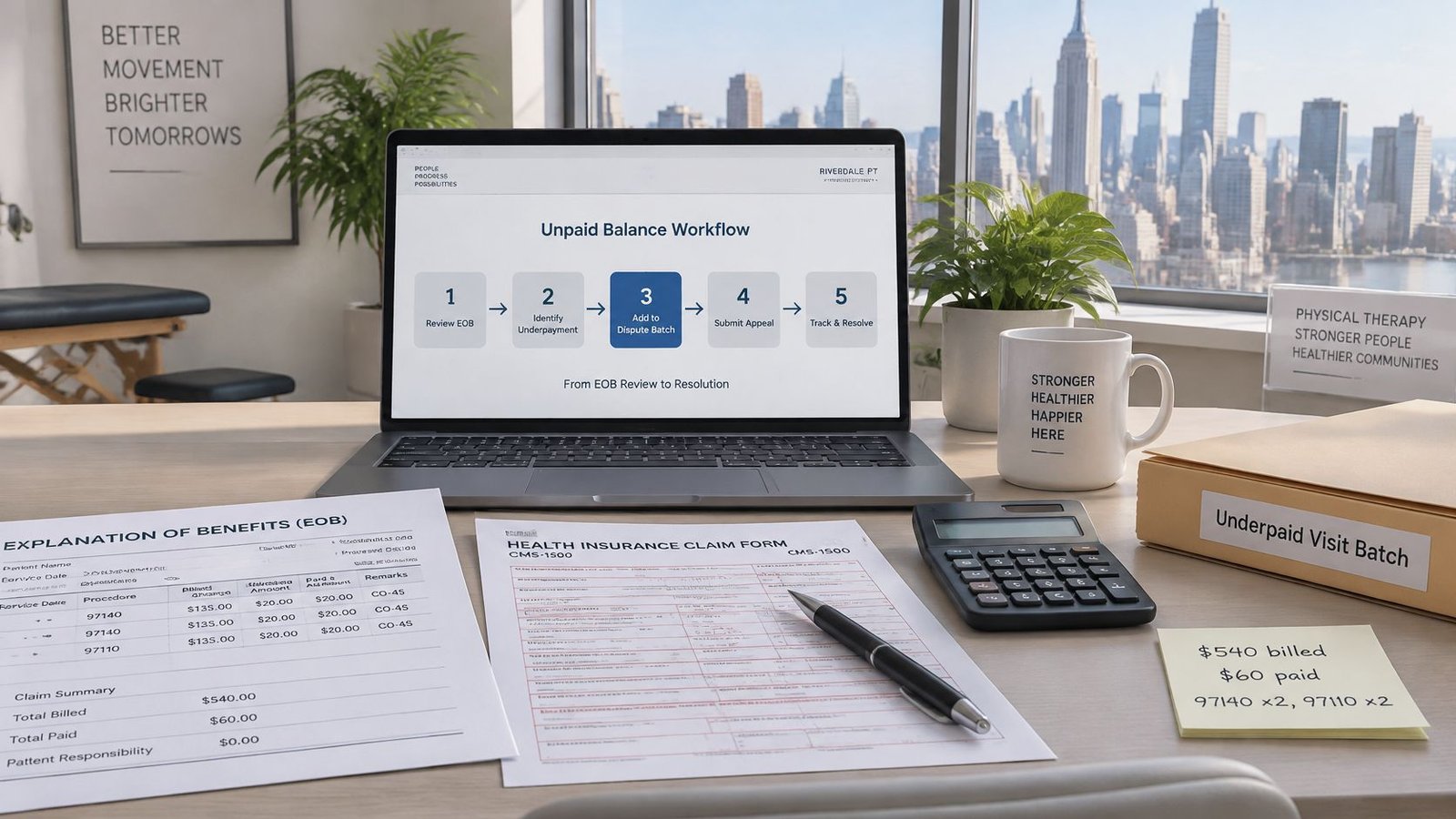
How we approach it:
Group underpaid claims only when the batching rules allow. A single $60 payment gap is easy to overlook. A properly grouped set gives the payer one consolidated issue to review, but grouping depends on the applicable CMS rules for the provider, plan, service relationship, and timing, and every line still has to qualify for the proposed route on its own.
Negotiate with documentation. Bring the claim record, the repricing detail, and the prior payment history into the discussion. A documented pattern of $300 to $400 payments followed by a $60 remittance is a stronger negotiating position than a complaint about one EOB.
Reset only when the record supports it. If a filing window has closed, resubmit for a fresh EOB only when that action is legitimately available. A new remittance should never be used to manufacture a deadline.
Escalate through the right channel. Use the payer's formal or one-time provider dispute process, or IDR for lines that passed the eligibility screen. The open-negotiation notice and clock guide helps keep the notice and timeline organized.
How long recovery takes depends on the payer, the route, and the current CMS instructions, so build the workflow around each dispute's notice and negotiation dates rather than a fixed calendar. Happy Billing handles IDRP filings as part of its standard A/R recovery workflow, and its team audits historical claims to identify and recover under-reimbursed amounts. Practices can also review our physical therapy underpayment recovery guide and specialty billing support.
US practices only.
Questions Practice Owners Ask Before Filing
Is an IDR case worth staff time for a small underpayment?
Usually not for a single small claim unless the likely recovery justifies the staff effort. Batch eligible claims first, apply the same forum test to each line, and compare the combined amount with the time needed to prepare and track the dispute. A larger total doesn't cure an eligibility problem.
What if the open-negotiation window already closed?
Don't submit a late federal filing as though the deadline were still open. Resubmit only when a fresh EOB can legitimately restart the process, then record the new dates and preserve the supporting documentation. If there's no valid reset, use another available payer dispute route.
Can repriced physical therapy visits be batched?
Only when the claims meet the applicable batching rules for the provider or facility, plan, service relationship, and timing. Each line must also pass the service and forum tests before it joins a federal IDR batch. A shared payer name or repricer alone isn't enough.
Do Medicare Advantage underpayments belong in federal IDR?
No. Medicare Advantage claims don't belong in the federal No Surprises Act IDR portal; Medicare, Medicaid, CHIP, and TRICARE claims also use separate payment or appeal systems. Route the underpayment through the applicable program rules instead.
Happy Billing helps practices assess out-of-network payment disputes, organize claim documentation, and route eligible cases through the appropriate dispute process. If federal versus state IDR decisions are leaving claims unresolved in A/R, visit Happy Billing to discuss your recovery workflow.