CPT for Cardioversion A Complete Billing Guide

For cpt for cardioversion, the two codes that matter are 92960 for elective external electrical cardioversion and 92961 for internal transvenous cardioversion. If your team confuses those with emergency defibrillation, critical care, or bundled EP work, revenue slips fast and denials follow.
That’s the situation many cardiology groups are in right now. The procedure itself is clinically familiar, but the billing friction shows up in all the small operational gaps: the note says “shock delivered” instead of “elective cardioversion,” the wrong diagnosis is paired, the same-day E/M isn’t separated cleanly, or a hospital-based event gets billed as though it were a straightforward office conversion. In high-volume cardiology, those aren’t minor misses. They turn into rework, payment delays, and avoidable audit exposure.
What works is simple in principle and demanding in execution. Code the exact cardioversion type. Keep elective and emergency logic separate. Match the CPT to the diagnosis and the note. Apply modifiers only when the record supports them. That’s how you protect first-pass payment and keep your billing team from fighting the same denials every month.
The Core CPT Codes for Cardioversion 92960 and 92961
The foundation of cpt for cardioversion is knowing that 92960 and 92961 are not interchangeable.
92960 is the code for elective external electrical cardioversion. It applies when the provider delivers a synchronized external shock to convert an arrhythmia such as atrial fibrillation or atrial flutter to normal sinus rhythm. It is not the code for emergency defibrillation. As ACEP coding guidance on cardioversion explains, emergency defibrillation is bundled into 92950 when performed with CPR, and documentation should explicitly state “elective cardioversion” and record the pre- and post-rhythm to support medical necessity.
92961 is the internal version. It applies to internal, transvenous cardioversion performed through intracardiac catheters, typically in an EP environment. It belongs in a narrower operational lane than 92960, and billing it correctly depends on showing that the internal shock service stands on its own rather than functioning as part of another larger procedure.
What each code actually means in practice
The word elective matters more than many teams realize. In coding terms, it separates a planned rhythm-conversion service from an emergency resuscitative event. If the chart reads like a crash response, the payer is going to scrutinize 92960 or 92961.
The word electrical also matters. These codes are for shock-based cardioversion. They do not describe medical management with antiarrhythmic drugs alone. If no electrical conversion occurred, your billing logic has to move away from procedural coding and into E/M coding, which I’ll address in the next section.
Here’s the operational view your coders and physicians should share.
CPT codes for electrical cardioversion at a glance
| CPT Code | Description | Method | Key Billing Note |
|---|---|---|---|
| 92960 | Elective external electrical cardioversion | External synchronized shock through chest electrodes | Must be documented as elective cardioversion, not emergency defibrillation |
| 92961 | Internal elective cardioversion | Internal shock through transvenous or intracardiac catheters | Often scrutinized for bundling when performed with EP or device work |
A useful companion reference for cardiology coding teams that also handle imaging is this guide to CPT code 93308, since same-day cardiac testing often creates documentation and bundling questions around rhythm management visits.
The denial trigger most groups can prevent
The biggest unforced error is billing 92960 when the documentation supports defibrillation, CPR, or critical care instead of elective cardioversion. The code description is narrow, and payers expect the note to reflect that narrow use.
Practical rule: If the provider note doesn’t clearly say the service was elective and synchronized, your billing team should stop before submitting 92960.
The second common error is oversimplifying 92961. Internal cardioversion sounds straightforward, but it becomes tricky once the case touches EP studies, catheter work, or implanted devices. If the physician performs internal cardioversion during a broader procedure and the note doesn’t establish a separate, billable service, the claim is vulnerable.
What clean claims usually have in common
When 92960 or 92961 gets paid cleanly, the record usually does four things well:
- Names the service precisely: “Elective external cardioversion” or “internal cardioversion” appears clearly in the procedure note.
- Describes the rhythm change: The chart states the arrhythmia before the shock and the rhythm after.
- Avoids the wrong terminology: Providers don’t mix “defibrillation” into a note that’s meant to support elective cardioversion.
- Supports the code choice operationally: The setting, physician work, and related procedures all line up with the billed CPT.
That level of specificity sounds basic. In real-world RCM, it’s where cardioversion revenue is either protected or lost.
Coding for Pharmacologic vs Electrical Cardioversion
Many billing teams still ask whether there’s a separate procedural CPT for pharmacologic cardioversion. The practical answer is no. If the physician manages rhythm conversion with medication rather than an electrical shock, you’re generally in E/M territory, not 92960 or 92961 territory.
That distinction matters because practices often under-document the physician work when no electrical procedure occurs. The cognitive effort is real: evaluating the arrhythmia, choosing the medication strategy, monitoring response, managing risk, and deciding whether escalation is needed. But none of that becomes a procedural cardioversion code just because the clinical goal was rhythm conversion.

Why electrical and pharmacologic billing follow different logic
Electrical cardioversion has a dedicated procedure code because the physician performs a discrete shock-based intervention. Pharmacologic conversion doesn’t. The claim has to reflect the professional evaluation and management involved in the decision-making.
That means your revenue capture shifts from “Was a shock delivered?” to “Did the note support the E/M level billed?” If your physicians are making complex medication decisions and closely monitoring the result, the note has to show that work clearly. If the documentation is thin, coders often downcode or leave money on the table.
Where 92961 helps clarify the boundary
One reason this distinction matters is that 92961 is tightly defined. As this internal cardioversion billing overview notes, 92961 is used for internal transvenous elective cardioversion, is distinct from 92960, is often bundled with catheter placement or ICD implantation, and requires specific ICD-10 pairing such as I48.0 or I48.1 with detailed procedure notes.
That precision tells you what these codes are not for. They are not catch-all rhythm management codes. They are not substitutes for strong E/M documentation when the provider chooses drug therapy. And they are not a workaround when the record doesn’t support a shock procedure cleanly.
For practice leaders reviewing denial patterns, this is also where workflow discipline matters. Your coders should have a simple branch logic:
- Electrical external shock performed: evaluate 92960
- Internal transvenous shock performed: evaluate 92961
- Medication-only rhythm conversion management: evaluate appropriate E/M
For a broader operational view of how specialty workflows should handle this distinction, this resource on cardiology medical billing services is worth reviewing.
What documentation supports the E and M instead
When the case is pharmacologic, the billable value usually lives in documentation like this:
- Clinical assessment: What arrhythmia was being managed, and how symptomatic was the patient?
- Decision-making: Why was medication chosen instead of immediate electrical cardioversion?
- Monitoring and reassessment: What happened after administration, and how did the provider respond?
- Escalation planning: Did the physician discuss conversion failure, admission, or later electrical intervention?
If your team bills 92960 because “cardioversion” appears in the assessment, but no electrical shock occurred, the denial is deserved.
The financial trade-off is straightforward. Procedural coding may feel more tangible, but forcing a procedural claim where the record supports E/M only creates rework. Clean E/M capture is better than a preventable cardioversion denial.
Distinguishing Elective vs Emergency Cardioversion Billing
Many cardiology practices lose money without realizing it. They know the patient received a shock, so they default to 92960. But coding doesn’t follow the shock alone. It follows the clinical context and the billing framework attached to that context.
If the service occurred during critical care, 92960 cannot be reported. The physician must report 99291 and 99292 instead. That rule isn’t academic. It changes how the entire encounter gets documented, reviewed, and billed.
Why the elective label drives payment
Elective cardioversion has its own reimbursement logic and setting-specific payment. According to this cardioversion reimbursement overview, 92960 pays $156.56 in a non-facility setting and $108.01 in a facility setting, and it cannot be reported during critical care time, where physicians must use 99291 and 99292 instead.
That creates two direct revenue implications.
First, place-of-service accuracy matters. If your team miscoded the setting, the fee schedule applied to the claim may be wrong.
Second, emergency cases can’t be pushed into elective coding just because someone wants the procedural line item. If the physician is delivering critical care, payers expect critical care billing logic. Using 92960 in that setting invites denial and can also trigger deeper review of your cardiology coding habits.
What emergency documentation should lead you to do
Look at the chart the way an auditor would. If the note describes acute instability, active critical care management, or resuscitative decision-making, your billing team should pause before touching 92960.
A practical internal review looks like this:
- Read the assessment and impression first: Does the physician describe a planned elective conversion or an emergent unstable rhythm event?
- Check the time documentation: If the physician documented critical care time, 92960 should not ride with that time.
- Review related services: If CPR is involved, billing logic changes again and may shift to 92950.
- Match terminology across the note: Mixed language such as “emergent defibrillation” and “elective cardioversion” in the same record is a claim problem waiting to happen.
Teams that separate elective workflows from emergency workflows at charge entry usually have fewer avoidable denials than teams that try to fix the distinction after claim submission.
If your front-end process needs tightening, it helps to review adjacent utilization controls too, especially when hospital and payer workflows intersect. This primer on prior authorization in healthcare is relevant because many cardiology groups confuse authorization, medical necessity, and post-service claim edits as if they were the same issue. They aren’t.
What does not work
What doesn’t work is trying to salvage an emergency note by adding elective language later, or expecting coders to infer intent from sparse documentation. Payers don’t reimburse intent. They reimburse documented, code-supported services.
The cleanest process is operational. Build separate encounter review rules for:
- Scheduled elective external cardioversion
- Internal EP-based cardioversion
- Emergency rhythm intervention with critical care
- Shock delivered during CPR or another bundled emergency service
Once those pathways are separated, physicians document more consistently and coders stop forcing mismatched claims.
Applying Modifiers and Navigating Bundling Rules
Most cardioversion denials don’t happen because the practice chose the wrong base code. They happen because the code was submitted in the wrong relationship to other services.
That’s where modifier logic and bundling review decide whether the claim pays or stalls. In cardiology, this gets messy fast. Same-day E/M. EP lab work. Cath lab activity. Imaging. Surgical package overlap. Cardioversion itself may be coded correctly, but the claim still denies because the surrounding claim architecture is wrong.
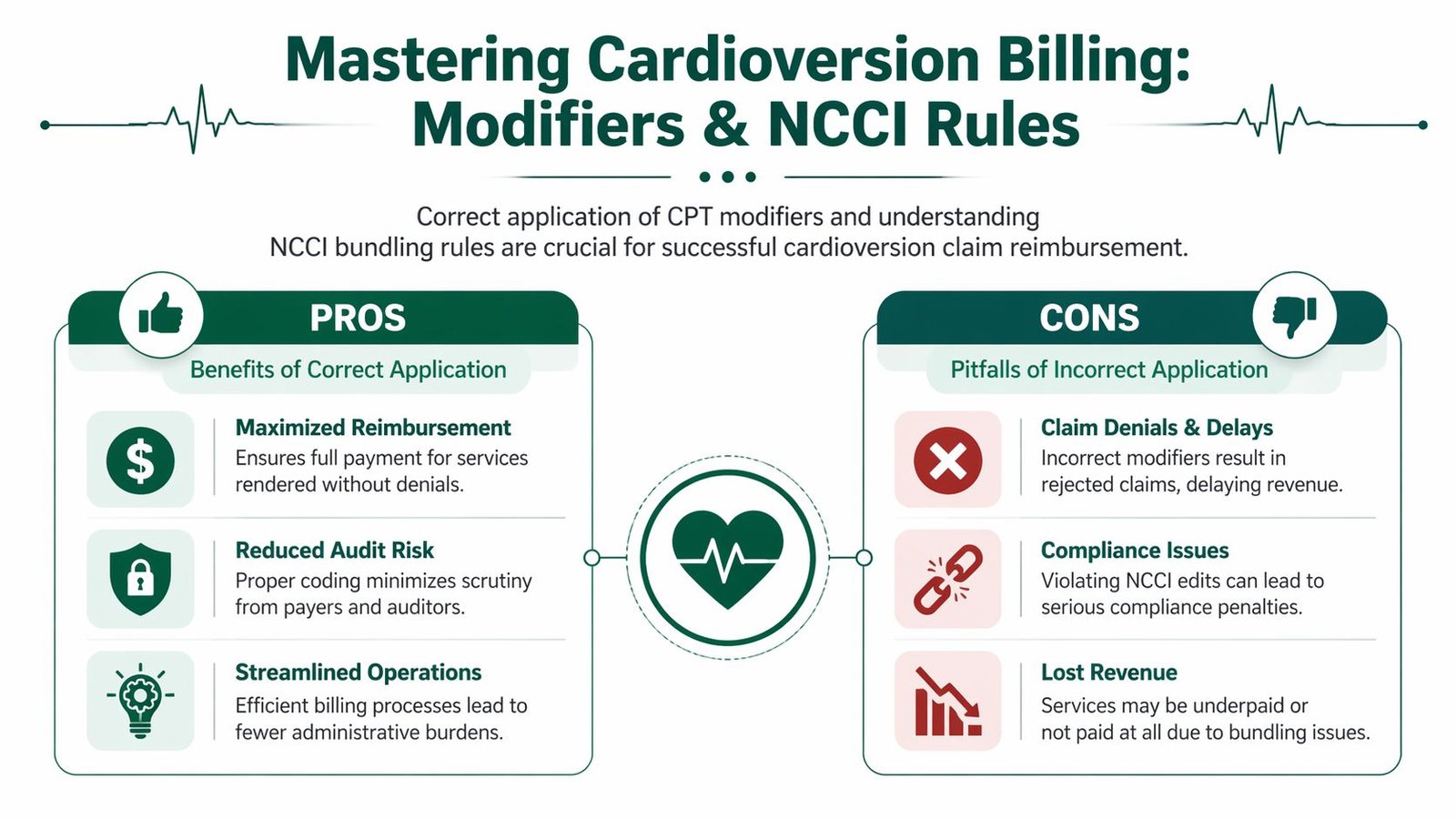
Where modifier 25 belongs and where it doesn’t
Modifier 25 belongs on the E/M code, not on the cardioversion code, when the physician performed a significant, separately identifiable E/M service on the same date as the procedure.
The key question is operational, not theoretical: did the physician perform evaluation work that went beyond the usual pre-procedure assessment for cardioversion? If yes, modifier 25 may be appropriate. If the visit was only the routine assessment needed to carry out the planned cardioversion, it usually won’t support a separate E/M.
A useful internal rule is to ask whether the physician would have documented the core work even if the procedure had not occurred. If the answer is yes, you may have a separately reportable E/M. If no, the E/M is probably bundled into the procedural encounter.
Modifier 59 and the bundling problem
Modifier 59 is where many teams either overuse or avoid it entirely. It can support unbundling when the record shows a distinct procedural service, but it is not a denial eraser. If the note doesn’t prove separation, modifier 59 only turns a weak claim into a more visible weak claim.
The larger issue is that bundling rules are a primary denial driver for cardioversion. As this cardioversion bundling analysis reports, modifier usage and bundling rules drive 30%+ denial rates, recent CMS updates tightened global period rules for PCI codes 92920-92998, and AI-driven RCM tools detect 22% more bundling errors than manual review, improving clean claim rates from 72% to over 98%.
Those numbers matter because they describe exactly what billing managers see in real production. The claim isn’t failing on diagnosis alone. It’s failing because coders don’t always see how one cardiac service changes the billability of another.
For a focused reference on this issue, keep this guide to CPT modifier 59 in your team’s training library.
A practical bundling checklist for cardioversion claims
Use this before the claim leaves your scrubber:
- Check same-day E/M first: If billed with 92960, confirm the E/M stands apart and append modifier 25 only when the documentation supports separate physician work.
- Review procedural overlap: If 92961 occurred during EP or device work, confirm whether it is separately billable or bundled into the larger service.
- Look for recent PCI history: Claims involving 92920 through 92998 need extra scrutiny because global period conflicts can block payment for 92960.
- Use modifier 59 narrowly: Apply it only when the record clearly shows a distinct procedural service and payer edits support that use.
- Audit the op note, not just the charge ticket: Bundling problems often become visible only when someone reads the full procedure documentation.
A strong cardioversion claim is rarely a one-code question. It’s a sequencing question, a modifier question, and a documentation question at the same time.
What actually improves results
Practices get better results when they stop treating cardioversion denials as isolated billing mistakes and start treating them as workflow design failures. The best-performing teams build a review step for any cardioversion claim that also includes E/M, cath, EP, imaging, or recent interventional cardiac procedures.
That approach reduces preventable rebills. It also protects physicians from the common downstream problem where coders keep sending chart queries after denial instead of fixing charge capture logic at the front end.
Documentation and ICD-10 Pairing for Medical Necessity
A cardioversion claim is only as strong as the note that supports it. In payer review, medical necessity is rarely proved by the CPT code alone. It’s proved by the CPT code paired with the diagnosis and the procedure documentation.
That isn’t just coding theory. In a validation study of cardioversion coding, CPT 92960 had a positive predictive value of 96.5% but sensitivity of 76.4%. When researchers combined 92960 with related diagnosis coding, sensitivity increased to 84.9% and specificity exceeded 98.4%. The combined approach also showed PPV of 94.5% and NPV of 95.4%, supporting the practical lesson that coding accuracy improves when the procedure code and diagnosis code work together in the record, not separately, as detailed in the published validation analysis.

What the provider note must show
For cpt for cardioversion, documentation has to do more than prove that a shock happened. It has to prove that the billed service was the right service for the diagnosed rhythm problem.
At a minimum, the note should clearly support:
- The indication: Why cardioversion was medically necessary for this arrhythmia
- The elective nature of the service: Especially important for 92960 and 92961
- Consent: The record should reflect that the physician explained the procedure and obtained consent
- Pre- and post-rhythm: The chart should document the rhythm before the procedure and the result after
- Procedure specifics: The note should describe the performed cardioversion in a way that supports the CPT selected
- Patient response: Immediate outcome and any clinically relevant follow-up observations
When any of those pieces are missing, coders start guessing. Once coders guess, denials increase.
Why ICD-10 pairing is not a back-end detail
Practices often treat diagnosis coding as a downstream billing task. That’s a mistake in cardioversion.
Diagnosis pairing is the front-line justification for the procedure. If the physician documents the arrhythmia vaguely, coders may choose a less specific diagnosis. If the diagnosis is less specific than the clinical reality, the claim can look weak even when the procedure itself was appropriate.
For internal cardioversion, the issue gets even sharper because payer scrutiny tends to be higher. Diagnosis specificity helps establish why the internal approach was used and why the service wasn’t treated as part of a broader bundled intervention.
A documentation checklist billing teams can enforce
Use a pre-bill review standard that asks six questions:
- Did the provider identify the arrhythmia clearly?
- Did the note say elective cardioversion rather than using emergency terminology?
- Did the note record pre- and post-procedure rhythm?
- Was consent documented?
- Does the diagnosis coding match the documented clinical indication?
- If the service was internal, does the note support 92961 as a distinct billable event?
Good cardioversion documentation doesn’t just defend payment. It prevents your coders from inventing the story the chart should have told.
That’s the business logic practice owners should care about. Better documentation doesn’t only reduce denials. It shortens rework cycles, lowers avoidable queries to physicians, and improves confidence during audits.
Real-World Coding Examples and Claim Scenarios
The easiest way to improve cpt for cardioversion billing is to study where claims fail. Most denial patterns repeat. The same wording problem, same modifier mistake, same bundling miss.
A targeted denial-prevention workflow usually starts with examples like these. If your team wants a broader playbook for recurring revenue leakage, this overview of cardiology billing denials is a practical next read.
Claim A denied and Claim B paid
Scenario one. Same-day office evaluation plus elective external cardioversion.
Claim A denied: The physician saw the patient for atrial fibrillation symptoms, performed a same-day elective external cardioversion, and billing submitted an E/M plus 92960 with no clear support for separate physician work. The note looked like a standard pre-procedure assessment.
Claim B paid: The physician documented a separately identifiable evaluation that addressed the patient’s current symptoms, decision-making, and treatment planning beyond the routine procedural work. Billing reported the E/M with modifier 25 and billed 92960 separately.
EP lab internal cardioversion
Scenario two. Internal cardioversion in an EP environment.
Claim A denied: Billing submitted 92961 on a case where the record suggested the internal cardioversion was part of broader catheter-based work. The procedure note didn’t establish a distinct standalone service.
Claim B paid: The note clearly described internal transvenous cardioversion as its own medically necessary intervention, with diagnosis support and procedure details that justified separate reporting.
The classic emergency mismatch
Scenario three. Shock delivered during an emergency event.
Claim A denied: The claim used 92960, but the record described an acute emergency rhythm event with critical care language. In some versions of this error, the note also used “defibrillation” terminology.
Claim B paid: Billing followed the emergency framework instead of forcing elective cardioversion logic. When critical care was the controlling service, the team billed 99291/99292 as supported by the record. When CPR defined the encounter, the coding moved into the CPR framework.
What these examples have in common
The winning claims weren’t built by appealing aggressively after denial. They were built by aligning four things before submission:
- The physician note
- The CPT selected
- Any modifier used
- The clinical context of the encounter
That’s what makes cardioversion billing operational, not just technical. Clean payment comes from upstream discipline.
Frequently Asked Questions About Cardioversion Billing
Can you bill 92960 and an E and M visit on the same day
Yes, but only when the E/M is significant and separately identifiable from the usual work of the cardioversion procedure. In practice, that means the note must support physician evaluation and decision-making that goes beyond routine pre-procedure assessment. If the visit only documents the standard work necessary to perform the cardioversion, billing the E/M separately is risky. When the E/M is justified, modifier 25 belongs on the E/M code.
Is emergency defibrillation billed with 92960
No. 92960 is for elective external electrical cardioversion. Emergency defibrillation follows different billing logic and may be bundled into 92950 when CPR is performed, or the encounter may instead support critical care coding depending on the documented services. If the chart uses emergency language, unstable-patient management, or resuscitative framing, billing should stop and reassess before submitting 92960.
When should 92961 be billed separately
92961 should be billed separately only when the record supports internal elective cardioversion as a distinct service. If the internal shock occurred as part of broader EP, catheter, or device work and the note doesn’t establish separate medical necessity, the claim is vulnerable to bundling edits and denial. The more complex the procedural environment, the less safe it is to assume 92961 stands alone.
What documentation matters most for cardioversion claims
The most important elements are the ones that establish medical necessity and code fit. The note should identify the arrhythmia, document that the service was elective when billing 92960 or 92961, record the pre- and post-procedure rhythm, include consent, and describe the procedure clearly enough that the billed code is obvious from the chart. If your coders have to infer whether the service was elective, external, internal, or emergency, the documentation is too weak.
Happy Billing helps cardiology groups tighten code selection, modifier use, denial prevention, and A/R performance without forcing an EHR migration. If your practice is losing time on cardioversion denials, same-day bundling edits, or specialty-specific workflow gaps, Happy Billing is built for that level of RCM complexity.