No Surprises Act for Independent Emergency Physician Groups: How IDR Works and When to Hand IT Off
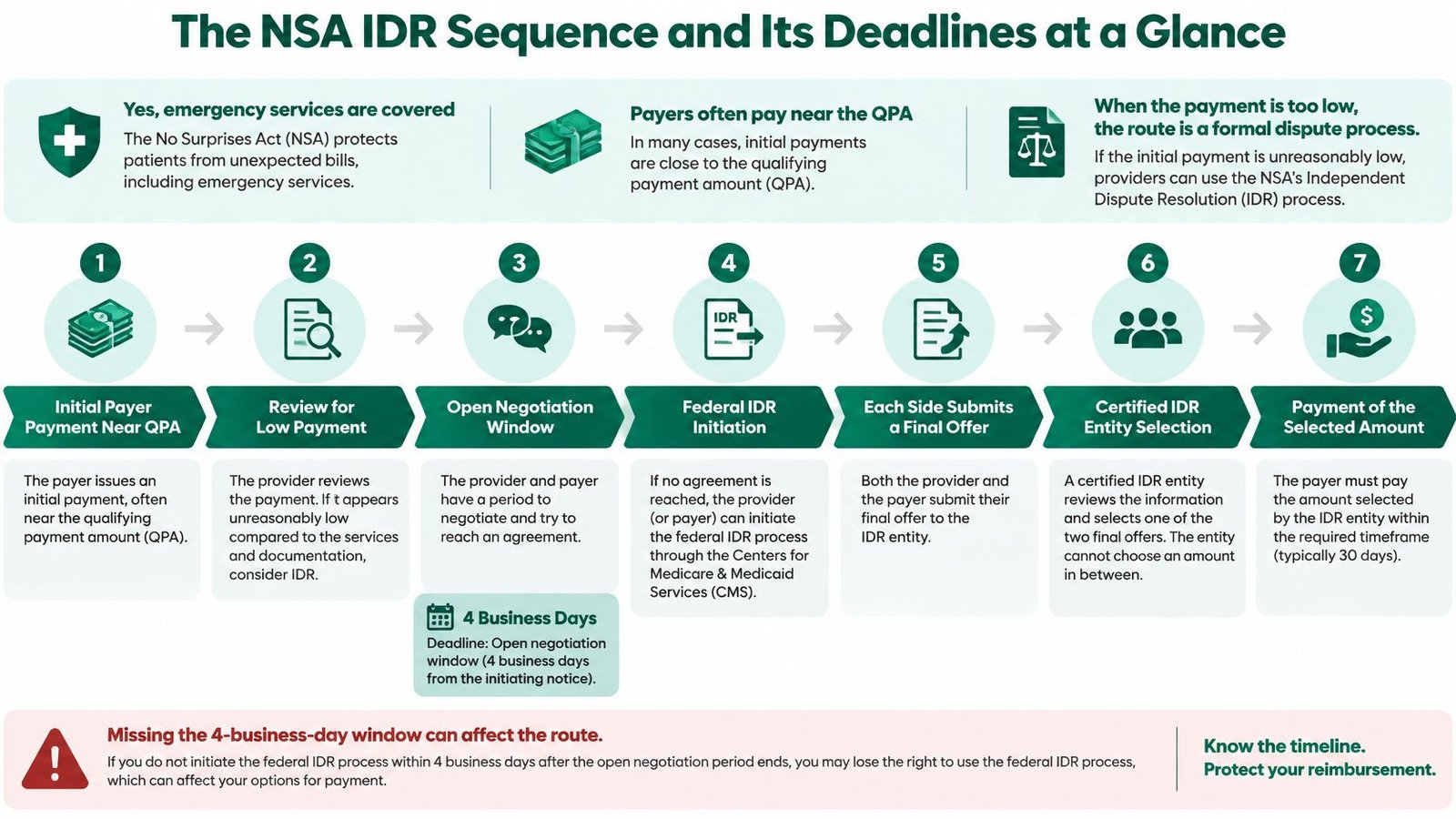
Emergency services are covered by the No Surprises Act, payers routinely pay close to the qualifying payment amount, and when that number is too low the route is a 30-business-day open negotiation followed by federal IDR, whose initiation window closes four business days after negotiation ends. A specialist can run both steps on contingency, which is why the first decision for an emergency group owner isn't whether to dispute a claim. It's who owns the calendar.
That's the counterintuitive part. The money an independent emergency group loses under the No Surprises Act rarely disappears inside arbitration. It disappears when a negotiation notice goes out with no follow-up owner, when a batched submission gets rejected for mixing payer products, or when a four-day window closes during a stretch of nights. Those files sit in A/R, the payer anchors at the same low number on the next remittance, and your days in A/R drift for reasons nobody can point to in a partner meeting.
So the working question behind the No Surprises Act for independent emergency physician groups, how IDR works and when to hand it off, resolves to something operational. The handoff trigger is a calendar event, not a dollar threshold.
The NSA IDR Sequence and Its Deadlines at a Glance
Federal IDR is a structured offer-selection process. A certified IDR entity picks the payer's offer or the group's offer in full. It weighs the qualifying payment amount (QPA) and permitted information such as provider training, experience, market share, service complexity, and documented good-faith contracting efforts. The CMS guidance for disputing parties sets the order of events: a 30-business-day open-negotiation period that begins with the payer's initial payment or denial, a dispute submission inside the initiation window, and then that entity decision. Let every statutory period run and one file can stay open for several months.
That timeline matters at volume. In 2024, more than 1.46 million federal IDR disputes were initiated, and approximately 1.42 million, about 97%, involved out-of-network emergency or non-emergency services, with emergency department and radiology services together representing nearly two-thirds of those medical disputes, according to a Congressional Research Service report on the No Surprises Act. Your group is competing for space in a crowded queue.
Happy Billing, a medical billing company headquartered in Houston, Texas, recovers out-of-network underpayments for independent emergency physician groups and handles federal IDR open negotiation and filings inside the A/R recovery workflow.
A sequence that lives only in someone's memory will slip. Put it on paper instead:
| Stage | Window or deadline | What the group does | Handoff trigger |
|---|---|---|---|
| Initial payment or denial | On the remittance | Compare the paid amount to the QPA and to the billed rate | Payment lands near the QPA with a material gap |
| Open negotiation | 30 business days from the initial payment or denial | Send the negotiation notice and a proposed amount | Calendar alert set on day one, hand off before the period ends |
| Federal IDR initiation | 4 business days after the open negotiation period ends | Submit the dispute through the federal IDR process | Initiate on time, a missed window can eliminate the federal remedy |
| Offer and evidence submission | Per the certified IDR entity's timeline | Submit the final offer, QPA comparison, evidence and the administrative fee | Hand off when that timeline starts if staff cannot build the offer, comparison, and fee on the entity's clock |
| Payment determination | The entity selects one offer in full | Track the outcome and post the payment | Escalate if eligibility or batching was challenged |
Two controls keep the queue from eating the remedy. Name one owner for every open negotiation. A shared inbox leaves the four-business-day initiation window with nobody watching it. Build the evidence file at remittance review, while the QPA gap is still on the explanation of benefits, rather than the week the window closes. Our federal IDR step-by-step guide walks through the filing mechanics if you want the sequence in front of your team.
The rule I'd carve into policy: hand the file off before open negotiation expires, never after the initiation window.
Book a free 30-minute call
US practices only.
Which Emergency Claims Qualify for Federal IDR
Treat eligibility as a cost filter, not a formality. Every ineligible filing buys an administrative fee and a few staff hours and returns nothing, and worse, it delays the claims that would have paid.
What clears the filter: out-of-network emergency services furnished in an emergency department, and certain non-emergency services delivered at an in-network facility by an out-of-network provider, when the coverage is a group health plan or health insurance issuer subject to the statute. What doesn't: Medicare, Medicaid and other federal programs, which sit outside this framework entirely, plus any claim where your group was in network and the payer met the contracted rate. Those belong in ordinary appeals follow-up.
A large share of eligibility mistakes trace to plan type rather than the service itself. Our breakdown of self-funded ERISA versus fully insured plans and when state law applies covers that fork, because a self-funded employer plan routes differently than a fully insured policy.
The three-question screen
Run this before anyone touches a filing:
- Is the plan NSA-covered? A group health plan or health insurance issuer, not a federal program.
- Was this an emergency service, or an out-of-network service at an in-network facility? Emergency classification depends on the place of service and the nature of the encounter, so capture it at the claim level, not from memory months later.
- Is the paid amount below a defensible rate? If the payer sent no QPA disclosure, that alone is a reason to pull the claim and review it.
The screen has to run before any fee is paid. Use a written version of it, which our No Surprises Act compliance checklist is built to support, so a new biller can apply it without asking an owner for a judgment call.
How Open Negotiation and Offer Selection Actually Work
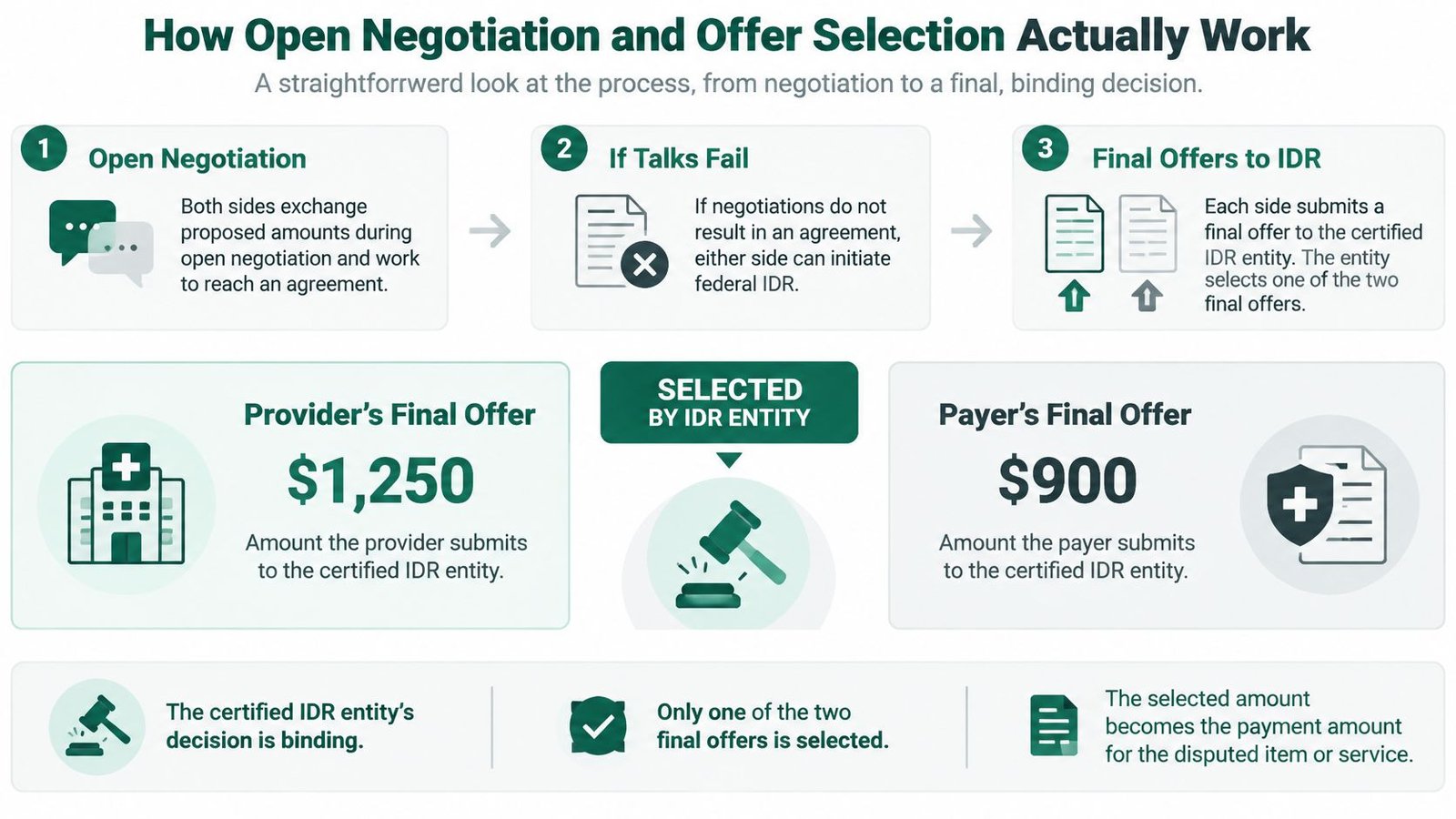
During open negotiation both sides exchange proposed amounts. If talks fail, either party can initiate federal IDR. At that point each side submits one final offer and the certified IDR entity selects one offer in its entirety. No splitting, no compromise number in the middle. Offer construction is the whole game.
The volume is real. CMS data for the first quarter of 2024 recorded 308,596 total federal IDR disputes initiated, including 263,926 involving out-of-network emergency or non-emergency items and services, with 141,194 payment determinations reached in the quarter, per the CMS federal IDR supplemental tables. Emergency services were the largest category of payment determinations in the first half of 2024 at 48%, with radiology at 16%.
What the certified entity actually weighs
The entity considers the QPA plus permitted information. That list is your evidence plan, in order:
- The QPA comparison. Show the dollar gap per claim, not a percentage in a narrative.
- Documentation of the emergency encounter. Prove the acuity and the service rendered.
- Your rate rationale. Provider training and experience, service complexity, case mix, market share, documented good-faith contracting efforts.
- A short cover rationale. Two or three paragraphs a reviewer can follow in under a minute.
Both parties pay the certified IDR entity's fee with the offer, plus an administrative fee for each single or batched determination. Model the disputed underpayment against those amounts before filing, because a well-built offer on a claim that can't cover its own costs is a hobby, not a recovery strategy.
An offer is only as strong as the claim file behind it. Start the negotiation properly with our guide to how to start the 30-business-day clock with the open negotiation notice, then check current CMS outcome data directly before deciding whether a given dispute is worth filing.
We run federal IDR recovery for physician groups end to end, including open negotiation, offer construction and award collection.
Batching Claims Without Creating Rejections
A rejected batch costs more than the administrative fee. It costs the weeks you spent assembling it, the initiation window ticking down on every claim inside it, and the clean filing you could have made instead. Groups that batch carelessly usually do it because grouping feels like efficiency. It is only efficient when the batch survives review.
Batch claims that share the same provider or group, the same plan or issuer, and a similar treatment condition, and that were furnished within the same 30-business-day period or the same applicable 90-calendar-day cooling-off period. Everything else stays separate.
CMS states those conditions plainly and treats bundled arrangements at the service-code level when a single payment covers multiple services, as described in the CMS batching and bundling guidance. The timing conditions come from the certified IDR entity technical assistance document, which identifies emergency services as qualified IDR items and services. Batch when the rules allow it, but never treat batching as the default posture for volume.
That leaves the trade-off most owners frame badly.
| Consideration | Aggressive batching | Narrow batching |
|---|---|---|
| Administrative fee exposure | One fee spread across many claims | Fee repeated per determination |
| Eligibility risk | High when conditions or payer products differ | Lower, each batch is easier to defend |
| Evidence strength | Diluted across unlike encounters | Stronger per claim |
| Staff effort | Lower per claim | Higher per claim |
| Best use | High-volume claims with clearly comparable treatment and payer | Mixed conditions, multiple payer products or uncertain eligibility |
Batching is a legal test, not a grouping convenience. "Everything from the same payer" is how a batch gets rejected.
The middle path works for most emergency groups. Normalize the data first: link remittance lines, service codes, dates of service, payer identity and clinical category, then build batches around comparable clinical circumstances and payment methodology. Before a batch goes out, reconcile the payer's adjustments against the original claim. Track payer adjustments in your ledger at the line level, because a remittance variance that sits in an unreconciled spreadsheet is exactly the variance that corrupts a batch later. The point is operational: batching decisions are only as good as the line-level data behind them, and that data has to be maintained before any dispute exists, not assembled after one.
The pre-submission audit
- Confirm each claim is an eligible emergency or qualifying item.
- Confirm the same provider or group and the same plan or issuer.
- Confirm dates fall inside the required window.
- Confirm clinical similarity within the batch.
- Confirm remittance lines map to the correct codes.
- Compare each batch's expected recovery against its single administrative fee.
Run this audit before every submission, not just the first. Payer products change, group membership shifts as physicians join or leave, and a batch structure that was defensible in March can fail in June because one payer moved members from a fully insured product to a self-funded arrangement. A batch rejected for ineligibility consumes the fee anyway and sends every claim in it back to the queue, where the initiation clock has been running the whole time.
The full grouping logic, including how comparable encounters get assembled into a negotiation-ready file, is laid out in our workflow for batching underpaid out-of-network claims for payer negotiation. When the volume of eligible claims exceeds what your staff can audit line by line, the batching decision itself becomes a handoff trigger, because an unchecked batch is a worse outcome than a smaller clean one.
Operational Risks That Cost Groups the Remedy
Start with the failure that ends the remedy outright. A missed four-business-day initiation window can eliminate the federal remedy, which means the claim goes back to your A/R with no arbitration route left. Nothing downstream repairs that. No appeal, no escalation call, no vendor relationship.
Then the slower leaks. Open negotiation notices go out and lapse because nobody owns the 30-business-day clock. Ineligible filings happen because a self-funded plan got filed as if it were fully insured. Weak offers, submitted without a QPA comparison or a rate rationale, lose to the payer's offer on the merits. And the fee math is unforgiving on small claims: CMS guidance identifies the administrative fee for disputes initiated on or after August 3, 2023 as $50 per party per dispute, subject to later rulemaking and updates, payable no later than offer submission though the certified IDR entity may invoice earlier, per the CMS administrative fee FAQ.
| Risk | What drives it | Safeguard |
|---|---|---|
| Missed IDR initiation window | No calendar owner for the four-business-day period | Escalate before open negotiation closes |
| Lapsed open negotiation | Notices sent without tracking | Weekly log review with a named owner |
| Ineligible filing | Mixed plan type or misclassified service | Eligibility screen before any fee is paid |
| Weak offer | No QPA comparison or rate rationale | Standard evidence template per dispute |
| Uneconomic small claims | Administrative fee exceeds the underpayment | Claim selection and batching review before filing |
| Broken batches | Remittance lines not linked to codes | Pre-submission data normalization |
The fix is governance, not heroics. Name one internal owner for the open negotiation log. Set an escalation threshold by disputed amount and by volume, so a cluster of modest claims escalates on aggregate value rather than sitting below a per-claim cutoff. Review the log every week, on a fixed day. Strong medical billing denial management discipline applies directly here, because a lapsed notice and a weak offer are denial problems wearing different clothes.
Two more controls earn their keep. Specialty-trained coders catch the upstream coding mismatches that generate disputes before a claim ever reaches a payer, and a shared view of denial management in medical billing helps an owner see which payer behaviors are systemic rather than one-off.
When to Keep IDR In-House and When to Hand It Off
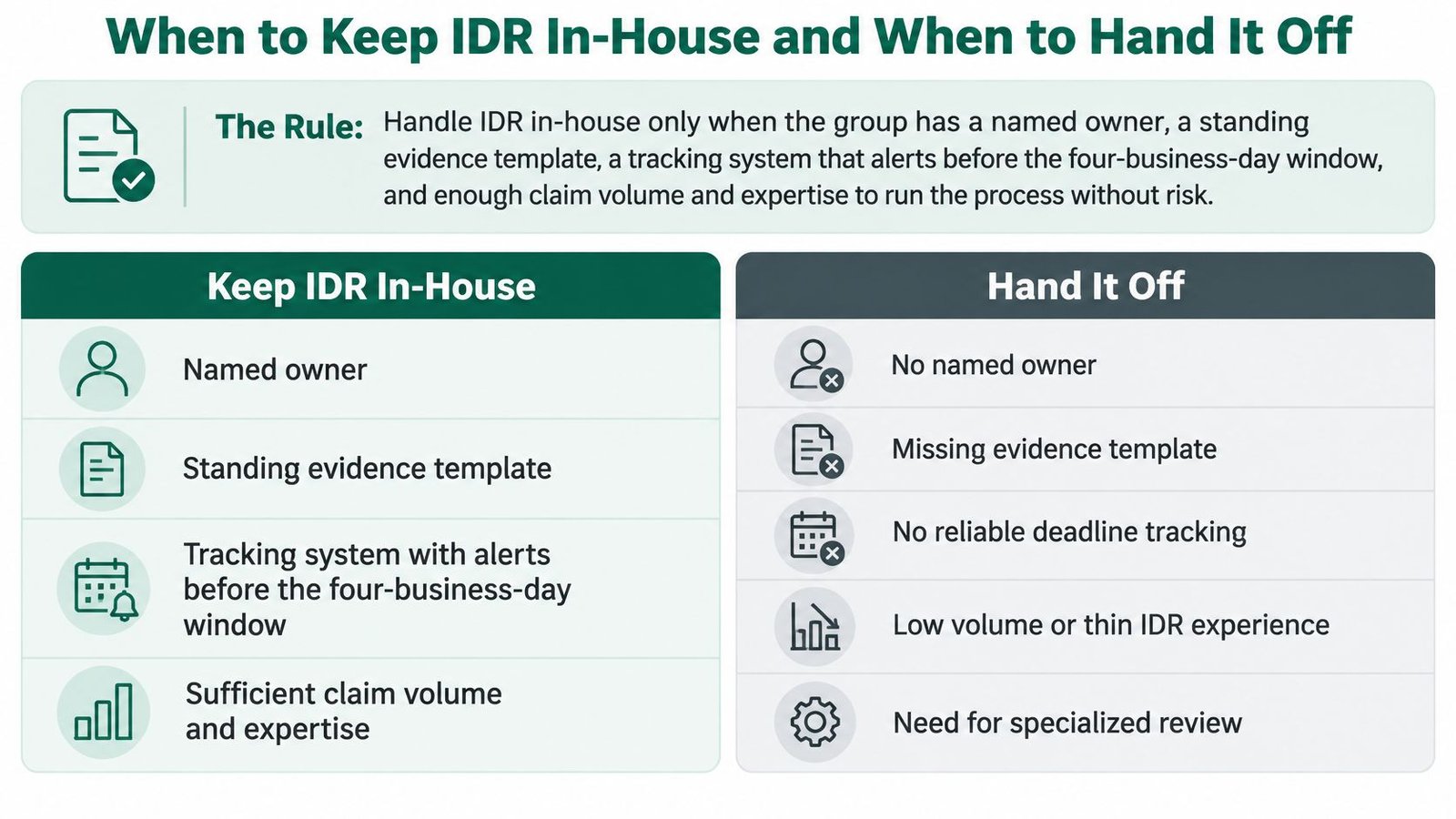
Keep IDR in-house only when four things are true at once: a named owner, a standing evidence template, a tracking system that alerts before the four-business-day window, and enough claim volume to spread the administrative fee across determinations. Miss any one of them and you aren't saving money. You're funding a slow leak with staff time.
The threshold I use: once a claim's negotiation period is inside its final week and no one has built the offer, it isn't an internal task anymore.
| Claim profile | Named owner, template and alerts in place | Recommended path |
|---|---|---|
| Small disputed amount, low volume | Yes | Keep in-house only after modeling the fee against the underpayment |
| Material amount, uncertain batching | Any | Hand off before open negotiation expires |
| High volume, comparable claims | Yes, with tracking | Keep in-house with a standing batch audit |
| Any claim near its negotiation deadline | No | Hand off immediately |
Questions an owner or CFO should ask any IDR vendor
- Who initiates and who signs the submission? Get a name and a title, not a department.
- What happens if a window is missed? The answer should describe an internal escalation, not an apology.
- How are batches built and audited before filing? Ask for the similarity test in plain language.
- How are outcomes and fees reported, and how often? Demand reporting by payer and by claim category.
- How do you work alongside our existing biller? You want a defined handoff, not a turf war.
- What happens to files that fail eligibility? They should come back to you documented, not disappear.
Contingency-only arrangements shift the upfront risk to the vendor, which is a real structural advantage for a group with tight cash flow. Fees depend on claim age and volume, and a clear number comes after a free 30-minute conversation, not from a rate card.
Happy Billing runs open negotiation and federal IDR recovery for physician groups and can sit alongside your existing biller or take the whole revenue cycle, with specialty workflows across our physician specialty billing services. If you're weighing the build-out cost against a partner, our breakdown of what outsourcing medical billing costs and an honest look at in-house versus outsourced out-of-network underpayment recovery will save you a quarter of internal debate.
Our coders and compliance team are trained on both SB 1264 and the federal No Surprises Act, and we track the in-network rating for every facility where a client's physicians practice, which matters when the QPA itself looks off.
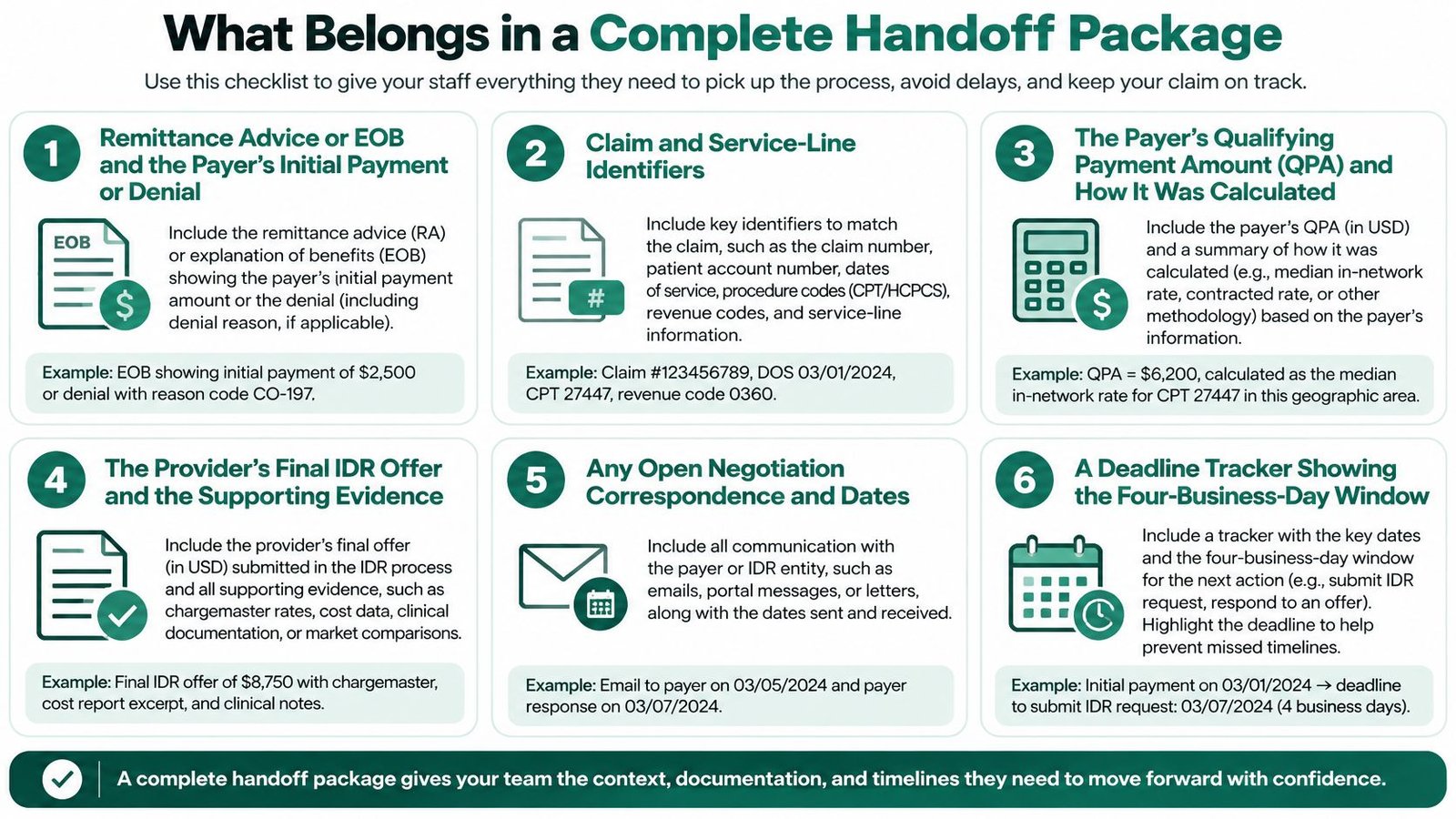
What Belongs in a Complete Handoff Package
A missed initiation window or an untracked batch costs an emergency group more than an unfavorable award. In the first half of 2025, parties initiated 1,186,812 federal IDR disputes, a 39% increase over the final six months of 2024, while certified IDR entities issued 1,082,247 determinations, up 55% over that period, and batched disputes represented 31% of determinations, up from 27% in late 2024, according to the CMS federal IDR supplemental background for the first half of 2025.
A package assembled in a rush at that volume is a package that loses. Hand the file off with this list before the initiation window, not after a denial lands:
- Remittance advice or EOB with the payer's initial payment or denial. This establishes the timeline start date.
- Claim and service-line identifiers with dates of service. Missing identifiers stall an entire batch.
- Place of service and emergency-service classification evidence. This is what makes the claim NSA-eligible in the first place.
- The payer's QPA disclosure. A missing QPA weakens the offer and is itself a review trigger.
- Contract-status evidence showing your group is out of network for that plan.
- All open negotiation notices and payer correspondence. A missing notice can void the initiation.
- Your proposed amount and the rationale behind it. The entity picks one offer in full, so this document does the arguing.
- Supporting documentation for training, experience, case complexity and market share.
Escalation trigger: if item 6 can't be produced on demand, escalate the file today rather than reconstructing the correspondence later.
A specialist can run the eligibility and batching audit before filing, while the dispute can still be opened cleanly. Preparing an offer after submission does not repair a batch the portal rejects or a notice nobody can find. Happy Billing's out-of-network appeal package checklist and template for providers gives staff a version they can work from on day one.
Book a free 30-minute call
US practices only.
Frequently Asked Questions From Emergency Group Owners
Does the No Surprises Act cover our emergency physicians when we are out of network?
Yes, for emergency services furnished in an emergency department when the coverage is a group health plan or health insurance issuer subject to the statute. The payer's initial payment typically lands near the QPA, and the dispute route is open negotiation followed by federal IDR. Medicare, Medicaid and other federal programs sit outside the framework, so screen plan type before your team spends hours on a file.
What happens if we miss the four-business-day IDR initiation window?
A missed window can eliminate the federal remedy, which means the claim returns to your A/R with no arbitration path left. No appeal or escalation call restores it. That's why the file should move to whoever runs IDR before open negotiation closes, not in the last day of the initiation period.
Can we batch claims from different payers into one dispute?
No. Batched items must be billed by the same provider or group, paid by the same plan or issuer, and related to treatment of a similar condition, and the services generally must fall within the same 30-business-day period or the same applicable 90-calendar-day cooling-off period. Combining payers or mixing unrelated conditions invites rejection and delays recovery.
How long does IDR take, and how does it affect our A/R days?
The process runs on fixed statutory windows, so it isn't fast, and unresolved files stay in A/R for the whole sequence. That's the cash-flow cost owners underestimate. Aging a disputed claim out of A/R before a determination hides the exposure rather than settling it.
Should we manage IDR internally or hand it off, and what does a specialist cost?
Hand it off when no named owner, evidence template and deadline alert system exist, or when a claim sits near its negotiation deadline. Fees are contingency-only, depend on claim age and volume, and we give a clear number after a free 30-minute call with a billing specialist. We work with independent practices across the United States.
Happy Billing takes the calendar off your plate: we screen eligibility, run open negotiation, build the offer, file federal IDR and collect the awards for independent emergency physician groups, and we can work alongside your current biller or run the full revenue cycle. If payer offers near the qualifying payment amount are becoming your write-off line, that's the conversation worth having. Visit Happy Billing to start it.
Where this fits