Out-of-network Underpayment Recovery Services: What Is Included and How to Compare Providers
Out-of-network underpayment recovery services audit remittance advice, benchmark allowed amounts against fair-value or contract data, negotiate or appeal shortfalls, and escalate appropriate cases to state complaints or eligible independent dispute resolution (IDR). Under a contingency-only arrangement, the service gets paid from recovered amounts, but winning a dispute isn't the same as putting cash in your practice's account.
That distinction matters when your denial rate looks acceptable but revenue still falls short. A clean claim can be paid below the appropriate amount, marked closed, and never reach an appeals queue. Your practice loses revenue without recording a conventional denial, or leaves the difference sitting in aging accounts receivable.
Compare services by who finds the payment variance, who owns the deadlines, and what your practice collects. An advertised win rate answers none of those questions.
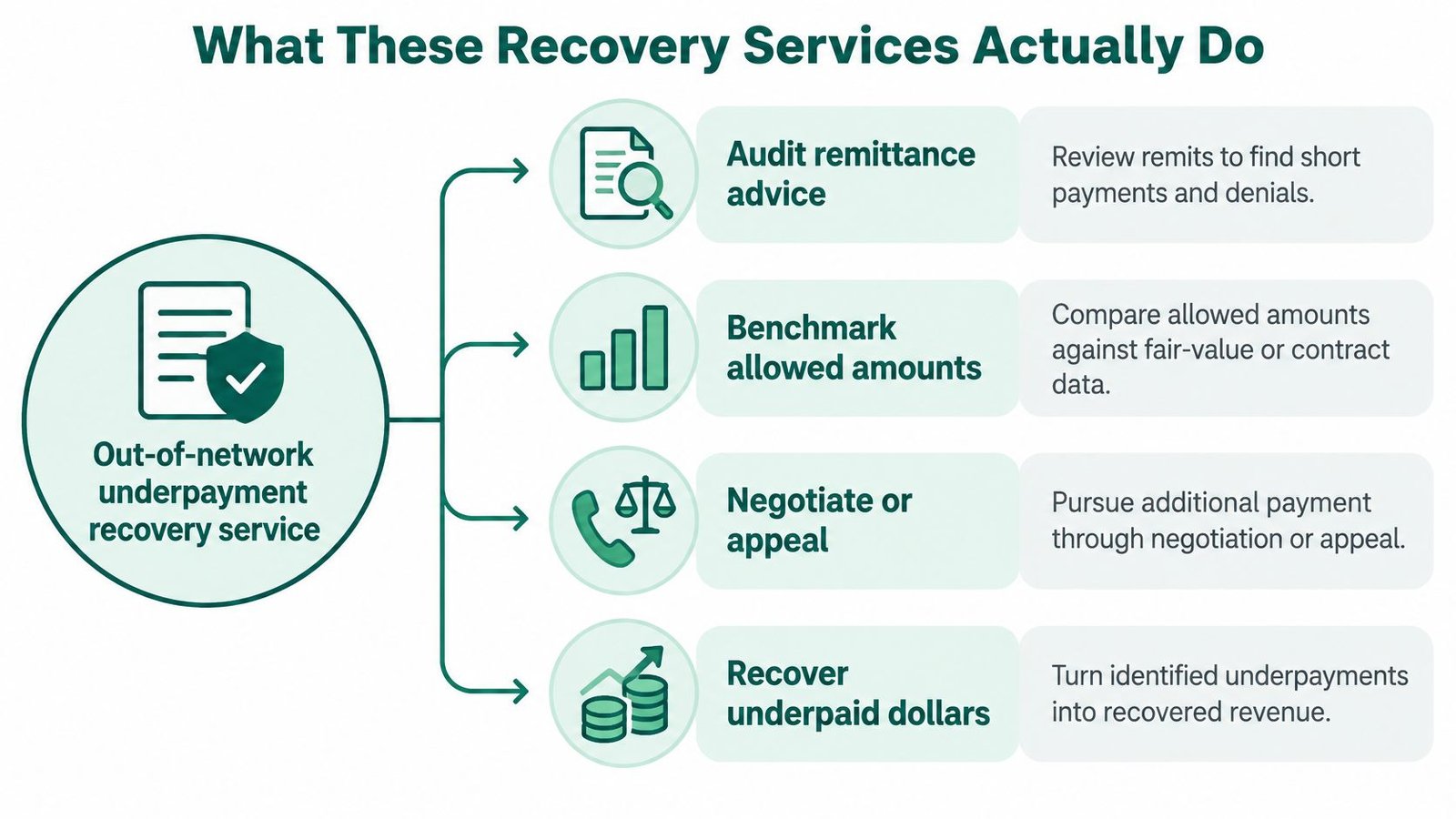
What These Recovery Services Actually Do
A paid claim can still leave money uncollected. If a therapy practice receives less than the applicable payment method supports, the remit may be posted correctly while the account is closed without anyone checking whether the allowed amount is defensible.
A recovery service compares the payment with relevant evidence, separates legitimate adjustments from potential underpayments, and determines whether a challenge is supportable. It also needs to identify the appropriate recovery route and track its deadlines. The value is not just a disputed amount, but the cash ultimately collected after fees and claims the firm declines to pursue.
Happy Billing is a medical billing and revenue cycle management company headquartered in Houston, Texas. Its specialties include physical therapy, chiropractic, anesthesiology, orthopedics and spine, cardiology, behavioral health, pain management and primary care.
The work starts with the allowed amount
A reference to MultiPlan, Zelis, Data iSight or Claritev can help identify how an allowed amount was set. The name alone does not establish that the payment is wrong. The practical question is whether the amount follows the applicable payment method and whether the claim record supports disputing it.
Recurring shortfalls deserve a closer look than an isolated low payment. These signs of systematic out-of-network underpayment can help practice owners spot patterns, while this physical therapy underpayment recovery guide explains how those patterns can leave revenue unworked.
Coverage and reimbursement answer different questions. These postpartum pelvic therapy insurance questions concern whether therapy may be covered; confirming coverage alone does not show whether the provider received the appropriate payment.
Define the scope before work begins
Happy Billing runs end-to-end billing and recovers underpaid out-of-network claims, including through historical claim audits. Recovery work can be coordinated with a practice's existing biller, so owners can define which tasks stay in-house and which are assigned to a recovery team.
Ask how the firm handles claims it considers ineligible, who tracks filing deadlines, and whether its fee applies only to cash recovered. Those terms shape net recovery alongside the amount initially disputed.
Book a free 30-minute call to discuss your claim mix and the work your current team wants to keep.
In-House Billers General Firms and Specialists Compared
Choose the operating model before comparing sales claims. These are typical boundaries, not guarantees about every company, so require the actual scope in writing.
Three ways practices handle out-of-network underpayments
| Provider | What they review | Payer contact and IDR | How they are paid | Best fit |
|---|---|---|---|---|
| In-house biller | Posted remits and routine follow-up already in the practice system | Staff calls payer; IDR usually isn't staffed | Salary and benefits, whether or not dollars are recovered | Low OON volume and disputes the team already wins |
| General billing company | New claims, denials, and standard A/R inside a full RCM contract | Appeals team; NSA or state arbitration often referred out | Ongoing RCM arrangement; recovery may not be separated | Practice needing end-to-end billing more than dispute specialization |
| Specialist recovery firm | Historical EOBs, repricer allowed amounts, and eligibility for appeal, state complaint, or IDR | Dedicated negotiators and IDR filers; can work beside the current biller | Contingency on recovered amounts; terms established after a call | Material OON underpayments, repricer reductions, or NSA-eligible claims |
What the table doesn't tell you
Your in-house billing manager knows your EHR, clinicians, and payer history. That knowledge is valuable. Keeping routine recovery internal works when someone has protected time, a usable benchmark, and authority to escalate beyond a status call.
The limitation is usually capacity and infrastructure, not effort. A biller responsible for new claims, posting, patient questions, and denials may not have time to audit historical allowed amounts or prepare formal disputes.
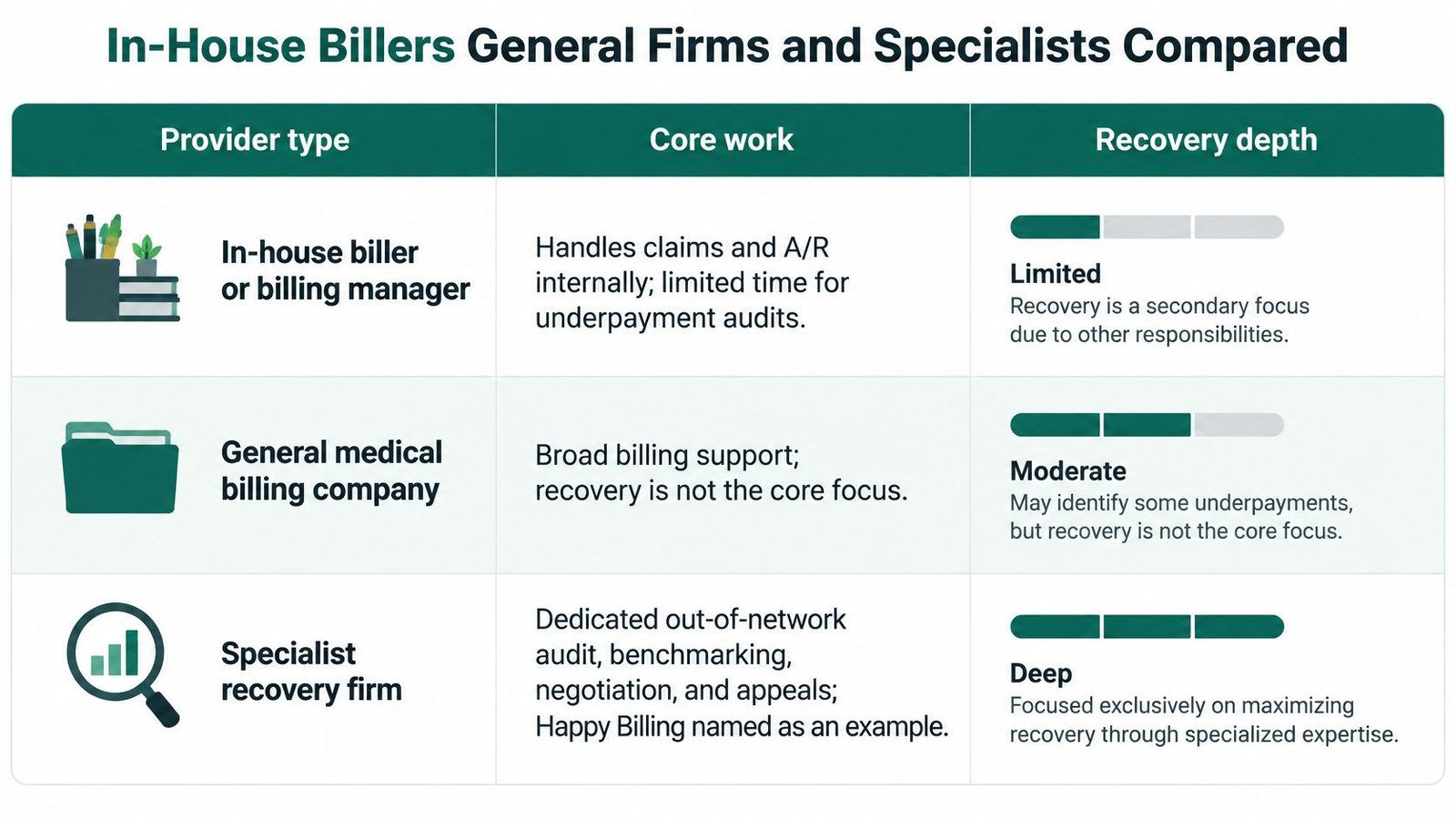
A general billing company can improve submission discipline, posting accuracy, and medical billing denial management. Those functions protect cash flow. But a contract covering ordinary appeals doesn't necessarily include historical underpayment detection, benchmark-supported negotiation, or formal IDR preparation.
A specialist recovery firm, such as Happy Billing, concentrates on that disputed-payment layer. The trade-off is coordination: your practice needs clear handoffs so the current biller and recovery firm don't pursue the same account independently.
Compare the workload you're transferring
Before evaluating the cost of outsourcing medical billing, identify which work would leave your practice. A recovery-only engagement won't automatically solve charge-capture delays, incomplete documentation, or enrollment problems.
Conversely, replacing your full billing operation may be unnecessary when routine claims perform well and the gap is unworked short payments. Buy the missing capability rather than a larger contract by default.
The right vendor is the one whose workflow matches the dispute, not the one with the largest advertised recovery rate.
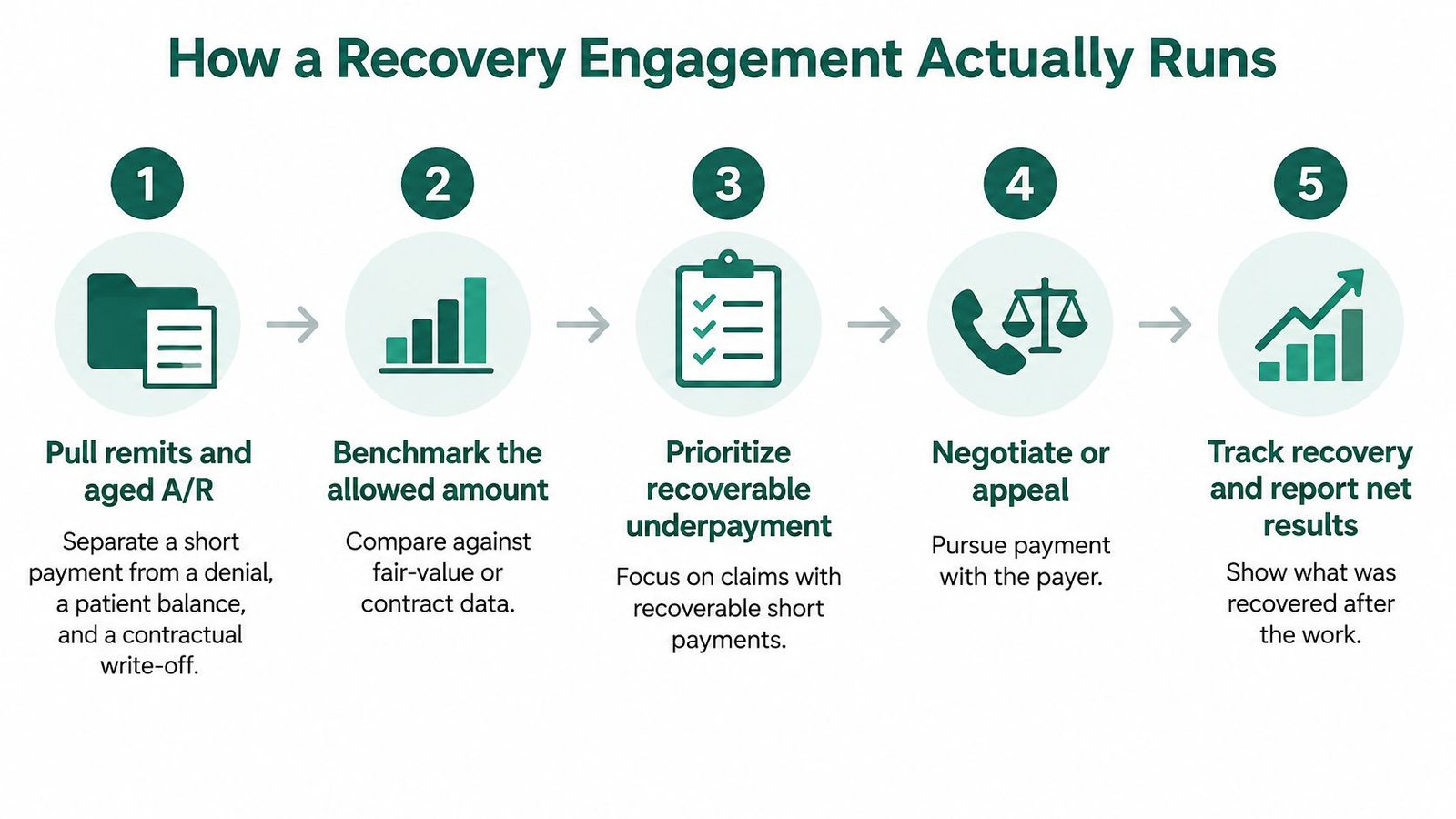
How a Recovery Engagement Actually Runs
A useful engagement produces a claim-level record of the payment issue, supporting evidence, responsible person, next deadline, and final collection. A spreadsheet of disputed balances without those controls isn't a recovery workflow.
From remit to a defensible dispute
Pull remits and aged A/R. Separate short payments from denials, patient balances, and contractual write-offs. Otherwise, the vendor may inflate the opportunity by counting balances the payer doesn't owe.
Benchmark the allowance. Compare the payer's stated methodology with relevant contract or fair-value information. For an eligible surprise-billing dispute, capture the qualifying payment amount (QPA) and related payer documentation rather than substituting an unrelated benchmark.
Validate the existing evidence. Confirm that the original service, coding, and documentation support the requested payment. Owners need to know whether the case is defensible, not receive instructions to alter claim fields.
Choose the appropriate route. Use payer negotiation, an ordinary appeal, an applicable state complaint or dispute process, or federal IDR when eligible. Grouping accounts for negotiation can improve handling, but it isn't interchangeable with formal IDR batching eligibility. Our guide to batching underpaid claims for payer negotiation explains that operational distinction.
Preserve the deadline and collect the result
Document open negotiation. The CMS federal IDR operations final rule describes a 30-business-day open-negotiation period, beginning with submission of the open-negotiation notice, payment remittance, or denial notice to the other party and the Departments through the federal portal. Require proof of the applicable submission and verify implementation requirements for the dispute. Missing the documented start can jeopardize escalation and leave the original payment in place.
Prepare the filing package before negotiation ends. The file should already contain the service details, complete EOB, claim identifiers, eligibility support, opposing-party contacts, and entity-selection information. The federal IDR process walkthrough is useful for understanding the handoffs without turning the owner into the filer.
Submit and support the offer. Under the 2026 federal IDR operations rule, offers are due 10 business days after final entity selection, and the payment determination is due within 30 business days after final selection. The recovery team should track the rules applicable to the filing, not rely on an undated checklist.
Reconcile payment. Match the settlement or determination to the remittance and deposit. Assign responsibility for pursuing any unpaid difference rather than closing the case when the award arrives.
We audit historical claims and handle IDRP filings within our standard A/R recovery workflow. Records also need controlled transmission; SendItFax's discussion of HIPAA-conscious faxing for clinics is a useful operational reference, not a substitute for evaluating the vendor's safeguards and agreements.
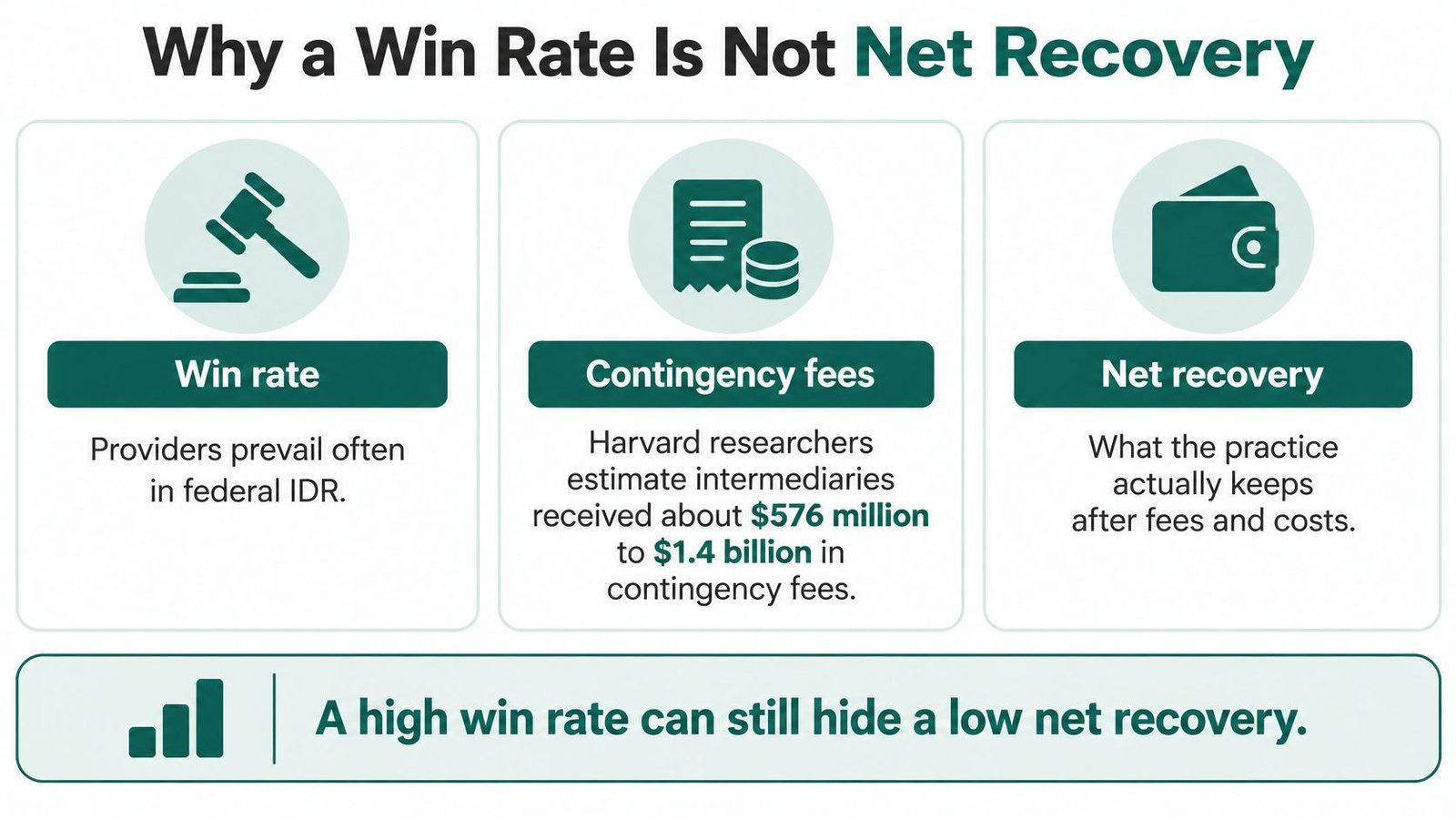
Why a Win Rate Is Not Net Recovery
A prevailing offer is a decision. Net recovery is collected money after deductions. A vendor can perform well on the former while leaving your practice disappointed with the latter.
Harvard researchers' analysis of No Surprises Act disputes highlights the role of intermediaries and contingency compensation in provider awards. Its relevance to an owner is straightforward: award totals don't establish what the practice kept, when it received the money, or how much internal work remained.
Demand a collection-based calculation
Require a cohort report that separates:
- Starting position. Initial payer payment, documented payment variance, and basis for the expected additional payment.
- Outcome. Settlement or determination, additional dollars received, and any amount still unpaid.
- Deductions. Administrative and certified-IDR costs, intermediary compensation, and other contractually allocated expenses.
- Time and effort. Days from assignment to deposit, remaining practice staff work, and accounts still awaiting collection.
- Selection. Claims screened, accepted, declined, and abandoned, with reasons.
Calculate net incremental cash from additional collections, not from the total claim payment that includes money your practice already received. Keep staff time visible even when it isn't deducted from the vendor's invoice.
CMS's federal IDR implementation timeline distinguishes the per-party, per-dispute administrative fee from separate certified-IDR entity charges. Require the contract to explain who bears each category and what happens when a dispute fails.
Selection changes the meaning of success
A firm accepting only strong, high-value claims can report attractive outcomes while declining much of your actual backlog. That may be sensible case selection, but you need the declined inventory to judge whether the engagement addresses your revenue problem.
For therapy, chiropractic, and behavioral health, individually modest shortfalls can matter across recurring visits. They may justify coordinated negotiation without justifying an individual arbitration. A usual-and-customary rate benchmark can support analysis, but it doesn't automatically establish an enforceable payment amount.
CMS's cooling-off report describes a 90-calendar-day cooling-off period after a final determination and, generally, a subsequent 30-business-day initiation window for affected services. Poor calendar management can therefore damage future recovery opportunities as well as the current case.
Owner's test: Count the cash deposited, the deductions taken, and the balances still outstanding. Don't treat an uncollected determination as recovered revenue.
Eight Checks Before You Sign a Recovery Firm
Use these checks to test the vendor's actual operating process. A confident explanation is useful, but an example report, file checklist, and written responsibility schedule are stronger evidence.
| Evaluation check | Pass test | Red flag |
|---|---|---|
| What they review | EOBs, billed charges, allowed amounts, applicable benchmarks, relevant QPA information, and repricer notices | They call every billed-charge difference an underpayment |
| Lookback | Historical review is limited by claim-specific appeal and dispute deadlines | They promise a broad lookback without checking dates |
| How claims are chosen | Written selection logic considers expected net recovery, evidence, and lawful grouping | Every low payment goes straight to IDR |
| Who contacts payers | A named role owns negotiation, escalation, signatures, and handoffs | Your staff still has to chase every response |
| Reporting | Screened, pursued, settled, determined, declined, and collected accounts remain distinguishable | One blended success metric replaces claim-level detail |
| Contract and exit terms | Work in process, recovered funds, outstanding costs, file ownership, and deadline transfer are defined | Ending the agreement strands active disputes |
| Payer-specific experience | The team can explain the plans, repricers, specialty patterns, and applicable state processes | National claims volume substitutes for relevant experience |
| What they will not take | Exclusions identify ineligible disputes, patient balances, expired opportunities, and weak economics | The firm accepts everything without qualification |
Test the document package
The CMS provider–health plan dispute guidance lists service dates and locations, service and place-of-service codes, the complete EOB, claim numbers, scope attestation, opposing-party contact information, and a preferred certified IDR entity; it also states that initiation generally occurs within four business days after open negotiation ends.
Ask the vendor to show how it checks that package before a deadline approaches. Missing records shouldn't become an emergency the practice discovers after outsourcing.
For ordinary appeals, require the same discipline around proof of submission and the applicable payer deadline. The guide to appealing a denied insurance claim provides context for assessing that control.
Make state experience concrete
For a New York practice, familiarity with DFS filing requirements and documentation is more useful than an unsupported claim of nationwide expertise. Our denial and appeals team is trained on NY DFS IDR requirements, documentation standards, and aggregation strategies.
Contract review deserves equal attention. Use the billing-company questions and warning signs to examine ownership and exit obligations, rather than turning this service comparison into another sales interview.
If the firm cannot show an audit trail from EOB to deposit, the recovery metric on its sales page isn't comparable.
Which Disputes Belong With Which Kind of Help
A therapy or chiropractic practice with recurring repricer reductions needs a different recovery process from an emergency group pursuing eligible surprise-billing disputes. Both involve out-of-network payments, but their evidence, economics, and escalation routes differ. Match the work to the dispute type before comparing vendors.
Repricer erosion across recurring visits
A therapy group may have a series of paid claims with unexpectedly reduced allowances. The owner needs to identify a recurring payment pattern, not pursue a single large emergency award. The recovery service should compare like services, identify the payment method, and determine whether the evidence supports negotiation or an appeal.
The overview of out-of-network medical bill repricing tools helps clarify the repricing context. The specialty billing overview can help owners match recovery needs to their service mix.
Results should be compared across similar dispute types, payers, and claim ages. An emergency-department arbitration average is a poor basis for estimating recovery in a behavioral-health practice.
NSA-eligible surprise-billing disputes
The CMS federal IDR reports recorded 610,498 disputes initiated from January 1 through June 30, 2024, and 348,607 payment determinations during that period. For practice owners, the volume makes filing capacity, eligibility review, and deadline ownership important criteria when comparing help.
Emergency, anesthesia, radiology, surgical-assistant, and facility-based groups need screening suited to their services. The certified entity selects a submitted offer, rather than creating an entirely new rate, so preparing the offer is substantive work.
Use a No Surprises Act compliance checklist to assess process controls. Confirm whether federal IDR or state law applies to the claim, since out-of-network status alone does not establish eligibility.
Historical short payments beside a functioning biller
A mixed independent group may submit new claims reliably but lack a systematic review of historical allowances. That is a defined recovery need, not necessarily a reason to replace the billing operation.
Motor vehicle accident and workers' compensation files require separate classification from ordinary NSA disputes. Keep reporting split by repricing, ordinary appeals, state processes, federal IDR, and other recovery paths. A published win rate is not net cash: compare who identifies the variance, owns deadlines, and accounts for fees, uncollected determinations, and claims the firm declines.
When to Hire a Specialist Instead
Keep recovery with your current team when out-of-network volume is manageable, remits match defensible expectations, and someone consistently pursues disputes within applicable deadlines. Outsourcing isn't automatically better than a capable internal process.
Add specialist capacity when paid claims age without meaningful review, repricer reductions recur, or eligible disputes move toward deadlines without an accountable owner. I would start with the narrowest scope that fixes the missing capability rather than replace a functioning billing operation.
Preserve the work that already performs
Happy Billing can run billing end to end, work alongside your biller, or handle a defined specialty or location. Our Old A/R Recovery service pursues unpaid claims older than 90 days, subject to the available recovery path and applicable deadlines. Motor vehicle and workers' compensation files can also be included.
Credentialing can stay separate. Your current biller can retain the responsibilities you want to keep, while we focus on historical short payments or broader A/R recovery.
The practical risk of doing nothing is that an unresolved shortfall becomes an accepted write-off without anyone making an economic decision. Judge the outsourcing decision against that unworked inventory, not against a headline win rate.
Decide the scope before transferring accounts
Bring a de-identified description of your payer mix, claim ages, repricer notices, and current follow-up process to the initial discussion. Don't send patient records through an unsecured inquiry form.
Our contingency-only terms depend on claim age and volume, and we give a clear number after a free call with a billing specialist. Nothing is due upfront; payment is tied to delivery.
Book a free 30-minute call to determine whether recovery should sit beside your biller or within a broader billing engagement.
US practices only.
Questions Practice Owners Ask Before Hiring
Will this replace my current biller?
It doesn't have to. A specialist can handle historical underpayments while your biller keeps routine claims. Full-cycle billing is a separate scope decision.
Does every short payment qualify for federal IDR?
No. Eligibility depends on the service, plan, and applicable legal framework. Many repricing disputes need negotiation, ordinary appeals, or state remedies instead.
How far back can old claims be worked?
Only as far as an available recovery route permits. Claim age alone doesn't establish eligibility. Require a deadline screen before treating an old balance as recoverable.
What should the monthly report show?
It should distinguish dollars identified, pursued, awarded, and deposited. Require payer, specialty, claim-age, and deduction detail. Include declined claims and unpaid determinations so selection and collection gaps remain visible.
What does the first call decide?
It identifies your dispute mix and the work your current team should retain. The discussion should separate repricing, NSA, state arbitration, motor vehicle, and workers' compensation files. Recovery terms are discussed on that call, not published as a universal rate.
Happy Billing offers historical underpayment recovery, payer negotiation, eligible dispute filings, and full-cycle billing for independent US practices. Visit Happy Billing to discuss who should own your disputed payments, how the work will be tracked, and whether specialist recovery can fit alongside your current biller.
Where this fits