No Surprises Act IDR for Intraoperative Neuromonitoring (IONM) Groups: Playbook
About 61% of early federal IDR disputes remained unresolved as of June 2023, a warning that filing isn't the same as collecting, according to GAO's review of federal implementation. No Surprises Act IDR for intraoperative neuromonitoring (IONM) groups can provide a payment-dispute route for eligible out-of-network services at in-network hospitals and ambulatory surgical centers, but state-law jurisdiction must be checked first. For the practice owner, the objective is collectible revenue and controlled A/R, not a larger inventory of pending disputes.
Whether Federal IDR Can Recover Your IONM Underpayments
One anesthesia group reported a 15% increase in monthly collections after specialty-trained coders took over its claims. IONM disputes run on the same discipline. The NSA protects patients from prohibited balance billing, and ancillary-service protections generally stop the group from shifting the disputed balance to the patient through a notice-and-consent waiver.
Federal IDR can challenge an eligible underpayment after unsuccessful open negotiation, but the order of operations matters. Check the route first. Build the evidence file second. Watch the statutory clocks throughout. A valuation argument assembled before the eligibility decision wastes staff time if the claim belongs in a state process.
When an IDR dispute is triggered for anesthesiology, pathology, radiology or emergency medicine, Happy Billing prepares the documentation package and timeline the OIC arbitration process requires. It manages the full revenue cycle for New Jersey physician groups, and its denial and appeals team handles New York DFS IDR filings.
IONM creates a particular collection problem because the monitoring group works inside another clinician's surgical episode. A clinically necessary, surgeon-directed service can still be underpaid when the initial payment ignores the resources used to provide it.
Owner's rule: Treat each short payment as a dated dispute file, not an open-ended sequence of payer calls.
An unresolved underpayment stays in A/R while staff keep working it. In files I've handled, groups that recovered had the operative record, remittance and negotiation history assembled before deadline pressure started.
Our federal IDR guide covering QPA and open negotiation explains the payment framework. For groups working alongside facility-based clinicians, surgical-team billing support keeps clinical documentation aligned with the entity that submits the claim.
The practical test:
- Route: does this claim belong in federal IDR?
- File: can the group substantiate its offer with permissible evidence?
- Clocks: can someone own the deadlines through payment?
Book a free 30-minute call with a billing specialist. US practices only. Fees are contingency-only, depend on claim age and volume, and we give a clear number after the call. There's nothing upfront; we only get paid when we deliver.
Eligibility Checks That Decide the Route Before You File
Out-of-network status alone doesn't establish federal IDR eligibility. An ancillary IONM service at an in-network hospital or ASC generally receives NSA protection, but the service setting, plan structure and applicable state law determine where the payment dispute belongs. The Congressional Research Service's NSA analysis explains why those distinctions matter.
Start with the facility's network status on the date of service. Happy Billing tracks the in-network rating for every facility where a client's physicians practice. A scheduling conversation or current directory listing isn't a substitute for date-specific verification.
Federal IDR eligibility by IONM claim scenario
| Claim scenario | Likely route | Verify first |
|---|---|---|
| IONM at in-network hospital or ASC, no notice-and-consent waiver | Federal IDR after open negotiation, unless state law controls | Facility network status on the date of service |
| Notice-and-consent form signed by patient | Ancillary-service protections aren't waived; federal IDR may remain available | Service billed as ancillary, not as a waived elective service |
| Fully insured plan in a state with its own IDR process | State process may control | State filing rules and deadlines |
| Self-funded ERISA plan | Federal IDR generally applies to otherwise eligible claims | Plan funding status on the date of service |
| Medicare fee-for-service or Medicaid | Not federal IDR; payer appeal rules apply | Payer appeal deadline |
| Facility network status unknown | Hold the filing decision while preserving deadlines | Obtain the facility rating for the date of service |
The state-law check comes before valuation. Sending a strong clinical argument to the wrong forum doesn't preserve the correct forum's deadline. Confirm funding status rather than assuming the carrier name identifies whether the plan is fully insured or self-funded.
Next, reconcile the service classification with the operative and monitoring notes. IONM happens during another clinician's procedure, but that doesn't make its claim interchangeable with anesthesia or another ancillary specialty.
A signed form also isn't a universal permission slip for balance billing. Confirm that ancillary-service protections apply before anyone treats consent paperwork as a waiver.
Our billing team ensures applicable OON Consumer Protection Act disclosure protocols, notification timelines and documentation requirements are met before submission. Use the No Surprises Act compliance checklist to organize those checks, while keeping Medicare and Medicaid appeals outside the federal IDR queue.
Coding, Modifiers and the Evidence That Supports a Higher Offer
95940 and 95941 require different monitoring documentation. The former describes continuous intraoperative monitoring in the operating room, one-on-one; the latter addresses monitoring from outside the operating room. Verify the current CPT descriptors, time requirements and payer recognition before filing, because an unsupported monitoring configuration weakens the payment position before valuation begins.
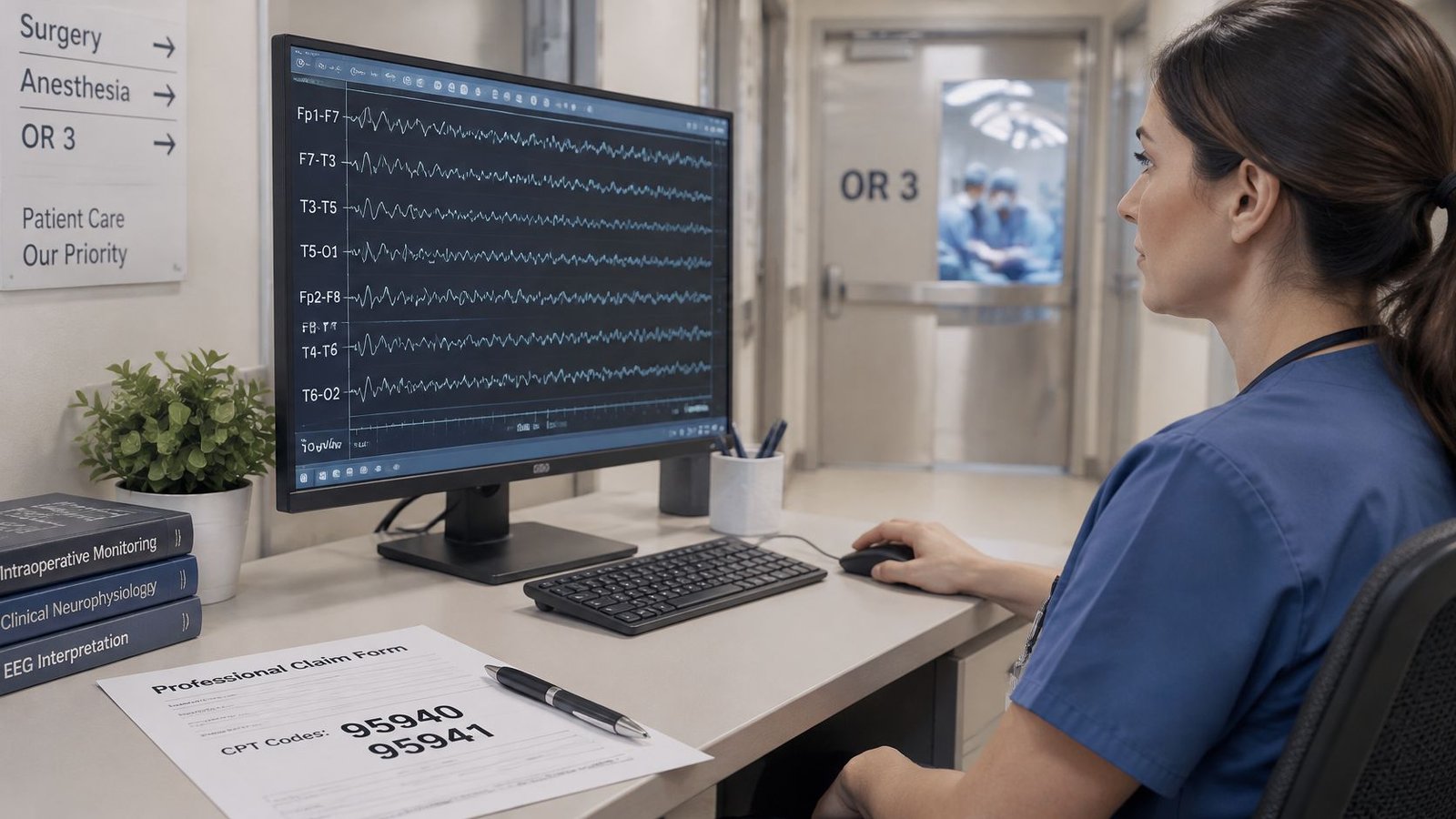
Don't automatically append a professional or technical modifier to every monitoring line. Apply component billing only where the underlying code permits it, and distinguish monitoring services from the associated diagnostic modalities.
| Code or modifier | What it covers | Financial risk if wrong |
|---|---|---|
| Modifier 26 | Professional component, where component billing applies | Misapplied split produces the wrong allowed amount before IDR starts |
| Modifier TC | Technical component, where permitted, supported by the entity furnishing the technical resources | Incorrect attribution of equipment or technologist services misroutes payment |
Build a case-specific valuation file
The qualifying payment amount, generally an indexed median contracted-rate benchmark for comparable services and geography, isn't the same thing as the group's charge. Our QPA explainer for out-of-network providers explains the distinction.
When the initial payment sits near that benchmark, the submission needs more than disagreement with the remittance. Reconcile each CPT/modifier combination, service date and unit count to the clinical record and payment information, then support the proposed offer with:
- Credentials: Relevant physician training and experience, plus technologist qualifications such as CNIM certification where applicable.
- Operative complexity: The actual spine, cranial or other high-risk procedure and the monitoring demands it created.
- Duration and modalities: Documented monitoring time, correctly calculated units, and the somatosensory, motor evoked or EMG services furnished.
- Supervision: Who monitored in-room or remotely, what oversight occurred and how staffing supported the case.
- Intraoperative events: Recorded alerts, interpretation and the surgeon's response, without unnecessary PHI.
- Contracting evidence: Relevant actual contracting history and a clear explanation of why the plan's comparison is inappropriate.
FAIR Health information may help frame a separate commercial negotiation, but charge-based benchmarks aren't automatically permissible federal IDR valuation evidence. Screen the proposed exhibits against the current rules rather than importing a negotiation packet unchanged.
AAPC-aligned, specialty-trained coder review should resolve encounter-level inconsistencies before the dispute exists. The owner gains a defensible offer, not merely a cleaner-looking submission.
Seeing this on your own EOBs? Bring a few recent out-of-network EOBs to a call. We will tell you which claims look underpaid and which are worth appealing.
How to Run the Federal IDR Timeline Step by Step
Assign the calendar before assigning the narrative. The CMS overview of federal IDR explains the open-negotiation pathway, binding offer selection and payment obligation. Keep the receipt date, negotiation initiation date and filing deadline as separate fields in one tracker, because each one starts a different clock.
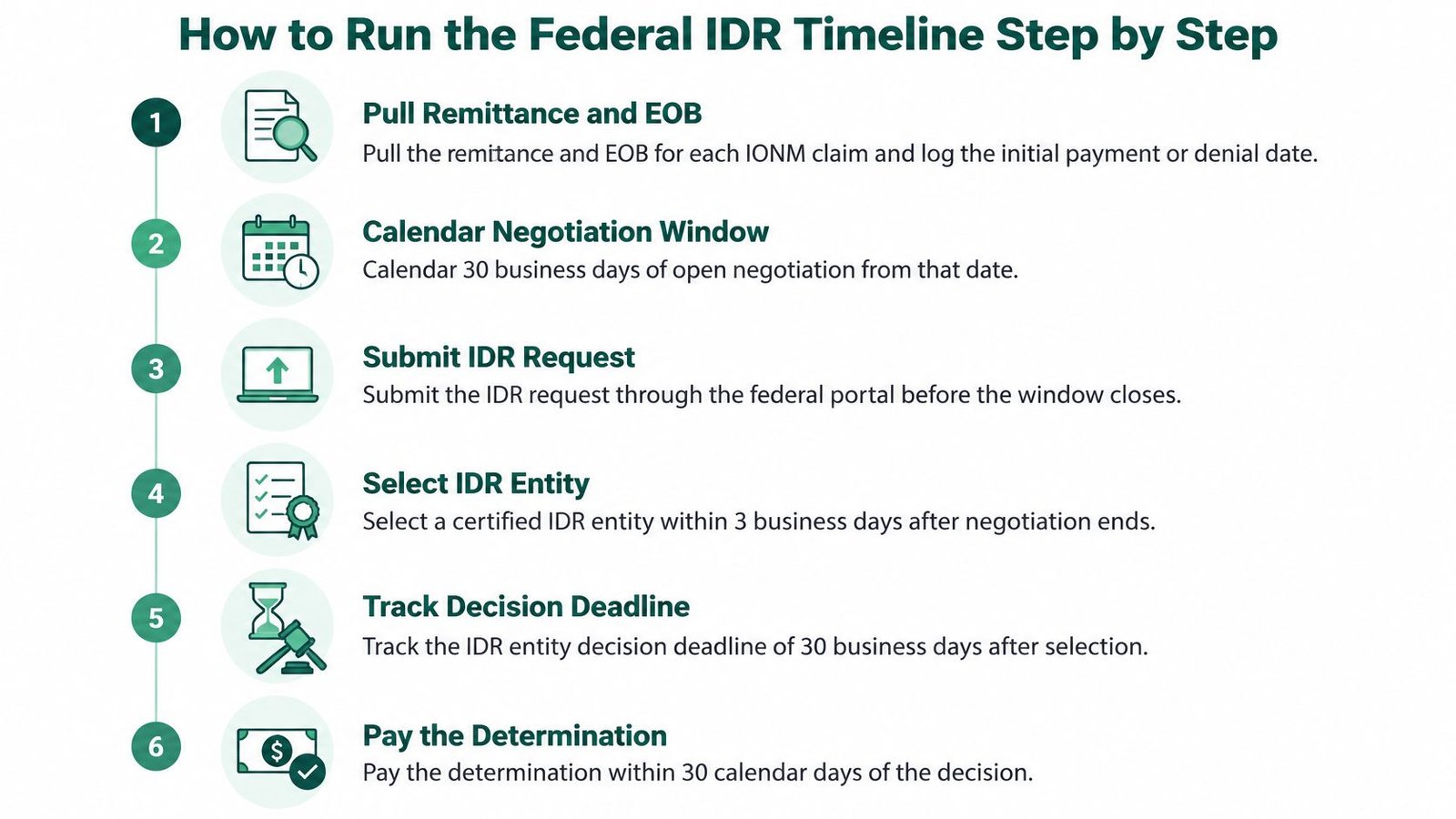
Work the route check first, the evidence file second and the statutory clocks third. Entity selection follows IDR initiation, not the end of negotiation, and that sequencing mistake is how otherwise valid IONM claims miss their window.
Capture the payment event. Pull the remittance and EOB, record when the initial payment or denial was received, and preserve the payer's QPA disclosures. The date someone noticed the short payment is not the operative date.
Initiate and document open negotiation. Send the required notice within the applicable initiation window and record its delivery. The negotiation period runs for 30 business days, and that period is distinct from the deadline for starting it.
File promptly if unresolved. Initiate federal IDR within 4 business days after open negotiation ends. Audit that deadline daily rather than relying on an employee's personal calendar.
Check grouping before submission. Confirm the same payer, the same provider or group, the same or similar service category, and that the service dates fall within the same 30-business-day period. A negotiation spreadsheet is not proof that the same claims qualify for a statutory batch.
Submit a reconciled offer packet. Include the final offer, payment and QPA information, and permissible evidence. Separate materially different operative profiles instead of obscuring them inside a generic narrative.
Confirm initiation and entity selection. Save portal confirmations, notices and selection communications. Track the certified entity's actual submission requirements and deadlines.
Reconcile the determination. The entity selects one offer rather than averaging the proposals. Compare the binding determination with the submitted offer and the previously paid amount.
Collect and close. Track the payer's 30-calendar-day payment obligation, post the funds and assign escalation if the payment is missing or short.
Federal IDR clocks for IONM claims
| Clock | Rule | What it means for IONM cash |
|---|---|---|
| Open negotiation | 30 business days after valid negotiation initiation following payment or denial | Preserve receipt and initiation dates separately |
| Initiate federal IDR | Within 4 business days after negotiation ends | A missed filing deadline can foreclose the route |
| Cooling-off period | 90 calendar days following a relevant prior determination | Track affected similar items separately |
| Batching window | Items and services must be furnished within the same 30-business-day period | Count the window from service dates, not negotiation dates |
| IDR determination | Due within 30 business days after entity selection | Measure the clock from selection; the selection period itself sits before it |
| Payer payment | 30 calendar days after determination | Follow the award through deposited cash |
CMS notices and batching materials address batching and cooling-off requirements. They also describe a post-cooling-off filing opportunity for affected items, so those claims need their own queue.
The federal IDR process walkthrough provides filing context. Actual turnaround remains a cash-planning risk: CMS reporting documents substantial filing activity alongside determinations issued outside the nominal resolution period, so forecast receipts conservatively rather than on the regulatory schedule.
Negotiation, Batching and the Economics of Each Claim
Run the economics only after the claim-level route check says federal IDR is available. A payer-facing negotiation package and a federal IDR batch serve different purposes. Confusing them can turn a useful commercial escalation into an ineligible filing.
I start by grouping related underpayments by payer so the case manager can see aggregate exposure, then I separate each claim's route status, evidence status and clock. Present a claim-level reconciliation and a specific request; a stack of EOBs with a demand for full charges reads as noise. Our guide to batching underpaid claims for payer negotiation explains that organizational approach.
A negotiation batch creates a manageable discussion. A statutory batch must independently satisfy the filing rules.
Separate repricing evidence from IONM valuation
Use a hypothetical example: a payer applies a repricing exhibit or fee schedule, the EOB posts a lower allowed amount than the group expected, and the remittance gives little detail about the derivation. That fact pattern can support a request for the methodology and contract basis. It does not prove an IONM rate.
For commercial negotiation, FAIR Health comparisons require a matching service, geography, benchmark type and date. Do not describe a percentile as a mandatory ceiling or a standard settlement entitlement. A payer's willingness to negotiate and an arbitrator's authority to weigh evidence are different questions.
Screen each file on five points:
- Recoverable difference: the supported additional amount over the posted allowed amount, capped by what the evidence can defend.
- Preparation burden: whether records already exist or need reconstruction.
- Procedural exposure: eligibility uncertainty, batching risk and a live filing window.
- External costs: applicable administrative and certified-entity costs, separate from any recovery partner's compensation.
- Capacity: whether this file puts a stronger claim's deadline at risk.
If a window has closed, a resubmission does not automatically create fresh federal rights. Resubmit for a genuine correction or payer-authorized reprocessing, then evaluate formal appeal, a provider dispute or IDR only where eligibility and timeliness remain valid. The insurance claim appeal guide helps distinguish an appeal from payment arbitration.
Small claims can justify a combined negotiation. They do not justify a filing merely because they are available.
Common IONM Pitfalls and How to Fix Them
The costliest valuation mistake is treating a high billed charge as proof of market value. An award close to the QPA doesn't, by itself, prove the reviewer ignored the service. It may reflect an unsupported offer, weak distinctions from the benchmark or evidence the entity couldn't consider.
Federal outcomes support disciplined selection, not indiscriminate filing. Approximately 3.4 million disputes were filed from 2022 through mid-2025, and providers prevailed in more than 80% of payment determinations, according to the Congressional Budget Office's discussion of federal IDR. Those figures aren't IONM-specific and aren't a win-rate guarantee.
IONM dispute symptoms, causes and fixes
| Symptom | Likely cause | Fix |
|---|---|---|
| Dispute rejected at eligibility | Missed state-law applicability or wrong service category | Run the route check on each claim |
| Batch rejected or delayed | Mixed procedures, modalities or service dates | Split by applicable code, payer and date criteria |
| Award near the QPA with no movement | Billed charge substituted for valuation evidence | Build the variance file with credentials, complexity, staffing and permissible comparisons |
| Filing deadline missed | No daily audit of the initiation clock | Review filing dates every morning |
| Claim keeps paying at a low level | Professional or technical split misapplied | Reconcile modifiers and correct the underlying claim |
| Determinations stuck in A/R | No escalation owner | Assign follow-up before the payment deadline passes |
Generic clinical narratives deserve particular scrutiny. A statement that monitoring protected neurological function doesn't explain the resources used in the disputed case. The narrative should connect the operative risk to the modalities, staffing, oversight and documented events.
Award reconciliation is another control owners should require. Don't close a file because the portal says a determination was issued. Confirm which offer prevailed, what remains payable and whether the payer's eventual remittance matches the determination.
Management control: A dispute isn't financially resolved until the practice has reconciled the payment or documented the next enforcement step.
Review these measures weekly:
- Initiation timeliness: Were eligible disputes filed within the applicable window?
- Eligibility and batching rejection rates: Which preventable routing or grouping errors recur?
- Offer selection versus QPA: Did supported arguments change the result?
- Days from denial to determination: Where do files stall?
- Determination-to-payment aging: Who owns awards that haven't converted to cash?
The denial-management workflow should support that reporting. Filing volume alone tells the owner little about net recovery or A/R performance.
Decide Whether to Run IDR In-House or Hand It to a Partner
Keep IDR in-house only if someone can own eligibility, evidence, deadlines and collections every business day. Count the eligible claims, evaluate staff coverage and compare the cost of missed filings with the cost of outside support. A capable employee without backup is still a fragile process.
A group with consistent eligible volume, reliable records and dedicated calendar coverage may manage the work internally. Sporadic volume doesn't necessarily make outsourcing mandatory, but it makes maintaining procedural expertise harder. The harder test is sequencing: whoever owns the file has to run the claim-level route check first, confirm the evidence file supports the offer, and only then argue valuation inside the statutory clocks.
Our in-house versus outsourced underpayment recovery comparison frames that decision around ownership and execution. The outsourcing cost guide helps owners compare scope rather than a headline fee alone.
What the recovery workflow must include
Happy Billing handles IDRP filings within its standard A/R recovery workflow. Compliance workflows route every claim through the correct pathway, including IDR filings when payment disputes arise, and AAPC-aligned certified coders with specialty training review encounters for CPT, ICD-10 and modifier accuracy. Specialty-trained coders also work upstream, reducing the coding errors that generate disputes in the first place.
Whether the work sits in-house or with a partner, require visibility into:
- Claim status: The selected route, next deadline and responsible person.
- Evidence readiness: Missing clinical or payment documents before submission.
- Financial reconciliation: The offer, determination, prior payments and outstanding balance.
Will my practice need to contact patients?
Payer recovery on an IONM claim normally runs without patient contact when a valid assignment of benefits is on file and the practice holds the operative note, monitoring record and supervising physician documentation the dispute requires. Disclosure obligations and balance billing limits still apply, so confirm both before the file moves.
How long before recovered IONM money reaches our account?
Open negotiation can resolve a dispute before arbitration begins, and that is where well-documented IONM files often settle. Files that reach a determination still need payment follow-up, because an award on paper is not cash in A/R. Budget against actual file aging rather than a promised collection date.
Is a small IONM claim worth filing?
Run the claim-level and batch-level cost-benefit screen first. IONM disputes recur by payer and code family, so grouping eligible claims under the same payer and similar service codes can spread preparation effort, provided the batching rules permit it. Compare the supported additional payment against preparation effort and eligibility risk before filing anything.
Happy Billing helps independent IONM groups evaluate the correct dispute route, organize evidence and follow eligible underpayments through negotiation, IDR and award reconciliation. Visit Happy Billing to discuss your payer mix, approaching deadlines and unresolved A/R with a billing specialist.
Want someone to run these disputes for you? Happy Billing handles No Surprises Act open negotiation and IDR for facility-based groups, from claim triage to collecting the award.