Best Medical Billing Company Los Angeles: 2026 Guide
Choosing the best medical billing company in Los Angeles comes down to one thing: whether it improves your practice's first-pass clean claim rate, denial rate, and days in A/R. If your billing partner is not shrinking rework and accelerating cash, it's costing you money every week, especially in a market where benchmarked first-pass resolution sits in the 70% to 85% range and top teams push above 97% clean claims (CredEx Healthcare). For a busy practice owner, that means the wrong vendor turns into an A/R problem, not just an admin problem.
We see this most often when a group is already living with payer friction from Anthem Blue Cross, Blue Shield of California, Medi-Cal managed care, or specialty-specific coding complexity. A good partner should reduce avoidable work, tighten appeals, and make your revenue cycle visible enough that you can act on it before month-end. If you're trying to separate real operational strength from polished sales language, the companies below are the ones worth a hard look, starting with the one built for high-stakes specialty billing. For context on broader outsourcing strategy, the CallZent guide for healthcare providers is a useful comparison point.
1. Happy Billing
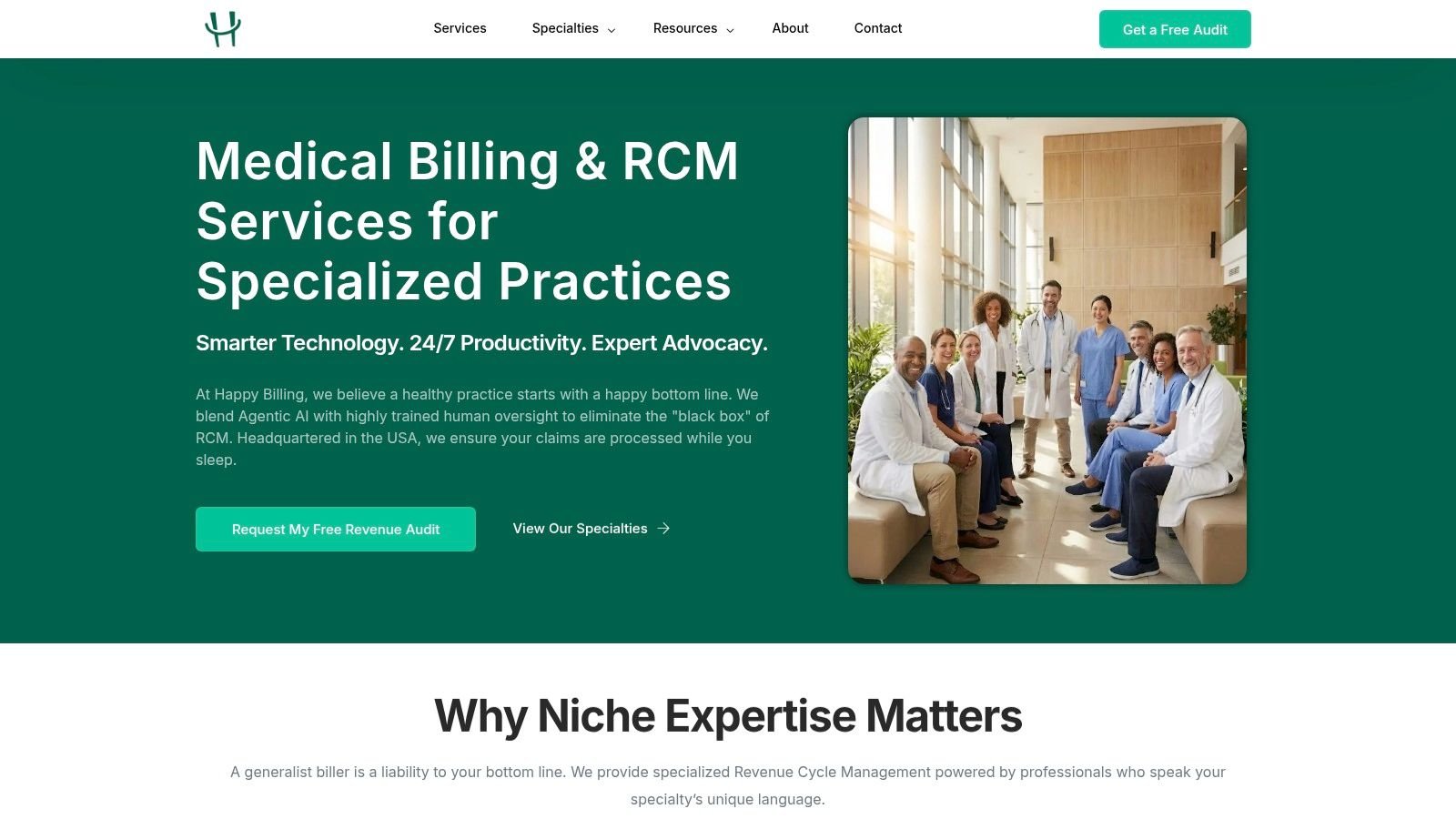
Happy Billing is the strongest fit for practices that need more than claim submission. It combines agentic AI with specialist human auditors, so the work is not trapped in a black box, and it runs inside your existing EHR without forcing a migration. For a practice owner, that matters because every extra implementation step delays cash, adds staff stress, and increases the chance that clean claims slip backward before the system stabilizes.
Why it stands out in real RCM terms
The company positions itself around 98%+ first-pass clean claims and under 35 days in A/R, which lines up with what high-performing Los Angeles groups need when they're trying to move above market averages rather than hover near them. It also supports full-cycle RCM, denial management, credentialing, and old A/R recovery, which means the vendor can attack leakage at registration, coding, submission, and follow-up rather than only fixing denials after they hit. For specialty practices, that breadth matters because the financial damage usually comes from workflow gaps, not one isolated bad claim.
Practical rule: If your billing partner cannot explain how it handles your highest-risk codes and modifiers, it is probably not reducing denials, it's just processing them later.
Specialty depth is where Happy Billing separates itself. Its workflows are designed for anesthesiology, behavioral health, cardiology, and orthopedics, the exact areas where modifier discipline, authorization control, and payer-rule awareness drive collection outcomes. AAPC-aligned coding practices and HIPAA-first security also make it a credible option for owners who care about audit readiness as much as speed. If you want a deeper look at how it positions its LA offering, review the medical billing services in Los Angeles resource and compare the operational claims against your current A/R profile. Website: Happy Billing.
2. BillingParadise
BillingParadise is a better fit for groups that want a technology-forward RCM partner with broad systems compatibility. It works across 50+ EHRs, including Epic, eClinicalWorks, and Veradigm or Allscripts, so practices that do not want to rip out their current platform can still get stronger billing workflows. That matters in Los Angeles because the cost of changing systems often exceeds the savings from a cheap but clumsy billing relationship.
The appeal for multi-specialty groups
The company's public positioning includes a 98% first-pass claim acceptance target and SOC 2 plus HIPAA controls, which signals a more enterprise-style operating model than a boutique shop. Its denial and A/R tooling are designed to help larger groups see where claims stall and where follow-up should happen first, which is useful when the practice has a lot of moving parts. In that sense, BillingParadise is less about hand-holding and more about process discipline.
The trade-off is scale. A smaller solo office may find the platform-heavy approach more than it needs, especially if the core issue is poor follow-up rather than weak analytics. That said, for multi-specialty owners who need software and services together, BillingParadise can be a practical option when the current team lacks visibility into denial patterns and aged A/R.
If your staff cannot tell you which payer is slowing cash, your billing vendor should be able to.
For owners comparing billing vendors on operational transparency, use the best medical billing company comparison resource to frame your questions before signing a proposal. Website: BillingParadise.
3. CLEAR Management Group
CLEAR Management Group makes sense for physician-owned practices and surgical facilities that want a local, high-touch partner rather than a broad platform play. Its El Segundo presence gives Los Angeles buyers a nearby escalation path, which is useful when billing concerns turn into reimbursement disputes and the practice needs direct accountability. In our experience, that local responsiveness can matter just as much as technology when a surgical group is fighting repeated claim friction.
Best for owners who want claim defense, not just submission
The firm emphasizes strategic coding and reimbursement defense, which is exactly where revenue is won or lost for procedure-heavy practices. A surgery center or physician-owned group often needs someone who can read the denial pattern, document the fix, and push back on payer behavior instead of merely resubmitting claims. That kind of posture can protect revenue that would otherwise disappear into appeal delays or weak documentation.
CLEAR's downside is visibility. It does not publish the same level of specialty KPI detail that some larger vendors surface, so buyers have to ask harder questions during due diligence. If you run a practice with complex procedure flow, the right conversation is not about brand size. It's about how the vendor handles denials, appeals, and documentation support under real payer pressure.
Practical rule: A local office is valuable only if it can show you how it reduces A/R aging, not just if it answers the phone quickly.
For a practice owner, that means bringing your most common denial categories to the conversation and asking for concrete examples. Website: CLEAR Management Group.
4. Meraki RCM Solutions
Meraki RCM Solutions stands out for one narrow but important reason, it understands workers' compensation and lien collections in California. That focus is useful because many generalist billing firms are uncomfortable with OMFS-compliant bill review and lien recovery, even though those workflows are routine in parts of Los Angeles. If your revenue depends on complex injury claims, specialty knowledge here is not optional.
Why its existing-software model matters
Meraki works inside clients' existing software, which keeps onboarding friction lower and avoids the kind of implementation drag that makes owners nervous about outsourcing. That matters when a practice already has a functioning front office but needs stronger downstream recovery, better reporting, or tighter handling of comp-related work. The vendor also publishes client testimonials that point to revenue lift and improved reporting, which at least gives buyers a sense of where the value is supposed to show up.
The trade-off is focus. If your payer mix is mostly commercial, Meraki's work-comp and lien emphasis may be more capability than you need. For practices with a heavy PI or WC blend, though, the depth can be a financial advantage because those claims require different discipline than standard commercial billing.
The what is RCM in medical billing resource is a useful baseline if you're deciding whether you need full-cycle outsourcing or just help with a few weak points. Website: Meraki RCM Solutions.
5. Med Claims CA
Med Claims CA is a specialist option for practices operating in personal injury and workers' compensation environments. That makes it different from the average Los Angeles billing vendor, because lien-heavy workflows depend on a different mix of documentation, follow-up, and legal sensitivity than standard commercial claims. For a practice owner, the value is simple, fewer collections get stranded in complex reimbursement channels.
A fit for practices that want flexibility
One notable advantage is its month-to-month contracting, which lowers the risk of getting trapped in a bad relationship. It also offers a free practice audit, so owners can pressure-test the vendor before committing. That is important in PI and WC environments, where the practice often needs specialized support but still wants the freedom to walk if the numbers do not improve.
The company also notes attorney referral networking, which can help drive volume in some niches, but that should be treated carefully. Referral support is not the same thing as revenue cycle control, and it should never distract from the basic question of whether claims are being followed through correctly. If the vendor cannot show organized denial follow-up and A/R discipline, the networking pitch does not matter.
A referral channel is helpful only after the billing engine is working.
The strongest use case here is for owners who already know their practice lives in lien work and want a vendor that understands the local legal-medical environment. Website: Med Claims CA. If you want denial playbooks before outsourcing, the insurance claim appeal guide is worth reviewing.
6. Billing Circuit
Billing Circuit is built for owners who want a small, meticulous billing team and flexible commercial terms. It offers percent, flat-rate, or hybrid pricing models, which gives practice leaders more room to match cost structure with claim volume and cash flow. That flexibility can be useful for smaller clinics that want predictable economics and direct access to the people working the account.
Why the boutique model can work
The firm's emphasis is on claim accuracy, appeals, and follow-up, which is exactly where many independent practices lose money after the front office has done its part. A compact team can be an advantage if your practice wants tight communication and fast issue resolution without layers of account management. That said, boutique strength only matters if the team has enough bandwidth to keep up when volume spikes or payer behavior gets messy.
The limitation is scale. Billing Circuit is less likely to be the best fit for large hospital-adjacent groups or highly complex enterprise workflows, because small teams can become stretched when there are many specialties, sites, or payers to coordinate. For solo and small multi-provider clinics, though, the personal touch can beat a larger vendor that is slower to respond.
If you are collecting candidate questions for your vendor shortlist, the questions to ask a medical billing company before hiring resource gives you a stronger framework than a generic sales call. Website: Billing Circuit.
7. Core One Med
Core One Med is a solid regional option for procedure-heavy practices that need strong billing support for anesthesia, cardiology, orthopedics, pain, vascular, and radiology. Its headquarters are in Irvine, so it is not inside Los Angeles city limits, but it still serves LA practices with the kind of specialty depth that many local generalists cannot match. For owners, the location matters less than whether the team understands how your payer contracts and procedure mix affect cash.
Strong on ASC and office-based lab workflows
The company emphasizes ASC and office-based lab billing, along with contract analysis and payer negotiation. That combination is useful for practices where reimbursement is shaped by both coding quality and payer terms, because the financial leak is often upstream of the claim itself. Core One Med also claims a 97% clean claim rate, which places it in the range that serious buyers should expect from a top-tier partner rather than a generic processor.
The practical upside is breadth. A multi-specialty owner can use one vendor across several procedure categories instead of stitching together separate teams for each specialty. The trade-off is geography and pricing opacity, because the company is quote-based and headquartered outside LA proper. Still, if the practice needs a partner that understands facility-style billing and specialty complexity, Core One Med deserves a close review.
Practical rule: If your vendor talks only about submission volume and never about payer-specific workflow, you're probably buying activity, not collections.
Website: Core One Med. For compliance-sensitive practices, the comprehensive HIPAA checklist from tekRESCUE is a good companion resource before you outsource.
Top 7 Los Angeles Medical Billing Companies, Comparison
| Provider | Implementation complexity | Resource requirements | Expected outcomes | Ideal use cases | Key advantages |
|---|---|---|---|---|---|
| Happy Billing | Low–moderate, integrates into existing EHR; onboarding for specialty workflows | Mid, hybrid AI + specialist auditors, 24/7 ops; custom engagement | High first‑pass clean claims (98%+ claimed); <35 days A/R; reported revenue uplift | Mid-to-large, high‑stakes specialty practices (anesthesia, cardiology, ortho, mental health) | Hybrid agentic AI + expert review, specialty coding workflows, real‑time dashboards |
| BillingParadise | Moderate, software + services integrating with 50+ EHRs | Enterprise, AI denial/AR tools, analytics, SOC2/HIPAA controls | Claimed 98% first‑pass acceptance; enterprise analytics and denial reduction | Multi‑specialty groups and hospitals seeking scalable tech-enabled RCM | Strong tooling/analytics, broad EHR support, enterprise security controls |
| CLEAR Management Group | Moderate, boutique onboarding with local, high‑touch setup | Human‑intensive, local account teams, hands‑on coding and appeals | Improved reimbursement defense and long‑term financial performance | Physician‑owned practices and surgical facilities needing high‑touch service | High‑touch claim defense, local presence, strategic coding focus |
| Meraki RCM Solutions | Low–moderate, works in clients' existing software | Specialized, workers' comp/OMFS expertise, lien recovery resources | Reported revenue lift in testimonials; improved reporting and ASC experience | Practices with WC/PI caseloads, ASCs requiring lien/OMFS compliance | Strong work‑comp and lien collection know‑how; no forced migrations |
| Med Claims CA | Low, month‑to‑month contracts; operates within existing systems | Legal‑adjacent, PI/WC litigation support, attorney referral network, 24/7 support | Effective PI/WC lien management and full RCM for complex cases | PI and workers' compensation–heavy practices needing attorney networking | No lock‑in contracts; focused lien management and referral network |
| Billing Circuit | Low, boutique setup with flexible pricing options | Small, meticulous team, choice of percent/flat/hybrid pricing, advisory support | Improved claim accuracy, denial tracking, and appeals outcomes | Solo and small multi‑provider clinics seeking hands‑on service | Flexible commercial terms, close denial/appeals attention, advisory services |
| Core One Med | Moderate–high, multidisciplinary onboarding for procedure workflows | Experienced, senior consultants, contract negotiation and ASC expertise | Claimed 97% clean claim rate; workflow optimization and contract gains | ASCs, procedure‑heavy specialties (anesthesia, orthopedics, cardiology) | Deep surgical/ASC billing expertise, contract analysis and payer negotiation |
How to Choose A Practice Owner's Due Diligence Checklist
Selecting a billing partner is one of the most critical financial decisions a practice owner can make. The right partner acts like a revenue engine. The wrong one becomes a cost center that inflates A/R and keeps your staff stuck in rework. Use the checklist below to vet any company on this list, and compare their answers against the benchmark ranges already noted, especially the expectation that stronger teams should clear claims above 97% and keep A/R from drifting into the long tail (CredEx Healthcare).
Your 4-Point Vendor Vetting Checklist
Demand KPI Transparency. Ask for average first-pass clean claim rate, days in A/R, and net collections by specialty. If the vendor talks in generalities, that is a red flag.
Verify Specialty Expertise. A generalist biller may not understand the modifiers tied to your most common CPTs, including modifier 59 for distinct procedural services versus XE for a separate encounter. Ask how they handle your highest-risk codes and payer edits.
Scrutinize the Denial Process. Find out how quickly denials are identified, appealed, and resolved. Ask whether the workflow is automated, manual, or hybrid, and what happens to claims that need a second review.
Confirm Reporting and Access. Make sure you get live claim visibility, meaningful dashboards, and ownership of your financial data. If you cannot see the work, you cannot manage the work.
Questions to Ask a Potential Medical Billing Partner
- What is your process for handling a claim denial from a major payer like Kaiser Permanente or Health Net?
- How do you integrate with our specific EHR system, and what is the onboarding process like?
- Can you provide an anonymized report from a practice similar to ours in size and specialty?
- What are the terms of your contract regarding length, termination, and data ownership?
If your answers are vague, you are not looking at a best-in-class vendor. You are looking at a sales presentation. For specialty-specific billing questions, review our billing resources by specialty at Happy Billing specialties and use them to pressure-test the vendor before you outsource.
Frequently Asked Questions
Will I have to switch my EHR system to work with you?
Not if the partner is built to work inside your current system. That should be a standard expectation, not a bonus feature.
How do you ensure the security and privacy of my patient data, PHI?
Ask about HIPAA controls, encryption, access logs, and who can touch the data. If the vendor cannot explain that clearly, keep looking.
What are the typical contract lengths and exit clauses?
Shorter, clearer contracts are better when you are testing a new RCM relationship. Long lock-ins make bad billing decisions expensive.
How do I know whether outsourcing will actually improve collections?
Compare the vendor's expected clean claim rate, A/R days, and denial handling against your current numbers. If they cannot show a path to better cash conversion, the engagement is not worth it.
If your practice is losing time to denials, underpayments, or aging A/R, Happy Billing can help you find the leak fast and fix it inside your existing workflow. Start with a free revenue audit to see where your claims are stalling, then compare that data against the vendors you're considering.