Expert Medical Billing Services Near Me: A 2026 Guide

If you're searching for medical billing services near me, don't make geography your first filter. A nearby billing company can still produce weak claims, slow follow-up, and bloated A/R, while a remote team with specialty expertise and EHR-native workflows can protect cash more effectively.
The buying decision should center on three operating outcomes: first-pass clean-claim rate, denial rate, and days in accounts receivable. A practical high-performance target is a clean-claim rate of 95% or higher, denials below 5%, and A/R at 35 days or fewer, according to healthcare revenue-cycle benchmarks. If your current vendor reports activity but can't connect its work to those measures, you're paying for motion rather than results.
What “Medical Billing Services Near Me” Really Means for Your Revenue
“Near me” is usually a proxy for responsiveness and accountability, not a literal demand for an office within driving distance. Specialty fit, denial root-cause prevention, and the vendor's ability to work inside your existing EHR matter more than the vendor's ZIP code.
Denials create the clearest financial pressure. TechTarget's coverage of a 2026 revenue-cycle report noted that hospitals' median final denial rate rose from 2.5% in 2024 to 2.7% in 2025, while the average initial denial rate increased from 11.4% to 11.6%. The same report said hospitals lost more than $48 billion through denials and uncollected bills. Optum's denial index also reported national denial rates around 12%, up from 10% in 2020 and 3% higher than in 2016, as detailed in the denial-rate coverage.
That's why we evaluate a vendor against three cash levers:
- Clean claims: Claims should pass payer edits the first time. Rejections delay adjudication and create avoidable staff work.
- Denial rate: A vendor should identify whether denials come from eligibility, authorization, coding, modifiers, or payer policy changes.
- Days in A/R: Slow payment posting and weak follow-up keep earned revenue trapped in work queues.
Operator's rule: If a vendor can't show performance by payer, provider, specialty, and denial reason, it can't manage the revenue problem with enough precision.
A local firm may offer useful advantages. You might get faster in-person escalation, an on-site workflow audit, and easier quarterly business reviews. Those benefits matter when your front desk, clinical team, and billing staff need to change behavior together. But local access doesn't prove coding competence, payer expertise, or strong denial prevention.
A remote vendor can often work directly within Athenahealth, eClinicalWorks, NextGen, Kareo, or another existing EHR without forcing a migration. The better question is whether the team can respond quickly, document ownership, and show cash-impact results. Review the practical trade-offs in this guide to outsourcing medical billing before you create a vendor list.
Where to Search for Local Medical Billing Companies
The right search starts with operational fit, not geography. Generic directories generate leads, but rarely show whether a company understands your specialty, payer mix, denial patterns, or EHR workflow.
Begin with systems already connected to your practice. Ask your EHR vendor and clearinghouse whether they maintain RCM partner networks. Athenahealth, eClinicalWorks, NextGen, and Kareo may identify vendors familiar with their environments. Require recommendations filtered by specialty, integration method, service scope, and region. EHR familiarity reduces implementation risk, but it does not prove coding skill or denial-prevention capability.
Specialty organizations offer more useful leads than broad search results. Review vendor directories and member resources from:
- MGMA: General practice-management contacts and local peer networks.
- ASOA: Ophthalmology vendors familiar with procedure, optical, and payer-specific complexity.
- APA: Psychology and behavioral-health billing contacts.
- ASA: Anesthesia vendors handling units, modifiers, and concurrency.
- State medical societies: Regional referrals from compliance-aware practices.
Local practice managers can provide the clearest warnings. Contact peers through a local MGMA chapter and ask:
- Who handles your billing?
- Who would you fire, and why?
The second answer often reveals more than a testimonial. Ask how the vendor handled a payer change, credentialing delay, staffing shortage, or denial surge. You are evaluating response speed, ownership, and accountability under pressure.
Build a working shortlist of 5 to 7 vendors, then cut weak candidates quickly. Remove any company without a U.S.-based escalation contact or references in your specialty. Treat missing client-retention information as a verification gap, not proof of quality.
Lead-generation listing sites deserve particular scrutiny. Their sales process can conceal offshore staffing, subcontracting, limited EHR access, or delayed escalation. Ask who performs daily claim work, who owns denials, and who answers urgent questions.
Use this resource on evaluating revenue-cycle management companies to structure the search. Then verify every finalist through specialty references, a live reporting demonstration, and a clear escalation test. A nearby office is useful only when it produces faster answers and measurable accountability. If a remote team delivers stronger workflow ownership and cash follow-up, distance is not the problem. Poor execution is.
Shortlist Criteria That Predict Real Performance
A polished demo does not prove a billing company can protect cash flow. Score each finalist against operational evidence in five areas: specialty fit, EHR integration, reporting, security, and pricing.
Specialty fit comes first. Ask whether the assigned staff understand your CPT families, modifier rules, authorization requirements, and payer edits. A generalist may handle routine E/M claims while missing the rules that drive anesthesia units, global surgical periods, behavioral-health authorizations, imaging, or complex procedure combinations. Require specialty references and procedure-level examples before advancing a vendor.
EHR integration also needs proof. Determine whether the company uses a native API, controlled application access, screen-scraping, or batch uploads. Native access usually provides cleaner data flow and faster work queues. Screen-scraping can increase reconciliation work, while batch uploads may delay corrections and hide claim-status changes. Ask the vendor to show how a corrected claim moves from work queue to submission.
Reporting must expose where cash is stuck. Require aging by payer, denial reason, and provider, rather than a blended collection report that can hide one payer's problem or a clinician's documentation pattern. Your team should be able to see claim status, unresolved work queues, payment posting, appeal activity, and A/R movement without waiting for a monthly summary.
Security review should cover HIPAA procedures, HITRUST or SOC 2 status, encryption, audit logs, and breach history. Confirm who can access patient-level data, whether access is limited by role, and how quickly the vendor must notify you after a protected health information incident.
Pricing should match your claim volume and collection pattern. Percentage-of-collections arrangements commonly fall within the 4% to 8% range, consistent with industry benchmarks discussed earlier. Flat-fee and hybrid models can fit stable or changing volumes, but only after you list included services, exclusions, implementation charges, and other fees in writing.
Use a 1 to 5 score for every criterion. Set the minimum weighted score before demonstrations, based on your practice's cash priorities. A comparison of medical billing companies can provide a useful review framework, but your own workflow test should decide the outcome.
| Criterion | Weight | What to Verify | Score (1-5) |
|---|---|---|---|
| Specialty fit and CPT/modifier fluency | High | Assigned staff, specialty references, payer-specific examples | |
| EHR integration depth | High | Native API, access controls, work-queue visibility | |
| Reporting depth | High | Aging by payer, denial reason, provider, and month | |
| Security posture | High | HIPAA controls, BAA, HITRUST or SOC 2, audit history | |
| Pricing structure clarity | Medium | Included services, exclusions, termination and export fees |
A vendor can score well overall and still fail your practice if its staff lack specialty depth. Test procedure knowledge before signing, because errors at that level reach directly into collections.
Specialty-Specific Billing Requirements You Cannot Ignore
A generalist biller who understands only basic E/M coding will leak revenue in specialized practices. The risk isn't theoretical. Authorization failures, incorrect modifiers, unit errors, and global-period mistakes can hold claims in denial queues long after the clinical work is complete.
Anesthesia and mental health
Anesthesia teams need staff who understand ASA physical status modifiers P1 through P6, base units, time, qualifying circumstances, and concurrency. Misapplied qualifiers can cost up to 30% of base payments, according to the specialty guidance in this anesthesia billing resource. The financial question isn't whether the vendor can enter a modifier. It's whether the vendor can validate the complete unit calculation before submission and reconcile payer payment against the expected amount.
Mental-health billing has a different failure pattern. Authorization tracking, DSM-5 code sequencing, and the distinction between CPT 90834 and 90837 can create denial clusters when the documentation and payer rules don't align. Vendors also need to protect confidentiality under 42 CFR Part 2 where applicable. For Medicare behavioral-health telehealth, CMS allows two-way interactive audio-only technology in some cases, but requires an in-person visit within six months of the initial telehealth visit and annually afterward. CMS says the timeline is waived only when the clinician and patient agree that the risks or burdens outweigh the benefits, as explained in Medicare telehealth guidance. Missing that requirement can jeopardize ongoing billed services.
Cardiology, orthopedics, and pediatrics
Cardiology requires close attention to diagnostic modifiers, including AI for multiple scans and B2 for cardiac stress tests, along with timely follow-up on MUE edits and hospital-physician split billing. A vendor that treats diagnostic imaging like ordinary office billing may leave legitimate reimbursement unresolved.
Orthopedic practices need expertise with 26 and TC modifier splits, global surgical package management, multiple-procedure rules, and prior authorization for durable medical equipment. CMS guidance on modifier 25 limits its use to a significant, separately identifiable E/M service beyond the usual procedure work on the same day. AAPC notes that modifier 25 belongs on eligible E/M codes, including 92002-92014 and 99201-99499, and may also apply to G0101 and G0175 when appropriate. Incorrect use can trigger payment edits and reduce same-day E/M reimbursement, as described in AAPC's modifier 25 guidance.
Pediatrics brings its own documentation demands. Growth-chart support, vaccine administration coding using J-codes and 9047x codes, and pediatric-specific ICD-10-CM selection require dedicated review. Multi-specialty groups should insist on sub-specialized coders rather than one set of generic rules.
| Specialty | Key Billing Nuance | Common Vendor Error | Revenue Impact |
|---|---|---|---|
| Anesthesiology | ASA modifiers, base units, time, concurrency | Incorrect qualifier or unit calculation | Underpayment, denials, delayed reconciliation |
| Mental health | 90834 versus 90837, authorization, confidentiality | Missing authorization or wrong code sequence | Denial clusters and disrupted recurring revenue |
| Cardiology | Diagnostic modifiers, MUE edits, split billing | Weak payer-specific follow-up | Unresolved procedure reimbursement |
| Orthopedics | 26/TC splits and global periods | Incorrect modifier or premature billing | Bundled denials and delayed surgical revenue |
| Pediatrics | Vaccine administration and growth documentation | Incomplete documentation or code selection | Rejected immunization and visit claims |
If your practice has specialty-specific revenue at stake, review mental health revenue-cycle management or the equivalent specialty workflow before accepting a generalist proposal.
Interview Questions That Reveal Whether They Can Actually Deliver
Most owners ask about years in business, software, and price. Those questions are easy to answer with polished language. Ask operational questions that force the vendor to show how it works.
Begin with performance by specialty. Ask for the finalist's first-pass clean-claim rate for practices like yours, then ask how the team maintains it. Don't accept a company-wide average. Require the underlying view by payer, provider, claim type, and month.
Then test denial intelligence:
- Root-cause detail: Can the vendor separate CPT errors, authorization failures, eligibility problems, medical-necessity mismatches, modifier issues, and payer policy changes?
- Action ownership: Who edits the workflow when the same denial repeats?
- Timing: How quickly does the team identify, route, appeal, and close a denial?
- Evidence: Can the vendor show a redacted denial trend report during the demo?
Staffing answers matter just as much. Ask whether coders are U.S.-based, offshore, or mixed; who supervises them; and what the average tenure is. A global delivery model can work, but you need a U.S.-based escalation owner and clear coverage during payer or documentation disputes.
Demand a live dashboard demonstration. The screen should show A/R aging, denial trends, unresolved claims, payment lag, and payer performance. A revenue summary without work-queue detail is a sales report, not an operating tool.
Ask for two recent references from practices in your specialty and of similar size. Ask those references how the vendor handled a volume spike, payer change, credentialing problem, and legacy A/R transfer.
EHR access requires a security answer. Find out whether the vendor uses read-only API access, controlled user accounts, or full administrative credentials. Full administrative access increases risk and should require strong controls, audit logs, and a documented reason.
Finally, ask what happens during the first 30 days if claim volume rises unexpectedly. Specific staffing plans, escalation paths, and reporting commitments indicate maturity. Vague assurances indicate a sales-first organization. Use this medical billing interview question guide to structure identical interviews for every finalist.
Contract, Pricing, and HIPAA Red Flags to Watch For
A low percentage can become an expensive contract once exclusions, add-on fees, and exit barriers appear. Read the agreement as a cash-control document, not a service brochure.
Reject lock-in clauses longer than 12 months when they lack performance milestones. You should have a penalty-free exit path if the vendor misses agreed targets. The contract should define the measurement period, data source, corrective-action process, and termination right.
Watch for unbundled fees for work that belongs in full-cycle RCM. Reporting, credentialing support, denial rework, payment posting, and A/R follow-up shouldn't appear as surprise line items after signing. If they're excluded, model the cost before comparing the percentage with another vendor's offer.
Your practice owns its billing data. The agreement shouldn't grant the vendor ownership of claims, remittances, patient-level reports, work queues, or historical A/R records. It also shouldn't require payment before releasing your own data.
Security terms need equal scrutiny:
- Business Associate Agreement: Confirm that a current BAA is signed before PHI access begins.
- Certification evidence: Request current SOC 2 Type II or HITRUST documentation where represented.
- Encryption: Verify protection for PHI at rest and in transit.
- Audit logs: Require a usable record of access and changes.
- Breach response: Ask for notification timing, investigation duties, and liability caps.
- Data access: Confirm that your team can retrieve patient-level records without vendor approval.
A vendor that refuses audit logs or denies access to patient-level billing data is not a partner. Walk away.
Termination should include a smooth transition, with complete data handover within 30 days of notice. Specify export format, claim history, remittances, open denials, aging, credentialing files, and work queues. Also define whether the outgoing vendor continues working old balances or stops at termination. Ambiguity here can strand cash exactly when your practice is changing vendors.
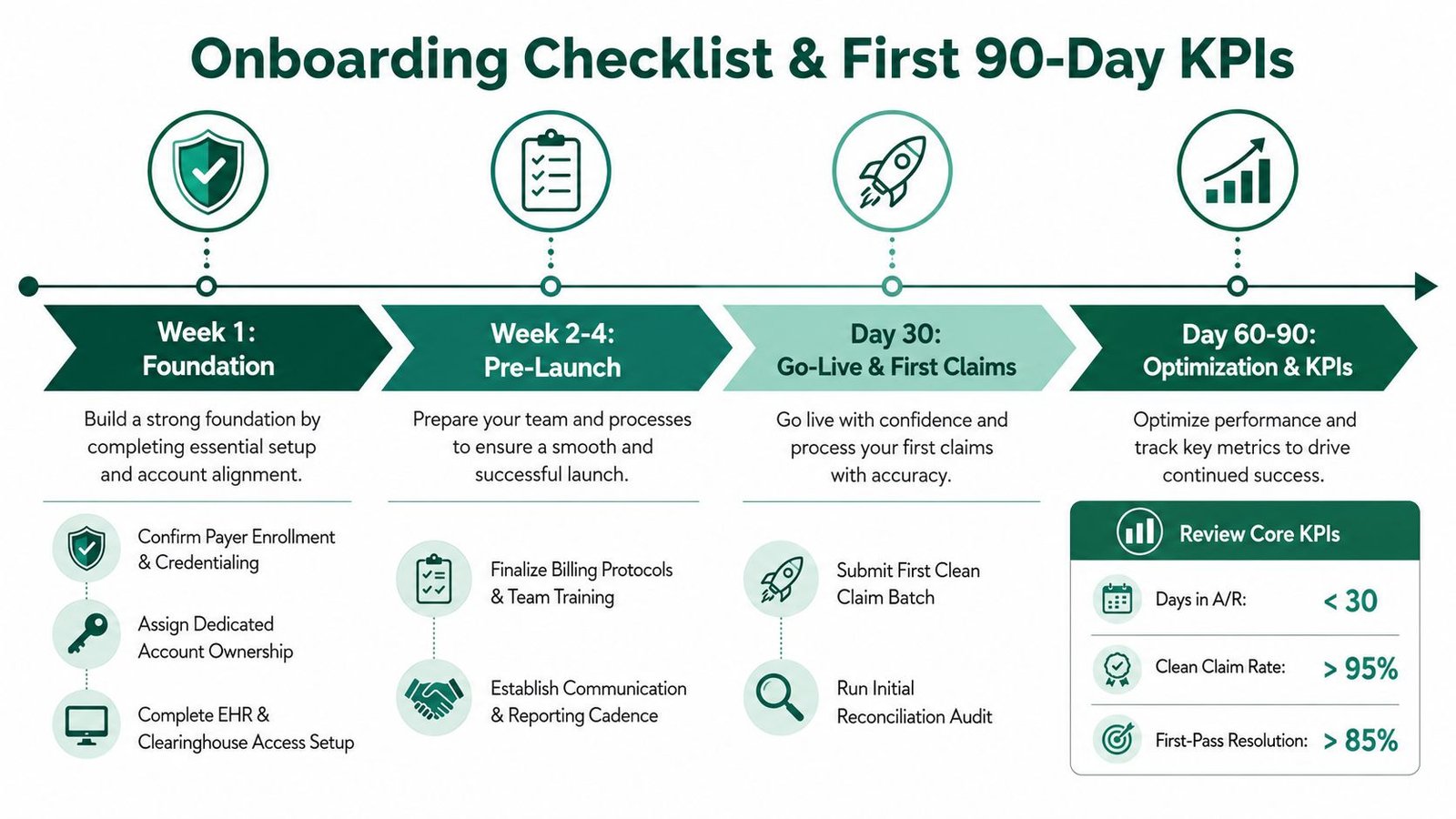
Onboarding Checklist and First 90-Day KPIs
Go-live isn't a file handoff. It's a controlled revenue transition, and weak preparation can create a temporary denial spike that obscures whether the new vendor is better.
Build the operating foundation
Before the first claim, confirm payer enrollment and credentialing for every relevant provider and location. Assign one accountable owner on each side. Complete EHR and clearinghouse access testing, and document exactly how the team will handle coding rules, authorizations, eligibility checks, patient statements, refunds, payment posting, and appeals.
Reconcile open A/R before the switch. Sort balances by payer, aging, work queue, and expected value. The inventory must identify which claims the outgoing vendor will continue resolving and which accounts the new vendor will assume. Don't allow either company to treat old A/R as someone else's problem.
Run test claims and validate fee schedules, payer routing, claim edits, remittance handling, and rejection mapping. Train front-desk and clinical staff on escalation paths, especially for missing eligibility, prior authorization, documentation, and demographic corrections. Establish a daily communication cadence and maintain one joint issue log with an owner and due date for every item.
CMS Medicare claims guidance states that clean claims must be paid or denied within 30 days, with an internal waiting period of 13 days for electronic claims and 26 days for paper claims, as described in CMS claims processing guidance. That timing makes early claim acceptance and status monitoring essential to cash conversion.
Measure the first 30, 60, and 90 days
Put targets in the contract, not in a post-go-live conversation.
During the first 30 days, monitor claim acceptance, eligibility failures, coding edits, unresolved A/R, access issues, and communication response times. The purpose is to identify implementation defects before they become aging balances.
By day 60, review first-pass clean-claim rate, denial rate by payer and reason, charge lag, payment lag, and days in A/R. Compare every measure with the pre-switch baseline, not with a vendor-wide average.
By day 90, assess net collections, collection cost as a percentage of collections, aging mix, unresolved denials, and the proportion of A/R that has moved into older buckets. Require a corrective-action plan when performance misses the agreed threshold. The plan should identify the root cause, responsible owner, correction, and due date.
A focused implementation typically takes six to twelve weeks, depending on EHR complexity, payer enrollment, open A/R volume, and credentialing issues, according to the provided industry guidance. Hospital contracts and unresolved accounts can extend the schedule, so assign milestone owners and a written go-live date.
Practice-owner questions after the agreement
How much does switching billing companies cost?
The cost depends on the contract, transition scope, credentialing work, open A/R, and whether the prior vendor charges for data export or unresolved account work. Model both direct fees and cash exposure from delayed claims. A cheap transition that creates avoidable denials is not cheap.
How long does switching billing companies take?
Plan for six to twelve weeks for a focused implementation. EHR complexity, payer enrollment, credentialing issues, and legacy A/R can change the timeline. Require a written schedule with owners for access, testing, staff training, claim validation, and go-live.
Will the new company take over existing A/R?
Usually, but the contract must define the transfer. Assign responsibility by payer, aging bucket, work queue, and dollar amount, then require a reconciled inventory before go-live. Without that inventory, both vendors can claim a balance belongs to the other.
Who owns the billing data and patient records?
The practice should retain ownership and receive usable exports of claims, remittances, work queues, and reports. The agreement should prohibit withholding data over disputed fees and specify secure export, retention, and deletion procedures.
Success after go-live means more than completed tasks. Establish a pre-switch baseline, then track first-pass clean-claim rate, denial rate, days in A/R, net collections, charge lag, payment lag, and aging over 30, 60, and 90 days. A vendor that reports activity but not cash-impact outcomes hasn't demonstrated performance.
Happy Billing provides EHR-integrated medical billing, denial management, credentialing, and A/R recovery for specialty practices that need tighter control over claims and cash flow. Review your current denial patterns and A/R before choosing a local or remote partner, then visit Happy Billing to discuss a revenue-cycle workflow built around your practice's specialty and payer mix.