7 Medical Billing Companies Austin Practices Should Compare

The best Austin billing partner is the one built for your specialty, your scale, and your denial profile, not the one with the flashiest homepage. In a market projected to reach USD 17.69 billion by 2033 at a 12.56% CAGR from 2026 to 2033, the practices that win are the ones that protect days in A/R, prevent denials, and keep collections moving instead of letting billing turn into a cost center (GlobeNewswire market report).
For Austin physician owners, that means comparing medical billing companies Austin practices can trust on workflow fit, not just on service lists. The seven firms below are a comparison set, not a single winner list, because the right choice depends on whether you need specialty depth, a software stack you don't have to rebuild, denial prevention, credentialing help, or a tighter handle on underpayments and aging A/R. If your current vendor can't show specialty-specific performance, ask for a gap review through Happy Billing's free audit and compare the findings against your specialty workflow at Happy Billing specialty solutions. For broader procurement discipline, the questions in this billing company hiring guide are the right place to pressure-test any proposal.
A local office doesn't automatically reduce denials. What matters is whether the vendor understands payer rules, front-end data quality, claim edits, appeal logic, and the billing consequences of authorizations that slip through.
Beyond the Austin market, our statewide guide to medical billing services in Texas covers the Texas Prompt Pay Act deadlines (30-day electronic / 45-day paper), BCBS Texas / TMHP / UHC payer landscape, and the 4–9% pricing benchmarks that apply across Austin, Houston, Dallas, and San Antonio practices.
1. PUREDI
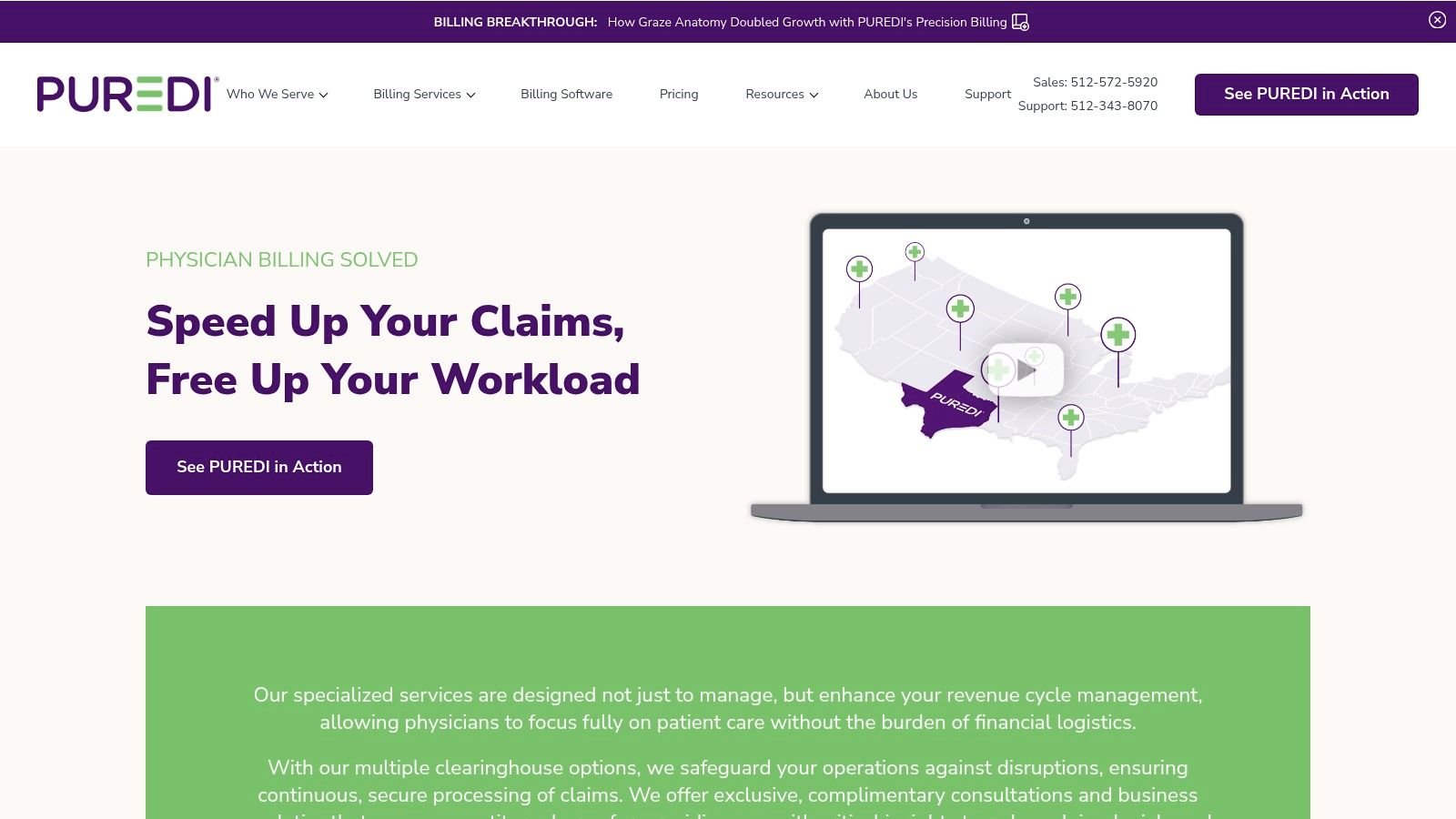
PUREDI stands out because it owns both the RCM software and the outsourced billing workflow. That matters for physician groups that want fewer handoffs between the clearinghouse, the edit engine, and the team working denials and A/R. The company also positions itself around pre-submission auditing, analytics, and credentialing support, which is the right mix for practices where a missed edit or payer enrollment delay directly shows up as cash lag.
For a multi-specialty group, the advantage is control. When the same vendor owns the platform and the service layer, you're less likely to hear that a reporting problem is “an EHR issue” or that a workflow change has to wait on a third-party software roadmap. PUREDI also has a local Austin presence and published testimonials, which helps when owners want a vendor they can hold accountable in the same market.
Practical rule: If a billing company can't explain how its edit engine, analytics, and follow-up team work together before the claim goes out, it's probably selling labor, not revenue protection.
The trade-off is scope. PUREDI looks best suited to physician groups, not hospitals or large integrated delivery networks, and it doesn't publish line-item pricing. That means owners should ask for a proposal tied to specialty mix, denial profile, and current A/R age, then compare the quote against the operational risk they're trying to remove. The best conversation is less about monthly fee and more about whether the vendor can reduce leakage from avoidable front-end misses.
2. EqualizeRCM

EqualizeRCM serves community hospitals, RHCs, FQHCs, physician clinics, labs, DME providers, and ASCs. That range signals capacity for organizations with multiple service lines and locations. The company reports 1000+ associates and 300+ clients per year, figures that may matter when denials, eligibility work, coding, and follow-up exceed a small internal team's capacity (EqualizeRCM website).
The operational fit is strongest for larger or growing practices with complex coverage, several locations, or aging A/R that requires focused staffing. A broader team can absorb volume and support automation across workflows, while internal employees remain focused on patient and practice operations rather than platform administration.
Scale creates a trade-off. A solo physician or small specialty office may prefer a consistent contact who knows its payer rules and weekly priorities. EqualizeRCM's custom quoting also means owners should clarify which team owns eligibility, coding, denials, appeals, and A/R follow-up, then require reporting on each function.
Before signing, use a structured list of questions to ask a medical billing company before hiring and ask how automated work is reviewed by staff. The Black Book provider survey describes providers using or considering outsourced RCM functions while retaining human review before AI takes claim or appeal actions. EqualizeRCM is a stronger candidate when it can document those controls, escalation points, and the effect on denials and aging A/R.
3. Med Xpert LLC
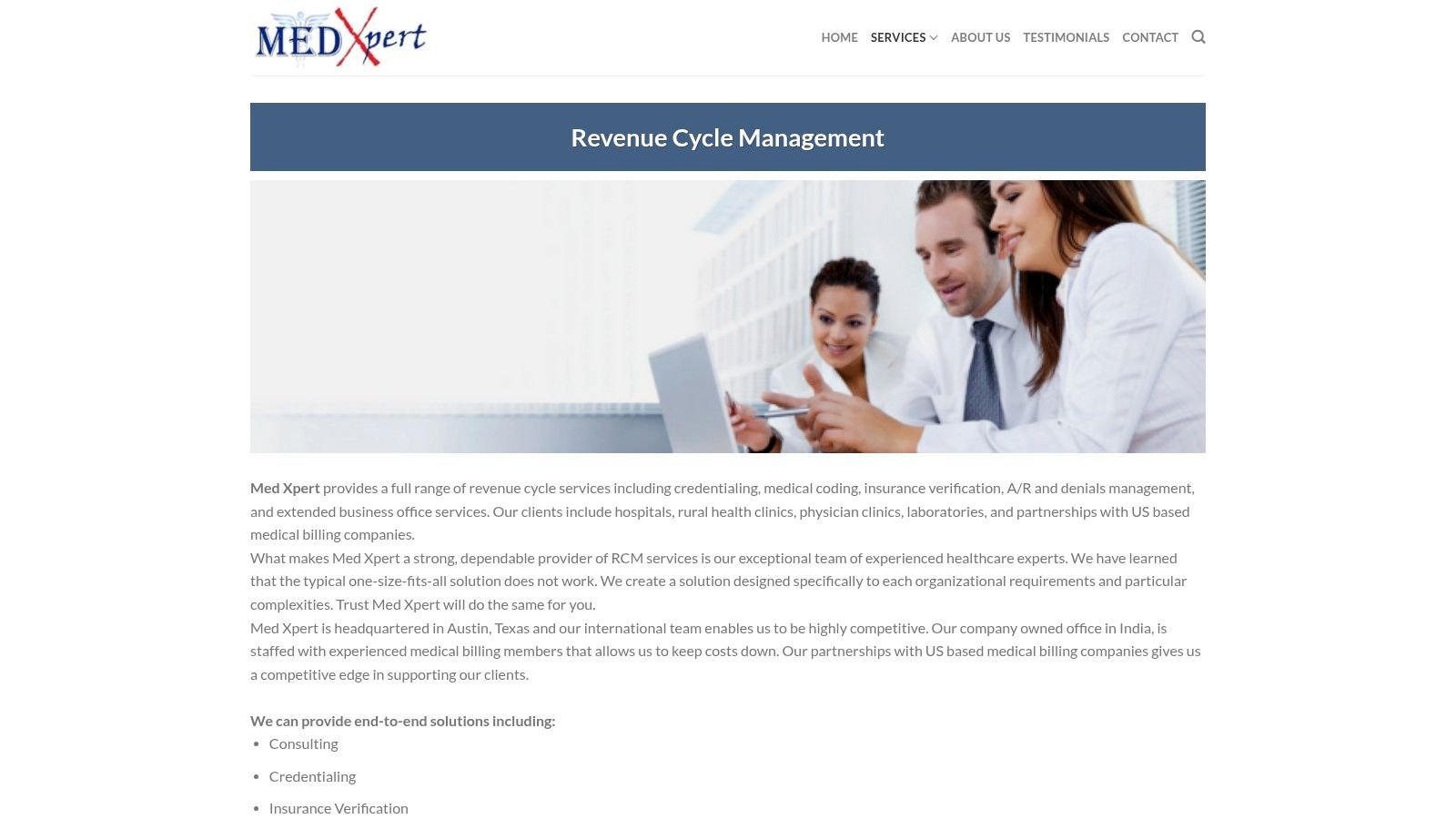
Med Xpert LLC suits organizations evaluating the delivery model as closely as the billing work. Its U.S./India structure may support cost control, and its services include credentialing, coding, insurance verification, A/R, denials, and extended business office support. That breadth makes it relevant to hospitals, rural and critical-access settings, and physician clinics with several revenue-cycle needs.
The practical advantage is co-sourcing. Med Xpert can supplement an existing team instead of replacing the entire workflow, allowing a practice to assign verification, follow-up, or denial work externally while keeping other functions in-house. This can reduce staffing pressure, but it also creates handoff and oversight requirements.
Owners should clarify who performs each task, where PHI is handled, and how work moves between U.S. and India teams. Reporting should show denial categories, aged A/R changes, unresolved accounts, and escalation ownership. A medical billing denial management guide can help frame the questions, but the vendor still needs to demonstrate how its process protects cash flow.
The main limitation is public proof. Med Xpert's site provides limited third-party review evidence or public performance benchmarks, so request references, relevant payer-mix experience, sample reports, and service-level expectations before signing.
What to verify first: Who touches PHI, where each task is performed, and how handoffs are tracked between onshore and offshore staff.
Med Xpert deserves comparison when staffing instability is the main risk. If reporting is already opaque, require examples of denial trends, aged A/R movement, and credentialing turnaround. Lower labor cost is only beneficial if follow-up quality improves rather than shifting more work to the front office.
4. Capital Medical Billing Services
Capital Medical Billing Services, or CMBS, is the most classic boutique option in this lineup. It focuses on physician practices nationwide and covers billing, collections, credentialing, contracting, and practice management consulting. For a small or mid-sized clinic, that combination can be useful when the billing problem is tangled up with payer enrollment, contract setup, and day-to-day management decisions.
The Westlake presence and direct phone support matter more than they sound. Owners who've dealt with delayed callbacks know that billing isn't just about claim status, it's about getting answers before a payer deadline or appeal window closes. CMBS's stated combined experience across credentialers, coders, and practice managers also makes it attractive for groups that want practical advice, not just production work.
The limit is capacity. A smaller team can be very responsive, but it may not scale well if your practice adds locations, specialties, or a high-volume payer mix. CMBS also doesn't publish performance metrics such as days in A/R or first-contact resolution, so you'll need to ask for proof rather than assume it.
For owners comparing outsource medical billing cost, the question is whether the vendor can defend revenue, not just process claims. If the practice is losing time to credentialing gaps or contracting delays, a boutique firm can be a smart fix. If your denial volume is growing, the absence of published KPI targets is something you should press on during diligence.
5. RevenueCareMD
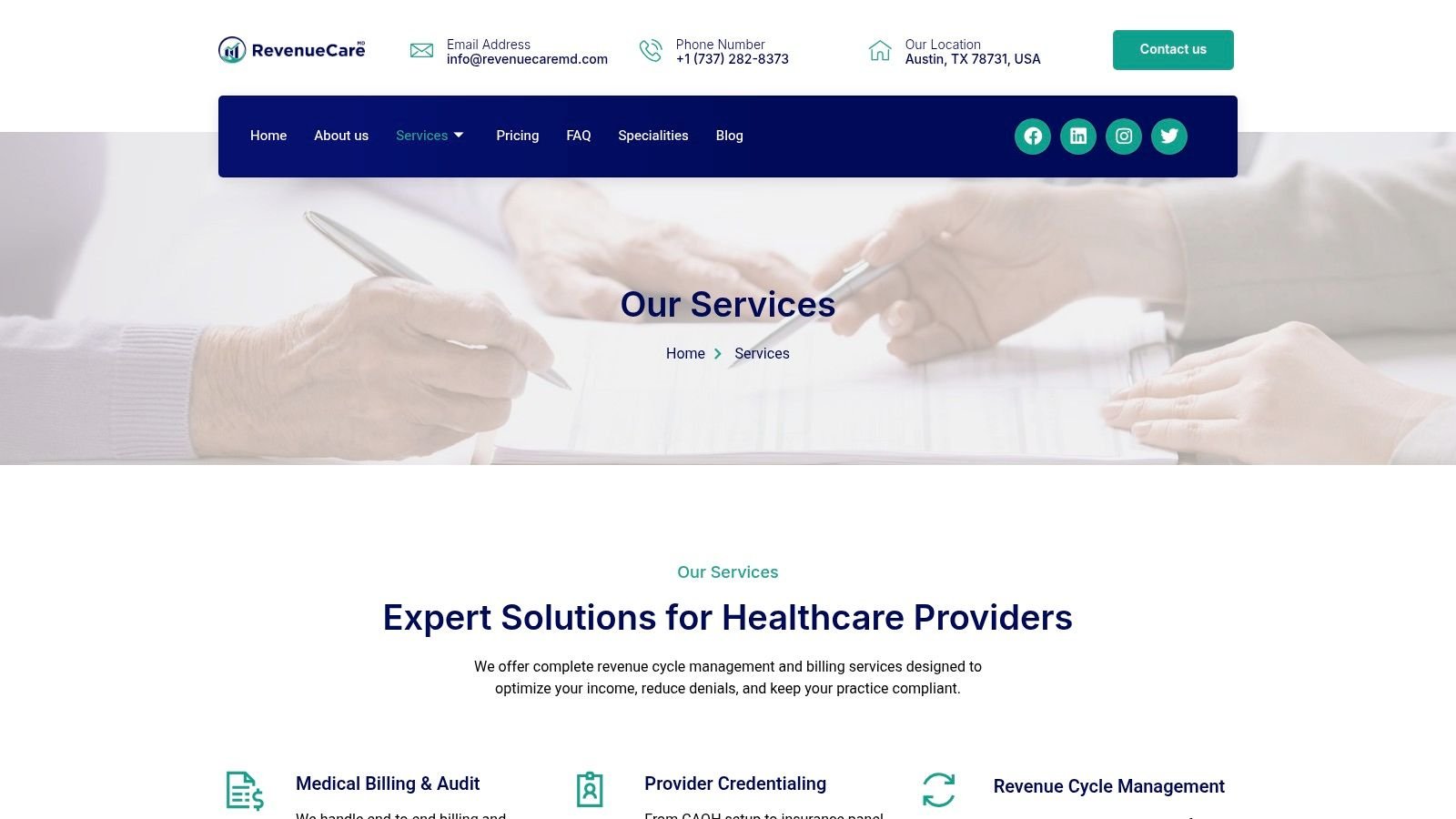
RevenueCareMD is more than a billing vendor. It also offers program operations for BHI, CCM, RPM, RTM, and AWV management, plus a patient help desk with onshore and offshore staffing. That makes it relevant to primary care, behavioral health, orthopedics, and cardiology groups that want to turn reimbursable programs into real revenue instead of leaving them underused.
The practical value is operational breadth. Many practices know they could bill more effectively for care management or wellness work, but they don't have the staff to track the activities, document the interactions, and manage the patient communication that makes those programs payable. RevenueCareMD fits a practice that wants billing and service-line activation in one place.
Its caution flag is the same one that appears across many smaller firms. The site doesn't show public performance benchmarks, and third-party reviews are limited, so owners should treat the first conversation as a verification exercise. Ask how they audit accuracy and compliance, what their credentialing process looks like, and who owns the call-center script when a patient questions a bill.
For practices with multiple service lines, this kind of vendor can create upside that a generic biller misses. For a straightforward solo clinic, it may be more tool than you need. The fit improves when the practice wants help capturing revenue from programs that already exist but aren't fully monetized.
6. Steady Medical Billing
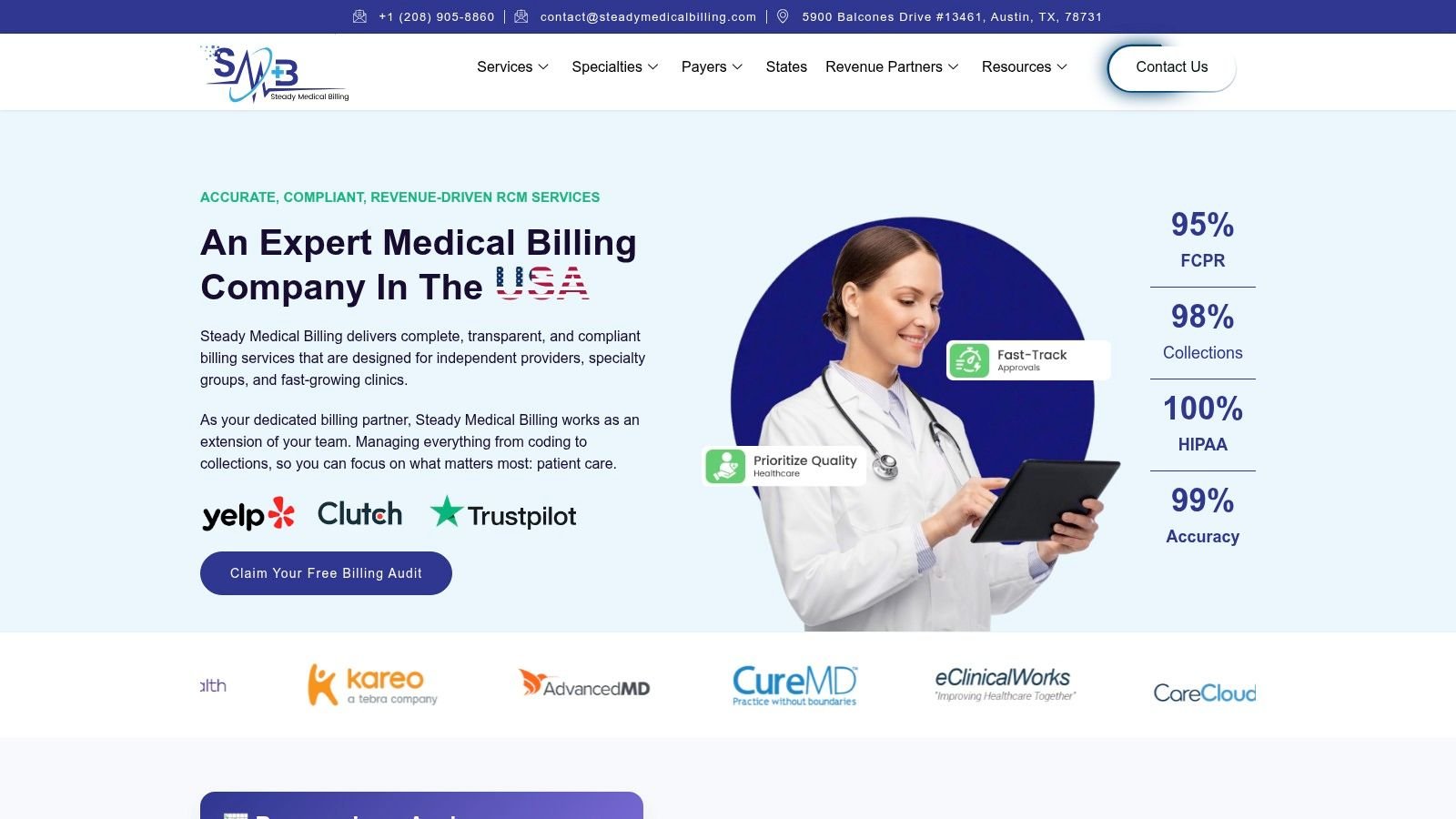
Steady Medical Billing is appealing because it speaks directly to specialty groups, including behavioral health, cardiology, ER, internal medicine, lab, and rehab. That specialization matters in a market where denial pressure is driven by front-end errors and payer friction, not just claim volume. The company also offers denial management, credentialing, underpayment recovery, and a free revenue loss analyzer, which gives prospective clients a low-friction way to test whether their billing leaks are material.
The strongest part of the offer is clarity around specialty fit. Behavioral health and cardiology are not the same billing problem, and a vendor that organizes its services around those realities usually understands why authorization, documentation, and modifier discipline matter to net collections. That's especially relevant for Austin practices that are trying to reduce reimbursement delays without overloading front-office staff.
Plain truth: A free audit is only useful if it identifies where revenue is actually slipping, not if it repackages your own charge list back to you.
The weakness is proof and transparency. The site appears to use a common Austin virtual-office corridor, and it doesn't publish SLAs or KPI targets. That doesn't make the firm a bad choice, but it does mean owners should ask for concrete reporting samples, a denial recovery process, and a clear explanation of how underpayments are tracked to resolution.
If you want to compare medical billing services Austin options on specialty relevance, this one is worth a close look, especially for procedural and behavioral health work. Just don't let a clean website substitute for measured performance.
7. RCM Bridge
RCM Bridge covers a lot of ground, including billing, coding, prior authorization, eligibility, denials, A/R, and patient billing. It also publishes specialty pages for anesthesia, cardiology, orthopedics, pediatrics, gastroenterology, and more, which makes it easy to see where the company wants to compete. For practices that live in procedural and authorization-heavy specialties, that breadth is useful.
The 24/7 contact positioning is another point in its favor. Billing problems don't respect office hours, and practices that handle urgent or high-stakes cases often need a vendor that can respond quickly when authorization or claim questions surface. The company's reporting and service catalog are also clearer than what many small firms publish, which helps during early-stage evaluation.
What's missing is equally important. The content feels templated, and there's limited third-party validation or public performance proof. That means owners should treat the company as a service catalog first, a proven operating partner second.
If your current pain point is denial follow-up and claim aging, RCM Bridge may be worth a call. If you need a vendor with a deeper public record of outcomes, ask for specialty-specific denial trends, examples of appeal success, and the exact reporting cadence before moving forward. A broad catalog is useful, but only if the team behind it can show that claims move.
Top 7 Austin Medical Billing Companies Comparison
| Provider | Implementation complexity | Resource requirements | Expected outcomes | Ideal use cases | Key advantages |
|---|---|---|---|---|---|
| PUREDI | Medium, cloud RCM + service integration | Moderate, vendor software + support team | Fewer denials, improved claim accuracy, KPI analytics | Multi‑specialty physician groups seeking single vendor | Proprietary cloud platform, pre‑submission audits, local references |
| EqualizeRCM | High, enterprise deployments with AI layer | High, large staffing and multi‑site capacity | Scalable end‑to‑end RCM across settings | Community hospitals, RHCs/FQHCs, ASCs, large practices | Enterprise scale, AI/automation, broad service lines |
| Med Xpert LLC | Medium, co‑sourced/onshore‑offshore model | Moderate, offshore cost model with US oversight | Cost‑efficient staffing, extended business office support | Hospitals, rural/critical‑access, practices needing co‑sourcing | U.S./India delivery, EBO services, flexible partnership |
| Capital Medical Billing Services (CMBS) | Low–Medium, boutique, local implementations | Low, small local team | Tailored billing/collections and practice advisory | Small to mid‑sized clinics wanting local support | Experienced local team, direct phone support |
| RevenueCareMD | Medium–High, RCM plus program operations | Moderate, program ops and help desk resources | Billing plus operationalized reimbursable programs | Primary care, behavioral health, cardiology, orthopedics | BHI/CCM/RPM/RTM program operations + billing |
| Steady Medical Billing | Low–Medium, standard RCM with EHR integrations | Low, compact team, prospect audit tools | Denial management, underpayment recovery, specialty focus | Independent providers and specialty groups | Specialty pages, free revenue loss analyzer for prospects |
| RCM Bridge | Medium, comprehensive service catalog, 24/7 model | Moderate, reporting and specialty coverage | End‑to‑end RCM with transparent reporting | Procedural/high‑stakes specialties (anesthesia, ortho, cardiology) | Clear service catalog, 24/7 contact, broad specialty coverage |
Turn the Shortlist Into a Revenue-Safe Decision
The right vendor decision starts with evidence, not promises. Ask each of the seven firms for specialty-specific denial and A/R reporting, then make them show where responsibility sits for eligibility, authorizations, coding edits, appeals, credentialing, and underpayment recovery. If a vendor can't define that chain cleanly, your team will end up owning the misses anyway.
You should also verify how the billing stack fits your current environment. Confirm EHR and clearinghouse workflows, ask how offshore access is governed, and review PHI controls, termination terms, implementation timing, fee structure, and performance provisions before you sign. In Texas, payer rules can also affect cash timing, including HMO clean-claim payment timelines and surprise-billing arbitration, so your vendor should be able to explain how those rules affect collections in practice (Texas Austin billing rules overview).
The metrics that matter are the ones tied directly to revenue. Compare each bidder's baseline and target clean-claim rate, denial rate, net collections, and days in A/R. Independent benchmarks used by practices often treat denial rates below 5% and days in A/R under 35 days as healthy targets, so if a vendor can't speak to those outcomes, it's probably not the right fit for a practice that wants tighter cash flow (medical billing benchmark guide).
Happy Billing is relevant here because its model is built for high-stakes specialties, with agentic AI plus human auditors, operation inside your existing EHR, 24/7 follow-the-sun claim turnaround, HIPAA-first controls, and specialty workflows for anesthesiology, mental health, cardiology, and orthopedics. That combination is designed for practices that want to reduce leakage without a migration project or a long learning curve, and it's worth comparing against any Austin vendor you're considering, especially if denials or aging A/R are already hurting cash.
What should I ask an Austin billing company about pricing?
Ask whether pricing is tied to collections, claim volume, specialty mix, or a fixed monthly fee. Then ask what is included, because credentialing, appeals, underpayment recovery, and reporting are often separated out.
How do I know if I'm ready to switch vendors?
You're ready when your current team can't explain denials, A/R aging, or underpayments in a way that lets you manage cash confidently. A short billing audit should show whether the problem is staffing, workflow, or payer friction.
What specialty expertise matters most for my practice?
It depends on your revenue risk. Behavioral health, cardiology, orthopedics, anesthesia, and procedural groups usually need stronger authorization, modifier, and appeal discipline than low-complexity primary care workflows.
What data should I give for a billing audit?
Share recent claim volume, denial categories, A/R aging, payer mix, underpayment examples, and a sample of your most common CPTs and modifiers. That gives a vendor enough context to identify leakage instead of guessing.
If you want a billing partner built around specialty workflows, clean-claim discipline, and measurable A/R control, review Happy Billing and ask for a free audit before you compare another contract. The fastest way to improve collections is to see where revenue is leaking now, then judge every Austin vendor against that baseline.