7 Medical Billing Companies in Minnesota for Practices

There's no universally best medical billing company in Minnesota. The right partner depends on your specialty complexity, denial sources, A/R aging, EHR workflow, and how much hands-on support your team needs. That choice directly affects collections, denial rates, and the number of days your cash remains tied up in accounts receivable.
Minnesota has an active billing labor market, with job listings consistently appearing across Minneapolis, Saint Paul, Eagan, Rochester, and Duluth. One salary tracker reported average medical billing pay of $20.09 per hour as of August 2026, with most workers earning between $17.16 and $22.12 per hour. Those figures make outsourcing a financial decision, not merely an administrative one. A practice must compare the cost of internal labor with the revenue lost through weak claim edits, delayed follow-up, authorization errors, and unworked old A/R. Indeed's Minnesota medical billing listings illustrate how established the category has become.
This roundup compares seven providers through the questions physician owners need answered: specialty fit, clean-claim controls, denial prevention, A/R recovery, pricing transparency, EHR continuity, security, staffing, and proof of results. For specialty-specific risks, review Happy Billing's specialty medical billing services and consider a free revenue audit before you compare proposals. Practices also need dependable technology and privacy support, which makes managed IT by CloudOrbis Inc. relevant when evaluating a vendor's broader operating environment.
If your group also operates in neighbouring states, see our guide to medical billing services in Illinois, where BCBS Illinois and the 2024 Medicaid rate reform change the payer math considerably.
1. Happy Billing
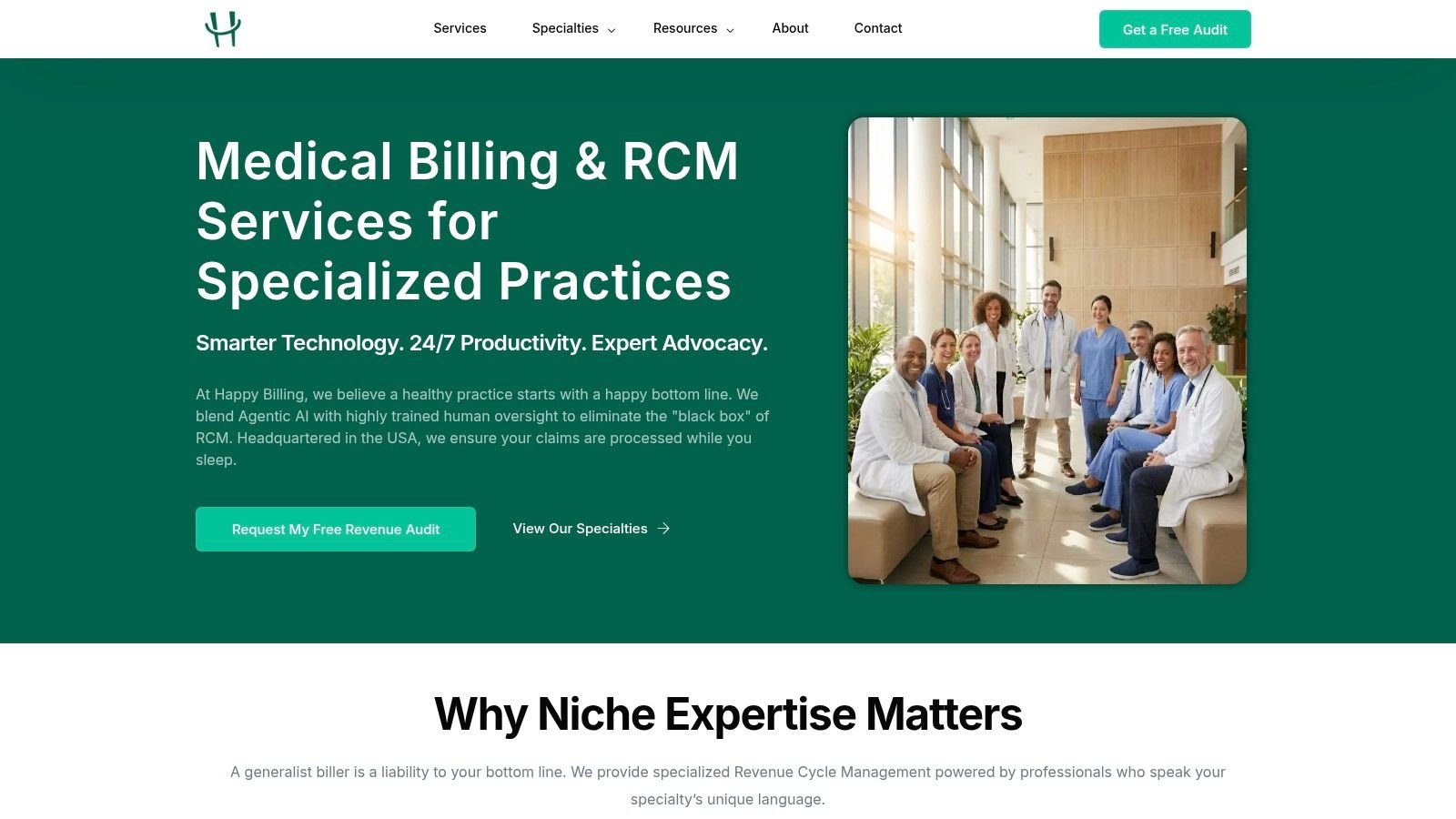
Happy Billing is the strongest fit for high-stakes practices that want specialty-focused RCM without moving data into a new platform. The company operates inside the practice's existing EHR, combining agentic AI with expert human auditors for claim review, denial prevention, and A/R follow-up. That model reduces one of the largest implementation risks in outsourcing, namely forcing staff to learn a separate workflow or migrate historical data before the billing team can work.
The company publishes a 98%+ first-pass clean claim rate and keeps days in A/R under 35, figures that are stated by Happy Billing and should be validated against a prospective client's payer mix and specialty. The financial relevance is straightforward. Clean claims move through adjudication with less rework, while faster A/R follow-up reduces the time between service delivery and payment. CMS defines a clean claim as one that doesn't require the payer to investigate or develop the claim further in its claims processing guidance.
Specialty controls and recovery capacity
Happy Billing's workflows are built for anesthesiology, mental and behavioral health, cardiology, orthopedics, pediatrics, and other complex specialties. For anesthesiology, that means attention to base units, modifiers, and concurrency. For orthopedics, the risk often sits in global periods and multiple-procedure reductions. For behavioral health, authorization management and payer-product classification can determine whether a claim is collectible at all.
Modifier discipline deserves direct scrutiny. CMS guidance says claim lines submitted with a GZ modifier are automatically denied, while claim adjustment reason code 4 applies when a procedure code conflicts with the modifier used or a required modifier is missing. A billing partner that treats modifiers as a final scrub instead of a specialty workflow can create avoidable denials in high-volume services.
Happy Billing also offers full-cycle RCM, credentialing, denial management, old A/R recovery, and provider support through a 24/7 follow-the-sun operating model with U.S. leadership and a global back office. Its security position includes HIPAA-first privacy protocols and bank-level encryption. The company provides real-time dashboards, which lets an owner monitor claim status, denial categories, collections, and A/R activity instead of relying only on monthly summaries.
Practical rule: Ask for performance data segmented by specialty, payer, and denial category. A blended practice-wide number can hide the exact workflow causing your cash leakage.
Proof, pricing, and trade-offs
Happy Billing features a named anesthesiology client that reported reaching a 98% clean claim rate and a 15% increase in monthly collections, along with a revenue recovery case study titled “Plugging the $32M Leak.” Those results are client-specific, so they should be treated as evidence to investigate rather than a guarantee for every practice.
Pricing isn't published on the website. Prospective clients need a consultation or audit to receive a proposal, which limits rate-card transparency but allows the scope to reflect specialty complexity, old A/R, credentialing, and denial work. Practices that prefer complete in-house control may also need to weigh access, change management, and concerns about a global back-office model, even with U.S. leadership and stated privacy safeguards. For more context on the financial side of outsourcing, review medical billing outsourcing costs.
2. Outsource Receivables, Inc.
Outsource Receivables, Inc. is a Minnesota-based third-party billing and revenue-cycle partner for practices that value local operating familiarity and hands-on implementation. ORI supports full-cycle billing and coding, eligibility, claims, A/R management, patient communication, and customer service. Its first-party approach is important for practices that want patients to experience the billing company as an extension of the physician's office rather than as a separate call center.
That distinction affects workload more than many owners expect. If ORI handles patient calls and statements under the practice's name, internal staff may spend less time explaining balances, correcting statement issues, and routing billing questions. The practice still needs clear escalation rules, because a patient-service model can create risk if clinical, financial, and privacy questions reach the wrong person.
Local implementation and accountability
ORI markets a free on-site operational assessment and a money-back guarantee, although the terms require consultation. An on-site review can help uncover workflow problems that a remote sales call misses, such as incomplete charge capture, delayed provider documentation, unclear work queues, or disconnected payment-posting responsibilities.
The local Upper Midwest footprint may appeal to independent clinics that want familiarity with regional health systems and payer relationships. That doesn't automatically prove superior collection performance, however. ORI publishes limited specific performance metrics and specialty benchmarks online, so an owner should request client-level evidence before assigning a value to the local presence.
Ask ORI to map every handoff from eligibility verification through patient balance resolution. The useful question isn't whether the vendor offers full-cycle RCM. It's who owns each exception when the normal workflow fails.
ORI's contract and guarantee deserve close review. Confirm whether the guarantee applies to billing fees, collections, implementation milestones, or a broader service commitment. Also ask how the vendor defines a collectible claim, how it treats payer delays, and whether old A/R work is included or billed separately.
For a broader due-diligence framework, use these questions to ask a medical billing company before hiring. The same questions should cover HIPAA safeguards, EHR permissions, audit logs, patient communications, termination rights, data return, and reporting cadence. ORI's main advantage is its local, first-party operating model. Its main evaluation challenge is the limited public evidence needed to compare results against national-scale firms.

3. Billing Buddies
Billing Buddies brings a long Minnesota operating history to a service mix that extends beyond claims submission. Based in Minnetonka and operating since 1994, the firm supports medical billing, credentialing, payer contracting, and workflow integration. That combination suits small and mid-sized practices that don't want to coordinate separate vendors for enrollment, contracting, and ongoing revenue-cycle work.
The financial benefit of combining these services is indirect but significant. Credentialing gaps can delay legitimate claims before a practice has a chance to dispute them, while payer-contracting errors can affect reimbursement expectations and patient estimates. A billing partner that understands both the enrollment relationship and the claim workflow can identify whether a payment problem began with coding, eligibility, contracting, or payer configuration.
Specialty breadth and EHR continuity
Billing Buddies supports behavioral health, audiology, physical and occupational therapy, chiropractic care, and primary care. It also integrates with client workflows and identifies platforms such as Office Ally and Practice Mate. That matters for practice owners who want to preserve their existing scheduling, documentation, and charge-entry process rather than introduce a full technology replacement.
The company states that account specialists hold AMBA certification. Owners should still ask how many staff members will work on their account, whether specialty-specific coding review is included, and how the vendor handles high-risk CPT and modifier decisions. A behavioral health practice, for example, should ask how authorization status, payer-product rules, and documentation are reconciled before submission.
Owner's test: Give each finalist a de-identified denial scenario and ask them to identify the root cause, the next action, the responsible role, and the reporting category. The response reveals more than a general service list.
Billing Buddies' Minnesota roots and multi-decade continuity may reduce relationship risk during onboarding. The trade-off is that the public site offers less detail about analytics, automation, dashboard design, and quantified outcomes than a technology-forward national provider. Pricing also requires consultation, so compare total scope rather than percentage alone.
A practice considering the benefits of outsourcing medical billing should include credentialing and payer contracting in the financial model. If those functions remain internal, the vendor's lower apparent fee may not represent a lower total operating cost.

4. SMB Medical Billing
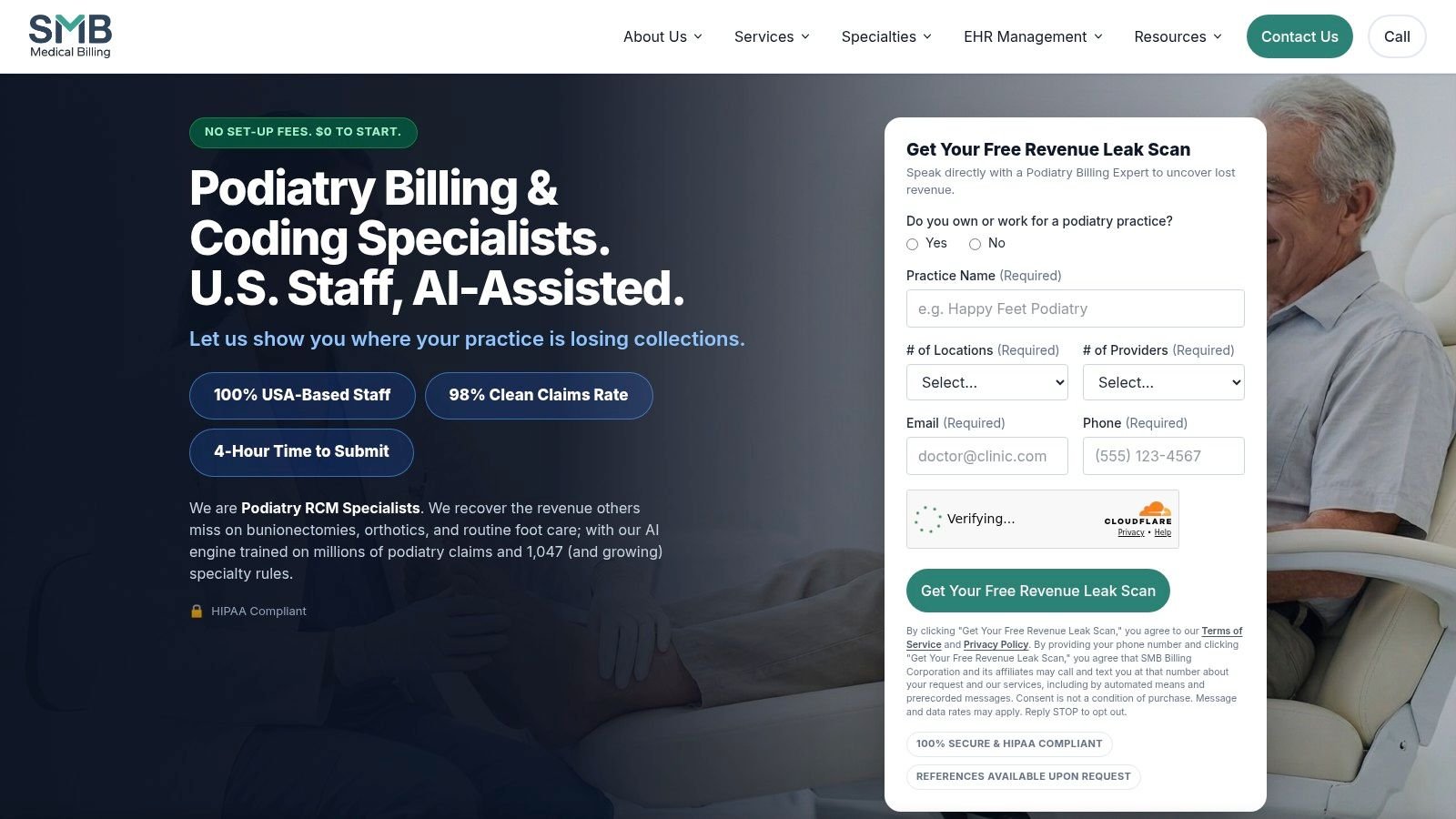
SMB Medical Billing is positioned around small and mid-sized practices in Saint Paul and the Twin Cities. Its end-to-end service scope includes eligibility verification, claim submission, payment posting, patient statements, denial reduction, and A/R follow-up. That focus makes it relevant for physician owners who don't need a hospital-scale platform but do need someone to own daily billing activity consistently.
For a smaller practice, operational consistency can matter more than an expansive feature catalog. One missed eligibility check, delayed payment post, or unworked denial can consume disproportionate staff time because there are fewer people available to absorb the exception. SMB's emphasis on hands-on support and long-term client relationships may fit practices where the owner or administrator still supervises billing personally.
Podiatry and ambulatory surgery relevance
SMB maintains specialty content and experience for podiatry and ambulatory surgery centers. Those environments require more than generic statement production. Podiatry claims can involve procedure-specific medical necessity and modifier questions, while ASCs need disciplined coordination among authorization, facility billing, professional billing, documentation, and payer edits.
Minnesota practices should ask SMB to demonstrate how it separates claim errors from payer-policy issues. That distinction determines whether staff corrects a charge, obtains missing documentation, submits an appeal, or escalates a contract interpretation question. It also affects denial reporting, because a single “denial reduction” category won't tell an owner whether the problem is eligibility, coding, authorization, timely filing, or payment variance.
SMB's website doesn't publish first-pass rates, days in A/R, or other specific KPIs. That isn't proof of weak performance, but it does create a measurement burden for the buyer. Request a baseline report, a target-state report, and a sample monthly dashboard before signing.
A local vendor can be highly responsive and still leave revenue uncollected if its reporting stops at claim submission. Require visibility through payment, appeal, adjustment, and final disposition.
The strongest use case is a smaller practice that wants direct support without an enterprise implementation. The main limitation is the less detailed public specialty coverage beyond podiatry and ASCs. Owners in cardiology, anesthesiology, orthopedics, or behavioral health should request specialty-specific references and CPT review examples. Practices with limited internal staffing can also compare SMB with medical billing services for small practices when assessing how much work should remain in-house.
5. Kaleidoscope Health Systems
Kaleidoscope Health Systems is a useful option when the immediate problem is a damaged A/R position rather than a desire to outsource every billing function indefinitely. Based in Bloomington, KHS offers A/R recovery projects, ongoing billing and RCM, coding, credentialing, compliance oversight, and business-office management. That flexibility lets a practice separate urgent cash recovery from longer-term operating design.
A targeted A/R engagement can be financially rational when old balances are consuming staff time but lack clear ownership. Before approving the project, ask KHS to segment the inventory by payer, age, balance, denial reason, timely-filing risk, and appeal status. Without that segmentation, a recovery project can generate activity without showing which balances remain collectible and which should be adjusted or written off.
Project work versus ongoing RCM
KHS emphasizes project and consulting support, including rapid A/R recovery. Practices seeking continuing RCM should define the ongoing scope in writing. The contract should state whether charge capture, coding review, claims, payment posting, patient statements, denials, credentialing, and reporting are included or treated as separate services.
Compliance oversight adds value when a practice is correcting historical processes. The owner should ask for audit methodology, sampling rules, escalation procedures, and documentation of corrective actions. This is especially relevant when modifier or documentation errors have created recurring denials. CMS guidance identifies missing or inconsistent modifiers as a reason for claim adjustment code 4, and a vendor's work should show whether it prevents recurrence rather than only resubmitting affected lines.
A/R recovery question: What percentage of the assigned inventory will receive a documented disposition, and how will you distinguish recovered cash from balances that were merely reclassified?
KHS's Minnesota presence and direct support team may appeal to owners who want a reachable local contact. The trade-off is limited public detail about automation, tooling, integration depth, and performance metrics. Ask how the team works inside your EHR, what access it requires, and how quickly it can return documentation or reports when staff need to investigate a payer issue.
For a practice with a severe backlog, KHS may be a better first conversation than a provider focused only on new-claim throughput. For a practice seeking advanced automation and continuous specialty analytics, compare the proposed workflow against a larger RCM operation. Review Minnesota medical billing services as part of that broader comparison.

6. MedStar Billing Services
MedStar Billing Services markets a broad RCM menu across medical, behavioral health, and dental practices. Services include credentialing, verification of benefits, prior authorizations, denial management, A/R follow-up, and after-hours support. Its behavioral health emphasis may be useful for clinics where authorization status and payer-product rules determine whether services can move cleanly from clinical delivery to payment.
MedStar also advertises entry pricing as low as 2.99%. That is the clearest pricing signal among the providers in this list, but “as low as” language should never be treated as a complete quote. The actual cost may depend on claim volume, specialty, payer mix, service scope, minimum fees, patient billing, credentialing, and old A/R.
Prior authorization needs a Minnesota-specific test
Minnesota's prior-authorization environment is changing for state-regulated commercial plans. Under Minnesota Statute 62A.59, carriers must not retrospectively deny or limit coverage solely because prior authorization wasn't obtained when the service would otherwise have been covered. The change applies January 1, 2026, for plans renewed on or after that date, and it doesn't apply to every payer type, including ERISA self-funded plans.
That creates a practical test for MedStar and every other candidate. Ask the vendor to show how it classifies plan type, identifies authorization-exempt services, manages pre-service workflows that remain required, and separates a true billing error from a plan-design issue. Minnesota DHS also describes different handling in Medicaid and managed-care situations involving other coverage and Medicare as primary payer in its coordination-of-benefits guidance.
A reduction in prior authorization doesn't eliminate revenue-cycle work. It shifts more responsibility toward eligibility classification, coding accuracy, documentation, and post-service denial appeals.
MedStar's listed phone area code isn't Minnesota, so confirm U.S. support hours, escalation ownership, and after-hours staffing. Request a written definition of the advertised price, including what's excluded. The provider may be attractive to price-sensitive practices, but the owner must model total cost against denial follow-up, patient communication, credentialing, and reporting requirements.
7. Precision Practice Management
Precision Practice Management is the national-scale option in this Minnesota shortlist. Its Minnesota-specific practice page combines full RCM, coding and charge capture, credentialing, EHR optimization, and 24/7 technical support. It lists support for platforms including Epic, NextGen, eClinicalWorks, Greenway, and Allscripts/Cerner, which makes it relevant for practices where EHR configuration is part of the revenue problem.
An EHR connection alone doesn't guarantee better collections. The value comes from identifying where templates, interfaces, charge workflows, edits, and documentation handoffs create leakage. If a physician completes the note but the charge doesn't reach the billing queue, a stronger A/R team can't recover revenue that was never submitted. PPM's EHR optimization capability should therefore be evaluated through a workflow demonstration using the practice's actual specialty and claim path.
Scale, integration, and local fit
PPM covers anesthesiology, cardiology, mental health, orthopedics, pediatrics, and other specialties. That breadth may suit multi-specialty physician groups that want one national partner rather than several local vendors. It may also support expansion across locations, but the owner should verify who will manage the Minnesota account, how escalations work, and whether specialty leadership is assigned or shared across a broader client base.
The main trade-off is local presence. National infrastructure can provide deeper technical resources and standardized reporting, while a Minnesota-only firm may offer more direct local access. Neither model is automatically better. The decision depends on whether the practice's bottleneck is EHR complexity, specialty coding, old A/R, local relationship management, or the need for a scalable operating model.
PPM doesn't publish pricing or Minnesota-specific performance metrics online. Request results for practices with comparable specialties, payer mixes, EHRs, and collection volumes. Ask for clean-claim definitions, denial root-cause reports, A/R aging views, coder qualifications, security controls, and a sample implementation plan.
Implementation checkpoint: Don't approve an EHR integration based on a compatibility list alone. Require a test of charge capture, claim edits, payment posting, denial queues, user permissions, and report delivery.
PPM is best considered by practices that need EHR depth and broad infrastructure. Smaller practices seeking a highly local relationship may prefer a Minnesota operator, while high-risk specialties should compare the proposed coding controls line by line. The right choice is the vendor that can prove it will improve the specific workflow causing your revenue problem.
Minnesota Medical Billing, 7-Company Comparison
| Provider | Implementation complexity | Resource requirements | Expected outcomes | Ideal use cases | Key advantages |
|---|---|---|---|---|---|
| Happy Billing | Low, in‑EHR integration, minimal migration | Moderate, EHR access, audit/consult, custom pricing | High, 98%+ first‑pass clean claims; <35 days in A/R; faster cash flow | High‑stakes specialties needing specialty‑tuned RCM (anesth, cardiology, behavioral health) | Agentic AI + human auditors, specialty workflows, 24/7 ops, HIPAA/bank‑level security |
| Outsource Receivables, Inc. (ORI) | Medium, onsite onboarding and first‑party setup | Low–Moderate, on‑site assessment, local payer engagement | Improved collections and operational fit; money‑back guarantee (terms apply) | Upper Midwest clinics wanting a local, hands‑on partner | Local presence, first‑party patient billing, free on‑site assessment |
| Billing Buddies | Low, integrates with common EHR/workflows | Low, standard EHR integrations, credentialing support | Stable billing + credentialing continuity; long‑term relationships | Small to mid‑size practices needing billing plus credentialing | Multi‑decade local experience, payer contracting and credentialing services |
| SMB Medical Billing | Low, local, end‑to‑end RCM setup | Low, hands‑on support for small practices; denial focus | Cash‑flow stability and denial reduction (KPIs not publicly detailed) | Small/mid practices in Twin Cities; podiatry and ASCs | Local testimonials, focused small‑practice support, denial prevention emphasis |
| Kaleidoscope Health Systems | Medium, project/scoped engagements for A/R recovery | Flexible, project teams or interim RCM; scoping required | Rapid A/R cleanup or interim stabilization; compliance oversight | Practices needing short‑term A/R recovery or targeted consulting | Flexible A/R projects, compliance oversight, local support team |
| MedStar Billing Services | Low, standard multi‑specialty RCM with after‑hours | Low, published teaser pricing (verify terms); verify US support | Cost‑sensitive entry pricing; multi‑specialty billing coverage | Price‑sensitive practices and behavioral health/dental providers | Teaser pricing, broad service menu, behavioral health emphasis |
| Precision Practice Management (PPM) | High, enterprise EHR integrations and optimization | High, EHR optimization, technical integration, larger vendor resources | Scalable RCM with deep EHR optimization; 24/7 technical support | Practices requiring deep EHR expertise and large‑scale RCM infrastructure | Extensive EHR support, coding audits, national infrastructure and 24/7 support |
Turn the Shortlist Into a Defensible RFP Decision
A shortlist becomes useful only when every vendor answers the same financial and operational questions. Start by documenting your current collections, denial rate, clean-claim rate, and A/R aging. Pull the figures from the same reporting period and define each metric before sharing it. A vendor can make performance look stronger by excluding patient balances, old claims, corrected claims, or certain payer categories.
Next, identify the highest-value specialty and payer-rule risks. An anesthesiology practice should examine base units, concurrency, modifier use, and charge capture. A behavioral health clinic should examine authorization status, plan type, documentation, and appeal routing. Cardiology groups should test imaging and interventional coding, while orthopedics should review global periods and multiple-procedure reductions.
Minnesota's claims environment makes payer segmentation especially important. The Minnesota All Payer Claims Database includes de-identified enrollment, medical and pharmacy claims, actual transaction prices, procedure codes, servicing and billing provider fields, payer identity, and patient share, as described by the Minnesota Health Economics Program. Practices don't need to reproduce that database internally, but they should expect a vendor to distinguish payer behavior, product lines, transaction types, and patient responsibility in its reporting.
Build the commercial test before signing
Request written pricing and contract terms from every finalist. Compare percentage-of-collections fees with flat charges, minimums, credentialing fees, patient billing fees, denial appeal fees, A/R recovery charges, implementation costs, and termination obligations. MedStar's advertised price as low as 2.99% is not comparable to an all-inclusive proposal until the scope behind that figure is documented.
Ask each vendor:
- CPT and modifier review: Who reviews specialty-specific codes, and how are errors involving modifiers such as 24, 25, 50, 51, 59, 78, 79, or GZ prevented before submission?
- Authorization work: How does the team classify Minnesota state-regulated commercial plans, ERISA self-funded plans, Medicaid managed-care products, and services with changing authorization requirements?
- Denial root causes: Will reports separate eligibility, coding, documentation, authorization, timely filing, bundling, and payer-processing denials?
- Old A/R recovery: What inventory will be worked, what disposition codes will be used, and how will recovered cash be separated from reclassification?
- Credentialing: Who owns payer enrollment, revalidation, contracting, and follow-up when a provider or location isn't active?
- Patient communications: Will the vendor communicate under the practice's name, and what issues must return to internal staff?
- EHR access: What permissions, interfaces, audit logs, downtime procedures, and data-return commitments apply?
- Security: How are PHI, user access, encryption, workforce training, incident response, and subcontractors governed?
- Implementation: What happens during the transition, who reconciles opening A/R, and when do dashboards become reliable?
- Exit rights: Can the practice terminate for missed service levels, how much notice is required, and who owns claim notes, reports, and work-product data?
Select evidence over presentation quality
Demand client-specific performance evidence where available. Happy Billing publishes a 98%+ first-pass clean claim rate, days in A/R under 35, and a client-reported anesthesiology result involving a 98% clean claim rate and a 15% increase in monthly collections. Other vendors in this roundup publish fewer quantified outcomes, so the buyer should use references, sample reports, denial inventories, and controlled pilot work to close the evidence gap.
Minnesota also has a replacement-claim rule that can materially affect recovery timing. The state billing policy says replacement claims must reach MHCP within six months of an incorrect payment or within 12 months of the date of service, whichever is greater, as described in Minnesota medical billing policy guidance. Ask who monitors those deadlines and how corrected claims are tracked to final adjudication.
A defensible decision doesn't require choosing the vendor with the lowest fee or the largest team. It requires matching the provider's controls to the revenue failure you can measure. If your practice can't establish a baseline, start with an A/R and denial audit, then require every finalist to explain how its workflow would change the numbers.
How should a practice compare percentage-based billing fees?
Compare the total financial outcome, not the headline percentage. Ask what the fee includes, whether it applies to patient collections, and whether denial appeals, credentialing, statements, and old A/R carry separate charges. Then compare each proposal against your baseline collections, clean-claim rate, denial categories, and A/R aging.
Is a local Minnesota vendor necessary?
Not always. Local firms may offer direct relationships and regional familiarity, while national providers may offer broader EHR resources, specialty staffing, and 24/7 support. The practical test is whether the vendor can provide Minnesota payer expertise, reliable escalation, secure EHR access, and references from practices with similar workflows.
What clean-claim and A/R metrics should owners request?
Request the vendor's clean-claim definition, first-pass rate, denial rate, denial root causes, A/R aging by payer, appeal recovery, payment-posting lag, and net collection reporting. Require the data to be segmented by specialty and payer where possible, because blended averages can conceal a failing service line.
How can a practice test a billing partner before committing?
Use a limited, documented pilot or an old A/R sample with defined success measures. Test charge capture, modifier review, authorization classification, claim edits, denial explanations, payment posting, reporting, and escalation. Don't judge the pilot only by activity volume. Judge whether the vendor identifies collectible revenue, prevents repeat errors, and gives your team usable evidence.
Happy Billing combines agentic AI, expert human audits, specialty-focused RCM, denial management, credentialing, and old A/R recovery inside your existing EHR. If you're comparing medical billing companies in Minnesota, visit Happy Billing to request a practice-specific revenue audit and a clear plan for improving clean claims, collections, and A/R performance.