Medical Billing Services for Small Practices: 2026 Pricing & Guide

Medical billing services for small practices are worth it when they fix specific revenue leaks that your current workflow isn't catching. If your front desk is rechecking insurance by hand, your clinicians are closing notes late, and your staff is touching the same denied claim three times, you don't have a staffing problem alone. You have an RCM diagnosis that needs treatment.
Most small practice owners don't start this search because they want a vendor. They start because cash is uneven, denials are piling up, and aging A/R is getting harder to explain at the end of the month. The right billing partner doesn't just "do billing." They tighten charge capture, reduce preventable denials, and move money through the cycle faster so revenue stops stalling between the encounter and the bank deposit.
If you are a solo physician rather than a small group, the economics are different again — see affordable medical billing services for solo practices.
Quick answer: Medical billing services for small practices (1–10 providers) typically charge 4–9% of monthly collections, with solo practices at the higher end and larger groups negotiating lower rates. A full-service partner handles claim submission, denial management, payment posting, patient statements and A/R follow-up — replacing an in-house biller who costs $45,000–$60,000 a year plus benefits. Below roughly $25,000–$40,000 in monthly collections, per-claim pricing ($4–$8 per claim) often works out cheaper than a percentage arrangement.
Why Your Practice Is Leaking Revenue Right Now
A familiar pattern shows up in small practices. The schedule is full, providers are working, and the month still closes short. The leak usually isn't one catastrophic mistake. It's a stack of small failures that keep reimbursement from ever reaching your account.
The biggest culprits are well known. The five most common denial reasons for small practices are missing or invalid prior authorization, incorrect patient demographics or insurance data, CPT, ICD-10, or modifier coding errors, duplicate claim submissions, and timely filing violations, according to this breakdown of denial causes in small-practice billing. That same source notes that for a practice submitting 300 claims per month, an 11.8% denial rate means roughly 35 denied claims monthly, and each denial costs $25 to $181 to rework, for as much as $6,335 per month spent fixing preventable errors.
That is the point where billing stops being back-office administration and becomes a direct hit to owner income, payroll flexibility, and growth.
The symptoms usually appear before the financial report does
You can usually spot a strained revenue cycle before you see it in collections:
- Front desk shortcuts: Eligibility isn't verified before every visit, or an authorization is assumed to still be valid.
- Documentation drift: Notes close late, so claims go out late.
- Coding inconsistency: Modifier use changes by provider or by whoever touched the claim that day.
- Follow-up fatigue: Denials are "worked" but not resolved, then age.
In procedural specialties, this gets expensive fast. A missed authorization for a high-cost service is not a clerical nuisance. It's often an automatic denial. A wrong modifier on a procedure claim can trigger a reduction, bundling issue, or rejection that stalls payment until someone reworks it correctly.
Practical rule: If your team is spending its week fixing avoidable denials, you're paying twice. Once in lost time, and again in delayed cash.
The hard part for owners is that these leaks often hide inside ordinary operations. The schedule looks healthy. The billing queue looks busy. But the practice is still under-collecting. If you want a sharper framework for diagnosing where the losses are starting, this guide on how to reduce claim denials is a useful place to compare your current process against common failure points.
What a Billing Partner Actually Does for Your Practice
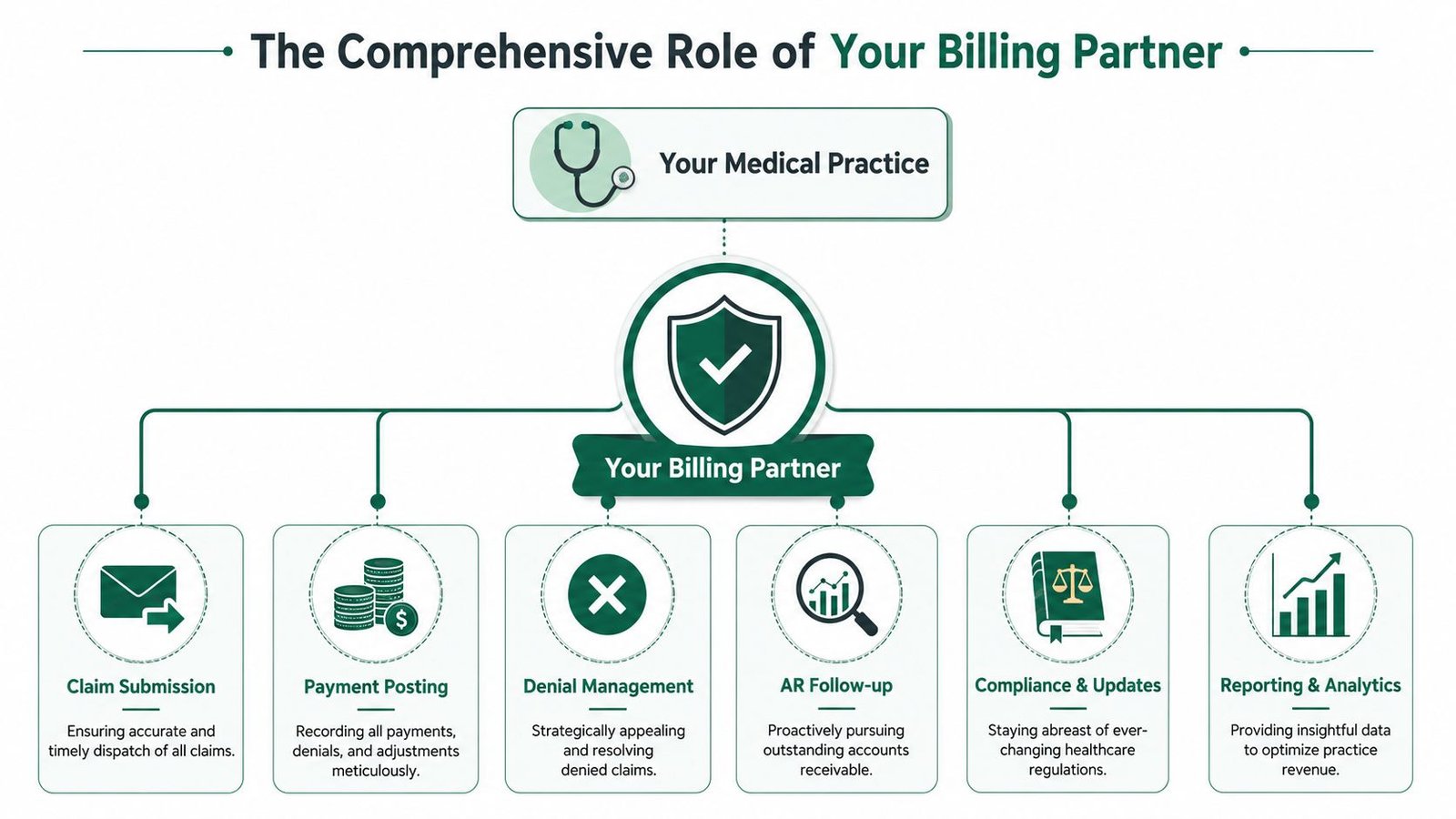
A good billing partner isn't just a claim submitter. They manage the full path from charge entry to posted payment, then keep pressure on every unpaid balance until it's resolved, appealed, or written off for a documented reason.
It starts before the claim goes out
Owners often think billing begins after the visit. Financially, it begins much earlier.
A billing partner should catch front-end defects before they become denials. That means checking insurance details, confirming that prior authorization is in place for services that require it, and reviewing whether the documentation supports the CPT and diagnosis combination being submitted. Under CMS and payer rules, that front-end discipline matters because claims that don't meet coverage or documentation requirements don't fail gracefully. They deny.
In practical terms, errors involving E/M coding, modifier use such as 25, 59, or 51, and payer-specific edits should be caught before submission. If that review doesn't happen, the claim enters the system already compromised.
The middle of the cycle is about clean submission and accurate posting
Once charges are entered, the claim has to be scrubbed and submitted correctly. Then payments, denials, and adjustments have to be posted accurately. If posting is sloppy, your reporting is unreliable. If your reporting is unreliable, you can't tell whether a payer underpaid, whether a denial was appealed, or whether an account is aging because of staff delay or payer delay.
That is why the strongest billing teams treat payment posting as revenue intelligence, not bookkeeping.
A clean claim isn't valuable because it looks organized. It's valuable because it gets adjudicated faster and gives you fewer reasons to spend staff time on rework.
The back end is where revenue is recovered or abandoned
Denial management and A/R follow-up are where many small practices lose momentum. An overextended in-house team often resubmits claims late, appeals inconsistently, or lets balances sit because current-day workload always wins.
A specialized partner works denied and aging claims as a recovery function. That includes checking payer edits, correcting data, attaching documentation, and escalating appeals within payer timelines. It also includes identifying when a denial pattern is operational, not accidental. If one provider's claims repeatedly fail on modifier logic, or one location keeps missing authorizations, the billing partner should surface that pattern quickly.
This is also the core economic argument for outsourcing. According to RhinoMDs' analysis of medical billing economics for small practices, outsourcing pricing is typically 4% to 6% of collections, which for a practice collecting $500,000 annually equals $20,000 to $30,000 per year, compared with $95,000+ for in-house billing. The same source describes that as a 70% to 80% cost reduction and notes that it also improves clean claim rates and reduces A/R days.
If you want a plain-English breakdown of the operational work involved, this overview of what medical billers do gives a useful baseline.
Decoding Medical Billing Pricing Models
The pricing question matters, but not in the way most owners frame it. The key question isn't "What percentage do they charge?" It's "Which fee structure makes this vendor accountable for fixing the revenue leak we have?"
Percentage of collections
This is the most common model in medical billing services for small practices. According to this 2026 pricing analysis for small-practice billing, outsourced medical billing services for small practices typically cost between 4% and 8% of monthly collections in 2026, while average internal billing cost runs between 12% and 15% of collections. For a practice generating $40,000 in monthly revenue, the outsourcing expense is $1,600 to $3,200, compared with $60,000 to $80,000 annually for an in-house biller.
The appeal of percentage pricing is incentive alignment. If the billing company collects more, it earns more. That works well when the partner is actively improving denial prevention, follow-up, and cash velocity.
The downside is that not every collection requires the same amount of work. A straightforward established patient E/M claim isn't the same operational lift as a claim involving surgery modifiers, prior auth review, or appeal documentation. Owners should ask whether the percentage reflects the true complexity of their specialty and payer mix.
Flat fee and hybrid models
Flat fee and hybrid pricing can work well in the right environment, especially when a practice already has some internal strength. A flat fee can make sense when your front end is disciplined, your providers document well, and the outside partner is mainly handling claims, payment posting, and follow-up.
A hybrid arrangement can also work when the practice wants co-management. For example, the internal team may own scheduling, eligibility, and authorizations, while the external partner handles claims, denials, and A/R recovery.
What matters is fit. If your leak is front-end eligibility and authorization failure, a cheap back-end-only model won't solve the underlying problem.
Comparing the models side by side
| Model | Typical Cost | Best For | Key Consideration |
|---|---|---|---|
| Percentage of collections | 4% to 8% of monthly collections in 2026 | Small practices that want full accountability for collections | Incentives are aligned, but the practice should confirm what's included |
| Flat fee per claim or per provider | Varies by vendor | Practices with strong internal controls that want predictable expense | Can reduce incentive for aggressive denial recovery if poorly structured |
| Hybrid model | Varies by vendor | Co-managed environments | Only works if responsibilities are clearly split and measured |
A pricing sheet is only useful if you can map it to your current losses. This guide to outsource medical billing cost is worth reviewing before you compare proposals, because it helps translate fee structure into actual financial impact.
Owner check: If a vendor is talking only about price and not about where your denials originate, they haven't diagnosed the problem yet.
How to Evaluate and Choose the Right Billing Partner
The wrong way to choose a billing company is to compare percentages and stop there. The right way is to ask whether the vendor can remove the friction that's costing you money now.
Start with operational proof, not sales language
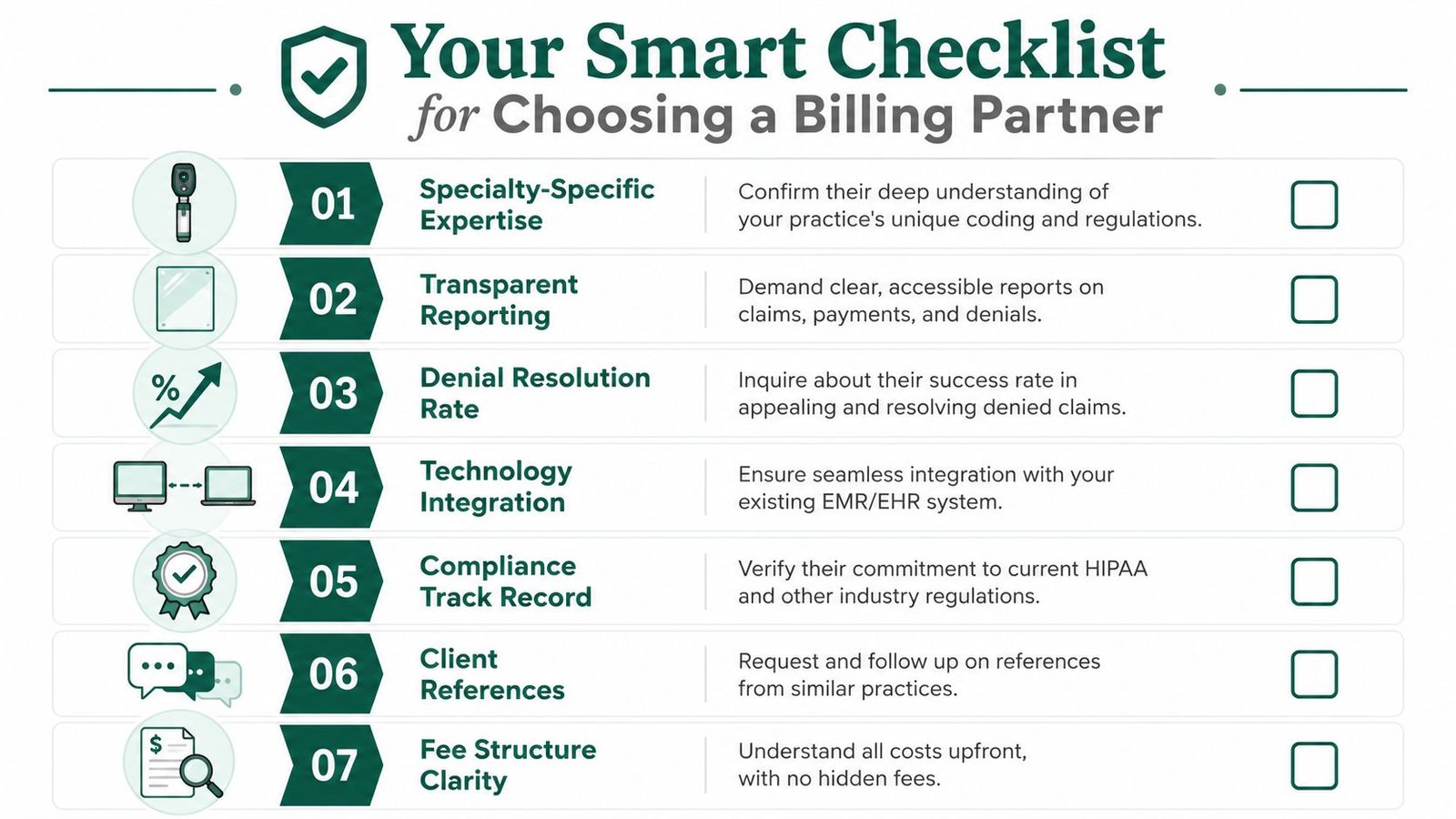
When we evaluate a billing partner from an owner's perspective, we look for evidence in four places:
- Specialty fluency: They should speak comfortably about the codes, modifiers, and payer edits that affect your field.
- Workflow compatibility: They should be able to work inside your current EHR or PM workflow without making your staff build a workaround for them.
- Reporting discipline: They should show you how denials, aging, and payer issues are surfaced and assigned.
- Escalation ownership: They should be specific about who handles old A/R, underpayments, appeals, and payer follow-up.
If you're interviewing a vendor for cardiology, for example, they should be able to discuss procedural coding, diagnostic testing workflows, and modifier-sensitive claims without resorting to generic billing language. If you're interviewing one for mental health, they should talk quickly about authorization tracking and recurring payer edits.
A practical question list helps. This set of questions to ask a medical billing company before hiring is a strong screening tool because it forces the conversation toward accountability rather than promises.
Watch for the hidden cost of oversight
A contract can look transparent and still cost you money. The neglected issue is compliance overhead.
As noted in this analysis of affordable billing solutions for small practices, while the AMA advises SLAs with audit rights, small practices often lose 3% to 5% of revenue not from billing errors, but because they lack the bandwidth to enforce the SLAs they signed. That turns a transparent contract into a passive revenue leak.
That matters more than most owners realize. If your office manager spends hours every week pulling reports, chasing status updates, preparing for vendor reviews, and checking whether old denials were appealed, the fee on paper is not the full cost of the relationship.
Compliance isn't a side issue
HIPAA and workflow governance should be part of vendor selection from day one. You don't need a vendor who offers a bare assertion of "we're compliant." You need one that can explain data handling, role-based access, audit logging, and breach procedures clearly. A practical outside reference for that review is CloudOrbis' HIPAA checklist, which is useful for pressure-testing whether a billing partner's security posture is operational or just contractual.
Don't confuse access to dashboards with transparency. True transparency means your team can tell what happened to a claim, who touched it, why it stalled, and what happens next.
Red flags that deserve a hard stop
- One rate for every specialty: If a vendor quotes the same low percentage for primary care, orthopedics, and anesthesiology, they may not understand complexity well enough to price or manage it.
- Vague denial answers: If they can't describe their appeal workflow, payer follow-up cadence, or how they identify root causes, expect unresolved aging.
- No clear owner on your account: Shared inbox support creates drift. Revenue problems need named responsibility.
- Reporting that only shows totals: You need denial reasons, payer mix issues, aging buckets, and action status. Totals alone hide leakage.
The best billing partner feels less like outsourced labor and more like a revenue specialist who understands where your practice is bleeding cash and how to stop it.
Why Specialty-Specific Billing Is Non-Negotiable
General billing knowledge isn't enough once your reimbursement depends on specialty rules, modifier logic, or authorization-heavy payer behavior. A vendor that handles "all specialties" can still miss the exact denial pattern that hurts your practice most.

According to this review of small-clinic billing challenges, most generic denial-management advice fails to account for specialty-specific denial patterns. The same source notes that mental health clinics are disproportionately hit by prior authorization failures, while orthopedics faces unique denials related to global period reductions. A vendor's ability to prevent those specific denials is a key determinant of value.
Anesthesiology depends on precision, not generic coding skill
Anesthesiology claims are unforgiving. Base units, time units, physical status, and concurrency all affect reimbursement. A modifier such as QK is not a minor coding choice. It's a payment-impacting decision that has to match the supervision structure and documentation.
If a generalist biller mishandles concurrency or time reporting, the practice may not just get denied. It may get paid incorrectly and never catch the loss unless someone reconciles the remittance against the expected anesthesia calculation.
Mental health lives and dies on authorization discipline
Mental health practices often struggle not because the therapy codes are conceptually difficult, but because payer rules around authorization, visit counts, and continuing reviews are easy to miss operationally. A claim for recurring services can look clean and still fail if the authorization expired, the approved units were exhausted, or the payer's documentation requirement wasn't met.
In that environment, the billing partner has to function like an authorization watchdog, not just a claims processor.
Clinical-financial connection: In behavioral health, a missed authorization isn't a coding problem after the visit. It's a revenue problem before the visit.
Cardiology requires procedural depth
Cardiology billing combines E/M, diagnostic testing, imaging, and interventional procedures. That means edits around medical necessity, documentation support, and modifier usage can create denials or underpayments that a general billing shop may miss.
Claims involving procedures such as 93000 or catheter-based work often require stronger payer-rule awareness than a broad generalist can provide. If your practice wants a deeper specialty reference point, the field-specific issues in cardiology medical billing services show why cardiology should never be treated like generic outpatient billing.
Orthopedics is where global rules punish inattention
Orthopedic billing exposes weak vendors quickly. Surgical claims involve global periods, multiple procedure logic, post-op visit bundling, and modifier-sensitive reimbursement. Modifier 51 and other surgical coding decisions aren't abstract technicalities. They determine whether the practice is paid correctly or reduced unnecessarily.
If the team doesn't understand what belongs inside the global package and what can be billed separately under payer policy, the revenue loss may not appear as a dramatic denial. It may show up as quiet under-collection.
Specialty fit also changes your compliance risk
Specialty-specific billing isn't only about payment. It's also about protecting PHI and workflows in settings where frequent authorizations, referrals, and records exchanges are routine. For office operations reviewing communication protocols, this guide on ensuring HIPAA compliance for medical offices is useful because it highlights how communication tools can affect privacy and operational reliability.
For practices comparing service models across fields, the broader specialty overview at Happy Billing specialties is a practical directory of where billing complexity changes by discipline.
Onboarding and Measuring Your Billing ROI
A weak transition can cost a small practice a month of cash. Claims sit in edit queues, old balances lose collectability, and staff stop trusting the new process before it has a chance to work.
Good onboarding prevents that. The point is not to switch vendors. The point is to stop specific revenue leaks without creating new ones during go-live.
What a clean onboarding process looks like
Start with ownership. Someone must own eligibility, prior auth status, charge entry timing, claim edits, payment posting, denial follow-up, and old A/R. If any step sits in a gray area, work gets delayed and denials get argued over instead of fixed.
We look for a partner that can map the future-state workflow inside the current EHR or PM system before touching anything. That includes claim routes, work queues, user access, reporting fields, and posting rules. A vendor that pushes a software replacement before diagnosing your breakdown usually has a product agenda, not an RCM plan.
Old A/R needs its own rule set.
If the partner is only taking new claims and leaving balances over 60 or 90 days untouched, the practice may see decent production on paper while cash stays flat. Owners should get a written answer on who works legacy A/R, how often, and how results will be reported by payer and age bucket.
The KPI set that actually matters
You do not need twenty metrics. You need a small set that shows whether charges are turning into cash faster and with fewer write-offs.
Track these every month against the same baseline:
- Days in A/R: Shows how long it takes to convert billed work into cash.
- First-pass clean claim rate: Shows whether claims leave the system ready to pay.
- Denial rate: Shows whether breakdowns are happening at the front desk, coding, or payer follow-up.
- Net collection trend: Shows whether the practice is collecting the revenue it earned.
For older balances, time matters. According to this review of medical billing revenue recovery, claims over 120 days in A/R are far harder to recover, and denied claims are often still collectible if the team acts quickly. That is why aging reports need weekly attention, not quarterly review.
If your A/R is aging without active follow-up, the practice is financing payers.
Measure the partner against your baseline
Before go-live, record your current numbers by payer and by month. Include denial categories, average claim lag from date of service to submission, aging buckets, and net collections. That gives you a clean before-and-after comparison.
Then hold the partner to movement in those numbers. If days in A/R stay high, ask where claims are stalling. If denials drop but net collections do not improve, check for underpayments, posting delays, or old A/R neglect. ROI should show up in cash, speed, and fewer preventable write-offs, not in polished dashboards.
The financial test is straightforward. If a billing service charges 6% of collections but improves cash by more than the fee through faster filing, lower denials, and better follow-up, the relationship is paying for itself. If it does not change those core metrics within a reasonable ramp period, the practice has changed vendors without fixing the leak.
Frequently Asked Questions from Practice Owners
Is outsourcing billing worth it for a very small practice
Yes, if the practice has identifiable leakage in denials, follow-up, or delayed claim submission. The smallest practices usually feel revenue interruptions more sharply because one backlog, one absence, or one payer issue can affect the whole month. The decision should be based on whether the partner fixes the leak, not just whether they cost less than payroll.
Should I choose the lowest percentage quote
Usually no. A low fee doesn't help if the vendor lacks specialty knowledge, weakens reporting, or creates more oversight work for your office manager. Owners should compare total economic impact, including denied claims, A/R aging, underpayments, and the staff time required to manage the relationship.
Can a billing partner work inside my current EHR
Often yes, and that should be the default expectation. The smoother approach is to improve claim flow, posting discipline, and follow-up inside your current environment rather than forcing a disruptive software change unless your existing system is itself the source of major billing failure.
What should I ask on the first call with a billing company
Ask where they think your current leak is likely happening, how they would confirm it, how they handle denials by root cause, and who owns old A/R. Then ask specialty-specific questions. If their answers stay generic, they probably won't protect specialty-specific revenue once the work starts.
If your practice is collecting less than it should, the fastest next step is to diagnose the leak before you change staff, software, or vendors blindly. Happy Billing helps independent practices identify where denials, aging A/R, and workflow gaps are draining revenue, then fixes those issues inside your existing systems. If you want a concrete starting point, request a review through their free audit for medical billing performance.