Affordable Medical Billing Services for Solo Practices: 2026 Pricing Guide
Quick answer: In 2026, affordable medical billing for a solo practice means an all-in fee of 5% to 8% of collections (roughly $1,500 to $3,200 per month for a practice collecting $30,000 to $40,000), or $4 to $8 per claim on a per-claim model, with denial follow-up, patient statements and payer credentialing included rather than sold as add-ons. Anything cheaper almost always excludes denial work, which is exactly where a one-provider practice loses the most money.
What a solo practice should expect to pay in 2026
| Monthly collections | Typical % fee | What that costs per month | Per-claim alternative (~$4–$8) |
|---|---|---|---|
| $20,000 | 7%–8% | $1,400–$1,600 | ~300 claims → $1,200–$2,400 |
| $30,000 | 6%–8% | $1,800–$2,400 | ~400 claims → $1,600–$3,200 |
| $40,000 | 5%–7% | $2,000–$2,800 | ~500 claims → $2,000–$4,000 |
| $60,000+ | 5%–6% | $3,000–$3,600 | ~700 claims → $2,800–$5,600 |
| In-house biller (for comparison) | — | $3,750–$5,000 salary + software, benefits and PTO gaps | — |
Rule of thumb: below about $35,000 in monthly collections a percentage fee is usually cheaper; above it, a per-claim or hybrid model starts to win, provided denial follow-up is still included. The fee that matters is the one you pay after adding back the revenue a cheaper vendor fails to collect.
Not sure whether your current fee is affordable or just cheap? Request a free billing audit. We review your last 90 days of claims and show you where the leakage is, with no sales pitch.
You're probably in one of two situations right now. You're either busy, seeing patients, and still wondering why cash feels tight at month-end, or you've already outsourced and you're not convinced the service is earning its keep. We've seen both. In a solo practice, billing problems don't stay in the back office. They show up as delayed payroll decisions, owner draws you postpone, and days in A/R that keep drifting in the wrong direction.
That's why this conversation starts with revenue, denial prevention, and cash velocity. If claims aren't going out clean, if denials aren't being touched quickly, and if your over-90-day A/R keeps growing, the fee itself is almost irrelevant.
Defining Affordable Beyond the Percentage Fee
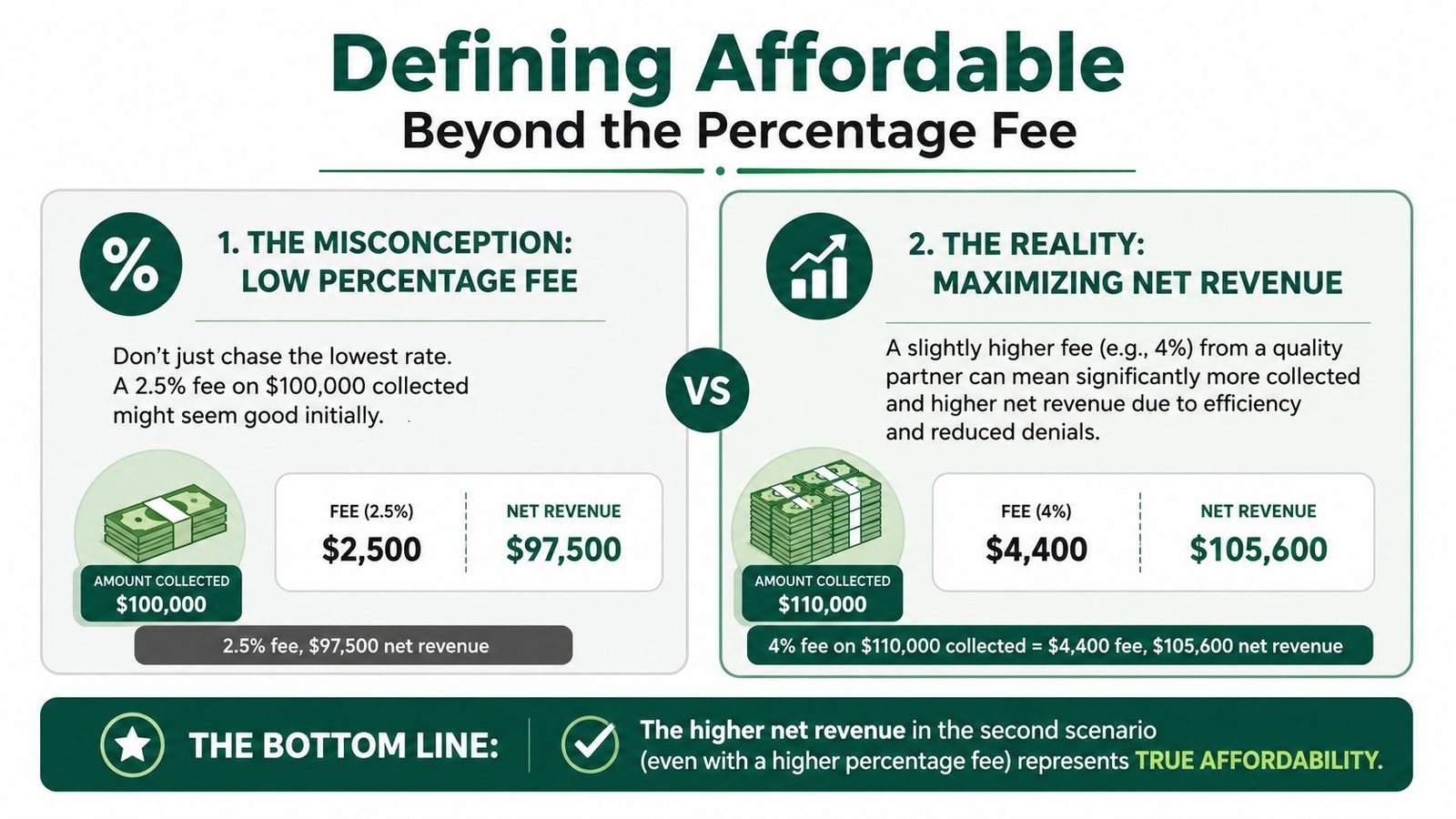
You hire a billing company at 4%. Six months later, cash is still tight, old A/R is growing, and you are spending your lunch break asking why claims were never corrected. That service was not affordable. It was cheap and expensive at the same time.
Solo physicians get into trouble when they treat affordability as a percentage quote instead of a math problem. The right question is simple: after fees, rework, delays, and missed follow-up, which model leaves more cash in the practice?
An analysis from MedVirtual reported that outsourcing can raise revenue within months, and it highlighted a case where a 3% billing model delivered a 4.2x ROI because collections increased 18% after the switch (MedVirtual analysis of small-practice billing economics). That is the standard. Do not ask whether the fee sounds low. Ask whether the vendor produces more net revenue.
Net revenue is the real affordability test
A higher-fee service can be the cheaper choice if it collects faster, recovers denials, and keeps claims from aging out. We have seen solo practices save a point on billing fees and lose far more in unworked rejections, weak follow-up, and patient balances that should have been collected weeks earlier.
Use a break-even collection volume test. This is the angle most physicians miss.
If a percentage-based vendor charges 6%, and a subscription service costs $1,500 per month, the break-even point is $25,000 in monthly collections. Below that, the subscription may cost less. Above that, the percentage model may be cheaper. The math is straightforward. The decision is not.
Your bookkeeping has to be clean enough to measure that difference. A messy P&L hides billing waste, which is why a founder's guide to quality bookkeeping is useful before you compare vendors.
What we look at first
Start with full billing cost, not just the outsourced quote. Include staff time spent answering billing questions, fixing eligibility mistakes, posting payments, and chasing old claims. Include software, clearinghouse fees, and the owner time lost to revenue-cycle cleanup.
MGMA explains that medical practice cost structure should be evaluated through total operating performance, not isolated line items, because overhead decisions only make sense in the context of collections and reimbursement trends (MGMA medical practice cost and revenue resources). That is the right frame for solo practices.
Then run the comparison with a realistic calculator. Use your actual monthly collections, claim count, specialty mix, denial volume, and A/R performance. A good starting point is this breakdown of medical billing outsourcing cost.
If your current setup looks cheaper on paper but produces slower cash, weaker follow-up, and more money stuck in A/R, it is not affordable. It is underperforming.
Decoding Pricing Models for Solo Practitioners
A solo physician collects $35,000 one month and $24,000 the next. The billing company still says, “We charge 6%.” That sounds simple. It is also how practices overpay.
Percentage pricing is common, but it should never be your default choice. You need to price the service against your actual collections, claim volume, specialty complexity, and the amount of billing work still left on your desk after outsourcing. We've seen solo practices sign a “low” percentage deal, then get hit with extra charges for patient statements, credentialing, old A/R, and denial work that should have been included from day one.
One outside benchmark shows small-practice billing fees are often quoted as a percentage of collections, with total monthly cost varying by specialty and volume (solo practice billing cost breakdown). That range is only a starting point. It does not tell you which model is cheaper for your practice.
The three pricing models that matter
| Model | Best For | Predictability | Incentive Alignment |
|---|---|---|---|
| Percentage of collections | Practices with uneven monthly revenue or owners who want fees to rise and fall with cash flow | Moderate | Strong, because the vendor gets paid when you get paid |
| Flat fee per claim | Practices with steady visit volume and consistent claim complexity | Moderate to high | Mixed, because claim count matters more than dollars collected |
| Monthly subscription | Lower-volume solo practices that want strict budget control | High | Mixed, because the fee does not automatically reflect collection performance |
Each model creates a different financial risk.
Percentage pricing protects cash flow in slow months, but it becomes expensive fast when collections improve. Flat-fee-per-claim pricing works well when your coding is straightforward and claim count is predictable. Subscription pricing can be the cheapest option for a small, stable practice, but only if the vendor clearly states what is included and what triggers added fees.
The break-even collection volume
This is the number you should calculate before every sales call.
Your break-even collection volume is the monthly collections level where a percentage-based contract costs the same as a fixed monthly fee. Once you know that number, you stop guessing and start buying based on math.
Use this formula:
- Take the flat monthly quote
- Divide it by the percentage rate
- The result is your break-even monthly collections
Example:
- Flat monthly fee: $1,800
- Percentage fee: 6%
- Break-even collections: $30,000
If you usually collect more than $30,000 a month, the flat fee is likely cheaper. If you usually collect less, the percentage model may cost less.
That is the pricing angle solo owners miss. The question is not “Is 6% fair?” The question is “At my collection volume, when does 6% become the expensive option?”
If a vendor cannot show you your break-even point, they are asking you to buy on trust instead of math.
We've seen this matter most in solo practices with stable follow-up schedules, repeat payer mix, and predictable monthly charges. Those practices often outgrow percentage pricing before they realize it.
How to compare quotes without getting fooled
Make every vendor price the same three scenarios:
- Your current monthly collections
- A weak month
- A strong month
Then ask for the full fee schedule in writing. That includes setup fees, clearinghouse charges, patient statement fees, prior A/R cleanup, credentialing, coding support, and denial appeals.
Next, compare total cost under each model:
- what you pay under percentage pricing
- what you pay under flat pricing
- what you pay under subscription pricing
- what work is excluded and billed separately
Use this side-by-side medical billing outsourcing cost comparison to run the numbers cleanly.
Affordable billing is not the lowest advertised rate. It is the model that leaves you with more net collections after all billing costs are counted.
Your Vendor Vetting Checklist and Must-Have Features
A solo physician usually hires a billing company after a painful month. Collections slip, denials pile up, and the vendor on the sales call sounds polished. Polished does not get claims paid. Process gets claims paid.
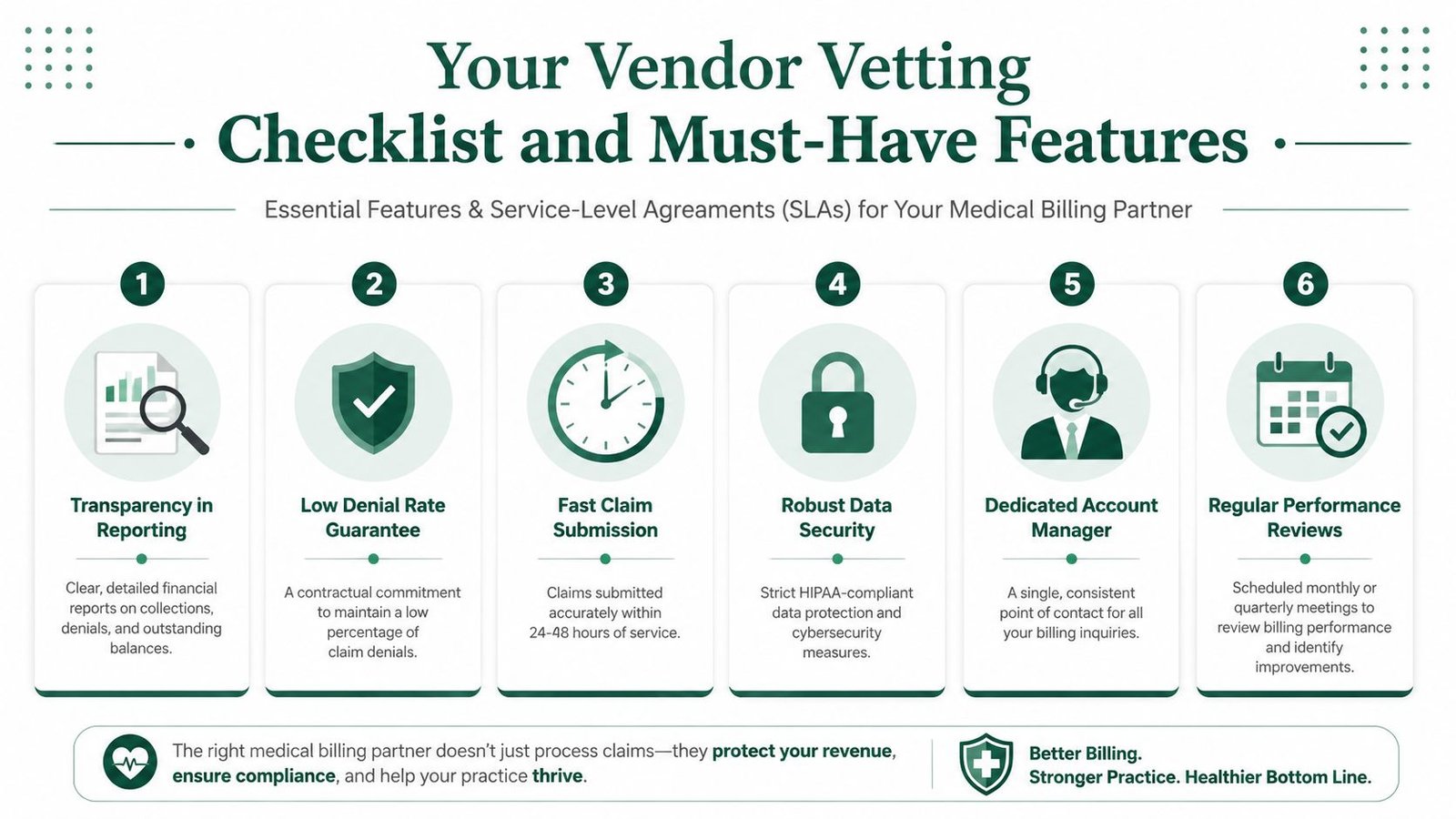
Your job in vetting is simple. Confirm that the service can protect cash flow at your current volume and still make financial sense as collections rise past your break-even point. A low fee means nothing if the vendor is slow, opaque, or weak on follow-up.
Core service requirements
Ask every vendor for operating targets in writing. If they dodge the question, cross them off your list.
- Clean claim discipline: They should explain how claims are scrubbed before submission, who reviews edits, and how modifier logic is handled. If your specialty depends on modifier 25, 59, or 95, sloppy billing will cut collections fast through denials, downcoding, and missed reimbursement.
- Denial ownership: You need a defined workflow for denial review, appeal submission, payer follow-up, and escalation. “We work denials daily” is not an answer. Ask who owns each step and how quickly they act.
- Specialty fit: A general billing team can miss revenue even when claims go out on time. We've seen orthopedics lose money on global period mistakes, behavioral health lose money on weak authorization controls, and cardiology lose money on payer edit issues tied to procedural coding.
- Reporting access: You should get regular visibility into collections, denials, aging, payer mix issues, and write-offs. If you have to ask repeatedly for basic numbers, you are managing in the dark.
- System compatibility: Confirm they work inside your EHR or practice management system, or explain exactly how data moves between systems. Extra handoffs create posting errors and slow down claim submission.
- Patient balance handling: Ask who sends statements, who fields billing questions, and how payment plans are handled. Poor patient billing hurts collections and creates avoidable complaints.
Questions that expose weak vendors
Skip broad questions about “service” and “support.” Ask for specifics that reveal whether the operation is disciplined or loose.
- What clean claim rate do you target, and how do you measure it?
- How quickly do you work denials after receipt?
- What does your over-90-day A/R look like across solo-provider clients?
- Who handles payer follow-up, and how often are unresolved claims touched?
- How do you review modifier-dependent claims, including telehealth billed with modifier 95 and E/M billed with modifier 25?
- Which tasks are included in your base fee, and which ones trigger extra charges?
- What reporting will I receive monthly, and can I see a sample?
- How do you adjust your service model if my monthly collections move above or below my break-even point for percentage pricing?
A billing company that cannot explain workflow metrics, accountability, and pricing boundaries will cost you more than it saves.
If you want a tighter interview framework, use these questions to ask a medical billing company before hiring.
What a strong setup looks like
A good billing partner is fast, measurable, and boring in the best way. Claims go out quickly. Edits are handled before submission. Denials are touched promptly. Reports arrive without prompting.
We've seen the best solo-practice vendors do one more thing that cheaper vendors often avoid. They connect operations to economics. They can tell you whether their pricing model still fits your volume, or whether you have reached the point where a flat monthly arrangement would leave more money in the practice.
That matters. Affordable billing is not just about the fee percentage. It is about whether the vendor protects collections and stays cost-effective as your revenue changes.
Red Flags That Signal a Bad Billing Partner
Cheap billing becomes expensive when the vendor creates rework, hides reporting, or leaves coding errors untouched. That damage is predictable.
Studies indicate that 80% of medical bills contain errors, 30% of claims contain at least one error, and 71% of those errors come from coding mistakes (independent practice billing error overview). For a solo owner, that means a weak billing partner doesn't just create annoyance. It mechanically pushes revenue into denial, delay, or underpayment.

Four warning signs that deserve a hard no
- Vague metrics: If a company says “we improve collections” but won't define clean claims, denial handling, or aging performance, they're hiding operational weakness.
- Long contracts without performance exits: You need a way out if results stall. Otherwise you're financing your own revenue problems.
- A la carte denial work: If appeals, follow-up, or aging A/R recovery are billed as extras, expect surprise invoices and neglected claims.
- No specialty references or examples: If they can't speak clearly about your specialty's coding pressure points, they'll learn on your revenue.
Where the losses show up
We've seen solo practices lose money not because the vendor was dishonest, but because the vendor was shallow. A common example is prolonged services, telehealth, procedural modifiers, or global-period confusion.
Take CPT 99354. If documentation support is weak or payer rules aren't understood, those claims can be missed or rejected. The same thing happens when a practice uses modifier 25 incorrectly on an E/M service, or when telehealth claims need modifier 95 and the workflow isn't consistent. CMS guidance, AAPC-aligned coding standards, and payer-specific edits all matter here because every avoidable miss lowers what you collect.
The red flag isn't the typo. The red flag is the system that keeps producing them.
If you're evaluating a shaky vendor now, review these common medical billing company red flags and compare them against your current reporting, not the promises in your contract.
Onboarding and Measuring ROI for Your New Service
A vendor switch fails when the handoff is sloppy. Claims stall, payer access gets delayed, and nobody owns the transition. Solo practices feel that immediately.
One standard we agree with is simple. Independent practices should prioritize real-time eligibility and patient estimates at check-in because that's identified as the number one revenue protector, and denials should be reviewed within 72 hours under the service agreement (solo-practice revenue protection standards).
What to lock down before go-live
- Payer access: Make sure the new partner has the enrollments, portal access, and contact paths needed to work claims from day one.
- Front-desk workflow: Eligibility and patient estimates can't be an afterthought. If the check-in process is weak, the back end inherits avoidable damage.
- Claim submission cadence: Daily submission beats batch mentality.
- Communication ownership: One person in your practice should own questions, documents, and escalation during onboarding.
If you're still deciding whether to move billing out of house, this guide on outsourcing medical billing gives a practical operational baseline.
The four KPIs that prove ROI
Don't measure success by whether the vendor seems responsive. Measure it monthly.
Net Collection Rate
This tells you how much collectible revenue you recover. If it trends up after the transition, the service is helping.Days in A/R
This is your speedometer for cash. Lower is better. If it drifts upward, fix workflow before the problem hardens.Denial Rate
If denials aren't dropping, either front-end controls are weak or claim quality is.A/R Aging over 90 days
This tells you how much money is getting old enough to become hard to recover.
For specialty owners, this matters even more. We've seen orthopedic practices with global-period complexity and procedure-heavy groups with modifier-sensitive claims improve only after they tracked these numbers consistently and tied them to accountability.
If you want a second opinion on your current billing fee, request a free practice audit and we will show you, claim by claim, whether it is earning its keep.
Frequently Asked Questions
How much should a solo practice expect to pay for medical billing?
Start with total cost, not just the quoted percentage. A solo practice should compare the vendor fee, software charges, statement costs, credentialing add-ons, and the staff time still required to fix eligibility, authorizations, and patient balances. We've seen cheap-looking contracts turn expensive once hidden fees and weak follow-up show up in the month-end numbers.
The better question is simple: after all billing costs, are you keeping more collected revenue and getting paid faster?
How fast should a billing service pay for itself?
A good billing partner should improve cash flow quickly, but do not judge this by a generic deadline. Judge it by early operating signals. Cleaner claim submission, fewer preventable rejections, and faster payment posting should show up early. If those do not improve, the service is not paying for itself.
Watch the first two to three monthly reporting cycles closely. If performance is flat and the vendor is still blaming onboarding, press hard or reconsider the relationship.
Does specialty experience really matter that much?
Yes. It affects revenue directly.
A generalist team may handle basic primary care well enough, but specialty billing errors hit harder because the rules are tighter and the dollars per claim are often higher. We've seen solo specialists lose margin on modifiers, procedure coding, global periods, and payer-specific documentation rules that an experienced specialty team would have caught. If you want to compare what specialty-specific billing support looks like, review the relevant practice areas on our medical billing specialties page.
Should I choose percentage-based billing or a flat monthly fee?
Choose the model that wins at your break-even collection volume. That is the point where a flat monthly fee costs the same as a percentage of collections. Below that number, one model is cheaper. Above it, the other is.
Run the math before you sign. If a vendor charges a flat monthly amount, divide that fee by the percentage quote from the alternative vendor. That gives you the monthly collection level where the costs match. We've seen solo physicians avoid overpriced percentage contracts once they realized their steady monthly collections made a flat-fee model cheaper.
What should I ask before signing a billing contract?
Ask direct questions. Who works denials. How often claims go out. How patient payments are handled. What reports you get each month. What happens if performance slips. Whether there are setup fees, minimums, termination penalties, or long contract terms.
If a sales rep answers in generalities, keep looking.
If you want a clear answer on whether your current billing setup is affordable, start with a practical review of denials, A/R aging, and collection leakage. Happy Billing offers a focused operating model for independent practices, so you can see whether your current vendor is saving money or just looking cheap.