California Out-of-network Underpayments: AB 72, Federal IDR and the DMHC and CDI Complaint Routes for Providers
Confirm the regulator before sending an appeal letter. For state-regulated coverage under the Department of Managed Health Care (DMHC) or California Department of Insurance (CDI), start with the plan's Provider Dispute Resolution process. If the plan's response does not resolve the underpayment, a complaint to the regulator may be the next step. A self-funded employer plan follows federal rules, so a state complaint may not address the dispute.
The order matters. A letter sent to the wrong forum can cost time while the claim continues to age. Practice owners often treat every underpayment as an appeals problem, but the first decision is where the claim belongs. Routing it correctly helps keep the appropriate dispute process and deadlines in view.
Happy Billing, a medical billing and revenue cycle management company headquartered in Houston, Texas, recovers underpaid out-of-network claims. Its specialty workflows include physical therapy, chiropractic, behavioral health and pain management, among other specialties. It serves California practices remotely.
Underpayments can form a pattern across repeated visits. When a payer consistently reimburses below the expected amount, identifying the trend early gives the practice more time to act on affected claims. Waiting to review the pattern can leave claims closer to applicable filing deadlines, limiting the time available to pursue payment. Track the underpayment, identify which coverage and dispute route apply, and direct each claim accordingly.
Which Route Applies to Your Underpaid Claim
Three of the four things providers call "appeals" in California are not appeals. AB 72's dispute path, federal No Surprises Act IDR, a DMHC complaint and a CDI complaint each have their own entry requirement, their own forum and their own clock, and two of them require you to finish a plan-level dispute before the regulator will read your file.
Funding decides more than geography does. A fully insured plan sold to an employer in your city is state-regulated and answers to DMHC or CDI. A self-funded employer plan administered by that same brand name sits outside state insurance jurisdiction, which is why the eligibility breakdown for self-funded ERISA versus fully insured plans belongs in front of your biller before the first letter goes out.
| Plan type | Governing route | Regulator or forum | First step |
|---|---|---|---|
| DMHC-regulated HMO or PPO, non-emergency care at a contracting facility | AB 72 process where the service qualifies, plus DMHC complaint | DMHC | Plan Provider Dispute Resolution, then complaint |
| DMHC-regulated plan, emergency or post-stabilization care | State IDRP or federal IDR, as DMHC guidance directs | DMHC and federal IDR portal | Confirm which process holds jurisdiction |
| Insurer regulated by CDI, not DMHC | Plan dispute, then CDI escalation | California Department of Insurance | Confirm regulator from the policy and remittance |
| Self-funded employer plan (ERISA) | Federal rules only; NSA IDR where it applies | Federal IDR portal; state complaint routes generally do not reach it | Check plan funding and documents, then check the current DMHC or CDI page |
| Office-based physical therapy or chiropractic care | Often outside the No Surprises Act; state route may apply if the service qualifies | Depends on the plan's regulator | Verify the service category before filing |
Say a physical therapy group sees one plan allow a fraction of its charge on every visit, for six months. The first move is not a regulator. It's a Provider Dispute Resolution request to the plan, packaged with the remittance, the fee schedule and the treatment notes that establish what was done. The physical therapy underpayment recovery guide covers how to read a repriced allowed amount before you argue about it, because arguing from the billed charge alone gives the plan an easy answer.
The rule that protects you: identify the regulator from the policy and the remittance, never from where your practice sits.
Book a free 30-minute call
US practices only.
How AB 72 and Federal IDR Differ in Scope
AB 72 and federal IDR cover different disputes. Choosing the wrong route can cost time and put recovery at risk, so check the service and applicable process before appealing.
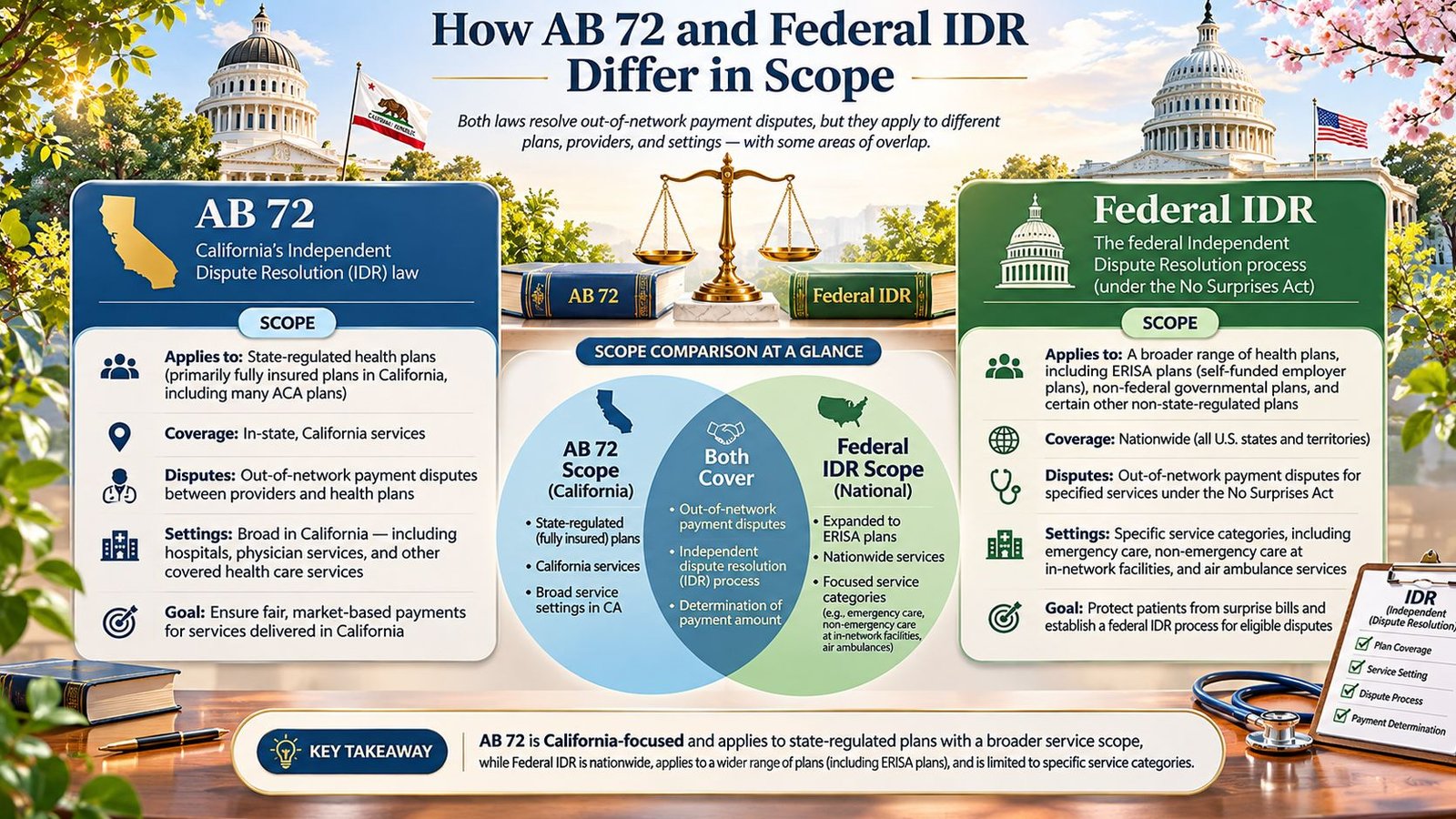
AB 72 applies to qualifying non-emergency services delivered by a noncontracting provider at a contracting facility. The patient is at an in-network hospital or surgery center, the clinician is out of network with the plan, and the payment is based on an out-of-network rate. Start with the plan's Provider Dispute Resolution process. If the plan's response is incorrect or does not arrive, the appropriate DMHC or CDI complaint route may be available.
Federal IDR has separate eligibility requirements and filing steps. First confirm that the dispute involves a qualifying out-of-network emergency service, certain post-stabilization care, facility-based non-emergency care, or air-ambulance service. Then establish that federal IDR applies to the plan and claim. Complete open negotiation before filing through the federal IDR portal within the applicable deadline. The process also requires fees and a single certified offer supported by evidence such as the qualifying payment amount, service code, complexity, provider training, and prior contracting history.
The error that costs the most money
Filing the same dispute with DMHC and through federal IDR without confirming whether the plan is state-regulated, federally regulated, or self-funded under ERISA. The DMHC 2024 annual report reports 2,214,176 provider disputes received by California full-service plans in 2024. With that volume, a complete, well-organized submission matters. Missing or misrouted records can delay review and recovery.
Office-based physical therapy and chiropractic care often fall outside the No Surprises Act. Federal protections depend on the service and setting, including emergency care, facility-based non-emergency care, and air ambulance. A routine outpatient visit should not be assumed eligible for federal IDR. The California No Surprises Act guide explains how state and federal protections overlap. The federal IDR step-by-step walkthrough outlines the portal sequence for eligible disputes.
Happy Billing's denial and appeals team is trained on AB 72 thresholds, IDRP procedures, and the 2024 AB 716 ambulance extensions. Its coders and compliance team are trained on both SB 1264 and the federal No Surprises Act.
Start by identifying which process governs the claim. The right route determines where the dispute goes and which filing steps apply.
Documents and Deadlines to Log Before You Escalate
The strength of an underpayment dispute often depends on whether the file captures the payment, the applicable rate, and each procedural date. Create one log entry per claim before escalation. That record helps the practice support its position in the appropriate forum without reconstructing the timeline later.
| Document | Why it matters | What to record |
|---|---|---|
| Explanation of payment or remittance | Shows the allowed amount and the payer's stated reasoning | Received date, allowed amount, reason codes |
| Provider contract and fee schedule | Establishes network status and the contracted rate | Effective dates, facility network status |
| Claim copy and submission proof | Supports timely filing | Submission date, acceptance report |
| Provider Dispute Resolution request | Starts the plan-level process the regulator requires | Submission date, plan reference number, 45-working-day due date |
| Plan response or non-response | Helps establish whether escalation is allowed | Response date and stated reason, or date the response window closed |
| Open-negotiation record for federal IDR | Records the step required before a federal filing | Start date, 30-business-day end date |
| Plan funding and policy documents | Identifies state or federal jurisdiction | Funding type, regulator named on the policy |
| Patient statements and balance notices | Shows whether a balance-billing problem exists | Statement dates, amounts, protections checked |
Where the log usually breaks
A remittance without the allowed amount leaves the practice without a clear figure to dispute. A claim packet without the contracted rate makes it harder to explain the gap between payment and expectation. Pull the full remittance and applicable fee schedule before sending the first letter.
Record the plan's response deadline and preserve proof of delivery. If the plan does not respond, log the date its response window closed and retain the submission record. Without that timeline, it may be difficult to show that escalation is permitted.
For practices treating behavioral health or addiction patients, confirm addiction treatment benefits early. Benefit terms can affect the allowed amount and whether the service is a candidate for a dispute. For a plan-specific deadline, check the current DMHC or CDI guidance and record the applicable date in the claim log.
Use a consistent packet structure: payment records, contract terms, claim submission proof, dispute correspondence, and a dated timeline. The out-of-network appeal package checklist lays out a format practices can adapt to their files. For balance-billing records, the No Surprises Act compliance checklist helps organize patient statements and related notices. Keeping these records distinct matters: a payment dispute and a patient balance-billing issue may require different routes, and combining them can obscure what the practice is asking the reviewer to address.
Negotiation, Appeals and When to Hold Off on IDR
Federal IDR is a narrow route, not a general appeal for any underpaid California claim. Filing before confirming eligibility can cost fees and staff time, while the plan-level dispute deadline continues to run. The CMS supplemental background on federal IDR explains that the process covers qualifying No Surprises Act items. Before filing, parties must complete a 30-business-day open-negotiation period, then submit competing offers with supporting information.
Apply four tests to each claim before choosing a route:
- Coverage type. Determine whether the plan is state-regulated, federally regulated, or self-funded under ERISA. The answer affects which remedies are available.
- Service category. Confirm whether the service qualifies under the No Surprises Act. A routine office visit generally does not enter the federal process.
- Nature of the harm. Separate an unlawful patient balance bill from an inadequate payment to the practice. They call for different remedies and may involve different regulators.
- Deadline status. Check whether the contractual provider-dispute deadline remains open. If it has expired, the practice's options and negotiating position may change.
If negotiation is the right route, send a written position rather than a general complaint. State the amount the practice will accept, cite the contracted rate, and attach comparable paid claims for the same service from the same payer. Date the letter and retain a copy. That record can also support a later regulatory complaint.
Sequencing test: A documented plan dispute resolved in six weeks can be preferable to a federal filing rejected as ineligible in four months.
Handle denials separately from payment disputes. If a claim was unfairly denied, challenge the decision with clinical evidence, including the operative note, the medical-necessity documentation requested by the payer's policy, and place-of-service details. The denial management playbook addresses worklist discipline, while the guide to appealing a denied claim covers the appeal letter.
For a potentially eligible federal dispute, send the open-negotiation notice that starts the 30-business-day open-negotiation clock before filing. Keep proof of the notice and its date, because the clock runs from the documented start of negotiations. Use the plan's dispute process when it applies, and preserve the records needed for any later route.
For every claim, establish the forum, the controlling deadline, and the evidence that preserves the practice's options.
How to File a DMHC or CDI Complaint Step by Step
A complaint is an escalation, not the first appeal. Route the claim to the right regulator only after completing the plan's dispute process, and keep the records that show when each step happened.
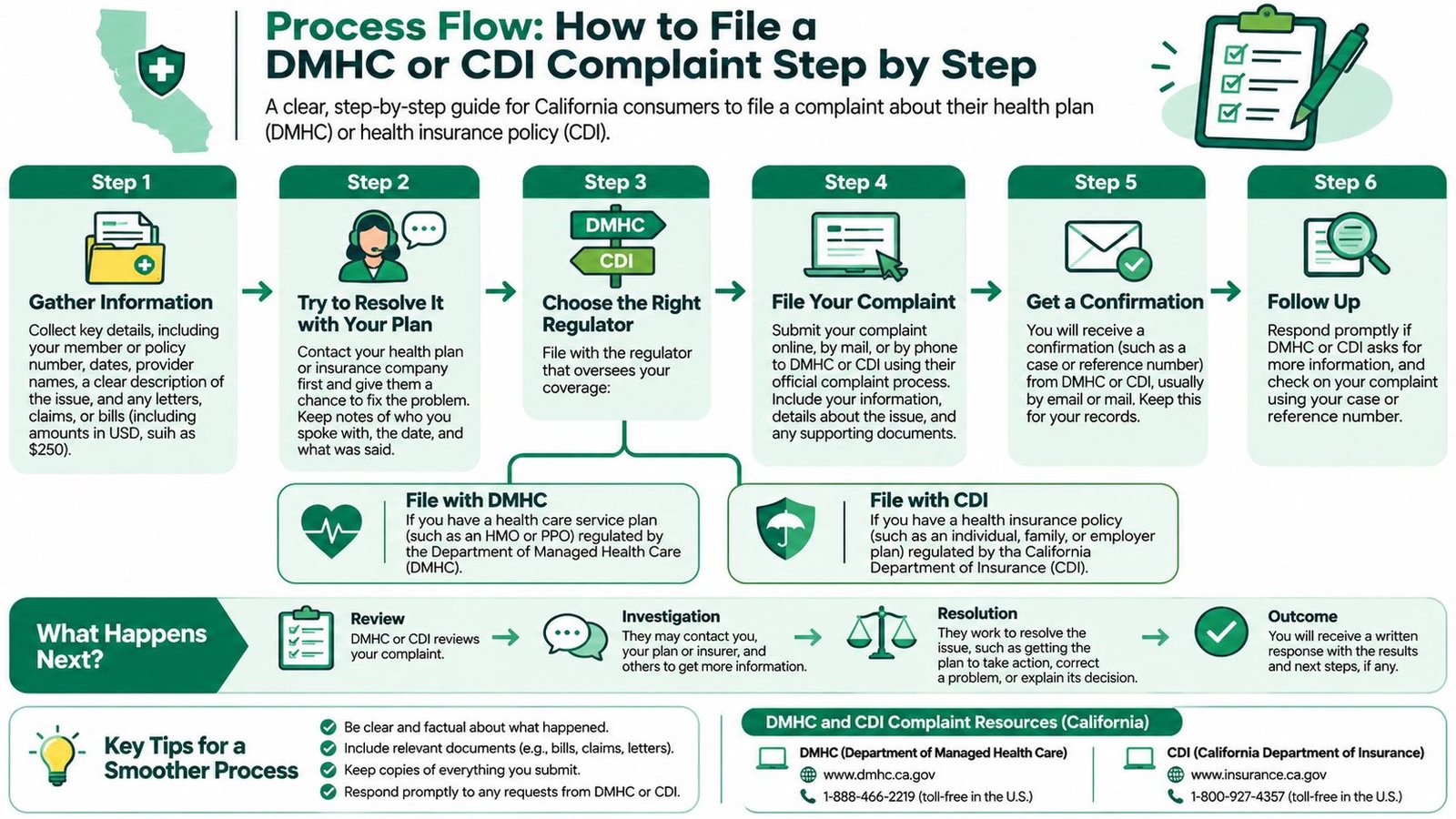
Confirm which regulator oversees the payer. Review the policy and remittance to determine whether the plan is regulated by DMHC or is an insurer overseen by CDI. A complaint sent to the wrong agency can be referred elsewhere, costing time while the dispute remains unresolved.
Submit the Provider Dispute Resolution request to the plan. Include the claim, remittance, and relevant contract evidence. The DMHC complaint FAQ explains that providers must first use the payer's own dispute process. Record the submission date and retain proof of delivery.
Log the plan's response and your next deadline. If the payer does not respond within the applicable response period, or the practice disagrees with its decision, consider whether a regulator complaint is available. Check the rules for the specific plan and dispute, and put the controlling dates in the claim log rather than relying on memory.
File with identifying details and supporting records. Include claim numbers, service and submission dates, and the amount in dispute. Select the complaint category that best fits, such as billing, claims, payment delays, authorization, or access. A clear timeline and organized attachments help the agency understand what happened without having to reconstruct the file.
Handle the CDI route directly when appropriate. DMHC may forward a complaint to CDI when CDI has jurisdiction. If the payer is known to be a CDI-regulated insurer, filing with CDI directly avoids relying on a transfer. Keep a copy of the complaint and any referral correspondence in the claim record.
Keep documentation of recurring payment issues. A complaint can concern broader plan conduct, not only one claim. When the same reduction appears across multiple claims, preserve each remittance and dispute response so the pattern is supported by records rather than a general assertion.
DMHC's Help Center handles provider complaints and reports payment recoveries, which makes the complaint route relevant to practices pursuing underpayments. That does not guarantee recovery on any individual claim. Keep the AB 72 process distinct: it applies to qualifying non-emergency services by noncontracting providers at contracting facilities, while a general provider complaint may address broader plan-payment conduct.
The filing decision should follow the claim's jurisdiction and procedural history. Happy Billing's compliance workflows route claims through the appropriate pathway, including IDR filings when payment disputes arise. A complaint package should therefore reflect the steps already taken and the specific issue still unresolved, rather than treating every underpayment as the same kind of appeal.
Run Recovery In-House or With a Billing Partner
The right recovery model depends on whether your practice can keep claim ownership, deadlines and follow-up consistent. Review how many underpaid claims arrive, how old the oldest are, which payers recur, and whether a staff member can check a deadline log every week. If no one can own that review, a written process alone will not move claims forward.
Federal IDR volume adds another operational constraint. In 2024, more than 1.46 million federal IDR disputes were initiated, more than double the 679,156 initiated in 2023, according to the Congressional Research Service. Complete documentation and timely filing matter when a practice is managing disputes alongside routine billing.
- In-house ownership: Assign a specific person, schedule weekly reviews, log deadlines for each claim, and ensure the plan dispute is filed before escalation.
- Partner support: Confirm who reviews eligibility and claims, handles denials, prepares appeal and IDR documentation, and reports billed, paid and recovered amounts.
- Before signing: Ask who assembles each dispute package, who maintains the deadline calendar, and what reporting the practice receives.
Happy Billing supports California practices remotely with end-to-end billing or alongside an existing biller. Services include eligibility verification, charge capture and certified coding, clean claim submission, denial management and targeted appeals, A/R recovery, provider credentialing and re-enrollment, and reporting dashboards. Compare the cost of outsourced medical billing with the staffing and follow-up capacity available in-house. The specialty pages describe workflows for physical therapy, chiropractic, behavioral health and surgical groups.
Routing and documentation should be settled before a partner takes over recovery. A billing partner can organize eligible claims and follow the correct process, but a dispute sent to the wrong forum can cost time and jeopardize recovery. Use this in-house versus outsourced recovery comparison to weigh internal ownership against outside support.
Book a free 30-minute call to discuss your practice's billing and recovery needs.
US practices only.
Five Questions Practice Owners Ask About Underpaid Claims
Does AB 72 apply to physical therapy or chiropractic claims?
It can apply when a qualifying non-emergency service is provided by a noncontracting clinician at a contracting facility, such as a therapist treating a patient at an in-network hospital. Office-based care may fall outside the No Surprises Act. Check the service category and identify the plan's regulator before choosing a route. If the policy does not make the plan's status clear, consult the current DMHC or CDI guidance.
Can I send the same claim to DMHC and federal IDR?
No. Confirm which regulator has jurisdiction before filing. Sending a dispute to the wrong forum can waste fees and staff time, while the deadline for the correct route continues to run. Treat routing as a decision to make before escalation, not as a reason to file everywhere.
When can I escalate after the plan responds?
A DMHC complaint may be available after an unfavorable plan response or when the plan misses its response window. Other deadlines depend on the plan and product. Check the regulator's guidance and record the applicable deadline rather than relying on memory.
Is a DMHC complaint worth filing for a small amount?
It may be, particularly when the complaint can document a recurring payment pattern rather than a single visit. Weigh the staff time against the value of recording that pattern. Outcomes vary, and a complaint does not guarantee recovery.
Should I hire a billing company or handle this myself?
Compare monthly claim volume, claim age, and the staff time your team can commit. Ask any billing partner to put its fee structure in writing and tie it to recoveries you can verify. Happy Billing recovers underpaid out-of-network claims and provides full-cycle revenue cycle management for California practices, including denial management and targeted appeals.
If unresolved California claims are sitting in the wrong queue, first identify which regulator owns each dispute and check the deadline. Happy Billing works in practices' existing EHR systems and can support recovery alongside an existing biller when that fits the practice. Visit Happy Billing to learn how its recovery process works, then bring your oldest unresolved claims to the first call.
Where this fits