Pennsylvania Out-of-network Underpayments: How Independent Practices Recover from Commercial Payers
Pennsylvania practices recover underpaid out-of-network claims through a documented payer appeal first, then through the Pennsylvania Insurance Department for state-regulated plans or federal No Surprises Act independent dispute resolution for claims that qualify. A billing partner such as Happy Billing can run that recovery on contingency alongside your current biller, starting with a free underpayment audit.
The counterintuitive part is what happens before any of those channels open. Most short payments in a Pennsylvania practice never belong in arbitration at all. Arbitration is a narrow lane for qualifying No Surprises Act claims, and everything else is a contract shortfall, a coding difference, an eligibility problem or ordinary appeal work. Treating every repriced claim as an arbitration candidate consumes staff hours on filings that get rejected, while substantial funds sit untouched in A/R. Owners usually notice it late: days in A/R drift above their normal range, the denial rate looks flat, and the net collection rate slides without an obvious culprit.
Who Recovers Underpaid Out-of-Network Claims in Pennsylvania
Three parties can move a Pennsylvania out-of-network short payment, and the practical answer is usually a combination. Your biller or billing staff owns the reconsideration and the follow-up. The Pennsylvania Insurance Department owns the complaint route for the fully insured plans it regulates. A contingency recovery partner such as Happy Billing owns the volume, the deadline calendar and the evidence file that a small billing office can't carry alongside scheduling and collections.
The federal channel explains why that division of labor matters. The federal IDR supplemental background published by CMS reports that nearly 490,000 disputes were submitted between April 2022 and June 2023, and approximately 61% were still unresolved as of June 2023. An inventory that grows faster than the certified entities can resolve it isn't a fast collection channel. It's a queue with a filing deadline attached.
What the queue costs you: an underpaid claim that misses its negotiation or filing window doesn't sit and wait. It closes, and the balance turns into a write-off nobody signed off on.
Recovering from that queue depends on four things a payer will check, and the CMS background lists the same elements: the complete record, an accurate payment comparison, the negotiation trail, and proof you filed on time. In our experience, the specialty matters less than the documentation discipline. The practices that recover are the ones where somebody owns the file from remittance to determination.
Four service lines in Pennsylvania carry most of this exposure:
- Physical therapy and rehab groups, where repricer reductions cut the allowed amount on visits already delivered and already staffed.
- Chiropractic, where high visit volume turns a small per-claim shortfall into a monthly number that funds a hire.
- Pain management, where injections and facility-adjacent services attract both repricing and medical-necessity edits.
- Orthopedics, where a single surgical case can hide a five-figure gap behind a clean-looking remittance.
Happy Billing is a medical billing company headquartered in Houston, Texas. We recover out-of-network underpayments for physical therapy, chiropractic, sports medicine and behavioral health practices, including practices in New Jersey and New York.
Pennsylvania also borders two markets where repricing cuts are widely reported, so the same payer behavior crosses state lines. Practices in New Jersey and New York see reductions that look like Pennsylvania's, and a group operating near Philadelphia or the Lehigh Valley often finds one payer behind most of the shortfall list. We serve practices in both states, which means one recovery workflow instead of three.
Start with the pattern rather than the claim. Our guide to the warning signs that your out-of-network claims are being systematically underpaid walks through the screens, and the physical therapy underpayment recovery guide covers what repricer-driven reductions look like on a therapy remittance. Our fees for recovery are contingency-only, they depend on claim age and volume, and a billing specialist gives you a clear number after a free 30-minute call. Nothing upfront.
US practices only.
Routing Each Short Payment to the Right Dispute Route
Most short payments are not IDR claims, and that single fact saves more money than any arbitration strategy. Triage before staff time gets spent, because a wrongly routed claim costs you twice: once in hours, and again in the deadline you missed while the file sat in the wrong bucket.
Screen Every Shortfall on Four Questions
- Emergency service or out-of-network clinician at an in-network facility. If neither applies, the federal path is probably closed no matter how low the payment looks.
- Service date and open negotiation timing. A qualifying claim still needs its dates checked against the payer's receipt record, not the date the claim was written.
- Expected benchmark against what the payer paid. Without a defensible expected allowed amount, there's no variance to argue.
- Whether the record supports the billed service. A weak record turns a rate dispute into a documentation dispute you lose.
Sort the result into three buckets: NSA-eligible for federal IDR, contract or appeal for ordinary shortfalls, and state complaint for fully insured plans the state regulates. Pennsylvania generated 4,409 federal IDR dispute initiations in Q3 2025 and 4,108 in Q4 2025, according to CMS independent dispute resolution reports. Those counts measure filings. They say nothing about how many underpayments occurred or what they were worth, so don't read them as a benchmark for your own volume.
Who Handles the Dispute by Plan Type
| Plan type | Primary complaint channel | Federal options | Note before filing |
|---|---|---|---|
| State-regulated, fully insured plan | Pennsylvania Insurance Department complaint, run alongside payer appeals | Federal NSA IDR for qualifying claims | State and federal rules can both apply to one claim |
| Self-funded employer plan | Federal channels only, with payer appeals | Federal NSA IDR for qualifying claims | The state insurance department generally lacks jurisdiction |
| Medicare Advantage or Medicaid managed care | Payer appeal, plus the state Medicaid agency or CMS depending on the plan | Set by the current federal filing sequence | Confirm governing rules with the payer before escalating |
The Pennsylvania Department of Insurance describes IDR as the mechanism available when a provider is not satisfied with the plan's qualifying payment amount, and its provider overview of the No Surprises Act sets out the sequence: negotiate directly with the plan, then proceed to the federally administered process if the dispute stays unresolved. The financial mechanic matters as much as the route. The patient's responsibility stays at in-network cost sharing, so the balance is a payer receivable and never a patient statement.
Pennsylvania legislative language has also contemplated a 60-calendar-day negotiation period after the insurer receives the bill and an independent dispute process for qualifying out-of-network claims, with a $500 threshold referenced in the proposed framework, per the amendment text filed in the Pennsylvania General Assembly. Proposed language is a signal of intent, not a rule you can file under today. The same text frames the practical control most practices lack: a claim-level recovery ledger that records billed charge, expected benchmark, payer adjudication, variance, appeal stage, filing deadline, documentation sent and recovered dollars.
A complaint is a regulatory channel, not a collection tool. It can change payer behavior and it can escalate a pattern, but it won't post cash to a specific claim on your schedule.
Before you escalate, confirm jurisdiction. The eligibility breakdown for self-funded ERISA plans versus fully insured plans settles which authority applies, the federal IDR process walkthrough covers filing mechanics, and the comparison of out-of-network repricing tools helps you identify which repricer cut the allowed amount in the first place.
Deadlines and Recovery Ledger for Claims Back to 2022
Claims from 2022 can still be worth reviewing, because the federal process has operated since April 2022. Each claim is limited by two things at once: its service date and the payer's own filing window. Check both before anyone spends an hour on the file. A 2022 date of service doesn't create a right to recover, and a payer's willingness to reconsider doesn't extend a statutory deadline.
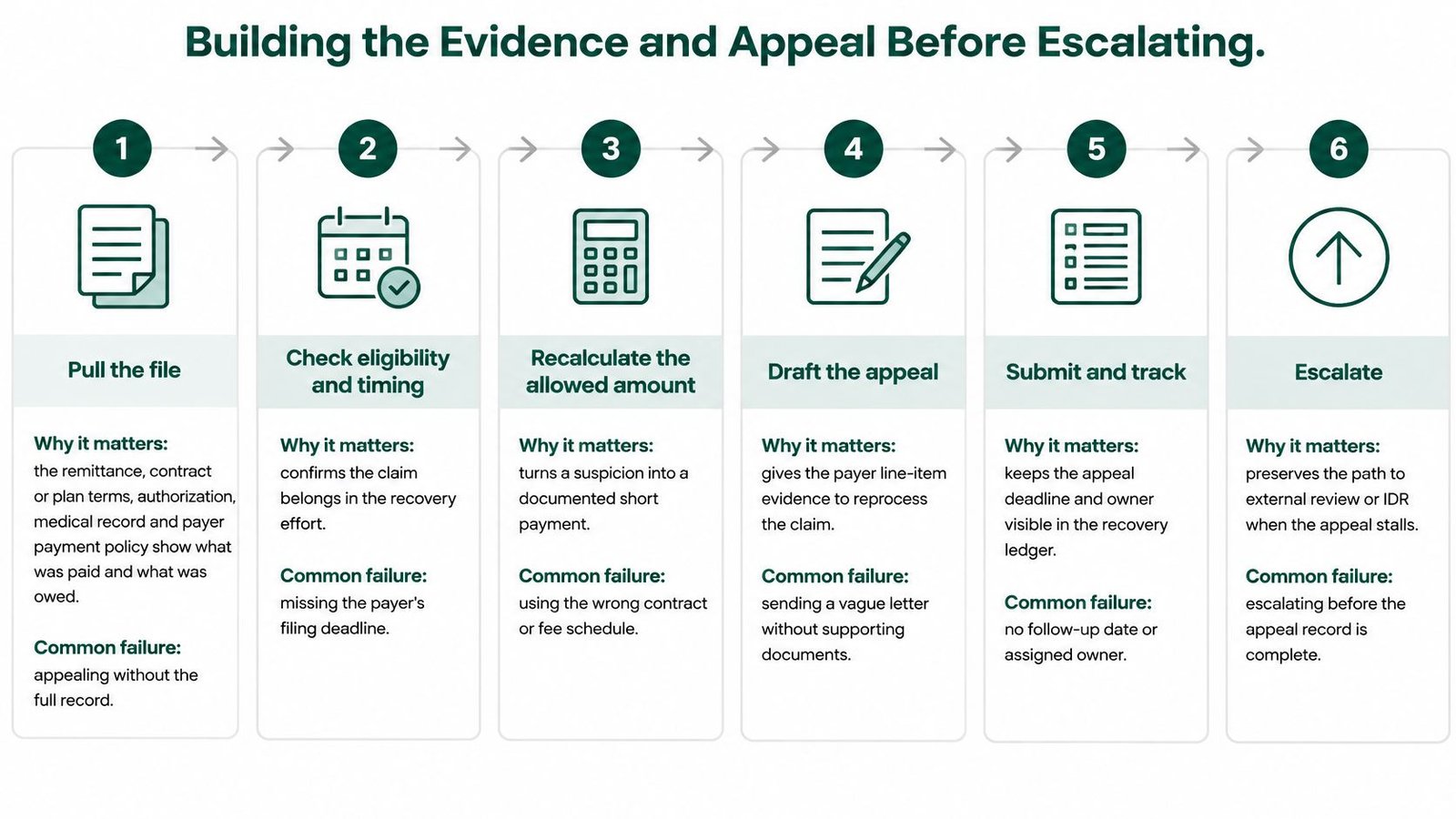
The recovery steps are the same in either direction. Pull the file, check eligibility and timing, recalculate the allowed amount, draft the appeal, submit and track it, then escalate only when the appeal record is complete.
| Requirement | Stated timing | Source status |
|---|---|---|
| Initial plan payment for qualifying Pennsylvania surprise services | Within 30 days after the plan receives the bill | Stated in Pennsylvania Insurance Department NSA guidance |
| Negotiation period in proposed framework | 60 calendar days after the insurer receives the bill | Proposed legislative language, not confirmed as law |
| Refund of excess patient payment in proposed language | Within 30 business days of receiving payment | Proposed legislative language, not confirmed as law |
| Payer appeal deadline | Per payer contract and remittance | Confirm in the payer contract |
| Federal IDR filing window | Set by the current federal filing sequence | Confirm with CMS guidance before filing |
The 30-day initial payment rule sits in the Pennsylvania Insurance Department overview for health plans, which also identifies the qualifying payment amount as the plan's required starting payment and permits the provider to negotiate when that amount is inadequate. Track a late or missing payment as a payer receivable. Don't write it off and don't shift it to the patient.
Three Ledgers, Not One
Proposed Pennsylvania language requires an insurer to follow prompt-payment rules on the applicable out-of-network amount, and it requires a provider that collects more than the permitted in-network cost sharing to refund the excess within 30 business days of receiving the payment, according to the out-of-network billing bill text. The same language bars advancing a surprise balance bill to collections. That means your underpayment program needs three separate ledgers: payer money owed to you, patient cost sharing you may legally collect, and amounts you must refund. Mix them and reported A/R inflates, compliance risk rises, and staff chase the wrong party.
The claim-level ledger is the discipline that holds it together. One row per disputed claim, one owner, one next date. Law firms run the same control through matter management controls for litigation teams, and the principle transfers directly: every open item needs a named person, a deadline and a documented next action. For the A/R side of the same work, the medical billing denial management guide shows how to stratify accounts, and our payer-by-payer breakdown of out-of-network appeal deadlines keeps the calendar honest.
Building the Evidence and Appeal Before Escalating
The strongest appeals lead with the payment calculation, not the complaint. A reviewer can check arithmetic in thirty seconds. A reviewer cannot do anything with a letter that says the payment felt low.
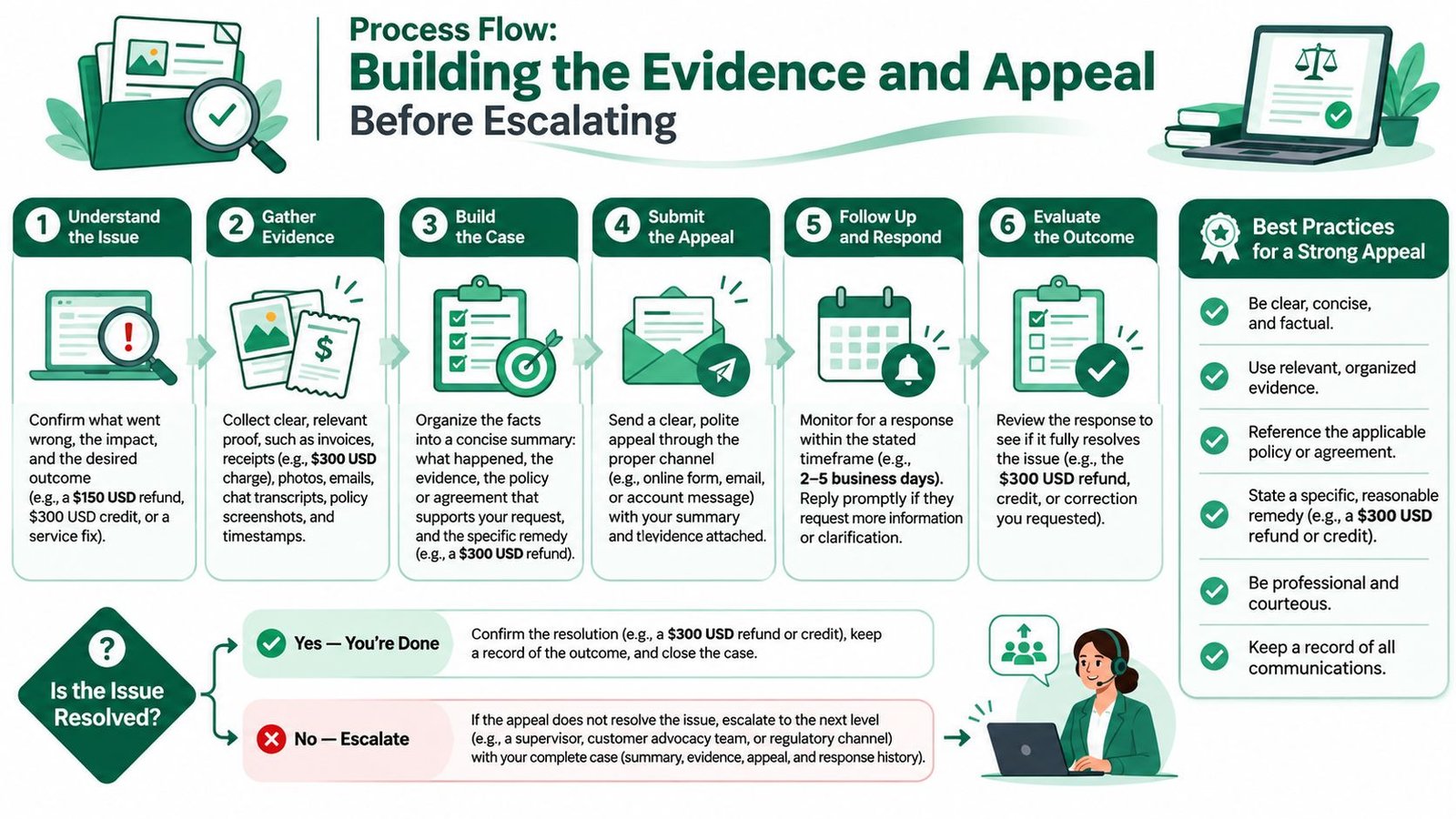
- Pull the file. Gather the remittance, contract or plan terms, authorization, medical record and payer payment policy for every disputed claim. Without them you can't prove the variance existed. The failure here is appealing a nonpayment without the remittance in hand.
- Recalculate the allowed amount. Compare what was paid against your expected allowed amount and put the number on paper. The reviewer needs to check your math and see where the gap starts. The failure is sending a complaint with no numbers attached.
- Classify the dispute. Label it contractual, coding-related, eligibility-related or NSA-eligible, because each class has a different destination and a different clock. The failure is routing every shortfall into arbitration out of habit.
- Submit the reconsideration. Send an itemized payment calculation with clinical and coding support attached. The failure is a bare request for more money with no supporting documents.
- Prove you filed, and track the deadline. Keep submission proof and put the appeal date in the claim ledger with an owner assigned. The failure is a missed deadline, which ends recovery on that claim.
- Escalate with the same file. Move unresolved eligible cases to the state or federal pathway using the identical evidence package. The failure is escalating before the payment calculation is complete.
The conversion gap between denials and formal appeals is where most of this revenue disappears. Pennsylvania's 2025 insurance transparency reporting showed individual-market plans denied 2.88 million claims in 2024, patients filed only 3,688 internal appeals, and 1,315 were overturned, per the Pennsylvania Insurance Department transparency report on ACA health plans. Only 139 external appeals were filed, with 59 overturned. Those figures cover individual-market claims and aren't a direct measure of provider recovery, but the shape of the problem carries over. Adverse decisions vastly outnumber formal challenges, and a meaningful share of challenges succeed.
Practical rule: if your practice files fewer appeals than it has unexplained adjustments, the problem isn't the payer. It's the follow-through.
Our team audits historical claims to identify and recover under-reimbursed amounts, and the audit is usually where owners discover why the file felt thin: the payment calculation was never written down. For mechanics, the guide to appealing a denied insurance claim covers the letter and the escalation ladder, and the out-of-network appeal package checklist keeps documents from going out half-built. Public adjusters solve a structurally identical problem when they fight a low storm damage settlement: document the loss, dispute the valuation with evidence, then escalate. Same logic, different policy.
Deciding Whether to Recover In-House or With a Partner

The decision starts after sorting. Count only the short payments that clear the eligibility screen, then group them by plan type and service line. A list dominated by ordinary contract shortfalls points to payer appeals and contract language. A cluster tied to a fully insured Pennsylvania product points toward the state complaint route. Eligible, well-documented outliers may justify federal IDR. If nobody can make that split before filing, volume is not the problem.
Use three tests. First, how many qualified short payments appear each month? A handful is an internal project; a few dozen is a staffing problem. Second, how many hours does the work pull from cash posting, ERA and EOB posting, and denial follow-up? Third, after escalation, is each claim owned by a named person with a next action and a date?
A multi-provider therapy group may find its underpayments clustering in two payers and one plan type. If one bucket belongs on a fully insured complaint track and the rest are straight appeals, filing every claim the same way wastes the strong files. The owner question is whether the team can keep those lanes separate every week.
Keep recovery in-house when the monthly list is short, the ledger is complete, and deadlines are not slipping. Bring in a partner when the list is long, appeal work is displacing posting, or no one can name the next action on a given claim.
Happy Billing runs end-to-end billing and recovers underpaid out-of-network claims for US practices. For the cost side, the breakdown of outsourced medical billing costs and the in-house versus outsourced underpayment recovery comparison show what each model absorbs.
US practices only.
Owner Questions About Pennsylvania Recovery
Can a state complaint fix a claim from a self-funded employer plan?
Usually, no. The Pennsylvania Insurance Department regulates insurers, and self-funded employer plans usually sit outside that jurisdiction, so federal channels and payer appeals carry the claim. Confirm funding status before using the complaint form, because it changes the route.
Are claims from 2022 still worth reviewing?
Sometimes. Check each service date against the federal process start in April 2022 and the payer's filing window, then decide claim by claim. Some 2022 files remain worth a close look. Others are closed by the calendar, not by payer discretion.
Should we send every underpayment to IDR?
No. Most ordinary shortfalls are appeal or contract matters. Arbitration fits eligible, high-value claims with clear payment evidence behind them. Filing weak cases costs money and buries the strong ones.
Do we pay anything upfront to have a partner recover claims?
Happy Billing's model costs 30–40% below what most practices spend on in-house billing when full staffing costs, software subscriptions, and revenue lost to uncoded or unworked denials are counted. A billing specialist gives you a clear number after a free 30-minute call.
Can a partner work alongside our current biller on recovery only?
Yes. Recovery can run alongside your existing biller, and credentialing can stay wherever it works today. You do not have to replace a billing relationship to fix a recovery gap. Happy Billing audits historical claims to identify and recover under-reimbursed amounts, then routes each claim by eligibility and plan type so ordinary contract shortfalls do not get treated like IDR cases.
The fastest way to see which claims are worth pursuing is a free underpayment audit, because it turns a suspicion into a list with dollar figures on it.
Happy Billing is headquartered in Houston, Texas, and works with independent practices across the country on out-of-network underpayments and No Surprises Act claims. We can run billing end to end or handle recovery alone alongside your current biller. Start by visiting Happy Billing and booking a free 30-minute call with a billing specialist.
US practices only.
Where this fits