Out-of-network Appeal Deadlines by Payer: How Long You Have to Dispute an Underpayment (Cigna, Aetna, Unitedhealthcare, BCBS)
There's no single national appeal deadline for out-of-network underpayments. The window is set by the payer, the plan, the state and the provider contract, and you have to read it from the EOB, plan document or provider manual for that claim.
That surprises owners who expect one number they can put on a wall chart. In practice, two claims paid by the same logo on the same day can run on different clocks, and the claim that looks safest in A/R is often the one closest to becoming unrecoverable.
Why the Appeal Window Decides What You Recover
An underpayment that passes its window isn't a delayed payment. It's margin you've already earned that sits in A/R, inflates your days in A/R, and eventually gets written off as if the payer's low allowed amount was correct. The clinical work is done. The coding is done. The only thing left is whether you preserved your right to dispute the math.
Happy Billing is a Texas-headquartered billing company that recovers underpaid out-of-network claims, including for practices in New Jersey and New York.
The same sequence plays out in independent practices again and again. The remittance posts, someone notes that payment looks low, and the account sits while staff work newer denials. The clock on that dispute usually runs from the payment or adjustment date, not the date of service, so a claim can look comfortably aged on the report while its appeal window is nearly gone. By the time an owner asks about that payer's underpayment pattern, the oldest and often largest variances are the hardest to reopen.
Deadline know-how decides which dollars are still real. Out-of-network appeal deadlines by payer, meaning how long you have to dispute an underpayment with Cigna, Aetna, UnitedHealthcare and BCBS, separate recoverable revenue from numbers that only exist on an aging report. And when the insurer's own review drags out the response, the window keeps running, which is why slow answers cost practices more recoverable money than outright denials do.
A paid claim can still be wrong. Payment closes the payer's process, not your right to challenge it, but only inside the window that governs that claim.
Book a free 30-minute call
US practices only.
Appeal Deadlines by Payer at a Glance
Deadlines vary widely by plan, state and contract, so this reference shows what starts the clock and where to confirm it rather than a fixed day count you could apply blindly.
| Payer | What starts the clock | Where to confirm it | Variations to check |
|---|---|---|---|
| Cigna | Initial payment, denial notice or last payment adjustment | EOP and Cigna provider appeals guidance | Out-of-network filing limit runs from date of service and is separate; Medicare products follow their own period |
| Aetna | Initial claim decision, then reconsideration, then a separate appeal step | Aetna provider disputes pages and member plan document | State exceptions for California HMO, North Carolina, Oregon, Rhode Island and Texas situations |
| UnitedHealthcare | Set by the provider manual and contract for the specific legal entity | UHC provider manual, provider agreement and EOB | Product, funding arrangement and state |
| BCBS (local Blue plan) | Set by the Blue plan that paid the claim | Plan provider manual, EOB and member card | Blue companies administer products through affiliates; plan name and state decide the rule |
For Cigna, the critical distinction is that a payment dispute and the original out-of-network claim filing limit are different clocks. The Cigna provider appeals and disputes guidance treats payment decisions and payment reductions as appealable, and it ties the review to the payment or a later adjustment. Don't let staff close a Cigna underpayment because the original claim was filed on time. Timely filing gets the claim processed. It doesn't protect the underpayment.
For Aetna, the trap is sequence. The process can involve an initial dispute, a reconsideration decision, and then a separate appeal step, each with its own deadline under the Aetna provider appeals guidance. If your team calendars only the first date, you'll miss the second. State exceptions can also change the answer materially, which is why the member's product and state belong on the work queue, not in someone's memory.
UnitedHealthcare and BCBS require the most verification because there's no single number you can safely borrow from another practice. With UnitedHealthcare, the legal entity, product and provider agreement control. With BCBS, the local Blue plan that paid the claim controls, and that plan may not be the brand your front desk recorded at intake.
Before you calendar anything, compare how each payer repriced the claim in the first place. Our comparison of how Aetna, Cigna and UnitedHealthcare reprice out-of-network claims helps you identify whether you're disputing a pricing method, a benefit calculation, or a plain processing error.
One check prevents a common waste of time. If the payer name on the EOB doesn't match the member card, verify the administrator first. Filing a well-built appeal with the wrong entity doesn't stop the right entity's clock.
Why the Payment Date Starts the Clock
Owners often count from the date of service or from the day someone first noticed the short payment. Both dates feel logical. Neither is the date most payment-review rules use, and counting from discovery is especially dangerous because your discovery date has no standing with the payer.
Two clocks on the same claim
For many payer review rules, the clock generally starts from the initial payment or denial notice. When a later adjustment changes the payment, that adjustment can restart the period for disputing the new result. The Cigna claim submission guidance illustrates the separate track. Its out-of-network filing limit runs from the date of service, while the post-payment dispute runs from the payment event. You can satisfy one clock and lose the other.
Deposited claims create the same confusion. The remittance deposit date is evidence you should keep, because it proves when money and the EOP reached you. It isn't automatically the controlling date. Confirm in the contract and provider manual which date the payer treats as controlling, because payers don't all use the same one.
ERISA adds a federal layer for employer plans. In plain terms, participants and their authorized providers have appeal rights under the plan, and the plan document defines the procedure and steps. The administrator's standard letter doesn't replace that document. If the plan gives you a defined appeal sequence, following the payer's generic portal prompt instead can leave a required step undone.
Track these dates separately in your system for every underpaid claim.
- Date of service
- Original submission
- EOB or EOP date
- Payment date
- Adjustment date
- Payer receipt date
Our notes on UnitedHealthcare timely filing limits show why filing and appeal dates need separate fields even inside one payer. Record the governing date when the EOB posts, not when you get around to reviewing low payments. Each missed day moves earned margin closer to write-off, and high-value codes feel that fastest. A short-paid surgical, therapy or behavioral health claim doesn't become less recoverable clinically over time. It becomes less recoverable administratively.
Situations That Change the Default Rule
A payer default is a starting point for research, not the controlling rule for every claim that carries that payer's name.
| Situation | Why it changes the clock | Where to confirm |
|---|---|---|
| Self-funded employer plan under ERISA | Federal law sets participant and provider appeal rights; the plan document sets procedure | Summary plan description and EOB |
| Fully insured plan regulated by a state | State insurance law can extend or shorten the window | State insurance rules and EOB |
| Medicare Advantage product | Federal rules and product-specific appeal forms apply | Payer product notice and EOB |
| Medicaid managed care plan | State Medicaid contract and managed care organization rules apply | Plan provider manual |
| Facility-based out-of-network services | Network status can come from the facility, affecting appeal rights | Provider agreement and payer notice |
| Surprise-billing protected claim | A federal or state dispute track can run alongside or instead of the ordinary appeal | CMS and state dispute guidance |
| Audit-related underpayment | Separate notification rules can apply | Payer audit letter and contract |
Funding decides which law is in the room
A self-funded employer plan under ERISA, a fully insured plan regulated by a state, a Medicare Advantage product and a Medicaid managed care plan each draw on different legal sources. The Aetna disputes and appeals overview shows how state and status-based exceptions sit alongside a payer's general process, including special Texas situations involving emergencies, network inadequacy and hospital-based physicians. That's why a front-office note that says only the payer name isn't enough to calendar a deadline.
Facility-based services deserve separate attention. In anesthesiology, emergency medicine and other hospital-based specialties, out-of-network status can come from the facility arrangement rather than the physician's deliberate choice not to participate. That origin can affect which protections and appeal rights apply. For how these arrangements play out by specialty, use our specialty billing guidance to find the rules that match your practice type before you assume a commercial default fits.
Surprise-billing protection creates another fork. A protected claim can run on a federal or state dispute track alongside or instead of the ordinary appeal, and entering one track doesn't automatically preserve the other.
Write the governing source beside the deadline in the practice record. The next person who touches the claim shouldn't have to repeat the legal check while the clock is running.
How Insurer Delays Push Claims Past the Window
A payer rarely has to deny an underpaid claim to kill it. It only has to review the claim slowly. A status of in process feels safe because the account looks alive, but a pending review does not stop the calendar, and a status call is not a filed appeal unless the payer or your contract says so in writing.
Delays arrive in predictable forms. The payer requests records you already sent. A review runs past the timeline quoted on the phone. A reprocessing letter arrives with a new payment result and no clear statement on whether a fresh dispute period applies. Each event burns days while producing nothing you can later submit as proof of a timely appeal.
Underpayments often sit in payer review for most of their window while the account still looks active. The owner assumes the payer is working it, so nobody files a protective written dispute. On the aging report that reads as progress. On the calendar it is exposure, and it is the single most common way recoverable underpayments die.
The countermeasure is a routine that doesn't depend on payer reassurance.
- Calendar the earliest deadline from each payment or adjustment date the moment the EOB posts, since an underpayment can age out while a reprocessing request is still pending.
- Log every status call with the representative's name, the reference number and the exact commitment made, so a verbal promise becomes a dated record.
- Escalate in writing if no written decision has arrived by the midpoint of your window. I treat the halfway point as the hard stop. The written filing ends any argument about timeliness; the phone log alone never will.
If you can't produce a dated submission receipt, you don't have an appeal in progress. You have a conversation.
The write-off that follows a quiet review period doesn't reflect the value of the care. It reflects a calendar nobody owned, on revenue the practice already earned by treating the patient.
How to Verify Your Deadline and Preserve Proof
Verification is cheap when the EOB is fresh and expensive when you reconstruct it months later. Work these steps in order, and assign each claim a named owner.
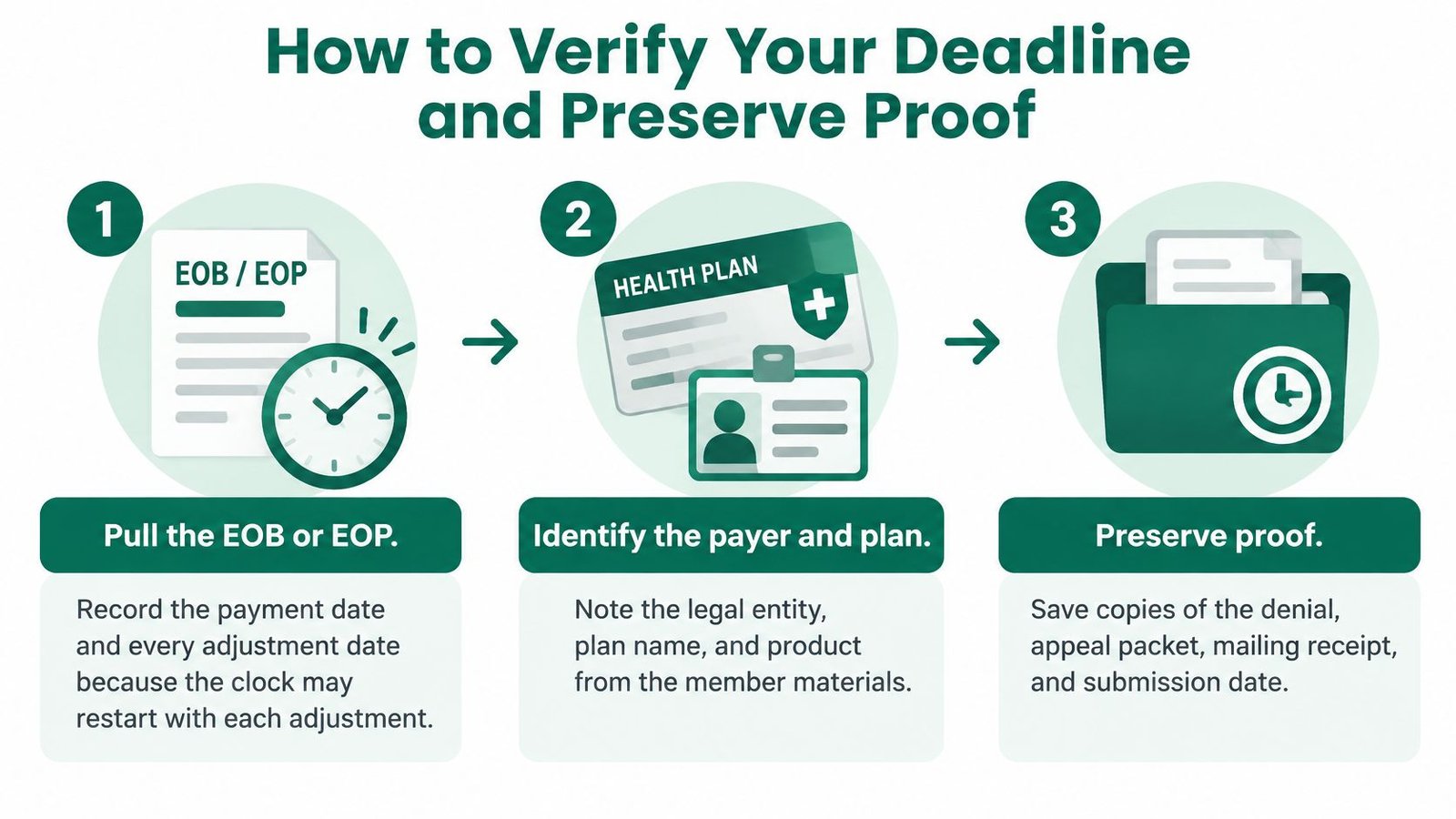
Pull the EOB or EOP and record every payment and adjustment date. The clock may restart with an adjustment, so a single payment date can misstate your deadline and cause you to abandon a live claim or file late on a revised one.
Identify the legal entity, plan name and product from the member card and EOB. The same payer brand can run different rules for each product, and an appeal sent under the wrong plan's rules can be rejected without anyone reviewing your pricing evidence.
Find the appeals section in the provider manual and your contract. Note the exact wording for reconsideration, formal appeal and corrected claims, because payers treat those routes differently and choosing the wrong one can burn your only window.
Check state law and product type for extensions or exceptions. A fully insured plan, Medicare product or state-specific rule can help or hurt you, and skipping this check means you're budgeting recovery on a deadline that may not exist.
Calendar the earliest deadline and the next required step. Put both in the practice system with a responsible owner, not in a spreadsheet one employee controls. Unowned deadlines are how recoverable A/R becomes an adjustment code.
Save proof of submission. Keep the portal confirmation, certified mail receipt and payer reference number with the claim. Without proof, a payer denial for late filing becomes your word against its intake log, and that dispute rarely ends in payment.
Attach the supporting documentation to the original claim record and the appeal. Include the EOB and relevant operative reports or medical records that support the CPT codes and modifiers as billed. Don't alter claim fields to make a resubmission look new. That creates a compliance problem on top of an underpayment problem.
What a clean packet protects
Say a physical therapy claim for CPT 97110 and CPT 97140 posts at an allowed amount well below the plan's stated out-of-network method. The financial question isn't whether the codes were documented in the chart. It's whether your packet connects the visit notes, units, billed charges, EOB math and plan language clearly enough that a reviewer can approve a specific additional amount. Vague complaints about low payment get vague denials.
Use our out-of-network appeal package checklist and template for providers to keep the EOB, calculation worksheet, plan excerpt, clinical support and submission proof in one reviewable sequence. A complete packet also shortens follow-up, because the payer can't pause your recovery with routine requests for records that should have traveled with the appeal.
What Older Underpaid Claims Can Still Recover
Some older claims are still recoverable. Whether a backlog claim qualifies depends on the governing rule for that plan, product and state, not on how old the service date makes it look, so don't write off an entire aging bucket just because the ordinary window appears closed.

A claim past one payer's default period isn't automatically dead. It may sit under a longer state period, a plan document with a different appeal sequence, or a later payment adjustment that created a new dispute event and restarted the relevant clock. The opposite is also true. A claim that looks young by service date may already be old by payment date, which is why backlog triage sorts by the posting and adjustment dates rather than the date of service.
Triage in this order.
- Sort by dollar variance and payer so staff time goes to recoveries that can move monthly collections, not to the oldest small balances first.
- Flag claims with an open adjustment or unresolved appeal, because an unfinished payer action can change which date controls and may leave the dispute window open longer than the A/R report suggests.
- Separate claims past the ordinary window and test each against state, plan and product exceptions before classifying it as lost.
Once the list is sorted, look for patterns. Underpayments in backlog tend to cluster under one payer, one repricing method or one contract year, and that clustering works in the owner's favor. One well-documented dispute logic can support a batch of similar claims, which keeps recovery economically worthwhile even when individual therapy or chiropractic variances look modest.
Happy Billing's A/R recovery work identifies the claims in scope, the variance on each, the governing rule and the order worth pursuing, including claims that are 60, 90 or 120-plus days past due. Our tactical guide on how to reopen a deposited underpaid claim explains how deposited status affects that work, and our physical therapy underpayment recovery guide covers the broader recovery process for practices where repeated unit-based underpayments accumulate over time.
Internal Appeals Versus Federal and State Dispute Tracks
Start with one routing question. Is the claim protected by federal or state surprise-billing rules, and does the payer's notice name a specific dispute process? The answer determines whether an internal appeal is the main route, a parallel step, or the wrong door entirely.
An internal reconsideration or appeal asks the payer to correct its own payment decision under the plan and provider manual. A provider dispute or negotiation may focus more directly on the pricing method and the dollar amount. Both depend on preserving the payer's deadlines and supplying the EOB, plan language and calculation evidence. For self-funded plans, our guide to ERISA appeal rights for out-of-network healthcare providers helps you separate the administrator's process from the rights created by the plan itself.
Federal IDR is different. For protected out-of-network disputes, the CMS No Surprises payment dispute guidance requires an open negotiation period before a party can initiate the federal process, and that sequence has its own strict timing. IDR isn't a substitute for an internal appeal unless the rules for that claim make it one, and waiting for an internal reviewer can cause you to miss the federal track.
State arbitration programs, where they exist, sit beside that federal route for plans the state can regulate. Complaints to a state insurance regulator serve another purpose. They can prompt the payer to explain its process and create a record, but they don't automatically pause an appeal or IDR deadline.
Use our federal IDR process guide for providers for the federal sequence and our No Surprises Act compliance checklist to confirm whether a claim belongs in that system. Choosing the wrong route can waste the one window the practice has, so route the claim before you write the appeal letter.
Build Your Deadline Calendar Before the Next Payment Run
Before the next payment run, list every open underpayment, assign the governing rule to each, put the earliest deadline on the team calendar and choose the dispute route for each claim. Most practices can complete that inventory in one working session with the EOBs in hand. Two dates belong on every line: the payment or adjustment date that starts the appeal clock, and the date of service that controls the filing limit, because the two windows run independently. If your current tracking lives in scattered notes, build a deadline management system that gives every claim a visible owner and due date.
A deadline without an owner slips. Insurer review delays are the most common reason recoverable underpayments die on the calendar, so pair each date with a reminder well before the window closes rather than relying on the payer's status notes. If you're weighing outside help, review what outsourcing medical billing costs before you commit internal payroll to months of payer follow-up.
Happy Billing runs end-to-end billing and recovers underpaid out-of-network claims, and our Old A/R Recovery service pursues unpaid claims older than 90 days, including balances sitting 60, 90, or 120+ days past due.
Book a free 30-minute call to review your open underpayments and the deadlines still left on them.
US practices only.
Common Questions About Appeal Deadlines
How long do I have to appeal an underpaid out-of-network claim?
There's no single number, so read the window from the EOB, plan document or provider manual for that claim. Record who verified it and when, because that note prevents a later staff change from resetting your process to a generic payer assumption.
Does the clock start on the date of service or the date we were paid?
Payment-review windows generally run from the payment, denial notice or latest adjustment, while the out-of-network filing limit runs separately from the date of service. Check both dates on every claim, since satisfying the service-based filing rule doesn't preserve the payment-based dispute.
Can we still recover underpayments from 2022?
In many cases, yes, depending on open adjustments, unfinished appeals and the governing state or plan rule. A free underpayment audit sorts which claims qualify and ranks them by recoverable dollars, so you don't spend equal effort on dead claims and live ones.
What if the insurer keeps the claim in review past the deadline?
A pending review doesn't stop the calendar unless the payer or contract says so in writing. Send a written escalation before the window is half gone, keep the reply with your submission proof, and file a protective dispute if the written decision still hasn't arrived.
Do we need a lawyer to dispute an underpayment?
Most internal appeals are handled by the billing team with the EOB, plan terms and pricing evidence. Complex ERISA, federal IDR or state arbitration matters may justify counsel, and the free 30-minute call can confirm which route fits before you pay legal fees to answer an administrative question.
If underpaid out-of-network claims are aging while your team waits on payer reviews, Happy Billing can audit the backlog, identify each governing deadline, and pursue the claims that are still recoverable. Book a free 30-minute call with a billing specialist to see which dollars remain within reach before another payment run turns them into write-offs.