Chiropractic Billing Company in New Jersey: What Owners Should Ask Before Hiring One
Most of what you'll read about hiring a chiropractic billing company in New Jersey measures the wrong things. A headline clean-claim percentage and a fee per claim tell you nothing about whether cash arrives. Hire a partner that can prove it collects on New Jersey commercial plans, NJ FamilyCare managed care and repriced out-of-network claims, and that reports the result claim by claim.
The arithmetic is simple. A visit that gets denied or repriced down is a service you already delivered and already paid staff and rent to produce. Every one of those that nobody works is revenue gone, and it surfaces in days in A/R long before it surfaces in your bank account.
This is a hiring checklist, not a coding tutorial. You'll leave with a scorecard to fill in before the first sales call, a map for routing a New Jersey dispute to the right venue, and questions that force a vendor to show evidence instead of adjectives.
Why Your Billing Partner Sets Your New Jersey Collections
A chiropractic billing partner earns its fee through cash recovered, not claims sent. In New Jersey, that means tracking collections across commercial plans, NJ FamilyCare managed care and out-of-network claims, then showing the result at the claim level.
Happy Billing provides full-cycle revenue cycle management for New Jersey physician groups, from NJ FamilyCare MCO credentialing and prior authorization through charge capture, claim submission, denial management and patient collections. Its team also handles out-of-network underpayment recovery and No Surprises Act federal IDR claims.
Cash can go missing after a claim is submitted. A remittance may show a lower allowed amount than expected, or a service may be denied for a missing authorization. In both cases, the practice needs a clear record of what was billed, what was paid, what remains outstanding and who owns the next action.
Practical rule: Ask a billing partner to report collected dollars against allowed amounts by payer. A fast submission process does not prove that underpayments were identified or pursued.
Claim submission and underpayment recovery require different work. A partner must submit accurate claims, then review remittances, identify shortfalls and follow the appropriate dispute route until the balance is resolved or closed with a documented reason.
Happy Billing serves practices throughout New Jersey and offers a free revenue audit on request. Practice owners can also book a free expert call through the website.
US practices only.
The Vendor Scorecard to Build Before You Meet Anyone
A polished proposal does not show whether a billing partner can explain where unpaid dollars are stuck. Ask each finalist to trace a sample balance from claim number to payer, assigned owner, next action, and final disposition. If the vendor cannot show that chain, do not assume its reports will tell you where cash is going.
Build the scorecard before the first call. Use the same requests and standards for every finalist.
| Criterion | What to request | Red flag |
|---|---|---|
| New Jersey payer workflow | Written process for NJ FamilyCare MCO credentialing, provider identifier checks, and authorization tracking | Generic chiropractic template with no named New Jersey payers |
| Out-of-network and repricer handling | Monthly allowed-versus-billed report by payer and repricer | Cannot say what a repriced claim paid or why |
| Denial and A/R reporting | Denials by payer and reason, days in A/R, aging over 90 days, and write-offs | One blended clean-claim figure only |
| Underpayment recovery evidence | An anonymized workflow showing detection, appeal ownership, and status through resolution | Recovery promised with no escalation timeline |
| Security controls | Practice-specific BAA, role-based access, multifactor authentication, encryption, and incident-response plan | “HIPAA compliant” with no documents to show |
| Scope and EHR fit | Partial, full, or single-location scope; works in your current EHR; can keep your current biller | All-or-nothing transition with no scope limits |
| Fee basis | Written fee terms, including whether fees apply to gross or net recovery | Vague or unwritten terms |
Where the security question belongs on the scorecard
Treat the business associate agreement and documented security controls as financial-risk controls. The U.S. Department of Health and Human Services received 663 reports of breaches affecting 500 or more individuals in calendar year 2024, and those incidents exposed approximately 242.9 million individuals, according to the HHS breach report to Congress. Ask whether the vendor signs a practice-specific BAA, limits access by role, uses multifactor authentication and encryption, and maintains written incident-response procedures. Get a clear answer on who pays notification and forensic costs if an incident occurs.
Scope and EHR fit
Happy Billing can manage billing end to end or work alongside an existing biller, including partial outsourcing for one specialty or location. Credentialing is separate from billing, so your current biller can stay for the work you want to keep. The team works in your existing EHR and integrates with eClinicalWorks, Athena Health, EPIC, NextGen, ModMed, and other systems. See how the chiropractic medical billing workflow fits into practice operations.
Screen every vendor for process, references, and evidence of what changed. A hiring guide for NYC small businesses makes a broader case for asking service providers specific questions before signing.
How In-Network and Out-of-Network Mix Changes the Hire
Out-of-network chiropractic claims rarely pay what you billed, and the cause usually isn't a denial. It's a repriced allowed amount applied by a repricer such as Data iSight, MultiPlan or Zelis before the payment ever reaches you. The remittance shows the reduced figure and the statement shows only a residual patient balance, so the gap never becomes a question, let alone an appeal.
Say a practice with a heavy personal injury and out-of-network mix watches visits pay well below charges for two quarters. Nobody compares the payment against the expected rate, nobody requests the repricing logic, and the write-off is recorded as a contractual adjustment. That is cash leaving the building with a signature on it.
Here's the desk where the gap gets found.
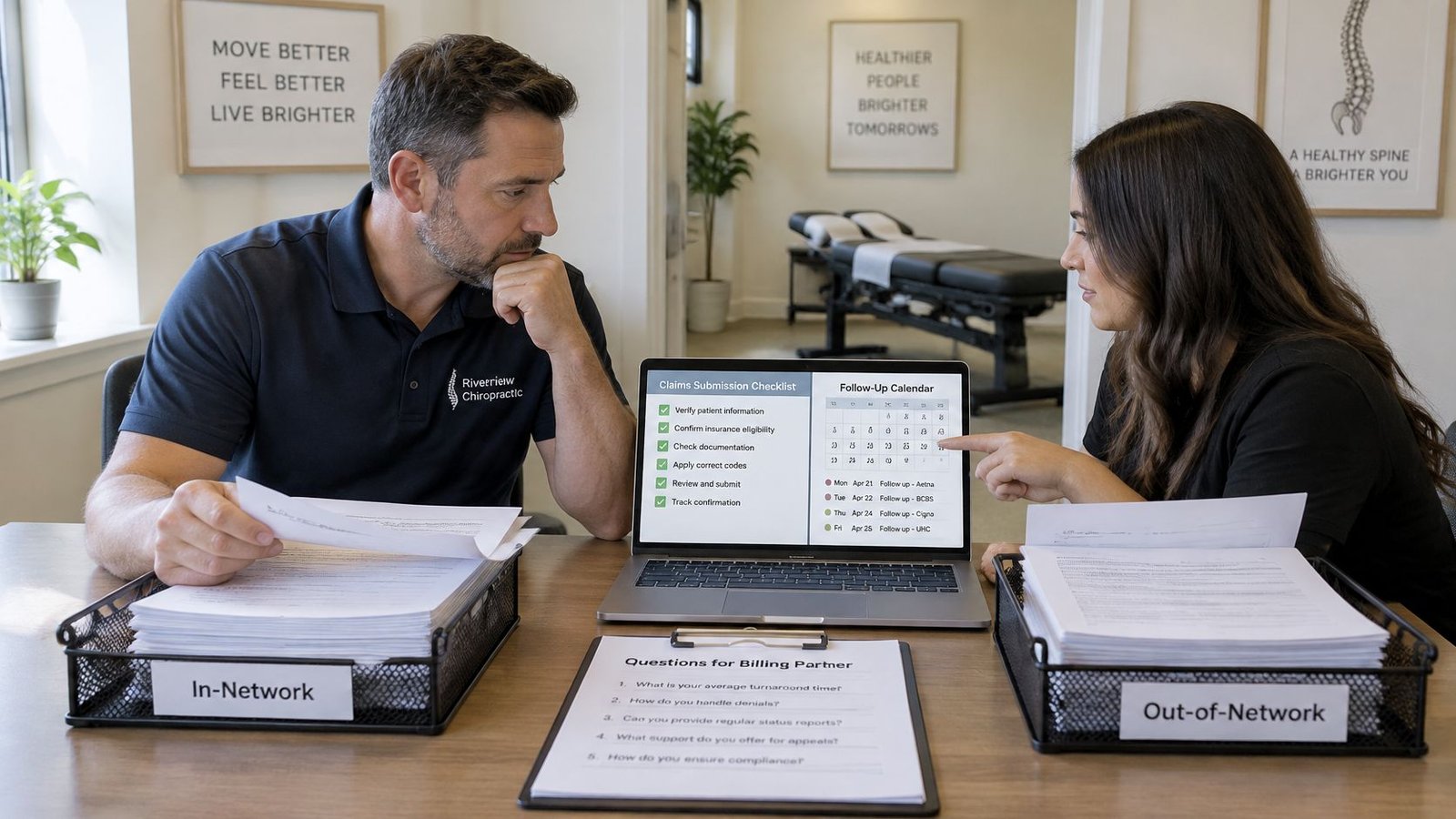
You can run the check yourself this quarter, and it takes an afternoon.
- Split last quarter's visits into in-network and out-of-network, by payer.
- Pull the remittances for every out-of-network visit, not the summary report.
- Compare each paid amount with the contracted rate or your benchmark expectation for that service.
- Ask the vendor who reviews every gap, how often, and what happens to the ones they can't resolve.
For the mechanics of how repricers set those allowed amounts, our guide to out-of-network repricing tools for practice owners covers the machinery. What matters here is what you demand to see, not how the calculation runs. The same is true for therapy codes billed alongside manipulation in chiropractic offices: if you're billing 97140 with a manipulation, know what payers should pay for 97110 and 97140 out of network before you accept a reduced figure as final.
What you should expect back from any candidate vendor is one page: a gap list by payer and repricer, with dollars attached, that someone can work from. A company that can't produce that list on your own claims isn't recovering anything.
Claim Submission and Underpayment Recovery Are Different Jobs
Claim submission gets money to the payer. Underpayment recovery gets the missing difference back. Those are different skills, different staff, different deadlines and different reporting, and a company that's good at one is often not built for the other.
| Stage | Claim submission | Underpayment recovery |
|---|---|---|
| Trigger | Claim is ready to send | Paid amount is below the contracted or benchmark expectation |
| Main document | Charge, codes and claim form | Remittance (explanation of benefits) compared with the contract or benchmark |
| Who decides the outcome | Payer adjudication | Negotiation, state arbitration or federal IDR |
| Deadlines | Timely filing limits | Open-negotiation and IDR submission windows |
| Money at stake | Original charge | Incremental amount above what was paid |
| Vendor report | First-pass acceptance and clean-claim rate | Recovery rate, days to resolution and recovered dollars by payer |
Ask for the escalation process in writing. It should start with eligibility screening, move to a remittance comparison against the contracted or benchmark expectation, then to open negotiation, evidence assembly and submission controls with dates attached. A vendor that mails statements and calls it recovery has built no escalation process at all.
The volume explains why this is now a discipline of its own. More than 1.46 million federal IDR disputes were initiated in 2024, more than double the 679,156 initiated in 2023, and New Jersey was among the seven states accounting for more than 70% of disputes involving out-of-network emergency or nonemergency services, according to the Congressional Research Service report on NSA dispute resolution. The same report notes the process initially reached payment determinations in only 8% of submitted disputes, which is the strongest argument for eligibility screening before anyone files.
Three money questions belong in this section and nowhere else. Who pays filing or administrative fees? Who holds settlement authority when an offer arrives? Do recovery fees apply to gross collections or to net incremental recovery?
The test that matters: not how many disputes a vendor filed, but how many became cash.
For the procedural steps, our walkthrough of the federal IDR process for providers covers what has to happen and in what order. Then demand four numbers: recovery rate, average days to resolution, dismissal or ineligibility rate, and recovered dollars by payer.
Which New Jersey Dispute Route Fits Each Plan
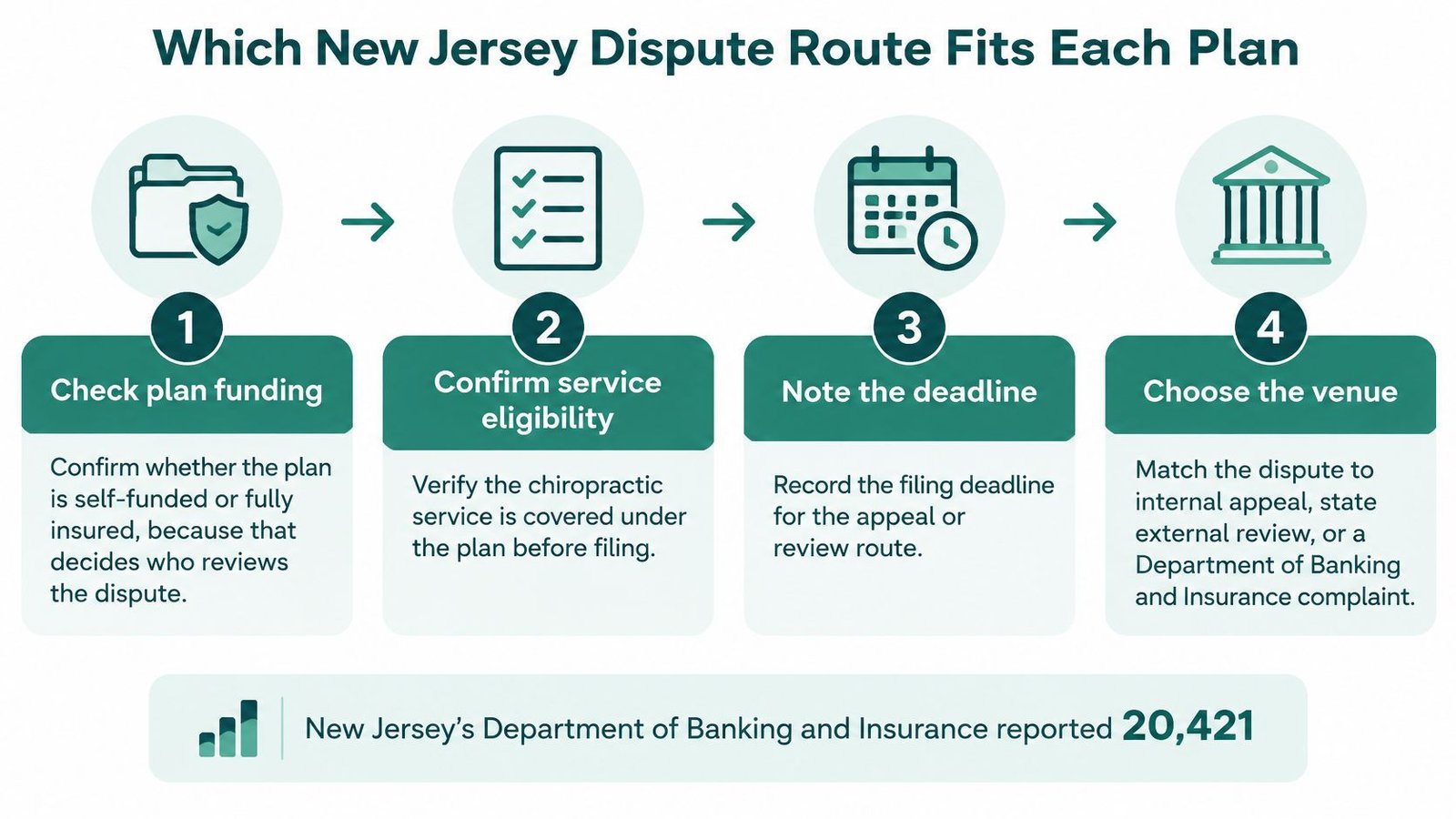
Every underpayment is not a denial, and every denial is not an appeal. The right route depends on plan funding, service eligibility, the deadline and the venue. New Jersey's Department of Banking and Insurance reported 20,421 arbitration requests received since the state process began in 2018, with 20,018 resolved by December 31, 2024, according to the DOBI out-of-network arbitration report. The state also notes that self-funded plans may opt out of New Jersey arbitration to use federal IDR instead.
| Plan or claim type | Likely route | Owner question |
|---|---|---|
| State-regulated commercial plan | New Jersey DOBI arbitration for qualifying out-of-network disputes | Is this claim eligible, and who is tracking the state deadline? |
| Self-funded employer plan | Federal IDR, if the plan has opted out of New Jersey arbitration | Did the plan opt out, and who files for the federal process? |
| Qualifying federal IDR dispute | Federal IDR under the No Surprises Act | Is the service eligible, and is the offer package complete before the deadline? |
| Government program claim (for example, Medicaid managed care) | Payer appeal or contract review, not commercial arbitration | Which appeal deadline applies, and who confirms the route with the payer? |
| Routine underpayment outside arbitration or IDR | Ordinary appeal or contract review | Is appeal ownership assigned and is the claim aged? |
Run triage in this order. Identify plan funding first, because a self-funded plan routes differently from a fully insured one. Confirm the service is eligible for the route you're considering. Check the deadline before you assemble anything. Choose between state arbitration, federal IDR, a DOBI complaint or an ordinary appeal. Then track the claim until it's paid or formally closed.
A DOBI complaint is a separate channel from arbitration. It fits when a state-regulated plan appears to be breaking New Jersey insurance rules, not as a substitute for a payment dispute. The mechanics sit in our guide to filing a NJ DOBI complaint for underpaid out-of-network claims, and the checklist side of compliance is covered in the No Surprises Act compliance checklist.
Here's the question that separates a real partner from a claim mill: "Show me three redacted New Jersey underpayments and explain why each belonged in state arbitration, federal IDR, ordinary appeal or contract review." The best capability you're buying may not be volume. It's correct triage of a smaller number of legally distinct disputes.
New Jersey Medicaid and Medicare Checks to Demand
A New Jersey partner has to run this state's payer rules, not a generic chiropractic template. New Jersey requires participating chiropractors to use an assigned provider identification number on every billing document, submit HCPCS procedure codes and follow the state fiscal agent's billing supplement, per NJAC 10:68 chiropractic services. If the vendor can't describe how it validates provider identifiers and maps services to current codes before submission, it's guessing with your license number.
Credentialing comes before all of it. Horizon NJ Health's provider manual limits coverage to medically necessary manual manipulation of spinal subluxation under CPT 98940, 98941 and 98942, requires prior authorization for subsequent treatments, and pays evaluation codes 99201 through 99205 only during the initial office visit, according to the Horizon NJ Health provider manual. The same manual requires an NPI on Medicaid claims unless the provider is atypical and warns that treatment delivered before credentialing and network acceptance can be denied. Unauthorized follow-ups don't bounce. They accumulate as unpaid balances.
Medicare is a separate universe. CMS states that an AT modifier must be reported for active or corrective treatment, and claims for those same manipulation codes without it are considered not medically necessary, per the CMS Medicare coverage article. A missing modifier turns a payable visit into a denial the practice absorbs after the service is already delivered.
Four checks to put to any candidate:
- Confirm plan status and effective date for every NJ FamilyCare plan you bill, starting with Horizon NJ Health.
- Verify the NPI on every Medicaid claim, not just the ones that reject.
- Ask how authorization counts are tracked per patient, and who catches an expiring one.
- Ask how initial-visit evaluation codes and the Medicare AT modifier are controlled before a claim leaves the system.
Happy Billing manages the full revenue cycle for New Jersey physician groups, from NJ FamilyCare MCO credentialing and prior authorization through charge capture, claim submission, denial management and patient collections, and maintains active credentialing with Horizon NJ Health, AmeriHealth NJ, Aetna Better Health of NJ, Wellcare of NJ and UnitedHealthcare Community Plan of NJ. Denial specialists clear New Jersey MCO rejections within 48 hours, including NJMMIS system errors and NJ FamilyCare remark codes. Our chiropractic billing work for practice owners shows how the specialty workflow is set up.
Denial and A/R Reporting That Shows Real Cash
A clean-claim percentage does not tell you how much cash reached the practice. Judge the billing partner by recovered dollars, unresolved balances, and whether every denial has an owner and a next action. Overall denial rates hide wide variation by insurer, payer, and reason.
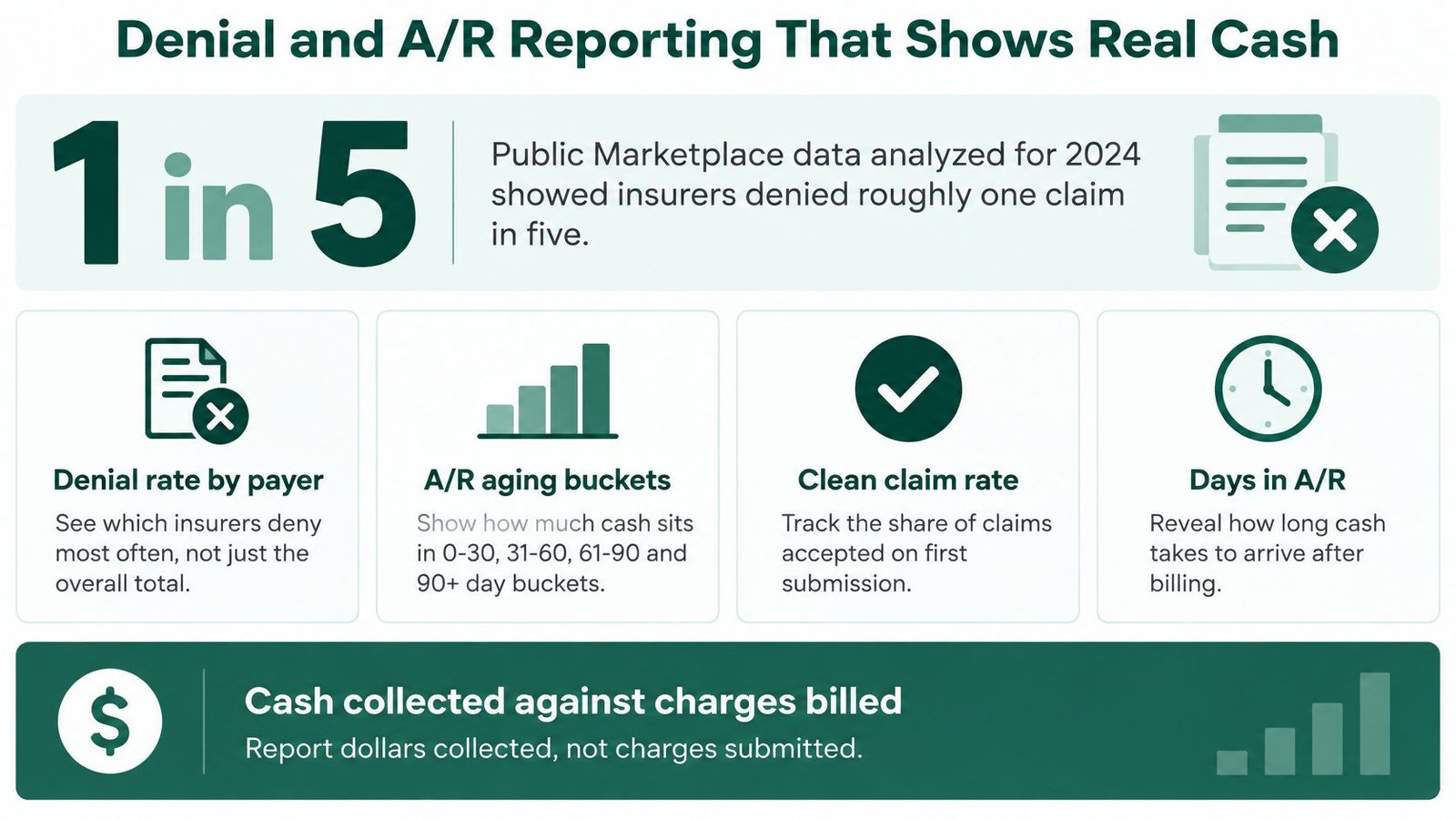
Require a monthly report that separates these measures:
- First-pass acceptance and final payment rate, shown as separate figures.
- Denials by payer and reason, not one blended rate.
- Appeal overturns and dollars recovered, so you can see whether appeals produce cash.
- A/R aging by payer, including balances over 90 days and the action planned for each.
- Write-offs by reason, with amounts and categories clearly identified.
Separate submission from recovery. A claim accepted by a clearinghouse has only cleared an early processing step; it has not necessarily been paid correctly. Ask the vendor to track underpayments against expected reimbursement and show the amount recovered, the amount still disputed, and the next follow-up date.
Use denial categories to find where cash is leaking. Eligibility errors point to front-desk verification. Authorization denials point to scheduling and tracking. Medical-necessity denials call for documentation review. Timely-filing failures indicate weak follow-up. Underpayments require remittance review; patient balances require a clear collection process. A single denial total conceals these different fixes.
A reported 98% clean-claim rate means little until the vendor defines the milestone. Ask whether it measures clearinghouse acceptance or claims paid, then compare the figure with actual collections and A/R movement. For a closer look at the work behind denial follow-up, review claim denial management workflows.
Ask for an anonymized monthly report and trace one unpaid balance from the report to its claim status, follow-up action, and expected next step. If that trail stops at “submitted,” the report does not show cash recovery.
Confirm the Scope and Fee Basis Before You Sign
A low quote can still leave expensive work uncovered. Before signing, spell out which parts of the revenue cycle the vendor will own, which your team will retain, and how fees are calculated. Compare proposals using the same scope. This medical billing outsourcing cost comparison can help you identify what a quote includes.
Choose the arrangement that fits your practice: full revenue cycle management, billing for one specialty or location, or a defined partial scope. Credentialing is separate from billing, so you can keep your current biller and assign credentialing elsewhere, or bring in a partner for selected work while your biller handles the rest.
Put the boundaries in writing. Specify who handles charge capture, claim submission, denial follow-up, A/R recovery, credentialing, patient collections, reporting, and the BAA. Then define the fee basis for each assigned service, including how any recovery fee is calculated. Don't sign a proposal that leaves “recovery” or “billing support” undefined.
Happy Billing offers a free New Jersey revenue audit for practices on request. Use it to review where collections may be falling short, then compare the proposed scope and fee terms with the work your practice needs. A free expert call can also be booked through the Happy Billing contact page.
If you are also weighing spending on your practice's website, see what a two-week website costs before setting the marketing and billing budgets.
Can we keep our current biller and hire only for underpayment recovery?
Yes. Happy Billing can provide partial outsourcing, full revenue cycle management, or a scope in between. Agree in writing on which tasks each party owns, including claim submission, follow-up, and reporting, so work does not fall between them.
Does a clean-claim percentage tell us how much cash we will collect?
No. Clean-claim acceptance measures a submission milestone. Ask how the vendor reports actual payments and A/R, then compare the figures with the specific scope and claims it will handle.
How do we know a vendor routes DOBI and federal IDR correctly?
Ask the vendor to explain how it determines the right route for each plan and dispute. The proposal should distinguish state arbitration, federal IDR, ordinary appeals, and contract review, rather than treating every dispute as the same process.
What must a business associate agreement cover before we share claim data?
Require a practice-specific BAA and written details on access controls, data protection, incident response, and responsibility for breach-related costs. Make sure the agreement identifies who handles each obligation before claim data changes hands.
If a billing proposal looks complete but leaves ownership or fees vague, pause before signing. Happy Billing works with independent practices in New Jersey and can handle full-cycle or partial revenue cycle management, including working alongside an existing biller. Visit Happy Billing to learn about its services.
Where this fits