Chiropractic Medical Billing Services: Your 2026 Guide

Chiropractic medical billing services are specialized third-party services that manage a chiropractor's entire revenue cycle, from claim submission and coding to denial management and A/R recovery. They matter because chiropractic billing carries a 33.6% improper payment rate on Medicare claims, and 95.5% of those errors are tied to insufficient documentation, which is exactly the kind of revenue leakage that drives denials, rework, and slow cash flow.
If your front desk is checking benefits one way, your providers are documenting another way, and your biller is appealing claims after the fact, you're already paying for the problem. In chiropractic, small billing mistakes aren't small. A missing AT modifier, the wrong spinal region code, or weak subluxation documentation can move a visit from payable to denied with almost no gray area. For owners, that shows up as rising A/R, preventable write-offs, and staff time spent chasing money instead of controlling it.
Chiropractic and multidisciplinary practices in the Northeast are also among the most affected by out-of-network repricing. If a meaningful share of your visits are OON, the physical therapy underpayment recovery guide and the guide on how to file a NJ DOBI complaint for underpaid out-of-network claims cover the recovery playbook most billing companies skip.
What Are Chiropractic Medical Billing Services
Chiropractic medical billing services are specialized outsourced teams that handle claim creation, payer submission, payment posting, denial follow-up, and accounts receivable for chiropractic practices. The important distinction is specialization. A generalist billing company may know medical billing. A chiropractic billing team knows where chiropractic revenue falters.
That difference matters most when your practice bills a mix of Medicare and commercial plans. Medicare's chiropractic benefit is narrow, documentation-heavy, and unforgiving. Commercial payers often follow different rules, which means the same visit can move through two completely different reimbursement paths depending on the payer. If your internal team treats every carrier the same, denials become a process problem, not a coding accident.
Owners usually feel this before they can name it. Payments lag. Staff say claims are “under review.” Providers keep getting note queries after visits are already submitted. A/R gets older because the office is reacting to denials instead of preventing them.
A real billing service should take work off your plate in a way that improves collections, not just reduces keystrokes. If you need a plain-language overview of the role itself, this explanation of what medical billers do in practice operations is a useful baseline.
What specialized support actually changes
A chiropractic-focused billing partner usually helps the practice tighten:
- Visit-to-claim alignment: The billed service matches the note, diagnosis linkage, and payer rule before the claim leaves the system.
- Medicare compliance discipline: Active treatment claims carry the right modifier and the required documentation trail.
- Follow-up speed: Denied and unpaid claims are worked with a revenue lens, not just a task-completion mindset.
- Provider consistency: Multi-provider clinics stop producing five versions of the same note standard.
When a practice says billing is “mostly under control,” I usually find that the claims are going out, but the revenue isn't arriving cleanly.
There's also a patient-education side effect. Practices that publish useful content about care, such as this guide on how chiropractors help scoliosis, often attract more informed patients. That's helpful operationally, but it also makes front-end benefit verification and financial communication more important because expectations need to match coverage.
The Scope of Full-Cycle Chiropractic RCM
A true chiropractic billing service doesn't just send claims. It manages the full financial path from intake to final payment.
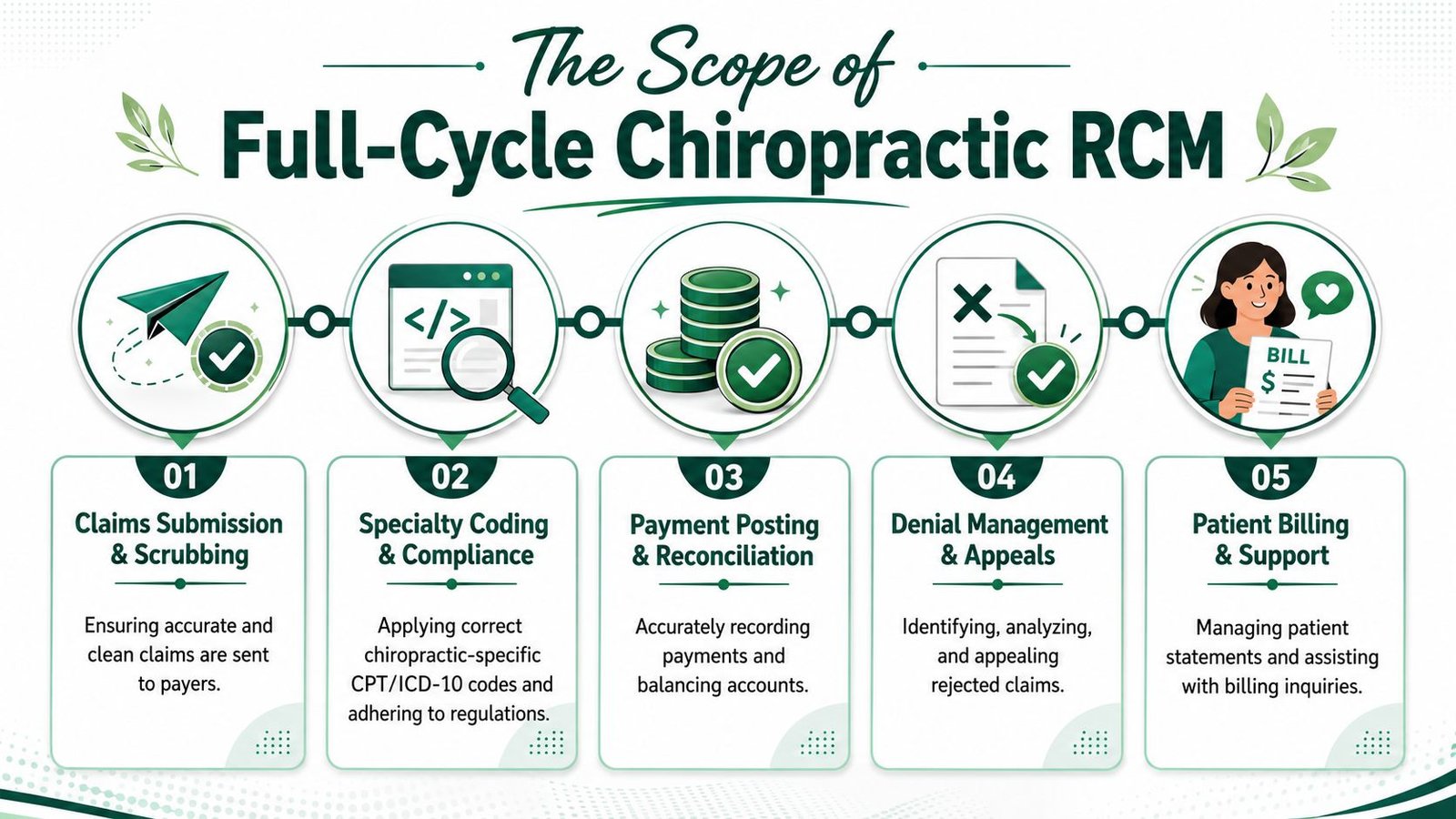
For owners comparing in-house billing to outsourcing, the key question is whether someone is managing the whole cycle or only the middle of it. A strong overview of that operating model is this resource on RCM for physician practices.
Claims submission and scrubbing
The first job is getting claims out cleanly. That sounds basic, but most chiropractic payment issues start before submission. Eligibility errors, wrong payer sequencing, missing modifiers, and diagnosis mismatches create denials that were avoidable.
Claim scrubbing is the control point. It catches problems before the payer does. That costs less than appealing after denial, and it keeps cash moving faster.
Specialty coding and compliance
Chiropractic coding is simple only if you ignore payer nuance. The CPT side may look narrow, but the reimbursement risk sits in documentation support, payer edits, and modifier logic.
For a chiropractic office, coding oversight should include:
- CPT selection: Especially whether the billed spinal manipulation code matches the documented regions treated.
- Diagnosis hierarchy: Whether the primary diagnosis supports the payer's rule set for payment.
- Modifier use: Particularly on Medicare claims where modifier logic can decide covered versus non-covered status.
- Documentation sufficiency: SOAP notes, treatment plans, and outcome tracking that support medical necessity.
Payment posting and reconciliation
Many practices underestimate this step. Payment posting isn't clerical cleanup. It's where underpayments, partial payments, and unexplained adjustments get exposed.
If your team posts checks and ERAs without reconciling against expected reimbursement and denial patterns, you miss a second category of revenue leak. Claims can be “paid” and still be paid incorrectly.
Practical rule: If the office can't explain why payments changed by payer, provider, or code mix, it can't manage collections with confidence.
Denial management and appeals
Weak billing vendors reveal themselves through their methods. A basic vendor resubmits what the payer rejected. A capable one finds the root cause and fixes the workflow upstream.
In chiropractic, good denial management means separating:
- Front-end denials tied to eligibility, authorization, or registration
- Clinical denials tied to documentation and medical necessity
- Billing denials tied to coding, modifiers, or payer edits
Without that split, the same denial repeats across the month.
Patient billing and A/R recovery
Chiropractic practices often carry a blend of covered, partially covered, and patient-responsible services. That makes patient statements and collections part of RCM, not an afterthought.
A full-cycle service should handle:
- Timely patient statements
- Clear balances after payer adjudication
- A/R follow-up on unpaid claims
- Escalation rules for aging balances
That's how billing shifts from back-office processing to revenue management.
Unique Financial Risks in Chiropractic Billing
A multi-provider chiropractic group can look busy, post charges daily, and still bleed cash for one simple reason. The rules that govern payment change by payer, and the charting habits inside the clinic rarely stay consistent from doctor to doctor.
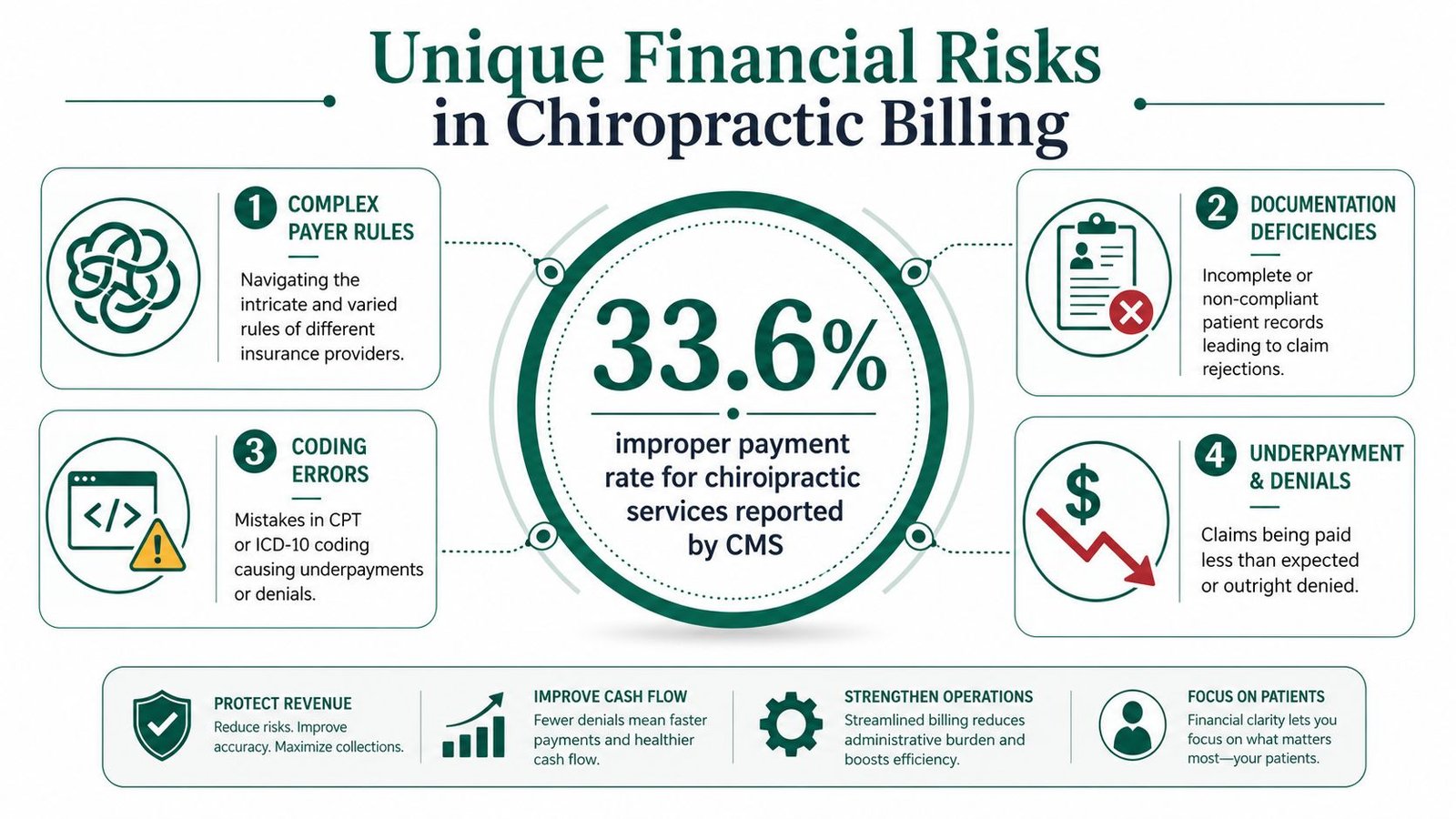
In chiropractic, billing risk usually hides in ordinary workflows. A provider documents three spinal regions but the claim goes out at the five-region level. A Medicare visit is billed without the AT modifier. A commercial plan requires authorization tracking that one location follows and another location misses. None of those mistakes look dramatic at the front desk. They show up later as denials, underpayments, refund requests, and older A/R.
Medicare rules create a narrower payment path
Medicare is not paying for the full chiropractic visit in the same way many commercial plans do. The covered service is spinal manipulation tied to active treatment, and the claim has to match Medicare's documentation and coding structure. CMS outlines the specialty billing framework in its Medicare Benefit Policy Manual, Chapter 15, including the coverage limits around chiropractic services.
That distinction matters financially. If the note does not clearly support active treatment, if the primary diagnosis setup is wrong, or if the claim lacks the expected modifier logic, the practice is not dealing with bad luck. It is sending out claims that were built to fail under Medicare rules.
I see this most often in groups that copy commercial billing habits into Medicare workflows. Commercial plans may reimburse a broader mix of services or apply different edits. Medicare does not.
Documentation errors turn into denials and recoupments
Chiropractic claims depend on tight alignment between the note, diagnosis selection, modifier use, and CPT level. The Office of Inspector General has repeatedly examined chiropractic claims because the specialty presents persistent documentation and medical necessity risk, as shown in OIG work on Medicare payments for chiropractic services.
The practical consequence is straightforward. Weak notes do not only delay payment. They also create takeback risk after payment if the record cannot support what was billed.
For owners, the expensive part is not a single denial. It is repetition across providers and locations. One doctor under-documents treatment goals. Another uses a template that never clearly supports active care. A third documents region count inconsistently. The billing team then spends hours reworking claims that should have been clean on day one.
Multi-provider groups carry a bigger operational risk
A solo practice can often spot a billing pattern by memory. A group cannot rely on memory. Once several providers, front-desk teams, and locations are involved, small differences in workflow create measurable revenue leakage.
Common failure points include:
- Modifier inconsistency by provider: One clinician's Medicare claims append the correct active-treatment modifier reliably, another clinician's do not.
- Region-count mismatch: The billed CMT code does not match the documented spinal regions.
- Diagnosis sequencing errors: Medicare claims are built from a commercial plan habit instead of the payer's own expectations.
- Authorization drift on commercial plans: One office verifies visit limits and referral requirements correctly, another office assumes prior visits set the rule for the rest of the year.
- Template variation: Providers use different note styles, which makes audit defense weaker and coder review slower.
These are not abstract compliance concerns. They reduce collections and push A/R older because the same errors keep cycling back through edits, denials, and appeals.
Payer-specific rules change how work should be scheduled
Commercial and Medicare claims should not move through the same checklist. The American Chiropractic Association's payer education materials and policy resources make that clear across common reimbursement topics, especially around documentation and coverage expectations in different plan types, as reflected in the ACA coding and reimbursement resource center.
The operational fix is discipline. Separate Medicare claim review from commercial review. Audit provider documentation by payer class, not only by total charges. Track denial reasons by provider and location so management can see whether the problem is eligibility, authorization, modifier use, or documentation support. A group that wants a sharper scorecard should review the medical billing KPIs to track and tie them back to chiropractic-specific denial patterns.
Because billing teams handle PHI across intake, coding, claim submission, and follow-up, access controls and vendor oversight also need regular review. A practical reference is Technovation's HIPAA guide for businesses, especially for practices standardizing workflows across multiple providers or sites.
KPIs to Measure Your Billing Performance
A multi-provider chiropractic group can post a strong month in visits and still miss payroll targets because cash is stuck in edits, denials, and underpaid claims. I see that pattern when owners track deposits but do not separate Medicare performance from commercial performance, or provider A from provider B. Billing metrics need to show where revenue is leaking, not just whether money eventually arrived.
A useful starting point is a focused list of medical billing KPIs for revenue cycle performance. For chiropractic groups, the metrics matter most when they are broken down by payer, provider, and location.

First-pass clean claim rate
This measures how many claims are accepted on initial submission without rejection. In a chiropractic office, that number reflects front-desk accuracy, coding discipline, and payer-rule setup in the practice management system.
A low clean-claim rate usually traces back to a short list of operational misses:
- Eligibility errors: Coverage was not verified correctly, or the wrong payer sequence was entered.
- Authorization gaps: Commercial plans often require visit tracking or preauthorization rules that Medicare does not.
- Modifier mistakes: The claim format does not match the payer's expectations for chiropractic services.
- Diagnosis and documentation mismatch: The billed service is not supported cleanly by the note.
For a group practice, watch this by provider and by payer class. If one doctor's commercial claims reject twice as often as everyone else's, the fix is rarely "work harder." It is usually a workflow, template, or training problem.
Days in A/R
Days in A/R is the clearest cash-flow metric on the board. If it rises, the practice is lending money to payers while staff keeps generating new charges.
Long A/R usually means one or more of these problems are present:
- Claims are leaving the office with preventable errors.
- Denials are not being worked inside the payer's timely filing or appeal windows.
- Secondary balances, patient balances, or underpayments are sitting without follow-up.
For chiropractic groups with several providers, total A/R can obscure the underlying issue. One location may be collecting well while another is carrying old commercial balances because authorizations expired or documentation is inconsistent. Review A/R aging by payer and by rendering provider, not just at the tax ID level.
Denial rate and denial mix
A raw denial count is not enough. The useful question is which denials are increasing, who is generating them, and whether they come from Medicare rules or commercial rules.
Medicare chiropractic billing has its own documentation and claim construction demands, as explained in the CMS Medicare Benefit Policy Manual, Chapter 15. Commercial plans create a different risk profile. They often add authorization rules, visit caps, referral requirements, or policy edits that vary by contract. If those two buckets are mixed together in one denial report, managers lose the ability to fix the right process.
Track denial reasons in categories your team can act on:
- Eligibility and registration
- Authorization or referral
- Modifier or coding edit
- Documentation support
- Timely filing
- Underpayment or payer pricing issue
If your report only says "denied" or "needs records," it is not a management tool. It is a backlog report.
Net collection rate
Net collection rate shows how much of the allowed revenue the practice collects after contractual adjustments. Hidden write-offs show up within this rate.
A chiropractic group can stay busy and still lose margin if underpayments are posted without review, small-balance denials are written off too early, or patient responsibility is transferred late. Net collections should be reviewed against payer mix. Medicare rules may create one set of limitations, while commercial contracts may create another. If one payer consistently pays below expected contracted amounts, that is a contract management issue, not just a billing issue.
Credit balance and refund trend
This KPI gets missed often, especially in growing groups. Credit balances can signal posting errors, duplicate payments, poor coordination of benefits handling, or delayed patient refunds. Left alone, they create compliance risk and distort the actual A/R picture.
For multi-provider chiropractic offices, this matters because payment posting is often centralized while charge entry or front-desk collection happens at different sites. A refund log tied to payer, provider, and location helps pinpoint whether the root problem is overcollection, posting inconsistency, or bad insurance sequencing.
What owners should review every month
A practical dashboard should answer a short list of questions fast:
- Are claims going out clean by payer and provider?
- How old is A/R by payer class and location?
- Which denial reasons are increasing?
- Are allowed amounts being collected in full?
- Which providers or sites are creating the most rework?
Those are the metrics that reduce A/R days and recover revenue. Everything else is secondary.
Understanding Chiropractic Billing Service Pricing
A three-provider chiropractic group can sign what looks like a low-cost billing contract and still lose money every month. The usual pattern is easy to spot during an audit: the vendor posts payments, sends claims, and leaves Medicare denials, modifier corrections, secondary follow-up, and old A/R to the practice staff. The quoted fee looks lean. Net collections do not.
Pricing only makes sense when it is tied to scope. In chiropractic, the primary cost driver is not claim volume alone. It is how much payer-specific follow-up your practice needs, how many providers are creating documentation variation, and whether the billing team is expected to work denied claims through to payment.
Many chiropractic billing companies charge a percentage of collections. Others use a flat monthly fee. The model matters less than the fine print.
| Model | Common Structure | Works Best For | Where Costs Get Hidden |
|---|---|---|---|
| Percentage of collections | Monthly fee tied to collected revenue | Practices that want the billing company paid based on actual recovery | Some vendors exclude old A/R, appeals, patient billing, or credentialing support |
| Flat fee | Set monthly charge based on provider count, claim volume, or service level | Owners who want predictable overhead and stable budgeting | Low quotes often limit follow-up touches, reporting depth, or denial work |
For a solo chiropractor with a simple payer mix, a flat fee may hold up well if the agreement includes charge review, payment posting, denial handling, patient statements, and monthly reporting. In a multi-provider group, flat-fee pricing can break down fast. More providers usually mean more documentation inconsistency, more payer edits, more rework on modifiers, and more internal coordination between front desk, therapy staff, and billers.
The bigger pricing issue is Medicare versus commercial payer work. Medicare chiropractic claims come with narrow coverage rules, strict documentation expectations, and frequent medical necessity scrutiny. Commercial plans often add their own authorization rules, visit limits, bundling edits, and modifier requirements. A vendor that prices your account as simple claim submission, while your practice needs contract-level follow-up and denial appeal work by payer, will look cheap on paper and expensive in A/R.
Ask every billing company what is included in the fee, in writing:
- Charge entry and claim scrubbing
- Payment posting and reconciliation
- Denial management and appeals
- A/R follow-up, including old balances
- Patient statements and patient balance follow-up
- Insurance correspondence and payer calls
- Credentialing or enrollment support
- Monthly reporting by provider, payer, and location
One sentence in the contract matters a lot. Watch for exclusions such as "claims submission only," "patient collections not included," or "A/R follow-up limited to 90 days." Those carve-outs shift labor back to your team and usually explain why one quote is far lower than another.
Owners should also ask how pricing changes as the practice grows. A five-provider group with two locations needs more than a basic per-claim workflow. It needs reporting by provider and site, tighter posting controls, and someone who can separate payer issues from provider-specific documentation problems. If the vendor cannot support that operationally, lower pricing does not protect margin.
For a clearer benchmark on fee structures and what vendors usually include, review this breakdown of outsourced medical billing cost models.
The best pricing model is the one that reduces write-offs, shortens A/R days, and gets more of the allowed amount into the bank. If the fee is low but denials sit untouched or underpayments go unworked, the practice is still overpaying.
How to Evaluate a Chiropractic Billing Partner
A five-provider chiropractic group can look profitable on paper and still lose revenue every week. One doctor documents active treatment cleanly. Another defaults to thin notes. The billing vendor submits both claim sets the same way, Medicare rejects part of one batch, a commercial payer downcodes another, and A/R stretches because nobody separates payer-rule problems from provider-level documentation failure. That is the standard you should use when evaluating a billing partner. Can they identify where money is leaking and fix it fast?
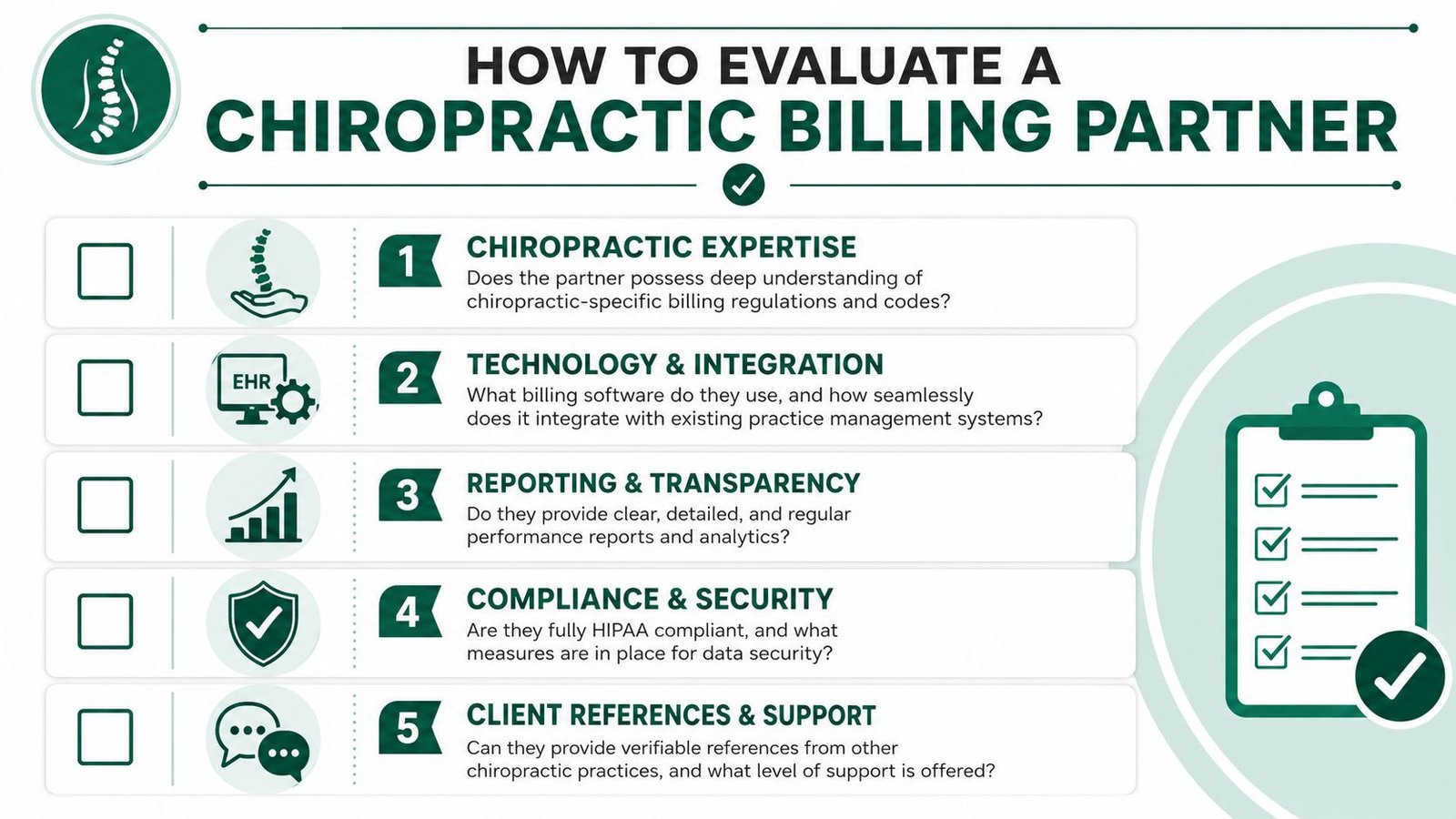
If you want a broader screening framework, review these questions to ask a medical billing company before hiring.
Check specialty depth first
Start with payer-rule questions and group-practice questions. Generic billing experience is not enough for chiropractic.
Ask how the vendor handles Medicare chiropractic claims versus commercial plans. Medicare has a narrow chiropractic benefit and stricter documentation expectations. Commercial plans often create a different problem set, such as visit limits, preauthorization rules, modifier edits, or inconsistent medical-necessity reviews. A capable partner should explain how they separate those workflows, who reviews exceptions, and how they prevent the same denial from recurring.
Ask a harder question next. What happens when one provider in the group has a denial rate that is materially worse than the others? A strong billing partner should have a method for tracing the cause to note quality, coding habits, front-desk intake, or a payer-specific edit. If they cannot isolate issues by provider and location, they will miss the source of avoidable write-offs.
Review how they actually operate
A polished sales pitch does not tell you much. The operating model does.
Ask these questions:
- How do you triage unpaid claims by payer and aging bucket? You want a disciplined follow-up process, not a general promise to work A/R.
- Who reviews documentation risk before claim submission? Chiropractic revenue often leaks before the claim goes out the door.
- How do you handle modifier issues and coding mismatches? Small errors here can delay payment or trigger downcoding.
- What is your process for payer underpayments? Many vendors post the payment and move on. That leaves money behind.
- How do you support multi-provider groups? Reporting and workflows should separate provider performance, payer trends, and location-specific breakdowns.
- Will you work inside our current systems? A vendor that forces workarounds can slow posting, create handoff errors, and extend A/R days.
Test reporting before you sign
Ask for real sample reports, not a dashboard demo.
The reports should let you see collections, denial categories, aging, and payment variance by provider, payer, and location. That level of detail matters in chiropractic groups because the same visit type can pay differently depending on documentation quality, modifier use, and plan rules. If the vendor only reports total collections, they are hiding the operational story.
Good reporting should also show action. I look for notes that explain why denials increased, what was corrected, and whether the fix reduced rework the next month.
The right billing partner shows where revenue was lost, why it was lost, and what changed to recover it.
Vet compliance and escalation paths
Billing vendors handle PHI, payment data, and patient communication. Ask who has access, how quality checks are documented, and how issues are escalated when claims stall with a payer.
Support depth matters even more in larger groups. A vendor may perform adequately for a solo clinic and still struggle with provider onboarding, cross-location standardization, and payer escalation in a two-office or five-office setup. Public information on specialty billing solutions across physician practice types can help you gauge whether a company understands specialty workflows or just sells a general billing service.
Ask for proof of revenue recovery
One question cuts through marketing fast. Ask the vendor to describe a situation where they reduced denials or shortened A/R for a multi-provider practice with mixed payer contracts.
Listen to how specific the answer is. The better firms talk about root-cause analysis, documentation feedback loops, payer-specific edits, and how they recovered missed reimbursement. Weak firms talk about submitting claims quickly.
Speed helps. Control gets paid.
Frequently Asked Questions from Practice Owners
How does chiropractic billing differ between Medicare and commercial insurance?
The biggest difference is that Medicare's chiropractic benefit is narrowly limited, while commercial plans may have broader coverage rules. Medicare chiropractic claims must fit the payer's defined benefit structure for spinal manipulation tied to subluxation and active treatment rules. Commercial plans may cover services differently, apply their own edits, or require a different workflow for review and follow-up. In practice, that means your billing team can't use one standard script for every payer.
Why do multi-provider chiropractic groups usually have more billing leakage?
Because the issue usually isn't one bad claim. It's variation. A billing guide focused on group practices notes that these settings are complex because of multiple providers, frequent code updates, and varied insurance policies, shifting the challenge from simple coding to standardizing documentation, assignment, and denial management across the group, according to this chiropractic billing guide for group practices.
If one provider documents thoroughly and another uses weak templates, the same visit type can produce different reimbursement outcomes. Owners need standard note expectations and centralized denial review.
Should we outsource billing or fix our current in-house process?
That depends on where the failure sits. If your team knows the payer rules, follows up consistently, and has strong reporting, in-house can work. If denials keep repeating, A/R keeps aging, and no one can identify the root cause by payer or provider, you don't have a staffing issue. You have a process issue. Outsourcing makes sense when the outside partner brings tighter controls than your current system can sustain.
What's the best first step if I suspect billing problems but can't pinpoint them?
Start with an audit, not a vendor switch. Review claim edits, denial categories, aging buckets, modifier use, documentation support, and provider-level patterns. That gives you a financial diagnosis before you make an operational decision. If you're still unsure where your practice is leaking revenue, request a free revenue cycle audit.
If your chiropractic practice is dealing with preventable denials, slow collections, or payer-specific billing confusion, Happy Billing can help you find the leak before it gets more expensive. Their team supports specialty-specific RCM, works inside your existing systems, and helps practices tighten claims, accelerate follow-up, and recover revenue that generic billing workflows often miss.