What Is the Qualifying Payment Amount (QPA) and How Out-of-network Providers Challenge IT
You're probably looking at a remittance that feels too low, and the question is whether the qualifying payment amount can be challenged before it drags down your cash flow, denial rate, and A/R days. The short answer is yes. The QPA is a payer-built benchmark, not a final price, and when it's wrong, it can anchor the entire dispute below what your practice should collect.
Happy Billing is a medical billing company headquartered in Houston, Texas. We recover out-of-network underpayments for physical therapy, chiropractic, sports medicine and behavioral health practices, including practices in New Jersey and New York.
If you're seeing underpaid out-of-network claims, the damage shows up fast in revenue leakage and longer follow-up cycles. In our experience, the practices that win are the ones that challenge the methodology early, not the ones that wait until the balance is buried in aging. If your team is still fixing credentialing and enrollment gaps at the same time, find credentialing forms for healthcare so the front end doesn't keep feeding the back end the same problem.
A low QPA doesn't just shrink one payment. It sets the tone for every negotiation that follows, and for out-of-network specialties with real acuity, that can strip meaningful dollars from expected reimbursement. If you want to know where that leakage is hiding, start with a free out-of-network underpayment analysis.
Disputing a payer’s qualifying payment amount? We help practices recover underpaid out-of-network claims.
Free 30-minute call with a billing specialist. We only get paid when we deliver. US practices only.
What the Qualifying Payment Amount Means for Your Practice
The qualifying payment amount, or QPA, is the payer's median contracted rate for the same or a similar service in a comparable specialty and geographic area, and it's the number insurers lean on when they pay or negotiate out-of-network claims under the No Surprises Act. It matters because it often becomes the opening move in the financial conversation, not the final word. The No Surprises Act framework became operational on January 1, 2022, creating a nationwide alternative to balance billing for protected services, and the QPA sits right at the center of that system (Congressional Research Service review).
For a practice owner, the operational impact is simple. A depressed QPA compresses the initial payment, weakens your position in open negotiation, and can leave extra dollars stuck in follow-up while staff chases appeals. That turns into more denials, slower recovery, and more time spent aging balances that should've cleared much sooner.
Practical rule: treat every low QPA as a methodology problem until proven otherwise.
The reason this hits revenue so hard is that the payer isn't using your billed charge as the benchmark. The QPA is a market-based median, and that distinction matters when the claim is for high-acuity out-of-network work at an in-network facility, or for ancillary groups that never agreed to the payer's internal math. If your team is also working through broader denial patterns, review your denial management workflow before the same claim sits in multiple queues.
The out-of-network specialties most exposed are anesthesia, radiology, emergency medicine, pathology, neonatology, assistant surgeons, and ancillary practices that operate around hospital-based care. When these claims are underpriced, the loss isn't abstract. It shows up in reduced collections on the exact services that are hardest to replace.
What Is QPA in Medical Billing and How the Median Is Built
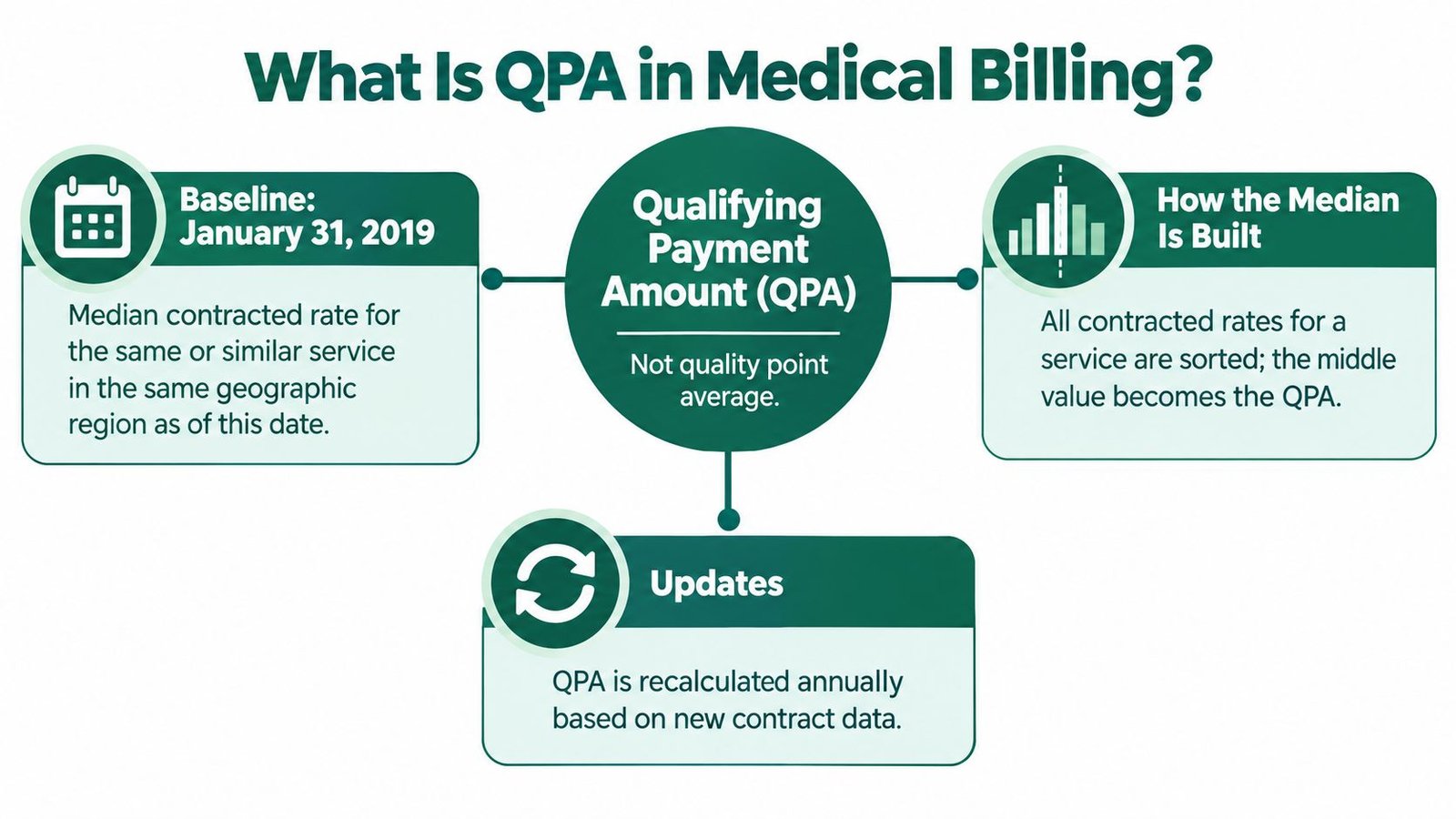
QPA in medical billing has nothing to do with quality point average. It is the insurer's median contracted rate benchmark for a service, built from its own network data, and that is exactly where payers can bury the lowest defensible number.
The calculation starts with a January 31, 2019 baseline and then gets adjusted for inflation using CPI-U in later years (CMS methodology). CMS also limits the comparison set by same or similar code, same or similar specialty, and the same geographic region, with separate contracts counted separately and risk-sharing payments, bonuses, penalties, and retrospective adjustments excluded (CMS calculation methodology PDF). For unit-based services, the median rate gets indexed and then multiplied by the relevant units, which is why anesthesia time, mileage, and other variable-unit claims deserve close scrutiny.
What to verify before you accept the number
Payers can make a low QPA look normal by sorting the wrong contracts into the comparison set. Verify the exact CPT or HCPCS code, modifier structure, specialty classification, geographic region, and unit conversion before you treat the remittance as accurate.
Operational takeaway: if the service family is wrong, the median is wrong.
That is why QPA disputes are not just arithmetic. They turn on whether the payer built the median from the right population in the first place. Keep the workflow tight from the start, because a clean first submission is what keeps the median challenge alive later.
The inflation adjustment matters too. CMS uses a defined CPI-U method, so the payer does not get to invent a fresh benchmark every year. That gives you a clean place to challenge unexplained drift when the plan's allowed amount looks disconnected from the actual service.
Where the QPA Shows Up in the Dispute Timeline
The QPA shows up three times, and each appearance changes the balance in the file. First, it appears in the initial payment or denial notice, where the payer has to issue payment or a denial after receiving the information needed to decide the claim, and that 30-calendar-day clock starts once the plan has what it needs (CMS issuer requirements checklist). Second, it anchors the 30-business-day open-negotiation window. Third, if the parties still cannot agree, it becomes part of federal IDR.
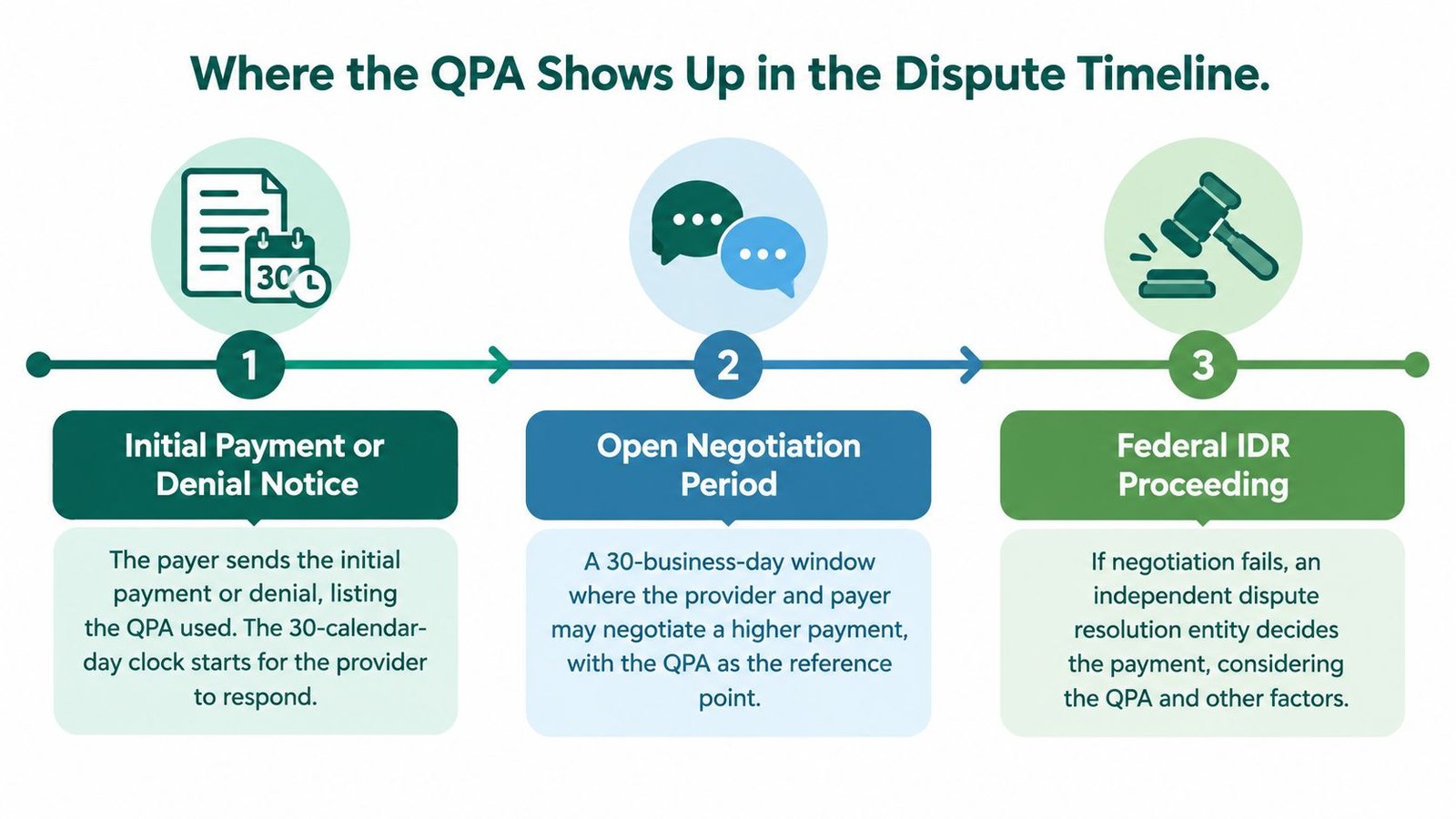
The payer must generally disclose the QPA and certify federal-rule compliance within that same payment clock. A missing or sloppy disclosure is already a dispute issue, not just a payment issue. For practices that are still sorting balance-billing workflows, the balance billing guide shows where the file breaks down before the QPA dispute even starts. The NSA compliance checklist helps teams spot those gaps faster.
What IDR entities weigh
The certified IDR entity does not treat the QPA as automatically final. It has to consider the QPA together with the provider's training and experience, market share, patient acuity, case mix, and the complexity or scope of services, as applicable (CMS notices; Congressional Research Service review). The practical point is blunt, the QPA is a required input, not a lock on the answer.
Missing the open-negotiation deadline or the IDR filing window is where practices lose real money. The balance sits in A/R while the payer keeps the low number in place, and every day of delay weakens your position.
Why the QPA Is Often Lower Than the Real Market Rate
The popular story says the QPA is a neutral median. That story is too clean. In practice, the payer can build the comparison set in a way that pushes the number down, and a low QPA is not proof that your market is weak. It may only prove the insurer constructed the median badly.
Where the benchmark gets distorted
The biggest problem is ghost rates, contracted rates for services the provider doesn't furnish. The Fifth Circuit found that including those rates can artificially depress the benchmark, and it also rejected a methodology that left out bonus and incentive compensation from the payment calculation (Congressional Budget Office review). That matters because the QPA is supposed to reflect a real market, not a contract shell game.
Geography can also be stretched too broadly, and specialty classification can be set too loosely or too narrowly. When that happens, the payer gets to compare your service against contracts that don't match the actual site of care, service mix, or provider type.
A low QPA is often evidence of a flawed comparison set, not a low commercial rate.
The right response is to ask for the QPA, the methodology, and the underlying calculation details, then compare the result against your actual contracted rates and the service history you know is valid. For a separate lens on how insurers anchor payments outside the NSA context, this explanation of usual and customary rates is useful because the same distortion pattern shows up there too.
What to demand from the payer
Request the QPA disclosure, the contract set used, the specialty grouping, the geographic grouping, and any unit logic if the claim is time-based or mileage-based. Then preserve the objection in open negotiation and, if necessary, in IDR. If the payer won't show its math, you're not dealing with a transparent benchmark, you're dealing with an assertion.
Real Out-of-Network Underpayments We Have Seen
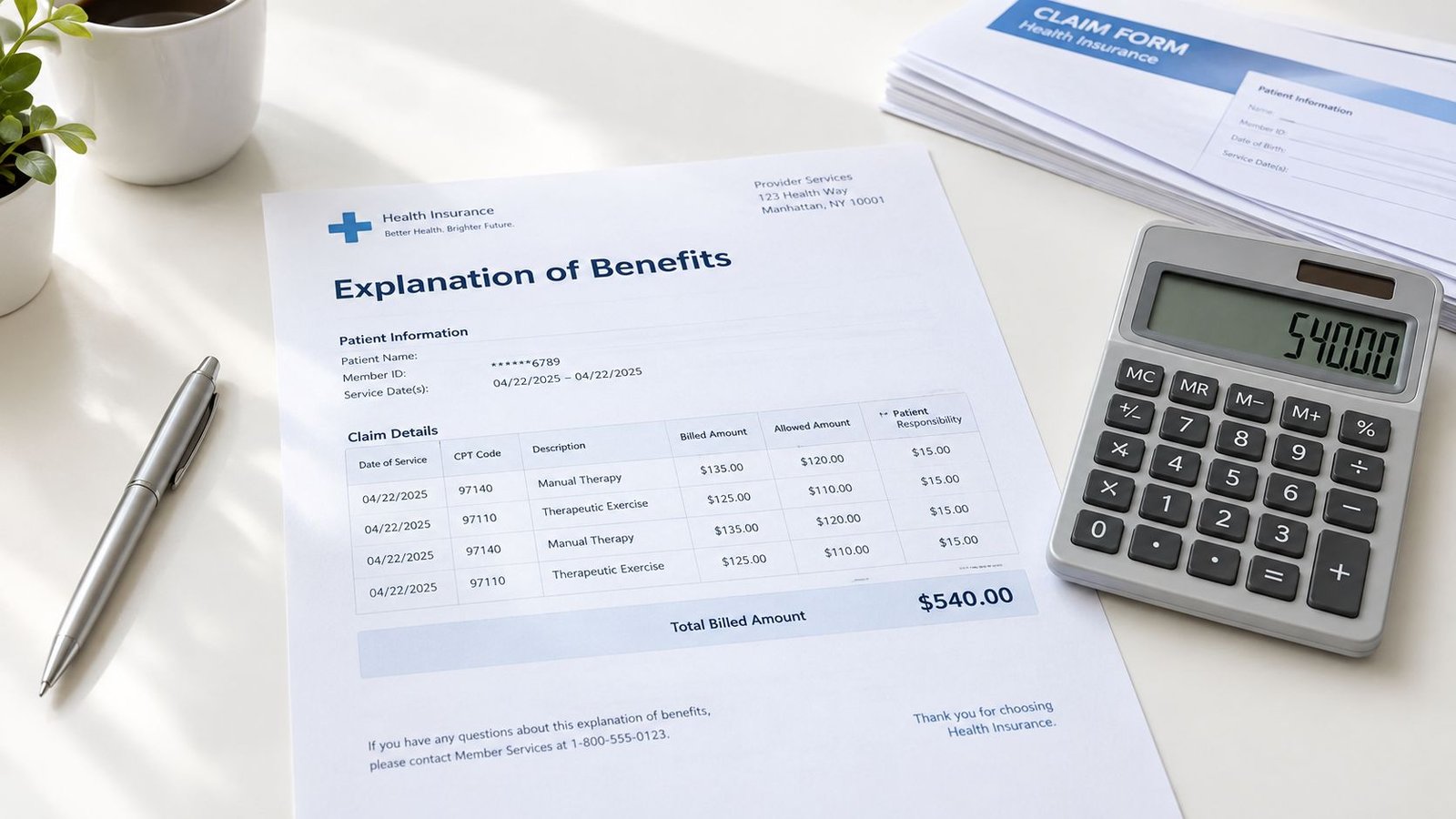
A Manhattan physical therapy practice billed $540 for a visit coded 97140 x2 and 97110 x2. Cigna paid about $60 after a Data iSight repricing, and before that repricing the same kind of visit had been landing closer to $300 to $400. That's not a rounding error, it's a direct hit to collections on the exact kind of visit that keeps the schedule profitable.
The same pattern showed up in a multi-location New Jersey sports medicine group. Cigna and Horizon repriced roughly $300 claims down to about $100 across multiple sites, which means the leakage wasn't isolated to a single office or a single payer contract. It was systemic.
Why the repricer matters
In both examples, the mechanism was a repricer, not a random manual underpayment. That's why we treat out-of-network underpayment as a pattern, not a one-off dispute. If the claim was touched by a repricer, start with the actual claim file and compare it to a known good benchmark before you spend time arguing the wrong point. The Data iSight underpayment appeal guide is the cleanest next step when the payer has already forced the payment down.
We also see this in the broader repricing market, especially where MultiPlan, Zelis, and Data iSight or Claritev are in the middle. A visit at an in-network facility does not protect an out-of-network ancillary group from being repriced into a lower settlement band. For a broader view of those tools, use the best out-of-network medical bill repricing tools guide.
The operating lesson
If you're seeing the same payer slash multiple claims across locations, don't appeal one claim in isolation. Group the underpayments, prove the pattern, and make the payer deal with the full dollar value.
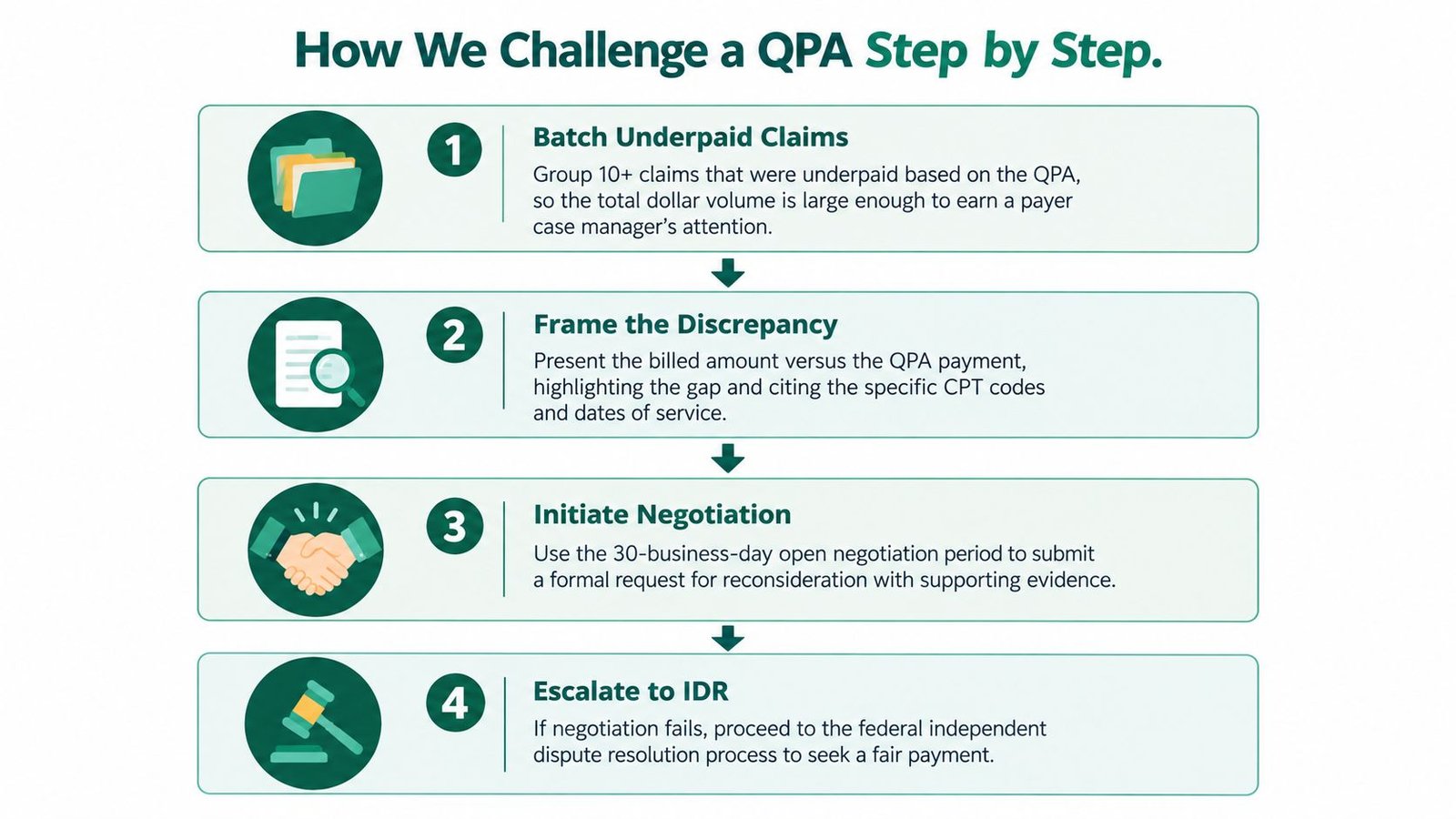
How We Challenge a QPA Step by Step
We start by grouping 10+ underpaid claims so the dollar value is big enough to get a payer case manager to pay attention. One claim gets brushed aside. A stack of claims gets reviewed.
From there, we frame the gap using the actual billed codes and a fair benchmark, not a vague complaint. FAIR Health is useful here because the 90th percentile gives you a ceiling to push against, while the 80th percentile is often where real settlements land when the payer knows the file is worth moving. If the claim window is closed, we resubmit for a fresh EOB when the payer process allows it, because the cleanest move is often to force the file back into a reviewable state.
How the escalation works
Next comes the payer's formal dispute track, including one-time provider dispute options where available, then federal IDR if the claim qualifies. The federal IDR process for providers, step by step matters because deadlines are where practices lose ground, not in the final argument.
If you have an assignment of benefits on file, you usually do not need to go back to the patient for permission or contact before pushing the dispute.
A typical timeline is 45 to 90 days from first submission to resolution, depending on how fast the payer responds and whether the file needs a fresh EOB or formal escalation. That matters because every extra day in A/R ties up cash and staff time, and every missed deadline gives the payer a reason to hold the lower number in place.
The strongest files tie the QPA objection to the exact CPTs, dates of service, and disputed payment pattern. That moves the discussion from “we paid the benchmark” to “your benchmark does not hold up.”
Revenue Impact and the Right Time to Escalate
The claims that get squeezed hardest are out-of-network anesthesia, radiology, emergency medicine, pathology, neonatology, and assistant surgeons at in-network facilities, plus out-of-network physical therapy, chiropractic, sports medicine, and behavioral health practices in New Jersey and New York. One weak QPA can suppress multiple collections cycles, not just a single remittance, because payers use the same low benchmark until someone forces a review.
If you are comparing outsourced help, this outsourcing cost guide is useful because the key question is not whether the vendor looks busy, it is whether the workflow brings back money fast enough to justify the friction. The same discipline shows up in other markets too, and Medicare billing patterns for Australian doctors shows how aggressively payers define the floor.
Revenue rule: escalate when the underpayment repeats, the claim is still collectible, and the group can prove the service level.
We price this work on contingency, and the number depends on claim age and volume. If you want to know whether a batch is worth the effort, start with how to reopen a deposited underpaid claim guide, then decide based on the dollars, not on hope.
Questions Practice Owners Ask About QPA Challenges
How long does federal IDR really take from submission to payment?
The filing itself is only the start. After submission, you still have the payer response cycle, the certified IDR review, and the delay that comes from incomplete documentation or bad grouping, so the file can move fast or sit depending on how clean it is.
When is a dispute worth the admin cost?
If the balance is small and the claim is old, the economics can turn against you quickly. The better test is whether the underpayment is part of a repeatable pattern that affects multiple claims, because that's where the recovery justifies the effort.
Do we have a real chance of beating the payer's number?
Yes, if the file is built around the right code, specialty, geography, and service facts. The strongest submissions don't argue in the abstract, they show why the payer's QPA construction doesn't match the service you furnished.
What changes if the patient already got a bill or the account hit collections?
Don't assume the dispute is dead. You still need to protect the claim record, correct the payer-side methodology issue, and stop the same problem from repeating on the next batch of claims.
If your practice is getting squeezed by low QPAs, repricers, or repeat out-of-network underpayments, we can help you isolate the pattern and decide what's worth pursuing. Visit Happy Billing to request a free out-of-network underpayment analysis and get a clear read on what your claims are really leaving behind.