Usual and Customary Rates (UCR) Explained for Out-of-Network Providers
If your out-of-network checks are coming in short, UCR is probably the number behind the damage. It's the payer's allowed-amount benchmark, and if you don't know how that benchmark is set, your revenue cycle can lose money claim by claim.
For independent practices, that shows up fast in lower reimbursement, more balance bills, and longer A/R. The fix is not guessing higher fee schedules, it's matching your charges and appeals to the payer's actual methodology.
Happy Billing is a medical billing company headquartered in Houston, Texas. We recover out-of-network underpayments for physical therapy, chiropractic, sports medicine and behavioral health practices, including practices in New Jersey and New York.
UCR, or usual and customary rates, is the amount an out-of-network plan recognizes as a benchmark for payment, not a promise to pay your full charge. If the payer's number is lower than your billed amount, the difference can land on the patient, get written off, or sit in A/R while your team tries to understand why the remittance doesn't match the claim.
That matters because UCR is tied directly to revenue leakage. If your fee schedule sits below the payer's benchmark, you're capping your own collections before the claim is even adjudicated. If your team doesn't compare remits against the plan's allowed-amount logic, you'll keep accepting repriced claims as if they were final.
For practices that want a practical benchmark for pricing and recovery, a good starting point is understanding how out-of-network reimbursement works in the first place. A useful primer is how cost plus pricing works, because the same discipline applies here, you need a defensible basis for what you charge and what you expect to collect. For a deeper look at payer recognition rules, see out-of-network reimbursement basics.
If your current billing vendor isn't checking UCR methodology claim by claim, request a free out-of-network underpayment analysis and find out where your revenue is leaking.
What Usual and Customary Rates Actually Cost Your Practice
UCR is not an abstract billing term. It is the ceiling many plans use to decide how much of your out-of-network charge they will recognize. Once that ceiling is set, the rest of the claim turns into a math exercise that often shifts cost to your practice, your patient, or both.
Why the payer's benchmark controls cash flow
Under the CMS glossary, UCR is the amount paid for a service in a geographic area based on what providers usually charge for the same or a similar service, and plans may use that figure to calculate the allowed amount for out-of-network care. The claim then splits into separate numbers: billed charge, allowed amount, patient responsibility, and any balance-bill exposure. The CMS historical review also shows that the benchmark is shaped by provider charges, peer-market distributions, geography, and payer rules, not by your submitted fee alone. CMS historical review
Practical rule: if you only compare the check amount to your charge, you are reading the claim too late.
Independent owners get caught here because the remittance looks final. A payer may use the wrong market, the wrong specialty, or the wrong percentile, and if no one checks the methodology, the underpayment stays buried.
What that means for your revenue cycle
UCR can compress reimbursement, shift more of the bill to patient responsibility, and inflate write-offs when your team posts the claim without challenging the calculation. I see this most often when practices handle out-of-network claims like ordinary commercial claims, then wonder why collections no longer match production. A payer may label an amount “reasonable,” but that does not make it local, current, or tied to the service you delivered.
The AMA's benchmark guidance points to comparable charges by specialty and geography, and that is where many underpayments begin. AMA benchmark guidance
For a working view of how reimbursement mechanics affect practice cash, see out-of-network reimbursement basics. If your current billing vendor is not checking UCR methodology claim by claim, request a free out-of-network underpayment analysis and find out where your revenue is leaking. Specialty practices like physical therapy and sports medicine should also align charge strategy with how the market is priced, not with a generic internal multiplier. For specialty-specific recovery context, see physical therapy underpayment recovery.
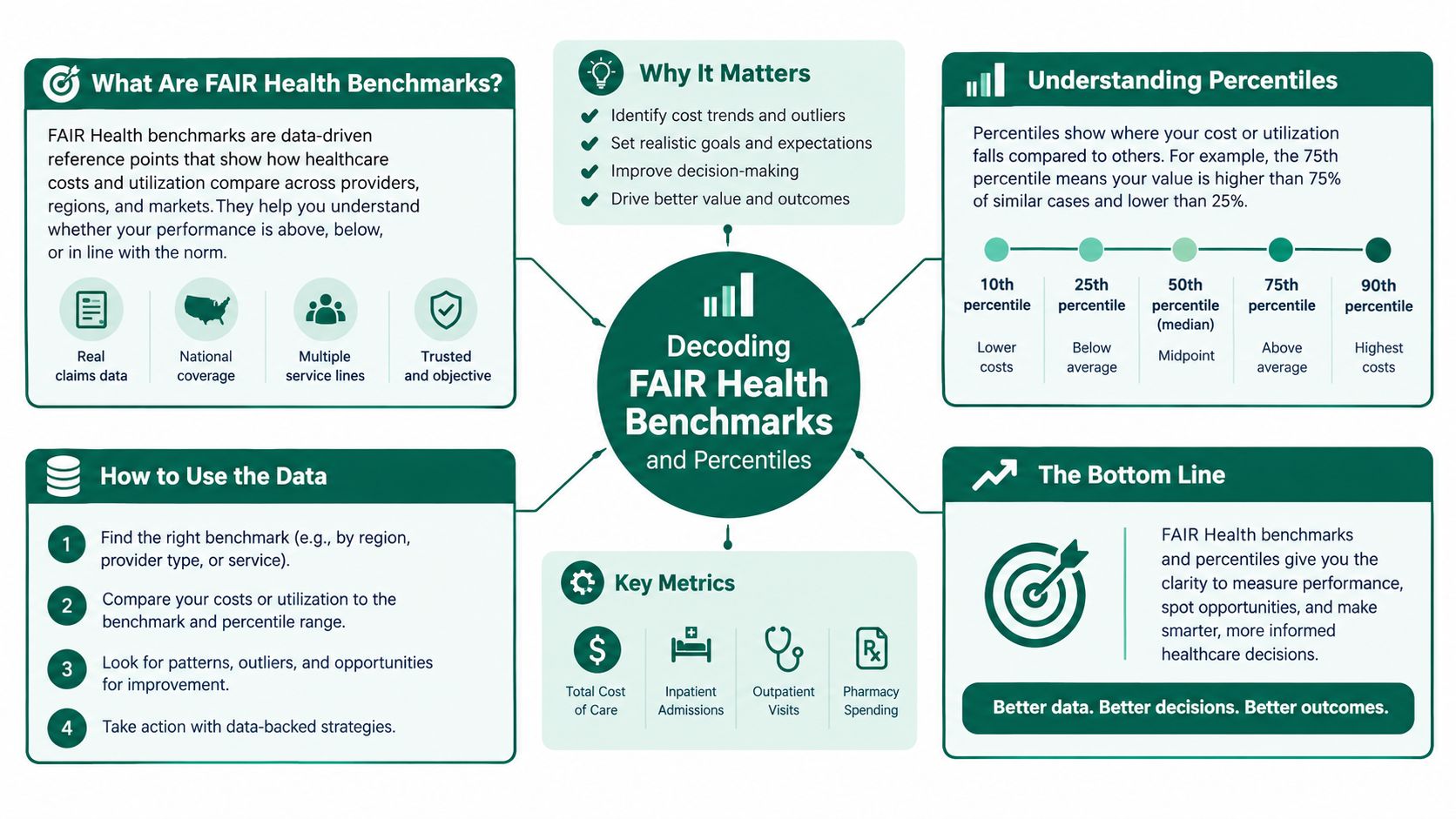
Decoding FAIR Health Benchmarks and Percentiles
A payer can call a claim “reasonable” and still underpay it if the percentile is wrong. That is why UCR disputes usually turn on the benchmark level, not just the raw number.
How to think about percentile logic
A 50th percentile benchmark sits in the middle of the charge distribution. An 80th percentile benchmark is more provider-friendly, and a 90th percentile benchmark sits higher still. New York's out-of-network disclosures use FAIR Health 80th-percentile data for specific ZIP codes, including ZIP code 11790 in the 2025 materials and ZIP code 13905 in the 2024 materials. New York also states that providers may bill above UCR. NYSHIP 2025 disclosure, NYSHIP 2024 disclosure, Empire Plan disclosure
That matters operationally. If the plan document points to one percentile and the remittance reflects another, the shortfall can sit in plain sight for months.
How to benchmark your fee schedule
Audit the fee schedule by ZIP code plus CPT code, then compare the benchmark to your own out-of-network charge. FAIR Health provides benchmark charge data, but it does not set UCR or insurer reimbursement rates. Insurers decide how, or whether, to use that data in payment policies. FAIR Health benchmark guidance
For a concrete example, a Manhattan physical therapy practice looking at CPT 97140 may see a 90th percentile around $179 per unit and an 80th percentile around $150. If your fee schedule sits below that range, you have already built a discount into the claim before the payer reviews it. Practices that want tighter control over out-of-network pricing and appeals often use medical billing services in New York for out-of-network specialty practices to keep benchmarks, charges, and remittance review aligned.
Your fee schedule should be a pricing tool, not a surrender document.
How Repricers Manipulate Reasonable Rates
A payer rarely calculates an out-of-network rate by hand. The claim is handed to a repricing vendor, then the result is treated as the allowed amount unless someone pushes back. That is how a so-called reasonable payment gets pushed down without much transparency.
Why “reasonable” often means “lowered”
The pattern is usually simple. The remittance points to a third-party tool, the allowed amount drops, and the payer gives little detail about how the figure was built. Vendors such as Data iSight, MultiPlan, and Zelis often sit in that repricing layer, and their methodology can diverge from the plan language or the state rule the payer is supposed to follow. For a closer look at the tools used in these workflows, see the best out-of-network medical bill repricing tools.
New York's physician practice rule says physicians in private practice are paid at the 80th percentile of usual and customary charges reported by FAIR Health's database at the time of billing. Texas guidance also shows that insurers can vary both the percentile they use and the percentage they apply to a FAIR Health-based calculation, which is why one payer's “reasonable” number may not match another payer's logic. New York regulation, Texas UCR report
Where the math usually breaks
The failure point is often not the database itself. It is the slice of data the payer selects, the specialty grouping it uses, or the benchmark it applies even when that benchmark conflicts with the plan's own promise. The AMA benchmark model ties charges to the same or similar specialty and geographic area, so a blended national average can distort reimbursement for anesthesia, cardiology, behavioral health, orthopedics, or therapy services. AMA benchmark guidance
That is why the remittance comes first in the review. Compare it with the plan language and the benchmark logic, line by line. The gap usually shows up there, and once it does, the repricer's reduction is much harder to defend.
Real World Underpayment Case Studies
The clearest way to see repricing is through actual claim behavior. In our anonymized underpayment audits, the pattern is rarely a simple coding mistake. It is a repeatable reduction method that changes the economics of an out-of-network practice.
Manhattan physical therapy
One anonymized Manhattan physical therapy claim was billed at $540 for a single visit, built from 97140 x2 and 97110 x2. Before repricing became aggressive, that payer had typically allowed $300 to $400 per visit. After the claim was routed through Data iSight, the allowed amount fell sharply and Cigna paid $60.
That swing does more than affect one deposit. It changes how the practice reads its own fee schedule and forces every later claim to be checked against the repricing logic line by line.
New Jersey sports medicine
A multi-location New Jersey sports medicine practice saw the same pattern across payers. Cigna and Horizon repeatedly repriced claims that were around $300 down to roughly $100. The immediate payment loss was only part of the problem, because staff also had to spend time chasing each mismatch after the fact.
| Metric | Billed / Historical | Repriced Outcome (Data iSight) |
|---|---|---|
| Manhattan PT single visit | $540 billed | $60 paid |
| Manhattan PT historic collection | $300 to $400 per visit | reduced sharply |
| New Jersey sports medicine claim | about $300 | about $100 |
The practical lesson is direct. If a practice keeps accepting repriced claims without appeal, it teaches the payer that the reduction is acceptable. From there, the payer has less reason to move on the next claim, and the next one after that.
The Batch Negotiation and Appeal Workflow
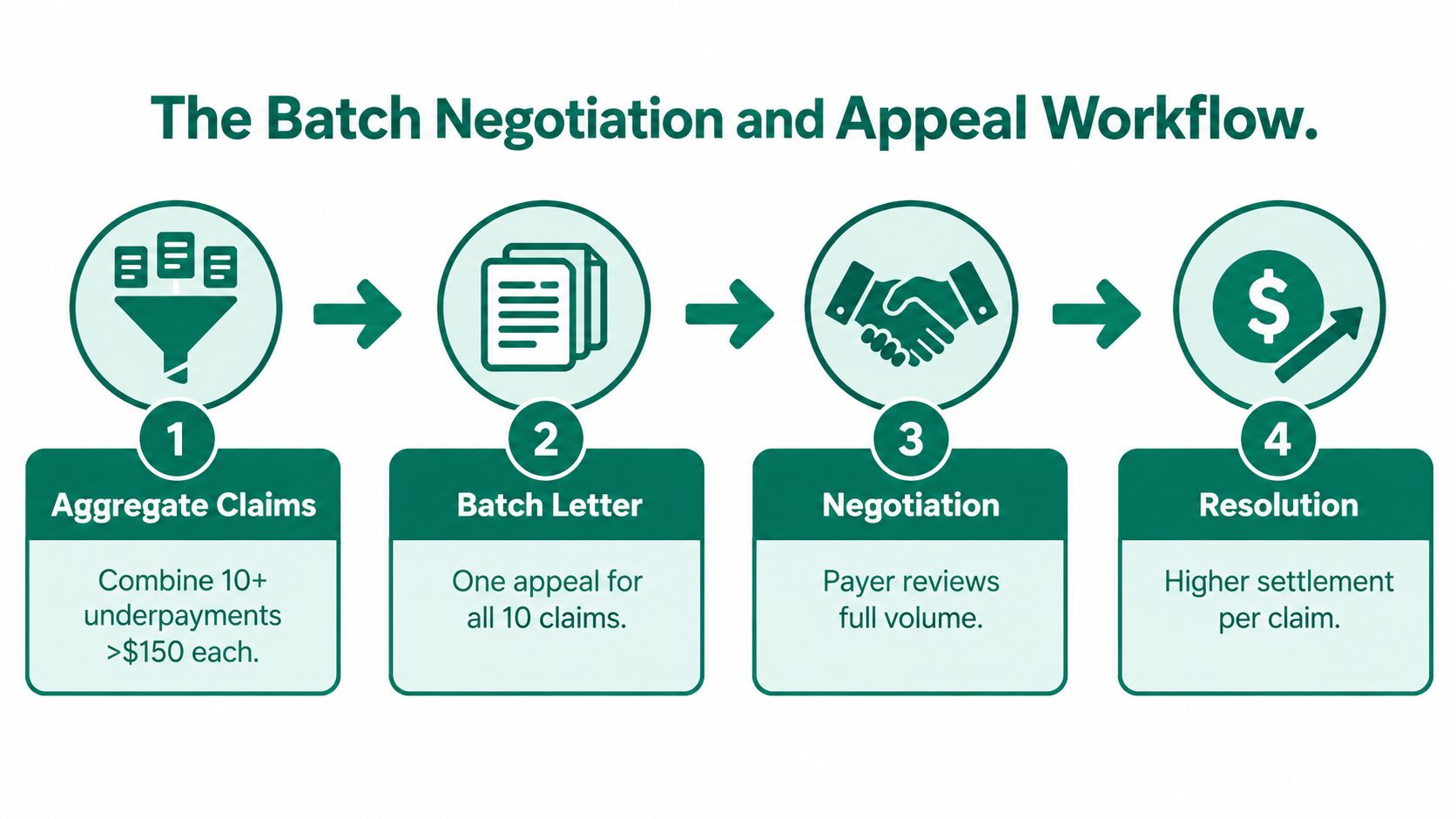
Single-claim appeals are usually a waste of staff time. A payer can ignore one shortfall easily. Ten or more underpaid claims tied to the same payer and provider are much harder to dismiss.
How to build leverage before you appeal
We approach these cases by batching 10 or more underpaid claims so the dollar value gets a payer case manager's attention. The point isn't volume for its own sake, it's to force the payer to review the pattern instead of treating each line as a minor adjustment.
Practical rule: lead with the benchmark, not the complaint.
The strongest outbound package ties the claim to FAIR Health data, the CPT code, the locality, and the plan's own allowed-amount language. In negotiation, the 90th percentile is often the ceiling, and the 80th percentile is a more realistic settlement anchor when the payer is willing to move. That framing gives the payer a range instead of a vague request.
What happens after the first round
If the appeal window has closed, resubmission can generate a fresh EOB and reset the timing. From there, the payer's formal dispute route or the Independent Dispute Resolution process becomes the next lever when the service is eligible. Georgetown researchers reported that 1.2 million disputes were filed during the first half of 2025, more than double the comparable 2024 volume, and that providers or facilities initiated 99.9% of cases, with 22% ending by default decision. Georgetown CHIR IDR data
AOB on file means you usually don't need patient contact to pursue the claim, which keeps the workflow cleaner and faster. The most useful operational guide for that package work is the out-of-network appeal package checklist and template for providers.
Navigating Balance Billing and Compliance Risks
UCR is a reimbursement benchmark, not a legal ceiling on every charge. That distinction matters because the patient's liability and the payer's payment rules do not always line up.
Where balance billing is permitted and where it isn't
For out-of-network elective care in a private office, balance billing may still be allowed depending on the plan and state law. Emergency services and certain ancillary services at in-network facilities are different. The No Surprises Act limits balance billing in those settings, and federal guidance from CMS explains how those protections affect what can be collected from the patient. CMS No Surprises Act provider page
That is where many practices get exposed. They assume a higher fee schedule will automatically produce a larger patient balance, then find that protected-service rules change the allowed amount and the amount that can be pursued.
Why assignment and consent matter
A clean billing workflow verifies out-of-network benefits before service, checks whether the claim falls under a protected-service rule, and confirms whether notice-and-consent requirements have been met. If you collect on the patient side before that sequence is clear, disputes can take more time and money to unwind than the original underpayment. The legal and operational risks tied to assignment language deserve close review, especially if the practice relies on patient signatures to keep cash moving. For a practical legal perspective, see assignment of benefits risks.
Separate payer recovery, patient balance responsibility, and protected-service compliance in the workflow. When those three get blended, collections can look healthy for a month and then turn into reversals, complaints, and avoidable write-downs. For a payer-facing overview of patient-side exposure, see balance billing guidance.
Frequently Asked Questions About UCR Recovery
How do I know if my fee schedule is too low for out-of-network work?
Compare your fees to the right benchmark for each ZIP code and CPT code, not to a Medicare multiplier you've used for years. If your charge sits below the plan's percentile benchmark, you've left room on the table before the claim even goes out.
What should I do when a payer says its number is “reasonable”?
Ask for the methodology, the percentile, the geography, and the specialty grouping used to calculate it. If the payer's explanation doesn't match the plan language or the benchmark data you can support, treat it as a recoverable underpayment, not a final answer.
Can older underpaid claims still be recovered?
Often, yes, if the appeal or dispute window hasn't closed or if a resubmission can generate a fresh EOB and reopen the workflow. Timing matters, so stale claims should be reviewed in batches instead of one by one.
Is outsourcing out-of-network recovery worth it for a small practice?
It can be, if the payer is systematically repricing claims and your team doesn't have time to build benchmark-backed appeals. The right model is contingency-only, with fees that depend on claim age and volume, and a clear number provided after a free underpayment analysis.
If your out-of-network claims are being repriced below fair market benchmarks, we can help you identify the pattern, quantify the leakage, and build the appeal file that gets attention. Happy Billing focuses on out-of-network underpayment recovery for practices that are tired of accepting silent cuts as final payment. Request a free out-of-network underpayment analysis and see exactly where your UCR revenue is getting lost.