Medical Billing Services in New York for Out-of-Network Specialty Practices
Most New York specialty out-of-network claims performed at in-network facilities now belong in a state or federal dispute workflow rather than a patient-billing workflow. The practice's real exposure is the gap between its charge and the payer's allowed amount, plus the revenue trapped in aging A/R, not patient collections.
New York's payment environment changed materially after the state's surprise-billing law took effect. The New York Department of Financial Services reported that the law saved consumers over $400 million from March 2015 through the end of 2018, reduced out-of-network billing by 34%, and reduced in-network emergency physician payments by 9% (New York DFS reporting). For a specialty practice, that means the claim must be managed as a reimbursement dispute from the moment the payer applies its allowed amount.
Happy Billing is a medical billing company headquartered in Houston, Texas. We recover out-of-network underpayments for physical therapy, chiropractic, sports medicine and behavioral health practices, including practices in New Jersey and New York.
Quick Answer for New York Out-of-Network Specialty Billing
Medical billing services in New York for out-of-network specialty practices should verify network status at the facility and plan level, classify protected services correctly, submit the required certification and claim records, and challenge inadequate payment through the correct state or federal pathway. A practice that just bills its full charge and waits for the payer to respond gives up control of the account.
The most important financial question is not whether the claim was submitted. It's whether the final allowed amount reflects the service, geography, specialty, facility setting, and applicable dispute rules. A single payment gap of several thousand dollars can outweigh the value of many routine claims, particularly in anesthesia, surgical assistance, pathology, radiology, and other hospital-based specialties. A New York DFS review found that 90% of more than 2,000 surprise-bill complaints involved non-emergency, in-hospital services, and one example showed assistant surgeons averaging $13,914 in charges against $1,794 in insurer payment (New York DFS review).
Your operating process should be simple:
- Confirm the plan type, facility network status, provider status, and referral or consent record.
- Separate protected surprise-bill claims from ordinary OON claims.
- Compare the payer's payment with a documented market benchmark.
- Appeal or initiate dispute resolution before the account ages beyond the practice's filing controls.
- Track the balance by payer, CPT family, facility, and aging bucket.
For a practice owner, this is a revenue-control issue. Poor classification can move a collectible payer balance into prohibited patient liability, while weak underpayment review leaves the difference between the charge and allowed amount permanently unrecovered.
Out-of-network physical therapy billing in New York City: who recovers the underpayments?
Happy Billing recovers underpaid out-of-network claims for New York City physical therapy, acupuncture and chiropractic practices that bill commercial insurance out-of-network. We work after the payment posts, alongside your in-house biller, and we’re paid only from what we recover.
The pattern we see most in Manhattan: Cigna claims repriced by Data iSight. One NYC practice billed $540 for a visit (97140 ×2, 97110 ×2) and was paid $60, after years of receiving $300 to $400. We benchmark each line against FAIR Health for the practice’s ZIP and CPT codes, batch the claims, negotiate with the payer, and escalate through formal disputes and NY DFS complaints where the plan allows.
- How far back: we review claims back to 2022, and the audit also flags which claims qualify for No Surprises Act disputes.
- Already deposited? Depositing a low payment usually doesn’t end your right to dispute it. The audit shows what’s still recoverable.
- Payers we see most in NYC: Cigna, Aetna, UnitedHealthcare/Oxford and Empire BCBS, with repricing by Data iSight, MultiPlan, Zelis or Naviguard.
Want to know what your underpaid out-of-network claims should have paid? Request a free out-of-network underpayment analysis. Contingency only, your current biller stays, and a call is optional: you can sign the NDA and BAA, upload claims to a secure folder, and we run the audit.
The New York Out-of-Network Payer Mix for Specialty Groups
A New York specialty claim can change materially after it leaves the practice. The payer identifies the product, applies its OON methodology, routes the claim through a claims administrator or repricer, and issues an allowed amount that may bear little relation to the charge or the specialty's contracted rate. That workflow is where New York DFS requirements, the No Surprises Act, and Fair Health benchmarks meet on one anesthesia, surgical, radiology, or pathology claim.
New York metro practices work across several commercial and employer-administered payer channels. Empire BlueCross BlueShield has broad commercial presence, Oxford Health has strong regional reach, and Cigna and UnitedHealthcare add variation in benefits, repricing, claims routing, and payment methodology. UHC and UMR should be treated as separate operational paths until the plan documents prove otherwise. EmblemHealth and New York Medicaid managed care plans create further differences for practices serving a wider local population.
The card logo is only the starting point. Confirm the exact product, employer arrangement, network, claims administrator, OON benefit language, facility status, and assignment-of-benefits requirements before staff project payment or bill the patient.
| Payer or arrangement | Operational note after claim submission |
|---|---|
| Empire BlueCross BlueShield | Confirm the commercial product, OON benefit terms, facility relationship, and payment notice before evaluating the allowed amount. |
| Oxford Health | Verify product-specific OON coverage and facility rules. Keep the plan document with the claim and appeal record. |
| Cigna | Review repricing, payment notices, and claim-level logic. Compare the initial payment with the documented service and specialty benchmark. |
| UnitedHealthcare and UMR | Separate UHC commercial workflows from UMR employer-plan workflows. Verify the claims administrator and applicable dispute route before escalation. |
The highest exposure remains concentrated in specialties with hospital-based work, complex documentation, or limited control over the facility network. Anesthesiology, emergency medicine, radiology, pathology, plastic surgery, orthopedics, fertility, and behavioral health can all face payment gaps when the payer's methodology does not reflect clinical complexity or the practice's charge structure. A New York DFS review found that three physician specialties accounted for about 50% of large bills reported by insurers and HMOs, while one insurer reported that 95% of its large non-participating emergency-service bills came from those specialties (New York DFS review).
Practical rule: Build a payer-by-specialty payment matrix. Set separate expectations and appeal evidence for anesthesia, behavioral health, and orthopedic OON claims.
Track billed charge, initial allowed amount, final allowed amount, and contracted equivalent for each claim. That comparison identifies whether the loss came from a low payment, coding issue, missing record, repricer reduction, or a dispute process that never began. A free out-of-network underpayment analysis can help identify those gaps by payer and service line.
How the No Surprises Act and New York Surprise Bill Law Interact
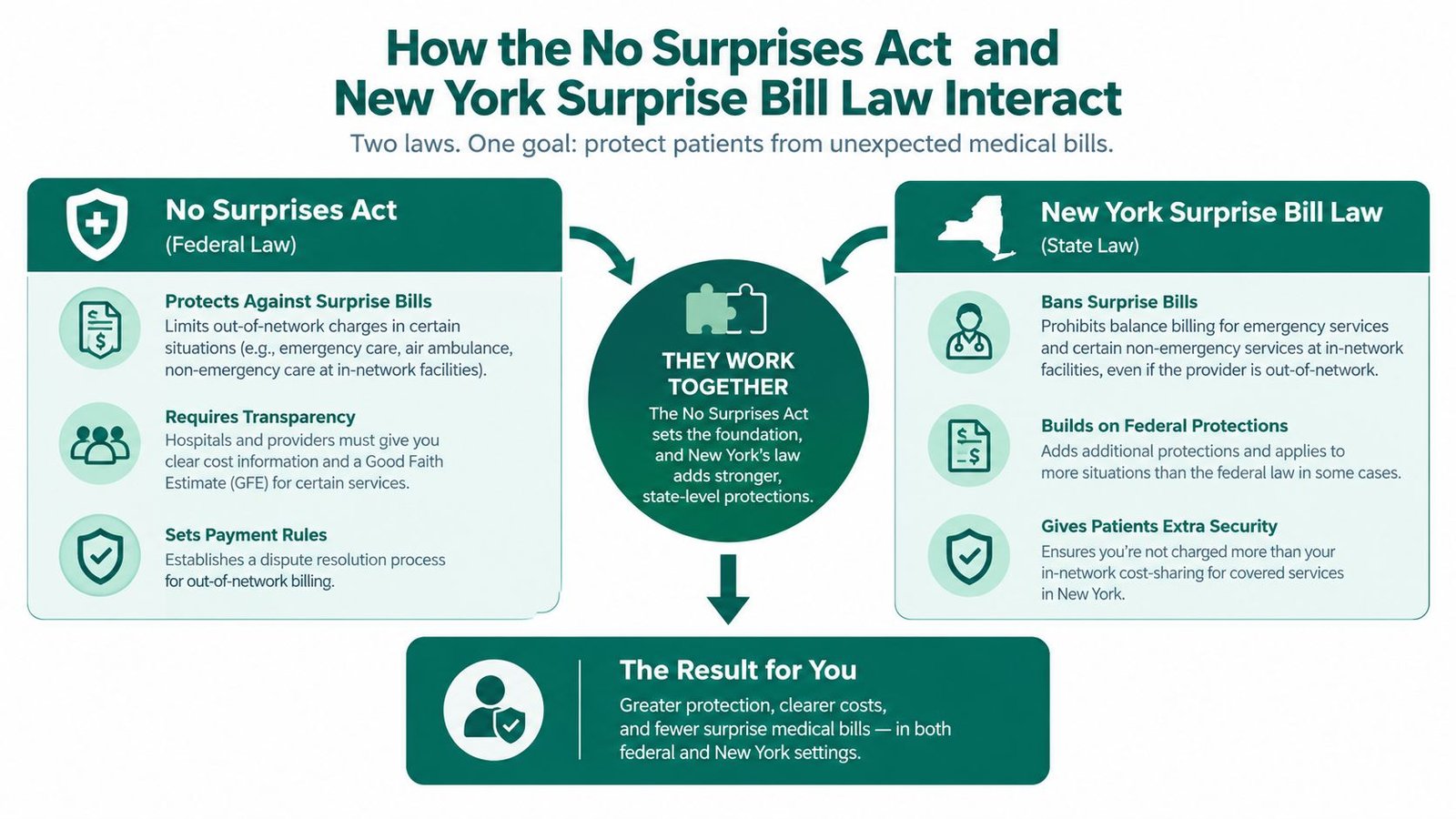
New York's Surprise Medical Bill Law and the federal No Surprises Act overlap, but they don't create one universal billing workflow. The governing path depends on the plan type, the facility, the service, and whether the plan is fully insured commercial coverage or a self-funded ERISA arrangement.
For fully insured commercial plans subject to New York oversight, DFS is central to the state dispute process. Federal IDR generally applies to qualifying self-funded ERISA plans and other claims governed by the federal framework. A practice must identify the applicable jurisdiction before sending a dispute, because a complete package sent to the wrong pathway still delays payment.
Common protected service categories include:
- Anesthesia base units and time, where the claim must support the units, modifiers, medical record, and facility relationship.
- Imaging professional or technical components, including modifier 26 and modifier TC when separately reportable.
- Surgical professional services, including claims affected by global-period rules and assistant-surgeon documentation.
- Pathology professional components, where the facility setting and provider role affect the payment pathway.
For a qualifying surprise bill, the patient generally owes only in-network cost-sharing and isn't the source of the disputed balance. The provider should send the claim, assignment-of-benefits documentation, required notice or certification records, and the payment challenge through the appropriate process. New York DFS guidance explains that providers can use a Surprise Medical Bill Certification Form, including for eligible services at an in-network hospital or ambulatory surgical center with dates of service on or after January 1, 2022 (New York DFS IDR guidance).
Read the New York No Surprises Act guidance for practice owners alongside the actual claim record. The financial question is whether the QPA or other initial allowed amount leaves enough margin after clinical labor, facility obligations, and dispute costs. Treat every dispute fee, documentation request, and aging delay as a contribution-margin decision, not as a compliance formality.
Fair Health Benchmarks Across the New York Metro
Fair Health is useful only when the benchmark matches the CPT code, place of service, specialty, and ZIP code. A Manhattan reference does not support a Brooklyn, Queens, Bronx, or Westchester claim. Using one statewide fee schedule gives the payer a straightforward argument that the charge lacks local support, putting the practice's reimbursement at risk.
Use these representative New York metro locations:
- Manhattan, ZIP code 10001
- Brooklyn, ZIP code 11201
- Queens, ZIP code 11101
- Bronx, ZIP code 10451
- Westchester, ZIP code 10601
Do not publish a benchmark table with missing dollar values. Pull the current Fair Health 80th-percentile amount for each code and ZIP from the practice's Fair Health subscription or another current, defensible source. Record the retrieval date, place of service, specialty, and service description with every result. The working set should include:
- 64483, transforaminal epidural injection
- 20610, major joint injection
- 90837, psychotherapy, 60 minutes
- 00142, anesthesia for eye surgery
This process shows how the benchmark intersects with the claim after it leaves the practice. On an anesthesia or surgical claim, the billing team compares the submitted charge with the applicable Fair Health amount, the payer's allowed amount, and the payment or dispute pathway governed by the claim's facts. New York DFS requirements and the federal No Surprises Act may control the process, but Fair Health helps establish whether the amount under review has local market support.
The operational rule is direct. Set charges with a documented relationship to the relevant ZIP-specific benchmark, retain the report used, and refresh the support when the service mix or payer response changes. Never state that a charge exceeds the 80th percentile unless the dated record proves it.
A payer can allow less than the practice's charge or Fair Health benchmark. That gap alone does not win an appeal. The record must connect the requested payment to the service's complexity, provider qualifications, facility setting, acuity, and documented New York market support. A surgical or anesthesia account with weak documentation can lose substantial reimbursement even when the original charge was reasonable.
For a practical evidence file, keep the claim form, operative or clinical record, provider credentials, place-of-service details, relevant correspondence, and the dated benchmark report together. The out-of-network reimbursement guide for practice owners offers a useful framework for organizing that evidence without replacing New York-specific figures with generic national data.
Credentialing and Enrollment Workflows for New York Payers
Credentialing is a revenue-blocking function. A provider who can perform the service but isn't correctly enrolled, rostered, or linked to the group may generate a claim that never reaches substantive payment review.
For Empire BlueCross BlueShield, Oxford Health, Cigna, UnitedHealthcare, EmblemHealth, and New York Medicaid managed care plans, maintain a payer-specific enrollment file containing the provider's NPI, taxonomy, group association, licensure, malpractice coverage, W-9, facility affiliations, and effective dates. CAQH ProView must remain current, and the practice should document each attestation rather than assume the profile is complete.
Use a live credentialing log with these fields:
- Provider and payer: Identify the individual, group, product, and network.
- Submission status: Record the date submitted, confirmation number, missing document, and payer response.
- Effective date: Separate credentialing approval from roster activation and claim-use dates.
- Facility relationship: Track hospital and ASC privileges where the service depends on facility access.
- Revalidation: Flag NPI and enrollment events before they interrupt billing.
A missing roster update can produce a provider-information denial even when the clinical documentation is perfect. A stale NPI record can also reduce clean-claim performance because the payer cannot match the rendering provider, billing entity, taxonomy, and service location.
Don't promise a new physician that OON revenue begins on the first day of clinical work. The revenue start date is the point at which the payer file, group linkage, facility record, claim configuration, and authorization workflow all support clean submission. The credentialing timeline for a new medical practice can help administrators separate those milestones and forecast the A/R drag created by a late enrollment step.
Outsourced Billing Pricing Models and the Revenue Trade-Off
The lowest billing fee can cost a New York OON practice more than it saves if the vendor leaves underpayments, denials, and appeals unresolved. Compare net collections, recovered underpayments, appeal work, and A/R aging, not the headline percentage alone.
| Pricing model | Vendor incentive | Practice risk | Best fit for New York OON work |
|---|---|---|---|
| Percentage of collections | Aligns the vendor with collected revenue | May underfund complex denial and underpayment follow-up | Specialty groups with variable claim values and strong reporting |
| Per claim | Rewards submission volume | Can price a complex anesthesia or surgical claim like a routine office claim | High-volume workflows with predictable documentation |
| Per encounter | Rewards throughput | May not cover post-payment appeals or dispute work | Standardized encounters with limited recovery work |
| Hybrid | Combines base processing with recovery support | Multiple fee components can be difficult to audit | OON practices with meaningful appeal or IDR volume |
Model every option against the same historical claims. Start with gross OON collections, then subtract vendor fees, internal payroll, clearinghouse expense, denial rework, credentialing labor, and missed recovery opportunities. Assign value to unresolved claims and underpayments. They are lost revenue, not administrative noise.
For a New York anesthesia or surgical claim, the contract should identify who handles the workflow after submission, including payer calls, records requests, corrected claims, payment posting, and underpayment review. It should also define responsibility for NY DFS submissions, No Surprises Act disputes, and Fair Health allowed-amount analysis where those issues affect the account.
Put ownership in writing for patient communications, appeals, and documentation. State whether recovered underpayments enter the fee base, whether dispute work carries a separate charge, and who keeps records needed for an audit. A low percentage is a poor deal if the practice pays extra for the work that recovers its largest claims.
Detailed charge capture supports every model. Practices can browse medical itemization tips to review how service-level detail creates a defensible account record when a payer questions the relationship between a charge and the documented service.
Before signing, compare outsourcing with the full in-house cost, including payroll, management time, and unrecovered A/R. Evaluate the cost of outsourcing medical billing against recovered revenue and reduced A/R, not payroll alone.
Denial Prevention, Appeals and New York Dispute Pathways
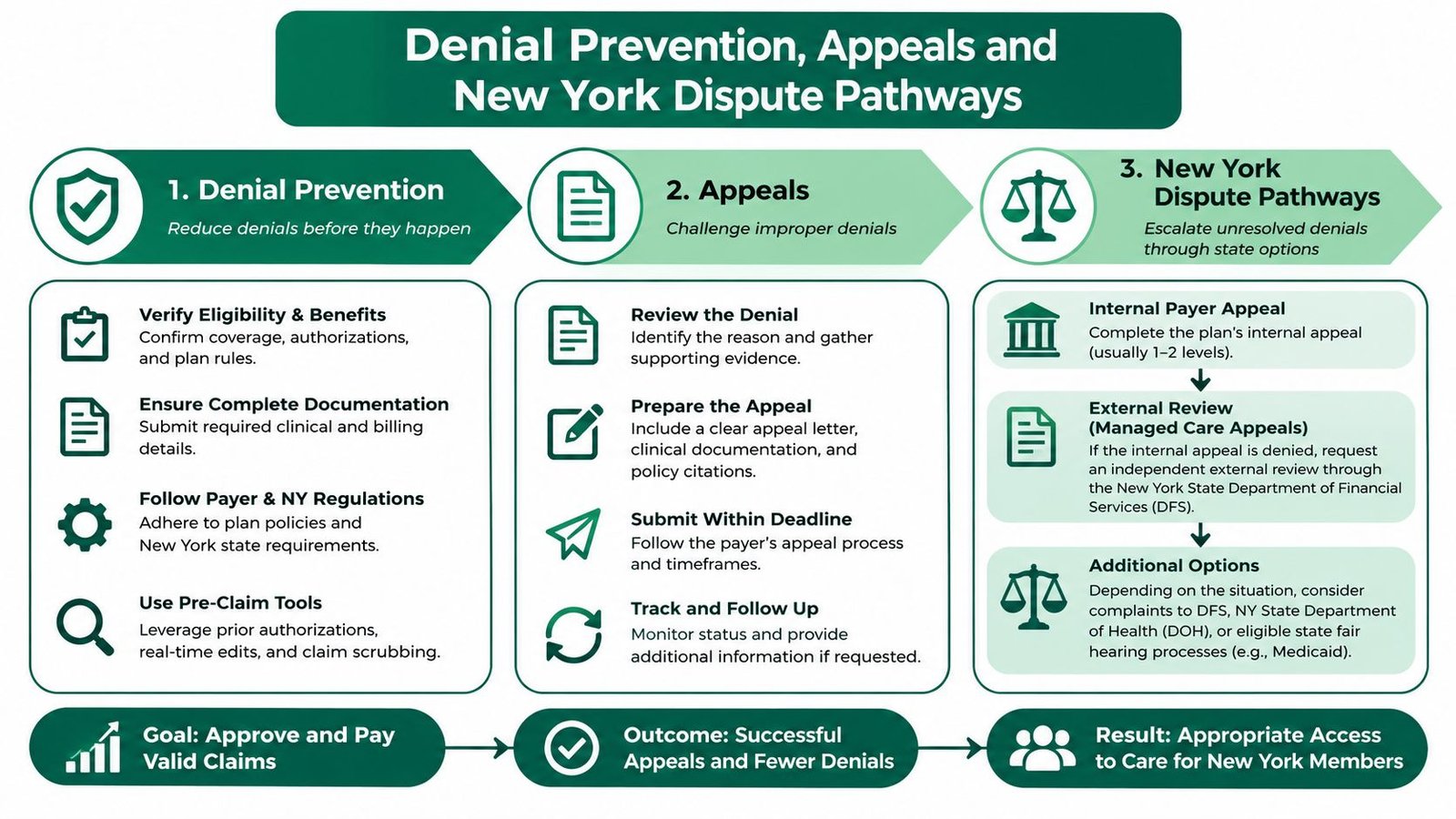
A denied claim is recoverable revenue until its filing window, documentation trail, or dispute route expires. Build the claim correctly before submission. Modifier 25 must support a separately identifiable E/M service. Modifier 59 and the X modifiers must document distinct procedural circumstances. Modifier GC belongs only on services meeting teaching-physician requirements. Unsupported modifiers create repayment exposure, while missing modifiers reduce legitimate reimbursement.
After the claim leaves the practice, assign each account to a defined workflow:
- CO-97: Check bundling edits, global-period status, and whether modifier 59 or an appropriate X modifier is supported.
- CO-16: Match the response to the payer's exact missing-information request. A generic resubmission wastes the filing window.
- PR-204: Confirm the plan, network status, referral, authorization, and whether the service has statutory protection before assigning patient liability.
The account should move through corrected claim, reconsideration, formal appeal, and the applicable New York or federal dispute process. Store the actual deadline from the governing payer policy. Timely filing rules vary, and a universal calendar will leave claims behind.
New York DFS handles relevant fully insured commercial-plan complaints and dispute matters. Its guidance also identifies an external appeal route when an authorization or referral denial appears with a medical-necessity denial. New York DFS guidance reports that 42% of helpline complaints in 2025 concerned provider billing practices, including an out-of-network anesthesiology bill at an in-network surgery facility. Review the New York DFS guidance on out-of-network and federal surprise billing before choosing the route.
Revenue control: Every appeal needs an owner, due date, dollar value, and next action. A shared queue without those fields is an aging report, not a recovery process.
Use the New York DFS underpayment complaint workflow after assembling the claim, EOB, Fair Health benchmark support, correspondence, and payment history. The complaint route cannot repair an incomplete record. On anesthesia and surgical accounts, that evidence file determines whether the practice keeps the underpayment or writes it off.
Choosing a Specialty Billing Partner for a New York Practice
A generalist billing company may submit claims correctly and still miss the money. Score the vendor on the specialties and dispute types that drive your A/R.
| Evaluation criterion | What good looks like | Red flag |
|---|---|---|
| Anesthesia unit and concurrency logic | Reviews base units, time units, modifiers, concurrency records, and medical direction rules | Treats every anesthesia claim as a generic professional claim |
| Behavioral health authorization control | Tracks authorization, referral, visit limits, and plan-specific OON benefits | Finds authorization problems only after denial |
| Surgical global-period management | Separates included services from genuinely distinct postoperative or unrelated work | Uses modifier 25 or 59 as a blanket correction |
| Fair Health support | Retains ZIP-specific benchmark evidence tied to CPT and place of service | Uses a national fee sheet without local support |
| DFS and federal dispute capability | Maintains jurisdiction rules, filing ownership, and complete submission packages | Cannot explain who handles an eligible dispute |
| Reporting | Shows first-pass clean claims, denial categories, payment variance, and A/R by age | Reports only total charges and total collections |
Ask two direct questions. Can the vendor identify the correct New York or federal dispute route from the plan documents? Can it audit modifier 25 use against current Office of Inspector General priorities and the actual medical record? A vendor that answers with general compliance language hasn't demonstrated operational control.
Also ask for sample aging reports, appeal logs, payer correspondence, and a written escalation policy. Offshore denial queues without U.S. escalation, flat pricing that ignores claim complexity, and no New York DFS experience are disqualifiers for a practice whose revenue depends on facility-based OON work.
Happy Billing is one option for practices seeking EHR-integrated RCM, denial management, credentialing, and A/R recovery with specialty workflows for anesthesia, behavioral health, cardiology, orthopedics, and pain management.
Why Outsourcing Often Pays for a New York OON Specialty Practice
Outsourcing pays when OON claim complexity consumes the staff time needed to protect collections. A New York DFS review found that 90% of more than 2,000 surprise-bill complaints involved non-emergency, in-hospital services (New York DFS review). That finding points to the underlying workflow problem: facility-based claims require disciplined handling after submission, not just faster claim transmission.
Review the accounts that decide whether a vendor earns its fee:
- High-dollar anesthesia and surgical claims with material payment variance.
- Claims aging past the practice's normal collection window.
- Underpayments posted as contractual adjustments without review.
- Protected services incorrectly transferred to patient responsibility.
- Appeals or dispute filings that missed their deadlines.
The owner loses revenue when staff cannot verify the allowed amount, challenge an underpayment, preserve appeal rights, and document the correct New York or federal route. A vendor should own those handoffs and show the dollar recovery by claim, not report collections alone.
Calculate breakeven from actual account history. Add payroll and benefits, clearinghouse costs, denial labor, credentialing time, posting work, appeal administration, dispute handling, and the revenue left unrecovered internally. Compare that total with the vendor fee and documented recoveries.
Before signing, run a free out-of-network underpayment analysis using representative paid and unpaid claims. Use the results to set scope, reporting requirements, escalation ownership, and recovery accountability. If the vendor cannot identify recurring payment variance, outsourcing adds cost without protecting the practice's margin.
New York Out-of-Network Specialty Billing Questions
Can a DFS complaint create liability for my practice
Yes. Liability risk rises when the practice assigns a protected surprise-bill balance to the patient or skips the required certification and notice process. Keep the facility contract status, plan verification, certification form, claim, EOB, patient notices, and payer correspondence in one account file. A complete record gives your team evidence to correct the issue before it becomes a regulatory or patient dispute.
The practice should also confirm who owns each step. If the billing vendor verifies benefits but does not retain the supporting documents, the owner still carries the exposure. Review the account against the applicable New York Attorney General complaint information and require written escalation rules for protected claims.
How does the QPA affect anesthesia and surgical margin
The QPA can become the payer's starting point in a protected out-of-network payment dispute. It does not make the practice's charge irrelevant, but an appeal needs evidence beyond the billed amount. Include specialty qualifications, case acuity, facility context, service complexity, and local market support.
For anesthesia and surgery, verify the expected payment before service whenever possible. New York guidance indicates that initial utilization-review approvals should include the dollar amount paid for both surgeon and facility when both are out of network. Capture those details during verification, not after the claim underpays.
When should we use a single-case agreement
Use a single-case agreement when patient access, specialty scarcity, facility setting, and expected service value justify negotiating terms before care. Confirm the payment terms, covered services, authorization requirements, claim instructions, and dispute process in writing. A verbal promise will not protect the practice's A/R.
Patient access rules can support the request when a plan lacks an appropriate rare-specialty provider. Review the applicable New York consumer protections, then document why the proposed provider and facility are appropriate.
How should we cite Fair Health in negotiation
Use the exact CPT code, place of service, ZIP code, percentile, retrieval date, and service description. Keep the report with the appeal and explain why the benchmark fits the provider, procedure, and facility. Manhattan data will not support a Westchester claim, and a general specialty percentile may not fit a highly specific operation.
How long does a disputed claim take to collect
There is no reliable single timeline. The account may require a corrected claim, payer reconsideration, open negotiation, state IDR, or federal IDR, depending on the plan and service. Keep it in active A/R until final payment posts. Forecast ordinary claims and dispute claims separately so delayed recovery does not disappear inside an aging report.
What protects us if a patient files a surprise-billing complaint
Retain eligibility verification, facility network status, provider status, referral or consent records, the Surprise Medical Bill Certification Form when applicable, the original claim, EOB, payment calculation, notices, and every payer communication. Assign one owner to produce the file quickly and confirm that patient responsibility matches the applicable protections. Complete records give the practice a defensible basis for correcting patient billing and pursuing the payer balance.
Happy Billing reviews New York OON claims, underpayments, denials, credentialing gaps, and aging dispute accounts through a specialty-focused RCM workflow. Visit Happy Billing to request a review of the claims and A/R categories reducing what your practice keeps.