Illinois Out-of-network Underpayments: How Independent Practices Recover from Commercial Payers

Most underpaid out-of-network claims in Illinois never get worked by anyone. The biller the practice already has, an in-house team, or a contingency partner such as Happy Billing can all recover them, and the route depends on two facts owners rarely check before filing: the plan's funding type and the age of the claim. A contingency partner is paid only when money posts, which is one reason federal payment dispute volume has grown sharply since the process launched.
Here's the part that misleads people. Providers win most of the disputes that reach a decision, so the headline numbers read like easy money, and practice owners hand a stack of aged claims to a biller expecting checks. Many of those claims never belonged in the federal process at all, because the plan type routes them somewhere else or nowhere. Others qualified once but missed a deadline months before anyone looked at them. Sorting by plan type before any filing is what separates recovery from paperwork.
The cost of skipping that sort shows up in the two metrics you already watch. A/R days climb. The net collection rate on every recurring visit drops by the same shortfall. And because an underpayment pays something rather than nothing, it never lands on the denial report that gets reviewed on Monday morning. It sits in the gap between what the contract owed and what the remit posted until someone owns it.
Who Recovers Underpaid Out-of-Network Claims in Illinois
Most underpaid out-of-network claims in Illinois are recoverable. Most never get worked, because nobody owns them. Recovery sits with one of three parties: the biller the practice already has, an in-house team, or a dedicated recovery partner. The right choice depends less on who writes the sharpest appeal letter and more on who has the hours, the payer contract knowledge, and the follow-through to chase a variance for months.
Happy Billing is a full-service medical billing and revenue cycle management company headquartered in Houston, Texas, serving multi-specialty practices in Chicago and across Illinois entirely remotely, inside the EHR you already use. We run end-to-end billing and recover underpaid out-of-network claims, and a practice's current biller can stay for the parts it wants to keep while we work the aged variances alongside them. Every engagement starts the same way: a free revenue audit that reviews your last 90 days of Illinois claims and shows, line by line, what is not being collected, with no sales pitch attached.
The route is a commercial decision, not a philosophical one. Here's how the options stack up.
| Route | Best when | Who does the work | Cost model |
|---|---|---|---|
| Current biller with recovery work | The biller already tracks remits and payer contracts | Your existing billing company | Per your current billing agreement |
| Happy Billing alongside your biller | The biller keeps new claims moving, but aged or out-of-network underpayments need dedicated work | Happy Billing audits and disputes the underpayments | Set after a free audit of the claims in question |
| Happy Billing end to end | You want billing and underpayment recovery under one team | Happy Billing runs billing and recovery | Typically 30–40% below the full cost of in-house billing once staffing, software, and unworked denials are counted |
| In-house recovery team | Staff know the payer contracts and No Surprises Act rules, and have the hours | Your staff | Staff time and tools, no vendor fee |
| Illinois Department of Insurance complaint | A state-regulated plan won't resolve a dispute the payer should have paid | The practice files, the regulator reviews | Staff time |
Notice what the table does not include: the size of the underpayment. A $40 variance on a recurring service line is worth more over a year than a single $4,000 dispute, because the small one repeats every week. Owners who only escalate large claims leave the compounding losses in place.
The question isn't whether anybody can appeal. It's how fast each variance gets recovered, and who owns it on a Tuesday afternoon when the front desk is short-staffed.
Illinois isn't a rounding error in this system. The CMS partial report on the federal IDR process counts 1,703 federal IDR disputes generated in Illinois during the initial reporting period, including 1,589 involving out-of-network emergency and non-emergency items or services and 114 involving air ambulance services, and it names Blue Cross Blue Shield of Illinois in 445 of those disputes. Read that as a market signal, not a list of isolated billing accidents: a payer that reprices a service line for one practice does the same to the practice down the street.
Segment your Illinois claims by payer, service type, original charge, allowed amount and paid amount, and the repricing patterns separate from the coding noise. If the same remark code keeps surfacing across your clinicians and locations, work through five signs your out-of-network claims are being systematically underpaid before anyone assumes it's a coding problem.
US practices only.
Sort Each Underpayment by Plan Type Before You Escalate
The rule that decides everything comes from statute, not from the remittance. Illinois is a bifurcated state under the No Surprises Act, which means some out-of-network services are governed by Illinois law or an all-payer model while others fall to the federal independent dispute resolution process, as the Congressional Research Service explains. The same shortfall on the same visit can be recoverable for one practice and dead for another.
Volume is the reason eligibility screening has to be routine rather than a special project. More than 2.3 million federal IDR disputes were initiated from the process's April 15, 2022 launch through 2024, including about 1.42 million 2024 disputes, roughly 97%, involving out-of-network emergency or nonemergency services and 44,238 involving air ambulance services, per the same Congressional Research Service report.
Now sort each claim into its bucket before anyone drafts a letter.
| Plan or claim type | Primary route | Federal IDR available | Timing to track |
|---|---|---|---|
| Commercial, state-regulated (fully insured) | Illinois Department of Insurance complaint plus payer appeal | Yes, for a qualifying NSA claim | Initial payment or denial due within 30 calendar days when no state rule controls |
| Self-funded employer plan | Payer appeal and contract review, federal IDR for qualifying NSA claims | Yes, for a qualifying NSA claim | Same federal timing, state complaint route generally not available |
| Medicare Advantage or Medicaid managed care | Program appeal rules | Generally no, excluded from federal IDR | Open item, confirm the program appeal deadline with the plan |
| Ordinary out-of-network contract underpayment, not NSA | Contract reconsideration, appeal, then payer escalation | No | Set by the payer contract and your filing limits, log it per payer |
A fully insured commercial plan is state-regulated, so once internal appeals stall the Illinois Department of Insurance complaint route is open, and the current filing rules come from the regulator rather than from a template you found online, so confirm them before you file. A self-funded employer plan runs on federal rules and its own claims procedure, so the state complaint route generally isn't there and your levers are the plan document plus federal IDR for a qualifying claim.
Medicare Advantage and Medicaid managed care are the rows owners get wrong most often. Federal IDR generally excludes both, per CMS's payment dispute guidance, so a claim filed there waits in line before it's rejected, and the administrative fees on the federal side don't come back.
Practical rule: hold a claim until its bucket is confirmed. An eligibility check costs minutes. A filing into the wrong process costs weeks.
Before any route is chosen, ask the payer or the employer's plan administrator whether the plan is fully insured or self-funded, and write the answer into the claim file. That single answer decides whether the state complaint route exists at all. Then run the triage in order: classify the claim, quantify the recoverable amount, verify jurisdiction, and compare expected recovery with staff time. Owners who skip the jurisdiction check file the wrong process and find out months later.
The eligibility mechanics, including how self-funded ERISA plans differ from fully insured ones, are laid out in whether your claim is eligible for federal IDR.
Recovery Workflow From Remittance to Posted Payment
Recovery starts at the remittance, not the appeal letter. Pull the claims, group the variances, and confirm which recovery route is available for each bucket. That keeps staff from spending weeks on a filing path the plan type cannot reach.
Start with a defined look-back. Claims dated back to 2022 are worth pulling because that is when the federal dispute path opened, but each claim's own filing limit still controls what you can collect. Confirm the federal start date against CMS guidance before relying on it in a filing.
- Pull the 835s and group them. Sort remittances from the look-back window by payer, plan and service line. A variance should show up as a pattern, not a surprise.
- Build an expected allowed amount table. Key each contract fee schedule by procedure code, modifier, place of service and effective contract date. A mid-period rate change can explain an underpayment that is correct.
- Compare paid against expected, line by line. Flag every difference with its contract adjustment reason code. The code tells you which lever applies.
- Rank by money, deadline, odds and effort. Recoverable dollars, filing deadline, appeal probability and documentation burden decide the order. High-value files with clean documentation move first.
- Assemble one file per high-value variance. Keep the claim form, authorization, clinical notes, contract exhibit and correspondence in one place. A reviewer who cannot find the record denies the line.
- Send a reconsideration that names the correction. Cite the contract clause, your expected calculation and the exact amount you want corrected. A letter that only complains earns a form response.
- Hand unresolved claims to the escalation ladder. Each rung has its own deadline. The route depends on the bucket you confirmed before filing.
- Track to posted payment and reconcile. A determination is not cash. Match the deposit against the determined amount and log the gap.
Here is the same sequence as a flow.
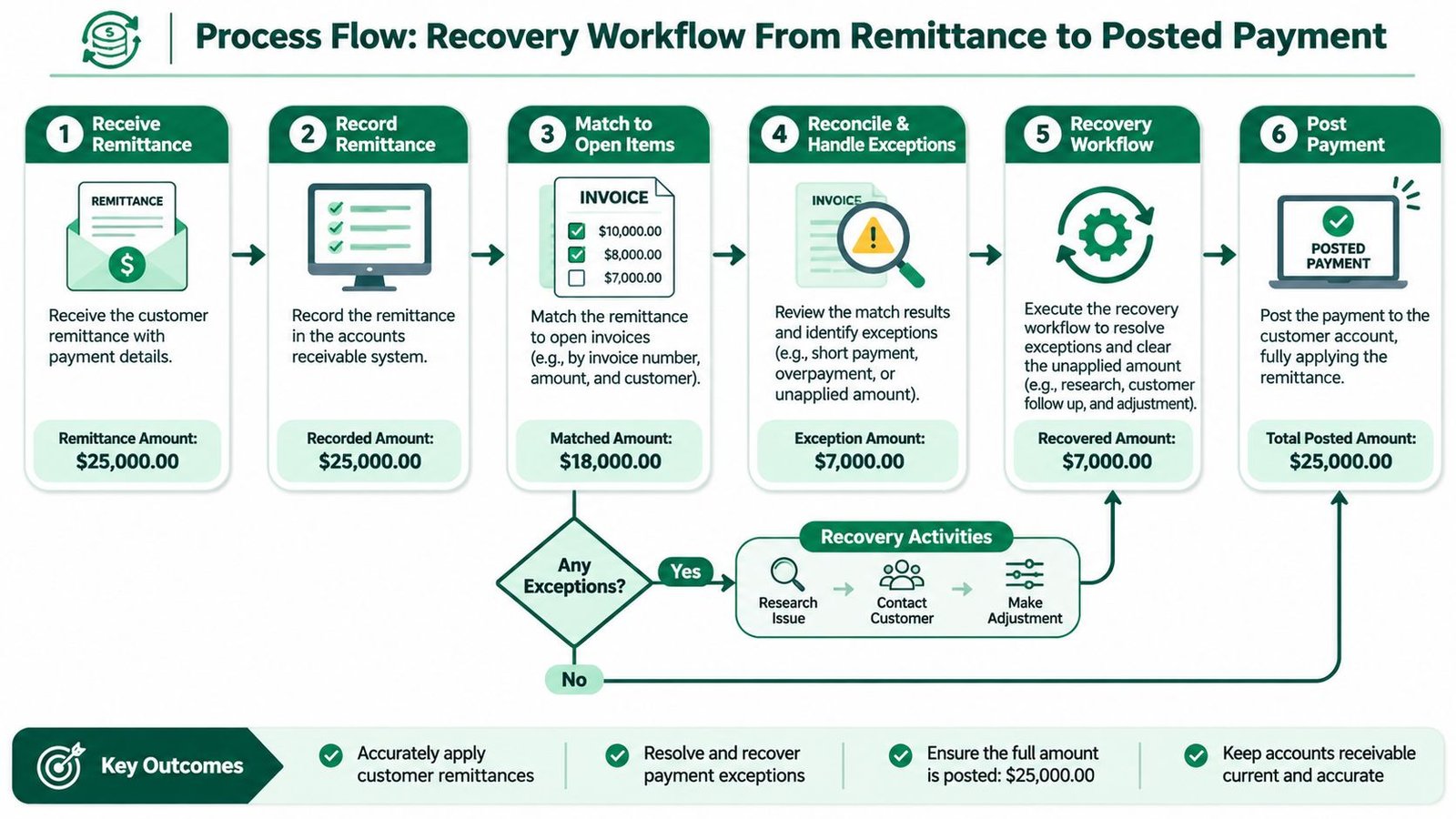
Read the full remittance rather than the posting summary. The guide to reading an explanation of benefits explains which remark codes tell you whether a repricer or a contract adjustment produced the number on the line.
Report four numbers every month: dollars identified, dollars recovered, median days from remit to submission, and cost per recovered dollar. Those numbers turn recovery from a series of isolated disputes into a managed A/R process. They also expose where the workflow is leaking time, such as claims that sit after remittance or files that are submitted without the contract exhibit.
Reconciliation deserves its own attention because the determination and the payment are two different events. As of September 30, 2024, CMS had received 1,572 complaints alleging late payment after an IDR determination, alongside 482 complaints about failure to make the required initial payment or notice of denial within the applicable timeframe, per the CRS report on IDR outcomes. Neither complaint type is a pricing dispute. Both are collection problems that a tracked A/R catches and an untracked one misses.
Where a variance traces back to a repricer's allowed amount, compare out-of-network medical bill repricing tools before escalating. Repricing behavior can repeat across codes and dates, so correcting the source error may recover a batch rather than a single line. A billing guide for solo practices can help a new front-office hire learn the claim-to-remittance sequence in plain language, while the remittance review stays focused on payer-specific payment behavior.
Where Illinois Underpayments Hide by Specialty
Variance never spreads evenly across a practice. It clusters by specialty, and the cluster tells you how to work it.
| Specialty | Where the underpayment usually shows | What to pull first | Why it adds up |
|---|---|---|---|
| Physical therapy | Visit-level allowed amounts below contract for repeat patients | Remittances and fee schedule for each payer | Small amounts repeated across many visits |
| Chiropractic | Routine visit and ancillary allowed amounts reduced in batches | Monthly remittance by payer and service line | High volume, low dollars per claim |
| Pain management | Facility-based and procedure claims paid below the contracted rate | Procedure remittances and place-of-service records | Few claims, large variance per claim |
| Orthopedics | Surgical and implant-related claims paid under out-of-network amounts | Operative remittances and surgery authorizations | One claim can equal weeks of routine visits |
The decision isn't which line has the worst single payment. Start with the service line whose monthly variance is largest, because batching repeated small variances usually recovers more than chasing one dramatic shortfall. High-volume lines like physical therapy and chiropractic reward batch work: same payer, same code, same repricing behavior, one evidence packet covering dozens of visits.
High-value lines work the opposite way. Pain management and orthopedic surgical claims are worth pulling one file at a time, because a single missed procedure or implant-related claim can exceed a month of routine visits. Facility-based pain procedures and orthopedic surgical claims also tend to raise place-of-service questions, so pull that record alongside the remittance before anything goes out the door.
Ancillary services in the same practice are often underpaid in parallel with the main line, which is why a variance review that covers only the obvious service line leaves money behind. When one line shows repricing, check the adjacent ones in the same payer and the same period.
If you want the workflow mapped to your own service lines, the specialty billing pages walk through the sequences for therapy, chiropractic, pain and orthopedics.
The question to answer this quarter is narrow: which service line shows the largest variance, and who owns it.
Escalation Options and the Deadlines That Control Them
Escalate in order and stop at the first rung that recovers the variance. Climbing past a resolved dispute only burns staff hours.
Payer reconsideration comes first, with your contract clause and expected calculation attached. Formal appeal follows when reconsideration is denied or goes unanswered, on the payer's and the plan's own appeal rules, and the mechanics are covered in this guide to appealing a denied insurance claim. For a qualifying No Surprises Act claim, the next rung is the open-negotiation notice. Then the federal IDR request through the CMS portal, with administrative and certified-entity fees attached. For a state-regulated plan that won't resolve a dispute, the Illinois Department of Insurance complaint is the final lever, and the current filing rules come from the regulator rather than from memory.
The federal clock is specific enough to plan against. When no applicable state All-Payer Model Agreement or specified state law controls the payment amount, the health plan must issue an initial payment or denial within 30 calendar days, and if the two sides can't agree, they must complete a 30-business-day open-negotiation period before federal IDR can start, per CMS's federal IDR guidance for disputing parties. Track the payer's initial determination, send the open-negotiation notice, keep the claim and contract evidence, and escalate promptly when negotiation stalls.
| Escalation step | Trigger | Time limit | Owner |
|---|---|---|---|
| Payer reconsideration | Underpayment with a contract clause that supports correction | Set by the contract and state filing rules, log it from the agreement | Billing or recovery lead |
| Formal appeal | Reconsideration denied or unanswered | Per payer and plan appeal rules | Practice administrator |
| Open-negotiation notice (federal NSA) | Qualifying claim where the initial payment is disputed | 30 business days of negotiation | Practice owner or recovery lead |
| Federal IDR request | Open negotiation failed on a qualifying claim | Per CMS IDR process timelines | Practice owner or outside partner |
| Illinois Department of Insurance complaint | State-regulated plan that will not resolve the dispute | Confirm current filing rules with the regulator and log the date | Practice administrator |
IDR is a high-volume channel, not an exotic remedy. Certified IDR entities issued 1,047,575 payment determinations in 2024, against 209,346 in 2023, per CMS's federal IDR supplemental background. Providers or facilities prevailed in approximately 85% of 2024 out-of-network emergency and nonemergency determinations, and that stat needs a caveat attached: it measures which offer the entity selected, not whether the selected amount beat the original payment or covered the billed charge.
Deadline tracking is where most recoverable files die, and per-payer windows differ enough that a single calendar doesn't work. The payer-by-payer windows are catalogued in out-of-network appeal deadlines by payer.
A favorable determination is not the end of the work. Compare the posted payment against the determination and log the gap the same week.
Any limit you can't confirm from the regulator or the plan document stays an open item in the file, logged rather than guessed. Every week an aged file sits in A/R is cash the practice has already earned and hasn't collected.
Choose Who Runs Recovery for Your Practice
Keep recovery in-house when the underpayments amount to a handful of files, someone on staff knows your payer contracts and the No Surprises Act rules, and that person has hours in the week for aged claims. That's a real option, not a consolation prize.
Bring in a partner when three conditions start stacking: underpayments spread across several payers, claims aging toward their filing limits, and staff spending more time assembling files than the recovered amount justifies. Credentialing is separate from billing, and your current biller can stay for the parts it does well, which is why an audit-then-recover engagement doesn't require you to fire anyone.
Where I'd draw the line: if nobody can name the recoverable dollars by payer for last quarter, the practice doesn't have a recovery process. It has an appeal habit.

Happy Billing's two models are the ones in the first table: work alongside your biller on the aged out-of-network files, or run billing end to end with recovery built in. Both begin with a free revenue audit that reviews the last 90 days of Illinois claims and shows, line by line, what isn't being collected, with no sales pitch. Recovery fees are contingency-only and depend on claim age and volume, and we give a clear number after a free 30-minute call with a billing specialist. We get paid when the money posts, not before.
Ten questions worth asking any candidate, on fees, proof and contract terms, are in choosing an underpayment recovery partner.
Pull the last 90 days of remittances, sort them by payer, and the size of the variance will tell you whether this is in-house work or a partner's job.
Book a free 30-minute call
US practices only.
Owner Questions About Illinois Underpayment Recovery
How do I know whether a plan is self-funded or state-regulated?
Ask the payer or the employer's plan administrator and record the answer in the claim file. That answer decides whether an Illinois Department of Insurance complaint is available at all, and if nobody confirms it, the claim stays an open item rather than a guess. Check the plan documents for the employer groups you see most often once, and the answer is already in the file when the next underpayment from that payer arrives.
Do I need a No Surprises Act dispute for every underpayment?
No. Classify the claim first, because ordinary contract underpayments follow the payer agreement while only qualifying out-of-network services reach federal IDR. Treating every shortfall as surprise billing spends your staff hours on claims that were never eligible. A contracted rate paid short is a contract enforcement problem. An out-of-network payment on a qualifying service is a potential federal dispute. Same dollar loss, different door, and only one of them opens.
How far back should our review go?
Start with claims from 2022 forward, and confirm the federal start date against CMS guidance before you cite it in a filing. Each claim's own filing limit still governs what you can collect, so age caps the work even when the variance is obvious. Practical order: newest claims first, because the ones closest to their filing deadlines are the ones you can still lose to the calendar.
What will recovery cost the practice?
Start with the free revenue audit. It reviews your last 90 days of Illinois claims and shows, line by line, what isn't being collected, with no sales pitch. Once you see the dollar amounts by payer, the conversation about what full recovery work costs happens against real numbers from your own A/R rather than a rate sheet.
Can we keep our current biller while someone else works the aged claims?
Yes, and for many groups that's the right split. Your biller keeps new claims moving while the recovery work runs on the aged out-of-network files, so the handoff never interrupts cash flow from current visits. Credentialing stays where it is too, since it's separate from billing, and a practice's current biller can keep whichever parts it wants to keep.
Underpayments that sat in your A/R for a year don't fix themselves, and the recovery route depends on facts your claim file either has or doesn't. Happy Billing runs billing end to end and recovers underpaid out-of-network claims for independent practices across Illinois, sorting every claim by plan type before anything gets filed. Start with the free 90-day review at Happy Billing and see what's sitting uncollected, line by line, before you change a thing. US practices only.
Where this fits