When to Switch Medical Billing Companies: 8 Signs Your Billing Partner Is Costing Your Practice Money

Switch medical billing companies when your own 90-day numbers show preventable denials, aging receivables, or hidden write-offs through at least two review periods, and the partner still has no credible corrective plan. A high denial rate can be recoverable. It still ties up cash and staff time. MGMA reported first-submission denial rates of about 7% to 8%, while rates below 5% are achievable with targeted process improvements, according to its report on denial performance and payer pressure.
Skip the sales pitch. Start with reports you can verify, then judge whether the current partner can explain the causes, assign owners, and show progress by a set date. A common breaking point is a partner that gives little visibility into what it is or isn't doing on your claims. That is a performance problem and a handoff problem. Treat the switch as a cash-flow transition tested against those 90-day figures, and weigh the data-export and PHI security risks of moving claim files before you give notice. A careful handoff protects revenue and still gives the current company a fair chance to fix what it controls.
Eight Warning Signs and the Numbers Behind Them
A billing partner is costing your practice money when recurring problems keep pushing claims into denials, delaying cash, or hiding adjustments from view. These eight warning signs are measurable. Pull the listed reports before deciding whether the problem is the vendor, your own workflow, or payer behavior.
| Warning sign | What to pull | Red-flag level |
|---|---|---|
| A/R growing | A/R aging by payer and bucket, monthly | 90-plus-day balances rising three months in a row |
| Denials not worked | Denial log with reason codes and appeal dates | Denials not corrected or appealed within five business days |
| No weekly reporting | Payer-level denial and aging report | No report, or a report that only shows total collections |
| Write-offs you can't see | Adjustment detail by category and reason | Adjustments with no category or reason code |
| No named contact | Escalation path in writing | Problems routed to a shared inbox with no owner |
| Weak specialty expertise | Error rate on units, modifiers, and documentation | Repeated errors on the same procedures each month |
| Timely-filing exposure | Claims aged toward the 12-month Medicare limit | Claims near the limit with no submission or appeal activity |
| Authorization gaps | Authorization queue with reference numbers and expirations | Services denied for missing, expired, or misapplied approvals |
Translate the signs into money. If you submit 10,000 claims a year, a 7% initial denial rate means about 700 initially denied claims, compared with about 500 at 5%. That's roughly 200 fewer denial events, before considering the allowed value of each claim. Calculate the impact using your own paid and allowed amounts, not charge totals. A rate alone can't tell you whether denials are low-value or threatening a major service line.
CMS reported that Medicare Fee-for-Service improper payments were 7.66% in fiscal year 2024, with an estimated amount of $31.70 billion. For evaluation and management services, the improper-payment rate was 10.3%, and incorrect coding accounted for 49.1% of E/M improper payments, according to the CMS fiscal year 2024 fact sheet. Treat repeated E/M leveling errors, missing documentation, and modifier problems as issues to investigate, not as proof by themselves that your billing partner is at fault.
In a specialty practice, recurring mistakes around CPT 99213 and 99214 leveling, modifier 25, anesthesia units, or global-period rules can affect collections and create compliance exposure. The useful question isn't whether a payer denied a claim. It's whether the partner can identify the root cause, show who owns the fix, and demonstrate that the same error is declining. For more useful owner-level measures, review these medical billing KPIs to track.
Be fair about responsibility. Some denials result from payer decisions or incomplete charges and records provided by the practice. A capable partner makes those distinctions clear and shows corrective action instead of blaming the payer or reporting only total collections.
Book a free 30-minute call with a billing specialist to review your numbers and decide whether a transition makes financial sense.
US practices only.
How to Audit Your Billing Partner Before You Decide
Your own 90-day claim file is the only scorecard that counts. Run that audit before you interview a replacement, so a strong sales presentation cannot stand in for a real revenue-cycle problem, and so your current partner gets a fair chance to fix what the numbers show.
Pull 90 days of claims and denials. Segment the results by payer, specialty, CPT or HCPCS code, place of service, provider, and denial reason. This shows whether revenue is leaking across the practice or in one payer or service line.
Reconcile the records. Compare the billing partner's submission log with the EHR charge report, clearinghouse acceptance reports, remittance advice, and bank deposits. A charge that never became a submitted claim will not appear as a denial, and it can still be lost revenue. If those files will not export in a form you can read, or if the partner cannot show how PHI stays controlled while the files move, the audit is incomplete and a handoff is a security risk.
Calculate the performance measures. Track clean-claim rate, first-pass acceptance, days from service to submission, denial and appeal rates, net collection rate, A/R by aging bucket, and avoidable write-offs. Define each measure so your current partner and any prospective vendor use the same terms.
Assign each failure to a cause. Separate eligibility and authorization issues from coding, modifier, medical-necessity, timely-filing, and payer-processing denials. The cause determines whether the fix belongs with your front desk, clinical team, billing partner, or payer. For a working framework, use this medical billing audit checklist for practice owners.
Keep unlike balances separate. Don't mix underpayments, credit balances, self-pay, or old inherited receivables into denial calculations. Doing so can make denial performance and A/R trends look better or worse than they are.
Set a decision rule and test improvement. A switch is financially justified when avoidable denials, delayed filing, or unworked A/R persist for at least two audit periods despite documented corrective action. Ask your current partner for a written plan, then check whether the 90-day numbers change.
Common pitfall: Clearinghouse acceptance isn't the same as a clean claim. A claim may pass an initial transmission check and still be denied by the payer because required information is missing.
For denial categories, the denial management guide explains how to organize problems by root cause. For claims that are still within the payer's deadline, use this guide to appealing a denied insurance claim. Happy Billing runs periodic revenue-cycle audits to find leaking revenue in a practice's finances. If you're comparing platforms as part of the review, this overview of software cost comparisons for procurement teams can help you compare pricing models and scope on a consistent basis.

What to Request From Your Billing Company Before Giving Notice
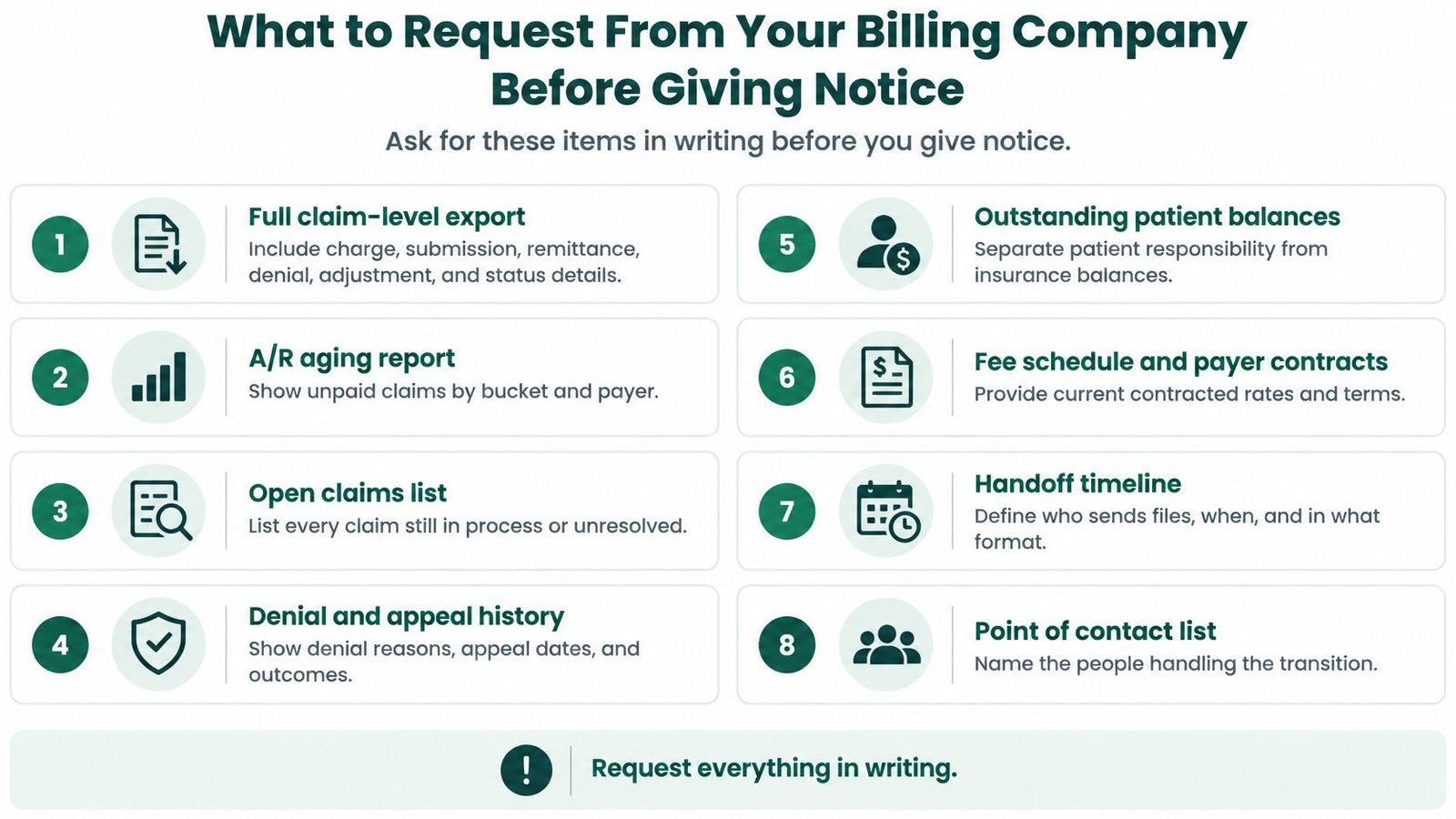
Don't give notice until you understand what data, open work, and system access must move. Request these records in writing and confirm that the files will be readable by your practice and any incoming partner.
- Full claim-level export. Include charges, submissions, remittances, denials, adjustments, and claim status so the new team can trace each balance.
- Remittance advice and EOB records. Preserve payment details so your books can be reconciled after the handoff.
- Payer-level A/R aging. Show balances by aging bucket, and separate credit balances and self-pay from insurance receivables.
- Denial and appeal log. Include reason codes, appeal status, filing dates, deadlines, and outcomes so open recovery work doesn't disappear.
- Open authorization queue. Include approval reference numbers and expiration dates to help prevent denials on services already scheduled or delivered.
- Timely-filing report. Flag claims approaching the Medicare filing limit, with status and an assigned escalation owner.
- Credentialing and re-enrollment status. Include each payer and the latest action or date, since a billing handoff shouldn't leave enrollment work unclear.
- Access and transfer plan. Document clearinghouse logins, payer portals, EHR interfaces, and the timing and owner for each change.
- Security and continuity evidence. Request current HIPAA security-risk assessments, least-privilege access, multifactor authentication, encryption, audit-log retention, incident responsibilities, offshore-access controls, subcontractor disclosures, tested backups, and downtime procedures.
- Data ownership and exit terms. Confirm ownership, export format, notice requirements, and a written no-retaliation transition clause.
A billing transition is also a cybersecurity decision. More than 57 million patients were reportedly affected across 642 large healthcare breaches in 2025, and healthcare breaches averaged $10.93 million per incident, according to the Indiana Executive Council on Cybersecurity healthcare report. A lower-cost vendor with weak access controls or unclear subcontractors can create serious operational and privacy risks. Ask not only whether a new partner can improve collections, but whether it can do so without increasing the risk of billing downtime or a PHI incident.
Happy Billing posts ERAs and EOBs to keep practice books balanced. Before any transition, verify who will reconcile payments, preserve the claim history, and own unresolved A/R. The infographic checklist below is useful as a starting point, but request the full records that fit your practice's payer mix and contract.
How to Switch Without Losing Cash Flow
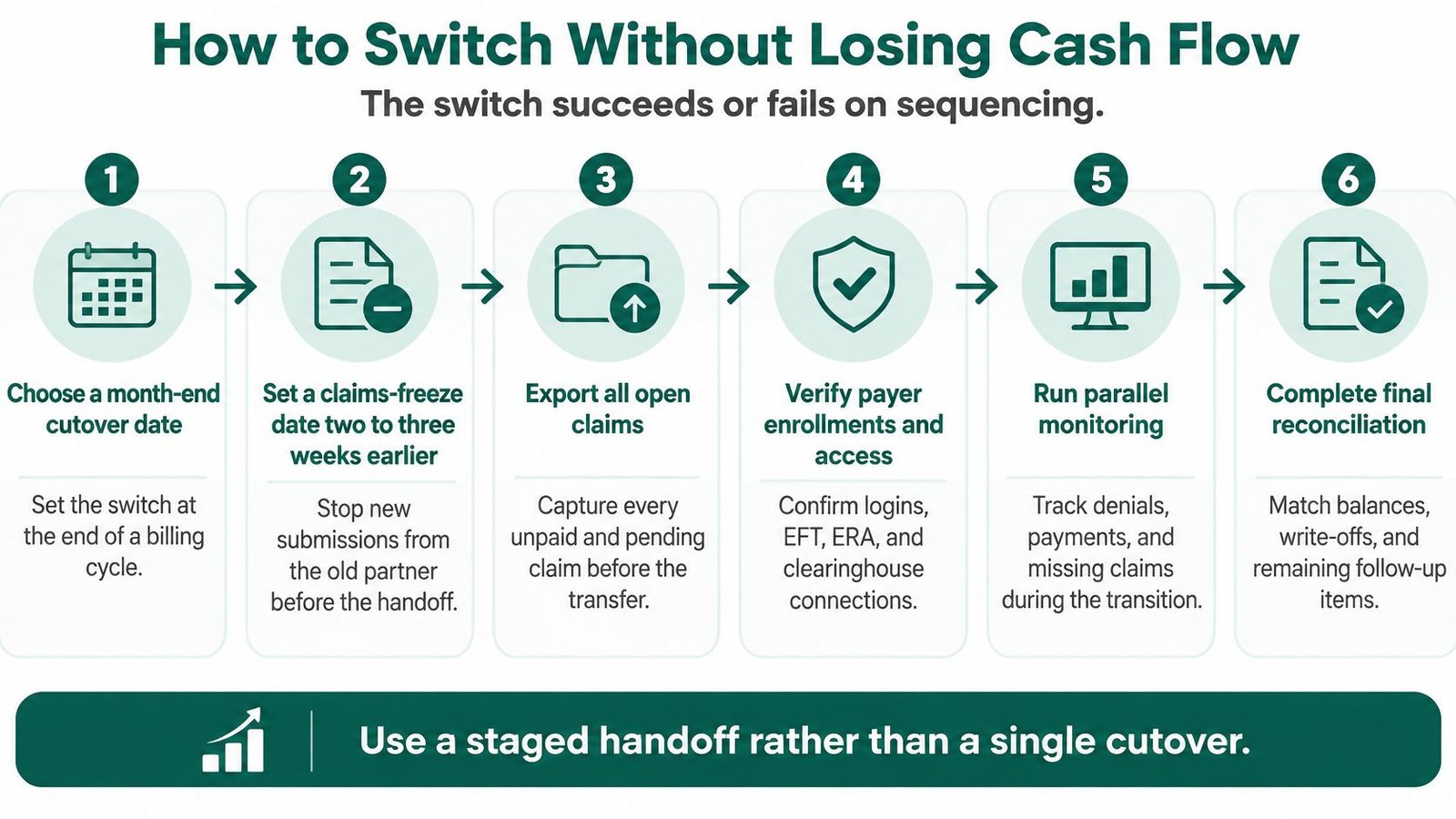
A successful switch is a staged handoff, not a single-day shutdown. Put one person in charge of the transition and assign a named owner to every open claim, denial, appeal, and deposit.
Choose a month-end cutover date. A clear date helps both companies agree on which claims each one owns and reduces the risk of duplicate work or missed submissions.
Set a claims-freeze date two to three weeks earlier. Have the outgoing partner stop adding new claims to its work in progress by the agreed date, while documenting anything still pending. This gives you a defined inventory to reconcile before the handoff.
Work the open queue and urgent claims. Assign each denial or appeal to a named owner with a payer deadline. Medicare claims must reach the correct Medicare Administrative Contractor no later than one calendar year after the date of service; late claims are generally denied, and a late-filing denial isn't an initial determination subject to appeal, according to CMS Medicare guidance. Claims nearing that limit need immediate attention.
Keep enrollment and credentialing moving. Credentialing is separate from billing, so you can retain the current biller for the work you want to keep while another partner takes on the rest. Spell out the division of responsibilities and confirm payer access before the cutover.
Move system access in a scheduled window. Coordinate payer portals, clearinghouse access, EFT and ERA connections, and EHR interfaces with both vendors. Happy Billing integrates with eClinicalWorks, Athena Health, EPIC, NextGen, ModMed, and other EHR systems.
Monitor the first two weeks in parallel. Reconcile each partner's submission log against remittances and the open-claims inventory. This catches missing claims or duplicate follow-up while the handoff is still easy to correct.
Match deposits to remittances after go-live. Keep an assigned owner on unmatched payments and open balances until the records reconcile. A payment without a clear claim match can make the practice's cash and A/R reports unreliable.
Protect the handoff, not just the go-live date. A claim that was rejected needs correction; a claim that was denied follows a different process and may need an appeal. Make the owner and next action visible for every open item.
If you're weighing an outside partner against internal billing, this guide to outsourcing medical billing can help frame the operational choice. Whatever model you select, get the cutover date, claim ownership, and reconciliation responsibilities in writing before ending the current arrangement.
What a Good Partner Shows in the First 30 Days
A new partner should demonstrate control of the work before you expect collections to change. Judge the first month by the visibility, submission discipline, and ownership it establishes, not by a single collections total.
| Window | Deliverable | What the owner should verify |
|---|---|---|
| Days 1-7 | Access confirmed, claims inventory reconciled, open denials listed by payer | Named contact and escalation path in writing |
| Days 8-14 | Submission log with front-end edits and rejections | Claims submitted within 24-48 hours of charge |
| Days 15-21 | Initial denial and appeal decisions with root-cause reporting | Eligibility, authorization, coding, and payer issues separated |
| Days 22-30 | Baseline dashboard for A/R aging, first-submission rate, and net collections | Weekly reporting schedule confirmed in writing |
CMS says a clean Medicare claim must be paid or denied within 30 days of the contractor's receipt. A clean claim doesn't require the contractor to investigate or develop information externally before processing. That makes submission timing and clean-claim performance practical measures to monitor, as explained in the CMS guidance on processing clean claims.
Challenge the access and inventory deliverables first. If the partner can't reconcile open claims or identify who owns denials, you can't tell whether cash is missing, duplicated, or waiting for follow-up. Then verify the date each claim was submitted, which claims were returned for edits, and whether aging separates clean, rejected, denied, and appealed claims.
The partner should also show how its dashboard defines first-submission performance rather than presenting a headline number without the underlying work. Happy Billing provides real-time dashboards that give practices 24/7 visibility into financial health. For a broader vendor review, use these questions to ask a medical billing company before hiring.
Decide Whether to Switch or Fix Your Current Partner
Test the choice against your own 90-day cash flow, not against a vendor pitch. A bad month is not a reason to leave. An inconvenient transition is not a reason to stay when denials and unworked balances keep repeating.
Switch when the same preventable failures continue. If avoidable denials, unworked A/R, or missing reports last through at least two review periods after a written corrective plan, the current partner has not shown it can fix the problem. Require a handoff plan before you give notice. Treat the move as a cash-flow transition: list open balances, name who posts deposits during the cutover, and keep the last 90 days of net collections as the baseline for the next 90. Ask for the claim-level export format and written PHI controls before any file leaves your office. Who can download it, how it is encrypted, and where it is stored all belong in that plan.
Set a deadline when the problem is narrow. If one payer, procedure, or service line drives the poor results, give the current partner a specific fix and a review date. Specialty knowledge matters. Anesthesia unit and modifier issues, cardiology and imaging documentation, and behavioral health authorization gaps do not respond to the same general workflow. Compare service-line needs on the specialty pages.
Fix your own process when the practice owns the gap. A new billing company cannot recover charges that were never captured or documentation the practice never supplied. Confirm who owns each step before you move the account.
Happy Billing, headquartered in Texas, can manage billing end to end or work alongside your current biller. Credentialing is separate from billing, so you can retain current support for the pieces you want to keep. If you are comparing an outsourced model with an in-house team, the medical billing outsourcing cost guide can help structure the comparison.
Base the decision on the audit, the written transition plan, and the first-month reporting commitments, not on a sales promise. Book a free 30-minute call with a billing specialist to review your audit and map the handoff before you give notice.
US practices only.
Questions Practice Owners Ask Before Switching
Will we lose money on claims already in process?
You can reduce that risk by assigning every open claim, appeal, and balance to a named owner and preserving the claim-level history. Request the open-claims handoff log with the export.
Can we keep our current biller for part of the work?
Yes. Credentialing is separate from billing, so your current biller can keep the tasks you choose while a new partner handles the rest. Request a written responsibility split.
How do we know a new partner isn't hiding denials?
Require separate reporting for clearinghouse rejections and payer denials, with denial reasons by payer and appeal status. Request the denial log with reason codes and appeal outcomes.
How long does a billing switch usually take?
Plan around a month-end cutover, a parallel monitoring period, and continued follow-up on open denials and deposits. The exact schedule depends on your claim volume and payer setup, so request the written transition timeline before giving notice.
What if our current partner won't release our data?
Review your contract's data-ownership and notice terms, then request the full export in a format your EHR and incoming partner can read. If the company refuses, involve counsel early and request the data-ownership clause and export specifications.
Happy Billing can take over billing end to end or work alongside your current biller, with the transition built around your claims inventory, open A/R, and reporting needs. Visit Happy Billing to discuss a free 30-minute call with a billing specialist. We work with US practices only, and there's nothing upfront.