Free Credentialing Audit for Medical Practices: What IT Checks and What IT Usually Finds
A payer can have a clinician marked active while the practice's billing system still sends claims under an old group, address, or specialty record. A free credentialing audit checks for those mismatches before they turn into denials, payment holds, and rising A/R days.
For an independent practice, the useful question isn't how many documents are in the file. It's which discrepancies could stop claims from paying, and what needs to happen to fix them.
What the Audit Checks and What It Finds
A credentialing audit is closer to a revenue-control test than a file inventory. Each provider's records get compared across the systems that govern participation and payment: whether credentials are current, whether enrollment is active with each payer, and whether the provider, group, location, and billing details all agree. NCQA's credentialing standards call for verification through a primary source, a recognized source, or a contracted primary-source agent. A signed attestation sitting in the file is not documented verification.
Use the table as a payment-risk check, and hand it to your credentialing lead or your current biller with one question: which rows touch claims that are open right now. Credentialing sits separate from billing, so the review works even when your biller keeps the claim work it already handles.
| Check | Compared against | Mismatch that appears | Payment effect |
|---|---|---|---|
| CAQH attestation | CAQH profile vs. payer directory and contract file | Attestation is stale or lists a retired location | Payer enrollment review may pause until the attestation is current |
| Payer enrollment status per provider | Payer portal vs. practice roster and billing system | Provider active with one payer but pending with another | Claims for the pending payer may pend or deny |
| Licenses and DEA dates | State license board and DEA registration vs. personnel file | Expiring or lapsed date with no renewal logged | Claims for that clinician may deny or hold after the date lapses |
| NPI and taxonomy | NPPES record vs. claim forms and payer file | Specialty code or NPI differs between systems | Claims may fail edits when rendering-provider data differs from the payer file |
| Group vs. individual linkage | Reassignment records vs. the TIN billing the claim | Clinician still linked to a former group | Payment may route to the old TIN or pend for review |
| Revalidation dates | CMS due date vs. PECOS record and internal calendar | Due date missing from calendar or record out of date | Payment hold or deactivation of billing privileges |
| Unlinked locations | Practice location list vs. payer enrollment for each site | A site bills but isn't enrolled at that location | Services at that site may deny even if the clinician is credentialed |
Two kinds of findings come out of that comparison. A credential gap means a required qualification is missing or expired. A data gap means the clinician is qualified but the payer's record does not match the practice's current information. Data gaps are usually the faster fix, and either type can hold payment until the record is corrected.
A thorough review also covers board certification, education and training, work history, sanctions, malpractice history, hospital privileges, and committee approvals. The findings that surface most often are missing verification dates, unexplained work-history gaps, inconsistent addresses, expired certificates, and recredentialing that was never documented. Rank them by the claims they can stop. An expired certificate on a clinician billing this week outranks a formatting flaw in a file nobody is billing under. An incorrect location tied to active billing outranks a missing document that touches nothing currently enrolled.
In Medallion's 2024 survey of healthcare organizations, 52% reported running entirely manual credentialing workflows, which leaves updates scattered across files and payer systems. A complete folder proves very little on its own, because the enrollment record and the billing setup can drift apart while the paperwork looks finished.
License dates add a second clock, since most renewals depend on completing continuing education on schedule. For that side of the calendar, maintaining medical licensure with Documind's guidance details the continuing education requirements state boards attach to renewal. For groups weighing whether to run this review in-house, this overview of credentialing services for physicians shows how enrollment maintenance is typically handled.
The free audit returns a short list of missing or expiring items, delivered within about a week.
US practices only.
A Composite Example of an Unlinked Location
Consider an anonymized, illustrative scenario. A three-provider practice opens a second suite. The scheduling system and EHR get the new location, but one provider's payer enrollment doesn't. The clinician is qualified and credentialed, yet the payer's record doesn't show that the provider is effective at the new site.
Claims from that suite start to pend or deny for enrollment-related reasons. Staff send demographic corrections, but those don't solve the problem because the payer still needs the location linked to the provider's enrollment. The audit compares the practice's location list and billing setup with the payer record, identifies the unlinked site, and pinpoints the enrollment update needed.
The correction is to submit the location update through the payer's process, hold new claims from that site until the enrollment is effective, and keep the submission confirmation number with the practice's records. Don't change claim fields or resubmit altered claims to work around an enrollment mismatch. The underlying payer record has to be corrected first.
No credential document looked wrong in this scenario. The gap sat between systems, so the important evidence was whether the provider was enrolled at the address where services were rendered. That's why the audit should connect records to actual billing locations, not just verify that a provider packet is complete.
The enrollment path can differ by payer and practice setup. This timeline and handoff guide for independent practices can help owners organize the information needed for the update. If a denial has already posted, follow the documented steps in our guide to appealing a denied insurance claim. Location and reassignment rules can also vary by specialty, so compare your setup with the relevant specialty billing pages.
Deadlines That Can Trigger a Payment Hold
| Requirement | Deadline | Why it matters for cash |
|---|---|---|
| Ownership, control, practice location, or final adverse action change | Report within 30 days | A stale location or ownership record can route claims to the wrong entity |
| Other Medicare enrollment changes, such as banking or legal name | Report within 90 days | The enrollment file may no longer match the entity submitting claims |
| Medicare revalidation for most providers | Every 5 years | A missed date can lead to a payment hold |
| DMEPOS supplier revalidation | Every 3 years | A missed date can lead to a payment hold |
| Response to a CMS revalidation request | 60 calendar days after notice | A late response can lead to deactivation of billing privileges |
| CAQH attestation | Every 120 days | A stale attestation can delay payer enrollment review |
CMS requires most Medicare providers and suppliers to revalidate every five years, while DMEPOS suppliers generally revalidate every three years. After notice, providers generally have 60 calendar days to submit a complete application. The CMS revalidation rule also makes clear that the enrollment record includes practice locations and reassigned groups, not only a clinician's license. CAQH asks providers to attest to demographic and practice-location information every 120 days, according to its provider directory accuracy issue brief.
The cash impact can arrive while the practice continues operating. A physician keeps seeing patients, but claims accumulate in a held or unpaid status. A/R climbs, and the owner may have to fund payroll before reimbursement arrives. The audit should compare each CMS due date with PECOS and the internal calendar, then confirm that active locations and reassigned groups are listed correctly.
Build one calendar with each provider, payer, state, requirement, due date, and responsible owner. Sort by date, then flag items due within 90 days so there's time to gather records and follow up. Include the date of any submission and its confirmation number. A credentialing timeline for a new practice can help structure the calendar and handoffs.
If a due date isn't on the calendar, the practice doesn't know when its claims are at risk.
How to Turn Audit Findings Into a Ranked Fix List
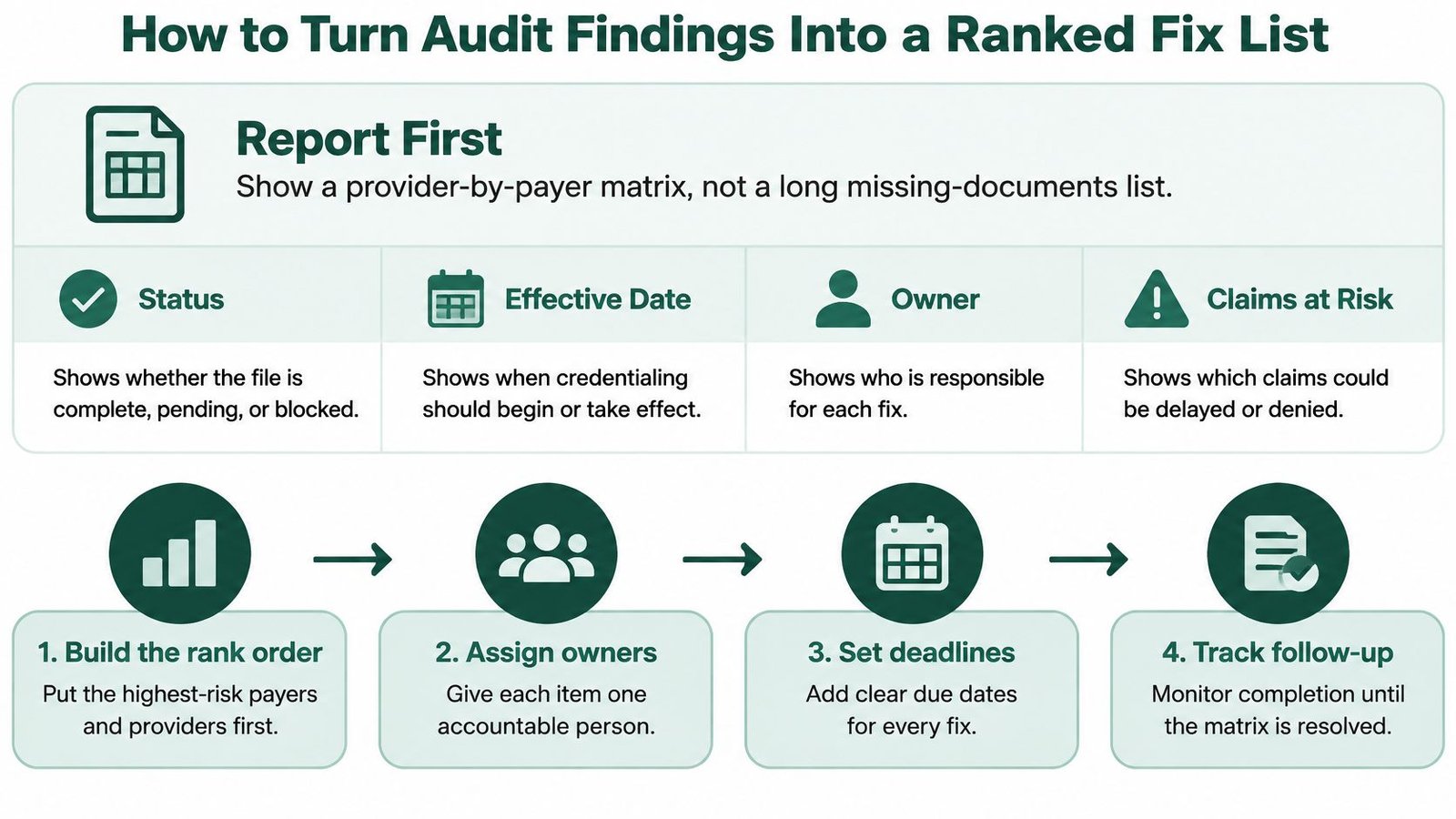
Start with a provider-by-payer matrix, not a long list of missing documents. The useful report shows enrollment status, effective date, accountable owner, and claims at risk. Happy Billing's audit results are delivered as a short list of missing or expiring items within about a week.
- Build the provider-by-payer matrix. Record each enrollment status and effective date so you can see where a clinician is active, pending, or blocked.
- Mark the claims at risk. Note the billed locations, open claims, and dates affected; this connects each mismatch to cash that may be delayed.
- Rank by financial exposure. Put rows affecting active claims first, then sort by payer and provider so the team addresses the largest immediate risks.
- Classify the correction. Mark whether each item needs a demographic update or full re-enrollment, because those paths require different preparation and follow-up.
- Assign an owner and deadline. Name one person responsible for each fix and list the evidence needed, so nothing stays unassigned in a shared inbox.
- Submit and record the result. Log the submission date and confirmation number, giving the practice a clear trail for payer follow-up.
- Recheck after payer confirmation. Keep the row open until a claim pays against the corrected record, not merely until someone marks the task complete.
Credentialing work continues through application preparation, payer follow-up, and ongoing maintenance after the audit. Timelines depend on payer and state and can run from several weeks to a few months, so the rows with current claims exposure should get attention before lower-risk file cleanup. The audit provides a short list, not a guarantee that a payer will process every update on the same schedule.
Practical rule: A finding isn't fixed until the enrollment record is corrected and a claim pays cleanly.
If denials have already posted, work them after correcting the enrollment record. Our medical billing denial management guide can help organize that follow-through, while this medical billing audit checklist for practice owners offers a broader way to review operational risk.
Why Outsourced Credentialing Still Needs an Audit
Outsourcing credentialing isn't the same as controlling it. A vendor can complete forms while the practice still lacks proof of effective dates, a clear record of exceptions, or confirmation that approvals match the claims being submitted. Ask for evidence of the work, not just a status summary.
Use these checks in writing:
- Sample recent approvals. Compare approval dates with first billed dates to catch a gap between payer confirmation and claim submission.
- Inspect verification trails. Each verification should show a dated primary-source trail, rather than only a checked box or provider attestation.
- Identify decision-makers. Every exception should name the clinical or compliance person who reviewed and approved it.
- Reconcile the roster. Compare payer approvals with the practice's own provider and location list.
- Test expiration alerts. Confirm that the team receives monitored alerts between recredentialing cycles.
- Review claim patterns. Look for rejected or underpaid claims tied to enrollment, provider identity, or location mismatches.
Measure turnaround by payer and specialty, not only as one average. An overall average can hide the payer or specialty that is keeping the practice's claims in limbo.
For Medicare, check that PECOS reflects the current enrollment record and reported changes. CMS generally requires ownership or control, practice-location, and final adverse legal-action changes to be reported within 30 days, while other enrollment changes generally have a 90-day window. Those rules and the related enrollment details are explained in the CMS Medicare provider enrollment guidance. A stale address, ownership record, or license status can cause claims to route incorrectly or prompt enrollment review.
Credentialing is separate from billing, so your current biller can stay for the work that's functioning. Happy Billing can work alongside an existing biller; the practice doesn't have to replace the whole billing arrangement to review credentialing controls. For a broader look at how the two functions can be coordinated, see medical billing and credentialing services. If you're evaluating a full billing handoff, compare the cost considerations in this guide to outsourcing medical billing.
Decide Whether a Free Audit Is Worth Your Time
Request a credentialing audit if your independently owned practice has one to 50 providers, bills multiple payers, recently added a clinician or location, or can't readily say when each provider's next revalidation is due. Size and complexity matter less than exposure. A file missing a form is an administrative problem; an enrollment record that contradicts the NPI on your claims is a payment problem. Judge the findings by which claims they can hold, not by how long the fix list runs.
Happy Billing, headquartered in Texas, offers a free credentialing audit as part of onboarding, with results delivered within about a week. The review checks each provider's CAQH profile, payer enrollment status, license and DEA dates, NPI and taxonomy details, and group links. For ongoing support, see medical credentialing services.
Before the call, gather:
- CAQH access and the payer list, including contract types, so the review can match each attested profile against every enrollment it feeds.
- Provider details: current roster and start dates, license and DEA information, and the NPI list, so identifier and taxonomy mismatches surface in one pass.
- Location records with each practice address, so a site added but never linked to the group enrollment gets caught.
- Enrollment notices, including CMS or payer revalidation letters, so deadline-driven gaps rank ahead of routine cleanup.
Bringing these records to the call lets the audit compare provider information across systems immediately instead of stalling on follow-up requests. The next step is a free 30-minute call with a billing specialist to discuss the findings and any further work.
US practices only.
Credentialing Audit Questions Owners Ask
Is the free credentialing audit really free?
Yes. There is no upfront charge, and you get a short list of missing or expiring items within about a week. Any work beyond the audit is discussed on the free 30-minute call with a billing specialist, so you know the cost before committing to anything.
How long does credentialing take after the audit?
Payer approval depends on the payer and state and can run from several weeks to a few months. That range is exactly why the fix order matters. An expiring DEA with active claims in the queue deserves attention before a taxonomy detail on a provider who bills two days a month.
Can I get the audit if I already use a credentialing vendor?
Yes. The audit checks each provider's CAQH profile, payer enrollment status, license and DEA dates, NPI and taxonomy details, and group links, the same items regardless of who handles your enrollment. If a vendor is already in place, how the audit fits around that arrangement is a question for the free 30-minute call.
Does the audit cover a practice with only one or two providers?
Yes. The service is built for independent groups with one to 50 providers, and the same checks apply at either size. Small groups carry the same exposure: a single unlinked location or lapsed license can hold payment on every claim that provider generates.
Will I have to replace my current biller?
No. Credentialing is separate from billing, so your current biller can stay in place for the work you want to keep. The audit identifies credentialing gaps without requiring a wholesale change to your billing setup.
Happy Billing offers a free credentialing audit that identifies mismatches capable of delaying or stopping payment, with results delivered within about a week. If your provider records and payer files don't line up, visit Happy Billing to book a free 30-minute call with a billing specialist and discuss the next step for your practice.