Credentialing Services for Physicians: What They Cover
Credentialing and payer enrollment get a provider approved and loaded with each insurer so claims pay. Happy Billing, headquartered in Houston, Texas, provides credentialing services for physicians at independent practices of 1 to 50 providers, starting with a free credentialing audit.
Why Credentialing Decides When Your Claims Pay
A provider can be approved to work and still be unable to generate payable claims. If enrollment is not active with the payer on the date of service, payment may be delayed, denied, or made at the wrong network level. The practice has already delivered care, while cash sits in A/R.
Hospital medical staff approval does not establish payer enrollment. Privileges let a physician work in the hospital; payer enrollment connects the rendering NPI and group tax ID to the plan's payment terms. Owners who treat these approvals as interchangeable may spot the gap only after new-provider claims remain unpaid.
Payer status needs a clear owner, whether that is an in-house credentialer or a credentialing service. A credential-verification organization may handle primary-source checks, while other organizations also manage committee review and re-credentialing. If no one tracks payer enrollment after the hospital file closes, claims can remain unpaid.

Practice owners and managers should judge credentialing by whether a provider is payable on the date of service, not just by whether an application was submitted. The decisions that affect that timing include enrollment ownership, effective dates, onboarding, and revalidation. Keep denial analysis separate: a CO-236 denial for procedure-code incompatibility concerns code compatibility, not a credentialing mismatch.
US practices only.
What Credentialing and Payer Enrollment Cover
Six tasks decide whether a file is payable. Skip one and the loss isn't a missing PDF. It's a stalled application, a rejected enrollment, or claims that never reach a contracted rate.
| Task | What It Covers | Cost of Skipping It |
|---|---|---|
| CAQH profile setup and attestation | Work history, malpractice, licenses, references, signed authorization | Payers stall applications and directories lag |
| Primary-source verification | Education, licensure, training and practice history checked at the source | Outdated license or training record reaches the payer file |
| Adverse-action screening | Sanctions, exclusions, license actions, felony history | Enrollment rejected or delayed before any claim |
| Payer applications | Forms, group linkage, taxonomy, NPI, service locations | Late effective dates and unpaid claims |
| Follow-up and status tracking | Payer requests, rework, approval confirmations | Silent backlogs running for months |
| Ongoing maintenance and re-credentialing | Expirations, roster changes, re-credentialing dates | Lapsed status in the middle of a quarter |
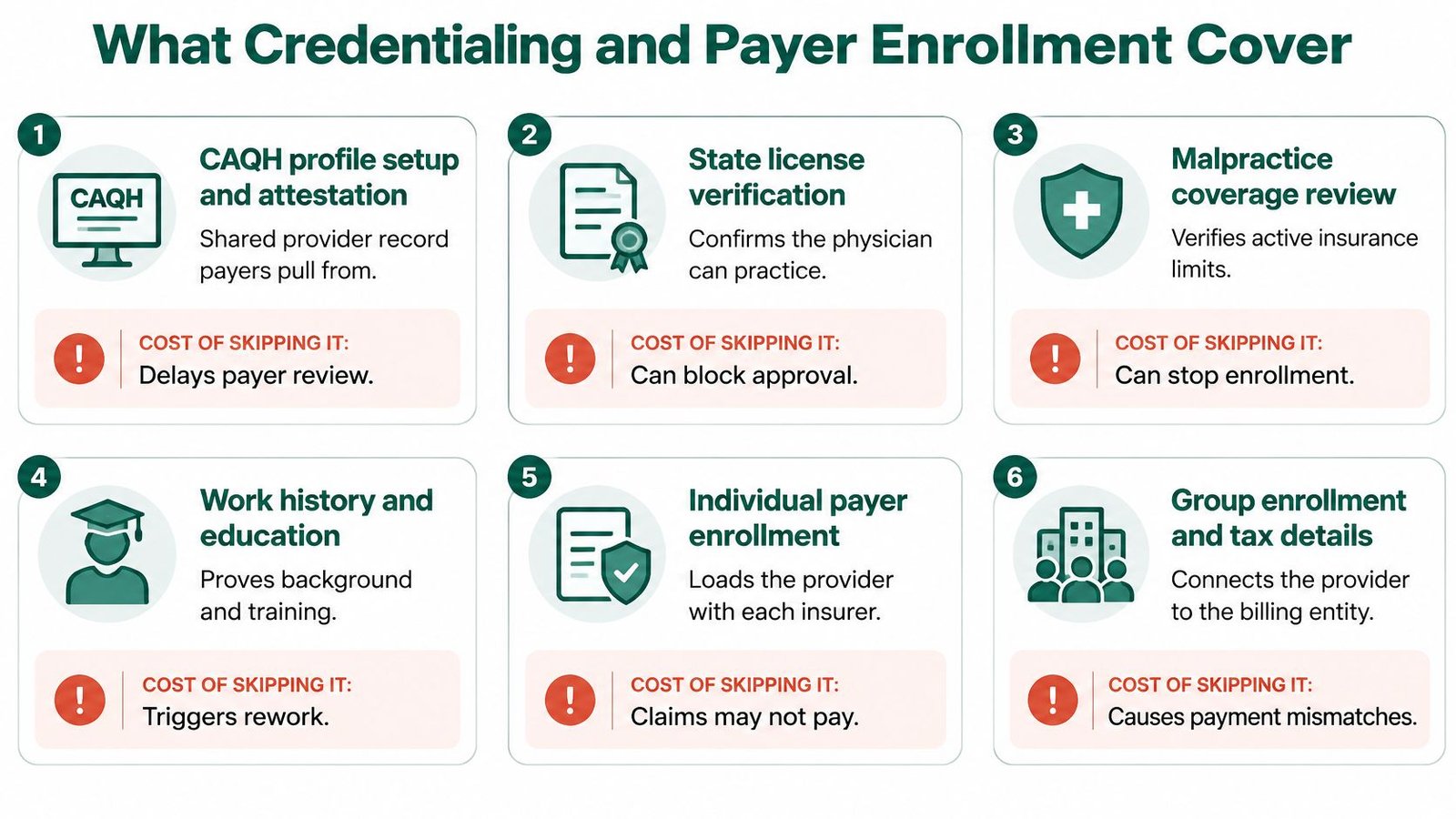
CAQH is the shared provider record many payers pull from. A thin profile means every application waits on the same missing malpractice page or unsigned authorization.
Primary-source verification checks education, licensure, training, and practice history against the original source, or a recognized source or approved agent, not a copy in the folder. NCQA separates credential-verification organizations, which perform that evidence check, from full-scope credentialing organizations, which also conduct committee review and recredentialing decisions. The control is traceable provenance: source artifact, verification date, verifier, discrepancy notes, and expiration alerts. Adverse information has to surface between formal cycles, including sanctions, license expirations, complaints, and quality issues. That matters most for high-risk specialties and multi-state practices.
Adverse-action screening looks for sanctions, exclusions, license actions, and felony history before you submit. A hit can stop enrollment before a single claim exists.
Payer applications carry forms, group linkage, taxonomy, NPI, and service locations. A wrong taxonomy or a closed location is how a clean clinical note becomes an unpayable claim. Treat payer participation as inactive until identifiers, taxonomy, locations, effective dates, and supporting credentials match across enrollment systems and the EHR. Until they do, you don't have a clean claim.
Follow-up is the part practices drop. Payers ask for a document, the request sits in a shared inbox, and the file goes quiet for months. Ongoing maintenance then catches expirations, roster changes, and re-credentialing dates so status doesn't lapse mid-quarter.
A free credentialing audit checks each provider's CAQH profile, payer enrollment status, license and DEA dates, NPI and taxonomy details, and group links. You get a short list of missing or expiring items within about a week. For a plain walkthrough of the sequence, healthcare credentialing steps explained by American Cardiology Group is a useful companion to the task list above.
Pull the current roster this week. Put a name next to each of the six tasks. A blank name is the task that will cost you.
CAQH Profiles and Individual vs Group Enrollment
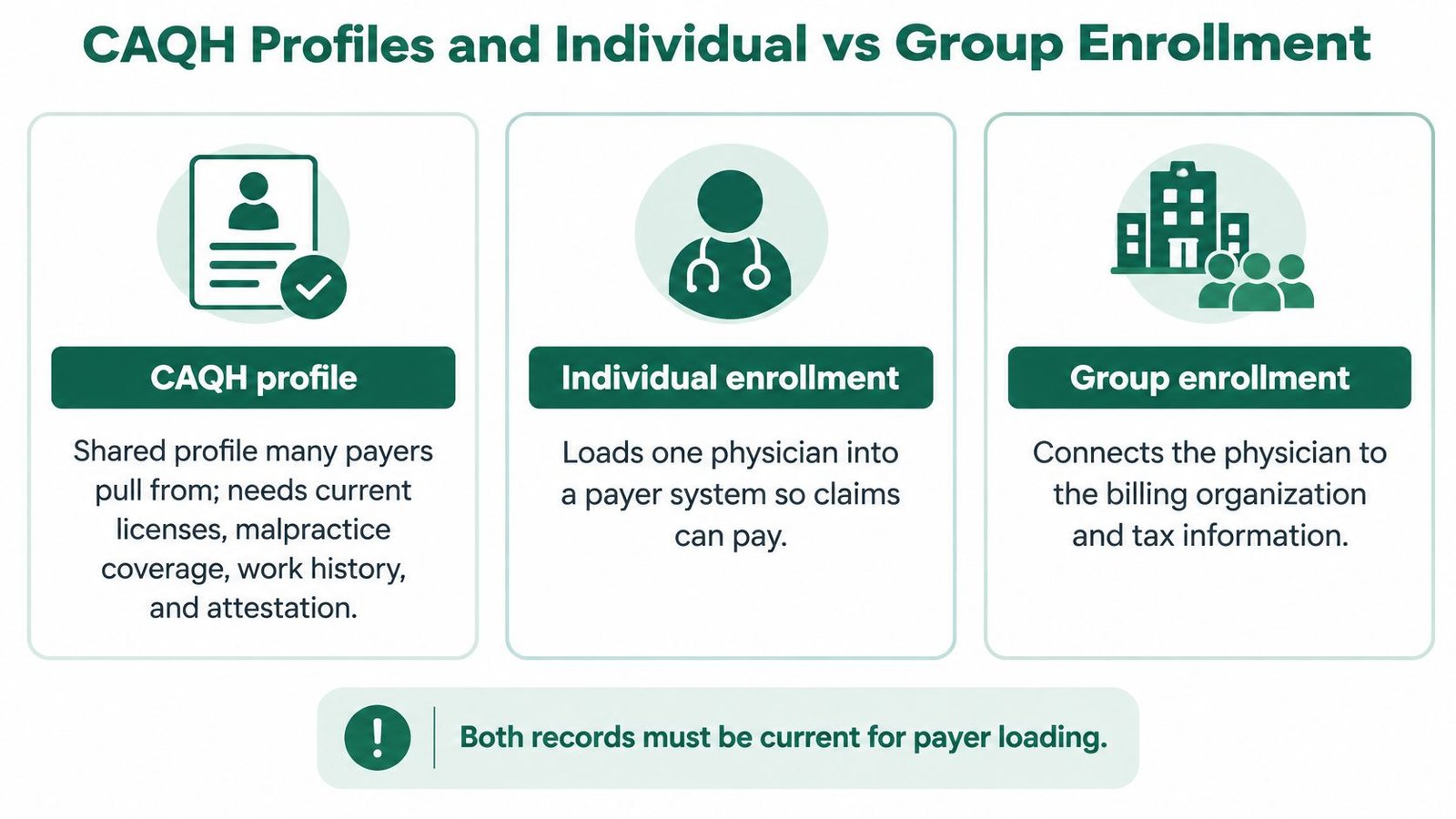
Two records have to be current before a payer can load a physician. One is the shared profile. The other is the enrollment that ties that physician to a contract and a tax ID.
The shared profile
CAQH is the profile many commercial payers read instead of asking for a fresh packet. Setup needs current licenses, malpractice coverage, work history, references, and a signed authorization. We set up, attest, and maintain each provider's CAQH profile so payers can verify the provider without a second round of document chasing. A profile that still lists a former employer will send the payer down the wrong contract.
The two enrollments
Individual enrollment ties one rendering NPI to each payer. Group enrollment links that provider to the group's billing NPI and tax ID, so claims pay under the group's contract rather than under a hospital employer or a prior practice.
Practical rule: Both records have to match. A perfect CAQH profile with the old group's tax ID still pays the wrong entity.
A new associate usually needs individual enrollment plus group linkage at every payer you bill. A physician leaving hospital employment for your independent group needs that linkage rebuilt even if the state license never changed. A provider who only changes a work address can still need a location update with each payer, because the service location on the claim has to match the loaded location.
Say a multi-specialty group of fourteen physicians finds nine profiles still linked to a former group tax ID. Claims pay under the wrong entity. Finance spends weeks rerouting payments, and the new group's A/R looks worse than the clinical volume justifies.
Our provider credentialing covers initial enrollment through re-credentialing and keeps payer contracts current. The first check is mechanical. Compare the group tax ID and billing NPI on every profile with the payer contract. Fix the mismatches before the next hire starts seeing patients.
Effective Dates and the Cost of a Late Start
A provider can be approved and still not be payable for services already delivered. The effective date determines when in-network reimbursement begins, so a gap between the first patient visit and that date puts cash at risk.
| Milestone | What It Means | Revenue Risk If Missed |
|---|---|---|
| Application accepted | Payer has the file and review has started | The file can stall without a clear follow-up date |
| Approval | Payer confirms the participation decision | The provider may still not be payable |
| Effective date | Date from which claims pay as in-network | Earlier claims may deny or pay at the wrong level |
| First payable claim | First claim processes at the contracted rate | Claims may be held or routed incorrectly |
| Directory visibility | Patients can find the provider in the payer directory | Patients may miss the provider when choosing in-network care |
Track these milestones separately. Acceptance means the payer has the file. Approval confirms participation, but the effective date sets the start of in-network payment. Directory visibility supports patient access, while the first payable claim confirms that the enrollment works in practice.
Credentialing delays can leave provider files incomplete or push completion into a later quarter. Reappointment and verification work also continues after hiring. A U.S. Government Accountability Office review reported that physician professional credentials and clinical privileges at seven Veterans Health Administration facilities had to be reviewed and renewed at least every two years. Incomplete files can delay appointments, restrict privileges, or interrupt payer participation.
A forecast you can rerun
Suppose a provider is expected to generate $40,000 in monthly collections. A 60-day effective-date delay puts about eight and a half weeks of work at risk: $40,000 multiplied by 8.6 weeks, divided by 4.3 weeks per month, equals about $80,000 in claims exposed to delay or denial. Run this estimate before opening the schedule, then compare it with the payer's confirmed effective date.
Timelines depend on the payer and state and can run from several weeks to a few months. Map the intended start date against a realistic credentialing timeline for a new practice before setting the first clinic day. Ask each payer in writing whether it grants a retroactive effective date and what conditions apply. Retroactive coverage follows payer policy and is not guaranteed. Route claims caught in the gap to a denial management process instead of assuming they will be reprocessed later.
How to Onboard a New Provider Without a Revenue Gap
A provider who sees patients before the effective date creates claims that can't pay. The six steps below exist to keep the first clinic day inside the payable window.
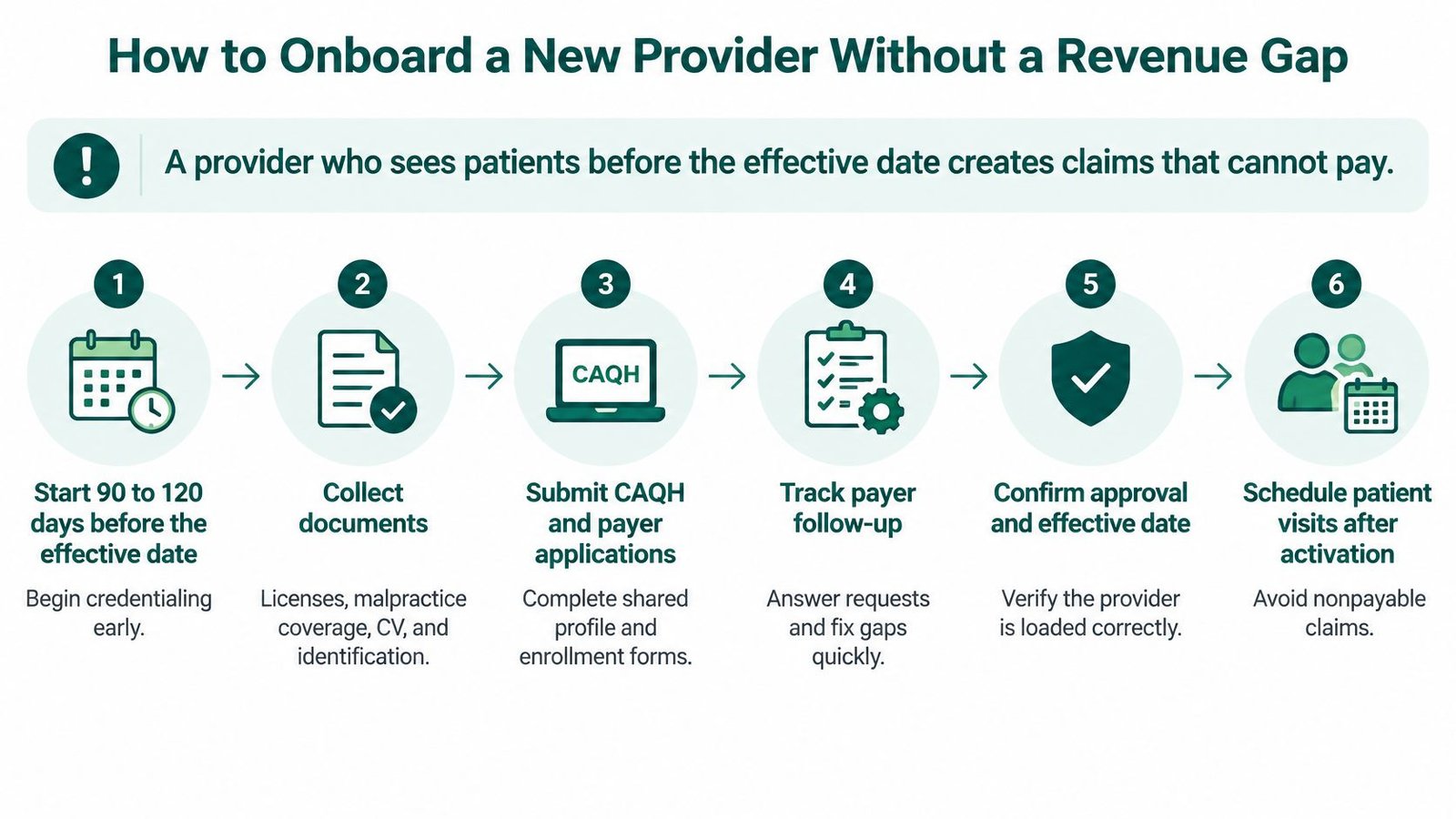
- Start 90 to 120 days before the first patient day. Begin as soon as the start date is firm. Waiting for the license to arrive in the mail burns the only slack you have.
- Collect the file. Current state licenses, DEA, board status, malpractice coverage, CV, work history, references, NPI, and taxonomy. A missing DEA or an unexplained work gap is what sends the file back.
- Set up or update CAQH and sign the authorization. Payers can't pull a profile they aren't allowed to see.
- Submit individual and group enrollments. Send both to each payer and write down the date each application went in. That date is your clock.
- Check status weekly. Escalate any file older than the payer's stated timeline. Silence isn't progress.
- Confirm the effective date and the first payable claim before you book non-urgent patients with the new provider. Urgent coverage can be a separate decision. Routine visits shouldn't be.
If you want the hiring side of that same window, plan your 90-day onboarding process so HR start dates and payer dates don't drift apart.
The workload is why a shared inbox fails. In a September 2019 survey of 1,240 physician practices, CAQH found that the average practice managed 20.2 health-plan contracts, and each contract can apply its own verification rules. Practices using multiple methods reported average monthly costs of $2,068, compared with $1,249.86 for a single credentialing platform. The gap is $818.14 a month, about $9,818 a year, a 40% reduction in that surveyed workflow cost. Each extra payer repeats data entry, attestation, and follow-up.
Credentialing runs in four steps on our side: a free credentialing audit, application prep, payer follow-up, and ongoing maintenance. Pair that file work with RCM for physician practices so charge capture doesn't start before the provider is payable.
Revalidation Cycles That Keep Enrollment Active
Approval expires on a calendar, not when someone remembers. Miss a cycle and appointments continue while claims go unpaid or process under the wrong network status.
| Requirement | Cycle | Consequence If Missed |
|---|---|---|
| CAQH re-attestation | Every 120 days (180 days in Illinois) | Stale profile slows payer credentialing and directory activation |
| Medicare enrollment revalidation | Every five years, or when CMS requests | Billing privileges can lapse |
| Adverse-action monitoring | Continuous between cycles | Sanction or license action reaches the payer file |
| Payer re-credentialing | Set by each payer contract; check each one | Provider removed from network mid-contract |
| License and DEA renewal | Per state and federal expiration dates | Expired credential disqualifies claims |
Maryland's CAQH ProView quick reference, drawing on CAQH guidance, sets a 120-day attestation cycle for most providers, with an Illinois exception that permits 180 days. Providers log in, review or update the profile, and affirm it's accurate. A signed authorization older than 120 days won't be accepted. An expired profile can delay payer credentialing, directory activation, or participation updates even when the license and malpractice coverage are current.
Medicare enrollment generally requires revalidation every five years or when CMS asks. Between those dates, screen for final adverse actions CMS treats as material to enrollment: Medicare revocation of billing privileges, suspension or revocation of a state healthcare license, exclusion or debarment from a federal or state healthcare program, and certain federal or state felony convictions within the preceding ten years. CMS enrollment guidance lists those actions because they can change whether a physician may participate and can trigger extra review or a denial.
A stale profile is a revenue leak you won't see on the schedule. The visits happen. The checks don't.
Our billing team manages credentialing and re-credentialing automatically when MCO contract rosters change, which is when a quiet lapse usually starts. Put one named owner on a recurring work queue and set a calendar reminder well before each expiration. Enrollment denials already sitting in A/R need a written appeal, and our guide on how to appeal a denied insurance claim covers those steps.
Decide Whether to Hand Off Credentialing This Quarter
Keep the work in-house only if the load is small and someone already owns the calendar.
Keep it when:
- Payer count is tiny: you work with one or two payers.
- The roster is stable: you aren't hiring several times a year.
- A person already tracks it: CAQH re-attestation and license expirations sit on a named calendar.
Hand it off when:
- Contracts pile up: the CAQH survey average was 20.2 health-plan contracts.
- Hiring is steady: new providers start more than once a year.
- Starts already slipped: the last two physicians missed their effective dates.
- Nobody chases status: payer follow-up has no owner.
| Task | Hand off | Keep in-house |
|---|---|---|
| CAQH setup and attestation | Vendor builds and re-attests the profile | Practice approves the signed authorization and profile content |
| Primary-source verification | Vendor collects and verifies documents | Practice confirms current licenses and DEA status |
| Payer applications and follow-up | Vendor submits, tracks and escalates | Practice names an owner for each payer escalation |
| Roster and contract decisions | Vendor tracks roster changes | Practice decides which providers and payers to add |
| Group NPI and tax ID linkage | Vendor prepares the linkage | Practice checks each linkage against the payer contract |
Happy Billing, headquartered in Houston, Texas, serves growing groups with 1 to 50 providers. Credentialing is separate from billing, so your current biller can stay for the parts you want to keep. The free credentialing audit is the test: it returns a short list of missing or expiring items within about a week, and the audit itself costs nothing. Practices with a defined specialty can start from the specialty billing teams. Compare scope against the outsourcing cost guide, and read how medical billing and credentialing services fit together before you look at Happy Billing's credentialing services. Pricing is covered on the free 30-minute call, not here.
US practices only.
Frequently Asked Questions About Credentialing Services
Do I still need credentialing if I already have a biller?
Yes. Credentialing is separate from billing. Your current biller can continue handling charge capture, claims, and follow-up while a credentialing team manages enrollment. Claims cannot pay at the contracted rate until the payer has loaded the provider.
How long does credentialing take?
Timelines depend on the payer and state. Enrollment can take several weeks to a few months, so start well before the provider's first patient day.
What is CAQH and who maintains it?
CAQH is a profile that payers use to verify provider information, including licenses, malpractice coverage, and work history. Providers or their credentialing team must keep the profile current and complete payer re-attestations when required.
What is the difference between individual and group enrollment?
Individual enrollment connects a provider's rendering NPI to a payer. Group enrollment links the provider to the practice's billing NPI and tax ID. A new physician generally needs both links in place for claims to route under the group's contract.
Can a late start be made retroactive?
Some payers may grant a retroactive effective date, but approval depends on the payer's policy. Ask the payer in writing and keep its response on file. Do not assume visits before the confirmed effective date will be payable.
Happy Billing offers a free credentialing audit and a free 30-minute discovery call. Contact Happy Billing to review what is missing before the next provider start date.