Out-of-network Billing Company for Physical Therapy Practices: How to Choose One That Recovers Underpayments

The popular advice to hire a billing company with a strong clean-claim rate misses the key buying decision. An accepted claim isn't necessarily a correctly paid claim. Your practice can post few denials while collections per visit shrink, unresolved payment disputes stretch A/R days, and staff close accounts that still deserve review.
Choose an out-of-network recovery specialist over a general biller. A general biller submits claims; a specialist audits every line repriced by Data iSight, MultiPlan, Zelis and Naviguard against fair-value benchmarks, appeals supported shortfalls, and keeps patients out of improper balance billing. Before you sign, confirm how the vendor is paid and what happens to claims it cannot recover.
Happy Billing is a medical billing company headquartered in Texas that recovers out-of-network underpayments for practices, including practices in New Jersey and New York. It works alongside your practice's existing biller, which can stay for the parts it wants to keep, and posts ERAs and EOBs so your books stay balanced.
Why General Billing Misses Out-of-Network Underpayments
General billing and underpayment recovery solve different problems. A biller asks whether the payer processed the claim. A recovery specialist asks whether the payer's calculation withstands scrutiny.
Consider an established-patient visit containing CPT 97110. The claim clears submission edits, the payer issues a remittance, and your staff posts the payment. Unless someone reconstructs the expected allowance, a repriced payment can pass through the workflow without anyone deciding whether it should be challenged.
That distinction matters when choosing an out-of-network billing company for physical therapy practices. The right partner must separate:
- Contractual underpayments, where an applicable agreement establishes the payment obligation.
- Repricing disputes, where plan language, payment methodology, historical allowances and geographic benchmarks support the challenge.
- Valid adjustments, where deductible allocation, benefit exclusions or documented billing limitations explain the difference.
Practical rule: Don't measure a recovery vendor by how much unpaid revenue it flags. Measure whether it can explain, defend and collect each validated difference.
We've documented $32M in revenue recovery for clients, across our client base, not as a physical-therapy-only result. Our historical-claim audits focus on identifying and recovering under-reimbursed amounts rather than treating every charge-to-payment difference as collectible.
Start by checking for signs your out-of-network claims are being systematically underpaid. For owners evaluating the broader workflow, our physical therapy underpayment recovery guide explains how payment review fits into practice revenue management.
Book a free 30-minute call with a billing specialist to discuss your repriced payments and existing billing workflow. We only get paid when we deliver recovered dollars, with nothing upfront.
US practices only.
Three Billing Options and Where Each Fits
Three billing options compared on the criteria that move revenue
| Option | Claim submission | Repricing audit | How paid | Best fit |
|---|---|---|---|---|
| Keep in-house biller only | Your staff | Usually none beyond standard denial work unless you assign it | Salaried staff and software | Practices with few out-of-network payers |
| General billing company | Vendor submits and follows up claims | Limited unless line-level benchmarking is explicitly included | Monthly fee or collection-based compensation under the agreement | Practices needing claim and A/R support |
| Out-of-network recovery specialist | Existing biller keeps claims; specialist audits repriced ERAs | Line-level comparison against applicable agreements, plan terms and fair-value benchmarks, plus appeals and negotiation | Contingency only, after recovered dollars post; terms reflect claim age and volume | Practices with repricer cliffs or aged out-of-network A/R |
You don't need to replace a capable biller to add payment accountability. A specialist can review the remittances your current team already receives, build the evidence for disputes and pursue additional payment without taking over routine submission.
A general billing company's strength is claim velocity, payment posting and A/R follow-up. Its limitation is scope: unless the agreement includes payment reconstruction, you shouldn't assume that follow-up staff benchmark every remittance. Ask whether the vendor closes an account when payment arrives or only after the allowance has been validated.
We run end-to-end billing and recover underpaid out-of-network claims. Your practice decides which functions to retain, and credentialing remains separate from billing. Our physical therapy billing specialty services can support that division of responsibilities.
Match the service to the actual bottleneck
Mostly in-network, little repricing. If your staff submits accurately, follows up consistently and can access current contracts, outsourcing the whole operation may add disruption without solving a meaningful problem. Assign a recurring ERA-to-contract audit and retain internal ownership. Best fit: keep the in-house biller.
Growing out-of-network volume. If payment amounts fall even though visit mix and documentation remain consistent, investigate repricing before blaming claim submission. Preserve your existing claim workflow while someone audits the allowance methodology and pursues supported differences. Best fit: add a recovery specialist.
Large, aging receivables. Old unpaid claims require eligibility review, status research, deadline checks and a clear recovery owner. Our Old A/R Recovery service pursues unpaid claims older than 90 days. Best fit: dedicated old A/R recovery.
A short-staffed practice. When staff can't keep up with submissions, payment posting or payer correspondence, specialist appeals alone won't fix the backlog. Give routine claim work to a general billing partner and assign repriced-payment review separately. Best fit: general billing support plus a recovery specialist.
Don't buy a full replacement when the missing function is a payment audit. Don't buy only an audit when nobody is keeping current claims moving.
Our comparison of in-house versus outsourced out-of-network underpayment recovery helps owners define that boundary. Before signing, document who owns submission, posting, appeals, patient communication and unresolved balances so neither team assumes the other is handling them.
The Repricer Cliff in Plain Numbers
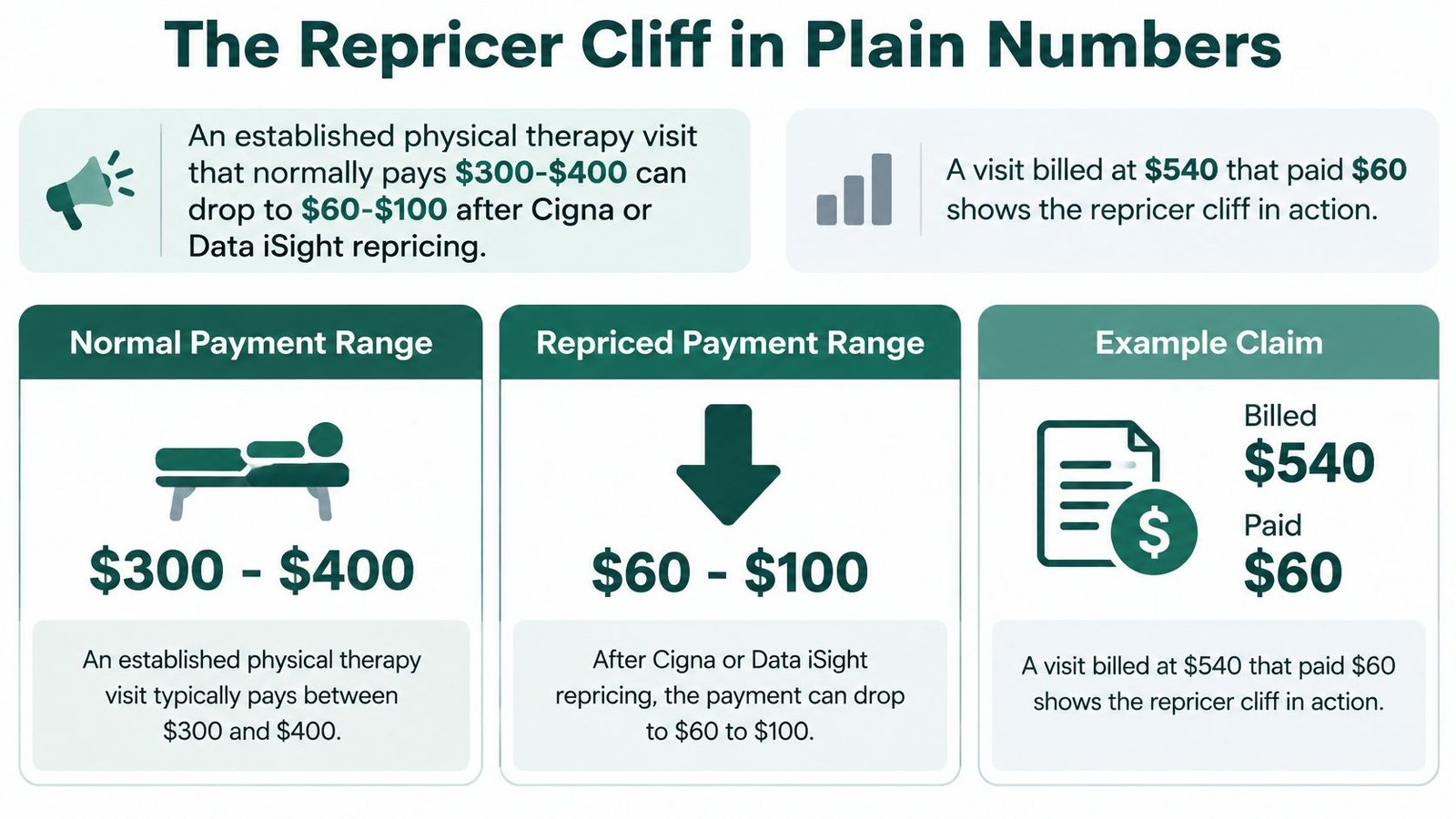
Consider a hypothetical repricer cliff: an established physical therapy visit previously paid at $300–$400 drops to $60–$100 following Cigna or Data iSight repricing. In a second hypothetical example, a visit billed at $540 receives $60. These are illustrations, not established market payment ranges or documented client results.
Visit payment before and after repricing, illustrative scenarios
| Scenario | Typical paid amount in the illustration |
|---|---|
| Established visit before repricing | $300–$400 |
| Established visit after Cigna or Data iSight repricing | $60–$100 |
| Example visit billed at $540 | $60 paid |
The financial issue isn't just the difference between charges and payment. It's whether the payer applied a defensible allowance and whether your practice inadvertently accepted terms that weaken future reimbursement.
The following graphic illustrates those payment scenarios, not a reimbursement guarantee.
Audit the reduction before choosing the remedy
- Read the benefit language. Compare the remittance with the member's out-of-network reimbursement provisions and request the payer's calculation.
- Compare historical allowances. Match payer, plan, geography, CPT code and service characteristics. Prior payment supports investigation, but doesn't automatically establish entitlement.
- Validate units against treatment time. Under Medicare's timed-code methodology, 22 total timed minutes support one unit, while 23–37 support two, according to CMS outpatient rehabilitation documentation guidance. Don't automatically apply Medicare's methodology to a commercial plan.
- Check the therapy modifier. For applicable Medicare claims, GP identifies services under a physical therapy plan of care, including 97110, as described in the CMS Medicare Claims Processing Manual transmittal. A modifier-processing error calls for a different remedy than a disputed allowance.
- Classify patient protections. Confirm the service setting, plan type and applicable state and federal rules.
- Review acceptance terms. APTA's 2025 annual report describes concerns about undervalued out-of-network PT payments and warns that accepting discounted amounts can affect future claims.
We audit historical claims to identify and recover under-reimbursed amounts. Contractual disputes and repricing disputes should remain separate in the results.
For context, MedAmerica Rehab Center's 2026 self-pay physical therapy prices address a different payment model, not proof of an insurer's obligation. Use our 97110 and 97140 out-of-network reimbursement analysis and out-of-network medical bill repricing tools guide to frame your own exposure.
Eight Questions to Ask Any Vendor Before You Sign
The strongest recovery partner audits every repriced line against the applicable contract and a named benchmark before anything is accepted as final. Require a line-level underpayment engine, not a dashboard that subtracts payment from charges. The vendor should reconstruct the expected allowance using the contract or plan terms, fee schedule, CPT/HCPCS code, units, modifiers, place of service, provider status and authorization rules.
A federal OIG review of outpatient physical therapy claims found 61% of sampled claims contained medical-necessity, coding or documentation errors, with coding errors in 145 of 184 noncompliant claims. That finding doesn't measure recoverable underpayments. It explains why your vendor must separate payment errors from unsupported billing before it disputes anything.
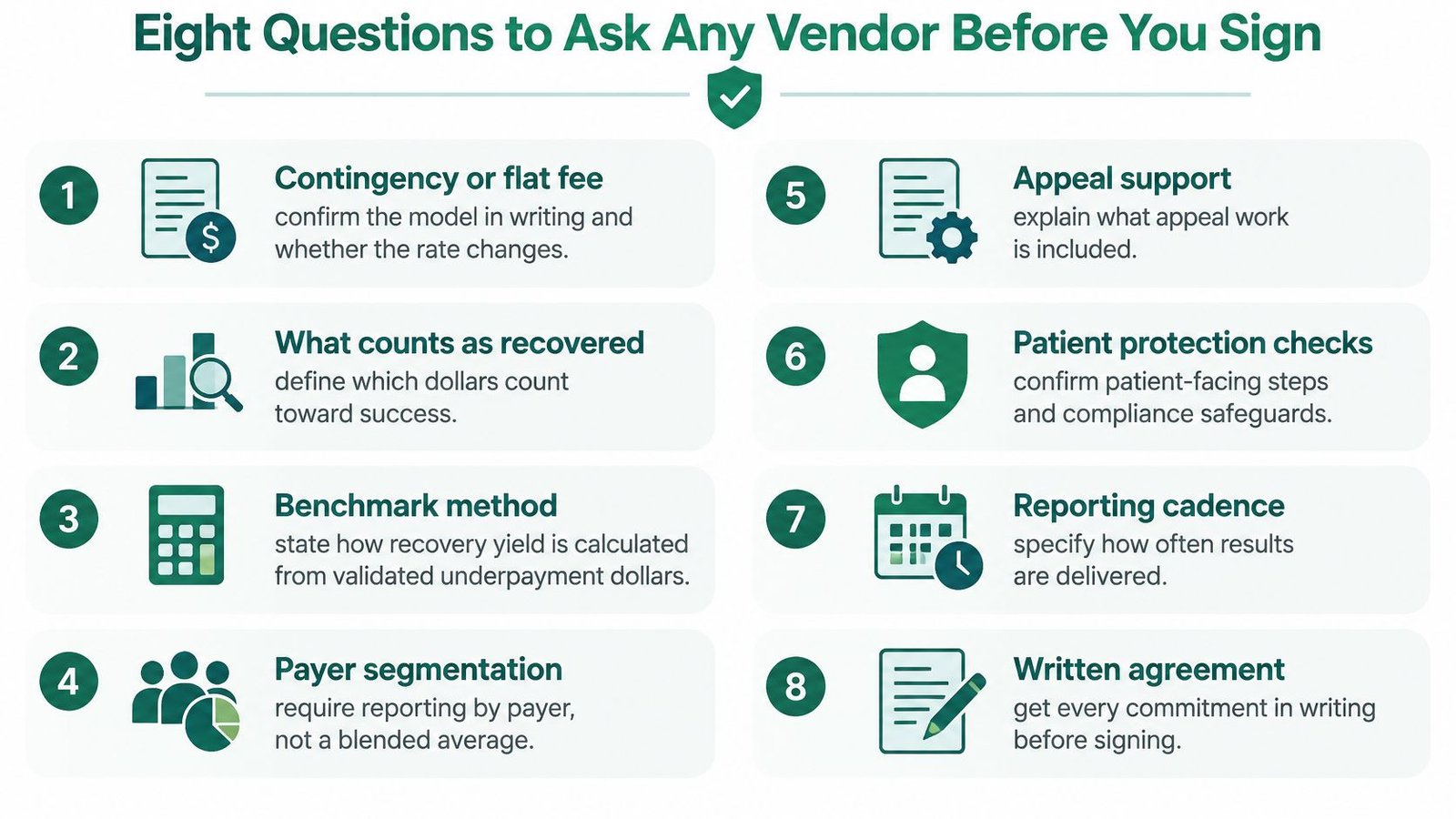
Use these questions to test the commercial agreement and the audit process behind it.
Get these answers in writing
Is compensation contingency-based or a flat fee? Neither structure is automatically better, but the full model belongs in the contract: the rate, which dollars it applies to, which services are included and the conditions that can change the terms. A vendor that keeps its pricing verbal isn't ready to sign.
Who pays if nothing is recovered? Some agreements still charge for audit time or letter writing. Require the contract to define success as additional payment posted to your account, not a demand letter, an identified variance or a payer's promise to reprocess.
Can you audit claims back to 2022? Request that lookback, but don't confuse audit access with an open recovery right. Require a payer-specific explanation of timely filing, appeal deadlines and settlement restrictions.
Can you review claims we already deposited? Payment receipt shouldn't automatically exclude a claim from review. Require a written process for examining releases, discount acceptances and other terms that could limit further recovery. This is how you stop accidentally locking in a low rate that sets a precedent for future claims.
What is your Cigna and Data iSight experience? Request anonymized examples showing the original reduction, evidence submitted, escalation route and final disposition. A payer logo on a sales deck isn't evidence of a repeatable recovery workflow.
Which benchmark do you use? Ask for the named source, such as FAIR Health, plus the geography, service match, benchmark type and calculation method. A charge benchmark isn't automatically a payer's required allowance, and the difference decides whether a variance is real.
What will reporting show? Require gross variance identified, validated underpayments, amounts recovered, appeal overturn rate, recovery cycle time and false-positive rate, segmented by payer and CPT code. The report must reconcile to actual payment postings.
How can we exit the contract? Obtain the notice period, data ownership terms, treatment of pending appeals and an exportable audit trail. Your practice keeps its original claims, evidence and correspondence.
Test these answers on a blinded sample of your own ERAs before expanding the scope. For broader receivables governance, Resolut's guide to how to outsource invoice collections offers useful operational context, though healthcare recovery also demands plan-specific appeal and patient-protection controls.
Reporting, Appeals and Patient Protections to Verify
Recovery yield equals recovered dollars divided by validated underpayment dollars. Don't accept a percentage of appealed claims as a substitute: that measure says nothing about the size of the recoverable opportunity or the cash ultimately collected.
Require segmentation by payer, plan, CPT family, provider, site of service and aging bucket. A blended total can hide a vendor recovering easy recent claims while deadline-sensitive disputes remain untouched.
For an initial evaluation, a 60- to 90-day retrospective pilot using at least 12 months of paid claims is a practical recommended design, not a promised recovery timeframe. The OIG audit of a Kansas physical therapy practice illustrates why service-level review matters: an incorrect HCPCS selection resulted in an underpayment involving compression wrapping rather than manual therapy.
Require reporting that connects each disputed line to its supporting evidence and final payment.

Verify the work queue and the books
Prioritize high-dollar claims and approaching deadlines. Each appeal file should preserve the original submission, remittance reason codes, payment calculation, supporting documentation and final payer response.
- Reconcile cash. We post ERAs and EOBs to keep practice books balanced. Additional payments must match the recovery report.
- Identify root causes. Require a monthly explanation of preventable errors, payer-specific reductions and recurring documentation gaps.
- Measure internal effort. Track staff time spent supplying records and answering vendor questions so gross recovery doesn't conceal operational cost.
Our medical billing denial management guide and explanation of how to appeal a denied insurance claim help owners evaluate whether the workflow produces usable evidence rather than repeated generic appeals.
Classify patient liability before collection
The CMS balance-billing training guidance explains that, in protected situations, applicable patient cost sharing may depend on an all-payer model, state law, or the lesser of billed charges and the plan's qualifying payment amount. That isn't permission to transfer every payer shortfall to the patient.
We track the in-network rating for every facility where a client's physicians practice. Setting and network classification help determine which protections and dispute routes apply.
Office-based PT requires particular care because out-of-network status alone doesn't establish federal IDR eligibility. Understand why the No Surprises Act usually doesn't cover office-based PT and chiropractic claims before selecting an escalation route.
A recovery that creates an improper patient bill isn't a sound financial result. It creates refund exposure, complaints and more reconciliation work.
Confirm the Vendor Terms Before You Change Billers
Make the decision from a claim sample and a written scope, not a headline collection promise. Your shortlist should demonstrate what it can substantiate, which claims remain actionable and how little disruption your current operation needs.
Take these actions this month
Prepare a focused export. As a practical starting sample, export 12 months of ERAs, remittances and applicable agreements for your three highest-volume out-of-network payers. Include plan documents where available, payment correspondence and any repricing acceptance terms. Transfer records securely and keep public examples free of patient identifiers.
Request a blinded reconstruction. Have the shortlisted vendor return the expected allowance, observed payment, validated variance and supporting method for each line. Require it to label uncertain cases rather than turn every unexplained difference into a recovery forecast.
Compare the recoverable opportunity with the net result. Separate gross variance from actionable claims, then account for contingency compensation and your staff's work. Choose the service that addresses your actual bottleneck, whether that's current claim flow, paid-claim repricing or dedicated old A/R recovery.
For day-to-day oversight, Recepta.ai's discussion of how to manage outsourced billing processes offers useful context for assigning responsibilities. Keep healthcare-specific authority, record access and appeal decisions explicit in your agreement.
Our outsourcing medical billing cost guide can help structure the broader comparison. For out-of-network recovery, pricing is covered on a free 30-minute call with a billing specialist, with a clear number based on claim age and volume rather than a published fee percentage.
Bring a de-identified repriced EOB, your payer list and the functions you want your current biller to retain. That gives the discussion a concrete starting point without committing you to a billing replacement.
Book a free 30-minute call with a billing specialist to review the appropriate recovery scope. We only get paid when we deliver, with nothing upfront.
US practices only.
Frequently Asked Questions About Recovering Underpayments
Can we recover claims we have already deposited?
Yes, deposited payments can still be reviewed for supported underpayments. Recovery depends on the applicable allowance, available appeal rights and whether you accepted a release or binding discount arrangement. A benchmark difference supports investigation, but doesn't by itself prove the payer owes additional money.
How far back can an out-of-network recovery review go?
Ask the vendor to assess a lookback to 2022, but don't treat that date as a universal recovery entitlement. Payer deadlines, prior appeal activity, settlement terms and applicable law determine which claims remain actionable. Require a distinction between claims that can be audited and claims that can still be pursued.
Do we have to replace our current biller?
No. Your existing biller can retain claim submission and routine A/R follow-up while we audit remittances and pursue supported underpayments. Define who posts additional payments and communicates with the payer so both teams don't work the same account or issue conflicting instructions.
Does this work for New Jersey and New York practices?
Yes. We manage New Jersey physician groups, including OON Act-compliant claim submission, and our denial and appeals team is trained on NY DFS IDR filing requirements, documentation standards and aggregation strategies. The appropriate route still depends on the claim's eligibility, plan and setting, not the practice's address.
Keep the billing functions that work and add a defensible audit of the payments that don't. Visit Happy Billing to discuss historical-claim review, repricing disputes and a recovery scope that works alongside your existing biller without treating unsupported balances as collectible revenue.