Cigna Provider Payment Dispute Process for Out-of-Network Claims
For out-of-network claims, Cigna runs a single-level internal appeal with a 180-day deadline, 365 days in California, a 60-day review and 75-business-day notification window, and a one-year window for alternate dispute resolution. Deadlines vary by plan and product, so the plan document and provider agreement control when they differ from Cigna's published standard.
You're likely reading this after an EOB landed that doesn't match the work. The claim paid, so your team may have posted it and moved on, but the allowed amount is a fraction of what the same visit paid last year. That's not a coding curiosity. Every underpaid Cigna claim you accept raises your effective denial rate, stretches A/R days, and trains the repricer to keep paying that rate on the next claim.
How the Cigna Provider Payment Dispute Process Actually Works
A PT clinic posts three Cigna EOBs on a Friday: same CPT mix, same rendering provider, three different allowed amounts. The biller marks two as contractual noise and moves on. By Monday, the window is shorter, the repricing rationale is still opaque, and the underpayments have already been normalized in posting.
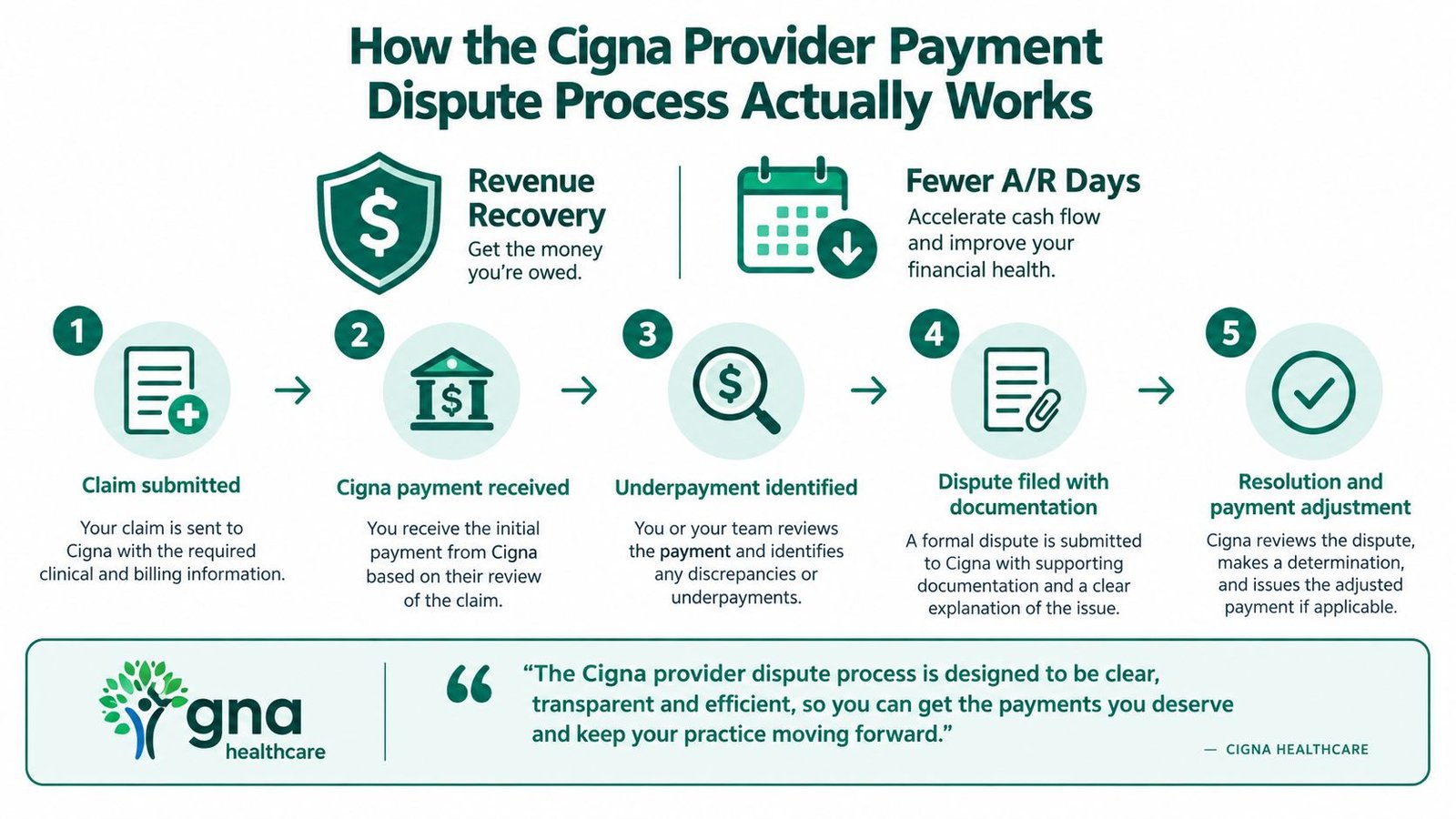
The Cigna provider payment dispute process for out-of-network claims gives you one organized internal shot, then pushes the decision into outside lanes with their own eligibility tests. Treat it as a revenue recovery run: group similar underpayments, anchor the ask to defensible benchmark data such as FAIR Health, and decide which forum can hear the claim.
Happy Billing is a medical billing company headquartered in Houston, Texas. We recover out-of-network underpayments for physical therapy, chiropractic, sports medicine and behavioral health practices, including practices in New Jersey and New York.
The Clocks That Run at the Same Time
Cigna tells providers to try customer service first, then file the formal dispute if the answer holds, under Cigna's provider appeals and disputes policy. The formal dispute standard is 180 calendar days from the initial payment or denial notice, and for an adjusted payment it generally runs from the last adjustment. Cigna states review is completed within 60 days, with notification within 75 business days after receipt of the original dispute.
Keep that clock separate from timely filing. The initial out-of-network claim generally must be filed within 180 days after the date of service, counted from the final date for consecutive-day services, under Cigna's claim submission guidance. California allows 365 calendar days for the provider dispute. Log date of service, submission, EOB issue, adjustment, dispute deadline, and external-lane deadline separately.
Practical rule: If your biller can't show you five separate dates for a Cigna claim, you don't have deadline control. You have a spreadsheet that'll fail on the claim that matters.
The lane after exhaustion depends on the plan, not your preference. A self-funded ERISA plan points toward plan appeal rights and fiduciary process; a fully insured policy can open a state DOI complaint; qualifying out-of-network items may fit Federal IDR if eligibility and notice rules are met. Behavioral health owners run the same math when they weigh staying out of network against panels, which is why resources on in-network psychiatrist costs in Florida can help frame what patients expect to pay in network versus what your practice must recover out of network to stay viable. Exhaustion matters because outside lanes often ask whether the internal remedy was tried.
If your Cigna A/R is sitting in underpaid status while clocks run, a free 30-minute call with a billing specialist can map which claims still have live windows. We only get paid when we deliver, nothing upfront. US practices only.
Filing the Internal Dispute the Right Way
Start with the informal call, but don't treat it as the dispute. Log the representative's name, reference number, date, and exact reason given for the payment. If the rep says the repricing is correct, you've satisfied Cigna's first step and created a record. What doesn't work is calling three times over six weeks while the formal deadline shrinks.
What Goes in the Packet
Cigna expects a specific packet, not a narrative letter with records stapled behind it.
- Request for Health Care Provider Payment Review form: Complete every field, including claim number, member, dates of service, billed amount, paid amount, and amount in dispute.
- Original EOB or EOP: Send the remittance that triggered the clock, plus any adjustment EOB if the payment changed.
- Documentation supporting reversal: Operative reports, medical records, visit notes, and coding support for the units and modifiers billed.
- Assignment and authorization records: Your assignment of benefits (AOB), authorized representative designation where applicable, and prior authorization facts if Cigna raises them.
- Payment benchmark: A clear statement of what should've been paid and why, tied to usual and customary data for the geography and codes.
Frame coding in dollars. If you billed timed PT units and Cigna bundled or reduced them, show timed minutes, total treatment time, and why each unit is supported. A missing modifier or unsupported unit isn't a paperwork issue. It's the difference between a paid visit and a write-off your therapists already worked.
Portal Versus Paper for Batches
The provider portal through CignaforHCP works for a single clean dispute and gives you a submission timestamp. It's slower for batches because each claim still needs its own form and attachments. Paper or fax submissions need proof of mailing and a cover index so Cigna can't claim pages were missing.
Keep files legible, labeled by claim number, and in a consistent order. On the payer side, a sloppy packet looks like unlabeled records, multiple patients in one PDF, and no amount in dispute. That packet gets closed, not negotiated. Our denial management workflow for practice owners covers the tracking discipline behind this, but for Cigna specifically, build the packet as if an external reviewer will read it next. Often, one will.
Send the packet you'd want an arbitrator to see, even at the internal stage. Rebuilding it later costs weeks you may not have.
What Cigna and Data iSight Underpayment Looks Like in Practice
Repricing rarely announces itself as a denial. The claim shows paid, your denial report looks clean, and cash per visit collapses. We have seen this pattern most sharply in physical therapy and sports medicine, where multi-unit visits give a repricer more lines to compress.
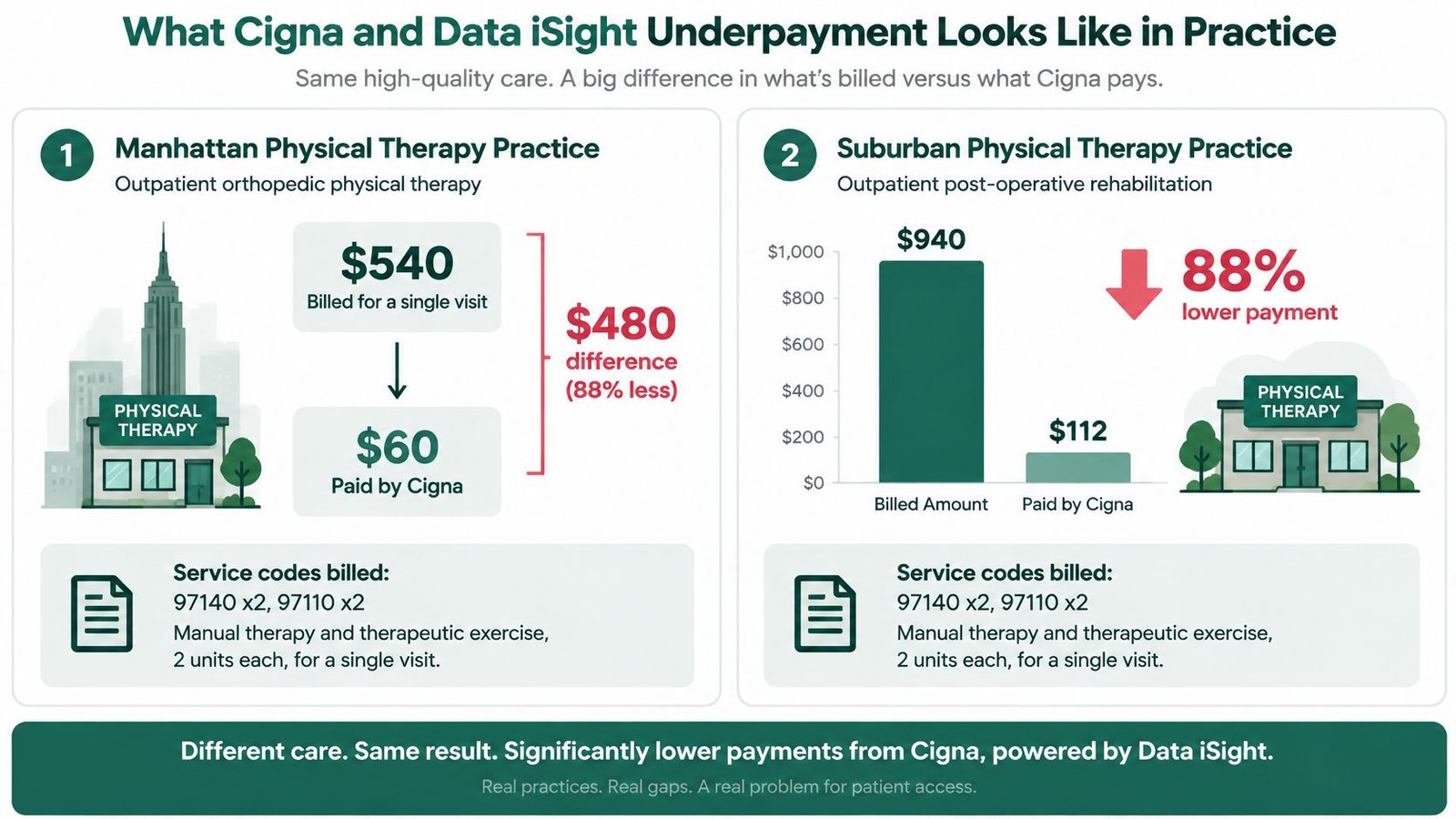
A Manhattan physical therapy practice billed $540 for one visit, built on 97140 x2 and 97110 x2. Cigna paid $60 after Data iSight repricing, down from $300 to $400 a visit the practice had historically received. The codes didn't change. The therapist's time didn't change. The allowed amount did, and every similar visit after it inherited the lower rate until someone disputed the pattern.
A multi-location New Jersey sports medicine practice saw Cigna and Horizon reprice claims of roughly $300 to roughly $100. Individually, staff debated whether each claim was worth an appeal. Across locations and weeks, it was a payer-level trend draining revenue while A/R reporting still called the claims resolved.
Reading the EOB Like an Owner
Pull the EOB and find the repricer reference, the allowed amount by line, patient responsibility, and any remark code pointing to a third-party pricing methodology. Compare billed, allowed, paid, and historical paid for the same code combination. A side-by-side PDF comparison guide is useful when you're lining up the original EOB against an adjusted EOB to prove exactly which lines changed and when the new clock started.
Document the gap by claim, then aggregate it. Your dispute shouldn't say payment seems low. It should show code, units, billed charge, repriced allowed, expected benchmark, and shortfall. Our Data iSight underpayment appeal guide for out-of-network providers details how to challenge that pricing, and PT owners can see how we structure this work on our physical therapy and related specialties page. Posting low payments without flagging them keeps denial rate artificially pretty and revenue permanently short.
Batching, FAIR Health Anchors, and the 80th vs 90th Percentile Play
Single-claim disputes on small underpayments usually die on economics. The payer knows your staff time costs more than the claim. That's why how we approach it starts with batching.
Why We Batch 10 or More Claims
We batch 10+ underpaid claims with the same repricing pattern so the aggregate dollar value gets a payer case manager's attention. The batch needs a unifying logic, such as same repricer, same code family, same plan type, or same reduction rationale. A random bundle of unrelated grievances doesn't negotiate. A documented pattern does.
Batching also protects the practice owner from bad decisions at claim level. One claim may have weak documentation. Ten claims show whether the issue is your documentation or Cigna's pricing. If nine are clean and paid at the same compressed rate, you've isolated the variable.
Anchoring the Ask
Outbound negotiation works when it's backed by FAIR Health benchmarks for the specific codes and zip code. We use the 90th percentile as the ceiling and the 80th percentile as a typical settlement point. That framing matters. You're not asking Cigna to pay billed charges because you want them. You're showing where the market sits and where a reasonable settlement lands within it.
Owners who want the underlying methodology should read our explanation of usual and customary rates for out-of-network providers before approving any negotiation target. Without an anchor, your biller is bargaining against a repricer algorithm with no counter-number.
Owner test: If your appeal doesn't state a specific dollar amount you're seeking and the benchmark behind it, Cigna has nothing to say yes to.
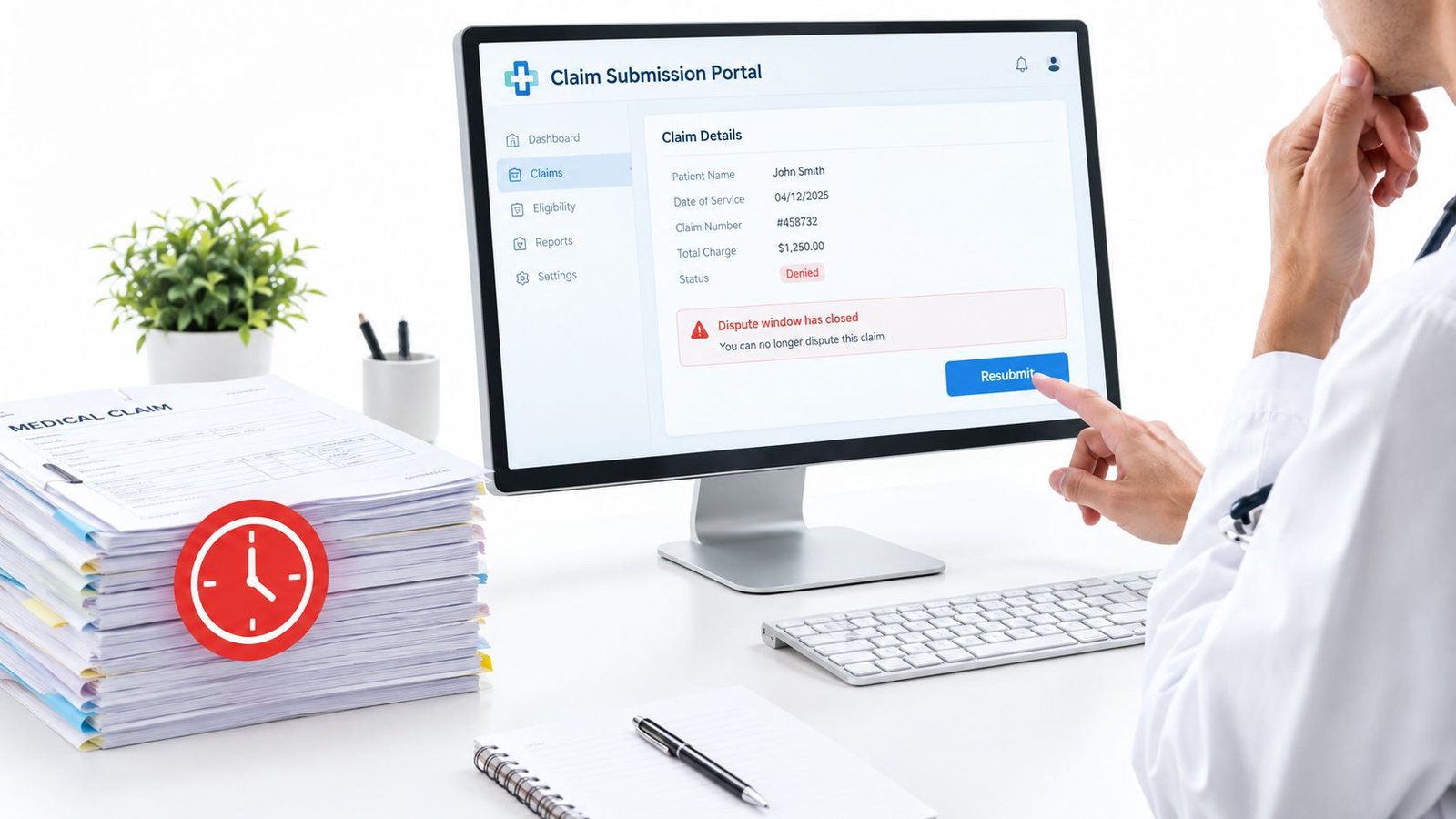
When the dispute window on a claim has closed, resubmitting the claim for a fresh EOB can reopen an actionable remittance in some circumstances. Use that deliberately, not reflexively, and confirm timely filing and plan rules first. Where the existing claim is live, push it into formal dispute or a one-time provider dispute rather than restarting it.
Set expectations at 45 to 90 days for a batched negotiation cycle. With a valid AOB on file, no patient contact is needed for this work, which keeps your front desk out of a payer fight.
Escalation Lanes Beyond the Internal Appeal
After the single-level decision, the right lane depends on plan funding, jurisdiction, service type, and amount. Picking the wrong one doesn't just fail. It can consume the deadline for the right one.
| Lane | Trigger | Typical Deadline | Key Requirement |
|---|---|---|---|
| Reconsideration | Processing or editing error on a correctly billed claim | Within the internal dispute window | Show Cigna applied the wrong edit or fee logic |
| Formal payment dispute | Underpayment or denial you contest on the merits | Standard Cigna dispute deadline, varies by state | Complete form, EOB, records, amount in dispute |
| Alternate dispute resolution | Dissatisfied after single-level review | Generally one year from the single-level denial letter | Provider agreement or program allows it |
| External billing dispute review | Eligible billing dispute after internal exhaustion | 90 calendar days after exhaustion where Cigna's instructions apply | Amount in dispute must exceed $500 |
| ERISA plan appeal | Self-funded employer plan underpayment or denial | Plan document controls | Valid AOB or authorized representative status |
| State DOI complaint | Fully-insured plan, unfair payment practice pattern | State rules control | Exhaust internal process, document pattern |
| NSA open negotiation and Federal IDR | Qualifying No Surprises Act service and payment dispute | Federal windows after negotiation step | Eligibility, notice and consent status, payment evidence |
Cigna's billing-dispute instructions state the amount must exceed $500, internal appeal must be exhausted first, and eligible external review must be filed within 90 calendar days after exhaustion or implied exhaustion, under Cigna's clinical and reimbursement policy library. Preserve the denial letter, exhaustion date, disputed amount, and jurisdiction before calculating any of these dates.
For self-funded plans, your bargaining position often sits in ERISA appeal rights for out-of-network providers, but only if the AOB or authorized representative paperwork survives scrutiny. Anti-assignment language in the plan can change that analysis, so get the plan document, not the summary.
Federal IDR is volume reality now, not a niche remedy. CMS reported 1,372,563 Federal IDR disputes from July through December 2025, with providers initiating 76% and prevailing in about 85% of cases in that period, in CMS Federal IDR supplemental data for late 2025. That doesn't make every Cigna underpayment an IDR case. It means documented, eligible disputes are worth filing correctly.
Where Most Practices Burn the Dispute Window
The most common reaction we see is resubmitting the same claim with medical records attached. If Cigna's position is repricing, not missing records, you get the same allowed amount on a new EOB and lose weeks. Records support medical necessity and units. They don't rebut a pricing methodology you never addressed.
The opposite reflex is sending every underpayment to Federal IDR. That's also a trap. Not every out-of-network service qualifies under the No Surprises Act, the open negotiation step can't be skipped, and ineligible filings create cost and admin exposure with no recovery. Our step-by-step Federal IDR process for providers and our guide on how to appeal a denied insurance claim draw that boundary, because confusing an ordinary appeal with IDR wastes both lanes.
Before choosing, answer four questions. Does the service qualify for NSA protection based on setting and notice and consent status? Is a valid AOB on file? Have you documented Cigna's offer and your counter-evidence, including median in-network rate information where relevant? Is the claim coding clean enough to survive review?
Practices that fix this operationally treat lane selection as intake triage, similar in spirit to the process discipline in this guide to streamlining clinic and law firm operations, where intake criteria decide the workflow before staff start working the file. Our method for batching underpaid out-of-network claims for payer negotiation applies that triage at scale.
Don't appeal harder. Qualify the claim first, then pick the one lane where it can actually win.
In our experience, the practices that recover aren't the ones sending the most appeals. They're the ones that stop low-value resubmissions early and spend staff hours only where eligibility, documentation, and dollars align.
Checklist, Decision Criteria, and Practice Owner FAQs
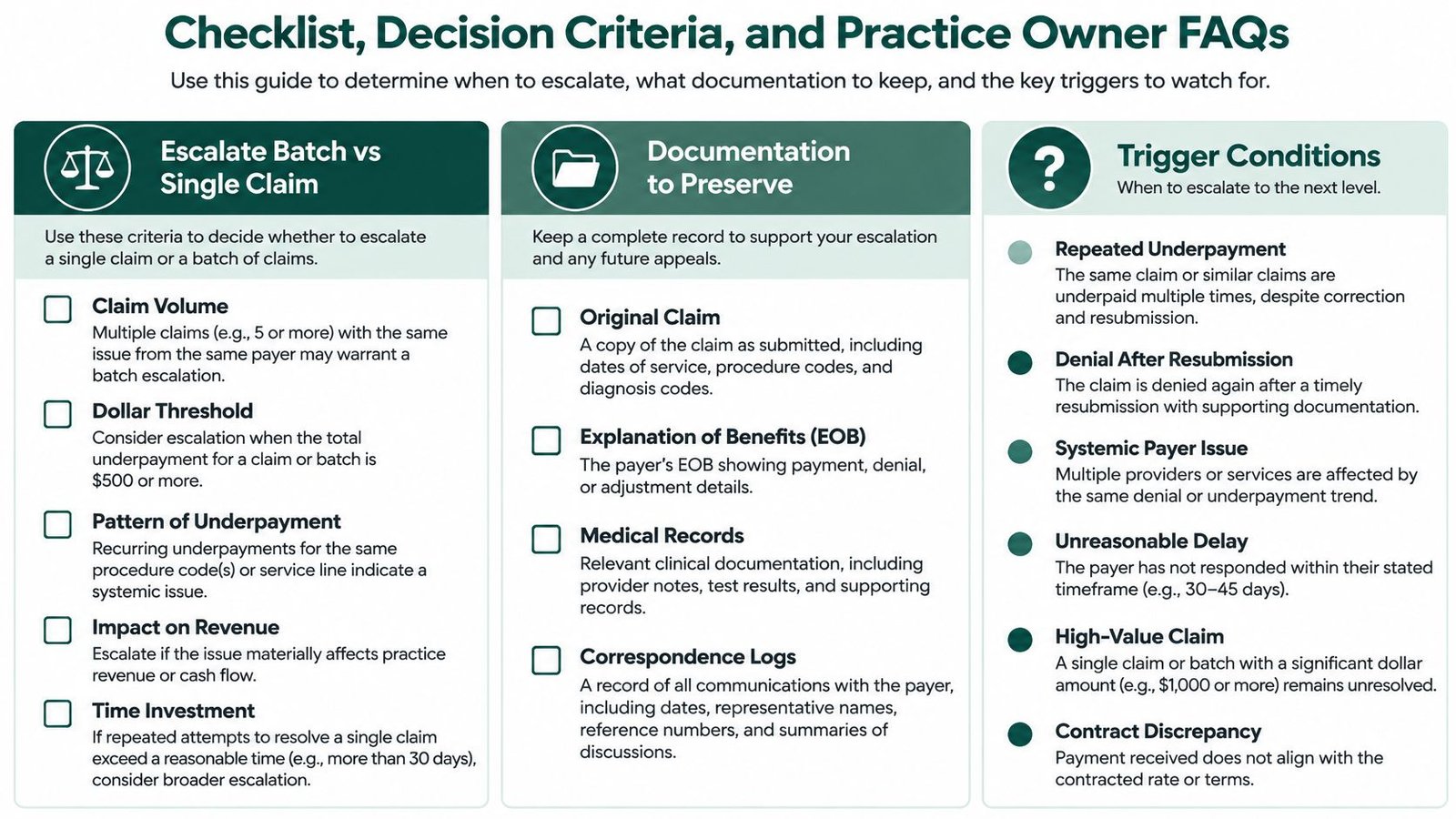
The checklist is short because the hard calls happen earlier in the process. Before escalating, confirm three things: the batch shows a repeatable pattern rather than one-off repricing noise, the aggregate shortfall justifies the staff or vendor hours, and every claim in the file still has a live deadline in at least one lane. A claim with an expired window is a loss, not a batch member.
Documentation drives the rest. Preserve the original claim, EOBs, AOB, medical records, call logs, the dispute packet, proof of submission, and the denial letter. Proof of submission matters more than most practices expect, because payers and regulators ask when you filed before they ask what you filed. Use our out-of-network appeal package checklist and template so nothing is rebuilt from memory while a deadline is running.
Book a free 30-minute call with a billing specialist to review your Cigna batch before windows close. We only get paid when we deliver, nothing upfront. US practices only.
Should I Dispute One Claim or Wait to Build a Batch
Dispute a single claim if its deadline is near, because an expired window cannot be batched back to life. Otherwise build the batch. Aggregate value and pattern evidence get payer attention that isolated claims don't, and a lone claim that can wait becomes the anchor example rather than the whole case.
What Does Outsourced Recovery Cost My Practice
Fees are contingency-only, depend on claim age and volume, and we give a clear number after a free 30-minute call with a billing specialist. We don't quote a fee before seeing the claims.
Will My Patients Get Pulled Into This
No patient contact is needed when an AOB is on file. If assignment paperwork is missing or defective, we flag it before anything is filed in the patient's name.
When Should I Involve a Regulator or Attorney
Escalate beyond negotiation when the internal appeal is exhausted, the amount clears applicable thresholds, eligibility for external review or IDR is documented, and deadlines are preserved in writing. As noted earlier, the state DOI complaint and the Federal IDR track run on different eligibility tests, so record which one applies before you escalate rather than after.
If Cigna underpayments are sitting in your A/R as paid in full, Happy Billing can batch, benchmark, and dispute them through the right lane before the windows close. Bring us a sample of repriced EOBs and we'll tell you plainly which claims are worth pursuing, which aren't, and what we'd file first.