5 Signs Your Out-of-Network Claims Are Being Systematically Underpaid in 2026
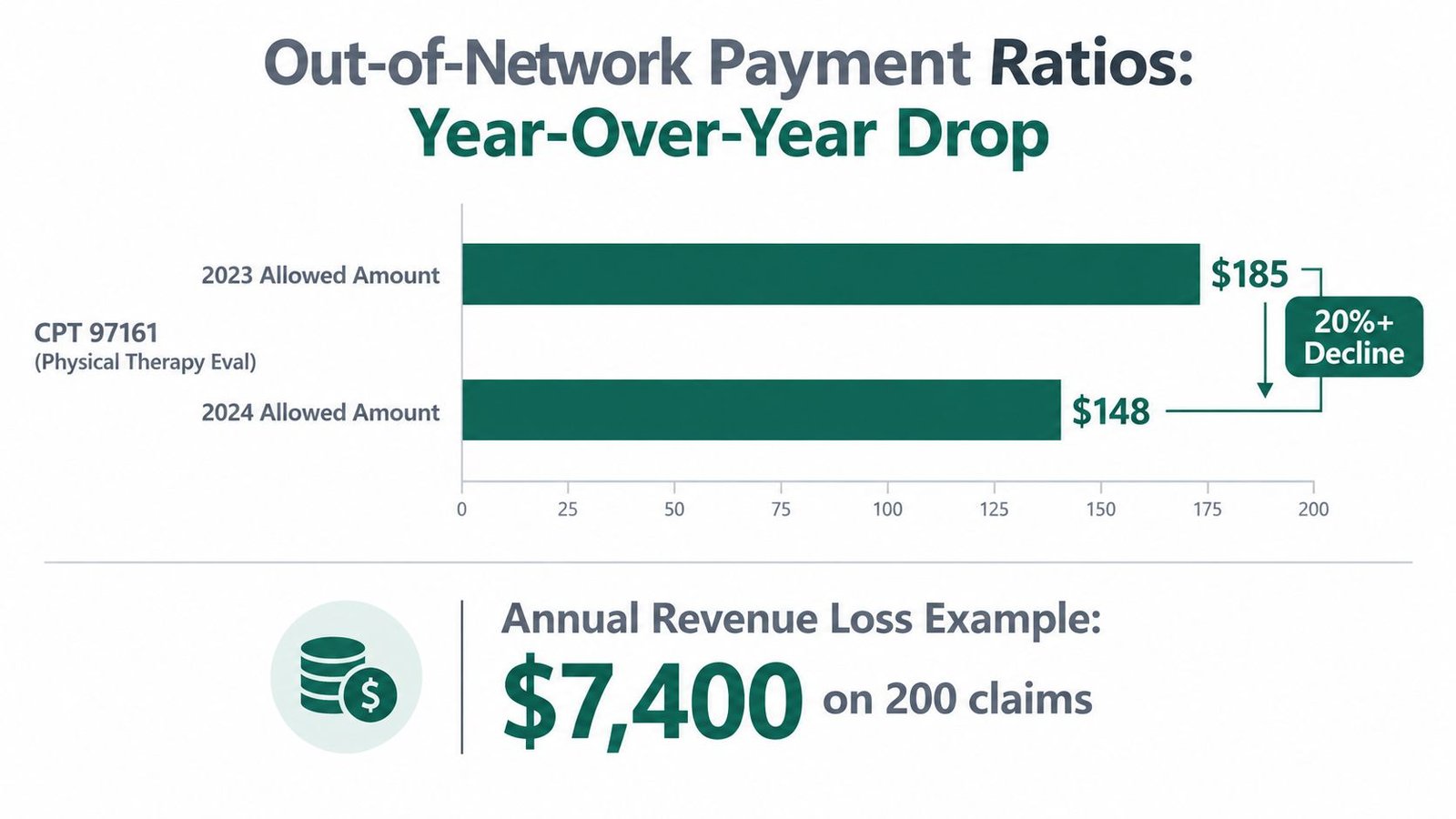
A practice likely has a systematic out-of-network underpayment problem when the same CPT code paid by the same payer falls 20% or more year over year, when repricing vendors appear on remittances without notice, and when deadlines, duplicate denials, or aged balances stop moving.
You may be losing revenue even while claims continue to pay. The warning usually appears in allowed amounts, denial rates, or days in A/R before it appears in your monthly collections report. Every percentage point of allowed-amount erosion affects cash flow, while unresolved denials increase staff work and push balances into older A/R buckets.
This is a diagnostic checklist for a physician owner or administrator. You can run it with your payment data, EOBs, denial log, and aging report in an afternoon. The key is to compare like with like, use allowed amounts rather than billed charges, and separate underpayment from nonpayment, bundling, incorrect modifiers, and patient-responsibility errors.
Happy Billing is a medical billing company headquartered in Houston, Texas. We recover out-of-network underpayments for physical therapy, chiropractic, sports medicine and behavioral health practices, including practices in New Jersey and New York.
In our experience, the strongest audits start with claim-level evidence. We compare CPT or HCPCS code, payer, modifier, place of service, rendering specialty, geography, and service date. CMS guidance under the No Surprises Act also makes the allowed amount and applicable qualifying payment amount more useful audit references than billed charges alone. AAPC standards and payer-specific appeal rules matter when deadlines and corrected submissions determine whether a recoverable claim remains open.
If two or more signs appear, start with a free out-of-network underpayment analysis before writing off balances or changing your billing vendor.
1. Out-of-Network Payment Ratios Have Dropped 20% or More Year Over Year on Identical CPT and Payer Combinations
The cleanest test is simple. Select one CPT code, one payer, one place of service, and comparable modifiers. Then compare the allowed amount across two periods while checking for a contract or benefit-design change.
Suppose CPT 97161 paid an average allowed amount of $185 in one year and $148 in the next. The decline is $37 per claim. If the practice submitted 200 comparable claims, the implied revenue gap is $37 × 200 = $7,400. That is not a billing opinion. It's a variance you can trace to individual EOBs.
The percentage decline is equally clear: $37 ÷ $185 = 20%. A drop of 20% or more on the same CPT and payer combination deserves investigation because broad collection averages can hide a payer-specific pricing rule.
Audit rule: Compare allowed amounts, not billed charges. Then control for the code, payer, modifier, place of service, provider, and service period.
Start with your highest-volume services. A physical therapy practice might review CPT 97161, 97110, and 97140. A behavioral health clinic might review CPT 90834. An orthopedic practice might review CPT 99213 or CPT 20610. The code list should reflect your own volume and revenue, not a generic benchmark.
The self-run test
Export paid claims for the same CPT and payer from the earlier and later periods. Remove obvious outliers, then inspect the EOBs for:
- Contract changes: Confirm whether the payer amended the provider agreement or benefit product.
- Repricing language: Look for a third-party vendor or a new allowed-amount explanation.
- Modifier differences: Separate claims with modifiers such as -25, -26, or -59 from claims without them.
- Place of service: Keep office, facility, and emergency settings separate.
- Payment basis: Normalize anesthesia claims by base units and time units, and separate professional and technical components for imaging.
The arithmetic is your recovery estimate:
Earlier allowed amount minus current allowed amount, multiplied by annual comparable claim volume, equals estimated annual variance.
That figure is not automatically collectible. Verify eligibility, timely filing, contract terms, patient benefit design, and whether the claim qualifies for a state or federal payment protection. But it gives you a defensible starting point for a payer appeal or contract review.
For a deeper review of payment discrepancies, compare your findings with this guide to out-of-network reimbursement analysis. You should also review the out-of-network underpayment recovery guide when the same payer and code family repeatedly produces a lower allowance.
2. EOBs Increasingly Reference Third-Party Repricing Without Prior Notice
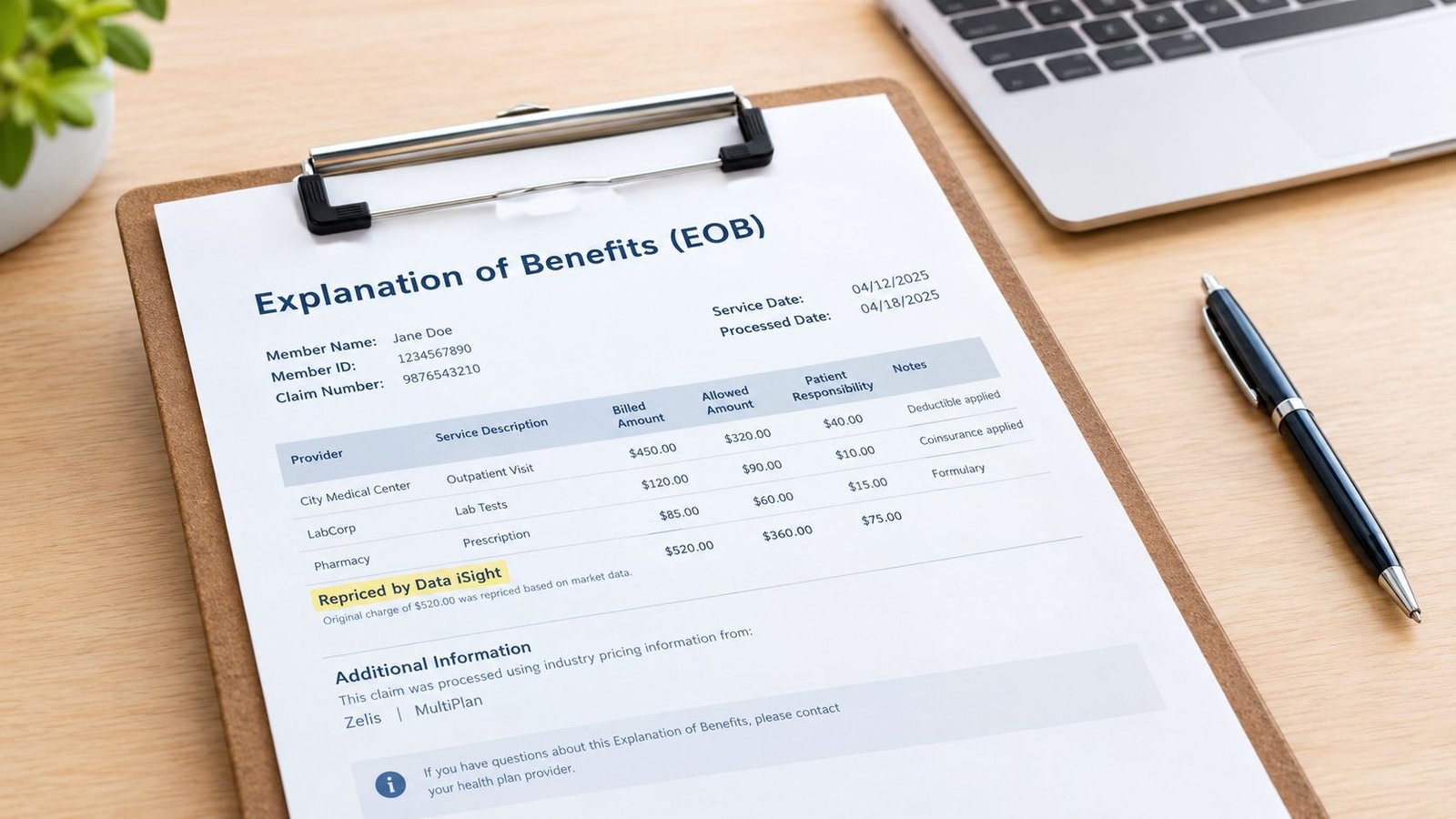
You post a payment that looks low, open the EOB, and see a name your staff did not see six months ago: Data iSight, Zelis, or MultiPlan. That is not proof of underpayment by itself. It is an audit trigger. When a new repricing vendor appears at the same time the allowed amount falls, I treat that as a testable change in payment methodology.
Start with the EOB language. Look for phrases such as “repriced by,” “processed through,” or “allowed amount determined by.” Record the first appearance of each phrase by payer and product. Then pull earlier claims for the same payer, same CPT, same modifiers, and similar dates of service. The question is narrow and measurable: did the allowed amount change when the vendor appeared, and did the payer disclose that change before applying it?
The pattern shows up across specialties. A sports medicine practice may see CPT 20610 paid at one allowance before Data iSight appears on the EOB. A chiropractic clinic may start seeing MultiPlan tied to CPT 98941. A physical therapy group may find Zelis on a regional Blue Cross remittance. Different code sets, same diagnostic.
Run the math before you build a full dispute packet.
Expected allowed amount minus repriced allowed amount, multiplied by affected claims, equals estimated cohort variance.
If the expected allowance is $285, the repriced allowance is $195, and 40 comparable claims were affected, the variance is $90 × 40 = $3,600. That does not guarantee recovery. It gives you a working estimate of the revenue leak so you can decide whether the issue is isolated, payer-wide, or large enough to escalate now.
Build a repricing evidence file
Create one row for each affected claim, or for a defensible sample if volume is high. Include:
- Payer and product: Carrier and plan type.
- Vendor name: Data iSight, Zelis, MultiPlan, or the exact EOB wording.
- CPT and modifiers: Code, units, and modifier combination.
- Allowed amount: The EOB allowance, not only the net payment.
- Effective timing: Service date, adjudication date, and EOB date.
- Disclosure record: Any payer letter, provider agreement amendment, or portal notice.
Then request written confirmation from the payer of the vendor's effective date, methodology, and authority to set or influence the allowance. Do not assume the vendor benchmark matches the payer's contract language or prior payment basis. New York guidance, for example, identifies the 80th percentile of usual and customary rates as a relevant comparison point for applicable out-of-network reimbursement disclosures, and that comparison turns on service, specialty, and geography. For the dispute path, use this Data iSight underpayment appeal guide for out-of-network providers.
Do not wait for every affected claim to age. Sample the first EOB that names the vendor and the most recent one, define when the pricing shift began, and dispute it while the payer's records are still easy to pull.
3. Staff Report Recurring 14-Day Response Windows That Expire Before Resubmission or Appeal
Your staff finishes the records packet. The denial is clear. The payer still rejects the response as late because the clock started days before the notice reached the office. I see this pattern often in out-of-network audits, and it rarely stays limited to one claim.
A recurring 14-day window is not just a staff training issue. It is a timing defect you can measure. Start with a small sample from one payer and one denial type. Pull the last several notices that required records, a corrected submission, or an appeal. Then line up six dates for each claim: the EOB date, the date the practice received the notice, the date staff first reviewed it, the date the packet was complete, the date it was sent, and the stated payer deadline.
The arithmetic is simple. Calculate usable response time as payer deadline minus actual receipt date. Then compare that number with the days your office usually needs to gather records, prepare the submission, and send it through the payer's accepted channel.
A single claim shows why this matters. Take a CPT 97161 denial for missing medical-necessity documentation. The EOB is dated January 15. The office receives it on January 24. If the payer counts from the EOB date, the practice has only the remaining days to act. If the portal fails on the day your team is ready, the claim can age out before anyone reviews the merits.
That is the diagnostic. The next step is classification.
If the gap appears once, document it. If it appears repeatedly with the same payer, vendor, or denial category, treat it as a process failure that is suppressing collectible revenue. I look for clusters. The same mail lag. The same portal queue. The same short deadline attached to documentation requests that cannot realistically be completed before expiry.
Build one log that operations and billing both use. It does not need to be elaborate. It does need to answer one question quickly: did the practice lose on the merits, or did it lose on elapsed time? Capture the notice date, receipt date, submission channel, proof of transmission, and any barrier that blocked timely filing, including portal outages, payer call reference numbers, and fax confirmations. Those records matter when you ask for an exception.
The recovery route depends on the denial type. Missing records usually calls for supporting documents with a cover letter tied to the original claim. A modifier issue calls for a corrected claim only if the coding and chart support that correction. An allowed-amount dispute is different. That belongs in an underpayment challenge, not a coding fix. This guide to appealing a denied insurance claim is useful for separating a corrected submission from a formal appeal and organizing the packet accordingly.
Do one more piece of math before you escalate. Estimate exposure as affected claims multiplied by expected payment per claim. If eight legitimate claims each carry an expected payment of $185, the exposed amount is 8 × $185 = $1,480. That figure is not final reimbursement. It is the amount of revenue the deadline process may be closing off before the practice can present its case.
Once you can show repeated timing loss, the conversation changes. You are no longer arguing that staff felt rushed. You are showing that the payer's response window, measured against actual receipt and submission capacity, is causing preventable underpayment.
4. Duplicate-Denial Rejections Appear on Legitimate Resubmissions and Corrected Appeals
A duplicate denial usually shows up after your team did the work. The chart was sent. The modifier was corrected. The appeal packet included the missing records. Then the payer issues the same denial again, with no sign that the new material was reviewed. I treat that as a workflow defect first, not a one-off denial.
You can test it on a single claim before you review the full backlog. Take CPT 20610. The first denial cites medical necessity. Your staff submits the operative note and imaging. The next response repeats the same denial. A third pass gets the same result. At that stage, the claim is no longer telling you only about coverage. It is telling you how the payer is routing corrected work, and whether anyone is reading it.
The useful audit here is a chain-of-custody check. Build it around the original claim number and compare each touchpoint in sequence. I want to see the exact denial language, what changed in the correction, how the packet was sent, what proof of receipt exists, and what came back after that. If one of those links is missing, the payer can classify a valid correction as an unchanged duplicate. If all of those links are present and the denial still repeats, you have a stronger basis for escalation.
A good cover letter helps because it reduces ambiguity. State the original denial reason. State the correction or added evidence. List the attachments. Include the payer claim number. The goal is simple. Make it difficult for the intake team or automated queue to treat a legitimate resubmission as the same unresolved claim.
For workflow design, the medical billing denial management guide is a practical reference for separating front-end rejection, adjudicated denial, underpayment, and post-payment adjustment. Those categories should not sit in the same bucket. They require different owners, different documentation, and different escalation paths.
Once a claim has received two materially identical denials after a documented correction, I stop sending the same packet again. I escalate. Depending on the issue, that can mean payer provider relations, the appeals unit, or a medical director review. If the dispute is really about the payment amount rather than medical necessity, treat it as a payment challenge and check whether federal IDR or a state remedy applies.
Run the math on the cohort, not just the anecdote. Use expected payment per claim × number of claims caught in the duplicate-denial pattern. If 12 comparable claims each carry an expected allowed amount of $400, the exposed revenue is 12 × $400 = $4,800. Then separate that number from internal labor. If one claim should pay $1,200 and staff spent 20 hours chasing it, the recoverable claim value is still $1,200. The labor cost is real, but it belongs in your operating analysis, not in the reimbursement demand.
That distinction matters. A payer can eventually pay and still force an uneconomic process. When duplicate denials cluster around the same payer, claim type, or submission channel, you are looking at a measurable revenue leak, with a clear recovery route.
5. Large Balances at 90 or More Days Aged Remain Stuck Without Progress
At 90 days, the problem has already moved from billing operations to cash flow. I treat these balances as a recovery cohort, not as routine aging, because the underlying failure usually happened earlier and now sits in one visible bucket.
Start with a filtered aging report. Break the 90-plus-day claims by payer, CPT family, repricing vendor, denial reason, and last documented action. Total A/R can look stable while one payer, one location, or one service line carries most of the unresolved out-of-network exposure. That concentration matters. It tells you where to audit first.
The backlog in the federal dispute system shows how long payment conflicts can stay unresolved. From April 2022 through June 2023, nearly 490,000 disputes were submitted, and about 61% remained unresolved as of June 2023, according to the Government Accountability Office. I do not read that as a reason to wait. I read it as a reason to classify every old balance by next action, owner, and deadline before it turns into a write-off.
A useful sort is simple. Separate claims that are pending payer action, underpaid, denied but still appealable, repriced by a vendor, assigned to patient responsibility, or close to a filing deadline. Those categories should not live in the same queue. They have different evidence requirements and different escalation paths. If follow-up capacity is the bottleneck, a medical admin assistant for short-term rental can handle documentation pulls and portal follow-up while your internal team works the appeal cohort.
Emergency claims need a second look. The No Surprises Act limits patient cost sharing for most emergency out-of-network services to the in-network amount. CMS also requires plans to assess emergency status under the prudent-layperson standard, based on presenting symptoms and documentation rather than only the final diagnosis code. When an emergency claim is processed as ordinary out-of-network care, the same account can contain an improper patient balance and an unresolved payer underpayment.
Then run the math at claim level.
Use expected allowed amount minus actual allowed amount, multiplied by unresolved claims. If 25 claims should have allowed $600 each but allowed $420 each, the variance is $180 × 25 = $4,500. After that, decide whether the cohort supports escalation once you account for filing fees, legal cost, and staff time.
For eligible federal claims, open negotiation comes before IDR, and that negotiation period lasts 30 business days, as outlined in the federal IDR process for providers. If no agreement is reached, a certified IDR entity chooses one party's offer as the binding payment amount. Keep the EOB, payer offer, benchmark support, specialty context, geographic factors, and service complexity together in one file. Old balances stall when the evidence sits in five places.
I also assign an owner and an escalation date to every 90-plus-day account. This framework to manage accounts receivable in medical billing is useful for that step. If two or more signs are present in the same aging cohort, quantify the exposure now and work the balances before they become write-offs.
5 Signs of Systematic Out-of-Network Underpayment
| Indicator | Implementation complexity | Resource requirements | Expected outcomes | Ideal use cases | Key advantages |
|---|---|---|---|---|---|
| Out-of-Network Payment Ratios Dropped 20%+ YoY (same CPT/payer) | Moderate, requires controlled period-over-period comparison and stratification | Claim history exports, analytics/spreadsheet, billing analyst time | Quantifies underpayment, identifies repricing or unilateral allowed-amount cuts, dollar loss estimate for appeals | High-volume CPT/payer combos; quarterly financial audits | Auditable, quantifiable recovery potential; strong evidence for appeals/negotiation |
| EOBs Showing Third-Party Repricing Vendor Names | Low to moderate, EOB scanning and pattern recognition | Dedicated EOB reviewer or automated EOB parser; training to spot vendor language | Identifies vendor involvement early, preserves appeal windows, enables vendor-specific challenge | When EOBs contain unfamiliar vendor language or sudden payment drops | Documentary proof of repricing; legal/regulatory leverage; targeted vendor remediation |
| Staff Report 14-Day Response Windows Expiring Before Appeals | Low detection, moderate remediation, requires workflow changes | Centralized deadline tracking, SLA enforcement, staff training, alerts | Reduces missed appeals, prevents deadline-driven claim abandonment | Practices with frequent time-barred denials or repriced out-of-network claims | Operationally fixable; supports regulatory complaints about unreasonable timelines |
| Duplicate-Denial Rejections on Legitimate Resubmissions | High, needs systematic tracking and escalation processes | Duplicate-denial tracker, staff hours for investigation, escalation to payer/regulator | Reveals processing failures or denial loops; can force manual review and recoveries | Repeated identical denials across CPT/payer pairs or high denial volume | Strong evidence for escalation/IDR; can recover batch amounts once resolved |
| Large Balances at 90+ Days Aged Stuck Despite Follow-Up | Low detection, high remediation, visible in standard A/R reports | A/R monitoring, collection/recovery services, possible third-party recovery or legal support | Quantifies trapped revenue and cash-flow impact; prioritizes recovery actions | Practices with rising days in A/R or worsening cash flow | Immediate visibility; actionable KPI to trigger systemic investigation and recovery efforts |
Turn the Five Signs Into a Recovery Plan
The five signs work as a sequence. A falling payment ratio and new repricing language are leading indicators. They tell you that the payer's pricing behavior may have changed. Expiring deadlines, duplicate denials, and 90-plus-day balances show where the financial impact is already trapped.
Start with a controlled sample. Choose comparable claims, preserve the EOBs, and calculate the variance at the line level. Then separate an underpayment from a denial, nonpayment, bundling edit, modifier issue, patient-responsibility error, or timely-filing problem. That classification determines whether you need a payment appeal, corrected claim, provider-relations escalation, regulator complaint, or IDR review.
This week's owner checklist:
- Payment ratio drop: Compare the same CPT and payer across two periods. Calculate the per-claim variance and annual exposure.
- Repricing notation: Log every Data iSight, Zelis, or MultiPlan reference. Ask the payer for the vendor's effective date and methodology.
- Short deadline: Record EOB date, receipt date, and submission deadline. Preserve proof of delayed delivery or portal failure.
- Duplicate denial: Stop repeating identical submissions. Escalate the claim with the original reference number and complete evidence chain.
- 90-plus-day A/R: Group aged claims by payer and denial reason. Prioritize the highest-value cohort and check IDR eligibility.
A practice owner who sees two or more signs doesn't need to guess at the size of the problem. The next step is a claim-level review that compares allowed amounts with a defensible benchmark, contract schedule, QPA disclosure, prior adjudication, or applicable state rule. Request a free out-of-network underpayment analysis and use the resulting cohort to decide what your current RCM process should recover, appeal, or escalate.
Happy Billing is a medical billing company headquartered in Houston, Texas. Its work includes out-of-network underpayment recovery, denial management, appeals, and A/R recovery for independent practices. It can review the payment data and workflow without treating every low payment as proof of a payer violation.
How do I know if a repricing vendor is cutting my allowed amounts without telling me?
Compare EOBs before and after the vendor name appears. Match the CPT code, payer, modifier, place of service, and provider. If the allowed amount falls at the same time, request written confirmation of the vendor's role, effective date, methodology, and disclosure history. Keep the EOB language and payer response together in the claim file.
What is a reasonable share of A/R to have over 90 days?
There isn't one universal target that fits every specialty, payer mix, and OON strategy. The useful question is whether the 90-plus-day share is concentrated in one payer, vendor, CPT family, or denial reason and whether documented follow-up is producing movement. Track aging by cohort, not only as a practice-wide average.
When should I file an IDR request instead of another appeal?
Use IDR only when the claim is eligible and the issue is an applicable payment dispute, not a coding correction or missing-documentation problem. Confirm the negotiation step, procedural deadlines, conflict attestation, certified IDR entity requirements, and supporting evidence. If the payer just needs a corrected modifier or clinical record, resolve that issue through the appropriate claim or appeal channel first.
Is outsourcing billing worth it if I only have underpayment problems?
Compare the recoverable cohort with your internal review time, appeal capacity, and deadline performance. Outsourcing may make sense when your team can identify variances but cannot consistently review EOBs, preserve evidence, or pursue aged balances. Review the cost of outsourcing medical billing and pair it with a defined underpayment scope. For denials that require structured escalation, use the medical claim denial appeal letter guidance before assigning the work.
If you've identified two or more signs, don't wait for another aging cycle. Send a representative claim sample for a free out-of-network underpayment analysis and quantify the payer, CPT, and repricing patterns before deciding whether to repair or outsource your RCM process.
Happy Billing reviews out-of-network payment patterns, repricing references, denial activity, and aged A/R for independent medical practices. Visit Happy Billing to begin a focused review of the claims that may be underpaid, delayed, or stuck.