In-house vs Outsourced Out-of-network Underpayment Recovery Which Is Right for Your Practice
Most independent specialty practices with fewer than 200 out-of-network claims per week recover more net revenue by outsourcing, because the fully loaded internal cost and IDR deadline risk usually exceed a contingency fee. High-volume, stable practices with specialized coding needs may justify an in-house model.
That answer matters because underpayment recovery isn't a generic billing task. It affects net collections, denial rates, and days in A/R. A practice can have competent claim submission and still lose revenue when staff fail to identify payer variance, challenge an allowed-amount reduction, or escalate a qualifying claim before the federal deadline. The right comparison is not an employee's salary against a vendor's fee. It's recoverable dollars per claim, recovery speed, deadline control, and total operating cost.
Happy Billing is a medical billing company headquartered in Houston, Texas. We recover out-of-network underpayments for physical therapy, chiropractic, sports medicine and behavioral health practices, including practices in New Jersey and New York.
The Short Answer for Practice Owners
Outsourcing is usually the stronger choice for independent practices below the 200-claim weekly threshold. Internal recovery can work, but only when the practice can maintain dedicated staff, payer expertise, reliable systems, and strict deadline control. An outside firm is not automatically better. The winning model is the one that recovers more money consistently after labor, technology, supervision, rework, training, turnover, and missed-opportunity costs.
The familiar fee comparison is only the starting point. A contingency fee can be reasonable when internal staff lack the time or expertise to identify payer variance and pursue each dispute. A lower internal cost can be misleading if claims remain untouched, appeals are incomplete, or qualifying disputes miss the federal process deadline.
| Decision factor | In-house recovery | Outsourced recovery |
|---|---|---|
| Low or fluctuating OON volume | Usually inefficient | Usually favorable |
| Stable high volume | May justify dedicated staff | Still viable if complexity is broad |
| Specialty-specific coding | Strong control if expertise exists | Useful when expertise is scarce |
| Federal IDR deadlines | Requires disciplined tracking | Specialist workflow can reduce deadline risk |
| Payer and repricer variety | Difficult to maintain internally | Often easier to distribute across specialists |
| Cost structure | Fixed payroll and overhead | Usually contingency-based on recovered amounts |
| Owner oversight | Direct operational control | Requires reporting and audit rights |
Use operational triggers to make the decision. If the last 90 days show more than 15% of OON payments below FAIR Health 80th percentile, prioritize the recovery model before comparing fees. That pattern points to a payment variance problem, rather than just a billing expense. Review 6 to 12 months of remittances, sort underpayments by payer, CPT or DRG, specialty, and reason, then measure recovered dollars per appealed claim and the time from payment posting to escalation.
The 14-day ISR window also changes the calculation. A qualifying claim can require prompt action after the open-negotiation period. A practice without assigned ownership, backup coverage, and deadline alerts can lose the chance to pursue payment even when the underpayment is identifiable. The operational risk is highest when one employee handles recovery alongside normal billing duties.
Specialty and payer mix matter just as much as volume. A practice may have manageable claim counts but still face difficult recovery if its procedures, coding rules, repricers, and payer contracts vary widely. That specialty × payer complexity multiplier often determines whether an internal process remains accurate as volume grows.
Practical rule: Choose the model that recovers more net allowed dollars while protecting deadline compliance, denial performance, and A/R aging.
Before comparing vendors, request a free underpayment analysis based on actual remittance data. The review should identify missed payment opportunities, payer patterns, and claims that require escalation, rather than repeat a headline recovery percentage. Industry cost guidance can help frame the discussion, but your own remittance history should determine the decision.
True Costs of In-House Out-of-Network Recovery
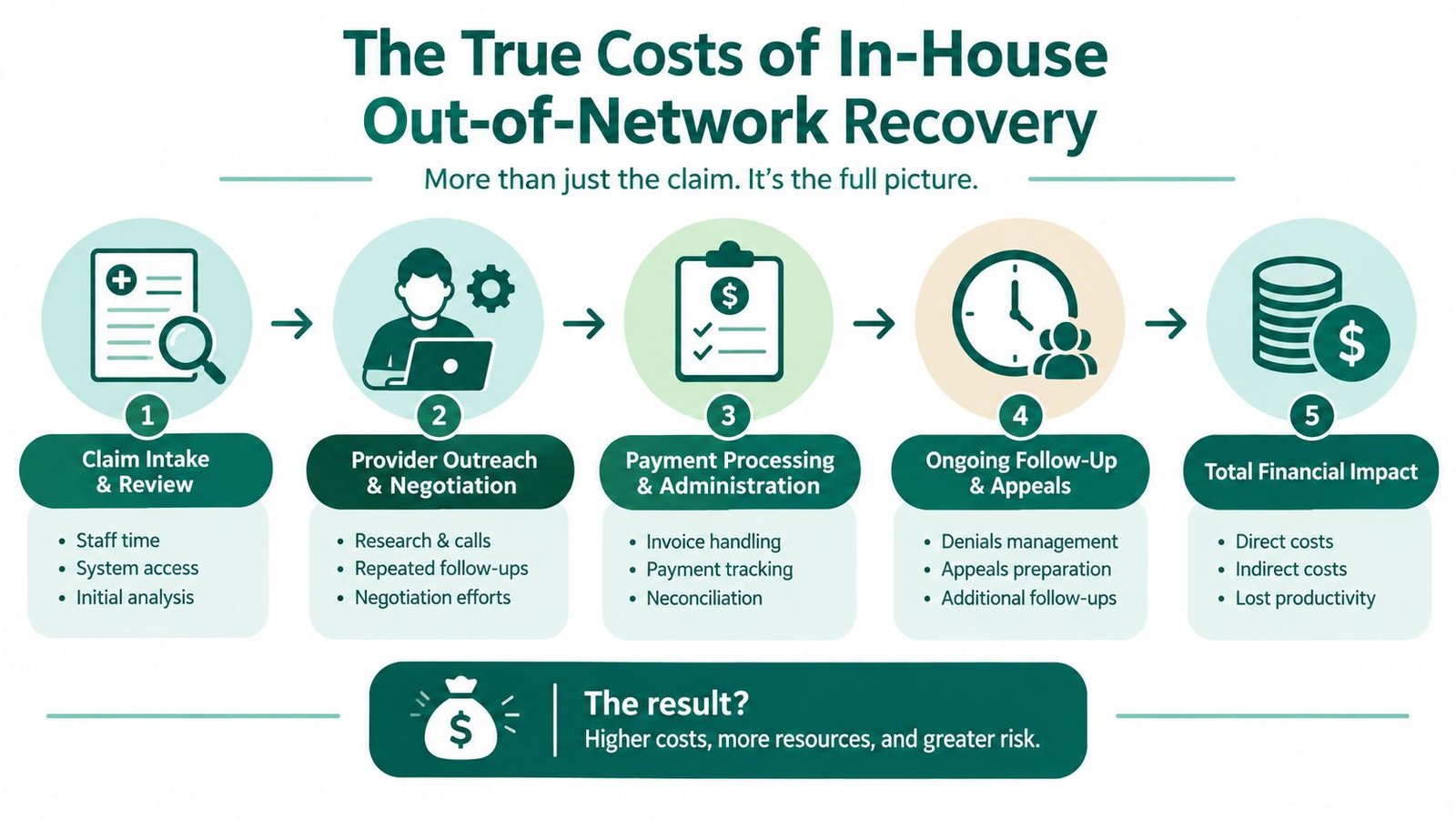
Internal recovery looks inexpensive when an owner counts only the salary of the person touching claims. That calculation misses the labor surrounding each dispute. Staff must review remittances, identify the expected payment, interpret payer methodology, gather records, prepare an appeal, monitor responses, update the account, and escalate when the first response fails.
The fully loaded cost also includes benefits, software, training, supervision, turnover, and denial-related rework. Industry analyses estimate that these costs can bring an in-house billing function to approximately 6% to 10% of collections. The estimate is useful for modeling, but it's industry guidance rather than a validated universal benchmark. Use your payroll ledger and time studies to replace the estimate with your own cost.
The 14-day window trap
The No Surprises Act creates a deadline-driven workflow, not an ordinary follow-up queue. For qualifying commercial claims, the provider and payer generally have a 30-day open-negotiation period after the initial payment or denial. If negotiation fails, either party generally has four days to initiate federal IDR, after which each side submits its proposed payment and supporting information within 10 days, with a binding decision generally due within 30 days after the arbitrator is selected. The process and deadlines are summarized in DLA Piper's explanation of the No Surprises Act payment-dispute model.
Some operational discussions describe a 14-day filing window after open negotiation. Whatever calendar applies to a specific claim, the practical danger is the same. A staff member who opens the remittance late, misclassifies eligibility, or leaves the case in a general work queue can permanently lose the recovery opportunity.
The internal team also needs to distinguish federal IDR claims from ordinary out-of-network appeals, state processes, and claims excluded by notice-and-consent or payer-jurisdiction rules. CMS reported that 42% of disputes in both Q3 and Q4 2025 were challenged as ineligible, which makes screening a financial control rather than a paperwork exercise. Review the federal IDR eligibility landscape before assigning every low payment to an arbitration queue.
Expertise is a fixed operating requirement
A general biller may know claim submission and basic denial follow-up without knowing how to defend an out-of-network allowed amount. Effective recovery can require FAIR Health data, QPA validation, payer-specific evidence, state regulator processes, and specialty coding analysis. A New Jersey practice may need a different escalation path through DOBI than a New York practice using DFS complaint procedures.
Internal teams also need specialty fluency. Anesthesia recovery can depend on base units, time, qualifying circumstances, concurrency, and modifiers such as QK, QX, QY, and QZ. A missed modifier or incorrect concurrency interpretation can reduce payment on every affected claim, not just one disputed account. The cost of that expertise includes continuing education and quality review, not only the initial hire.
For process design, pair claim recovery with a documented medical billing cost analysis and a practical AR collection automation playbook. Automation can organize work, but it can't replace payer interpretation or an accountable escalation owner.
What Outsourcing Actually Costs and Delivers
Out-of-network recovery firms usually charge a contingency fee on recovered amounts. If nothing is recovered, there is generally no contingency fee on that claim. Fee structures vary by firm, and practices should not assume that every vendor uses the same terms. Happy Billing's specific pricing isn't stated here, so request a written proposal rather than relying on a market assumption.
The comparison should include every cost on both sides:
- Internal payroll: Salaries, benefits, supervision, training, and coverage during absences.
- Dispute administration: Staff time for remittance review, documentation, payer calls, appeals, and IDR submissions.
- External charges: Contingency fees, administrative fees, filing fees, and any fixed charges specified in the agreement.
- Revenue delay: Aging-related write-offs and cash-flow impact when a claim remains unresolved.
- Opportunity cost: Physician, administrator, and revenue-cycle attention diverted from operations.
A vendor's fee is reasonable only when the practice receives more net value after that fee. For example, compare the vendor's annual fee with the complete internal cost, then add the value of recovered underpayments and avoided write-offs. Don't compare a percentage to salary in isolation.
What a credible operation should show
Ask for a claim-level audit trail. Every disputed claim should show the billed code, expected benchmark or contractual reference, paid amount, variance, eligibility status, documentation used, appeal or IDR action, final settlement, and net recovery after fees. A vendor that can't show this information makes it difficult to verify whether it recovered a genuine underpayment or merely processed a routine payment.
Published federal data show why capacity matters. Providers prevailed in approximately 85% of federal IDR determinations during 2025, and the prevailing offer exceeded the insurer's QPA in about 87% of reported cases. Providers initiated 76% of second-half 2025 federal IDR disputes, and the program handled approximately 1.4 million disputes during that six-month period, 16% more than in the first half of 2025, according to CMS-related reporting on IDR volume and outcomes. Those numbers don't prove that outsourcing is better by nature. They do show why a practice needs disciplined eligibility screening, evidence preparation, and calendar control.
Measure net performance, not gross collections
Require monthly reporting on:
- Underpayment dollars identified
- Eligible claims submitted
- Appeal overturn rate
- IDR eligibility rate
- Average recovery per claim
- Days from payment to detection
- Aged unresolved inventory
- Net recovery after fees
A useful recovery partner should also explain how it handles non-IDR claims. The federal process doesn't apply to every low payment, and ordinary appeals, payer negotiations, state complaints, or contract remedies may be more appropriate.
For broader outsourcing governance, the enterprise outsourcing governance tips from AnyBPO offer a useful framework for defining responsibilities, access controls, reporting, and escalation rules. Apply that discipline to the business associate agreement, data transfer process, and termination terms.
If you're modeling the full economics, compare your assumptions with this medical billing outsourcing cost guide. The answer should come from your claim inventory and recovered dollars, not a vendor's fee sheet alone.
Volume Thresholds and Specialty Complexity
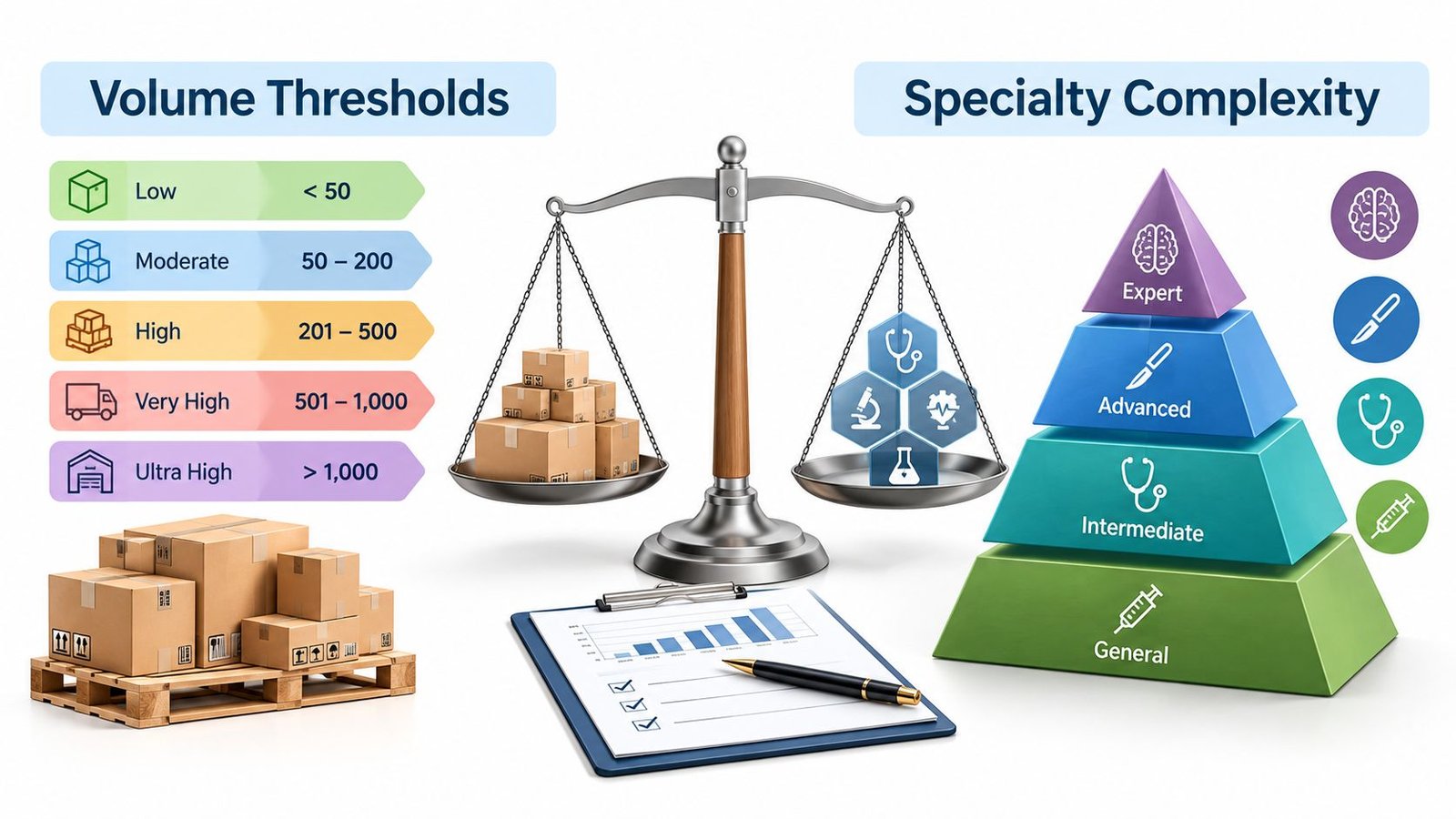
Volume is the first filter, but it isn't the final answer. Under 200 out-of-network claims per week usually favors outsourcing because a practice often can't keep a dedicated recovery specialist productive when volume fluctuates. The employee still costs money during slow periods, while a contingency-based external model can assign work across a broader portfolio.
Higher volume changes the calculation. A stable anesthesiology, cardiology, or orthopedic practice may justify internal specialists when the claim stream is predictable and the practice already has strong coding, analytics, legal oversight, and rapid escalation. The internal team must still prove that it recovers more net dollars per staff hour than an external option.
Apply the specialty by payer multiplier
A practice with one specialty and a narrow payer mix faces a simpler operating problem than a multi-specialty group working across several jurisdictions. The specialty × payer complexity multiplier rises when coding logic, payer methodology, state rules, and claim volume all vary at once.
Consider the financial exposure behind common examples:
- Anesthesiology: Review base-unit mismatches, time units, medical direction, concurrency, qualifying circumstances, and modifiers. A repeated error across high-value cases can depress allowed amounts across an entire payer relationship.
- Cardiology: Investigate imaging bundling, global-period edits, procedural coding, and modifier logic. A payer pattern that bundles a diagnostic service incorrectly can affect both the current claim and related professional services.
- Orthopedics: Check global-period rules, multiple-procedure reductions, bilateral services, and LT, RT, and 50 modifiers. A missing modifier can turn a payable service into a reduced or denied line.
- Behavioral health: Focus on authorization, medical necessity, session limits, telehealth rules, and documentation. A delayed authorization dispute can increase both denied revenue and A/R days.
An external specialist gains an advantage when your work is episodic, hospital-based, spread across multiple payers, or subject to different state processes. It can maintain specialized queues and reuse payer-specific evidence standards without requiring your practice to keep every skill active every day.
Use a three-part test
First, measure weekly claim volume and separate routine OON claims from disputed underpayments. Second, map each payer to its repricer and escalation rules. Third, test whether your current staff can identify a payment variance quickly enough to meet the applicable appeal, negotiation, and IDR deadlines.
The physical therapy underpayment recovery guide for practice owners illustrates why claim context matters. A physical therapy practice may need to distinguish a payer's allowed-amount reduction from a coding error, a repricer decision, or a patient-responsibility issue. The same principle applies across specialties.
Medicare rules add another benchmark. CMS generally requires clean Medicare claims to be paid or denied within 30 calendar days, with interest due when payment exceeds the applicable ceiling period, subject to exclusions. Medicare Advantage contracts must require payment of 95% of clean claims within 30 days for specified claims and provide interest on qualifying late payments. Use CMS clean-claim guidance and the Medicare Advantage prompt-payment rule to identify timing patterns that belong in recovery rather than write-off.
Why Half-Measures Fail at Recovery
The most common internal failure isn't total neglect. It's partial attention. A biller adds underpayment review to an existing workload, checks a few remittances, sends occasional appeals, and calls the process active. The practice owner sees activity, but revenue remains stuck in A/R.
A general biller who lacks FAIR Health methodology, DOBI and DFS complaint experience, payer repricer knowledge, and federal IDR discipline can't reliably build a defensible recovery case. The person may identify a low payment but lack the evidence to prove what should have been paid. That gap produces weak appeals, slow cycle times, and unresolved inventory.
A recovery workflow isn't effective because someone touched the claim. It's effective when the practice can show the expected payment, the variance, the legal path, the evidence submitted, and the final net result.
The work queue must be continuous
Recovery requires a queue that begins when payment posts and continues through escalation. It should flag unusual allowed amounts, compare similar CPT or DRG payments by payer, identify claims approaching deadlines, and separate ordinary appeals from potential IDR cases. A spreadsheet can support a small portfolio, but it becomes fragile when several payers return different remittance codes and response windows.
Half-measures also create coding drift. An internal employee who rarely handles anesthesia may not recognize how base units and concurrency affect expected reimbursement. A staff member supporting behavioral health may not know which authorization documentation a payer expects. When the same error repeats, the practice loses revenue across a pattern rather than a single account.
Measure the cost of inconsistency
Start with four operational measures:
- Detection delay: How many days pass between payment posting and underpayment identification?
- Submission speed: How long does the team take to prepare a complete appeal or negotiation package?
- Deadline loss: How many eligible claims become unrecoverable because the filing window closed?
- Net yield: How many recovered dollars result from each staff hour after rework?
If the answers are unclear, your practice isn't managing recovery. It's hoping that individual effort will compensate for a missing operating system. That hope often increases days in A/R because staff move between routine billing, denials, patient calls, and underpayment work without a protected queue.
Review medical billing company red flags before deciding that outsourcing solves everything. A poor vendor can create the same fragmentation as an internal half-measure, especially if it doesn't provide claim-level reporting, deadline ownership, or a clear definition of recovered revenue.
The answer to “Why can't we do this ourselves?” is simple. You can, if you have enough recurring volume, dedicated expertise, reliable analytics, documented escalation paths, and a person accountable for every deadline. If you don't have those conditions, assigning recovery to an already busy biller is not an in-house strategy. It's an underpayment write-off process with extra steps.
Decision Matrix and Vendor Selection Checklist
Use the matrix below with actual remittance data. Don't select a model based on preference for control or frustration with a vendor's fee. Select it based on volume, complexity, deadline control, and net recovery.
Out-of-Network Underpayment Recovery Decision Matrix
| Condition | Favors In-House | Favors Outsourcing |
|---|---|---|
| Claim volume | High and stable enough to support dedicated specialists | Under 200 OON claims per week or materially fluctuating |
| Payer mix | Concentrated and familiar | Multiple commercial payers, repricers, and jurisdictions |
| Specialty complexity | Existing expertise in relevant CPT, DRG, modifier, and documentation rules | Specialized coding knowledge is missing internally |
| Deadline control | Centralized calendar with tested ownership and backup coverage | Remittance review is delayed or deadlines are tracked manually |
| Data capability | Reliable variance detection and claim-level reporting | No payer-specific benchmark or underpayment dashboard |
| Escalation | Legal, regulatory, and clinical support is readily available | The practice needs external appeal, DOBI, DFS, or IDR capacity |
| Staffing economics | Internal cost is lower after all overhead and rework | Contingency fee produces higher net recovery with less fixed cost |
| Owner priority | Direct control outweighs administrative burden | Owner needs to reduce A/R work and protect operating capacity |
Calculate the break-even point
Gather the following information before signing anything:
- Total internal cost: Include wages, benefits, software, training, supervision, turnover, coverage gaps, and rework.
- Recoverable portfolio: Identify underpayments by payer, specialty, CPT or DRG, and reason.
- Recovery productivity: Calculate recovered dollars per staff hour and days from payment to escalation.
- External economics: Model contingency fees, fixed fees, filing costs, denied or ineligible submissions, and payment delays.
- Future leakage: Estimate the cost of preventable underpayments that continue because nobody analyzes payer patterns.
The owner should see two outputs, net dollars recovered and cash recovered per unit of effort. Gross collections can hide an inefficient process if the practice spends more to obtain them than the recovered amount justifies.
For Medicare and Medicare Advantage claims, include late-payment review where applicable. For NSA claims, include eligibility screening because CMS reported that 42% of disputes in both Q3 and Q4 2025 were challenged as ineligible. A vendor that submits every low payment without screening may increase administrative cost without increasing net revenue.
Questions to ask every recovery firm
Ask for direct answers, written into the agreement where appropriate:
- How do your fees work? Is the fee contingent on amounts recovered? Are there fixed charges, filing fees, administrative fees, or fees on payments the practice would have received without intervention?
- Will you sign a BAA before seeing claims? The business associate agreement should be completed before the vendor accesses protected health information.
- Which payers and repricers do you handle? Ask specifically about MultiPlan, Zelis, and Data iSight or Claritev, not just "major payers."
- What is your NJ DOBI and NY DFS experience? Request examples of complaint workflows and the documentation the practice must approve.
- How do you screen federal IDR eligibility? Ask how the firm handles service type, patient protections, payer jurisdiction, notice and consent, and state versus federal processes.
- What data must we send? Clarify whether the firm needs remittance files, EOBs, claim forms, medical records, fee schedules, contracts, QPA information, and payer correspondence.
- Who owns deadlines? Confirm responsibility for payment dates, open negotiation, IDR filing, evidence submission, responses, and payment reconciliation.
- How often do you report results? Require at least regular reporting with claim-level status, identified variance, action taken, recovery, fees, and unresolved aging.
- How do you define recovery? The benchmark should be expected allowed amount or documented payment expectation, not gross billed charges.
- Can we audit the work? Require access to records, status history, documentation, and a process for disputing an incorrect classification.
Use these questions alongside questions to ask a medical billing company before hiring. The same governance principle applies whether you're evaluating a full RCM partner or a narrow underpayment specialist.
Outsourced accounting guidance for small and midsize businesses also emphasizes scope, controls, reporting, and accountability. The outsourced accounting for SMBs resource is relevant because underpayment recovery should be governed like a financial process, not treated as an informal vendor task.
Happy Billing can be one option for practices evaluating this model. It provides medical billing and A/R recovery services, including workflows for out-of-network underpayments and denial management, and operates within a practice's existing EHR according to the publisher information provided. Compare its proposed scope with at least one internal cost model and one alternative vendor.
The right answer in-house vs outsourced out-of-network underpayment recovery which is right for your practice is the model that protects recoverable dollars without creating more A/R aging. If your volume is below 200 claims per week, your first presumption should be outsourcing, then test that presumption against actual net recovery data. If volume is high and stable, build an internal team only when you can fund the expertise and controls that the work requires.
Request a free out-of-network underpayment analysis from Happy Billing and provide recent remittance data, payer mix, specialty information, and current A/R metrics. The analysis can help identify recoverable variances, deadline exposure, and whether your practice's economics favor a dedicated internal function or specialized external recovery. Learn more about Happy Billing before choosing your next operating model.
Should a small practice recover out-of-network underpayments in-house?
Usually not when the practice handles fewer than 200 out-of-network claims per week. At that volume, staffing, training, payer expertise, and deadline coverage often make a dedicated internal function less efficient than a contingency-based external model. Confirm the decision with your own recovered dollars per claim and fully loaded internal cost.
Does outsourcing cost anything if the firm recovers nothing?
Many OON recovery firms use a contingency fee on amounts recovered, so there is generally no contingency fee when nothing is recovered. Fee structures vary, and some firms may charge fixed, administrative, or filing fees. Get every charge in writing before transferring claims.
What should a vendor report every month?
Require identified underpayment dollars, claims submitted, recovery by payer, appeal and IDR outcomes, days from payment to detection, unresolved aging, eligibility decisions, and net recovery after fees. A gross collection total isn't enough to evaluate financial performance.
Can our existing biller handle IDR and payer appeals?
Yes, if the practice has dedicated time, payer and specialty expertise, reliable data, documented eligibility screening, and calendar ownership with backup coverage. If the biller is adding recovery to an already full workload, the practice risks weak documentation, increased A/R days, and missed filing windows.