Florida Out-of-network Underpayments: How Independent Practices Recover from Commercial Payers
Your practice's biller handles routine payer follow-up; Happy Billing can recover repriced and underpaid commercial claims for Florida practices on contingency alongside that biller, starting with a free underpayment audit. Recovery starts by identifying the plan's funding, checking which dispute process applies, and documenting the difference between what the payer paid and what your practice can support.
You may already have the warning signs: visits marked paid despite low allowances, surgical claims moving into older A/R, or a biller who keeps calling without getting a substantive response. Those accounts need a recovery owner, not another generic follow-up note. Otherwise, your practice can report completed visits and healthy collections while accepting avoidable revenue losses.
Happy Billing is a medical billing company headquartered in Houston, Texas. We recover out-of-network underpayments for physical therapy, chiropractic, sports medicine and behavioral health practices, including practices in New Jersey and New York.
Who Recovers Underpaid Out-of-Network Claims in Florida
A claim can sit in aging A/R because the current biller is handling submissions, payment posting, first-level appeals, and routine payer follow-up. Underpayment recovery needs a different owner. That person or team audits remittances, identifies under-reimbursed amounts, and pursues the variance without taking daily billing work away from the biller.
The practice owner should assign accountability. If both sides assume the other is working the disputed payment, nobody protects the deadline. Name one recovery lead, keep one shared claim-status record, and set a clear rule for who communicates with the payer and when.
Keep the dispute with the responsible payer
For covered emergency services within its scope, Florida Statute § 627.64194 makes the insurer solely liable for the nonparticipating provider's fees, with the insured responsible only for applicable copayments, coinsurance, and deductibles. The practice should not treat the disputed excess as a patient-collection opportunity when that protection applies.
That matters to emergency, anesthesia, radiology, and surgical groups. The recovery file must establish why the payer owes additional reimbursement, rather than shifting the unpaid balance to another party. The same discipline applies before escalation: route each claim by plan funding and federal eligibility first, so the practice does not spend IDR effort on claims that cannot win or miss state windows on claims that can.
Who does what in a Florida out-of-network recovery
| Party | Role in recovery | What it means for your revenue |
|---|---|---|
| Practice's current biller | Routine follow-up and first-level payer appeals | Keeps daily A/R moving, and credentialing can stay separate from billing |
| Recovery partner working alongside the biller | Audits historical claims and recovers underpaid out-of-network claims | Finds under-reimbursed amounts without replacing the existing biller |
| Commercial payer | Determines the initial allowance and answers reconsiderations | Must address additional payment supported by applicable plan terms or law |
| Florida regulator for state-regulated plans | Complaint channel for matters within its jurisdiction | Provides an escalation route, not an automatic payment award |
| Federal IDR entity | Selects an offer in an eligible federal dispute | Determines payment through the applicable formal process |
Ownership rule: Every disputed account needs a named person, a next action, and a deadline. “With insurance” isn't a recovery status.
Happy Billing runs end-to-end billing and recovers underpaid out-of-network claims. Its denial and appeals team is trained on Florida's IDR framework and includes it in every out-of-network A/R recovery strategy it builds for Florida clients. The team audits historical claims to identify and recover under-reimbursed amounts, and it serves Florida practices entirely remotely.
A Book a free 30-minute call lets the practice review its underpayment backlog and how recovery would fit alongside its current biller. Happy Billing works with independent practices across the United States.
Sort Each Claim by Plan Type Before You Escalate
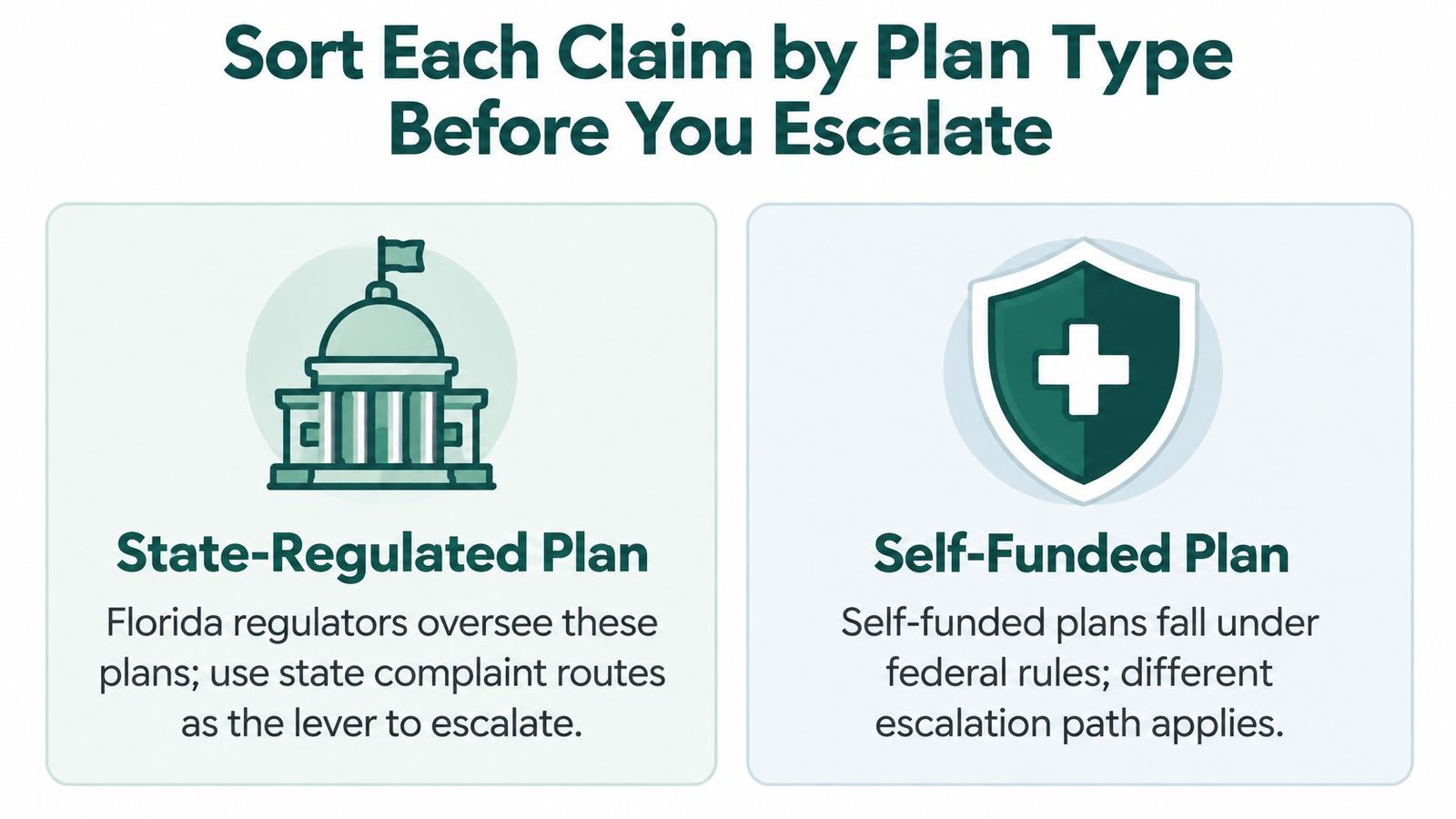
Start with funding, not the payer logo. The company on an insurance card may administer benefits without insuring the employer's risk. Ask your recovery lead to obtain the plan's funding status, governing documents, and applicable claims procedures before selecting an escalation route.
The distinction between state-regulated coverage and self-funded coverage changes the jurisdiction question. Florida's Department of Financial Services and Office of Insurance Regulation are relevant contacts for state-regulated insurance concerns; a self-funded employer-plan dispute requires the applicable federal channel rather than assuming Florida insurance jurisdiction. Confirm the proper recipient and complaint procedure before submitting anything.
The routing distinction is illustrated below.
Separate jurisdiction from payment eligibility
The Florida legislative analysis of provider payment disputes distinguishes qualifying federal disputes from claims that need another recovery route. Treat legislative analyses as explanations of the framework and proposals, not substitutes for checking the currently effective law.
Your recovery lead should answer these questions before authorizing escalation:
- Coverage: What plan funded the service, and which jurisdiction controls?
- Service eligibility: Does the service qualify for the No Surprises Act process?
- Timing: Which notice, negotiation, and filing windows remain open?
- Economics: Is the supportable additional payment worth the administrative expense and effort?
- Evidence: Can the practice defend its requested amount?
Recovery route by plan type and claim eligibility
| Claim or plan type | Complaint or dispute route | First check |
|---|---|---|
| State-regulated plan, routine out-of-network claim | Applicable Florida complaint channel, payer appeal, or qualifying state dispute process | Confirm funding and claim-received date |
| Self-funded plan, routine out-of-network claim | Plan appeal and applicable federal channels, not a Florida insurance complaint | Confirm funding with the plan sponsor |
| No Surprises Act eligible claim, either plan type | Open negotiation, then federal IDR only where federal jurisdiction applies | Confirm eligibility, controlling law, and negotiation clock |
| Claim with unclear eligibility | Preserve payer appeal rights while investigating jurisdiction | Obtain plan documents and service-setting evidence |
An emergency claim might qualify for a protected-service dispute pathway. A routine out-of-network therapy appointment doesn't become federal-IDR eligible just because the payment is low. Our Florida No Surprises Act routing guide helps owners distinguish those questions.
For behavioral health groups, Refresh Psychiatry & Therapy's explanation of how to verify psychiatric benefits in Florida provides useful coverage context. Benefit verification is a starting point, however, not proof of dispute jurisdiction.
Spot the Underpayments Hiding in Your Remittances
Ask your administrator for a remittance-to-expected-payment comparison, not merely an unpaid-claims report. An underpaid account may already be closed in the billing system because someone posted the payer's allowance as final.
Compare the remittance with the applicable agreement, payer policy, or legally supportable benchmark. Where relevant, record the qualifying payment amount separately. Don't confuse the billed charge, allowed amount, insurer payment, patient responsibility, and disputed shortfall.
Florida's exclusive-provider-organization statute contains a specific reimbursement relationship for covered services outside the scope of network services. That provision isn't a universal out-of-network payment entitlement; the recovery lead must verify the plan and statutory conditions before using it as an audit benchmark.
Look for patterns before selecting accounts
Where underpayments usually hide by specialty
| Specialty | Remittance pattern to check | First comparison |
|---|---|---|
| Physical therapy | Visits repriced below an applicable agreed rate | Remittance against the governing fee schedule |
| Chiropractic | Repeated low allowances for comparable visits | Allowed amount against the applicable plan terms and benchmark |
| Pain management | Procedure payments falling after a repricer change | Current repricer output against prior comparable payments |
| Orthopedics | Surgical or facility-related services with unexplained allowances | Applicable payment benchmark and qualifying payment amount where relevant |
Prior payments are useful leads, not automatic proof of an entitlement. A changed benefit, service setting, or payment policy can make apparently similar claims different.
The physical therapy underpayment recovery guide explains how to investigate repeated payment gaps. Owners can also use these signs of systematic out-of-network underpayment to decide whether a payer-specific review is warranted.
Review old claims without promising old money
Include claims dating back to 2022 in the historical review where records are available, but separate review eligibility from recovery eligibility. A surviving commercial appeal or other lawful remedy must be established claim by claim; the service year alone doesn't preserve a dispute.
Have the recovery lead label accounts as actionable, awaiting evidence, outside the identified window, or economically unsuitable. Our specialty billing workflows provide the clinical-service context for that review without turning the owner into a coding specialist.
A large historical variance isn't collectible revenue until someone identifies a valid route and supports the amount.
Build the Claim File Before Anyone Calls the Payer
A payer conversation is productive when the representative can identify the claim, understand the disputed calculation, and route the evidence. Calling first and assembling records afterward creates repeated contacts without moving the dispute toward a decision.
The scale of formal disputes makes file quality consequential: CMS's federal IDR operations document reports 853,374 disputes initiated between July and December 2024. A practice needs an organized submission, not an assumption that a reviewer will reconstruct its argument.
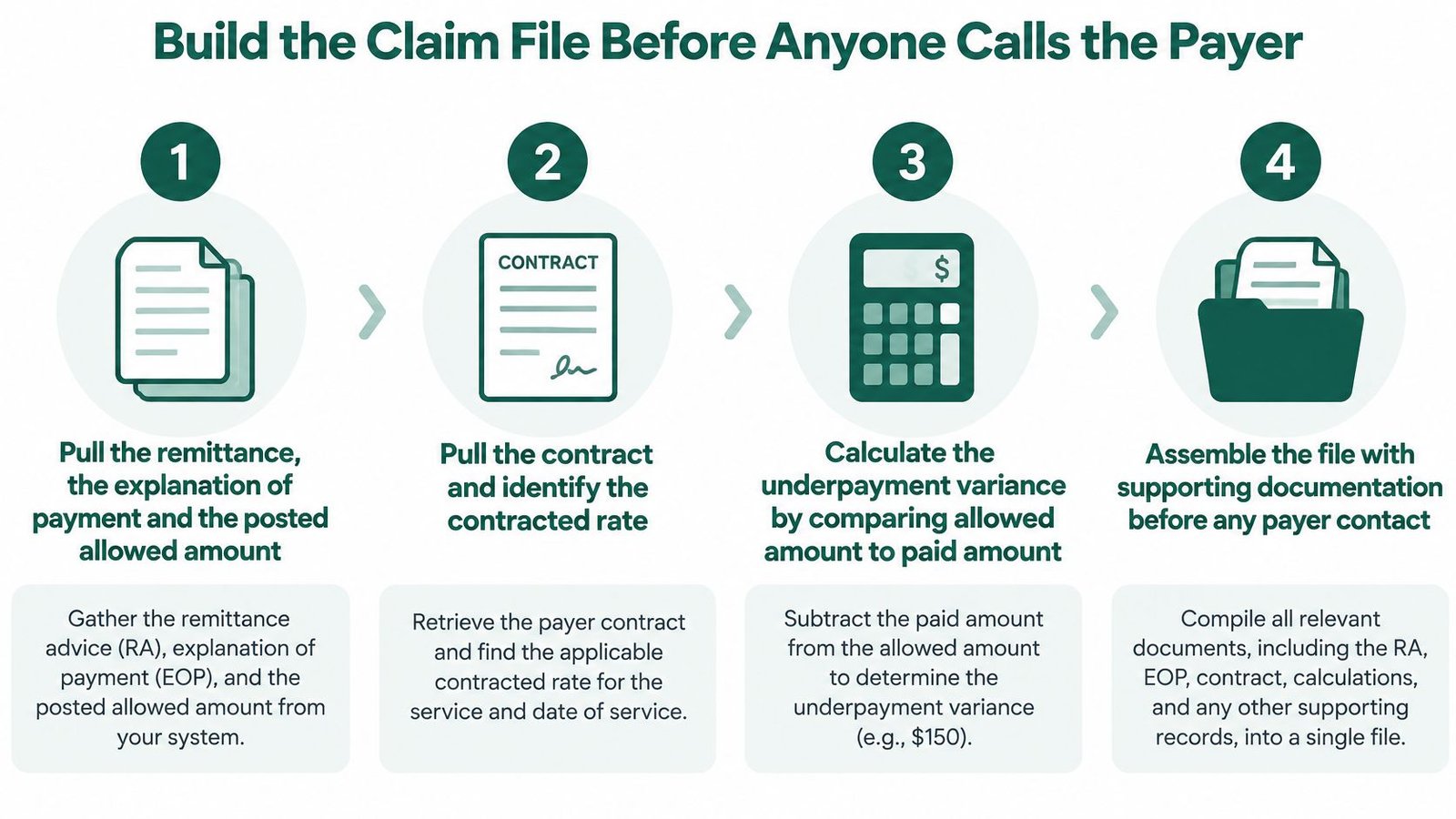
The file-building sequence starts with payment evidence and ends with a defensible, traceable recovery request.
Give the recovery lead a complete record
Pull the remittance and explanation of payment. Preserve the original allowance, adjustments, insurer payment, and patient responsibility. This prevents the team from arguing over a balance distorted by payment-posting decisions.
Identify the payment authority. Attach the applicable contract, payer policy, or benchmark and explain why it governs this service. A requested increase without a payment basis is just a request.
Calculate the line-level variance. Compare the supportable insurer obligation with the actual insurer payment, accounting for legitimate cost sharing and adjustments. Don't use the difference between charges and payment as a shortcut.
Attach service and clinical support. Include records supporting the service, complexity, and relevant provider or facility characteristics. The physician should resolve substantive clinical questions; the recovery lead should organize the submission.
Preserve negotiation history. Record the date, recipient, delivery evidence, response, and outcome of each material contact. Keep portal acknowledgments and written offers with the claim.
Document the clocks. Store claim-received evidence, payment or denial dates, notices, and the identified filing windows. Put the next action in the A/R system so a deadline doesn't depend on someone remembering an email.
The out-of-network appeal package checklist can standardize this handoff. Owners don't need to prepare the packet, but they should insist that the packet exists.
For therapy practices, Be Your Best Self & Thrive Counseling, PLLC's 2026 guide to therapy superbills offers useful context on service documentation. A superbill alone doesn't replace remittance evidence, jurisdiction checks, or negotiation records.
Finally, reconcile additional payments, any applicable interest, dispute expenses, and remaining deadlines in the practice's A/R system. A determination isn't cash until the payment is received and posted correctly.
Escalate Through Appeal, Negotiation and Federal IDR
Use escalation to obtain a decision on a documented dispute, not to send the same complaint to more inboxes. Your administrator should know the requested outcome, who owns the next action, and what event triggers advancement.
A complaint, an appeal, a negotiation notice, and an IDR initiation serve different purposes. Submitting one shouldn't be treated as completing the others.
Run the correct sequence
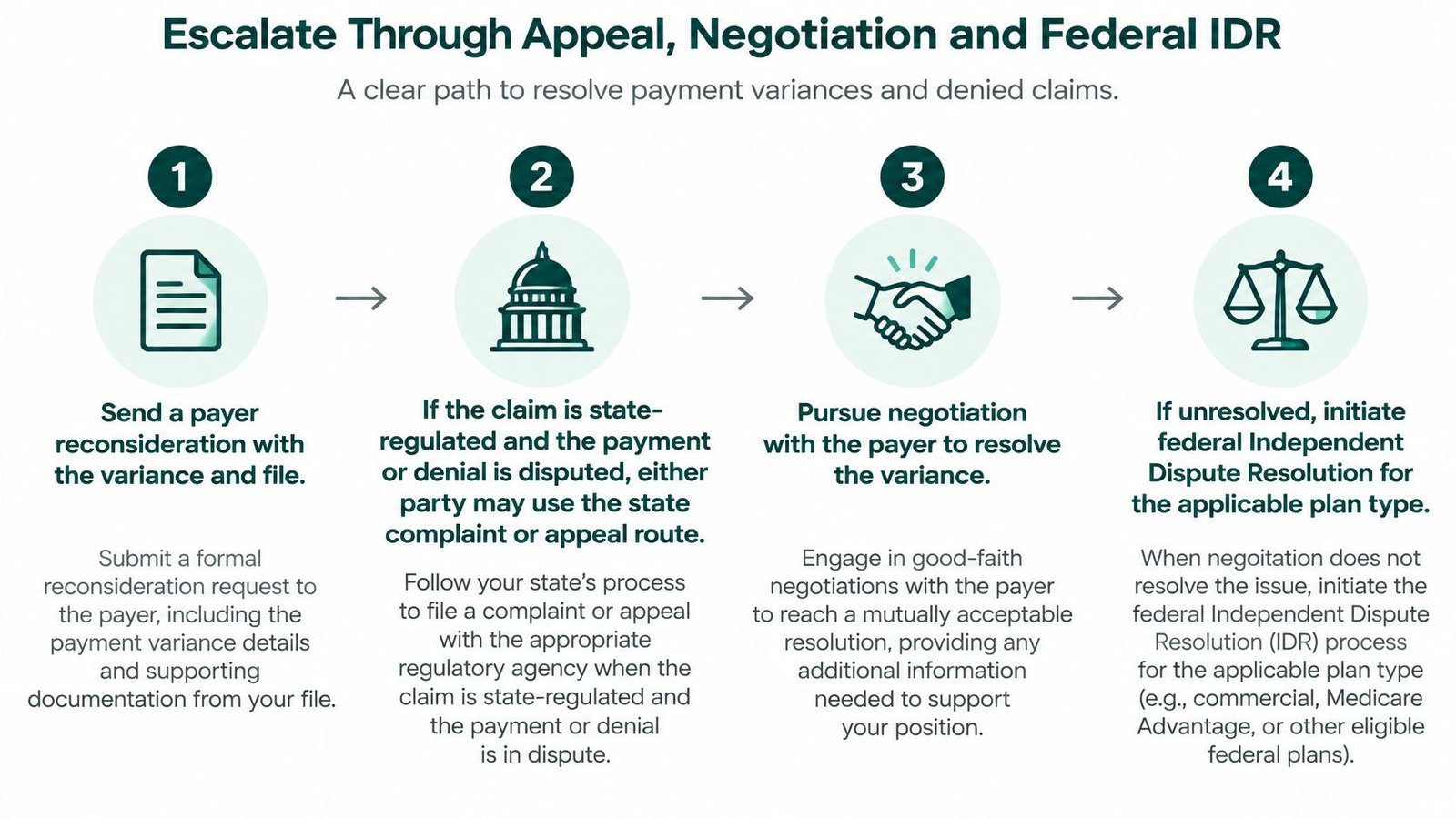
Submit a targeted payer reconsideration. State the disputed allowance, the supportable payment basis, the variance, and the action requested. Attach the file through the payer's designated channel and retain submission evidence.
Use the applicable state process when it controls. A Florida legislative analysis of the state dispute framework describes payment or denial within 30 days of claim receipt and a 30-business-day negotiation period for the qualifying claims it discusses. Because the document analyzes legislation, verify the effective statutory requirements and their application before treating those periods as controlling a live account.
Conduct federal open negotiation only for qualifying claims. The CMS independent dispute resolution reports describe the 30-business-day open-negotiation process before eligible unresolved disputes proceed to federal IDR. Preserve the notice and delivery evidence, and separately verify the initiation and submission deadlines.
Submit a defensible federal offer when jurisdiction and timing permit. Under the CMS federal IDR notices framework, the certified entity selects one party's payment offer rather than creating a conventional negotiated compromise. Build the offer around permissible, claim-specific evidence.
The escalation sequence is useful only after the routing decision has been made.
Manage deadlines as financial controls
Maintain a shared log with the claim-received date, initial payment or denial date, notice delivery, negotiation end, submission deadline, and responsible person. The administrator should review approaching deadlines separately from ordinary aging follow-up.
Say an orthopedic group identifies a surgical underpayment but leaves it in the general follow-up queue. Staff keep requesting reprocessing while an applicable dispute window expires. The clinical argument may remain strong, but the available recovery options may have narrowed.
Don't authorize escalation because the claim looks unfair. Authorize it because the route is open, the amount is supportable, and the expected recovery justifies the work.
Our federal IDR step-by-step guide helps owners evaluate whether their team has the operational capacity to manage that process. IDR is an escalation route for qualifying disputes, not a replacement for ordinary payer follow-up.
A favorable decision also doesn't establish profitability by itself. Account for dispute expenses, staff effort, delayed collection, and the work required to obtain the awarded payment before deciding which claims deserve continued investment.
Decide Whether to Recover In-House or With a Partner
Keep recovery in-house when the backlog is manageable and a named employee has protected time, authority, and reliable deadline controls. Assigning it as extra work to someone already responsible for daily submissions is not the same as creating capacity.
A partner becomes more useful when the backlog is aged, the disputed amounts justify specialized attention, or routine billing repeatedly pushes recovery aside. The comparison of in-house and outsourced underpayment recovery gives owners a practical way to evaluate that trade-off.
The operational difference is dedicated ownership, not a different company name.

Choose a repeatable operating model
CMS's first-half 2024 federal IDR report records 610,498 disputes initiated from January through June 2024. Formal recovery requires a repeatable workflow, even when your practice submits only a small portion of its accounts.
Build prevention into the assignment:
- Monthly payment review: Compare remittances with applicable payment expectations and investigate repeated reductions.
- Standing deadline review: Require an owner and next action for every active dispute.
- Quarterly payer review: Identify recurring allowance problems and address the cause rather than reopening the same issue indefinitely.
Happy Billing serves Florida practices entirely remotely. Our denial and appeals team is trained on Florida's IDR framework and includes it in every out-of-network A/R recovery strategy we build for Florida clients. We can handle billing end to end or work alongside the existing biller.
For behavioral health owners coordinating referrals, contacting a clinical practice is a separate task from recovering payer revenue. Use the option to contact Total Mental Wellness for clinical-practice inquiries, while keeping payment disputes with your designated recovery team.
Book a free 30-minute call with a billing specialist to discuss plan routing, historical claims, and who should own your recovery work.
US practices only.
Can we use federal IDR for every underpaid commercial claim?
No. Federal IDR requires qualifying services, federal jurisdiction, and compliance with the applicable process; a low out-of-network payment alone doesn't establish eligibility. Routine office-based claims may need payer appeals or another valid remedy.
Does our current biller have to leave to recover underpayments?
No. Your biller can retain routine billing while a recovery partner handles an agreed set of disputed accounts. Define communication ownership and payment reconciliation so both teams don't pursue the same account independently.
How far back can we recover claims from 2022?
Claims from 2022 can be reviewed, but review doesn't guarantee an open recovery route. The governing agreement, payment history, notices, and applicable deadlines determine what remains actionable.
What does recovery cost us?
The recovery arrangement is contingency-only, with terms based on claim age and volume. A billing specialist provides a clear number after the free introductory call, so you can evaluate the arrangement before proceeding.
What should we ask our administrator to prepare?
Start with remittances, payment-posting records, relevant payer agreements, and existing appeal correspondence. Have the administrator identify known deadlines and disputed accounts without emailing patient information through an unsecured channel.
Happy Billing helps Florida independent practices identify underpayments, select the appropriate recovery route, and pursue supported commercial-payer disputes. Visit Happy Billing to arrange a review of your backlog and decide whether dedicated recovery should complement your current biller or sit within end-to-end billing support.
Where this fits