Texas Out-of-network Underpayment Recovery for Independent Practices: What to Do When Payers Reprice Your Claims
Appealing every reduced payment buries the claims that belong on a different track. Happy Billing recovers underpaid commercial out-of-network claims for Texas practices, working alongside your existing biller or running billing end to end.
Happy Billing is a medical billing company headquartered in Houston, Texas. We recover out-of-network underpayments for physical therapy, chiropractic, pain management and behavioral health practices.
When a payer reduces the allowed amount, your practice collects less for the same work. If your team leaves that difference in reconsideration without a deadline or a defensible payment expectation, A/R days rise while your denial report can look deceptively clean. Before drafting an appeal letter, identify the regulator and recovery route that govern the claim.
Who Recovers Underpaid Out-of-Network Claims in Texas
An effective recovery operation needs one owner for the entire disputed balance, from spotting the reduction to reconciling the deposit when it lands. That owner can be an internal payment-integrity lead or an outside recovery partner. What fails is a balance passed between payment posting, provider relations, and your existing billing company with nobody holding the filing deadline.
Physical therapy, chiropractic, pain management, orthopedics, and spine practices should audit claims that appear paid, not only claims that were denied. A payer can apply an unsupported reduction to the allowed amount and still send a remittance that clears the bank. Owners who track denial rate alone won't see it. Compare paid lines against the contracted or statutory allowed amount, and the gap becomes visible.
What a recovery partner should own
- Payment validation: Establish what the payer owed on the date of service, not what the practice billed or what the remittance advised.
- Route selection: Decide whether the dispute belongs in reconsideration, negotiation, a regulatory complaint, or an eligible payment dispute, and confirm that the plan's regulator covers the claim before anyone files.
- Deadline ownership: Assign filing, receipt confirmation, follow-up, and escalation to one named person.
- Cash reconciliation: Match every additional payment to the disputed lines before reporting a recovery.
Happy Billing serves practices statewide, including every major Texas metro and beyond. Our team knows Texas Medicaid, BCBS TX, and Aetna payer rules, and that knowledge still gives way to claim-specific plan verification. A payer's brand does not establish which rules govern an employer's plan, so the funding document decides the route.
The physical therapy underpayment recovery guide explains the payer mechanics behind recurring reductions. Our specialty workflows address the different documentation needs across independent practices.
Book a free 30-minute call with a billing specialist to discuss your repriced claims.
Which Texas Route Applies to Your Plan
Classify the claim before you appeal it. The insurer's logo doesn't tell you whether Texas insurance law governs the payment dispute. Start with the insurance card, funding information, place of service, claim record, and explanation of benefits.
The Texas Department of Insurance provider guidance distinguishes protected emergency and certain unavoidable out-of-network services from voluntarily selected out-of-network care. Texas protections don't automatically convert every office-based underpayment into an arbitration claim.
Recovery route by plan or claim type in Texas
| Plan or claim type | Who regulates it | Recovery route | First step for your team |
|---|---|---|---|
| State-regulated HMO, PPO, or EPO | Texas Department of Insurance | Texas arbitration or mediation for eligible claims, plus a TDI complaint where appropriate | Confirm plan status from the card and payer documents |
| Self-funded employer plan | Federal law rather than Texas insurance regulation | Federal No Surprises Act IDR for eligible claims; the state complaint route generally doesn't apply | Confirm plan funding before choosing a track |
| Eligible emergency or surprise-billing claim under a federal plan | Federal No Surprises Act | Federal IDR after open negotiation | Confirm service eligibility, notices, and timing |
| Out-of-network care the patient knowingly chose | Applicable contract, plan, and payment rules | Reconsideration and appeal; ordinarily no surprise-billing track | Don't transfer the disputed shortfall to the patient without a separate legal responsibility review |
That last row needs care. Voluntary out-of-network care doesn't create automatic arbitration eligibility, but it also doesn't establish an automatic prohibition on every patient balance. Keep payer recovery separate from any determination of lawful patient responsibility.
Texas also distinguishes professional-provider disputes from facility disputes. The TDI medical-billing overview identifies arbitration for eligible out-of-network provider disputes and mediation for eligible facility disputes. An independent practice shouldn't prepare a facility-mediation file merely because treatment occurred at a facility.
Network status isn't dispute eligibility
For a useful coverage contrast, Aspen Falls Wellness explains in-network chiropractic rules for BCBS plans. Use that distinction to ask better network-status questions, not as authority for a Texas out-of-network payment remedy.
Routing rule: Put the governing regime on the account before any letter goes out.
Our Texas arbitration versus federal IDR comparison addresses the detailed distinction. For an owner evaluating recovery performance, the immediate requirement is simpler: every disputed claim needs a documented jurisdiction decision, not an assumption based on the payer name.
How to Audit Repriced Claims Back to 2022
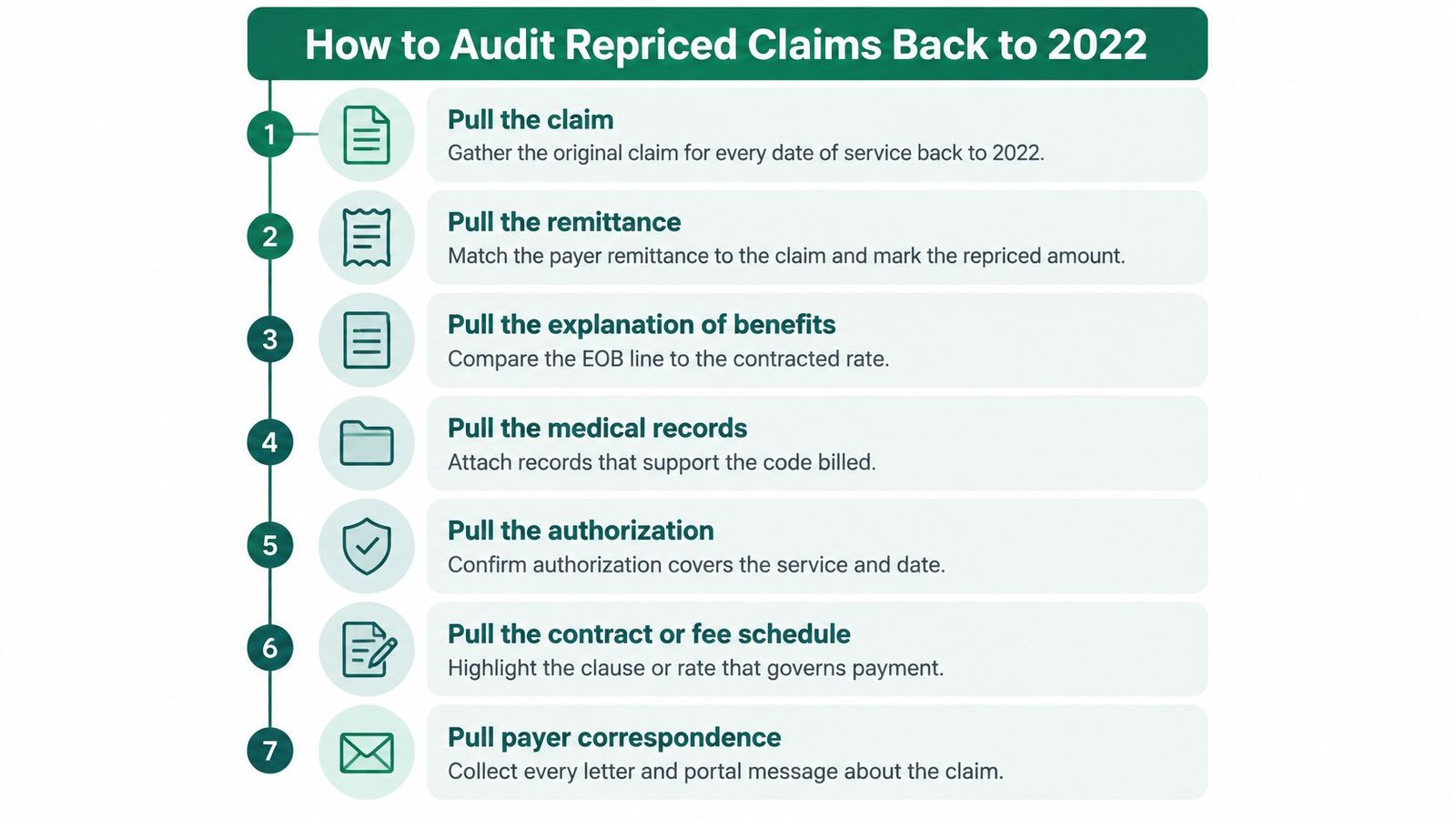
The first mistake in a 2022 lookback is treating the calendar as the recovery rule. A 2022 service date can be a useful audit boundary. It does not keep a claim alive. Records, payer provisions, prior submissions, and applicable deadlines decide which balances remain actionable.
Happy Billing's team audits historical claims to identify and recover under-reimbursed amounts. I would compare payer behavior across service periods first, then separate potentially recoverable balances from amounts that need a documented closure decision. That keeps the project from becoming a wish list.
Build a defensible claim inventory
The Congressional Research Service federal IDR overview supports a document-driven approach that separates payment discrepancies, claim errors, and potential formal disputes. Use this workflow to keep a historical review tied to evidence.
Pull the complete file. Gather the original claim, remittance, explanation of benefits, medical records, authorization, contract or fee schedule, and payer correspondence. Missing attachments stall reconsideration. The common slip is relying on a portal summary instead of preserving the underlying documents.
Reconcile each claim line. Compare billed charge, allowed amount, patient cost share, and actual payment, because a reduction may affect only part of the encounter. A whole-claim payment total is not proof that every service was reimbursed correctly.
Calculate the defensible payer gap. Subtract actual payer payment from the supportable expected payer payment after separating lawful patient responsibility. Billed charges minus the check amount is not a reliable recovery estimate.
Sample apparently paid claims. Include a random selection outside the denial queue to catch reductions your reports miss. Owners often skip this because paid claims look finished. The common error is auditing only accounts staff already flagged.
Test the historical reach. Include records back to the proposed starting year where available, then validate each payer's remaining review and dispute rights. Owners often avoid older files because retrieval takes effort. The opposite mistake is assuming accessible records mean an open filing window.
Classify the cause. Separate contract interpretation, coding or modifier issues, bundling edits, authorization problems, workers' compensation or liability claims, and possible surprise-billing disputes. Tag each line for the likely dispute track, state or federal, before it enters a queue. A contract appeal and a surprise-billing complaint need different evidence and different deadlines.
Use this document checklist to organize the evidence before valuing the inventory.
Look for repeatable payment changes
Compare like services before and after contract renewals, network-status changes, and newly applied payer edits. A cluster of lower allowances deserves investigation. It does not prove that the payer breached an agreement.
Where remittances identify MultiPlan, Zelis, or Data iSight/Claritev, determine which entity supplied the reduction and which plan provision supposedly authorizes it. The out-of-network repricing tools guide helps frame that review without assuming a repricer's involvement alone makes a payment improper.
An owner doesn't need a coding tutorial to supervise this work. You need a vendor who can identify the affected service, explain the financial effect of the edit, and distinguish a valid adjustment from a recoverable reduction. These signs of systematic out-of-network underpayment help separate isolated discrepancies from a payer-level pattern.
Deadlines and Escalation Steps That Protect Recovery
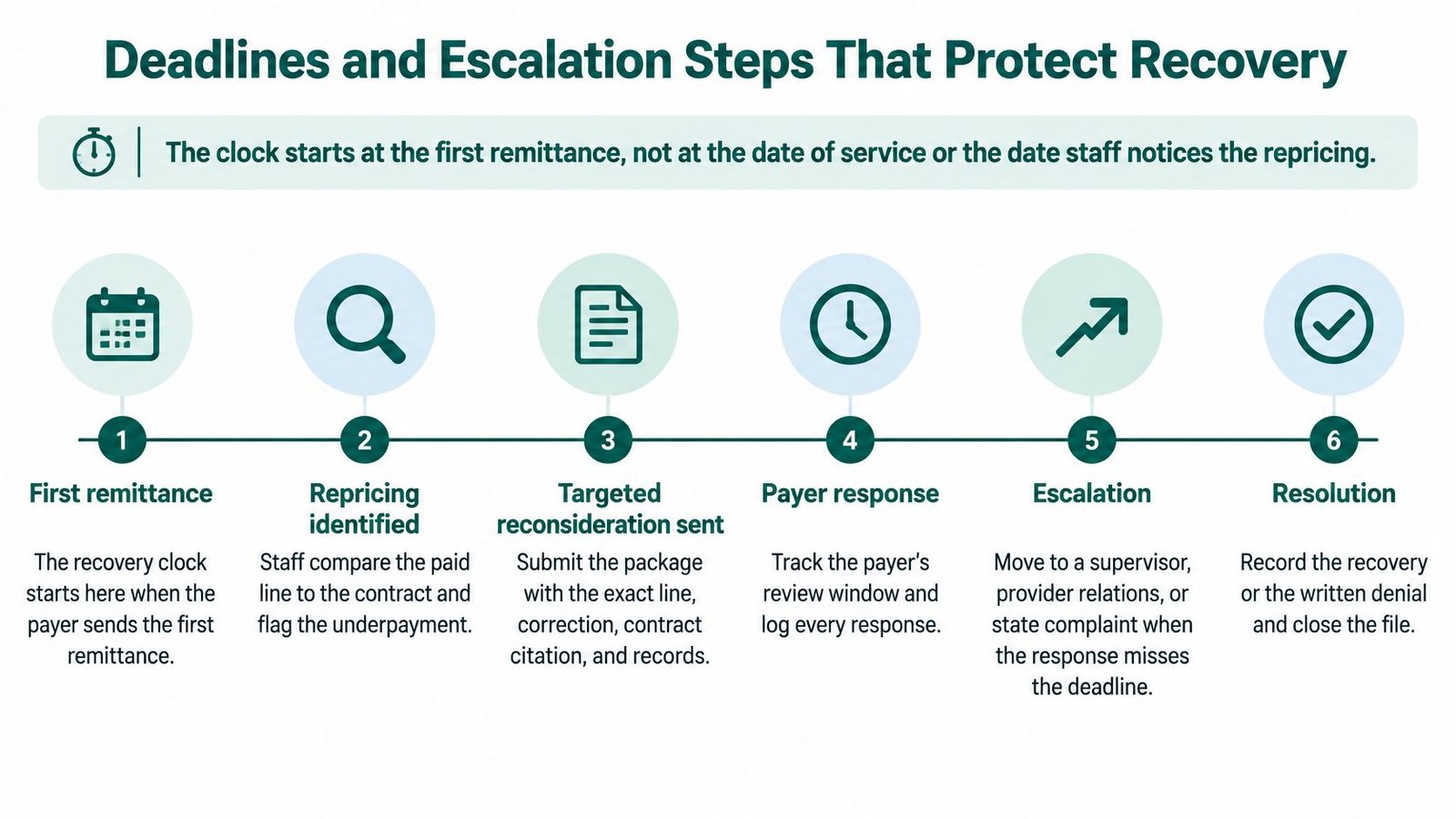
Most Texas owners lose out-of-network recovery on the calendar, not the merits. The clock that matters for the state surprise-billing process starts with receipt of the first payment or denial, not the day your team notices the reduction. The TDI surprise-billing training material describes a request window generally running 20 to 90 days after receipt of the first payment or denial for eligible provider disputes.
That window is route-specific. A contractual appeal, a federal IDR dispute, and a TDI complaint each run on a separate trigger set by the plan document or the applicable regulator. I recommend classifying the plan before anyone drafts a letter. Filing on the wrong track burns the window you needed.
Dispute stages, windows and owner actions
| Stage | Window | What starts the clock | Owner action |
|---|---|---|---|
| Payer reconsideration | Contract-specific; retrieve the governing provision | Initial adjudication or other contract-defined trigger | Send a line-level request with the payment basis |
| Formal payer appeal | Contract-specific; verify before submission | The applicable adverse decision or contract-defined trigger | Escalate with the complete evidence package |
| Texas arbitration request | Generally 20 to 90 days | Receipt of first payment or denial | File within the applicable window for eligible claims |
Federal IDR and TDI complaints sit outside that table because their clocks come from federal notice rules and the TDI complaint process, not the Texas arbitration provision. Treat those as parallel calendars, not fallbacks. A pending state arbitration does not pause a federal IDR deadline, and a complaint does not preserve an appeal you never filed.
Make payment posting a deadline control
On posting, capture the receipt date, allowed amount, payer payment, adjustment reason, claim identifiers, and plan classification. Assign a named owner the moment a payment falls below the supported expectation. That receipt date triggers every downstream window, so a posting delay is a recovery delay.
A pending reconsideration isn't permission to let a separate dispute deadline expire.
Resolve posting errors through internal payment-integrity review first. Then pursue targeted reconsideration, formal appeal, and the appropriate state or federal route as available. Some claims will run on parallel calendars rather than a rigid sequence, and that is normal for accounts with mixed plan types.
Our payer-specific out-of-network appeal deadline guide gives you a framework for organizing those controls. Your governing documents supply the actual dates.
Require an owner report listing approaching deadlines, the next action, and the person responsible. A monthly management review is too slow for the shortest window in that range. Staff need an active work queue between meetings. Stop spending on a claim when its remaining expected recovery no longer justifies the work.
Documenting and Appealing a Payer Dispute
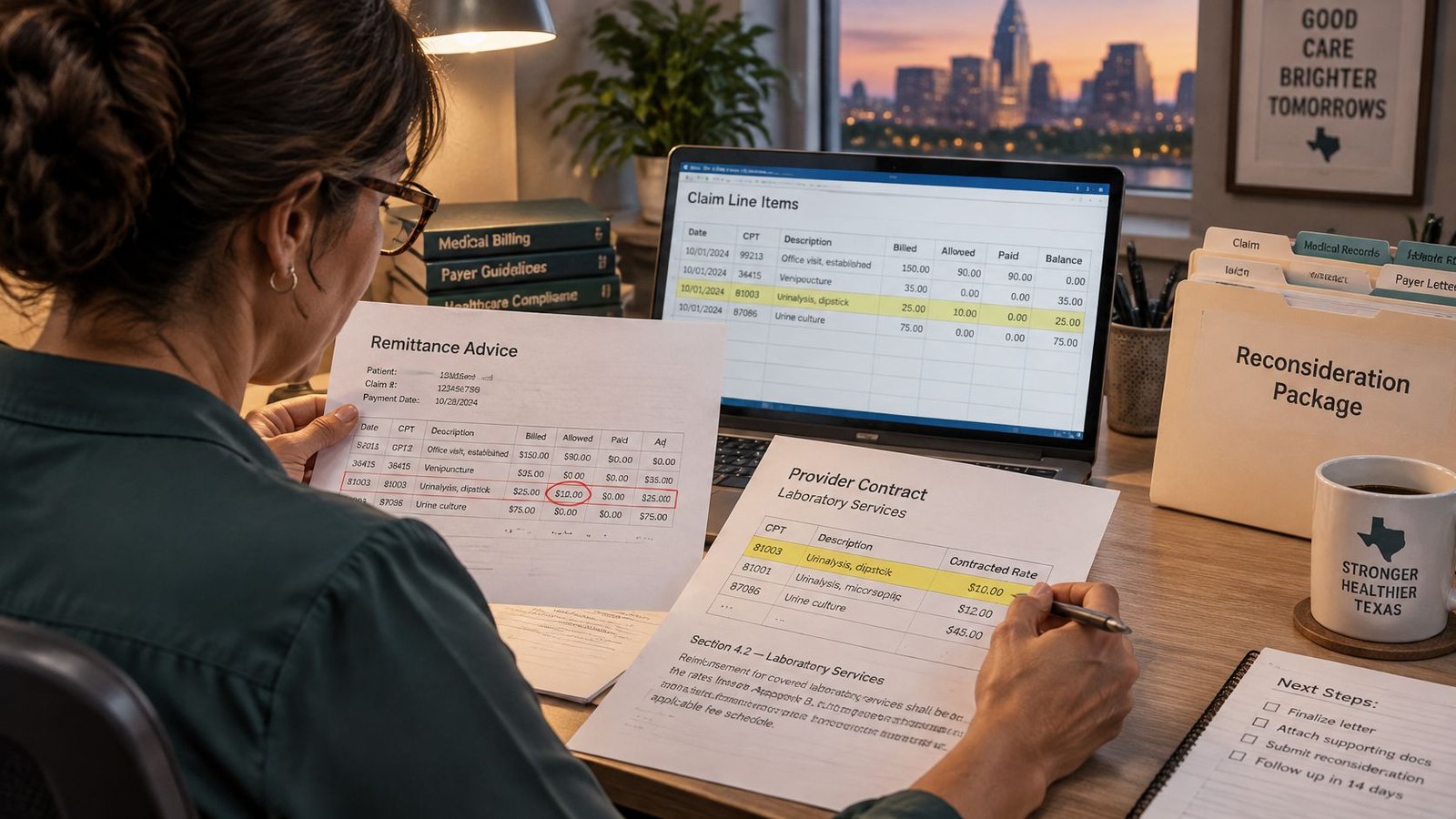
A generic appeal asks the payer to reconsider an outcome. A targeted reconsideration explains which line is wrong, why it's wrong, and what corrected payment should follow. That's a stronger starting point, though no package guarantees recovery.
For example, if the payer applied an edit inconsistent with the governing payment provision, identify that edit and cite the relevant provision. Don't argue only that the total reimbursement was disappointing.
Assemble one coordinated evidence file
- Original claim and remittance: Identify the service line and the payer's actual adjudication.
- Explanation of benefits: Preserve the stated allowance, adjustment explanation, and patient responsibility.
- Clinical and eligibility support: Include relevant records, authorization, and the eligibility response.
- Payment authority: Attach the applicable contract page, fee schedule, or plan provision.
- Comparable-rate evidence: Use relevant market information where appropriate and permitted, rather than unsupported billed-charge comparisons.
- Timeliness evidence: Preserve submission confirmations, receipt records, and prior decisions.
- Payer correspondence: Include portal messages, letters, and a dated contact log.
The file should let a reviewer move from the disputed line to the supporting document without reconstructing your argument. This out-of-network appeal package checklist and template helps standardize that handoff.
A side-by-side review keeps the contract basis visible.
Separate the payer demand from patient responsibility
Show the expected payer payment, actual payer payment, and disputed payer balance separately from lawful patient cost sharing. For protected services, the recovery demand must not shift a prohibited balance to the patient.
For a TDI complaint involving a state-regulated plan, use the same organized file. Name the plan, identify the claim and affected line, describe the repricing, document your prior attempts to resolve it, and state the correction sought. A complaint isn't an automatic payment award or a substitute for preserving an arbitration deadline, and it generally isn't the route for a self-funded employer plan.
Federal IDR files also need a coordinated qualifying payment amount, or QPA, analysis. The CMS notices guidance describes the QPA framework, generally the insurer's median in-network rate for the same or similar service in the geographic area in 2019, indexed for inflation.
The federal decision-maker selects a party's offer rather than splitting the difference. Build the offer, permitted supporting evidence, and QPA analysis as a coherent argument, not unrelated attachments.
I would reject any workflow that reports an appeal as complete merely because someone uploaded a PDF. Every submission needs a receipt, a diary date, and an assigned next action.
Decide Whether to Keep Recovery In-House or Hand It Off
Keep recovery in-house when your team can demonstrate reliable performance across the benchmarks below for the payers that matter. If a benchmark fails, decide whether the problem is fixable through clearer ownership and better controls or whether it requires dedicated recovery capacity.
Appeal volume isn't a financial result. Neither is a favorable decision that hasn't produced a reconciled payment.
Benchmarks to judge recovery performance
| Benchmark | What it shows | Owner check |
|---|---|---|
| Recovered dollars per eligible claim | Real yield rather than activity | Compare recovery against the cost of pursuing the claim |
| Median days from identified underpayment to cash | Speed of cash recovery | Review by payer on the A/R report |
| Share of claims passing eligibility review | Quality of screening | Request payer-level results and reasons for rejection |
| Payer-specific net yield | Which disputes justify further work | Rank payers using your own recoveries, pursuit costs, and cash delays |
The scale of formal disputes makes claim selection important. The Congressional Research Service report on federal IDR reports 1,463,868 disputes initiated in 2024. That national volume isn't a forecast of your practice's recoveries, but it demonstrates why an undifferentiated dispute queue can consume substantial administrative capacity.
Compare accountability, not just staffing
An internal team retains direct control over records and payer relationships. It can also address upstream problems quickly when credentialing, authorization, or contract interpretation caused the reduction. The trade-off is capacity: the same people may already be responsible for denials, enrollment, and aging receivables.
A dedicated recovery partner can maintain a separate queue, but the arrangement needs clear boundaries. Specify who contacts the payer, who owns deadlines, how existing appeals are identified, and who reconciles additional payments. Otherwise, duplicated effort can create conflicting submissions without improving collections.
Owner test: Ask for the last completed recovery report, not a description of how diligently the team follows up.
Our in-house versus outsourced recovery comparison helps structure that decision. The outsourced medical billing cost guide addresses the broader staffing comparison, including work that extends beyond recovery.
Happy Billing can work alongside an existing biller, so evaluating recovery support doesn't require replacing your entire billing operation. Our Old A/R Recovery service also pursues unpaid claims older than 90 days, but claim age alone doesn't establish that an appeal or formal dispute remains available.
Ask for a handoff plan that addresses current underpayments, historical inventory, and the upstream errors that create new shortfalls. Recovering an old balance is useful; preventing the same avoidable reduction from recurring is a separate management responsibility.
Book a free 30-minute call with a billing specialist to review which recovery responsibilities your practice should retain or delegate.
US practices only.
Common Owner Questions About Texas Underpayment Recovery
Does Texas law cover every out-of-network claim?
No. Your team must establish both the plan's regulatory status and the service's eligibility before selecting a state remedy. Self-funded employer plans generally fall under federal rather than Texas insurance regulation, and ordinary voluntary out-of-network office care isn't automatically eligible for surprise-billing dispute resolution.
How far back can we review underpayments?
A historical audit can target records back to 2022, but that isn't a promise that every claim from that period remains recoverable. Ask for separate totals for identified discrepancies, supported underpayments, and balances with an available recovery route. The review should also document inaccessible records and expired remedies rather than excluding them.
Can our current biller keep running billing while a recovery partner works the underpaid claims?
Yes. Happy Billing can work alongside your existing biller, with responsibilities divided by claim type and recovery stage. The arrangement needs shared status reporting and a clear prohibition on duplicate payer submissions, so both teams know who owns the next action.
When is a claim not worth appealing?
A claim isn't worth pursuing when the expected additional collection doesn't justify staff time, administrative expense, and delayed cash. Ineligibility for a formal dispute track doesn't always eliminate ordinary reconsideration, but it does mean you shouldn't spend resources filing through that track. Require a written reason for closing material balances.
How long before underpaid claims turn into cash?
There isn't a responsible single timeline for every payer and dispute route. Ask for median identification-to-cash time by payer, plus a separate list of favorable decisions awaiting payment. A recovery report should distinguish money requested, money awarded, and money received.
Happy Billing helps independent practices identify underpaid out-of-network claims, establish the correct recovery route, and pursue supported payer balances without disrupting an existing billing team. Visit Happy Billing to discuss a historical claim review and a recovery workflow built around your Texas practice's payer mix, deadlines, and cash priorities.
Where this fits