Provider Credentialing and Payer Enrollment for Independent Practices: Timeline, Cost and What to Hand Off
A clean Medicare plus commercial rollout usually takes several months, and Medicare's electronic enrollment processing target is 45 days after a complete, signed application. That timing affects when a new provider's first visits can generate payment.
A provider may be clinically ready before payers have loaded the enrollment. Until then, visits can add to A/R without producing collectible claims, and denials cannot be fixed with better coding.
How Long Credentialing and Payer Enrollment Really Take
An approval date is not a revenue-readiness date. Credentialing timelines depend on the payer and state, and can run from several weeks to a few months. Until the payer has approved the enrollment and activated the provider for billing, scheduled visits may not produce payable claims.
The CMS Medicare enrollment guide states that contractors must process 90% of electronically submitted enrollment applications within 45 days after receiving the signed certification statement and supporting documentation. For paper applications, the guide sets a target of processing 80% of initial applications within 60 days. CMS allows applications up to 60 days before a Part B effective date and 180 days before a Part A effective date. Providers generally have 30 days to respond to information requests before an application may be rejected.
Enrollment Timelines by Path
| Enrollment path | Published benchmark | Plan for |
|---|---|---|
| Medicare, electronic (PECOS) | 90% processed within 45 days of signed certification and complete documents | About 60 days, allowing for one round of corrections |
| Medicare, paper application | 80% of initial applications processed within 60 days | 75 to 90 days |
| Commercial payer enrollment | About 60 days | 60 to 90 days per payer |
| Full rollout, Medicare plus commercial | Timelines vary by payer and state | Several weeks to a few months, with additional time for corrections or payer committee review |
These are processing benchmarks, not reliable go-live dates. A missing signature, unpaid fee, outdated malpractice certificate, or unanswered information request can delay the application. Approval alone does not confirm that the payer has loaded the provider, linked the group, and activated the account for claims.
Set the start date around revenue readiness. Begin the enrollment work before the provider's first scheduled visits, and track the status of each payer separately. Keep the tracker current with licenses, malpractice coverage, tax documentation, ownership, locations, EFT details, and payer forms.
For an overview of where administrative work can be handed off, see this guide to outsourcing medical billing for independent practices. Credentialing works in four steps: a free credentialing audit, application prep, payer follow-up, and ongoing maintenance. A missed maintenance date can interrupt an enrollment even after initial approval.
For a comparison outside the U.S., understanding AHPRA psychology registration requirements covers Australian registration. U.S. practices should base their enrollment schedule on the requirements and timelines of their own payers and states.
Book a free 30-minute call
US practices only.
Group vs Individual Enrollment and the Records That Stall Them
Group and individual enrollment solve different billing problems. Individual enrollment connects a clinician to a payer; group enrollment connects the practice and its billing details. Both relationships need to be in place for claims to process under the intended provider and group.
Medicare formalizes group enrollment through CMS Form 855-B. An individual provider's credentialing alone does not establish the group's enrollment.
Build One Master Provider File
Use one source file to keep application details consistent across payers:
- Identity and practice data: Legal name, NPI-1, taxonomy, practice locations, W-9, and EFT details
- Clinical credentials: State licenses, DEA and CDS registrations, board certification, and malpractice coverage
- History and relationships: Work history, disclosures, and supervising or collaborating relationships where applicable
The CMS guide to getting started with Medicare enrollment reports that 30 to 35% of applications are delayed because they require at least one correction. Common mismatches include taxonomy that differs from NPPES, a license address that conflicts with CAQH, or an outdated malpractice end date. Check these records against one another before submitting.
Patient-facing network information also needs to match the enrollment status. Therapy billing guidance for Phoenix patients addresses the patient side; on the practice side, verify that the payer has linked the provider to the group before relying on a directory listing.
Happy Billing's free credentialing audit checks each provider's CAQH profile, payer enrollment status, license and DEA dates, NPI and taxonomy details, and group links. Headquartered in Texas, Happy Billing submits individual and group applications with commercial payers and follows up until each is approved. Its credentialing service also covers initial enrollment through re-credentialing and keeps payer contracts current.
Effective Dates and the Retro-Billing Risk You Cannot Ignore
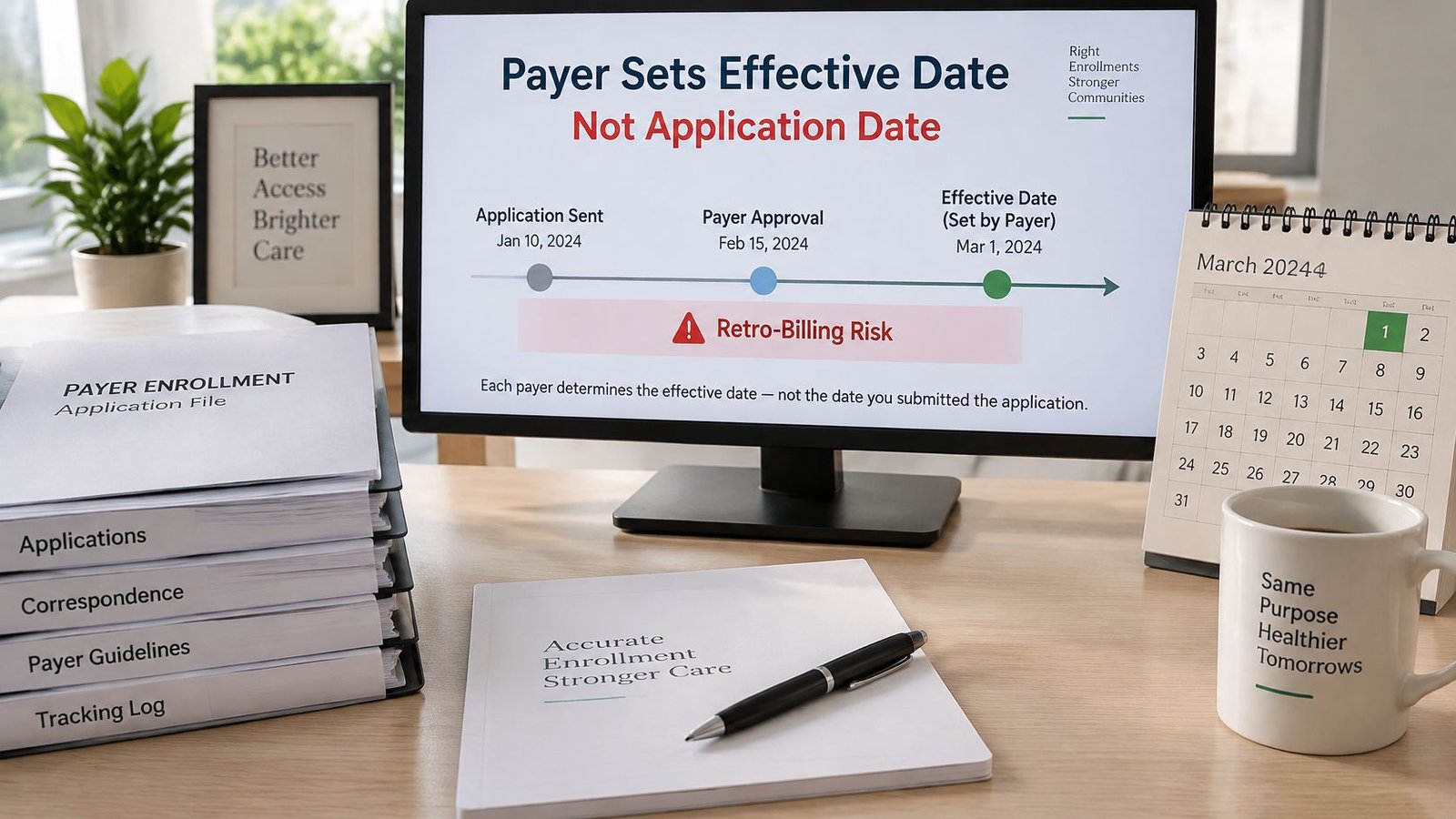
An approval letter does not always mean a provider is ready to bill. The payer's effective date determines when covered services may be billed under that enrollment. It may differ from the application date, approval date, or the provider's first day seeing patients. Confirm the effective date in writing before scheduling visits for that payer.
What Happens When You Bill Too Early
Claims for dates of service before the effective date are generally denied. While those claims sit in accounts receivable, timely filing limits continue to run. A PR-26 denial is a different payer message, so review this explanation of the PR-26 denial code and its implications before treating every enrollment-related denial the same way.
Hold claims for dates of service before the confirmed effective date. Billing under a supervising provider's number to cover the gap creates a compliance risk for both providers.
Keep a new provider off a payer-specific schedule until the payer confirms loading in writing.
If an effective-date denial occurs, follow a structured medical billing denial management process. An appeal needs supporting evidence, such as the approval letter. If the payer assigned the wrong date, request a correction before resubmitting within the applicable filing window. The steps in this guide to appealing a denied insurance claim can help organize that response.
Your billing system should make it possible to hold claims until enrollment is confirmed. Practices comparing systems can consult this medical billing platform shortlist, but software cannot establish the payer's effective date. Happy Billing tracks each provider's license, DEA and revalidation dates so enrollment does not lapse.
CAQH Attestation and Revalidation
Credentialing doesn't end at approval. The recurring calendar after approval is where independent practices lose network status, directory accuracy, and claim eligibility.
The CAQH Provider Data Portal guide requires providers to verify and re-attest their information every 120 days, with an Illinois-specific 180-day interval. CAQH also reports that a physician practice averages about 20 plan contracts and spends at least one full day each week maintaining provider-directory information, at an estimated cost of almost $1,000 per month.
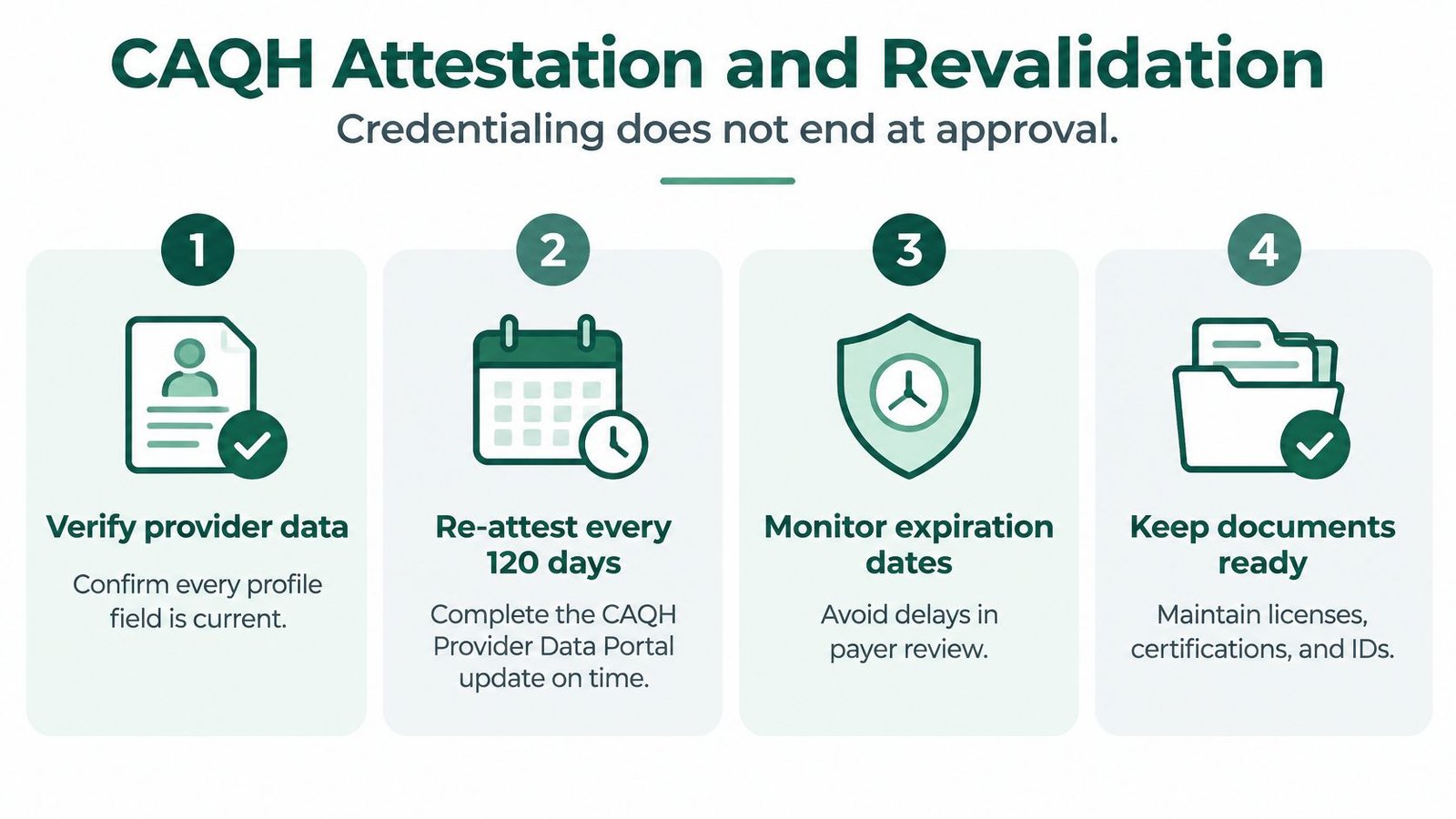
Update changed information and documents before you attest. Plans also need authorization to access the profile. An expired attestation, stale address, wrong affiliation, or missing document can stop a payer from finishing credentialing or directory maintenance, delay effective dates, and raise the odds that claims are held or paid under the wrong network status.
Put These Items on One Calendar
- CAQH re-attestation: Verify data, replace expiring documents, then attest on schedule
- Licenses and DEA: Renew before expiration and upload the new documents everywhere they're stored
- Malpractice and privileges: Track certificate dates and hospital privilege renewals by provider
- Revalidation: Log each payer's revalidation due date, since Medicare and commercial payers run separate cycles
- Practice changes: File address, tax ID, ownership, and location changes with every affected payer
A missed revalidation can deactivate billing status until the payer processes the paperwork. Assign one named owner for the calendar, with an escalation rule when a provider doesn't supply a document. We set up, attest and maintain each provider's CAQH profile so payers can verify them quickly, but the practice still has to tell us when a provider moves, changes hours, or adds a location.
What to Hand Off and What to Keep In-House
Hand off repetitive work measured in days and documents. Keep decisions that carry legal, contractual, or clinical weight. That's the line that protects you in an audit and still gets the owner out of the portal-chasing business.
Credentialing is separate from billing, and a practice's current biller can stay for the parts it wants to keep. You don't have to replace a biller to fix enrollment.
Credentialing Task Handoff Matrix
| Task | Hand off to billing partner | Keep with the practice |
|---|---|---|
| CAQH profile setup and 120-day attestation | Assembles, updates and attests on schedule | Approves attestations and disclosures |
| Payer application packets | Prepares, submits and tracks reference numbers | Signs certifications and fee authorizations |
| Payer status requests | Answers routine requests within the 30-day response window | Supplies missing clinical or legal information |
| Effective date tracking | Logs dates and confirms claim-system activation | Decides start dates and whether to bill before loading |
| License, DEA and malpractice renewals | Calendars and reminds the team | Owns clinical licensure and coverage |
| Practice location and tax ID changes | Updates each affected enrollment | Approves the change before it is filed |
| Contract terms and fee schedules | Reports status and open items | Negotiates and approves |
The CMS Medicare Learning Network enrollment resource identifies a Medicare enrollment application fee of $750 for 2026 in applicable cases, with waivers possible in some circumstances. CMS describes online enrollment at approximately 45 days versus 60 days for paper and notes electronic submission can reduce staff time and administrative costs.
That fee is only one direct cost. Staff time, document collection, rework, follow-up, and delayed revenue cost more. A partner can assemble packets, submit them, monitor portals, answer routine status requests, document effective dates, and escalate discrepancies. A partner cannot supply your signatures, attestations, disclosures, or clinical information, and CMS warns contractors cannot fully process applications without the required signature, fee when applicable, and supporting documentation.
We update payer enrollments when a provider, location or tax ID is added, and our billing team manages credentialing and re-credentialing automatically when MCO contract rosters change. Owners comparing models should read our analysis of in-house vs outsourced medical billing and our guide to outsourced medical billing cost. Pricing for credentialing is covered on the free call, not published here, because payer count and file condition change the work.
How to Build a Start-Date Plan That Protects Cash Flow
A provider's approval date is not a revenue-readiness date. Track when each payer makes the provider billable at the correct location, then plan the clinical start around that date.
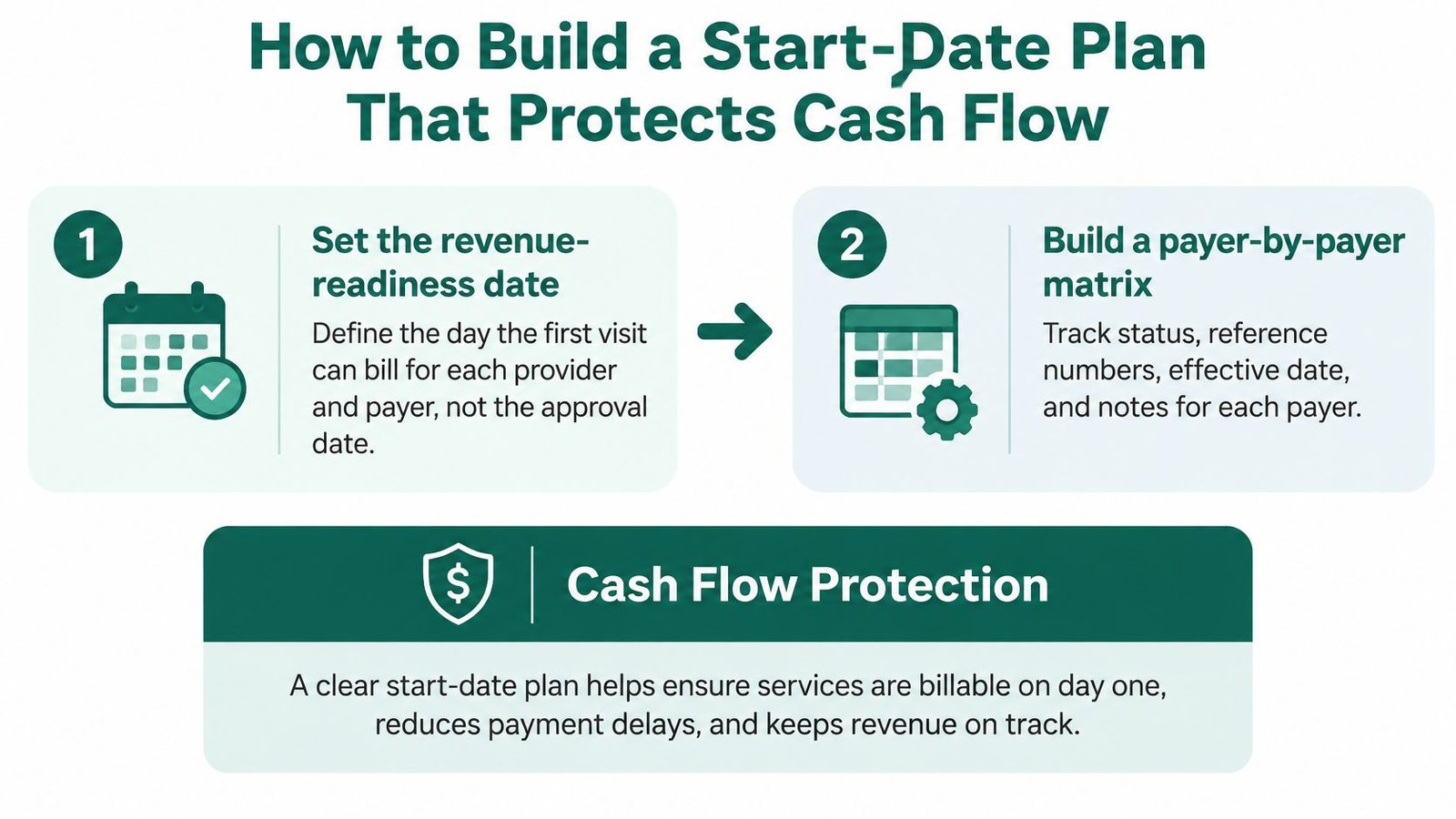
Payer enrollment can take several weeks to a few months, depending on the payer and state. Build in time for corrections and follow-up rather than treating an application's submission as a firm start date.
Six Steps Before the First Visit
- Set a revenue-readiness date: For each payer, identify when the provider can bill for services at the intended location.
- Build a payer-by-payer matrix: Record application status, reference number, effective date, loading confirmation, and next follow-up date.
- Begin early: Start the process well ahead of the first scheduled visit, leaving room to correct missing or inconsistent information.
- Plan for the cash-flow gap: Forecast collections between the clinical start and each payer's effective date. Review days in A/R weekly until payments normalize.
- Assign payer requests promptly: Name an owner for each request and track its due date, response, and follow-up.
- Set a go or no-go rule: Schedule payer-dependent visits only when the enrollment is active and the provider is loaded. Reschedule visits that cannot be billed as planned.
The cost of a delayed start depends on how much scheduled work relies on the provider and payer. Anesthesiology, behavioral health, and procedure-heavy groups may have fewer ways to shift that capacity. Review relevant specialty billing services when planning the schedule.
Happy Billing handles provider enrollment and primary source verification for all major payers, helping providers become in-network and ready to bill from day one. Its credentialing service supports growing groups with 1 to 50 providers.
US practices only.
Questions Practice Owners Ask Before Outsourcing Credentialing
Can We Bill for a New Provider While the Payer Is Still Processing?
Do not assume a pending application makes a provider billable. Confirm the payer's effective date and that the provider is loaded before submitting claims under that provider's NPI. An approval date alone does not establish revenue readiness.
Will Outsourcing Credentialing Replace Our Current Biller?
No. Credentialing is separate from billing. Your current biller can stay in place for the work you want to keep while another partner handles enrollment and payer follow-up.
What Does a Free Credentialing Audit Check?
The audit checks each provider's CAQH profile, payer enrollment status, license and DEA dates, NPI and taxonomy details, and group links. That identifies gaps to address before applications go to payers.
What Should We Decide Before the Next Hire?
Set the provider's start date and payer strategy, and confirm who will approve attestations and disclosures. Clarify contract and fee-schedule decisions, privileges, and whether the provider may see patients before payer loading is confirmed. Use these questions to ask a medical billing company before hiring to assess how a potential partner handles those responsibilities.
I Do All the Billing, Office Admin, Credentialing and Onboarding Myself. Where Do I Start?
Start by handing off packet assembly, portal follow-up, reference tracking, and effective-date logging. Assign one person to oversee CAQH attestations and renewal dates. Keep signatures, contract approvals, and provider start-date decisions with the practice.
A free credentialing audit can help identify open-file gaps and clarify which tasks can be handed off. Book a free 30-minute call to map each provider's revenue-readiness date.
If a new provider is seeing patients before payers have loaded the enrollment, Happy Billing can audit the files, confirm effective dates, and manage CAQH maintenance, payer follow-up, and revalidation tracking. Book a free 30-minute call with a billing specialist to map each provider's revenue-readiness date.