Empire BCBS (Anthem) Out-of-Network Underpayment Appeals for New York Providers
A paid Empire claim can still require an appeal, and a low payment doesn't automatically belong in arbitration. Empire BCBS (Anthem) out-of-network underpayment appeals for New York providers start with identifying the governing plan and dispute route, because the commercial provider manual requires a written appeal within 180 calendar days of the denial or benefit limitation, not whenever the practice discovers the shortfall (Empire commercial provider manual).
For a practice owner, that makes underpayment detection an A/R control, not just a billing task. If your team closes every claim with a payment, your denial report can look manageable while unresolved reimbursement differences remain outside the recovery queue.
Happy Billing is a medical billing company headquartered in Houston, Texas. We recover out-of-network underpayments for physical therapy, chiropractic, sports medicine and behavioral health practices, including practices in New Jersey and New York.
Why Empire BCBS Underpays Out-of-Network Claims in New York
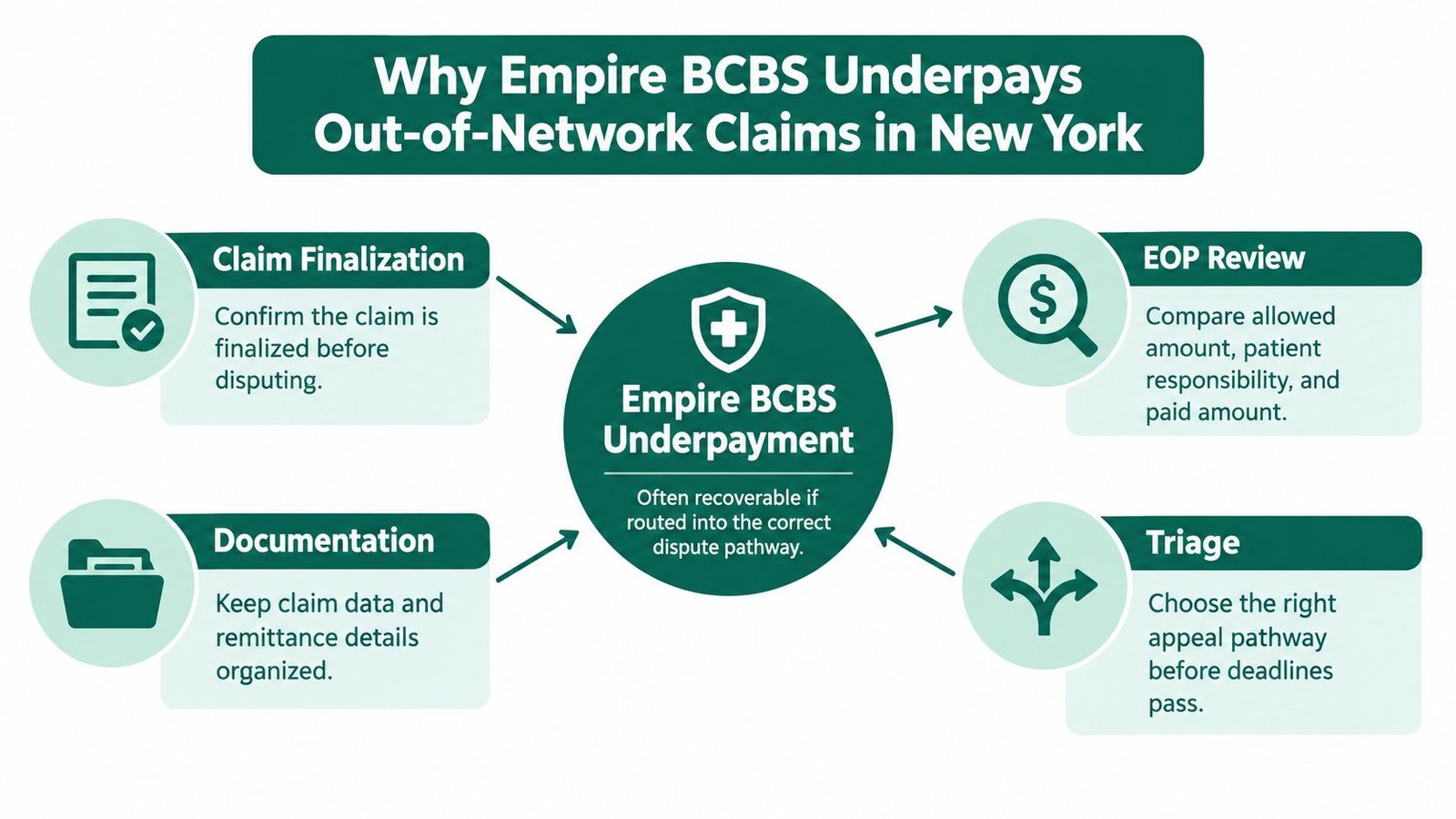
The billed charge isn't enough to establish what Empire owes. A recoverable underpayment requires a defensible reimbursement basis: the applicable benefit provision, provider agreement, exception approval, or governing payment rule.
For each claim, ask what generated the allowed amount. Does the plan describe a usual, customary, and reasonable methodology? Does it reference a percentage-of-Medicare schedule? Does the remittance identify a repricer or negotiated adjustment? Treat these as questions to investigate, not universal Empire policies.
Our explanation of usual and customary rates for out-of-network providers provides context for reviewing those provisions. The financial issue is whether the payer applied the governing methodology correctly, not merely whether its allowance fell below your charge.
Identify who made the payment decision
BlueCard adds another layer. In litigation involving Northwell, the appellate record describes claims submitted through Empire but processed by out-of-state Blue Cross Blue Shield insurers; Northwell alleged more than $5.5 million remained outstanding for services delivered from 2019 through 2022, after an unsuccessful contractual dispute process (Second Circuit Northwell opinion).
That allegation isn't a recovery result. It demonstrates why your team should distinguish the local claim-routing plan from the entity responsible for the challenged allowance.
- Identify the product. Record the exact plan, funding arrangement, and network status.
- Identify the decision-maker. Determine whether Empire handled the payment decision or communicated another plan's determination.
- Identify the payment basis. Preserve the provision or calculation that supports your expected allowance.
For a plain-language explanation of network terminology, Paul L. Gregory, DDS offers a resource to understand dental insurance network differences. It's background on network distinctions, not authority for medical reimbursement appeals.
Practical rule: Don't send a rate argument to a claim-routing entity without identifying who controls the disputed reimbursement.
Book a free 30-minute call with a billing specialist to review your Empire products, disputed allowances, and remaining filing windows.
US practices only.
Reconciling Empire Remittances and Spotting Underpayments
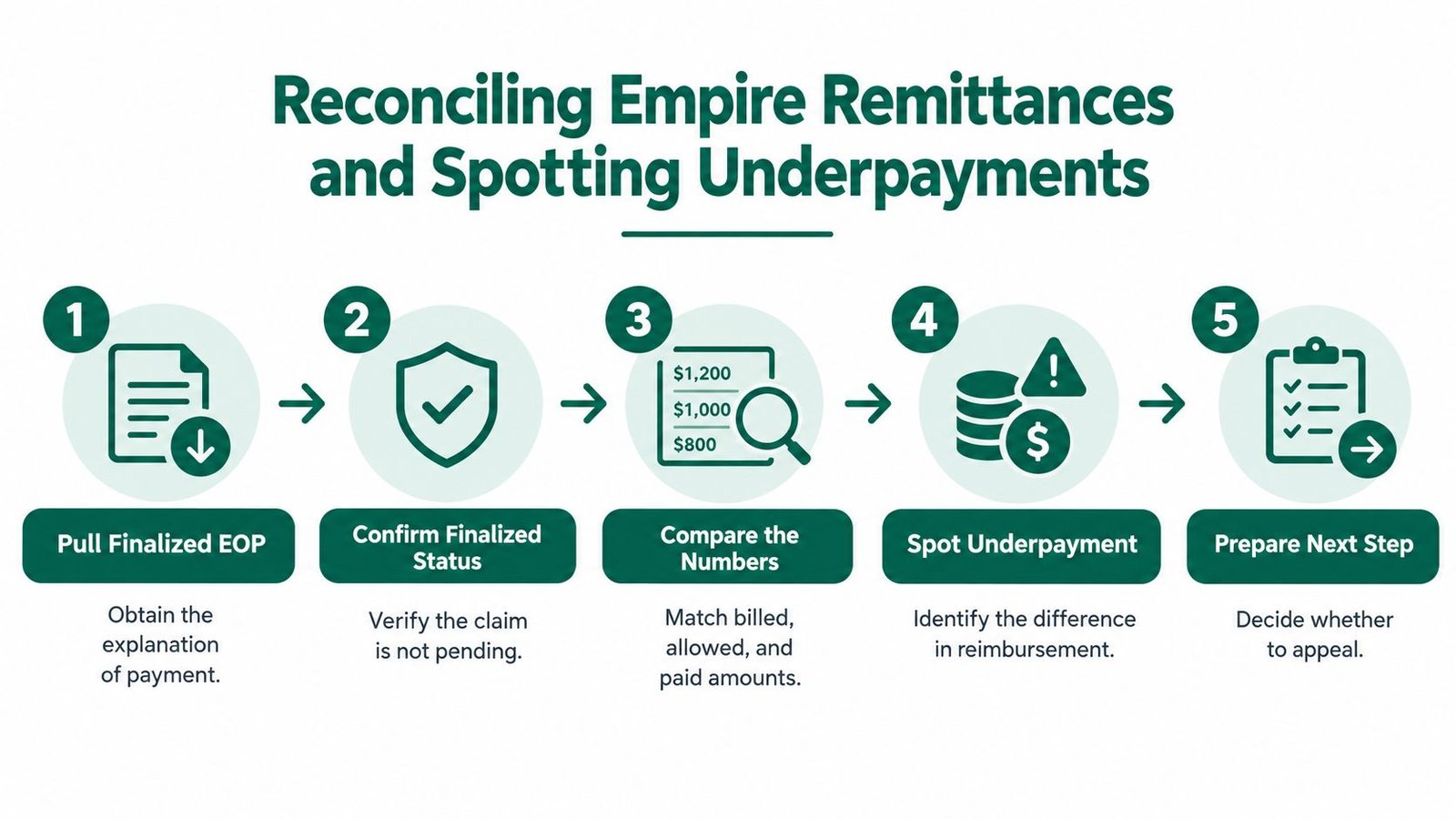
Start with the finalized claim, not the charge ledger. Anthem's New York workflow directs providers through Availity's Claims & Payments, Claim Status Inquiry, and Claims Status Detail functions, with a dispute option for denied or final claims before redirecting to the payer's submission site (Anthem New York claims submissions and disputes).
A pending claim and a finalized underpayment need different work. Your administrator should require confirmation of claim status before assigning an appeal, then preserve the payment determination that triggered review.
Compare allowance before comparing cash
A low payment isn't necessarily a low allowance. Patient responsibility and payment adjustments must be separated from the amount the payer recognized for the service.
Use a reconciliation worksheet rather than a general note that the claim was underpaid:
| Reconciliation field | What the practice owner needs to know |
|---|---|
| Claim-control number and service date | Can the team trace the disputed service? |
| Billed, allowed, and paid amounts | Is the disagreement about pricing or payment allocation? |
| Expected allowed amount | What document supports the expectation? |
| Line-level variance | Which service or adjustment caused the difference? |
| Adjustment explanation | Did the payer reduce units, bundle services, or apply another limitation? |
| Original determination date and deadline | Is the recovery route still available? |
| Dispute status and confirmation | Can the practice prove submission and follow-up? |
Our guide to reading an explanation of benefits helps owners evaluate whether their current reporting distinguishes those amounts.
Build a queue that preserves recovery options
Key the deadline queue to the original EOB or EOP, rather than assuming a corrected submission creates a new appeal period. Keep the original determination attached even when the payer later issues another remittance.
For behavioral health owners reviewing benefit language, ABA Finder explains out-of-network benefits as useful background. Your claim analysis still needs the actual member-plan terms and payment record.
- Prioritize expiration risk. Work approaching deadlines before comfortable deadlines.
- Separate recurring patterns. Group similar reductions without losing claim-level detail.
- Require documented closure. A payment posting alone shouldn't close an identified variance.
The management report should distinguish cash received, reimbursement still disputed, and amounts closed with a documented explanation. Otherwise, an apparently clean A/R report can conceal unworked underpayments.
Choosing the Right Empire Dispute Pathway for Each Claim
The first routing question is payment amount or coverage. A claim paid below the applicable allowance is different from a service denied as medically unnecessary, and neither automatically qualifies for surprise-bill arbitration.
Build the triage record around plan type, funding arrangement, service date, emergency status, service setting, patient notice or consent, network status, and the reason for the adverse determination. Don't let the Empire logo substitute for that review.
Empire Dispute Pathways and Filing Windows
| Pathway | Applies To | Filing Window | Key Evidence |
|---|---|---|---|
| Commercial provider payment appeal | Applicable contractual payment limitation or denial | Commercial window identified above; verify the controlling plan documents | Original remittance, reimbursement provision, variance calculation |
| Medicaid reconsideration and subsequent payment appeal | Finalized Medicaid claim payment disagreement | 45 calendar days from EOP for reconsideration; 30 calendar days from the reconsideration determination for the subsequent appeal | Finalized EOP, reconsideration submission, determination letter |
| New York state IDR | Eligible emergency or surprise out-of-network bills | Verify the applicable state process and claim-specific requirements | Eligibility facts, clinical records, payment offers, pricing support |
| Federal No Surprises Act IDR | Eligible disputes governed by the federal process | Verify current federal initiation and submission requirements | Eligibility analysis, required notices, offers, supporting records |
| New York external appeal | Qualifying coverage denials rather than routine price disagreements | Follow the applicable denial notice and external-appeal requirements | Clinical rationale, denial history, authorization and medical records |
The Medicaid deadlines come from Empire's New York Medicaid provider manual. They shouldn't be replaced with the commercial timeline or an appeal sequence borrowed from another Anthem state.
Seeing this on your own EOBs? Bring a few recent out-of-network EOBs to a call. We will tell you which claims look underpaid and which are worth appealing.
Separate arbitration, external review, and complaints
The New York DFS guide to surprise-bill and emergency-service IDR is the starting point for state eligibility. An out-of-network service isn't automatically a legally qualifying surprise bill.
A routine coding or contract disagreement may be inappropriate for IDR. Conversely, an external appeal may address a qualifying medical-necessity or out-of-network coverage denial that payment arbitration won't resolve.
For a self-funded employer plan, flag ERISA and plan-document review before selecting a state remedy. Don't assume that treatment in New York alone establishes state jurisdiction; obtain the plan's funding information and controlling appeal provisions.
Choosing the wrong forum costs staff time while the correct filing window may continue running.
Administrative complaints also serve a different purpose. Our New York DFS complaint guide for out-of-network underpayments can help organize a complaint, but it shouldn't replace a timely claim dispute. Review the No Surprises Act compliance checklist separately when assessing notice, consent, and federal-process issues.
Building an Appeal Packet Empire Cannot Dismiss
No packet can guarantee acceptance or payment. The objective is to make the claim, requested correction, and supporting reimbursement basis clear enough that a reviewer can evaluate them without reconstructing the file.
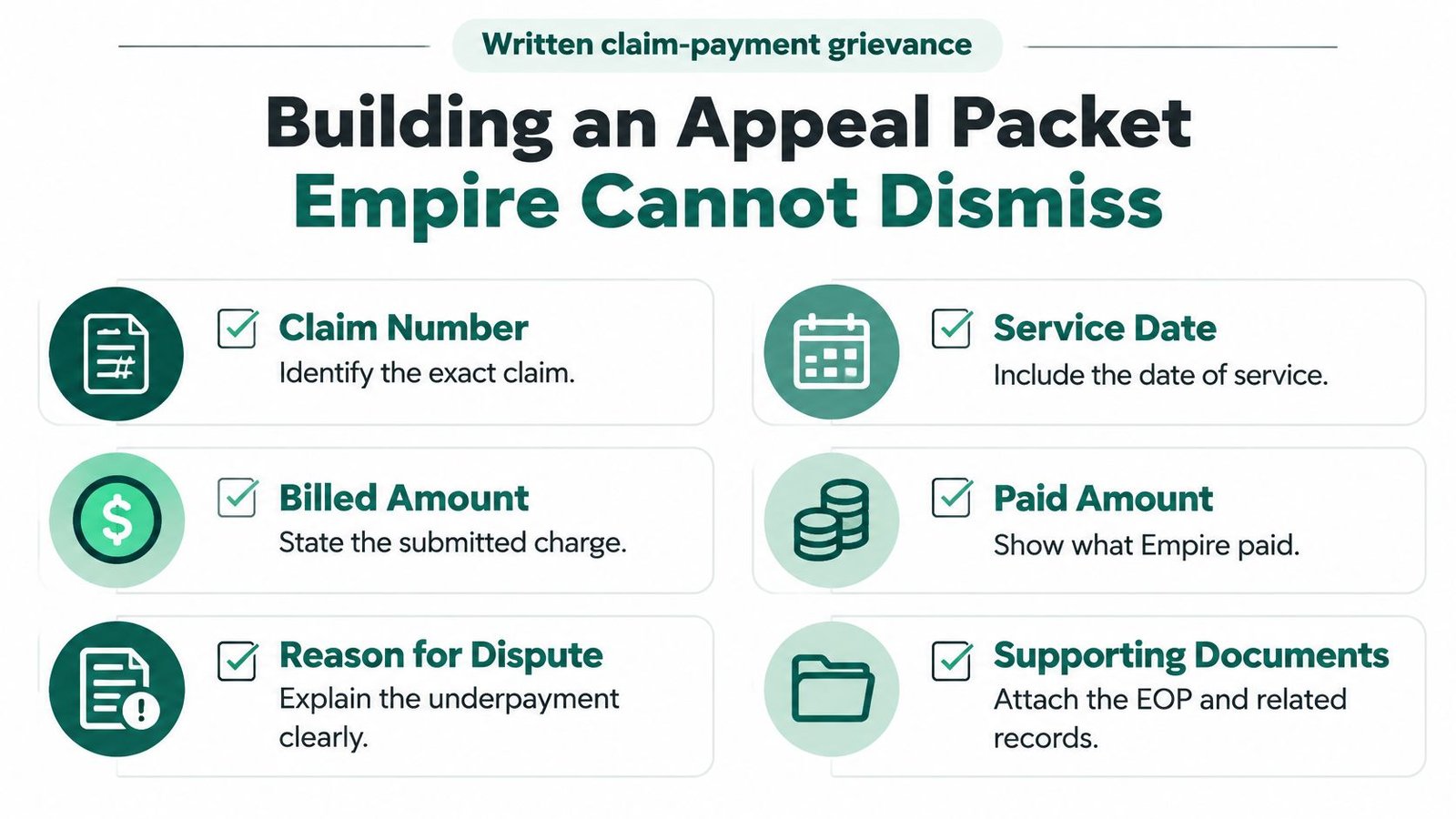
Empire's provider manual describes a written claim-payment grievance that identifies the disputed payment and supporting evidence. It requires timely filing and states that Empire will make reasonable efforts to decide a complete payment grievance within 30 days (Empire New York provider manual).
Put the payment argument before the attachments
Lead with a concise explanation of what went wrong. State whether the payer used the wrong reimbursement provision, failed to apply an approved exception, reduced supported units, or applied a disputed payment adjustment.
Then organize the packet:
- Claim identification. Include the claim number, service date, provider information, and relevant member information.
- Financial comparison. Show billed, allowed, paid, and expected allowed amounts, followed by the disputed variance.
- Payment authority. Identify the applicable agreement, schedule, benefit provision, exception, or statutory basis.
- Clinical and coding support. Attach only the records needed to explain the disputed service and adjustment.
- Submission history. Include prior correspondence, determinations, authorization records, and proof of timely filing.
Use the out-of-network appeal package checklist and template to standardize assembly without turning the argument into a generic form letter.
Translate specialty details into reimbursement consequences
For anesthesia, separate base units, time units, physical-status modifiers, qualifying circumstances, and concurrency documentation. An owner needs to know whether the disputed allowance reflects the wrong conversion basis, unsupported unit reduction, or missing documentation, rather than poor anesthesia payment.
For surgery, isolate global-period, bilateral, multiple-procedure, and modifier 59 effects. Tie the disputed adjustment to the operative record and applicable payment policy; don't assume a modifier overrides every payer edit.
The contractual basis matters just as much as the medical record. In Redstone v. Empire HealthChoice HMO, Inc., physicians challenged out-of-network reimbursement and an alleged entitlement to an in-network exception after an unsuccessful internal appeal; their allegations included use of competitive-fee data for the geographic service area (Redstone decision).
That case illustrates the difference between stating that reimbursement was inadequate and identifying the provision allegedly requiring a different calculation.
Batching Claims and Negotiating With Empire
A physical therapy claim reduced after repricing and a sports medicine claim reduced under a different plan may look similar on an aging report. They don't necessarily share a payment basis, appeal channel, or negotiation strategy.
That distinction matters when reviewing reductions associated with Data iSight, MultiPlan, Zelis, or Claritev. Investigate the remittance and applicable documents before attributing an Empire allowance to any particular repricer. A repricing pattern observed with Cigna or Horizon isn't proof of Empire's methodology.
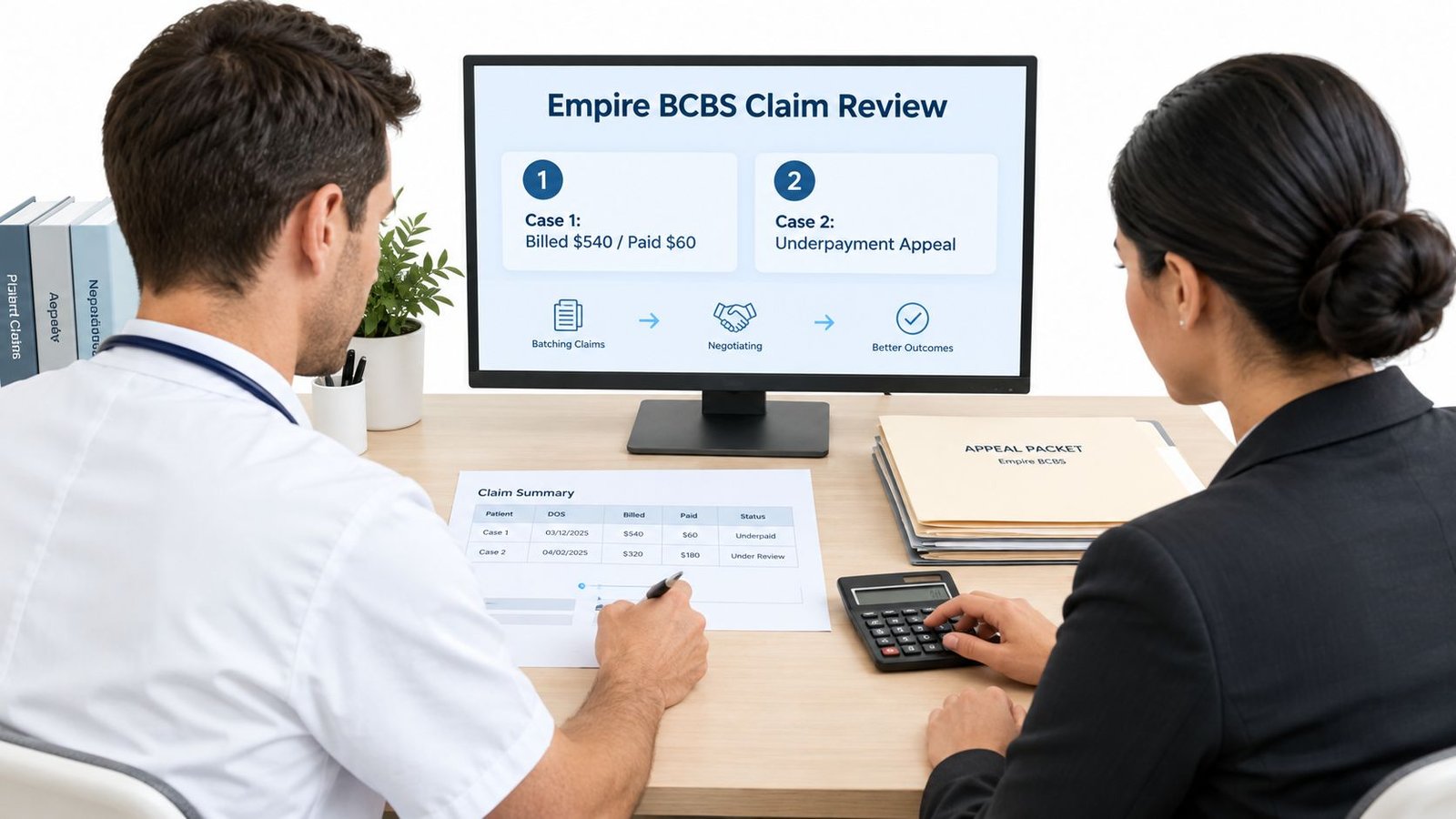
How we approach a negotiation batch
We start with claims that share a defensible issue, then preserve each claim's independent deadline and evidence. The purpose is to give the payer a coherent reimbursement problem to investigate, not an undifferentiated spreadsheet of disappointing payments.
A useful batch combines:
- Consistent routing. The same responsible payer or home-plan entity.
- Comparable payment issues. A shared methodology, service family, modifier effect, or recurring reduction.
- An auditable demand. Claim-level calculations supporting the aggregate request.
- A defined escalation. A named payer contact, case reference, response request, and next permitted step.
Our guide to batching underpaid out-of-network claims for payer negotiation explains how to organize that work. Negotiation batches are operational tools; formal IDR batching requires its own eligibility analysis.
Benchmarks support an argument, not an entitlement
FAIR Health data can inform an offer when the benchmark matches the service, geography, and governing process. Don't present a selected percentile as a universal Empire settlement rule, ceiling, or guaranteed payment.
New York's state arbitration model is final-offer arbitration, meaning the arbitrator selects the insurer's offer or provider's charge. The analysis considers billed-charge benchmarks alongside median in-network rates and other factors, so a high charge alone isn't a complete argument (Brookings analysis of New York arbitration).
Negotiation discipline: Ask the payer to explain its calculation, then challenge the specific unsupported component.
If negotiation fails, use the formal dispute route available for that product, or IDR when eligible. Don't invent a universal one-time provider dispute entitlement.
Likewise, don't resubmit an unchanged claim merely to obtain a fresh EOB and assume the expired appeal window has reopened. Submit legitimate corrections through the proper channel and seek written confirmation of any reopened review.
Preventing Future Empire Underpayments and Deciding When to Outsource
Prevention begins before the first remittance. Your scheduling and clinical teams should capture enough information to identify the product, verify network status, preserve authorization records, and support the services delivered.
An assignment of benefits should be available where appropriate, but don't treat it as blanket authority for every possible appeal. Keep authorization to pursue a particular remedy separate from the reimbursement calculation.
Fix the handoffs before buying more follow-up
Ask your administrator to trace a disputed claim from scheduling through payment posting. Missing information often becomes visible at the handoff between eligibility review, clinical documentation, submission, and reconciliation.
- Before care. Confirm the product and document relevant authorization and out-of-network information.
- At claim release. Validate supported units and modifiers against the applicable payer rules.
- After adjudication. Assign a named owner to unexplained variances.
- At escalation. Preserve submission confirmations and written payer responses.
Specialty differences matter. An authorization-heavy behavioral health practice needs a different control emphasis from a procedure-heavy sports medicine group. Review the specialty billing services against your actual claim mix rather than evaluating recovery as a generic collection task.
Decide based on capacity and net recoverability
Keep the work in-house when your team can reconcile allowances, identify deadlines, prepare supported disputes, and manage follow-up without neglecting current claims. Consider outside support when ownership is unclear, recurring reductions remain unexplained, or staff activity can't be tied to documented outcomes.
IDR also requires an economic decision. Eligibility screening, documentation, administrative fees, representation, and delay all affect whether a dispute makes financial sense; favorable aggregate outcomes don't eliminate those costs (Georgetown analysis of federal IDR costs).
We evaluate recovery work by claim age, documentation readiness, remaining procedural options, and the supportable amount. Fees are contingency-only, depend on claim age and volume, and we give a clear number after a free 30-minute call with a billing specialist. We only get paid when we deliver, with nothing upfront and no recovery guarantee.
Book a free 30-minute call to discuss a representative Empire remittance, the supporting payment basis, and whether your current workflow can pursue it efficiently.
US practices only.
Frequently Asked Questions From New York Practice Owners
How long should I expect an Empire underpayment appeal to take?
Separate the payer's stated review period from the time needed to resolve the dispute. Document retrieval, home-plan clarification, negotiation, and further escalation can extend the process, so require dated milestones and written status updates rather than a promised recovery date.
Can my practice proceed without contacting the patient?
Check the assignment of benefits and the authorization requirements of the selected pathway. An AOB may support the practice's role, but don't assume it satisfies every member-representation or appeal requirement; confirm that before committing staff time.
What if the original appeal window has already closed?
Review whether the payer used the correct determination date and whether your practice has proof of an earlier timely submission. Then assess legitimate correction options or another available remedy, but don't assume a new EOB automatically restores expired rights.
Should I choose New York IDR or a commercial provider appeal?
Choose based on eligibility and the issue being disputed, not the apparent size of the shortfall. Use the commercial route for an applicable payment disagreement and assess state IDR for qualifying emergency or surprise bills; coverage denials need their own review.
Bring a representative Empire EOP, the relevant plan or reimbursement documents, and your outstanding dispute list to Happy Billing. We can help assess claim routing, evidence gaps, and recovery options so you can decide whether to strengthen your internal process or outsource the work.
Want someone to work these claims for you? Happy Billing handles out-of-network underpayment recovery for independent practices: repricing disputes, plan appeals, state complaints, and No Surprises Act IDR where it applies.