Cigna Out-of-Network Underpayment Appeal Process for Healthcare Providers
Cigna typically allows 180 calendar days for a first-level out-of-network payment review, while self-funded plans generally require you to follow the plan's federal ERISA appeal terms rather than relying on state insurance deadlines. For a practice owner, missing that distinction can leave valid revenue tied up in A/R while the payer treats the dispute as late or improperly filed.
The practical answer is to identify the plan funding type, confirm whether the claim was processed in-network or out-of-network, and submit a complete written package through Cigna's provider process. Cigna says the package should generally include the original EOB or EOP, the original claim, the applicable payment review form, and supporting records such as operative reports or medical records. Cigna's provider appeal guidance also indicates that processing can take up to 60 days, unless state law or the provider agreement creates a different timeline.
An underpayment isn't merely a billing inconvenience. It reduces your net collection rate, extends A/R days, and can hide recurring leakage across a physician, location, CPT code, or product line. The Cigna out-of-network underpayment appeal process for healthcare providers works best when the practice treats every low payment as a claim-level financial variance, not as an ordinary EOB adjustment.
Why Cigna Out-of-Network Underpayments Cost You More Than You Think
A claim can be processed correctly from a payer's perspective and still produce an amount that doesn't support your practice's economics. Cigna's provider materials require the filer to identify whether the claim processed in-network or out-of-network, and that classification affects the review pathway, the applicable plan language, and the evidence you need to submit. Cigna's claim submission guidance confirms that out-of-network claims have their own filing and reconsideration considerations.
Practices may also see repricing references associated with vendors such as Data iSight, MultiPlan, or Zelis, depending on the product and claims arrangement. Don't assume the vendor name itself proves that Cigna applied an incorrect rate. The stronger argument is that the claim was assigned the wrong network status, the plan language was misapplied, the repricing methodology is unsupported, or the payment doesn't match the governing benefit terms.
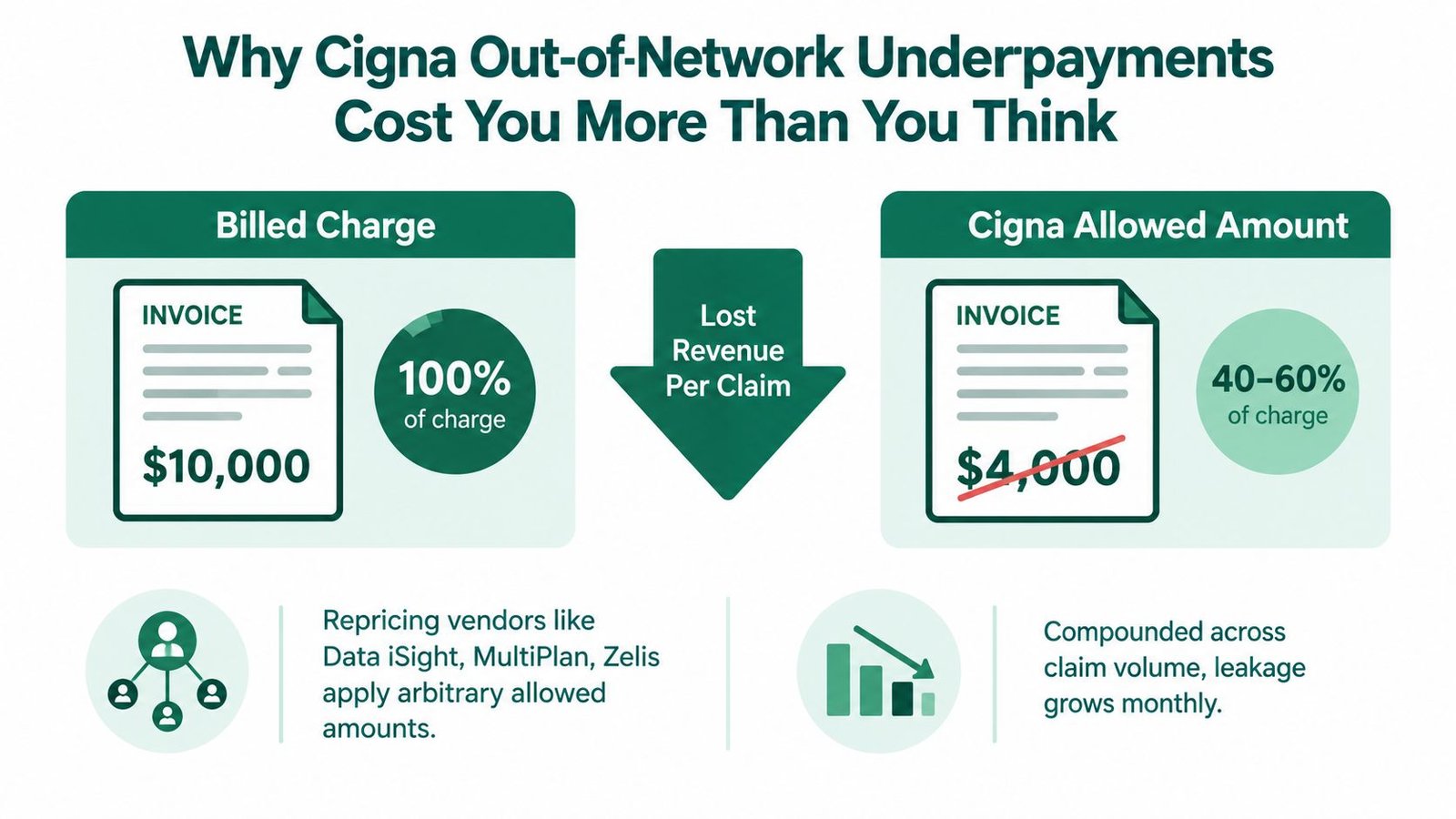
The billed charge and allowed amount aren't interchangeable. A claim with a large billed amount may still have a lower contractual or plan-defined allowed amount, but that doesn't end the analysis. The owner needs to know which plan paid the claim, who funded it, which pricing provision was used, and whether Cigna or a repricing vendor can explain the result.
The plan type controls the escalation route
Start with the member's plan documents and the EOB. Look for language identifying the employer, the plan administrator, the funding arrangement, and whether the plan is fully insured or self-funded. Ask Cigna or the employer's benefits administrator for confirmation when the EOB is unclear.
| Plan Type | Appeal Authority | Typical Deadline | Best For |
|---|---|---|---|
| Fully insured commercial plan | Cigna's internal review, then applicable state insurance process | Generally 180 calendar days for Cigna's provider payment review, subject to state or agreement-specific rules | Claims governed by state insurance requirements |
| California provider dispute | Cigna's California provider dispute process | 365 calendar days from the initial payment or denial notice, or from the latest adjustment after reprocessing | California claims requiring the longer state-specific window |
| Self-funded plan | Cigna's internal plan process, followed by the applicable ERISA or federal route | Plan document controls, with Cigna's review process often taking up to 60 days | Employer plans where state insurance remedies may not control |
Cigna's California guidance demonstrates why a national deadline assumption is dangerous. The California provider dispute rules provide a 365-calendar-day submission window in the circumstances described there, materially different from the general 180-day provider review rule.
Practical rule: Verify plan funding before you choose the regulator, the appeal form, or the escalation deadline.
A practice owner reviewing broader reimbursement exposure can also use this out-of-network reimbursement resource to organize claim-level payment comparisons. For general background on assembling a denial dispute, this guide on how to appeal an insurance denial offers another perspective, but it shouldn't replace Cigna's own forms and plan-specific requirements.
Documentation Package Every Cigna Appeal Must Include
Cigna's review process is document-driven. A persuasive argument can fail if the reviewer can't connect the appeal form, original claim, EOB, clinical record, and requested correction to the same claim.
Build the packet in a consistent order. The exact sequence can vary by submission channel, but the reviewer should be able to identify the disputed payment immediately.
Cover letter and claim identifiers. Put the patient account reference, member ID, claim number, date of service, rendering provider, billing entity, and appeal level on the first page. State the requested remedy in direct language, such as reprocessing under the correct network status or reconsideration of the allowed amount.
Cigna payment review form. Use the applicable form and explicitly identify that the claim processed out-of-network. Cigna's provider materials indicate that the filer must distinguish in-network from out-of-network processing during reconsideration or appeal.
Original claim and submission evidence. Include the original claim data, submission confirmation, and any corrected claim history. A corrected claim isn't a substitute for a payment appeal when the issue is an allowed amount or repricing decision.
Original EOB or EOP. Mark the payment, adjustment, denial, patient responsibility, remark codes, and any reference to a discount or repricing vendor. Don't rely on a portal screenshot alone if you can obtain the complete remittance.
Supporting medical documentation. Cigna identifies records such as operative reports or medical records as appropriate supporting documentation. Include only records that support the service, coding, medical necessity, provider identity, and disputed payment. A large unindexed chart can slow review rather than strengthen it.
Plan and network evidence. Add the relevant out-of-network benefit provision, provider participation confirmation, effective dates, location information, and any correspondence showing how the provider was loaded. If the claim should have been in-network, lead with that issue instead of arguing only that the rate is low.
Make the reviewer's job easy
Use a searchable PDF with an attachment index and page numbers. Keep the same provider NPI, group NPI, taxonomy, place of service, date of service, CPT code, and diagnosis references across the claim and attachments.
If the dispute concerns a professional service, include the documentation that supports the billed service and the provider who performed it. For a behavioral-health practice, for example, a CPT 90837 claim should be reconciled against the clinician's identity, service date, place of service, plan benefit, and EOB before the practice argues about the allowed amount. That example is claim-specific, not a universal payment standard.
Submit through Cigna's provider portal or the channel identified in the applicable provider instructions. Retain the submission confirmation, uploaded files, and response date. The practice should calendar the applicable follow-up date immediately rather than trusting the portal to manage the entire appeal cycle.
A focused Cigna out-of-network appeal package checklist and template can help standardize the packet across locations and specialties.
State DOI Complaints Versus Federal IDR Appeals for Self-Funded Plans
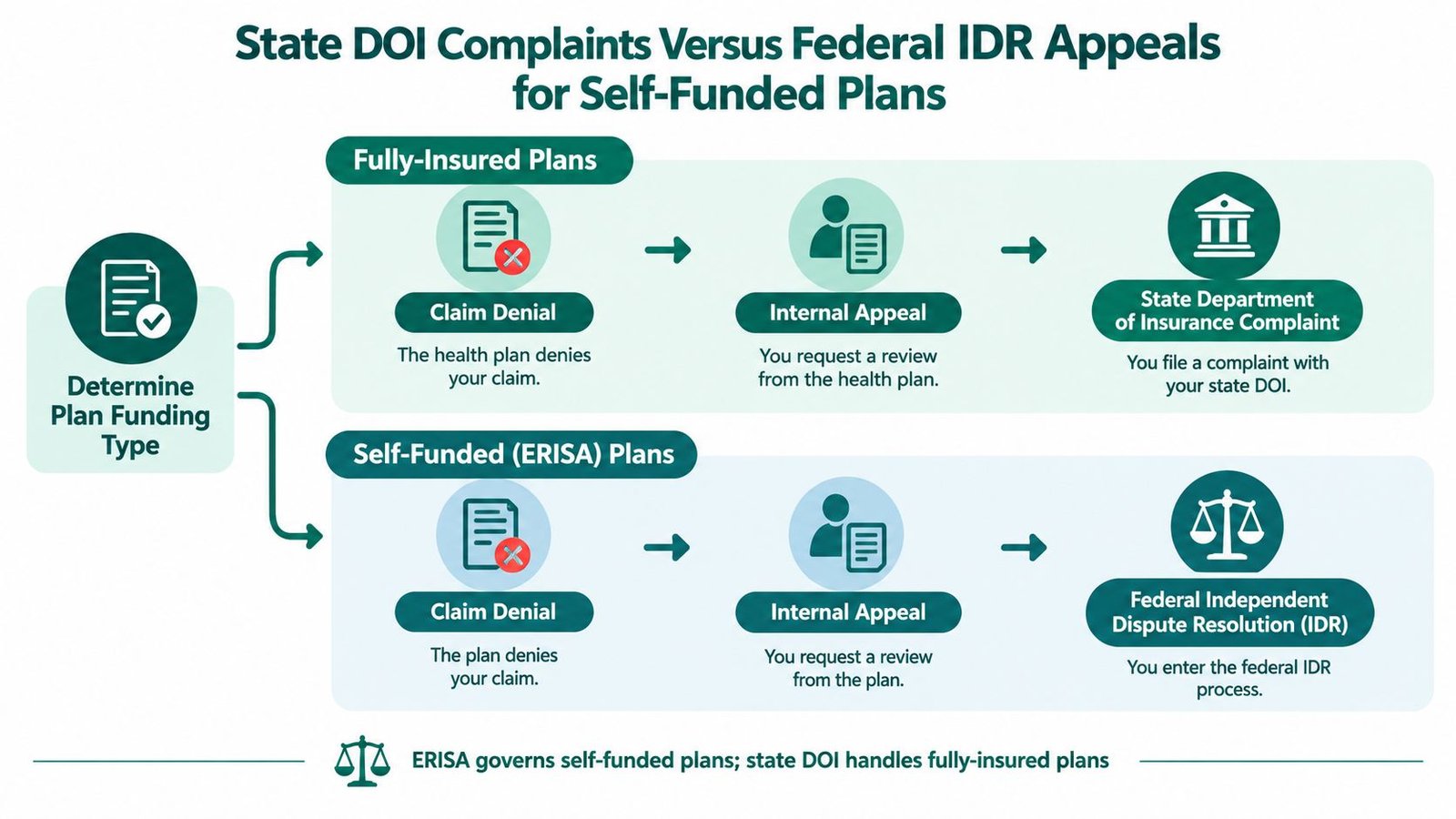
The most expensive routing mistake is filing in the wrong forum. A state Department of Insurance complaint may be appropriate for a fully insured product, while a self-funded employer plan generally requires review under the plan's federal ERISA procedures. The administrator may use Cigna's infrastructure, but the employer plan's funding arrangement still matters.
Don't infer funding type from the Cigna brand alone. Request the plan document, summary plan description, EOB disclosures, or written confirmation from the employer's benefits administrator. A claim can carry Cigna branding while the remedy depends on the underlying employer plan.
Use this decision matrix before escalating
| Question | If the answer is yes | Operational response |
|---|---|---|
| Does the documentation identify a fully insured plan? | State insurance oversight may apply | Complete Cigna's internal process, then evaluate the state DOI route |
| Does the documentation identify a self-funded employer plan? | ERISA plan procedures are central | Follow the plan's internal appeal terms and evaluate the applicable federal route |
| Is the claim a protected emergency or qualifying surprise-billing dispute? | The No Surprises Act may affect the remedy | Review negotiation and IDR eligibility before treating it as a standard underpayment |
| Is the plan funding unclear? | The escalation route is uncertain | Obtain written confirmation before filing a regulator complaint |
For self-funded Cigna plans, the practice should distinguish a standard ERISA benefit appeal from a No Surprises Act dispute. Federal IDR isn't a universal substitute for a payer appeal, and not every out-of-network underpayment qualifies. The claim's setting, service type, plan terms, and applicable federal requirements must be checked first.
For a fully insured plan, a state DOI complaint can be useful after the practice has created a clean administrative record. Submit the EOB, original claim, appeal correspondence, plan information, and a concise explanation of the requested correction. A regulator is more likely to understand a claim-specific chronology than a broad complaint about Cigna's general payment practices.
Cigna's general provider materials indicate a first-level review period of up to 60 days, unless a different state or contractual rule applies. The materials supplied for this process don't establish a universal 60-day second-level appeal deadline, so don't insert that deadline into every Cigna case. Confirm the second-level deadline in the plan document, Cigna correspondence, or applicable state instructions.
Escalate with a complete record
A second-level appeal should identify what the first reviewer failed to address. That might be the network indicator, the plan provision, the supporting record, the repricing explanation, or the calculation of the disputed amount. Repeating the first letter without adding a specific unresolved issue rarely improves the file.
Providers handling federal escalation can use this step-by-step federal IDR process for providers as a workflow reference. Treat it as a route-selection aid, not proof that a particular claim qualifies.
Real-World Example Recovering $47,000 in Underpaid Cigna Claims
A real recovery story needs claim records, remittances, plan documents, appeal correspondence, and proof of payment. Those records aren't available in the verified information for this article, so the $47,000 figure should be treated as a worked planning example, not a documented case study or guaranteed recovery.
That distinction matters to a physician owner. A fabricated before-and-after denial rate or A/R result can lead management to overvalue a recovery opportunity, choose the wrong escalation route, or approve an expensive contingency arrangement without understanding the underlying claims.
A defensible $47,000 planning model
Assume a practice identifies a group of Cigna out-of-network claims with a combined disputed balance of $47,000. The practice hasn't yet established that Cigna owes the entire amount. It has identified the amount as the difference between the billed charges and the payment received, pending review of network status, plan language, patient responsibility, and the applicable pricing methodology.
The practice would then separate the balance into claim categories:
- Network-status issue: The provider believes Cigna processed the claim as out-of-network even though the provider record, location, product, or effective date supports in-network treatment.
- Pricing issue: The network status appears accurate, but the allowed amount doesn't match the plan's out-of-network benefit or the documented methodology.
- Documentation issue: The payment dispute can't be evaluated because the original EOB, claim history, medical records, or provider evidence is missing.
- Non-recoverable balance: The plan language supports the payment, or the filing deadline has expired.
The $47,000 figure is only an initial work queue. The recoverable amount may be lower, and the practice shouldn't post an expected recovery to financial statements before receiving a payer determination.
What the appeal letter should say
The letter should avoid unsupported accusations and focus on the requested action:
Requested correction: Please review the enclosed claim under the applicable plan terms, confirm the network indicator used for the date of service, identify the payment methodology applied, and reprocess the claim if the network classification or allowed amount was calculated incorrectly.
For a claim involving CPT 90837, the packet would need to reconcile the rendering clinician, group identity, date of service, place of service, supporting clinical record, EOB, and plan benefit. For a surgical claim, the relevant records could include an operative report and related medical documentation, which Cigna identifies as examples of supporting material in its provider review guidance.
Use a claim-reopening workflow only when the payer's rules permit it and the issue is appropriate for reopening. The guide to reopening a deposited underpaid claim can help practices distinguish a payment correction from a formal appeal.
Don't claim that $47,000 was recovered unless the remittance, corrected payment, and deposit reconciliation prove it. A strong internal report should show the original payment, requested correction, payer response, recovered amount, remaining balance, submission date, and escalation route for every claim.
Preventing Future Underpayments Through RCM Workflow Integration
Appeals recover past leakage. Workflow controls prevent the same variance from reaching delinquent A/R. The practice should review Cigna payments at the line level, compare the allowed amount to the expected plan result, and route exceptions before staff close the account.

Build an underpayment control loop
At scheduling, staff should capture the member's product information and confirm whether the practice expects an in-network or out-of-network claim. They shouldn't promise a payment amount to the patient. They should document the verification result and route unclear cases for review.
At charge entry, preserve the rendering provider, group identity, location, place of service, CPT code, modifiers, and diagnosis information. A mismatch between the clinician, taxonomy, location, and payer record can create a network classification problem that no payment poster will detect from the EOB alone.
At remittance posting, compare:
- Expected network status: Was the claim processed under the status anticipated during verification?
- Allowed amount: Does the payment reflect the applicable plan provision and known pricing arrangement?
- Adjustment reason: Does the remittance explain the reduction, or does it leave a material variance unresolved?
- Vendor reference: Does the EOB or remittance identify a repricing pathway that requires documentation?
- Appeal clock: What is the applicable submission deadline for this plan and jurisdiction?
A practice can use a spreadsheet for a smaller volume, but recurring Cigna variance analysis benefits from structured RCM automation. Revenue cycle management automation can support exception queues, payment comparisons, and deadline tracking when the underlying data is accurate.
Measure leakage by provider and service
Don't judge the problem from total collections alone. Segment the report by clinician, location, plan product, CPT code, network status, repricing reference, and appeal outcome. A recurring low payment attached to one product may require a plan-specific appeal strategy, while a recurring mismatch for one clinician may point to credentialing or roster data.
For mental-health practices, review services such as 90834, 90837, and 90791 as separate payment categories. Those codes are examples for claim review, not evidence of a standard Cigna fee schedule. The practice should compare actual remittances with the applicable plan terms and preserve the EOB supporting each variance.
We have seen practices lose time by sending every low payment to the same generic appeal queue. That approach creates volume without prioritization. A better queue ranks claims by filing deadline, disputed balance, evidence quality, recurring pattern, and likelihood that the issue is administrative rather than purely contractual.
Owner's test: If your team can't tell which claims are underpaid, why they were underpaid, and when the appeal expires, the practice doesn't have an underpayment workflow. It has a payment-posting workflow.
Happy Billing is one possible RCM partner for practices that need claim denial management, A/R recovery, credentialing support, and payer-specific exception handling within an existing EHR. Whether you outsource or keep the work internal, require reporting that connects each appeal to the original claim and the final remittance.
Frequently Asked Questions About Cigna Out-of-Network Appeals
How long does a Cigna provider have to appeal an out-of-network underpayment?
Cigna generally states that a provider payment review request should be submitted within 180 calendar days of the initial payment or denial notice. California's provider dispute guidance uses 365 calendar days in the circumstances described by Cigna. Check the plan, state, provider agreement, and latest payment adjustment before relying on the general deadline.
What should I do if Cigna says the claim is out of network?
First, verify the provider NPI, group NPI, taxonomy, location, product, and effective date against the payer's records. Then obtain the EOB, plan language, participation evidence, and claim history. If the network assignment is wrong, make that the lead issue. If it's correct, focus the appeal on the applicable out-of-network benefit and payment methodology.
Can I file a state DOI complaint for any Cigna claim?
No. Confirm whether the plan is fully insured or self-funded before filing. A fully insured plan may be subject to state insurance oversight, while a self-funded plan generally requires attention to the plan's ERISA procedures and any applicable federal dispute route.
Is a low allowed amount automatically an underpayment?
No. The practice must compare the payment with the governing plan terms, network status, claim data, patient responsibility, and any documented pricing methodology. A difference between billed charges and payment is a review signal, not proof that Cigna owes the full difference.
Happy Billing can review Cigna out-of-network claims, organize payer-specific appeal documentation, and identify recurring underpayment patterns by provider and CPT code. Visit Happy Billing to request a free audit and determine which balances deserve immediate recovery attention.