Top Medical Billing Denial Codes: A Reference Guide for Practice Owners
A denial code is not just a remittance note, it's a cash-flow event. For a busy practice, the main question is which denial codes are slowing payments, raising A/R days, and forcing your team to work claims twice.
The hardest part is that many denials aren't final. A 2022 national survey published in 2024 found that nearly 15% of claims submitted to private payers were initially denied, and nearly 70% of those initial denials were eventually overturned and paid medical billing claim denial statistics. That means the owner's job isn't just decoding the denial, it's building the front-end controls that prevent avoidable losses and route appealable claims fast.
Introduction to Top Medical Billing Denial Codes
A denial on your workqueue is a revenue event, and it affects more than one claim. The first question for a practice owner is where cash is stalling, eligibility, authorization, coding, or filing discipline. Repeated denials mean more rework, slower reimbursement, and more touches per claim, which pushes A/R higher and ties up staff time.
The pattern is usually upstream. A coverage change was missed at check-in, prior authorization was never captured, or the claim went out with the wrong code set. The denial appears at the end, but the fix belongs at the point where the error entered the workflow.
Owners recover faster when each denial is tied to the control that should have stopped it. This guide pairs the top denial codes with prevention controls, specialty-specific workflows, and payer handling examples, so you can reduce repeat denials and protect cash flow instead of just decoding rejection notices.
A denial may still be appealable, but appealable claims still take time and cost money medical billing claim denial statistics.
Denial Code Categories
A denial code is most useful when you group it by the workflow that failed. That approach shows where the money stalled, and it is more actionable than memorizing isolated reason strings. For practice owners, the main categories are coverage and eligibility, authorization gaps, medical necessity, bundling and NCCI conflicts, and timely filing.
The remittance tells the story, but only if your team reads the full code pair. CARC and RARC on the 835 remittance advice show why a claim was reduced or denied, and the remark code adds the detail needed to route the work correctly. If staff only read the reason code, they can send the claim to the wrong queue, bill the patient too soon, or miss the correction that would get it paid. For a closer look at CO-236, see the Happy Billing CO-236 denial code guide.
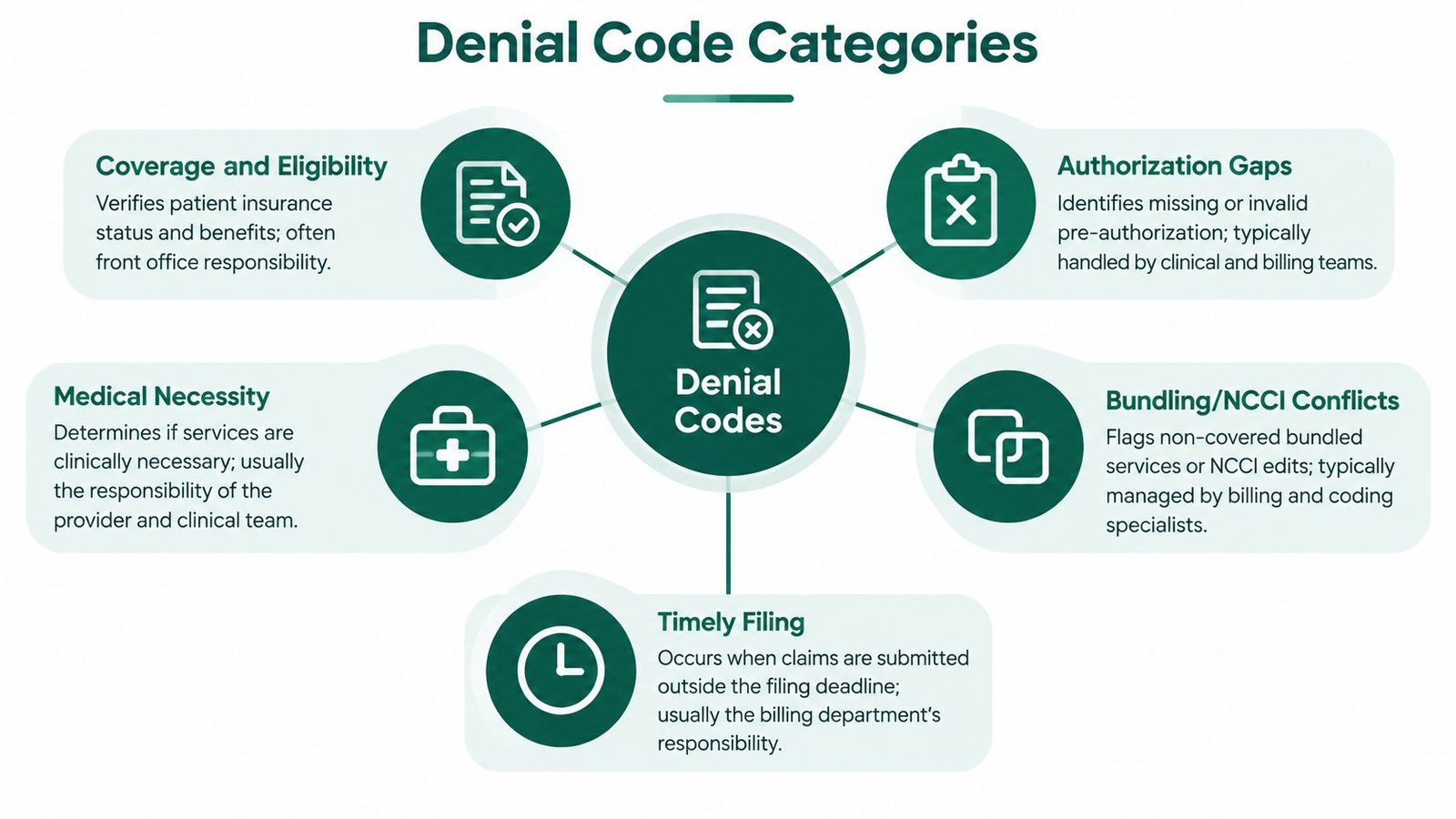
What each category means for your workflow
- Coverage and Eligibility: Confirms patient insurance status and benefits. This is usually a front-office control. If it fails, the claim may be built on bad coverage data before payer review even starts.
- Authorization Gaps: Captures missing, expired, or exceeded prior approvals. Scheduling and referral tracking usually own this step.
- Medical Necessity: Tests whether the diagnosis and documentation support the service. Coding and clinical documentation must align here.
- Bundling and NCCI Conflicts: Flags services the payer treats as inclusive. These denials often call for modifier review and charge-level correction.
- Timely Filing: Reflects missed payer deadlines. This is a process control issue, usually tied to follow-up discipline and claim submission timing.
Each category points to a different control point, and that is where the financial gain sits. Fixing a recurring denial family lowers total denial volume, cuts rework, and reduces staff touches per claim. A reference guide is strongest when it connects the denial to the upstream fix, not when it treats the denial as back-office cleanup CARC and RARC denial code guide.
Claim routing gets easier when the code family maps to one owner, one fix, and one deadline.
Breakdown of CARC and RARC Codes
A denial often looks simple on the remittance, then the follow-up team finds there are two codes to interpret. CARC gives the primary reason for the adjustment on the 835, while RARC adds the payer's extra detail. Read together, they tell your staff whether the claim needs correction, appeal, patient billing, or write-off review.
The practical test is straightforward. If the CARC shows the claim failed and the RARC explains why, both codes need to be reviewed before anyone works the account. Group codes such as CO, PR, OA, and PI tell you who carries the financial responsibility, so they matter for follow-up, balance transfers, and patient statements.
| Code Type | Responsibility | Meaning | Operational Note |
|---|---|---|---|
| CARC | Payer or claim workflow owner, depending on the adjustment | Explains why the line was denied, reduced, or adjusted | Use it to identify the root reason |
| RARC | Adds context for the next action | Gives supplemental detail and instructions | It cannot stand alone |
| CO | Provider write-down or payer-adjusted amount | Contractual or payer-related adjustment | Review denial routing first |
| PR | Patient responsibility | Amount the patient may owe | Confirm balance before billing |
| OA | Other adjustment | Administrative or non-standard adjustment | Check whether appeal or correction applies |
| PI | Payer responsibility | Adjustment assigned to the payer | Often relevant in coordination issues |
Operational rule: if the pair isn't read together, you'll waste touches on the wrong fix.
The highest-value work starts before the claim ever reaches the payer. Eligibility checks, authorization capture, coding review, and filing-window control reduce avoidable denials because they stop the error at the source. A denial code like PR-119 is a good reminder that responsibility may shift when benefit detail or coordination is incomplete, so staff need a clear route from code review to action. The PR-119 denial code reference is useful for training teams on that workflow.
Profile of Top Denial Codes and Causes
The codes that show up most often are usually not mysterious. They point to a small set of repeat failures, including missing data, terminated coverage, lack of authorization, non-covered services, bundling, and filing errors. CO-16 is a clear example, since it signals missing or malformed data and usually traces back to preventable front-end leakage CO-16 denial code explanation.
The practical question is simple, what stopped the payer from processing the claim cleanly? If a required field is missing, the claim cannot adjudicate. If the service was not authorized, the charge is exposed. If the procedure was bundled into another service, separate payment depends on the right modifier and documentation.
Common denial codes owners should watch
| Code | Typical trigger | Financial meaning |
|---|---|---|
| CO-16 | Missing or malformed claim data | Rework, delay, and preventable resubmission |
| CO-27 | Coverage terminated | Likely patient responsibility if eligibility was stale |
| CO-29 | Timely filing missed | Payment risk is high because the filing window closed |
| CO-50 | Medical necessity not supported | Appealable when clinical records are strong |
| CO-96 | Non-covered service | Often needs benefit review, not just resubmission |
| CO-97 | Bundled service | Modifier and coding review are essential |
| CO-109 | Wrong payer | Eligibility and coordination of benefits failed |
| CO-197 | Prior authorization missing | Front-end approval workflow failed |
| CO-204 | Service not covered under current policy | Policy review matters more than claim correction |
CMS guidance on modifier 59 matters in specialties where same-day procedures are common. The modifier is meant for a distinct procedural service, not as a generic override, and it should be supported by a different session, different procedure, different site, separate incision, or separate lesion when appropriate CMS modifier 59 guidance. Misuse can turn a payable claim into a denial or a recoupment problem.
Procedure-heavy practices also need to separate coding errors from payer disputes quickly. A claim with bundling or modifier problems may be fixable with documentation and corrected coding, while a stale benefit check or wrong-payer issue usually points upstream. For that reason, a CO-253 code reference can be useful when staff need to route the denial to the right work queue and avoid losing time on the wrong fix.
For practice owners, the financial impact is not just one denied line. These codes slow cash, add rework, and expose gaps in eligibility, authorization, coding, and payer setup. The strongest controls are upstream, before the claim leaves the practice.
Immediate Remediation Steps for Denials
A denial should trigger action the same day it lands. The longer it sits, the more rework it creates, and the more likely the cash stays buried in A/R. Recovery usually comes from a clean, ordered response, not from challenging every denial as if the payer made a mistake.
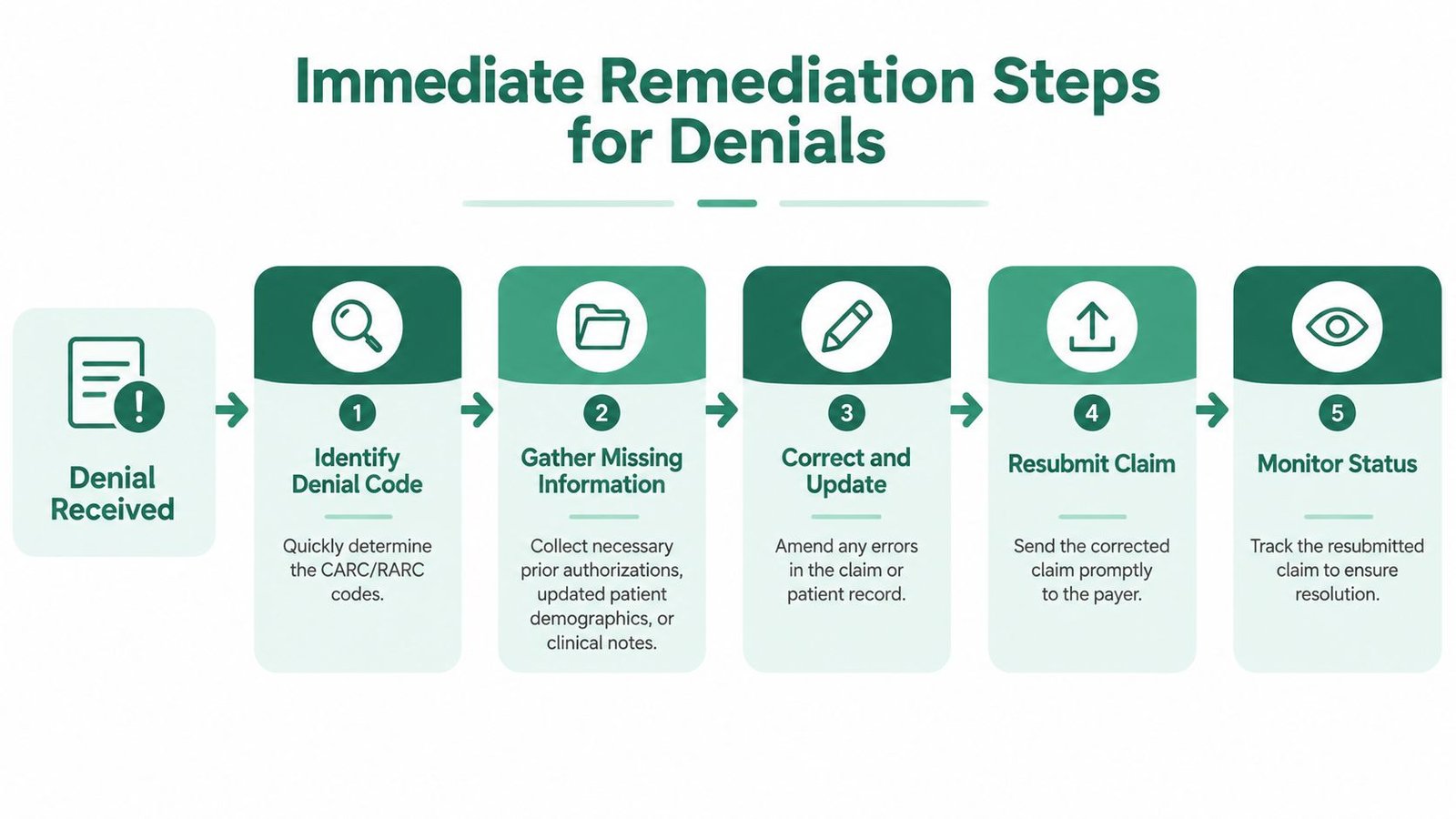
Start with the denial code, not the invoice
Identify the CARC and RARC pair first, then decide whether the claim needs correction, more documentation, or an appeal. If the code points to missing data, do not lead with an appeal letter. Correct the claim structure first, then resubmit.
Payers usually respond better when the next submission answers the exact issue they raised.
Then gather the right backup
For authorization denials, pull the approval record, referral, or order right away. For bundling or modifier problems, gather the operative note, timing details, and the exact code combination. For eligibility or filing problems, confirm whether the claim belongs with another payer or whether the payer still accepts a corrected claim.
Assign one person to each denial family. That keeps duplicate work down and prevents the common problem where everyone touches the claim and nobody owns the fix. If records are scattered across systems, a document intake platform such as TOOLii's medical document upload tool can help centralize the files needed for appeal packets.
Resubmit with a documented purpose
Resubmissions should be deliberate. Attach the correction, include the supporting documents, and keep the explanation tight. If the payer cannot see why the denial should be reversed, the claim just moves to another queue.
For teams that want a structured workflow, our medical billing denial management resource outlines a process practices can standardize across payers and specialties.
Preventive Measures by Specialty
Specialty-specific workflows matter because denial patterns aren't identical across a practice mix. A cardiology group, a behavioral health clinic, and an anesthesia team don't fail in the same place, even when the denial code looks similar on paper. Experian Health's 2025 State of Claims survey found that missing or inaccurate data caused 50% of denials, while authorizations drove 35%, which is a strong signal that prevention has to start before submission Experian State of Claims 2025.
Build the front-end controls around the specialty
Anesthesiology should tighten time-unit and modifier review before claims leave the practice, especially where base units and concurrency documentation affect payment. Cardiology teams need pre-checks around imaging authorization, service bundling, and ordered-test documentation. Mental health clinics need reliable authorization tracking because recurring visits can drift past approved limits quickly.
Orthopedics is different again. Global periods, postoperative visits, and multiple-procedure logic can create avoidable denials if the charge team doesn't know what's included and what needs separate support. Pediatrics depends heavily on clean eligibility capture, because family coverage changes and coordination issues can create preventable claim churn.
Operational takeaway: specialty workflows should stop the denial before the coding queue ever sees it.
For practice owners comparing process design resources, Doczen's business process improvement methods is a helpful external read on how to standardize repeatable workflows without turning every exception into an ad hoc decision.
The key trade-off is time. You can spend that time correcting denials after submission, or you can spend it tightening intake, auth, and documentation rules so the claim goes out clean the first time. We've seen the second model hold up better in multi-specialty groups because each service line gets its own pre-bill checklist instead of one generic billing rule set.
Payer Specific Handling Examples
Payers don't process denials with equal flexibility. Some focus heavily on documentation completeness, while others enforce tighter modifier or authorization edits. That matters because denial rates are rising across specialties, and some outpatient groups are seeing over 15% denial rates with higher average denied amounts than in previous years, which makes each denial more expensive to chase denial rates and trends report.
Medicare and documentation-driven corrections
With Medicare, the strongest reversals usually come when the record clearly supports the service and the denial was tied to a correctable claim issue. That means the appeal packet needs clean documentation, not just a protest letter. For claims that hinge on modifier use or medical necessity, Medicare-style review tends to reward specificity over general arguments.
UnitedHealthcare and modifier discipline
UnitedHealthcare denials often expose modifier or coverage-rule mismatches, especially when a service was billed as though it were separate but the documentation didn't support that separation. For those claims, a strong appeal usually includes the encounter note, the service distinction, and the exact reason the line should stand apart from the bundled service. That's where the coding team's discipline pays off financially, because a vague appeal rarely fixes a structurally weak claim.
Cigna and pre-service approval history
Cigna-style handling often becomes a documentation story around pre-service approval. If authorization exists, the approval record, dates, and service scope need to match the billed claim exactly. If the approval was missing, the practice should decide quickly whether the claim is appealable or whether the patient conversation needs to shift to responsibility and payment options.
If you want a structured example of how owners can compare denial handling across services, the CO-119 denial code reference is a useful reminder that benefit-related denials require different handling than documentation or modifier problems.
Escalation Criteria and Appeals Workflow
Not every denial deserves the same effort. Owners need a simple escalation rule so staff don't spend appeal time on low-value claims while high-value claims age out. The decision should hinge on denial age, dollar value, and whether the code suggests a true payer mistake or a fixable internal error.
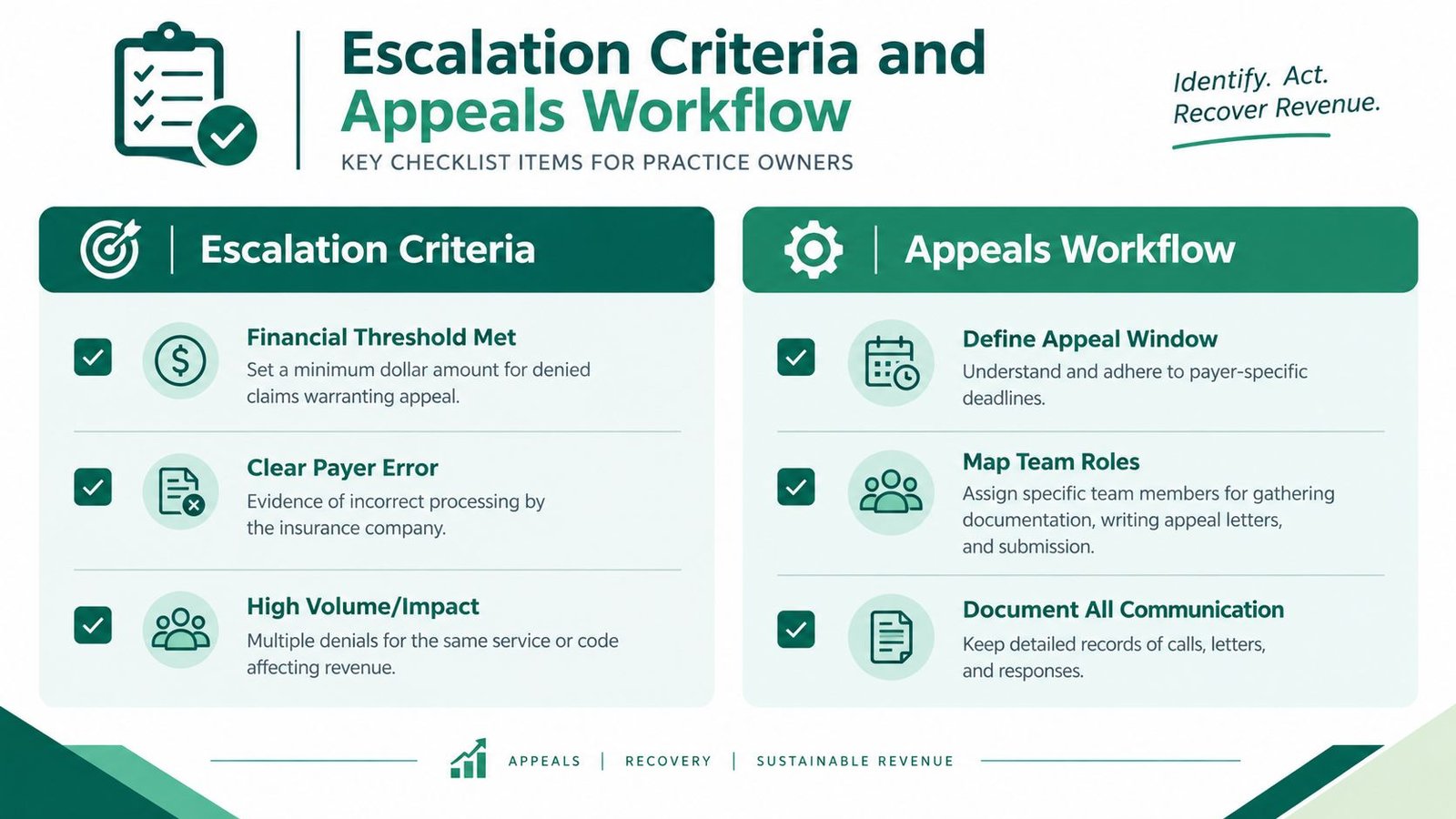
Escalation criteria that should trigger review
- Financial Threshold Met: Set a minimum dollar amount for denied claims that justifies appeal time.
- Clear Payer Error: Escalate when the documentation shows the payer processed the claim incorrectly.
- High Volume or Impact: Escalate repeated denials for the same code because they usually indicate a workflow problem, not an isolated mistake.
Appeals workflow that keeps claims moving
- Define Appeal Window: Use payer-specific deadlines, not a generic office policy.
- Map Team Roles: Assign who gathers records, who writes the letter, and who submits it.
- Document All Communication: Keep call logs, fax confirmations, portal screenshots, and payer responses together.
If the appeal file lives in too many places, the claim slows down. A document platform like TOOLii's medical document upload solution can support the record-collection side of this workflow when practices need tighter intake discipline.
Practical rule: appeal the claim when the record is strong and the reimbursement is worth the labor, not just because the code looks annoying.
If your team doesn't know which denial families are recurring, a denial audit is the fastest way to find hidden leakage. Request a free audit if you want to see where claims are being delayed, corrected, or written off more often than they should be.
In House vs Outsourced RCM Workflows
In-house denial management works when the practice has a disciplined team, strong payer knowledge, and enough time to keep up with policy changes. Outsourced RCM works when the practice wants tighter follow-through, more specialized denial handling, and less dependence on one or two internal employees. The trade-off is control versus capacity.
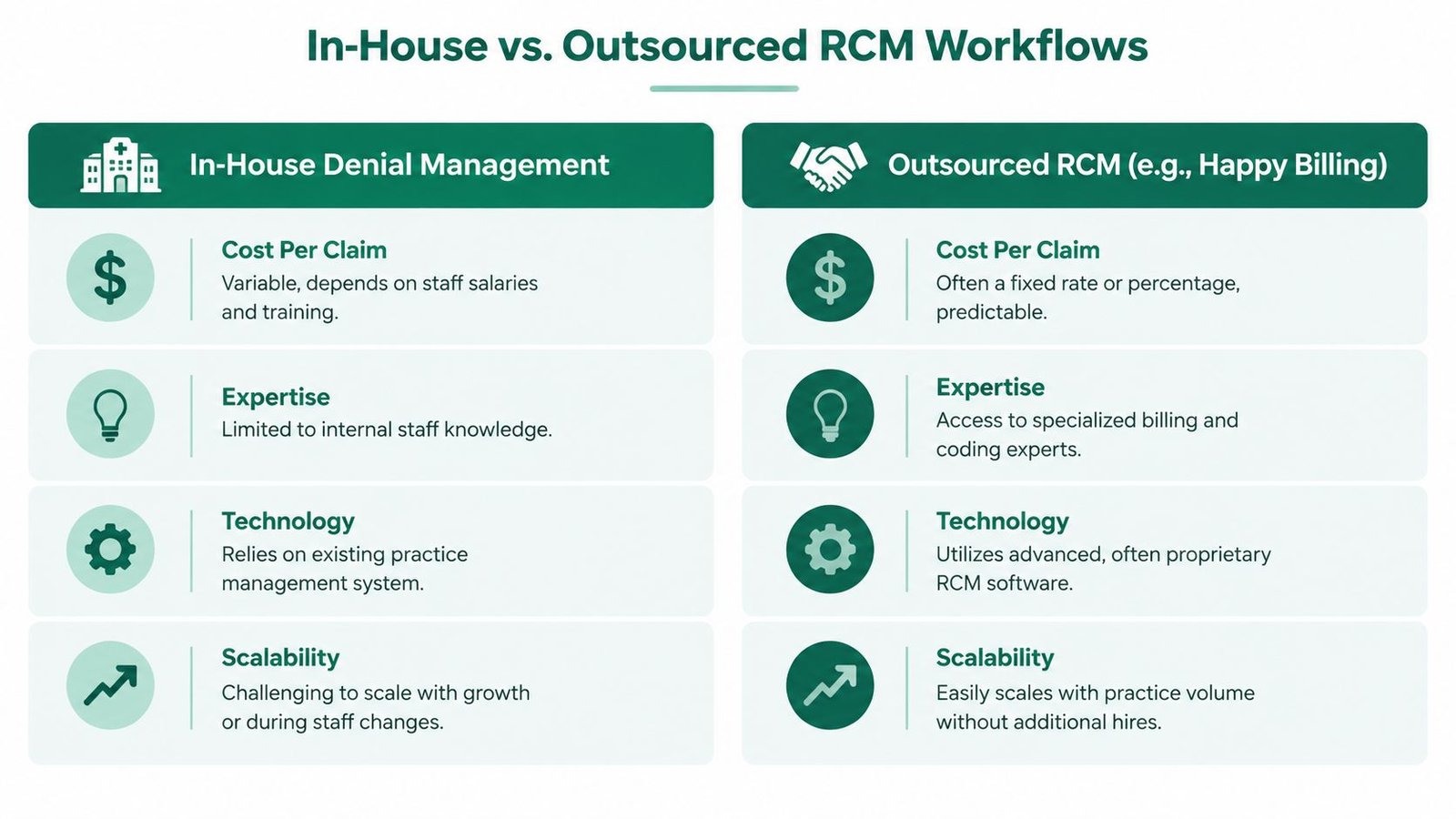
What owners usually gain or lose
| Comparison point | In-house denial management | Outsourced RCM |
|---|---|---|
| Cost per claim | Variable, depends on staff salaries, training, and turnover | Often more predictable |
| Expertise | Limited to the team you already have | Access to specialized billing and coding experience |
| Technology | Uses the practice's current system | May add more advanced workflows and tracking |
| Scalability | Harder to scale during growth or staffing gaps | Easier to absorb volume changes |
The practical question isn't whether one model is morally better. It's whether your team can prevent repeat denials, work appeals fast enough, and keep claims from aging while still supporting patient-facing operations. That's where outsourcing can make sense for owners who don't want denial work to compete with clinical management.
Happy Billing is one option in that outsourced model, with denial management, claim appeal support, and prior authorization support designed to fit inside the existing EHR workflow rather than forcing a system migration. For some practices, that's enough to solve the bottleneck. For others, the right answer is to tighten in-house rules and add better denial analytics.
FAQs for Practice Owners
Which denial codes should I fix first
Start with the denials that recur and can be prevented. CO-16, authorization denials, and timely-filing denials usually come first because they point to upstream workflow gaps, not isolated claim errors.
How fast should we appeal a CO-16 denial
As soon as the missing or incorrect information is identified. CO-16 is usually a front-end data problem, so correction and resubmission often work faster than a full appeal packet.
Can modifier 59 misuse trigger audits
Yes. CMS says modifier 59 is for a distinct procedural service, and it must match the facts in the record, such as a different session, site, incision, or lesion. Weak use can lead to denial, recoupment, or audit risk, as noted earlier.
Is outsourcing denial management worth it for a small practice
It can be, if denials keep repeating and staff are already stretched. The question is whether your team can keep up with appeals, documentation retrieval, and payer follow-up without letting A/R days rise. Happy Billing is one option for practices that want denial management, claim appeal support, and prior authorization support inside the existing EHR workflow.