Revenue Cycle Management US Healthcare: Key Strategies

The surprising truth about revenue cycle management in US healthcare is that a practice can have steady patient volume and still lose meaningful cash through preventable denials, delayed follow-up, and weak front-end controls. Initial denial rates are commonly reported at 5% to 10%, while a 2026 analysis covering 2,400 hospitals and 375,000 physicians found an overall initial denial rate of 10.63%, with private-payer claims near 19.98% and Medicare Advantage inpatient claims at 9.15% (industry analysis).
For an independent practice owner, RCM is therefore a cash-flow decision before it's a workflow decision. Pull your denial rate, days in A/R, and net collection rate first. Those three figures tell you whether revenue is leaking at registration, getting trapped in payer follow-up, or being written off after payment should have been collected.
What Revenue Cycle Management Actually Means for a US Practice
Revenue cycle management is the system that converts a patient encounter into collected dollars. It begins before the appointment with scheduling, eligibility, demographic capture, and authorization. It continues through documentation, coding, claim submission, payment posting, denial work, secondary billing, and patient collections.
That broader view matters because medical billing is only one part of the cycle. A claim can be coded correctly and still fail because the practice captured the wrong member ID, missed a referral, used the wrong place of service, or didn't follow a payer's authorization rule.
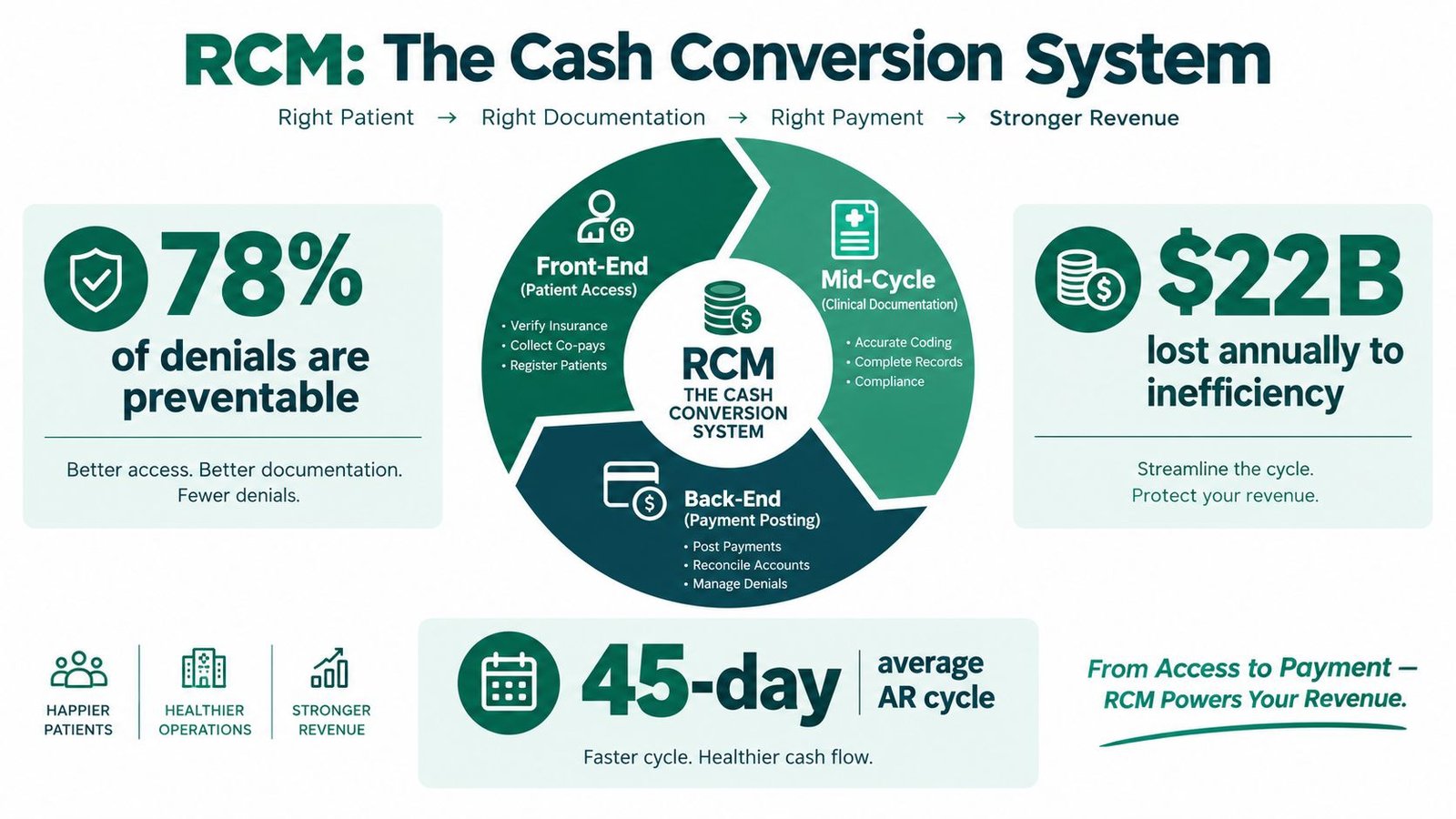
Start with the three numbers owners control
Denial rate: Calculate denied dollar amount divided by total submitted dollar amount, the approach described by the AAFP practice-finance guidance. Compare overall denials with clean claims that pass edits without manual intervention. HFMA defines clean claim rate as claims passing edits without manual intervention divided by claims accepted into the billing tool (HFMA MAP Keys).
Days in A/R: This measures how long it takes to collect outstanding balances. HFMA says provider days in A/R should ideally fall between 30 and 40 days, with A/R over 90 days below 10% (HFMA KPI guidance).
Net collection rate: This shows how much collectible revenue the practice receives after contractual adjustments. A weak result usually points to missed follow-up, incorrect adjustments, patient balance leakage, or underpayments that were posted without review.
Practical rule: Don't buy another RCM tool until you can explain which of these three numbers is failing, which payer or workflow causes it, and who owns the correction.
A practice with a low denial rate but aging A/R still has a cash problem. A practice with acceptable A/R days but poor net collections may be posting payments quickly while accepting underpayments or writing off balances incorrectly. The point of understanding RCM's financial benefits is not to add another dashboard. It's to connect operational work to cash that should reach the practice.
The End-to-End Revenue Cycle Workflow
Every stage creates a different type of financial exposure. Owners should audit the handoff between stages, because revenue often disappears between departments rather than inside one isolated task.
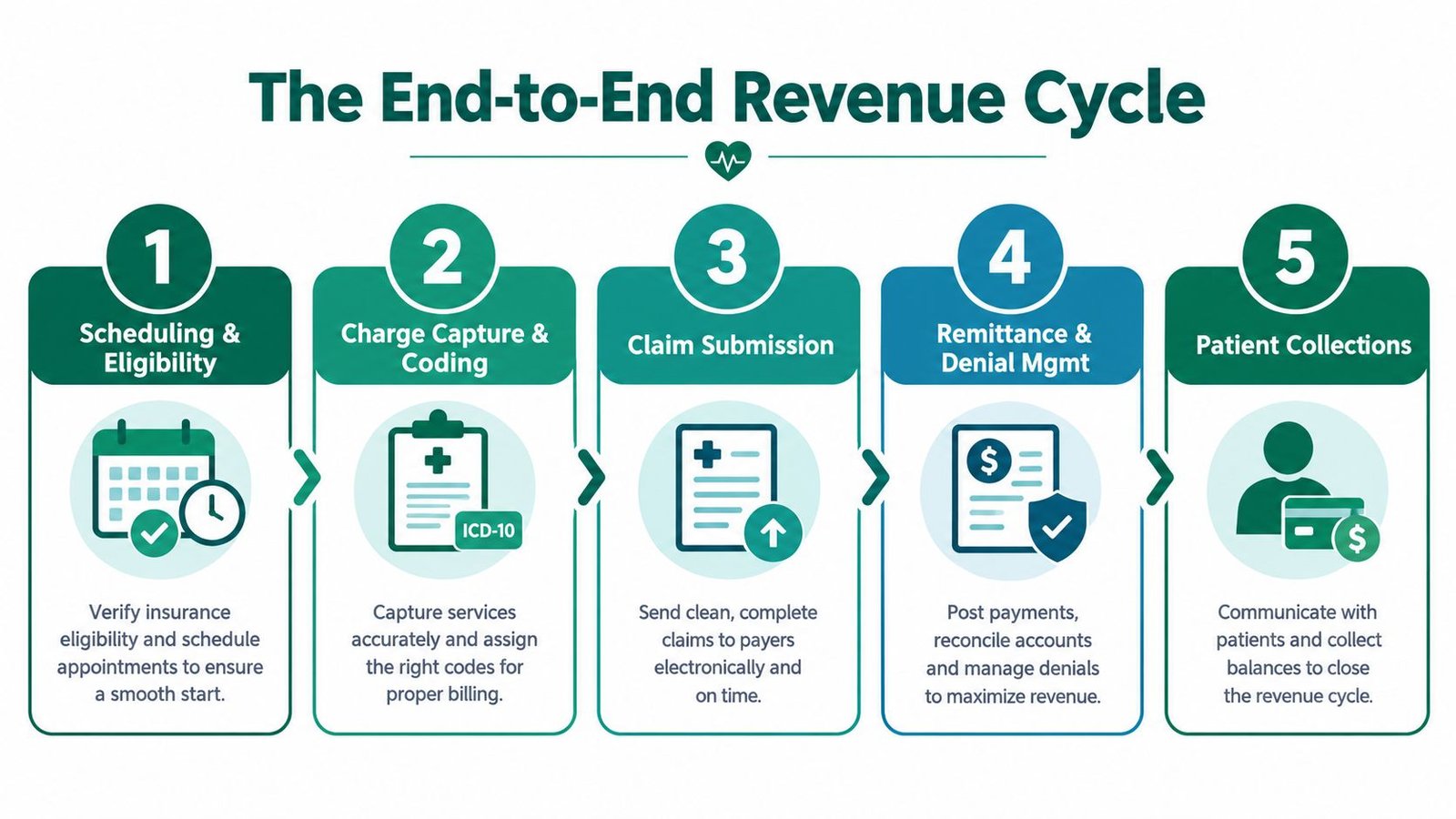
From appointment to claim
Scheduling and registration: Staff capture the patient's legal name, date of birth, address, guarantor, insurance ID, group number, and referral details. A small demographic mistake can cause a rejection before clinical work is even evaluated. Verify eligibility before service and document the response, not just a verbal confirmation.
Authorization and referral: Authorization is a payer permission, not a suggestion. Missing approval for imaging, procedures, therapy, or behavioral health services can turn a clinically appropriate encounter into a noncollectible balance. Build a work queue by payer and service, with an owner and expiration date.
Charge capture: Compare the provider note, procedure log, ancillary services, and charge ticket before release. Practices lose revenue when an injection, diagnostic study, prolonged service, or separately reportable component never reaches the claim.
Coding and modifiers: CPT and ICD-10-CM codes must describe the documented service and support medical necessity. Modifier 25 may be appropriate for a significant, separately identifiable E/M service on the same day as a procedure, while modifier 59 and the more specific X{EPSU} modifiers require distinct-service documentation. Incorrect modifier use can trigger a denial or an audit, while omitted modifiers can suppress legitimate payment.
Claim submission: Use the clearinghouse transmission report and rejection report every day. The medical claim form guide is useful when owners need to trace how demographic, diagnosis, procedure, and payer fields travel into a submitted claim.
From remittance to final collection
Payment posting isn't finished when the electronic remittance is loaded. Review allowed amounts, contractual adjustments, noncontractual write-offs, denial codes, and patient responsibility. A “post and go” process can hide an underpayment or an appeal opportunity.
Insurance follow-up should prioritize claims by filing deadline, balance, payer behavior, and appeal yield. Secondary claims need clean coordination of benefits information. Patient statements should explain what insurance paid, what remains, and why the balance is owed. Staff also need a reconciliation process that ties charges, payments, adjustments, refunds, and deposits together.
For owners who want a broader operational perspective, these accounts receivable insights provide useful context on receivables discipline beyond healthcare billing. The principle is the same: an unpaid balance isn't revenue until someone has a defined path to collect it.
Payer Mix and Regulatory Forces That Shape US Healthcare RCM
Payer mix determines the work your RCM operation must perform. Medicare fee-for-service, Medicare Advantage, Medicaid managed care, TRICARE, and ACA Marketplace plans don't share one authorization process, one filing rule, or one appeal path. A practice with substantial commercial volume may face different edits and contract terms than a practice serving a large Medicaid managed-care population.
Prior authorization illustrates the difference. KFF reports standard prior authorization denial rates of 12% in Medicare Advantage, 14% in Medicaid managed care, and 18% in ACA Marketplace plans. Appeal overturn rates were about 67%, 47%, and 43%, respectively, across those same categories (KFF prior authorization metrics). Those figures support a practical conclusion: appeal triage must be payer-specific. A blanket “appeal everything” policy wastes labor, while abandoning every denial leaves recoverable cash behind.
Regulatory pressure changes the workflow
CMS rules also affect staffing and process design. The No Surprises Act creates requirements around certain out-of-network services, good faith estimates, disclosures, and the federal Independent Dispute Resolution process. CMS's interoperability and prior authorization final rule, CMS-0057-F, affects how payers and providers exchange information. Appropriate Use Criteria requirements for advanced imaging, Medicare physician fee schedule adjustments, and payer-specific medical-necessity edits require ongoing policy monitoring.
Use the No Surprises Act compliance resource to review operational obligations, but don't treat compliance as separate from cash flow. A missing disclosure, unsupported estimate, or incomplete authorization record can delay payment or force staff into avoidable disputes.
| Payer Category | Typical Denial Rate Range | Net Days in A/R | Authorization Burden |
|---|---|---|---|
| Medicare fee-for-service | Varies by service and edit profile | Contract and claim dependent | Moderate, service specific |
| Medicare Advantage | 9.15% for inpatient claims in the cited analysis | Payer and plan dependent | High for many managed services |
| Medicaid managed care | 14% standard prior authorization denials | Plan and state dependent | High and plan specific |
| ACA Marketplace | 18% standard prior authorization denials | Plan and contract dependent | High for selected services |
| TRICARE | Varies by network and service rules | Contract and claim dependent | Referral and authorization dependent |
A 60% commercial and 40% Medicare practice won't have the same queue structure as a 30% commercial, 50% Medicaid, and 20% Medicare practice. The first may need stronger contract and underpayment review. The second may need more authorization tracking, eligibility work, and payer-specific appeals. Don't staff from provider count alone. Staff from payer complexity and denial causes.
The KPIs and Benchmarks That Tell You If Your RCM Is Healthy
A useful RCM dashboard doesn't need dozens of metrics. It needs a small set of measures that explain whether claims are clean, whether cash is moving, and whether the practice is collecting what it earned.
Read the core metrics together
Denial rate should be calculated from denied dollars divided by submitted dollars, as outlined by the AAFP. HFMA says the industry average is 5% to 10%, with less than 5% considered optimal (HFMA KPI guidance). Separate front-end rejections, payer denials, clinical denials, and patient-responsibility write-offs. One blended number hides the fix.
Days in A/R should be compared with the HFMA ideal range of 30 to 40 days. Also inspect aging over 90 days, which HFMA says should be less than 10%. A/R days rising while denials rise points to claim quality or follow-up failure. A/R days rising with stable denials often points to posting delays, payer turnaround, or weak work-queue ownership.
Net collection rate answers a different question. It tells you whether the practice collected the revenue it was contractually entitled to collect. If it lags while denials look controlled, examine underpayments, incorrect contractual adjustments, refunds, and patient balance policies.
Pull these reports this week
- Claim rejection and denial report: Group by payer, reason code, CPT family, rendering provider, location, and date of service.
- A/R aging report: Separate insurance and patient balances, then isolate older accounts by payer and dollar value.
- Payment variance report: Compare allowed amounts with contract expectations and flag unexplained reductions.
- Charge lag report: Find encounters that remain unbilled after documentation is complete.
- Adjustment and write-off report: Separate contractual adjustments from avoidable write-offs.
- Authorization work queue: Identify services performed without a completed authorization record.
A practice can use an AI-enabled operational dashboard to consolidate work queues, but the dashboard won't decide whether an appeal is economically justified without clear rules. For a practical KPI checklist, review medical billing KPIs to track, then assign each metric to a person who can act on it.
Where Independent Practices Quietly Lose Revenue
New software gets blamed for problems that began with an incomplete registration script or an unowned work queue. We have seen practices buy claim scrubbers while staff continue to skip eligibility documentation, providers leave ancillary charges out of notes, and managers accept payer reductions without comparing them to contract terms.
The losses usually fall into a few recognizable patterns.
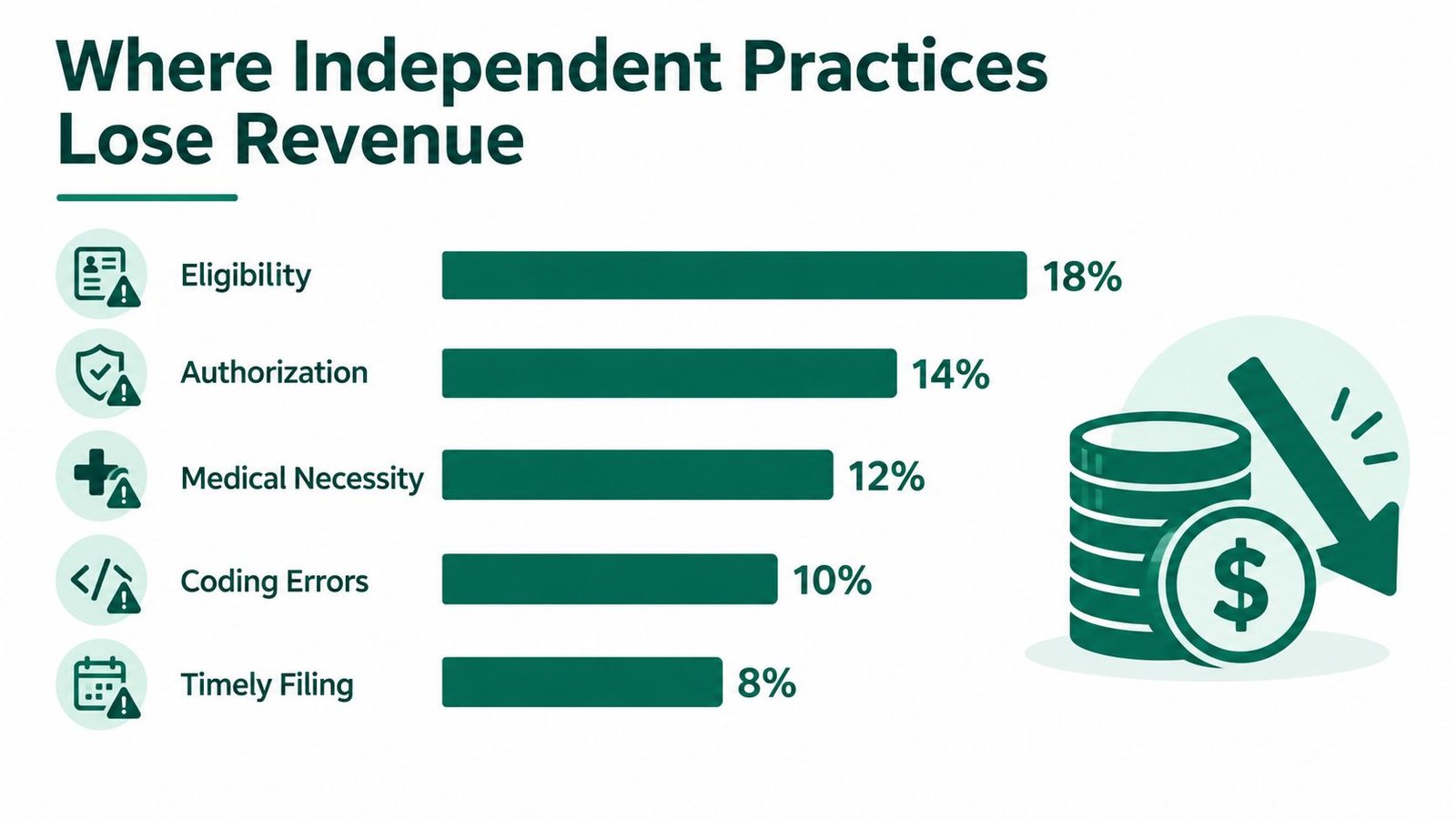
The failure points worth auditing first
Eligibility errors produce immediate rejections and downstream patient confusion. The cheapest fix is a mandatory verification checklist that captures the response date, active coverage, benefit limits, and member identifiers.
Authorization leaks are common in imaging-heavy specialties, therapy, behavioral health, and procedures. Before purchasing an automation platform, map every authorization-required service by payer and make the scheduling system stop or escalate when documentation is missing.
Medical-necessity denials often reflect a mismatch between the diagnosis submitted and the payer's policy, not a lack of clinical justification. Ask clinicians and coding staff to review recurring diagnosis-procedure combinations and payer edits together.
Coding-driven denials include unsupported E/M levels, missing modifiers, incompatible code combinations, and unspecified ICD-10-CM codes where the documentation supports greater specificity. A focused chart audit and provider feedback usually costs less than a new platform and addresses the source directly.
Credentialing lapses can stall otherwise clean claims. Track enrollment, revalidation, taxonomy, location, and rendering-provider status as operating controls, not as occasional administrative tasks.
Patient-estimate failures create bad debt when staff quote a balance without explaining deductible status, network position, authorization requirements, or the limits of the estimate. Use a consistent financial-clearance script and document what was communicated.
The operating lesson is simple. Technology can identify patterns, but it can't replace ownership, training, or payer-specific judgment. Before approving a software purchase, assign each top denial category a root cause, a process owner, a corrective action, and a review date.
AI, Automation, and Outsourcing in Modern RCM
AI is useful in RCM when it reduces repetitive review and sends complex decisions to qualified people. It isn't a substitute for documentation, payer policy interpretation, or accountability.
McKinsey's 2025 survey found leaders expected increases in denial of payment at 50%, A/R days at 56%, self-pay bad debt and uncompensated care at 76%, and out-of-pocket share at 85%. The same survey reported that 2.63% of net patient service revenue was written off due to clinical denials (McKinsey RCM survey). Those pressures justify investment, but they don't justify buying a tool without a process baseline.
Match the solution to the operating problem
EHR-native automation: Best for lower-complexity primary care workflows with stable payer rules. It can automate eligibility, charge routing, reminders, and routine claim edits while preserving control inside the existing system.
AI-driven platforms: Useful for coding suggestions, denial prediction, work-queue prioritization, and payment variance detection. Human review remains necessary when documentation is ambiguous or a payer policy requires interpretation.
Agentic automation: Can move a task through predefined steps, such as checking status, collecting missing information, and preparing an appeal packet. Marketing becomes misleading when “autonomous” means the system can safely make unsupported coding, medical-necessity, or legal decisions without review.
Outsourced human teams: A strong fit for complex payer mixes, high denial volume, specialty coding, credentialing gaps, or unstable staffing. The trade-off is less direct control and the risk of margin erosion if the contract lacks service-level agreements, escalation rules, reporting rights, and audit access.
Guidehouse and related 2026 industry reporting found 69% of providers prioritizing RCM technology investment, 69% outsourcing all or part of RCM, and 41% using automation and AI to speed manual processes. Oliver Wyman reported broad or enterprise-wide AI use in roughly 20% to 40% of organizations, while 80% of health systems were exploring, piloting, or implementing generative AI for RCM. These figures show adoption, not guaranteed financial improvement.
Read the revenue cycle management automation guide before comparing vendors. Happy Billing is one option that combines agentic AI with human auditors inside an existing EHR, with services covering full-cycle RCM, denial management, credentialing, and A/R recovery.
Specialty-Specific RCM Nuances That Generalist Billers Miss
Generalist billing teams often apply the same review logic to every specialty. That approach fails because the financial risk sits in different details.
| Specialty | High-Risk CPT/Modifier | Most Common Denial Reason | Fix |
|---|---|---|---|
| Anesthesiology | Time-based units, AA, QK, and 01996 | Concurrency, modifier, or unit mismatch | Reconcile anesthesia records with documented start and stop times, physician direction, and payer edits |
| Cardiology | Diagnostic studies, same-session E/M, C-codes | NCCI edits or unsupported separate reporting | Review bundling rules, imaging documentation, and device-related coding before submission |
| Mental health | 90791, 90834, POS 02 and POS 10 | Documentation, authorization, or telehealth mismatch | Match the note, duration, place of service, and payer policy |
| Orthopedics | Modifier 59, X{EPSU}, global-period services, DME | Bundling, global denial, or ASC place-of-service dispute | Document distinct services and separate post-operative, DME, and facility workflows |
Where specialty revenue slips
In anesthesiology, a generalist may miss how base units, time units, medical direction, concurrency, and modifiers AA and QK interact. Code 01996 also receives payer-specific scrutiny. A unit or modifier error can affect the entire claim, so reconcile the anesthesia record before submission rather than appealing after payment is denied.
Cardiology groups need separate controls for diagnostic studies, interventional services, and device-related claims. Same-session E/M services can face NCCI edits, while device coding may involve C-codes and payer-specific coverage logic. The practice should review whether documentation supports a separately reportable service before relying on a generic scrubber.
Mental health claims often depend on the distinction between 90791 and 90834, documentation thresholds, authorization status, and telehealth place of service. Since 2024, teams must distinguish POS 02 from POS 10 based on where the patient receives telehealth. Commercial carve-outs can also route behavioral health claims outside the medical payer workflow, creating a reconciliation gap.
Orthopedic practices face global-period denials, multiple-procedure reductions, DME requirements, and ASC place-of-service disputes. Modifier 59 and X{EPSU} modifiers need documentation that establishes a distinct service, not merely a billing preference.
The financial gain comes from preventing undercoding and avoidable denials before claim release. A specialty audit should compare operative or clinical notes, payer policies, code combinations, modifier use, and remittance outcomes.
Evaluating Your Next Move and FAQs for Practice Owners
Don't choose between in-house, automation, and outsourcing based on sales presentations. Score the operation you have.
| Signal | Fix In-House | Add Automation | Consider Outsourcing |
|---|---|---|---|
| Denial rate | Root cause is narrow and owned | Repetitive edits dominate | Denials are high or unmanaged |
| Days in A/R | Posting or queue issue is visible | Status checks can be automated | Follow-up capacity is inadequate |
| Net collection rate | Contract variance is understood | Payment anomalies need flagging | Underpayments and appeals lack expertise |
| Payer mix | Rules are stable | Rules are structured | Rules vary by plan and specialty |
| Staffing stability | Experienced team is accountable | Staff need leverage | Turnover prevents consistent execution |
Use this seven-day plan:
- Pull denial, A/R aging, and net collection reports.
- Calculate denial rate using denied dollars divided by submitted dollars.
- Compare days in A/R and A/R over 90 days with HFMA guidance.
- Review net collection rate and unexplained adjustments.
- Identify the three largest denial categories by payer and service.
- Request a workflow audit from your current team or prospective vendor.
- Interview two vendors, require references from similar specialties, and review their SLA, data-access, escalation, and termination terms.
What denial rate should a practice target?
The AAFP and HFMA describe 5% to 10% as an industry-average range, with less than 5% more desirable. Use that as a benchmark, then separate preventable denials from payer or clinical complexity.
What should an outsourcing contract include?
Require definitions for clean claim rate, denial rate, days in A/R, aging categories, appeal ownership, reporting frequency, response times, data access, security responsibilities, and termination assistance. A percentage-based fee without measurable accountability can reward activity rather than collected revenue.
Is AI safe for independent practice RCM?
AI can support repetitive review, prioritization, and anomaly detection. Human oversight remains necessary for ambiguous documentation, specialty coding, medical necessity, authorization disputes, and appeals that depend on payer policy.
Will outsourcing work with our EHR?
Ask the vendor to demonstrate the workflow inside your current EHR and PM environment. Confirm what data the team can access, what remains your responsibility, how work queues are synchronized, and how you'll export records if the relationship ends.
For a practice-specific baseline, request a free RCM audit that ties denial causes, A/R aging, and collection performance to an actionable workflow plan.
Happy Billing combines agentic AI with expert human auditors for full-cycle RCM, denial management, credentialing, and A/R recovery inside your existing EHR. Visit Happy Billing to evaluate where your practice is losing cash and decide whether targeted in-house fixes, automation, or outsourced support makes the most financial sense.