Zelis Underpayment Appeal Process for Out-of-Network Providers Explained
Zelis reprices out-of-network claims using an aggregated methodology, and providers generally need to act within a 30-day appeal window, which is longer than Data iSight's 14-day window. If you want a real chance of reversing a Zelis underpayment, you need a tight documentation packet and a clear escalation path through the payer's dispute process, federal IDR when the No Surprises Act applies, or a state DOI complaint when the facts support it.
If you're staring at a remittance that paid far less than expected, this isn't just an annoying billing issue. It hits your net collections, denial workload, and days in A/R immediately. We've seen practices lose ground because a Zelis-adjusted claim got posted like a normal payment instead of being treated like a time-sensitive revenue recovery opportunity.
This guide is part of our out-of-network underpayment series. If you run a therapy or rehab practice, start with the physical therapy underpayment recovery guide for practice owners; the companion guides cover Data iSight and MultiPlan.
Already deposited a Zelis-repriced payment? That does not close the claim. Our guide on how to reopen a deposited underpaid claim covers the reopening paths that keep the file out of duplicate-claim territory.
What Zelis Underpayments Cost Your Practice Right Now
Zelis underpayments hurt twice. First, they reduce the payment on the claim. Second, they pull your team into a slower, more manual recovery cycle that drags out A/R.
For an independent practice, that matters more than the label on the EOB. Whether the affected claim is a 99213, 90837, 20610, or 27447, the financial problem is the same. You performed the service, incurred the staffing and supply cost, and then a third-party repricing process inserted itself between your billed charge and your final reimbursement.
Why owners should care immediately
A Zelis remittance shouldn't be treated like a routine posted payment. It should trigger review the same day because the delay risk is real. Zelis' provider-facing materials say that when Zelis is involved in pricing a claim, the remittance or explanation of payment includes instructions on how to dispute or request review, and qualifying No Surprises Act claims may move into a formal federal arbitration process rather than a single universal Zelis form through Zelis provider guidance.
That means two things for a practice owner:
- Your staff can't assume one standard appeal path. The route may depend on the payer, the claim type, and whether the service falls under NSA rules.
- Every day of delay weakens cash flow. If your team waits to sort out ownership of the dispute, the claim ages while no one is pushing the file forward.
If you're already tracking days in A/R closely, Zelis underpayments deserve their own work queue. They don't behave like ordinary coding denials or simple filing edits.
Practical rule: If the remittance shows repricing language, don't auto-post and move on. Freeze the variance, flag the deadline, and assign ownership that day.
The hidden cost is operational, not just contractual
Most practices underestimate the labor cost of appealing repriced claims. The issue isn't only whether the payment was low. It's that your team now has to compare the billed amount, the paid amount, the payer instructions, and the repricer's methodology with almost no room for sloppiness.
A lot of owners are now using external claim workflow references, including tools discussed in Nutmeg Technologies claims solutions, because the practical challenge is claim-routing discipline as much as reimbursement math.
Here's the blunt truth. If your front end is clean but your back end treats Zelis remittances as low-priority correspondence, you'll carry more aged receivables than you should. The underpayment itself is the first loss. The slow appeal response becomes the second one.
Seeing Zelis reductions on your remits?
We will compare a sample of your out-of-network claims against a fair benchmark and show you what is recoverable, claim by claim. Get a free underpayment analysis →
How Zelis Prices Out-of-Network Claims Behind the Scenes
Zelis isn't acting like a simple payer fee schedule. It functions as a repricer and payment integrity intermediary, and that distinction matters because you're not always arguing directly with the entity that issued the patient's coverage.
The company is commonly understood in the market as the successor platform many providers associate with RedCard and PaySpan, and the ownership discussion around Zelis often includes Bain Capital and Parthenon in industry conversations. What matters operationally is this: Zelis sits inside a broader payment chain and applies an aggregated repricing methodology to out-of-network claims.
Aggregated methodology changes the fight
When a payer applies its own published policy, your team usually knows where to attack. You look at the contract, the fee schedule, the modifier logic, the medical necessity standard, or a published payment rule.
When Zelis is involved, the repricing issue can look more opaque. Recent litigation filings describe Zelis' out-of-network process as one where providers are often left with choices framed as accept, negotiate, or appeal, and allege that the process is burdensome and delay-heavy in practice through this public complaint discussing Zelis repricing disputes.
That matters if you own a practice because you may be dealing with:
- A benchmarked offer instead of a familiar contracted rate
- A payer process layered on top of a repricer process
- A negotiation track that feels administrative but is really financial management
For high-value claims like 27447 or procedure-heavy pain cases with modifier 59 line separation issues, that difference can be substantial. Even routine office-based out-of-network work such as 99213 or 99214 can become unprofitable if enough of the claim inventory gets repriced downward.
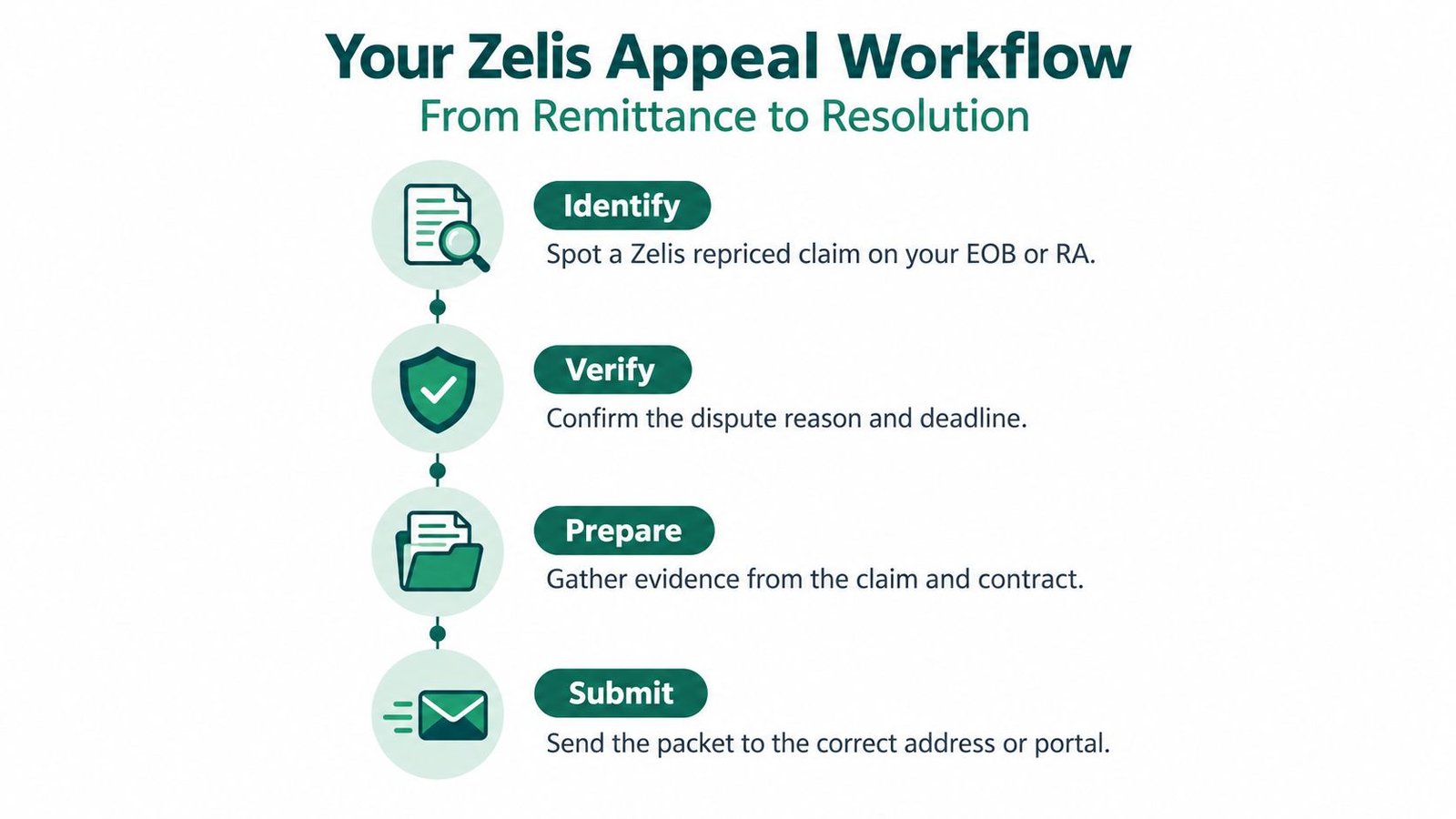
Here's the workflow most owners need to visualize clearly.
Inbound and outbound negotiation are not the same thing
Zelis processes both inbound and outbound negotiation situations.
Inbound cases usually mean your practice is reacting to a repriced payment or offer that already landed. You're defending the value of the service after the reimbursement was suppressed.
Outbound cases are different. Your team pushes the challenge proactively and tries to reshape the reimbursement before the low payment becomes final. In real life, the distinction affects staffing. Inbound work is often reactive and rushed. Outbound work requires tighter pre-submission control and cleaner financial positioning.
If you're comparing vendors or internal tactics, a broader review of out-of-network medical bill repricing tools helps. Not because software solves the dispute by itself, but because visibility into repricing patterns changes which claims you chase and which ones you write off too early.
Why owners should distrust “normal payment” assumptions
A repriced out-of-network claim can look paid in the system while still being materially underpaid. That's why relying on posting staff alone is dangerous. The claim doesn't hit the denial bucket, but your reimbursement yield still falls.
For a practice owner, the key takeaway is simple. Zelis repricing is not just an administrative detour. It's a pricing event that changes your margin on the encounter.
Your Zelis Appeal Workflow From Remittance to Resolution
The best Zelis appeals start the moment the remittance arrives. Not a week later. Not after month-end posting. The first move is identifying that the payment was repriced and isolating the claim before it disappears into normal cash posting.
Start with the remittance, not the billing note
Zelis' own provider-facing guidance says the remittance or EOP includes instructions on how to dispute or request review, and for qualifying No Surprises Act claims a provider may be able to move into the federal dispute process through this state-specific Zelis NSA guidance.
That means your first review should center on the payment artifact itself:
- EOB or RA: Confirm the repricing language and identify who routed the claim.
- Claim detail: Match line items, modifiers like 25, 59, or professional/surgical combinations, and any reduced units or bundled services.
- Instruction path: Determine whether the dispute goes to the payer, a payer email box, a portal, or a formal NSA track.
If your team doesn't have one owner for this handoff, appeals stall fast.
Respect the deadline even when the process is messy
The practical rule many practices use is a 30-day Zelis appeal window, and that's one reason providers often view Zelis as more workable than Data iSight's 14-day window. But don't confuse “longer” with “safe.” A month disappears quickly when the claim needs records, coding validation, and a reimbursement comparison.
Separate from that operational appeal timing, Zelis' Payments Terms of Use also give users 60 calendar days from the date of an invoice, bill, statement, or report to raise a good-faith written objection identifying the disputed amount and basis through this filed litigation exhibit quoting the Terms of Use.
Those are not interchangeable clocks. Smart practices track both.
Handle inbound and outbound paths differently
Inbound cases should move through a simple decision tree:
- Was the payment repriced? If yes, hold the account out of final resolution.
- Does the remittance identify a dispute channel? Follow that first.
- Is the service NSA-eligible? Preserve everything needed for potential IDR.
Outbound negotiation is more strategic. Use it when the claim value justifies more aggressive positioning or when a pattern is emerging across the same payer or employer plan. In outbound cases, your narrative matters more. You're not only disagreeing with the number. You're framing why the methodology failed on that claim.
Don't let your team file a generic “please reprocess” request. Zelis appeals need a payment argument, not a customer service message.
What to do when the window has expired
If the ordinary appeal window is gone, resubmission may still be worth trying when you can reframe the issue as one of incorrect routing, incomplete remittance instruction, claim-level documentation mismatch, or objection preserved under the broader written dispute standard.
That's the practical resubmission playbook:
- Rebuild the claim file from the original submission and remittance.
- Send a written objection identifying the exact disputed amount and basis.
- Push the issue through the payer channel if Zelis itself isn't moving it.
- Preserve all correspondence in case escalation to regulator review or formal dispute becomes necessary.
If your staff needs a tighter claims template, a solid operational reference is this guide on how to appeal a denied insurance claim. The core principle applies here too. Precision beats volume.
Use a deadline tracker your administrator can trust
Your spreadsheet should capture at least:
| Field | Why it matters |
|---|---|
| Claim identifier | Prevents chasing the wrong account |
| Date initial payment received | Starts the appeal clock |
| Repricing indicator | Confirms Zelis involvement |
| Payer dispute route | Determines submission path |
| NSA eligibility | Preserves IDR rights |
| Objection sent date | Protects the record |
| Escalation owner | Avoids handoff failure |
Most missed recoveries aren't lost on merits. They're lost because no one controlled the timeline.
Building an Appeal Packet That Actually Gets Overturned
A weak Zelis appeal packet gets ignored or delayed. A strong one makes the reviewer confront a specific underpayment on a specific claim with a specific reimbursement basis.
That distinction is where owners either recover revenue or waste staff time.
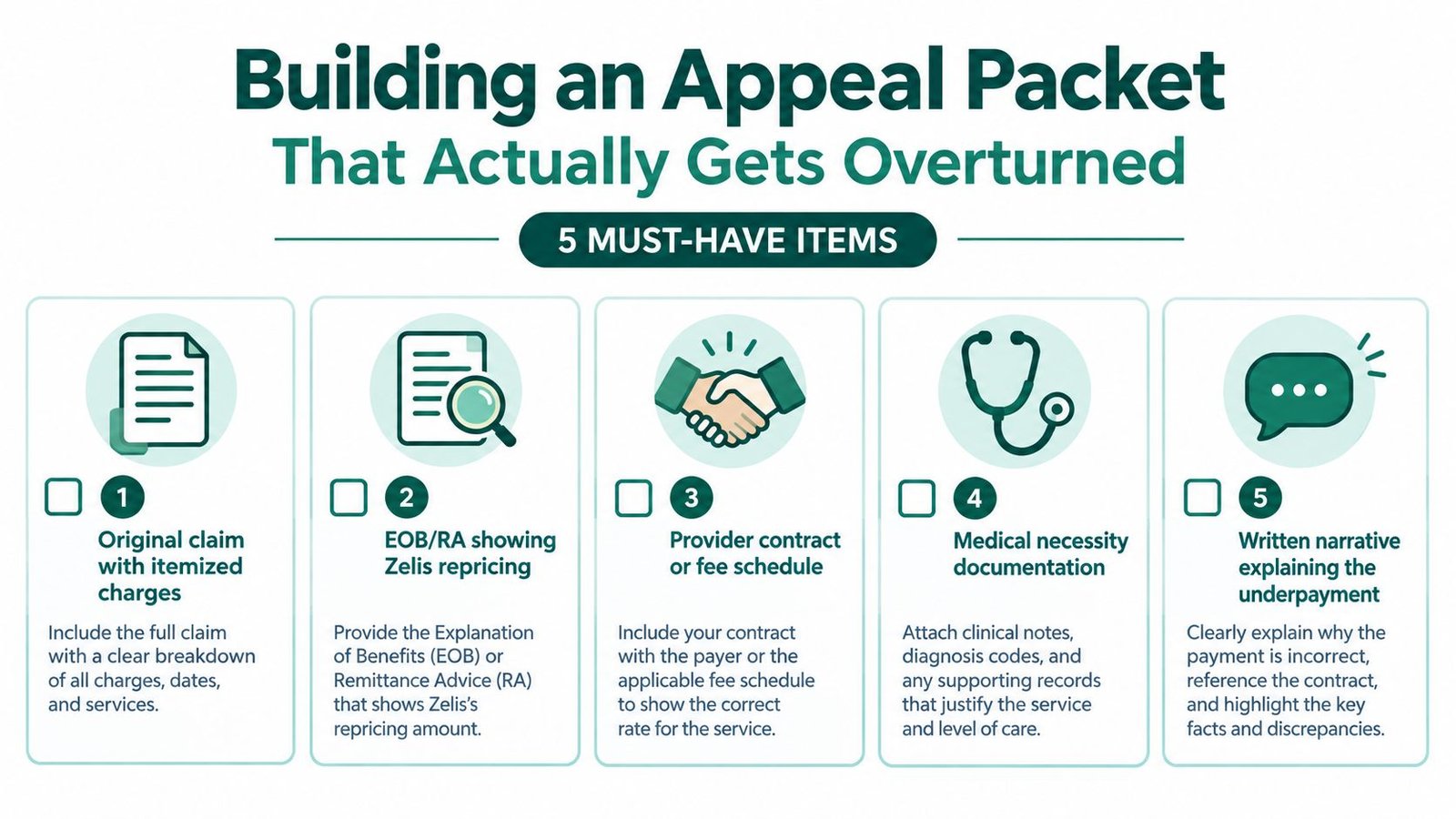
Include the documents that matter
A technically effective appeal packet should preserve the original remittance, the repricing offer, and a clean comparison to the benchmark used to set the amount. In practice, that means documenting claim-level variance, the payer or repricer methodology, and the contractual or statutory basis for the higher amount, as reflected in Zelis provider-facing NSA material cited above in the earlier workflow section.
Your packet should usually include:
- Original claim and itemized charges: Show exactly what was billed and by line.
- EOB or RA with repricing detail: This proves the payment event you're challenging.
- Procedure coding support: Include CPT codes and any modifiers such as 25, 59, or assistant-surgery modifiers if applicable.
- Medical necessity support: Office notes, op note, treatment rationale, and any records that support the service intensity.
- Payment comparison narrative: Spell out why the paid amount is wrong and what amount you're requesting instead.
- Benchmark support: If you're making a UCR, contract, or statutory argument, attach the basis cleanly.
A numeric example owners can use
Here's a simple way to frame the economics.
Your practice bills an out-of-network 27447. Zelis reprices the claim and the payer issues a lower payment than expected. Your appeal should not say, “Please reconsider.” It should say:
- Billed charge: your original submitted amount
- Paid amount: the repriced amount on the remittance
- Disputed variance: the gap between the two
- Requested reconsideration amount: the amount supported by your records, benchmark, contract language, or NSA position
I'm not inserting invented dollar amounts because your real advantage comes from your own file, not a canned example with fake economics. The point is to show the reviewer a clean variance calculation tied to evidence.
Write the letter like a payment dispute, not a complaint
Your appeal letter should be short and forceful:
- Identify the patient, DOS, claim number, CPTs, and paid amount.
- State that the claim was repriced and underpaid.
- Explain the basis for the higher amount.
- Attach supporting records.
- Reserve rights for any payer appeal, state complaint, or NSA IDR path.
We've seen this work best when the tone is professional but firm. Don't over-argue. Don't send a manifesto. Send a structured reimbursement challenge.
Owner-level advice: If the appeal packet doesn't let an outside reviewer understand the variance in under a few minutes, your staff has overcomplicated it.
Align the packet with recognized standards
The documentation should still be consistent with CMS timing and dispute rules when the claim qualifies for federal IDR, and the coding support should be clean enough to hold up under normal AAPC-style coding scrutiny. That means no sloppy modifier use, no unsupported level selection on E/M claims, and no vague narrative that avoids the actual reimbursement basis.
If you want a contrast point, this guide on Data iSight underpayment appeals is useful because it highlights how repricer disputes depend on deadline control and documentation discipline more than generic billing follow-up.
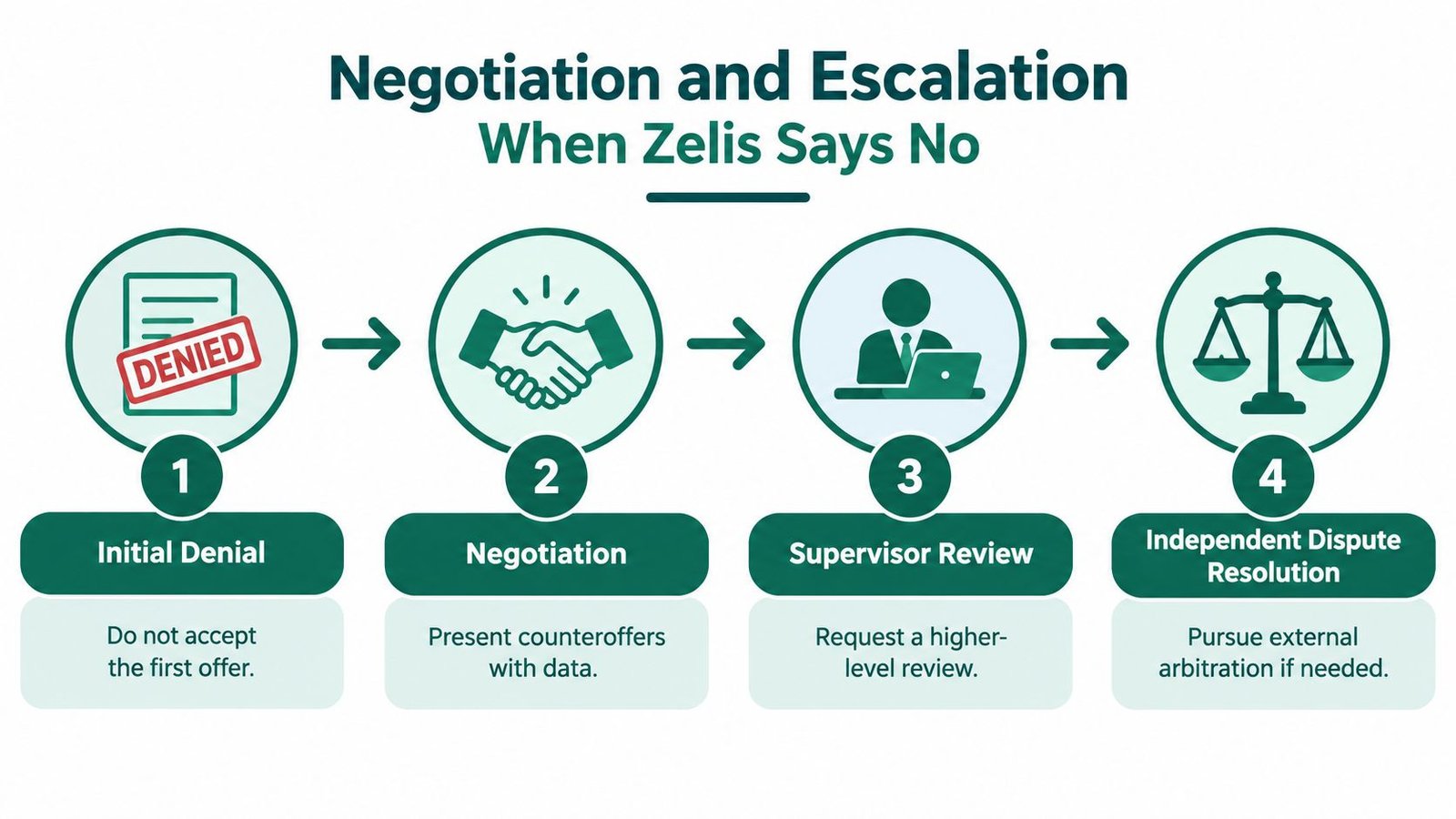
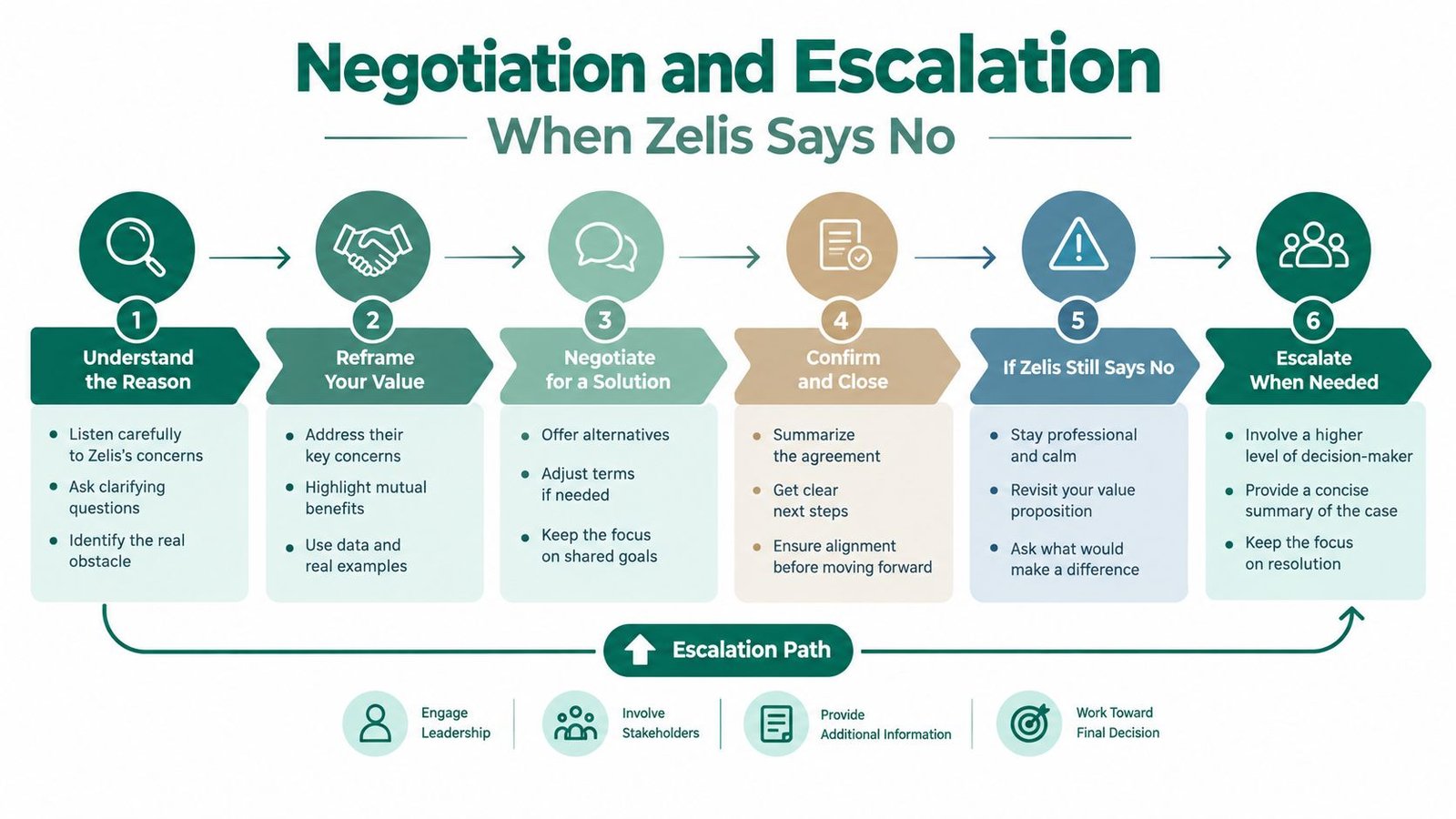
Negotiation and Escalation When Zelis Says No
If the first appeal fails, don't default to acceptance. Decide whether the claim is worth negotiation, payer escalation, regulatory pressure, or federal dispute action.
The mistake I see most often is practices treating every low payment the same. They shouldn't. Some claims should be pushed hard. Some should be settled quickly. Some should be escalated outside the ordinary payer channel because the internal route is producing delay, not resolution.
Use leverage, not emotion
Public litigation filings have characterized Zelis repricing disputes as scenarios where providers are pushed toward accept, negotiate, or appeal, with allegations that the path can become a take-it-or-leave-it proposition and that appeals may delay payment or even produce a lower result in some cases through this publicly tracked court filing.
That's exactly why your team needs a business rule for escalation.
| Escalation Option | Best When | Timeline and Risk |
|---|---|---|
| Internal appeal or reconsideration | The variance is clear and documentation is complete | Fastest route, but can stall if routed incorrectly |
| Direct negotiation with payer or repricing contact | Claim value is meaningful and methodology is disputable | Can improve yield, but consumes manager time |
| State DOI complaint | You have a transparency, routing, or unfair-payment issue that warrants regulator attention | Adds leverage, but not every case fits |
| Federal IDR | The service qualifies under the No Surprises Act and open negotiation failed | Formal path with strict timing rules |
Know the federal IDR clock
CMS says the Federal Independent Dispute Resolution process begins only after a 30-business-day open negotiation period, and the initiating party must start that negotiation within 30 business days after receiving the initial payment or denial notice. If no agreement is reached, either party then has only 4 business days after the negotiation period ends to initiate IDR through this litigation filing quoting CMS timing rules.
That window is tight enough that your staff can't “look into it later.” If the claim may qualify, preserve the route immediately and review the No Surprises Act IDR process before the negotiation period closes.
When a DOI complaint makes sense
State Department of Insurance complaints are useful when the dispute is no longer just about amount. They're especially helpful when the process lacks clear response standards, the payer and repricer are bouncing responsibility back and forth, or the appeal channel is functionally stalling.
The goal isn't drama. The goal is documentation and pressure.
A concise DOI complaint should include:
- Claim identifiers and dates
- The remittance or repricing notice
- A timeline of your appeal efforts
- Why the process was inadequate or unfair
- What resolution you're seeking
If negotiation keeps circling without a decision, move the issue up. Owners lose money when staff keep “following up” without changing the venue.
Preventing Future Zelis Denials and Operationalizing Appeals
One-off appeals won't fix a weak operating model. If Zelis underpayments keep appearing, your practice needs a repeatable process.
Tighten coding and front-end claim quality
Start with the basics that protect reimbursement value. Make sure E/M leveling is defensible on codes like 99213 and 99214. Validate modifier 25 use on same-day E/M with procedures. Clean up modifier 59 separation where distinct procedural service is supported. Review payer-specific edits before submission, not after repricing.
Those are not coding classroom issues. They're yield protection issues.
Build a workflow that catches repricing early
The operational gap in most practices is simple. Underpayments, disputes, and appeals may route to different channels, but the evidence standards, turnaround expectations, and escalation rules often aren't clear in payer quick-reference materials, leaving practices without a repeatable playbook through this provider quick reference guide example.
That's why your internal workflow should include:
- Daily remittance review for repricing indicators
- A dedicated queue for out-of-network underpayments
- A/R aging triggers for unresolved appeals
- Template letters that preserve payer, DOI, and NSA options
- Manager review for high-value procedural claims
If you're comparing internal capacity against outsourcing, keep the decision practical. Can your current team identify Zelis repriced claims, build a defensible packet, and push follow-up without letting those accounts age? If not, you should look at a specialty-specific RCM model, especially for groups like orthopedics where high-dollar surgical and procedural claims make underpayment leakage more expensive.
If you want an outside review of whether these claims are being missed, request a free underpayment analysis. That's the fastest way to find out whether repricing variance is extending your A/R.
Seeing Zelis reductions on your remits?
Send us a sample of your out-of-network claims. We compare each allowed amount against a fair benchmark, flag which claims are still appealable, and estimate what is recoverable. BAA signed before we see any data. Get a free underpayment analysis →
Frequently Asked Questions From Practice Owners About Zelis Appeals
Is appealing a Zelis underpayment actually worth the delay?
Yes, if the variance is meaningful and your packet is strong. No, if your team is sending generic appeals without payment logic. The financial decision is whether the expected recovery justifies the labor and delay risk.
Does inbound versus outbound Zelis negotiation change my leverage?
Yes. Inbound cases are more reactive because the low payment already landed. Outbound cases usually give you more room to shape the narrative and preserve options earlier, but they require tighter internal control.
What should I do after the 30-day appeal window closes?
Don't assume the claim is dead. Rebuild the file, send a specific written objection identifying the disputed amount and basis, and escalate through the payer if the ordinary Zelis route is closed. If NSA rules or regulator issues are in play, preserve those separately.
When can I use No Surprises Act IDR instead of a normal appeal?
Only when the service qualifies under NSA rules and you meet the timing requirements. That includes the 30-business-day open negotiation period and the 4-business-day window to initiate IDR after negotiations fail, based on CMS timing described in the cited filing above.
If Zelis underpayments are stretching your A/R or slipping through as “paid” claims, Happy Billing can audit the pattern, isolate the repriced inventory, and build a tighter recovery workflow inside your existing RCM process. We help practices move faster on underpayments, denials, and out-of-network variance so cash doesn't sit idle while your staff chase the wrong claims.