7 Best Remote Medical Billing Companies of 2026
The best remote medical billing companies are the ones that fit your specialty, EHR, and cash-flow goals, especially if you need a stronger clean-claim process and fewer days stuck in A/R. The right partner is usually the one that can show NCR, days in A/R, and denial control that match your practice's real financial pressure, not just a polished feature list.
If your denials are creeping up or your A/R is aging past where it should, you already know the problem isn't “billing support.” It's revenue leakage, and it shows up fast in collections. We've seen practices get stuck choosing between a cheap generic vendor and a more strategic partner, and the difference usually comes down to whether the company can work inside your current systems, handle specialty-specific rules, and keep cash moving without disruption.
Intelligent Contacts revenue cycle management
Solo physicians have a tighter budget ceiling than the multi-provider groups most vendors quote. If that is you, start with affordable medical billing services for solo practices.
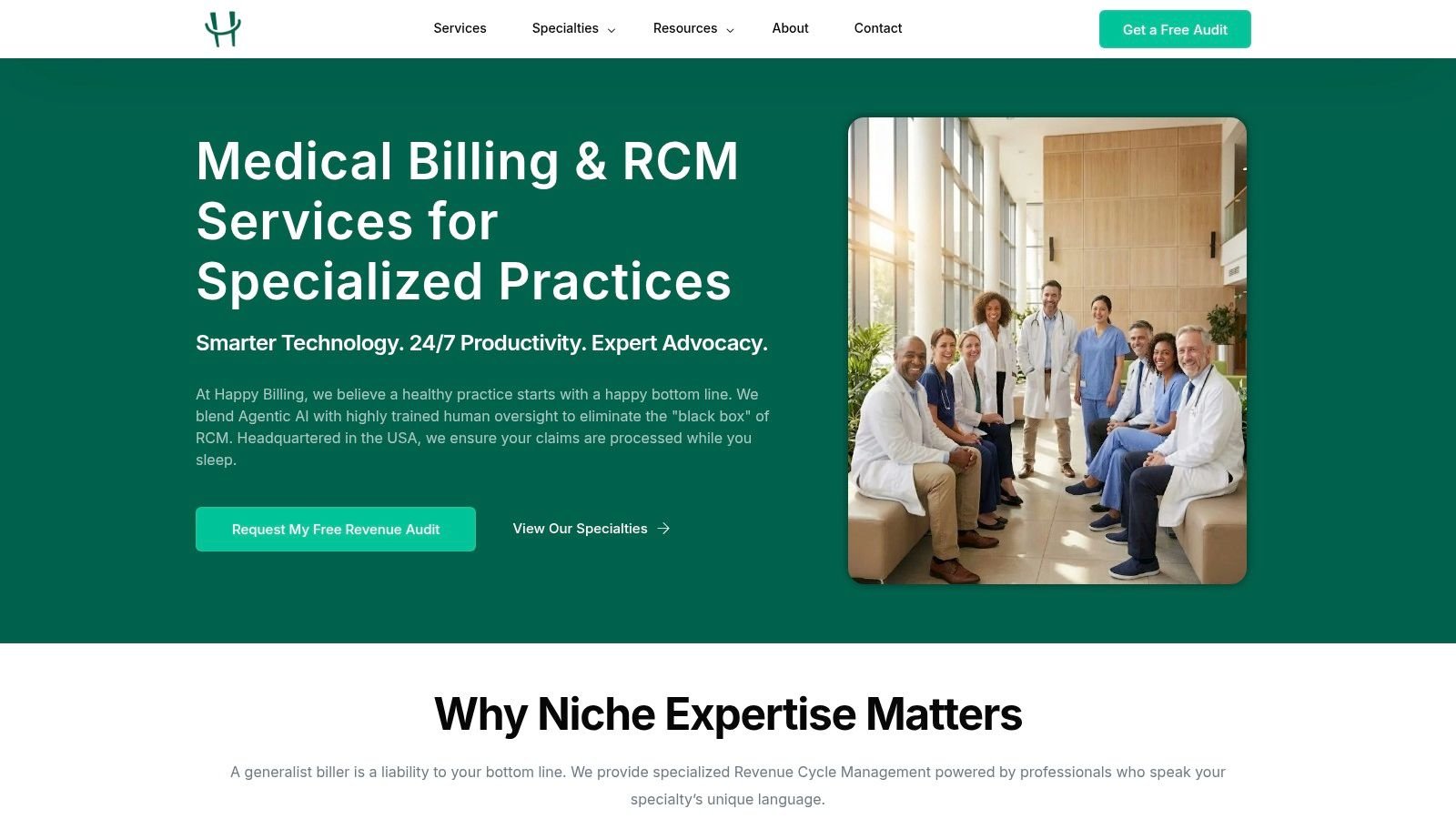
1. Happy Billing
Happy Billing is the strongest fit when a practice wants remote billing to function like a financial operations layer, not a back-office add-on. It works inside your existing EHR, which matters because every migration risk adds friction before you ever see cleaner collections. The company's stated operating target of a 98%+ first-pass clean claim rate lines up with top benchmark expectations for remote billing partners, and its stated goal of keeping days in A/R under 35 is the kind of metric a physician owner can use to judge whether cash conversion is improving. Those targets also fit the broader benchmark framework that says top remote medical billing companies should be measured by NCR, A/R days, and denial performance, not by price alone. See Happy Billing's overview of the work billers perform on its medical billers resource page.
Why it stands out for specialty groups
Happy Billing's clearest advantage is specialty depth. For anesthesiology, mental health, cardiology, orthopedics, and pediatric workflows, the value isn't generic claim submission, it's reducing preventable denials upstream, where modifiers, authorizations, concurrency, and bundled services can damage collections. That matters for practices that can't afford repeated follow-up on claims tied to nuanced procedure logic.
The company also combines agentic AI with human auditors, which is the right model for practices that need speed without giving up oversight. We like the operational logic here, because automation alone can miss context, while human-only work can slow down throughput. Happy Billing's 24/7 follow-the-sun model is another practical advantage for groups that want claims moving continuously rather than waiting for a single daytime queue.
The best outsourcing decision is the one that reduces rework before it reaches your staff, not the one that just promises faster filing.
Best fit and trade-offs
Happy Billing is strongest for independent and multi-specialty groups that want measurable performance and low-disruption onboarding. It's also attractive for owners who want a free audit before signing anything, because that helps quantify leakage before a contract is on the table. The trade-off is that pricing isn't public, so you'll need a consult to understand the economics for your specific payer mix.
Best for: specialty groups that care most about clean claims, denial prevention, and faster cash conversion.
Watch for: contract terms, transition planning, and whether the promised operational metrics are documented in writing.
Website: Happy Billing
2. athenahealth Revenue Cycle Services
athenahealth makes sense for practices that want billing and software under one roof. Its revenue cycle services sit inside the athenaOne platform, so the operational appeal is obvious, fewer vendors, fewer handoffs, and less integration work for your team. For owners who hate stitching together separate billing, PM, and EHR systems, that can be the difference between adopting an outsourced model and staying with the status quo. Visit the platform on athenahealth's Revenue Cycle Services page.
The main strength here is standardization. Eligibility, prior authorizations, coding support, claim submission, payment posting, and denial resolution are all part of the package, and the vendor can apply network-wide benchmarks to its playbooks. That's helpful when your internal team is tired of improvising around the same denial patterns every month. We also like that this structure can be easier for small and mid-sized groups that want a single operational point of contact.
Where it fits, and where it can pinch
The trade-off is price structure. Percentage-based billing can become less attractive as your revenue grows, especially if your practice has already improved front-end controls and doesn't need a heavy-touch partner for every task. Some practices also report variable denial follow-up quality, which is a real concern if you're relying on the vendor to close the loop on payer rejections rather than just submit clean claims.
For a practice owner, the decision is simple. If you want integrated technology and a largely standardized process, athenahealth is compelling. If you want specialty-heavy customization or a more surgical approach to denial root causes, the fit may be less exact.
Use a bundled platform when integration risk is your biggest cost. Use a specialty partner when denial leakage is your biggest cost.
The Happy Billing automation resource is useful as a contrast point if you're comparing platform-first outsourcing against a more specialty-led model.
Best for: groups that want a single vendor for software and revenue cycle services.
Watch for: how denial follow-up is handled when claims require deeper specialty context.
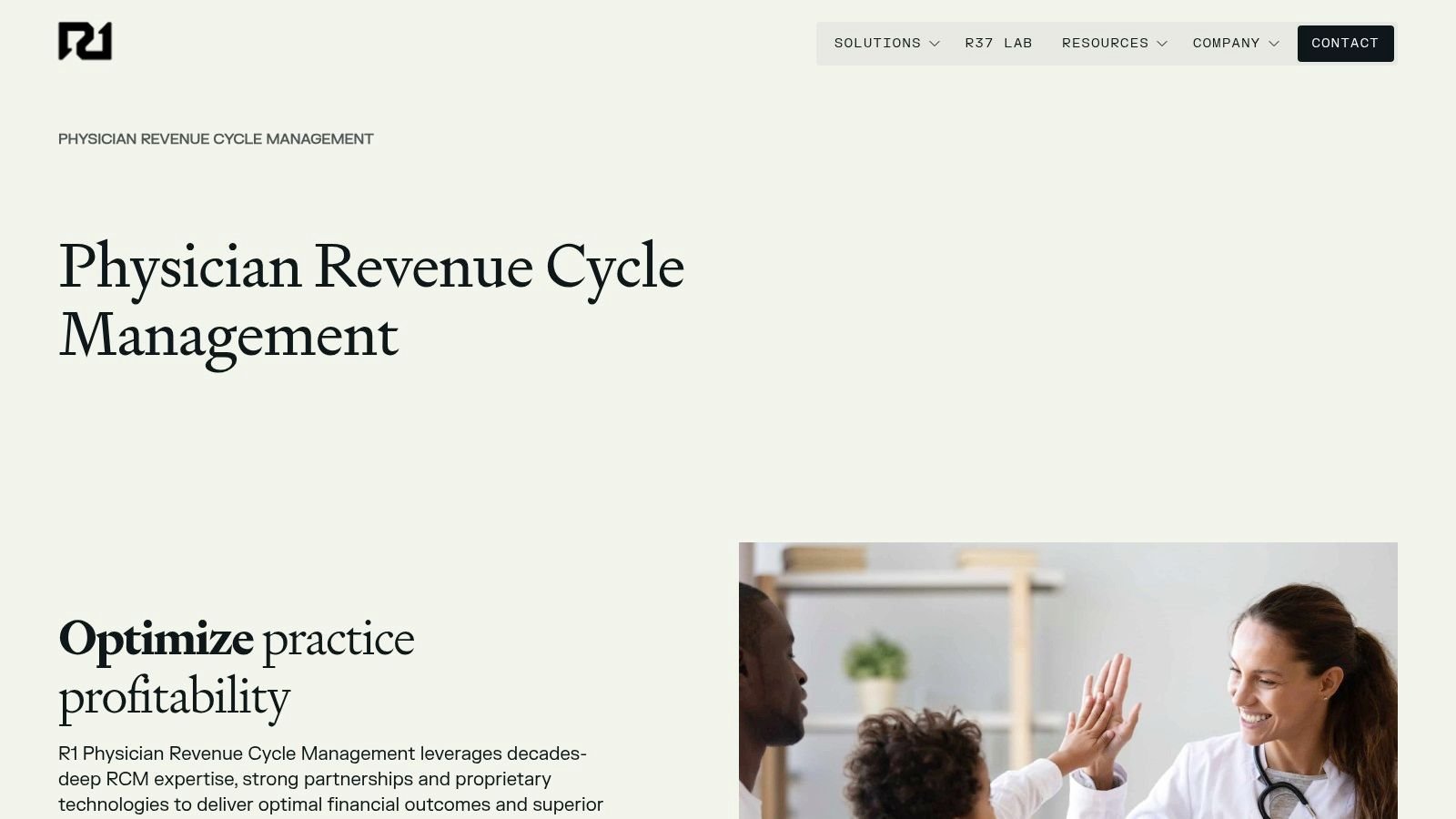
3. R1 RCM Physician Revenue Cycle Management
R1 RCM is built for organizations that already know they need enterprise scale. It's EHR-agnostic, which matters if your group spans multiple systems or if your current stack isn't going anywhere soon. That flexibility is one reason larger physician groups and health systems look at R1 when they want outsourced billing without forcing a software migration. Explore the service directly at R1 RCM's physician page.
Its real selling point is analytics depth. AI-enabled charge capture, denials, and A/R workflows make sense for organizations with enough volume and complexity to benefit from layered process control. In a larger group, that can help surface where revenue is leaking across sites, specialties, or payer classes. The company also leans into proprietary technology for charge capture and validation, which is the kind of tooling that can matter when billing errors are tied to more than just claim submission.
The practical buyer profile
R1 is not usually the first choice for a small clinic. It's heavier, more enterprise-oriented, and the procurement process is likely to feel more formal than a smaller practice wants. That's not a flaw, it's a fit issue. If you're running a multi-specialty environment with multiple EHRs, a centralized team, and enough revenue at stake to justify a bespoke agreement, R1's structure can be a strength.
The downside is predictability. Bespoke pricing and longer procurement cycles can slow decisions, and smaller practices may end up paying for capabilities they won't fully use. From a consultant's standpoint, that's the classic enterprise trap, excellent tooling, but more machine than a lean group needs.
The Happy Billing physician-practice resource is a good internal benchmark if you want to compare enterprise RCM logic with a more specialty-focused approach.
Best for: mid-to-large physician groups and health systems with complex workflows.
Watch for: contract specificity, implementation timeline, and whether the automation is customized to your actual specialty mix.
4. CareCloud Concierge
CareCloud is a strong option for practices that want outsourced billing layered onto an already integrated cloud platform. The appeal is straightforward, charge capture review, coding validation, claim submission, denials and A/R follow-up, plus patient payments all sit in one environment. For a busy administrator, that reduces the number of systems that need to be managed every day. Start with CareCloud's outsourced billing services.
The concierge model is especially relevant if your practice wants a bundled software and services arrangement rather than a separate billing company plugged into a different stack. That can make onboarding easier and reporting more coherent. It also tends to fit independent and multi-specialty practices that want a more unified revenue cycle experience without building an internal team from scratch.
Where the value shows up
CareCloud's percentage model aligns the vendor's incentives with collections, which is useful when you want a partner motivated to move claims through. The challenge is that this pricing style also means you need to pay attention as volumes rise. If the service works well but the fee structure scales faster than your margin, what looked efficient early can feel expensive later.
The bigger caution is operational consistency. Mixed third-party ratings around usability and support mean you should validate references carefully, especially from practices similar to yours. We've seen many groups underestimate how much service quality matters after go-live, then discover that software breadth doesn't automatically equal denial discipline.
The Happy Billing outsourcing guide is a useful comparison if you want to think through how full-service outsourcing should behave in a practice that cares about collections and not just claim submission.
Best for: practices wanting a bundled software-plus-billing model.
Watch for: support consistency and whether the reporting helps you manage A/R, not just review it.
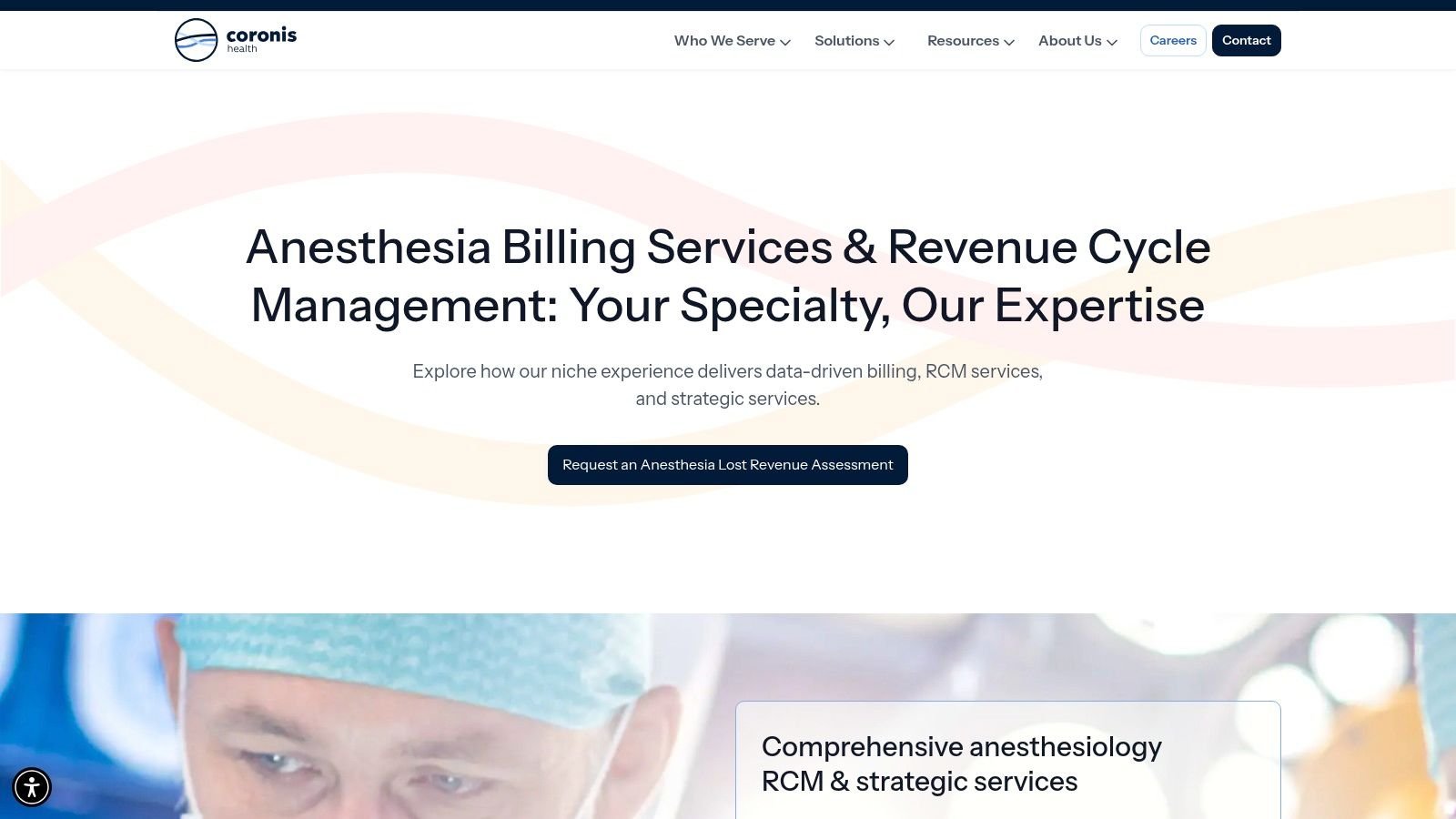
5. Coronis Health Specialty Focused RCM
Coronis Health stands out most clearly for anesthesiology, and that matters because anesthesia billing is one of the places where small mistakes create outsized financial consequences. Base units, modifiers, and concurrency rules require disciplined handling, and a generalist billing team often misses the nuance that keeps claims clean. Coronis' dedicated anesthesia presence makes it worth a close look if your schedule is procedure-heavy. See their specialty page at Coronis Health anesthesia services.
This is the kind of vendor that fits when the problem isn't volume alone, it's billing precision. If a group is fighting recurring denials tied to modifier usage or concurrency logic, the right partner needs to understand that the revenue risk lives in the details. Coronis also offers broader specialty coverage, so it can work for multi-specialty settings that still need a strong anesthesia backbone.
What to verify before signing
Scoping matters here. Pricing isn't public, so you'll need to understand how the engagement is structured and which teams will handle your work. We also recommend asking how standardized the process is across specialties, because different teams sometimes mean different reporting styles, different escalation paths, and different turnaround times.
That said, Coronis is compelling if your practice leadership wants a specialist partner rather than a broad platform. For anesthesia groups, that specialization can protect revenue more effectively than a generic “full-service” pitch ever will.
The Happy Billing anesthesiology resource is worth comparing side by side if your group wants to benchmark anesthesia handling against a specialty-first RCM model.
Best for: anesthesiology groups and other procedure-heavy specialties.
Watch for: team consistency, reporting standardization, and contract clarity.
6. GeBBS Healthcare Solutions Technology Enabled RCM
GeBBS makes sense for organizations that need scale and flexible staffing more than they need a boutique relationship. Its mix of RCM, HIM, coding, billing, denials, and A/R services positions it as a broad operational partner for larger groups and health systems. For physician practices with backlogs or seasonal spikes, that breadth can be useful because it gives you more control over workload than a narrower vendor can. Visit GeBBS Healthcare Solutions.
The FlexSource staffing model is a practical reason buyers look here. If your internal team gets overwhelmed or your claim volume shifts, a partner with staffing depth can help stabilize throughput. That's especially relevant when billing isn't the only issue and coding, audits, and extended business office functions are all part of the same operational headache.
The caution for buyers
GeBBS is enterprise-oriented, so pricing and contracting tend to follow that pattern. You'll need to scope carefully and make sure the service model doesn't feel too large for your practice's actual need. We also recommend confirming U.S. time-zone coverage and PHI controls if your team is sensitive to handoff timing or global delivery models.
For buyers who are comparing on capacity rather than on a small-practice experience, GeBBS is worth considering. For a lean independent group, though, it may be more machinery than you need.
Best for: larger organizations with volume spikes, backlog cleanup, or integrated coding and billing needs.
Watch for: service-zone coverage, security controls, and whether the staffing model matches your workflow.
7. IKS Health RCM and Physician Enablement
IKS Health is a strong contender for practices that want revenue cycle support tied closely to clinical documentation and patient access. That combination matters because many denial problems start before the claim is ever sent. If eligibility, authorizations, and documentation support are weak, billing staff end up cleaning up avoidable messes later, and that costs real money. See the service at IKS Health revenue cycle management.
The best reason to look at IKS Health is the pairing of operational support with measurable outcomes. When a vendor connects documentation, coding, and RCM, it can reduce rework instead of just chasing it. That's particularly useful for large physician groups and MSO-backed practices where workflow complexity is already high and leadership wants the partner to touch more than one part of the revenue cycle.
Who should keep it on the shortlist
IKS Health is usually better suited to larger or growing groups than to tiny clinics. That isn't a negative, it's just the reality of a solution that's designed around deeper operational involvement. The pricing is bespoke, so the economics will depend on scope and implementation depth.
We like the strategic logic here because documentation support and revenue cycle work often fail together. Fix one without the other and you still have leakage. Fix both, and you can sometimes remove the source of repeated denials rather than just appeal them.
If a billing partner can't explain how it reduces rework upstream, it's probably only managing symptoms.
For practice owners comparing this kind of model, the question is whether you want a billing vendor or a broader enablement partner. IKS Health leans toward the second option, which can be exactly right when your internal team is stretched.
Best for: larger physician groups, MSO-backed practices, and operations-heavy environments.
Watch for: scope creep, custom pricing, and whether documentation support is fully integrated.
Top 7 Remote Medical Billing Companies, Side-by-Side Comparison
| Product | Implementation complexity | Resource requirements | Expected outcomes | Ideal use cases | Key advantages |
|---|---|---|---|---|---|
| Happy Billing | Low, operates inside existing EHR, minimal migration | Moderate internal oversight; engagement for free revenue audit; HIPAA controls | Faster cash conversion; claims velocity; reported 98%+ first-pass clean claims and <35 days in A/R | Specialty practices that need rapid cash flow improvement with low disruption | Agentic AI + senior human auditors, 24/7 follow-the-sun processing, specialty-tailored workflows |
| athenahealth, Revenue Cycle Services | Medium, easiest if on athenaOne; otherwise requires platform adoption | Software + outsourced RCM (quote/percent of collections); integration with athenaOne | Standardized RCM performance using network benchmarks; consolidated workflows | Practices wanting an all-in-one EHR + outsourced RCM from a single vendor | Integrated EHR+RCM, scaled playbooks and benchmark-driven processes |
| R1 RCM, Physician Revenue Cycle Management | High, enterprise onboarding, bespoke SLAs, multi-system integration | Significant enterprise contracting, analytics integration, performance-linked pricing | Scalable, analytics-driven revenue optimization; improved charge capture and DRG validation | Mid-to-large multi-site or multi-specialty groups and health systems | EHR-agnostic at-scale platform, proprietary charge-capture and DRG validation technology |
| CareCloud, Concierge (Outsourced Medical Billing) | Medium, works on CareCloud platform; tiered concierge onboarding | Cloud PM/EHR/payments + percentage-based service fees; platform setup | End-to-end billing and payments consolidation; outsourced charge capture to patient payments | Independent and multi-specialty practices wanting bundled software + services | Mature cloud platform, concierge service tiers, bundled software+outsourcing |
| Coronis Health, Specialty-Focused RCM (Anesthesiology strength) | Medium, specialty scoping and tailored playbooks required | Specialty-dedicated teams; quoted pricing after scoping | Fewer specialty-specific denials; improved anesthesiology coding/concurrency accuracy | Anesthesia groups and procedure-heavy specialties | Deep anesthesiology expertise, specialty playbooks, analytics-driven denial prevention |
| GeBBS Healthcare Solutions, Technology-Enabled RCM | High, enterprise contracting and global delivery considerations | Large-scale staffing (FlexSource), enterprise procurement, confirm PHI/time-zone coverage | Extended business office capabilities; handles volume spikes and backlogs | Health systems and organizations needing scale and flexible staffing | Flexible staffing model, AI-assisted denials/appeals, broad HIM + RCM services |
| IKS Health, RCM and Physician Enablement | Medium–High, enterprise EHR and documentation integration | Clinical documentation support + revenue cycle integration; bespoke pricing after discovery | Reduced rework through better documentation, measurable ROI-focused improvements | Large physician groups and MSO-backed practices seeking clinical + RCM alignment | Combines clinical documentation support with RCM; recognized for AI-driven performance |
Decision Checklist Selecting Your Next Billing Partner
Choosing the right remote billing company is a financial decision, not a vendor search. We tell practice owners to start with the numbers that affect cash flow first, because that's where bad outsourcing choices hurt the most. A billing partner can look polished and still leave you with slow A/R, weak denial recovery, and reporting that doesn't help you manage the business.
Start with specialty fit. If your practice bills psychotherapy, echocardiography, anesthesia, or another code-heavy service line, ask the vendor how it handles your most common encounters, including CPT 90837 for psychotherapy and CPT 93306 for echocardiography. The vendor should be able to talk through workflow reality, not just claim “specialty expertise.” You can also review our specialty billing approach to see how specialty alignment should be evaluated in practice.
Next, look at integration. If a vendor wants you to move off your current EHR just to start billing, that's a disruption cost you're paying before collections improve. An EHR-native or EHR-agnostic model that works inside your existing stack usually shortens onboarding and reduces training friction. That's especially important when your staff is already stretched.
Then press on KPIs. Insist on written targets for clean-claim rate, days in A/R, net collection rate, and reporting cadence. If the vendor won't state them clearly, you're being asked to buy confidence instead of performance. Pricing also needs to be modeled against your revenue, because a lower percentage isn't a win if denials, lag, and write-offs remain high.
Practical rule: if the contract doesn't name the metrics, the partner isn't really accountable for them.
Before you sign, use a free billing audit to identify where the current leakage is coming from. That gives you a baseline for the conversation and stops the sales process from hiding the underlying issue.
How much do remote medical billing companies charge
Pricing usually depends on the service model, the specialty, and the complexity of your claims. The important question isn't only what the fee is, it's what you'll recover in lower denials and faster cash conversion.
What is the difference between a billing company and a full RCM partner
A billing company often focuses on claim submission and follow-up. A full RCM partner goes further, handling denial prevention, A/R management, credentialing, and broader revenue workflow control.
How long does it take to switch to outsourced billing
A well-run transition should be managed carefully, with the first measurable improvement showing up after go-live and the fuller financial picture becoming clearer over the following weeks. The key is clean cutover planning, not rushing the handoff.
Happy Billing is built for practice owners who want remote billing to improve collections, not just move claims around. If you want a partner that combines specialty expertise, existing-EHR workflow, and a free revenue audit, visit Happy Billing and see how a stronger RCM model can reduce denials and shorten your A/R cycle.