Anesthesiology Billing Services: A Practice Owner’s Guide

A full OR board does not guarantee healthy cash flow. We see the warning signs in practices that are clinically busy but financially underperforming. Charges lag behind documentation, concurrency is coded conservatively or inconsistently, and payer terms sit unreviewed for years. Revenue slips out through small misses that add up fast.
For an anesthesiology practice owner, billing is a financial control point. It determines whether the work your team already performed is translated into the right units, modifiers, and payment under each contract. When those details are handled without anesthesia-specific discipline, the practice gets paid late, gets underpaid, or spends staff time fighting avoidable denials.
The bigger issue is that anesthesia revenue leakage is usually hidden. A claim may still go out. A payment may still post. But if time capture is incomplete, concurrency is miscoded, or the payer is applying terms your team has never audited against the contract, the shortfall can sit in plain sight. That is why owners who want stronger collections need more than general revenue cycle management best practices. They need a billing partner that can find the exact leakage points inside anesthesia reimbursement and fix them.
Documentation also shapes billing performance upstream. If your providers are evaluating tools that improve time stamps and note quality, it helps to compare medical speech to text vendors alongside your RCM workflow, because cleaner source documentation usually means fewer manual corrections and fewer missed units.
Anesthesiology Billing Is a Revenue Engine Not an Expense
Most owners don't start reviewing anesthesiology billing services because they're curious. They do it when the numbers stop making sense. Cases are being performed, schedules are full, clinicians are working hard, yet the aging report keeps stretching and net collections don't reflect the intensity of the work.
That happens because anesthesia billing isn't a generic claim-submission task. It is the system that turns base units, time units, modifiers, and payer rules into cash. When that system is weak, the practice gets paid late, paid less, or not paid at all.
The billing model itself creates distinct advantages and risk. Anesthesia reimbursement is built on time, procedure complexity, and modifiers, then multiplied by a payer conversion factor. Medusind's overview of the model explains that each 15-minute increment of anesthesia time counts as one unit, then combines with base and modifier units before reimbursement is calculated through the payer's conversion factor, as outlined in this anesthesia billing overview.
What owners actually need to watch
A physician owner doesn't need another coding lecture. You need to know where revenue slips:
- Time capture: A short documentation gap can reduce billable units.
- Modifier accuracy: Wrong or missing modifiers can reduce payment or trigger denial.
- Payer interpretation: The same claim logic doesn't behave the same way across plans.
- A/R follow-through: Even correct claims lose value if no one works denials and underpayments aggressively.
Billing performance shows up in cash velocity long before it shows up in a financial statement.
This is also why operational tooling matters. If your providers struggle to complete clear, timely documentation, billing gets weaker downstream. Practices reviewing front-end efficiency should also compare medical speech to text vendors, because documentation speed and completeness often affect anesthesia time reporting and modifier support more than owners expect.
A stronger billing operation usually comes from cleaner workflows, tighter documentation, and a team that understands anesthesia-specific rules. If you're evaluating the broader process, these revenue cycle management best practices are a useful benchmark for what a disciplined billing engine should look like.
The Unique Financial Risks in Anesthesia Billing
A healthy case volume can still produce weak collections in anesthesia. We see this when the schedule is full, claims are going out, and revenue still trails because the leakage sits inside unit calculation, modifier logic, payer contract terms, and follow-up discipline.
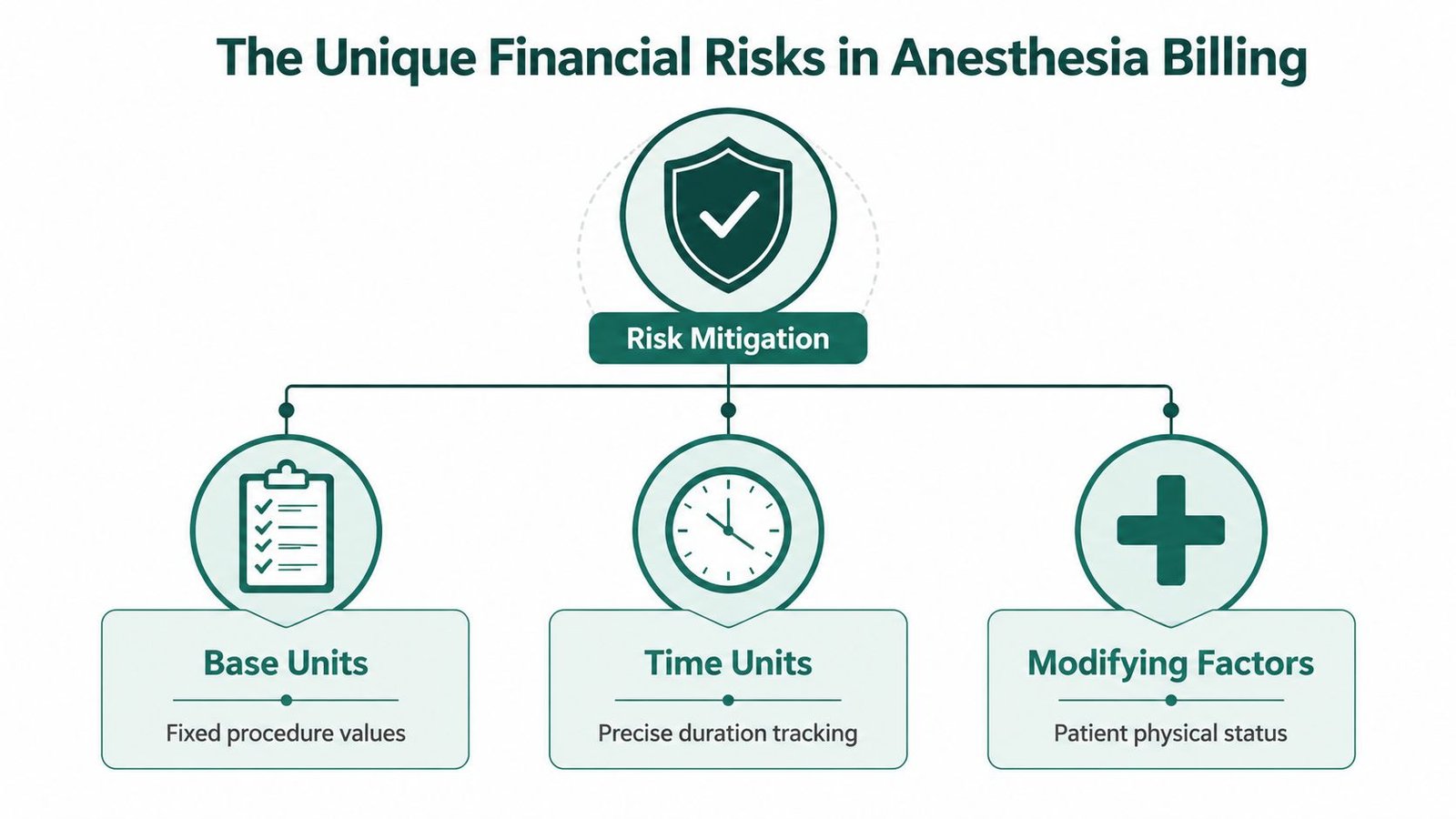
Base units time units and modifiers all carry risk
The reimbursement formula looks simple. Base units plus time units plus modifier units, multiplied by the payer's conversion factor. In practice, each input creates a separate place to lose money.
A claim can be complete enough to submit and still underpay. Wrong medical direction reporting changes payment allocation. A concurrency mistake can shift the billing physician's role on the case. A monitored anesthesia care claim can deny or pay incorrectly when QS is handled poorly. Physical status coding can also leave money behind when the record supports higher acuity but the billed modifier does not.
The financial problem is not limited to coding accuracy. The fee structure itself does not always reflect the work intensity of high-acuity cases, so practices with difficult case mix already start from a narrower margin. That makes preventable leakage even more expensive. If your team is not auditing every part of the formula, small misses on a high-volume service line turn into a material drop in monthly cash.
Where owners lose money
The patterns are usually consistent:
- Incomplete time records: If start and stop times are unclear, billed units are easier to cut on review.
- Concurrency miscoding: Modifiers such as AA, QK, QX, and QY determine payment distribution, not just claim format.
- MAC documentation gaps: For monitored anesthesia care, QS and, for some payers, G8 or G9 need chart support that holds up on appeal.
- Underaudited physical status: P1 to P6 often get assigned by habit instead of against the chart, which suppresses payment on sicker patients.
- Weak payer contract oversight: Many groups accept underpayments because no one is reconciling anesthesia units, conversion factors, and carve-outs against the contract.
That last point matters more than many owners expect. We often find groups focused on denial volume while missing a quieter problem. Claims pay without denial, but at the wrong rate.
Practical rule: In anesthesia, a minor charting gap or modifier error can turn a billable case into a reduced-payment case.
Owners should also ask a security question during vendor review. If a billing partner touches your EHR, who is checking access controls, audit logs, and PHI exposure? A practical way to test your process is to compare the vendor's controls against the CloudOrbis HIPAA checklist.
For teams tightening claim construction, our guide to anesthesia CPT code requirements and reporting logic is a useful reference. The goal is to protect payment on every case.
The Financial Case for Outsourcing Anesthesia RCM
Monday morning. Your weekend cases are posted, claims are going out, and cash should be on the way. Instead, payment slows because concurrency was mapped wrong, modifiers were applied inconsistently, or an underpaid claim cleared the bank without anyone matching units and conversion factors back to the contract. That is not a billing inconvenience. It is margin loss.
The outsourcing decision usually gets framed as staffing versus vendor cost. For anesthesia groups, that is too shallow. A more critical question is whether your current team can catch the specific leakage points that affect anesthesia payment before they hit A/R.
A capable in-house team can absolutely perform well. I have seen it work in groups with anesthesia-specific billing leadership, tight documentation feedback loops, disciplined underpayment review, and enough staffing depth to absorb vacations and turnover without losing control of aging accounts. The problem is that many independent groups are trying to manage anesthesia billing with a small team that also touches other specialties. In that setup, claims often get worked after denial instead of built correctly at the front end.
That is where outsourcing changes the economics. A specialized anesthesia RCM partner does not just submit claims. They standardize charge review, monitor payer edits, reconcile payments against contract terms, and escalate aging balances with a process that holds up under volume. The financial gain comes from fewer preventable errors, faster follow-up, and stronger recovery on claims that would otherwise sit or pay short.
What specialized teams usually improve
The difference shows up in day-to-day controls, not sales language:
| Billing issue | Generalist team | Anesthesia-focused team |
|---|---|---|
| Medical direction modifiers | Understands code sets | Reviews payment impact by payer and case structure |
| Concurrency review | Often manual and inconsistent | Built into pre-bill review and exception handling |
| MAC modifier logic | Added if documentation supports it | Checked against chart support and payer rules before submission |
| Underpayment follow-up | May stop at posting | Reconciles units, rates, and carve-outs against the contract |
Anesthesia revenue leakage is often quiet. The claim does not always deny. It pays at the wrong amount, ages without escalation, or gets written off after avoidable rework. We see groups focus on denial percentage while missing the larger issue of under-collected revenue.
Outsourcing also changes management time. Physician owners and practice administrators spend less time supervising task work and more time reviewing usable operating data. A strong partner should be able to show first-pass trends, denial root causes, payer lag, underpayment recovery, and A/R by payer class without making your team build the report by hand.
When in-house still makes sense
Keeping billing internal is reasonable if you can show four things without digging through three systems:
- You have anesthesia-specific billing leadership, not just general medical billing experience
- Your team audits underpayments against payer contracts, not just denials
- You can track A/R performance by payer, place of service, and aging bucket
- You have backup coverage that protects collections during turnover or leave
If those controls are already in place, in-house may be the lower-risk choice. If they are not, compare your current model against a specialty partner using this guide to in-house vs outsourced medical billing. The goal is not to outsource for convenience. The goal is to stop preventable revenue loss and create a billing operation that stands up to payer pressure.
Your Evaluation Checklist for Billing Partners
Most billing vendors sound competent in a sales call. The useful question is simpler. Can they show you the controls that protect anesthesia revenue?

Ask for operational proof not promises
Use this checklist when you're interviewing anesthesiology billing services.
First-pass clean claims
Ask: What is your current first-pass clean claim rate for anesthesia clients, and how do you validate it?
Don't settle for a vague answer. Ask whether they segment by payer, by place of service, and by denial category. A strong vendor should be able to explain exactly what causes claims to fail before submission and what controls they use to stop that.
A/R discipline
Ask: How do you keep anesthesia A/R moving, and what escalation rules do you use on aging claims?
You don't need a generic dashboard. You need a team that can explain what happens when a claim ages, who touches it, how payer follow-up is documented, and how unresolved balances get escalated.
Concurrency and modifier review
Ask: Who reviews AA, QK, QX, QY, QS, and physical status assignment before claims go out?
The limitations of average vendors become evident. If the answer is "our coders check modifiers," that isn't enough. You want to hear that claims are reviewed against anesthesia records, scheduling data, and payer rules.
If a vendor can't explain its concurrency workflow clearly, don't assume it's under control.
Evaluate the fit with your current systems
A switch shouldn't force an operational reset inside your practice. Ask directly whether the vendor works inside your existing EHR and PM workflow or expects a separate platform with duplicate effort.
A good implementation usually includes secure access, role-based permissions, and a documented handoff between charge capture, claim review, submission, payment posting, and A/R follow-up. Owners should also ask whether reporting is available by provider, facility, payer, and denial category. If those views aren't available, you'll struggle to diagnose leakage.
Vet compliance and accountability
Not every capable billing vendor is safe, and not every secure vendor is operationally strong. You need both.
Use questions like these:
- Security controls: Ask how PHI is protected, how access is restricted, and how user activity is monitored.
- Denial ownership: Ask who owns denied claims from first touch through appeal or corrected claim.
- Underpayment review: Ask whether they compare payments against expected reimbursement logic or contract terms.
- Leadership access: Ask who you contact when cash slows down and how quickly issues are escalated.
A capable partner should be able to answer all of that without hand-waving. This is also where real anesthesia specialization matters. A vendor that serves every specialty under one generic workflow usually misses the billing details that drive your revenue.
For a practical starting point, review the standards on Happy Billing's specialties page for anesthesiology billing services. Use it as a benchmark against any vendor you're considering.
Beyond the Claim The Hidden Value of a Strategic Partner
The best billing partner doesn't just file claims correctly. They find money your current process isn't seeing.

Silent underpayments are real
One of the most overlooked problems in anesthesiology billing is payment auditing after the claim is paid. Industry research notes that many anesthesiology practices are systematically underpaid for months or years because payers reimburse below contracted amounts, and that this form of leakage often goes unnoticed when billing teams focus only on front-end claim accuracy, according to this review of anesthesiology billing service gaps and contract underpayment risk.
That distinction matters. Denials are visible. Underpayments are quieter. The remittance posts, the case looks closed, and revenue stays lower than it should be.
A claim can be paid and still be wrong.
Practices that never audit payer behavior against contract terms usually discover the problem late. By then, appeal windows may be tighter, supporting records may be harder to retrieve, and the cumulative loss is larger than expected.
Multi-provider compliance got harder after the No Surprises Act
The second hidden value is regulatory interpretation in complex OR environments. The ASA overview of surprise medical bill protections outlines the No Surprises Act framework and the independent dispute resolution process. What many owners still don't get from their billing vendor is practical guidance on how that interacts with anesthesia concurrency, multi-provider claims, and out-of-network scenarios.
That matters in settings where an attending and CRNA share a case, where multiple providers rotate through long cases, or where the claim path differs from the patient-facing compliance obligation. A generic RCM shop may understand balance billing at a high level, but not how modifier choices and concurrency sequencing can create downstream compliance and payment problems.
If you're evaluating the broader strategic upside of an external partner, this overview of the benefits of outsourcing medical billing is useful. The hidden value isn't convenience. It's financial recovery and risk control in places your current workflow may never inspect.
Implementation and Pricing Models Explained
A billing transition usually gets judged by one question. Will cash slow down while the new partner gets up to speed? In anesthesia, that risk is real if implementation is handled like a generic PM system handoff instead of a revenue protection project.
A good transition starts before anyone touches your workflows. We review recent claims, denial codes, modifier usage, concurrency patterns, payment posting, and old A/R ownership. The goal is simple. Find the leakage points that will carry over if no one corrects them.
What a clean implementation looks like
The first phase is discovery and baseline measurement. An anesthesia group should know its current state before go-live: where charges are being dropped, which payers are underpaying, how often time units need correction, and whether concurrency is being coded consistently. Without that baseline, a new vendor can look "stable" while the same missed revenue continues under a different logo.
The second phase is system and workflow mapping. In many cases, we prefer to work inside the current EHR and practice management setup instead of forcing a platform change. That reduces staff retraining and lowers the odds of documentation gaps during cutover. If the current setup is part of the problem, then a system change may be justified, but it should be tied to a specific billing failure, not sold as a default upgrade.
Then come rule-building and ownership lines. Charge capture, edits, modifier logic, payer routing, denial queues, posting rules, and reporting all need named owners. Anesthesia groups get into trouble when everyone assumes someone else is checking the details.
Go-live should be controlled. Parallel claim review for a short period, daily exception monitoring, and a clear escalation path matter more than a polished kickoff call.
How pricing usually works
The standard model is a percentage of collections. That can work well if the contract is written tightly and the partner has real anesthesia expertise. It can also hide weak performance if collections are rising only because volume rose, while underpayments, denials, and aged A/R still sit unresolved.
Some groups prefer a flat fee or hybrid structure when case volume is predictable. That can make budgeting easier, but it shifts the incentive question. You need to know how the vendor is held accountable for follow-up intensity, denial recovery, and underpayment work if their fee does not move with results. This breakdown of outsourced medical billing cost models and fee drivers is a useful reference when you compare proposals.
Before signing, get direct answers to four points:
- What is included in collections. Define whether the fee applies to insurance payments, patient payments, old A/R, recovered underpayments, and credits tied to prior periods.
- What extra fees apply. Ask specifically about implementation, credentialing support, legacy A/R cleanup, custom reports, patient statements, and appeal work.
- How long the contract lasts. Shorter terms with clear termination language reduce your risk if performance slips after the first few months.
- Who owns pre-existing A/R. If old balances, payer reconsiderations, or takebacks are not assigned clearly, they often get neglected.
Pricing matters. Implementation quality matters more. A low quoted rate does not help if the partner misses anesthesia-specific edits, mishandles concurrency, or posts payments without checking contract variance. The right model is the one that protects cash during transition and gives you a clear way to measure financial performance after go-live.
FAQs for Anesthesiology Practice Owners
A common scenario. Claims are going out on time, the schedule is full, and cash still trails expectation by 5 to 10 percent. In anesthesia, that gap often comes from a few specific failure points. Modifier errors, concurrency miscoding, weak denial follow-up, or payer underpayments that no one reviews against contract terms.
| Question | Answer |
|---|---|
| How expensive are billing mistakes in practice? | Billing mistakes can significantly impact revenue. For an anesthesia group, the financial hit usually shows up as delayed cash, avoidable denials, rework for staff, and missed underpayments that stay on the books as if they were settled correctly. |
| Should I outsource if my current billing team is already getting claims out? | Timely claim submission is only one checkpoint. The better question is whether your team can show clean anesthesia coding, low preventable denial rates, disciplined follow-up, and payment posting tied to contract review instead of simple transaction entry. |
| What should I ask before changing vendors? | Ask for proof of anesthesia-specific execution. Request examples of how the vendor handles concurrency review, modifier accuracy, underpayment identification, aging discipline, and communication with your physicians and facility contacts during documentation gaps. |
| Will outsourcing make me lose visibility into my revenue cycle? | A capable partner should improve visibility, not reduce it. You should be able to see why cash is slowing, which payers are underperforming, where denials start, and what actions are assigned to fix each issue. |
How do I know my practice has leakage
Look for patterns across several weeks, not one bad batch of claims. Repeated modifier denials, anesthesia time discrepancies, aged claims sitting without meaningful follow-up, and payer payments that look consistently light are stronger signals than isolated errors.
We usually advise owners to review a small sample of denials and paid claims side by side. That is often enough to see whether the problem is front-end claim quality, weak follow-up, or underpayment tolerance.
What if my problem is underpayment, not denials
That happens often in anesthesia. A claim can pay and still pay short.
Standard billing reports may not catch that. You need a process that compares posted payments against expected reimbursement logic and payer terms, especially for units, modifiers, medical direction, and contract carve-outs. Otherwise, money leaks out after adjudication and never shows up in denial metrics.
Can a billing partner work inside our existing EHR
Many can, and in many groups that is the best setup. It reduces disruption, keeps your clinical workflow intact, and gives the billing team direct access to records needed for time validation, documentation support, and appeals.
The trade-off is operational discipline. If the EHR is poorly configured or user access is limited, your partner may still struggle to work accounts quickly. Ask how they handle system permissions, charge capture timing, and documentation exceptions before go-live.
What's the right next step before I decide
Start with evidence, not a contract. Review your denial categories, aging by payer, days to bill, and a sample of paid claims that may be under reimbursed.
That review gives you a clearer decision. You may find that your current team needs tighter anesthesia controls, or you may confirm that the practice needs a partner built to fix specific revenue leakage points rather than just submit claims.