Should Your Practice Take Motor Vehicle Accident and Workers’ Comp Patients? What IT Does to Cash Flow and Who Should Chase the Claims

Take motor vehicle accident and workers' comp patients only when the net cash each case returns, after the staff hours spent chasing it, beats your commercial average, and only when you can carry the tail for 90 to 180 days without touching payroll. The timing split is the whole argument. Motor vehicle claim resolution times vary widely by representation status: a straightforward claim can close quickly, while a case where the injured party hires an attorney moves at litigation speed. You rarely know which clock a case runs on the day you accept it.
The popular advice says accident cases are high-dollar, so take them and bill them like any other claim. That advice is expensive. Gross charges on an accident claim describe what the injury was worth. They say nothing about what your practice collects or when the money arrives. A settlement that lands in month nine is cash you lent an insurer all year at zero interest.
Whether you should take motor vehicle accident and workers' comp patients comes down to three numbers you can measure and one name you can write down. Net cash per case after labor. Days from service to cash. The person who owns each stalled account on the day it stops moving. Get those wrong and the segment lifts your A/R days and your denial rate while the schedule looks full.
Yes, but Only When Net Cash Justifies the Chase
Bill size is the wrong filter. A five-figure comp bill that pays in seven months after three records requests and an appeal costs you more than a routine commercial visit that pays in three weeks, because the comp bill tied up payroll, clinician capacity and a biller's attention the entire time. Practices that judge these cases by billed amount discover later that the money arrived late, arrived short, or never arrived at all.
Treat the settlement tail as a financing decision. Every month a case stays open, your practice is lending against it: staff hours on records requests, lien paperwork, authorization calls and status letters go out before a dollar comes in. Judge each case by net cash after that labor, and a "high-dollar" accident claim often ranks below a modest commercial visit that pays clean and fast.
The economics are also less about volume than owners assume. Average medical services paid per indemnity claim rose 9.5% in fiscal year 2024 versus fiscal year 2023, while the price component of medical payments rose 3.1% over the same period, according to Sedgwick's workers' compensation state of the line. Nearly two-thirds of that increase came from something other than price, and reimbursement still swings on jurisdiction, claim status, fee schedules, authorization rules and payer coordination.
The administrative load is real. Workers' compensation systems handle a heavy flow of documents from providers, injured workers, employers, attorneys and insurers before a claim is even assembled as complete, and state reporting on how quickly injured workers get their first benefit payment measures worker benefits, not provider reimbursement. None of it reduces your billing risk by a dollar.
Before the first visit: verify compensability or the accident, the employer and carrier, the claim and authorization numbers, the state fee schedule, any network or panel requirement, and whether the payer has accepted liability.
The cash-flow implication is operational. These accounts need their own work queues, eligibility and authorization checks before service, fast submission of medical records, and systematic follow-up on delayed, denied or disputed claims. That's why the medical billing KPIs worth tracking in an accident-heavy practice are net collections per case and days to verified acceptance, not charges posted.
Happy Billing, headquartered in Texas, handles motor vehicle accident and workers' comp claims end to end or alongside the biller you already have, and the specialties we bill for run from orthopedics and pain management to behavioral health.
Book a free 30-minute call with a billing specialist and bring last quarter's accident and comp A/R.
US practices only.
How Cash Timing Changes by Claim Type
Cash timing splits by who pays first, not by how badly the patient was hurt. A commercial claim usually fails on eligibility or a coding error and gets fixed in about a week. A comp claim fails on liability and can sit for a season. An accident claim fails on coverage limits, attorney involvement and settlement timing, and no amount of follow-up moves a case that hasn't settled.
Claim size caps the upside before timing even matters. In 2024 the average PIP claim was $8,966 and the average MedPay claim $4,674, per reporting on the real cost of car crashes. Those are claim totals, so they mark the ceiling on each account, not the date it pays.
| Claim type | Who pays first | Typical time to cash | Cash-flow risk |
|---|---|---|---|
| Commercial health plan, clean claim | Health plan | Fastest row; a corrected denial usually pays within about a week | Low; failures are usually eligibility or coding errors |
| Workers' comp, accepted claim | Workers' comp carrier, then Medicare only as secondary | Weeks on the carrier's schedule under the state fee schedule | Medium; the file can stall while liability is disputed |
| MVA with PIP or MedPay | PIP or MedPay where the policy applies | Early in the case; pays under no-fault rules while the liability claim is still open | Medium; coverage limits cap what you can collect |
| MVA, unrepresented, fast-resolving | Liability or PIP carrier | More than half resolve within 11 days | Low to medium |
| MVA, attorney-represented | Liability settlement | Median closure near 440 days | High; months of carrying cost |
| Medicare beneficiary in an MVA | Liability or no-fault first, then Medicare as secondary | Last in the sequence; waits on the primary payout, so a represented file can push receipt past the 440-day median | High; billing Medicare early can cap recovery |
The Settlement Tail Is a Financing Decision
Roughly 15 to 20 percent of auto claims take 80 to 120 days or more, and represented bodily-injury claimants had a median closure time near 440 days, more than twice the unrepresented figure, per Enlyte's auto claim trend analysis. Read that as a loan you didn't agree to make. Every month a represented file stays open, the practice finances the payer's delay with rent, supplies, clinician hours and the staff time spent re-sending records and calling adjusters. A high-charge MVA case can return less net cash than a modest commercial claim that paid in weeks.
The rule I'd use: if you can't name the month a case converts to cash, you've already lent the payer your working capital.
Payer order carries money too. When a comp carrier disputes responsibility and won't pay promptly, CMS permits billing Medicare as primary, but the account then has to move through the Medicare process instead of sitting open in a work queue, as the Medicare Secondary Payer guidance for providers describes.
Then run the arithmetic on your own census. Sort every open accident and comp account into one of the table's rows, estimate the days to cash, and put a realistic abandonment rate on each. Multiply the balance by its carrying months and subtract the staff hours the chase will eat, because that net figure is what the case is worth, not the gross charge. Your days in A/R number will tell you which row you're living in, whatever the billing system says.
Where the Administrative Load Builds Up
A claim has to be accepted before it can be paid, and acceptance is a separate event from the visit. That gap between "we saw the patient" and "the payer agreed to owe it" is where the staff hours accumulate, and every hour spent pushing a bill toward acceptance is payroll attached to money you have not received yet. The load matters because it raises the break-even point on each case: the same gross charge yields less net cash the longer a bill sits unaccepted.

The lifecycle runs in a fixed order, and each stage can stop the money:
- Confirm the payer. Establish compensability or the accident and identify who is primary.
- Lock the data. Secure authorization, claim numbers and, for comp, the claim administrator.
- Submit with the required records. Give the payer the medical report and itemized claim it asks for.
- Clear the edits. Reach acceptance, not just transmission.
- Chase the humans. Work adjusters, attorneys and liability carriers by name and date.
- Land the payment. Take the check, the denial or the settlement, and route it correctly.
Federal OWCP rules require a CMS-1500 or equivalent plus supporting medical documentation before a bill is reimbursable (OWCP billing regulation). Other payers run the same basic gate: submitted bills pass through automated edits, and a rejected bill generally is not treated as timely filed until it is corrected, resubmitted and accepted. A clinically valid encounter can stay unpaid for weeks with nothing wrong except a missing claim number.
Silent Aging Is the Expensive Failure
Rejected bills get mistaken for payer delay. They sit in a bucket labeled "waiting on insurance" while the timely filing window closes, and nobody notices until the account is dead. That is the same failure mode covered in medical billing denial management, with a longer fuse.
The stall points are predictable:
- Missing claim or employer data, which leaves the bill with nowhere to go.
- No authorization on file, which turns a covered service into a write-off.
- Accident documentation gaps, which force a denial and a resubmission cycle.
- An incorrect injury relationship, which disputes the whole encounter rather than one line.
Happy Billing submits clean claims within 24 hours of charge capture and proactively follows up on every outstanding claim, which is the only way this queue stays honest. The metric that matters is days from service to verified claim acceptance, because unaccepted bills are hidden A/R that makes your book look healthier than it is.
Keep one ledger per account with the service date, submission date, payer acknowledgment, authorization status, last action, appeal deadline, expected allowed amount and next escalation date. When your state adds a review layer, as workers' comp bill review companies do, that ledger is the only thing standing between you and a balance nobody can reconstruct.
Who Should Own Each Step of the Claim
Ownership should follow the bottleneck, not whoever has a free hour. Here's the split that holds up.

| Task | Best owner | Revenue at risk if it fails |
|---|---|---|
| Accident, employer and carrier intake | Registration, verified before treatment | A bill with no payer to send it to |
| Causation, work status and necessity notes | Clinical staff document, billing reviews | Denial for missing documentation |
| Primary-payer order (liability, PIP, workers' comp, then Medicare) | Specialized A/R owner | Early Medicare billing can cap recovery |
| Claim submission and edit correction | Certified billers | A rejected bill that isn't treated as timely filed |
| Adjuster, attorney and lien follow-up | Specialized A/R owner or billing partner | An open file that ages untouched for months |
| Denial appeals and fee-schedule disputes | Appeals specialist, in-house or partner | An underpayment written off without a fight |
| Patient responsibility terms | Front office, under a written policy | A balance left over after settlement |
The payer-order row is where the most money leaks. CMS warns that providers generally must bill liability insurance before Medicare, and that billing Medicare first can limit what the practice ultimately receives to the Medicare-approved amount even if Medicare doesn't pay or the payment is later refunded, per the Medicare Secondary Payer manual chapter on liability insurance. CMS also treats filing an acceptable lien against a liability settlement as billing the liability insurer, which is why lien and attorney coordination belongs to someone trained in it.
Where the Handoffs Break
Front desk staff and clinicians should supply facts, not run repeated payer follow-up. When a bill keeps going back out because it needs an adjuster, an attorney or a board filing, that isn't a staffing problem, it's a wrong-owner problem, and it will not fix itself with more reminders.
Denials on these accounts get their own discipline. The approach in how to appeal a denied insurance claim applies here with more supporting records and a shorter clock.
Happy Billing's Certified RCM Specialists act as advocates for the practice and fight claims that are unfairly denied. Our team can run billing end to end or work alongside your current biller, and if you're weighing which roles to keep in house, this is the same analysis as what medical billers actually do day to day.
Keep a task in house only if the in-house owner has the authority, the evidence and the time to resolve the specific failure assigned to them. Anything short of all three is a task that ages.
Set the Accept-or-Decline Rule and This Week's Intake Steps
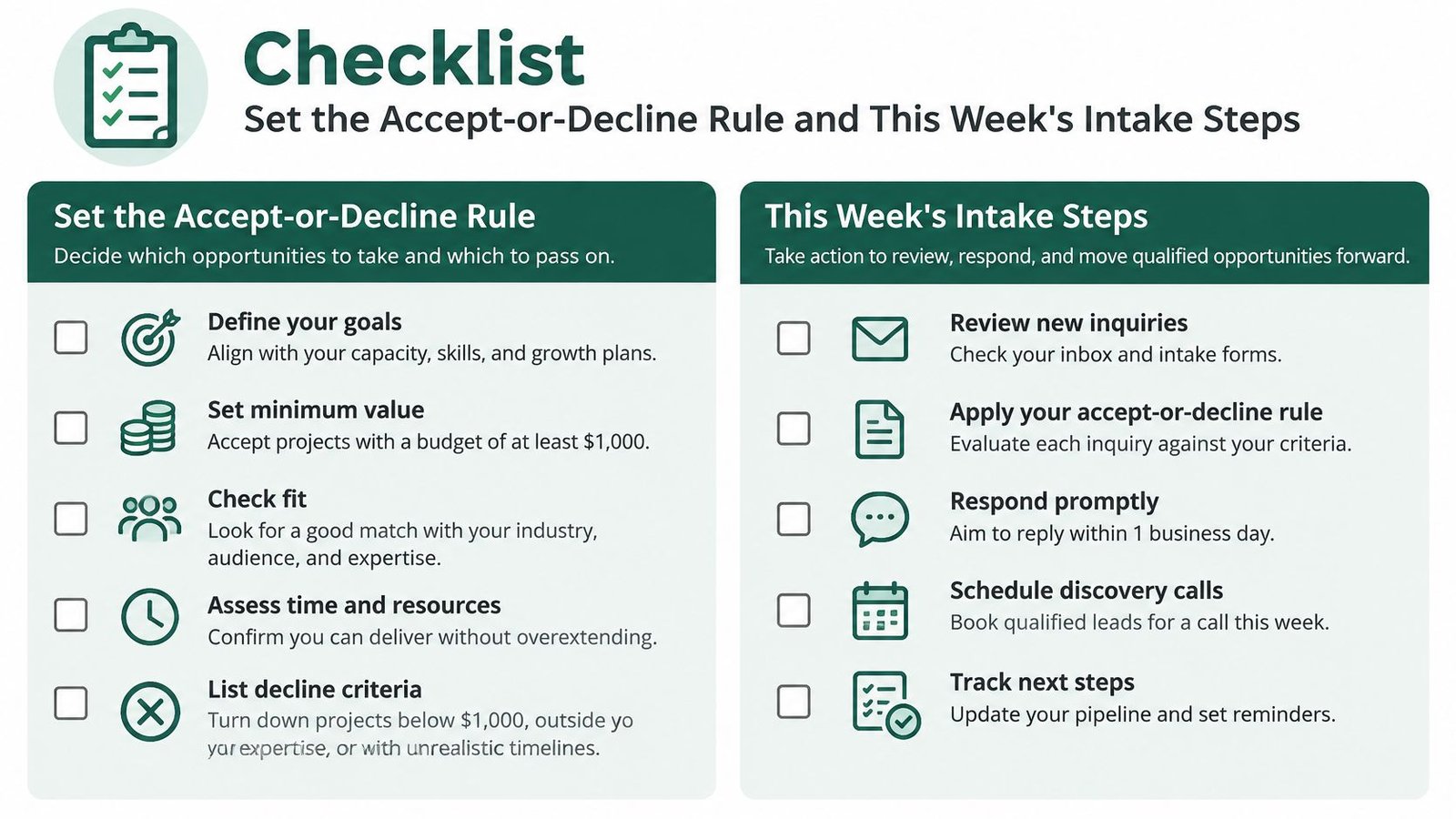
Gross charges are a weak yes. Treat the settlement tail as financing: accept a case only when net cash after staff time and carrying cost still beats your commercial average.
Score each item from one to five. Decline the segment when the total sits low.
- Net cash per case after staff hours and carrying cost, compared with your commercial average.
- Working capital to carry 90 to 180 days without straining payroll or a credit line.
- Coverage and authorization verified before the first visit, every time.
- Attorney-involved share of the census, because that's where the long tail lives.
- A named owner for each queue, with escalation authority.
- Volume high enough to justify a dedicated workflow rather than a side task.
Owners skip the part that moves money: who can act. The New York Workers' Compensation Board reports processing more than 3 million claims work items a year, with medical and transportation reimbursement requests that can sit denied or unanswered for 60 calendar days (New York Workers' Compensation Board conference materials). A request that sits that long is cash the practice financed.
The Escalation Trigger
Escalate the moment an item passes its expected next action date with no payer response. A red aging report is already late.
If you're staffing intake or after-hours phone coverage for this work, the logic behind choosing front desk coverage for lawyers applies to your practice too: coverage has to match when the calls arrive, or the work piles up faster than anyone can answer it.
Then set up this week:
- Write a segment rule at intake that sorts each case by confirmed coverage, available limits, attorney status, authorization and patient credit risk.
- Set a deposit or written payment-plan rule when expected collectible value falls below the cost of continuing care. Keep clinically needed care in place. Do not stop treatment, or discharge a patient, because the balance looks weak.
- Assign one named owner to each queue, including the escalation path.
- Open the ledger and measure days from service to verified acceptance for 60 days.
- Rerun last quarter's accident and comp claims through the segment rules to get a real net cash per case.
I would rather fund a short list of cases that clear this test than a larger census that ties payroll to unpaid balances. If the test shows the work sits with people who lack authority or time, a billing partner can own the chase end to end or work alongside your current biller. Happy Billing is headquartered in Texas, and its fee model typically saves practices 30 to 40% compared with in-house billing once full staffing costs, software and unworked denials are counted. Read the cost of outsourcing medical billing before you compare quotes, and in-house versus outsourced medical billing covers the staffing side.
Book a free 30-minute call and bring a sample of open accident and comp claims so the conversation is about your numbers.
US practices only.
Owner Questions About Accident and Comp Billing
Should we send an accident claim to Medicare when the patient has Medicare?
Bill the liability, no-fault, or workers' comp insurer first. Medicare goes on the claim only as secondary, and only when that order is appropriate and the primary payer's response is already documented. Reverse it and you can spend months unwinding a denial the practice created. Check payer order at intake, before the service, not after the first rejection.
When should we escalate an unpaid workers' comp claim?
Escalate the day the claim passes the expected next action date in your ledger with no payer response. That date is the trigger in the accept-or-decline rule. Another quiet cycle does not improve the odds. It just ties payroll to a receivable whose net cash is still unknown.
Can our front desk handle accident claims if we only see a few a month?
Front desk staff do intake well: accident details, employer, carrier, claim number, and attorney. That record is useful. The chase is different work. Repeated payer calls, portal checks, records requests, appeals, and settlement coordination rarely survive as a side task between patients. A few cases a month is enough to lose money when nobody owns those hours, because staff time comes off net cash even when the gross charges still look fine.
How much of our accident census can we carry for 90 to 180 days?
Treat the tail as financing, then model it. Run working capital against the attorney-involved share of the census and the expected days to cash for each segment. The ceiling shows up quickly. If carrying that tail would pressure payroll, debt covenants, or hiring, the limit is a stop-treatment or deposit rule at intake. Adding volume does not fund the wait.
What should we check in a billing partner that handles these claims?
Ask who owns intake, who owns appeals, and who owns settlement and lien follow-up, each by name. Ask how status gets reported to you and how often, and whether the partner can work alongside your current biller instead of replacing the team. A partner who cannot answer those four questions in the first meeting will not move your A/R days. Judge the fit by net cash after the hours those queues consume, not by the gross on the accident log.
Happy Billing handles motor vehicle accident and workers' comp claims for independent practices, either end to end or alongside the biller you already have. Visit Happy Billing to see how the team works, then bring the accident and comp claims you've written off to a free 30-minute call so the numbers on the table are yours. US practices only.