How to Write a Medical Claim Denial Appeal Letter (with Template)

A strong medical claim denial appeal letter is a payer-facing evidence packet, not a complaint. It identifies the claim, quotes the denial precisely, answers the payer's rationale with policy and clinical evidence, and demands a specific remedy. That discipline protects legitimate reimbursement and prevents avoidable additions to your practice's A/R.
In 2024, ACA Marketplace insurers denied 19% of in-network claims and 37% of out-of-network claims, for a combined average denial rate of 20%. Fewer than 1% of denied claims were appealed, and 66% of appeals were upheld. Yet HealthCare.gov consumers filed at least 262,982 appeals that year, and insurers overturned 165,863 of those denials, according to KFF's analysis of ACA Marketplace claims denials and appeals. The lesson for an independent practice is direct: an appeal isn't automatically successful, but a specific, complete submission gives recoverable A/R a real path back to cash.
What Denials Cost Your Practice and Why Appeal Letters Decide the Outcome
A practice owner doesn't experience a denial as an abstract payer metric. You experience it as an unpaid CPT claim, a growing A/R balance, staff time spent calling representatives, and cash that never reaches payroll, rent, or expansion. On a $1.2 million annual collections baseline, even a modest recurring denial pattern can erase six figures of legitimate revenue if staff appeal only a small share of the affected claims.
The available Marketplace data shows both sides of the problem. Appeals are uncommon, and many challenged denials remain upheld, but the overturn volume proves that appealing can reverse a meaningful portion of payer decisions. The important operational point is not to assume that every denial deserves a letter. It's to separate reversible denials from true exclusions, then make the reversible cases easy for a reviewer to approve.
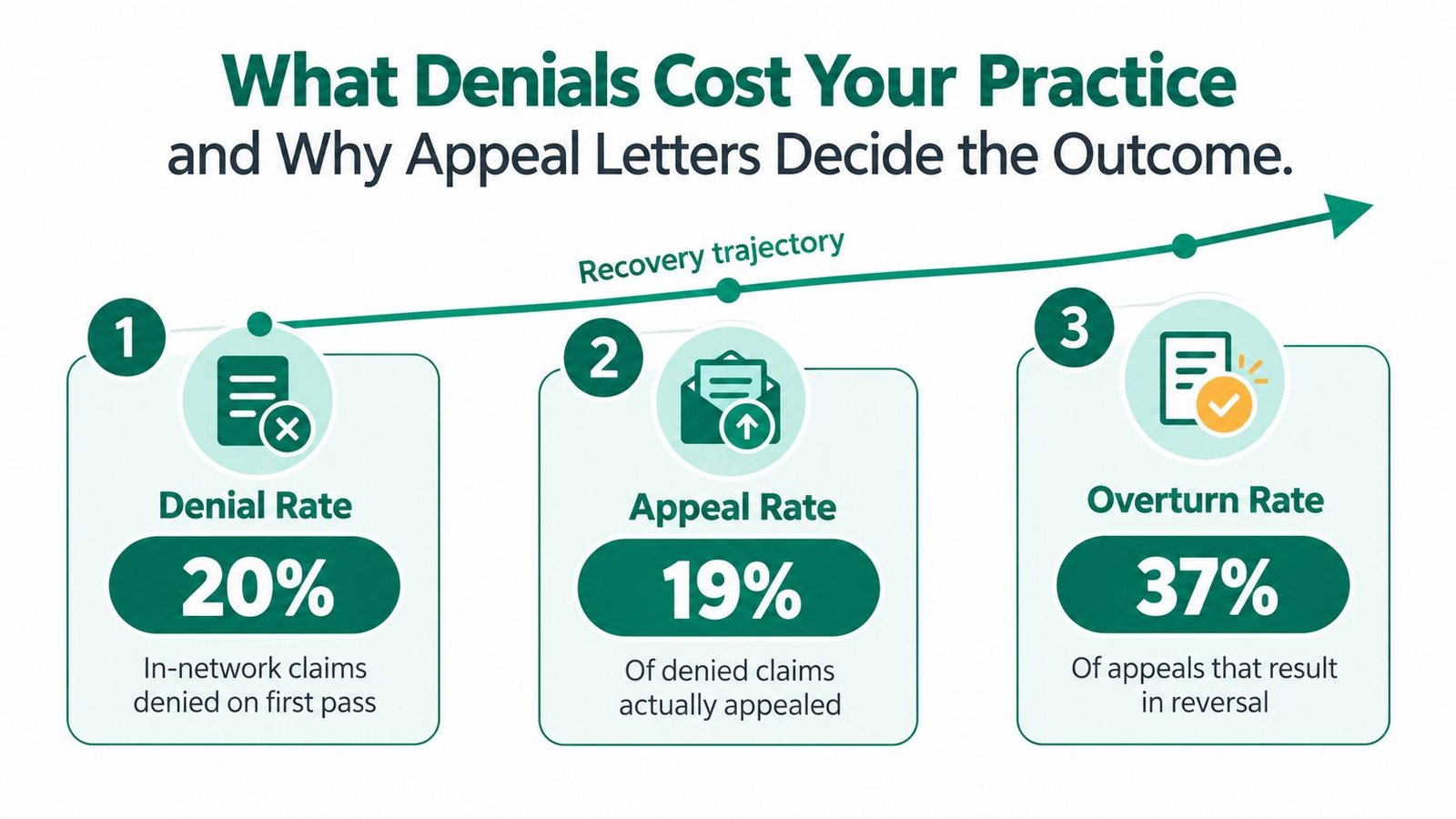
A denial appeal letter is often the most impactful document your RCM team produces after the claim has already failed. A call may clarify status, but the letter creates the formal record, preserves the argument, and gives the payer's reviewer an organized basis for reprocessing. The practice still has to respect the plan's filing deadline and submission rules, but a well-built packet can recover cash that silence would permanently lose.
Operator's view: A denial isn't a write-off until the practice has checked the reason, confirmed appeal rights, and made a documented decision to pursue or release it.
Use a denial tracker that records the payer, denial code, billed amount, allowed amount, date of denial, appeal deadline, submission date, and outcome. Review recurring patterns by payer and CPT code. The operational methods in this medical billing denial management resource help connect individual appeals to larger prevention work, while Bookkeeping and Accounting of Florida Inc revenue guidance provides useful context for linking revenue-cycle performance to broader practice financial controls.
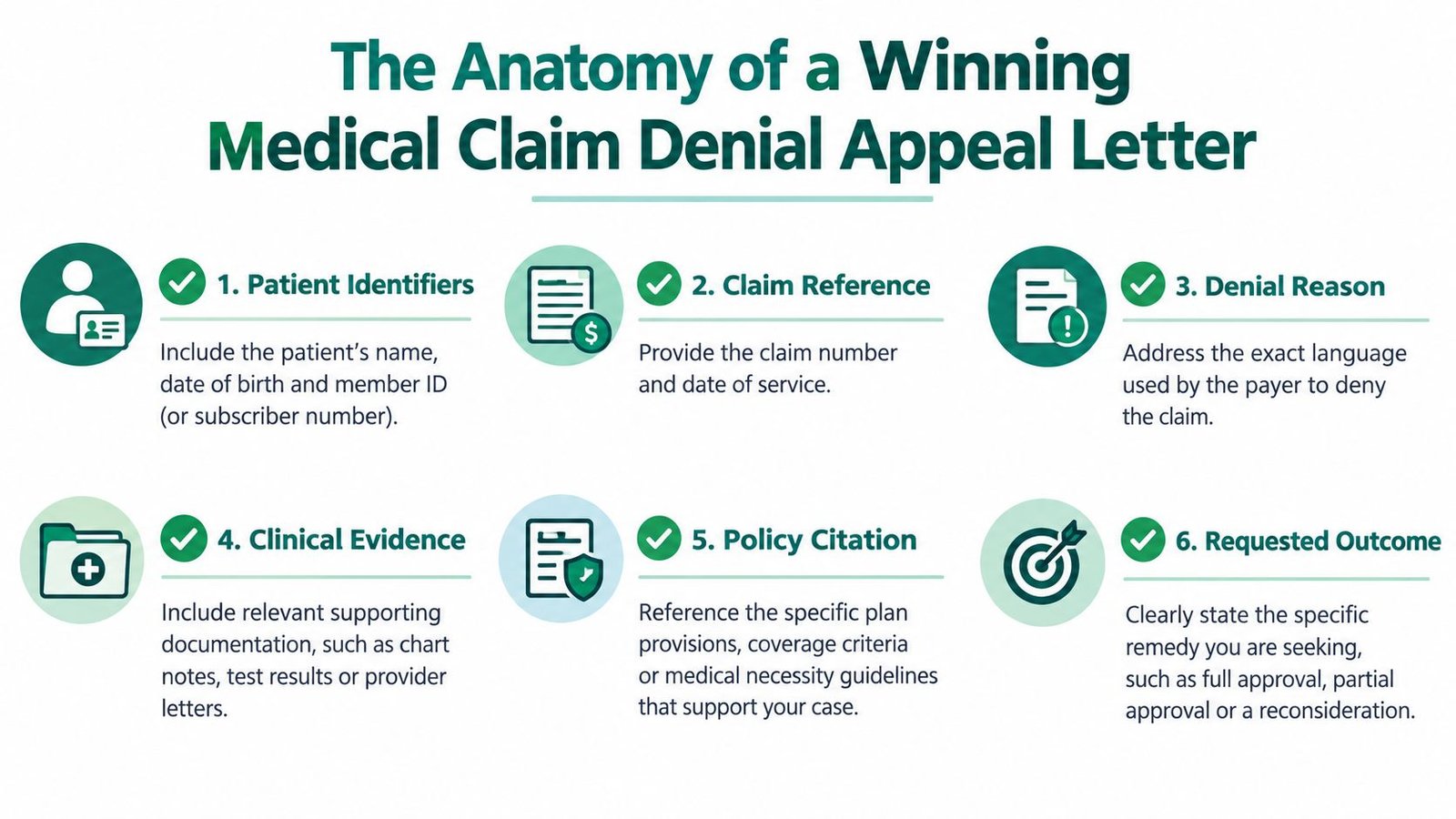
The Anatomy of a Winning Medical Claim Denial Appeal Letter
A reviewer should be able to understand the case without searching through the chart or guessing what the practice wants. Build the letter in the order below, then place the supporting records behind it as a numbered evidence packet.
Start with identifiers and the exact denial
1. Precise identifiers. Include the patient's full name, date of birth, member ID, claim number, dates of service, provider name, NPI, practice contact information, and the CPT, HCPCS, and ICD-10 codes under review. These fields prevent the payer from attaching your argument to the wrong claim. Practical tip: use template variables, but validate every variable against the EOB and claim record before submission.
2. Denial specifics. State the denial date, EOB or remittance date, denial code, and the payer's reason verbatim. Don't paraphrase “not medically necessary” into a broader argument about fairness. Request the coding or clinical rationale if the notice gives only a vague explanation. Practical tip: copy the relevant denial language into the subject line or opening paragraph so the reviewer knows exactly what is being challenged.
Turn the dispute into a documented argument
3. Clinical and contractual argument. Tie each denial reason to a short rebuttal. Reference progress notes, imaging, lab results, operative reports, prior authorization records, the plan's medical policy, and any applicable Medicare LCD or NCD. The guide to reading an Explanation of Benefits can help your team distinguish the claim status, adjustment, patient responsibility, and denial explanation before drafting. Practical tip: embed the relevant policy citation instead of attaching an uncited policy document and expecting the reviewer to find the answer.
4. Exhibit list. Number the enclosures and reference them in the body. A focused packet might include the EOB, claim form, relevant chart notes, physician letter, authorization, policy excerpt, and objective test results. Practical tip: label exhibits and pages, and send only records that support the disputed service.
Ask for a remedy and preserve escalation rights
5. Requested action. State exactly what you want: overturn the denial, reprocess the claim, and pay the service at the contracted or otherwise applicable rate. Include the billed or disputed amount when the record supports it. Practical tip: use “reprocess and pay” language rather than “please reconsider,” which leaves the remedy vague.
6. Escalation clause. Identify the next review level and the deadline stated in the plan documents. Explain that the practice will request external review or pursue the applicable regulatory remedy if the payer upholds the denial or fails to respond. Practical tip: calendar the next deadline when the first appeal is submitted, not after the decision arrives.
The letter should be concise, factual, and easy to route. A reviewer doesn't need an emotional narrative. The reviewer needs a traceable connection between denial reason, evidence, policy, and requested payment.
Three Ready-to-Use Appeal Letter Templates for Common Denial Scenarios
The right template depends on the denial. A clinical-necessity dispute requires records and policy criteria. A timely-filing dispute lives or dies on submission evidence. An out-of-network underpayment requires a reimbursement methodology and contract or statutory argument. These templates are starting points, not substitutes for reviewing the plan documents.
| Denial Scenario | Typical $ at Stake | Core Argument | Statutory/Contractual Hook |
|---|---|---|---|
| Clinical necessity | Claim-specific | The service met the payer's stated clinical criteria | Plan medical policy, LCD, NCD, or contract |
| Timely filing | Claim-specific | The claim was submitted within the applicable window | Plan filing provision and submission proof |
| OON underpayment | Claim-specific | Payment doesn't reflect the applicable rate methodology | Contract, state law, Fair Health or UCR support, and applicable No Surprises Act process |
Template A, generic clinical necessity appeal
Subject: Formal Appeal of Medical Necessity Denial, Claim [number], DOS [date]
Dear [Payer Appeals Department]:
[Practice name] formally appeals the denial dated [denial date] for [patient name], member ID [member ID], claim [claim number], for services provided on [date of service]. The denial states: “[insert the payer's exact denial language].”
The service billed under CPT/HCPCS [code], with diagnosis [ICD-10 code and description], met the applicable medical-necessity criteria because [state the patient's condition, objective findings, treatment history, and reason the service was required]. The enclosed records show [identify the specific progress note, imaging result, laboratory finding, operative report, or other evidence]. The applicable policy provision is [policy name and section], which addresses [criterion]. The patient met that criterion because [short, factual explanation].
Please overturn the denial, reprocess claim [number], and issue payment at the applicable contracted rate. If the plan continues to question medical necessity, please refer the matter for medical-director or qualified peer review.
Exhibits:
- Denial notice or EOB
- Claim form or remittance detail
- Relevant clinical records
- Treating physician statement
- Applicable payer policy, LCD, or NCD excerpt
- Diagnostic results and other supporting evidence
Sincerely,
[Physician name, credentials]
[NPI]
[Practice name and contact information]
Template B, timely-filing appeal with proof of submission
Subject: Timely-Filing Appeal, Claim [number], DOS [date]
Dear [Payer Appeals Department]:
We appeal the timely-filing denial dated [denial date] for claim [claim number], patient [patient name], member ID [member ID], and date of service [date]. The claim was submitted on [submission date] through [clearinghouse, payer portal, fax, or mail], within the filing period stated in the applicable plan documents.
Enclosed proof includes [clearinghouse acceptance report, payer portal confirmation ID, fax confirmation sheet, certified-mail receipt, or other evidence]. The submission record identifies the claim as [claim reference], transmitted to [payer or destination], and accepted or received on [date and time if shown]. If the payer disputes receipt, please provide the payer's internal receipt timestamp and the specific contractual provision supporting the denial.
Please overturn the timely-filing denial, reprocess claim [number], and issue payment at the applicable rate. We reserve the right to pursue the next appeal level and any available regulatory review if the claim isn't reprocessed.
Exhibits:
- Denial notice or EOB
- Original claim record
- Clearinghouse or portal confirmation
- Fax confirmation or certified-mail documentation, if applicable
- Corrected claim or resubmission record, if relevant
- Applicable filing-limit provision
Sincerely,
[Authorized representative or physician]
[Practice, NPI, contact information]
Template C, out-of-network underpayment appeal
Subject: Out-of-Network Underpayment Appeal, Claim [number], DOS [date]
Dear [Payer Appeals Department]:
[Practice name] appeals the payment issued for [patient name], member ID [member ID], claim [claim number], for CPT/HCPCS [code] provided on [date of service]. The payer allowed or paid [amount], while the billed amount was [amount]. The remittance does not adequately explain the reimbursement methodology or the basis for the payment.
The enclosed documentation supports reimbursement consistent with the applicable plan terms and the relevant out-of-network methodology. We request that the payer identify the fee schedule, benchmark, contract provision, or other calculation used to determine payment. We also enclose [Fair Health benchmark, UCR documentation, operative report, medical record, itemized claim, and patient cost-sharing information] supporting the requested amount of [amount].
Please reprocess the claim and issue the unpaid balance according to the applicable contract, state requirements, and federal requirements where they apply. If the plan maintains the payment, please treat this letter as a request for the next formal review and provide the instructions and deadline for any available external or No Surprises Act dispute process.
Exhibits:
- EOB or remittance advice
- Original claim
- Medical records supporting the service
- Fair Health or UCR documentation
- Applicable plan or contract language
- Itemized calculation of the disputed amount
- Prior authorization or referral records, if relevant
Sincerely,
[Physician or authorized representative]
[Practice, NPI, contact information]
For related documentation workflows, a PatientNotes referral letter guide offers useful background on organizing provider-facing correspondence. Keep the claim form and supporting identifiers consistent with the submitted appeal packet, using the medical claim form resource as a reference point for the underlying claim data.
Deadlines, Submission Method, and the Proof of Receipt Playbook
A perfect appeal submitted late is usually a failed appeal. Start by identifying the payer type, the denial date, the date the practice received the notice, and the deadline printed in the plan's appeal instructions. Don't apply a commercial-payer assumption to Medicare, Marketplace, Medicare Advantage, or a state-specific process.
| Payer Type | First-Level Appeal Deadline | Expedited Window | Recommended Channel | Proof Artifact |
|---|---|---|---|---|
| Medicare Part B fee-for-service | 120 days from receipt of the remittance advice listing the initial determination, according to CMS Medicare appeals guidance | As soon as possible, subject to the applicable process | MAC or Medicare portal, or the prescribed redetermination channel | Portal confirmation, remittance record, fax confirmation, or mailing receipt |
| Commercial medical plans | Check the plan notice. Many ACA-market rules provide at least 180 days for an internal appeal | Urgent appeals must be handled as soon as possible and no later than 72 hours, under CMS appeals guidance | Payer provider portal, Availity where accepted, fax, or certified mail | Confirmation ID, timestamped portal screen, fax report, or return receipt |
| ACA Marketplace consumer appeal | Marketplace eligibility appeals generally have a 90-day window, while internal coverage appeals generally have at least 180 days, according to CMS Marketplace appeal materials | Use the notice's urgent process | Marketplace or payer channel specified in the notice | Electronic confirmation, fax report, or certified-mail record |
Medicare Part B redetermination has a distinct operational rule. CMS presumes receipt 5 days after the notice date unless evidence shows later delivery, so track the remittance date and the date your practice received it. CMS also describes five Medicare appeal levels, and the first-level redetermination has no monetary threshold. CGS advises placing the appeal form on top of the submission and sending supporting documentation with the request.
Use the payer's required address or portal. For paper, certified mail with a return receipt creates a stronger record than ordinary mail. For time-sensitive cases, a fax confirmation or portal acknowledgment is generally easier to retrieve than a paper receipt.
Receipt playbook: Save the confirmation number, screenshot the portal acknowledgment, retain the fax confirmation, attach the certified-mail return receipt to the claim file, and set a follow-up tickler.
The UnitedHealthcare timely-filing limits resource can support payer-specific workflow checks, but your staff should always verify the actual plan notice. Maintain a deadline log with the appeal level, submission channel, evidence location, and next escalation date.
Common Appeal Letter Mistakes That Cost Practices Real Money
The most expensive appeal errors are procedural, not dramatic. They happen when a team treats the letter as administrative paperwork instead of a revenue-recovery document.
Generic form-letter language
Copying a form letter and changing only the patient name creates a fast rejection when the argument doesn't address the actual contract clause or denial code. On a $2,500 claim, the immediate exposure is the full disputed amount, followed by additional A/R aging while the practice submits a corrected argument. The remedy is simple: quote the denial, identify the exact CPT and ICD-10 combination, and answer the stated rationale with evidence.
Missing supporting exhibits
A letter that says “medical records are available upon request” makes the reviewer do extra work and often leaves the case unsupported. Include the EOB, relevant chart notes, physician statement, authorization, policy excerpt, and objective records that prove the disputed point. If the reviewer upholds the denial because the packet is incomplete, the practice loses another opportunity to recover the $2,500 claim without changing the underlying clinical facts.
Using the wrong appeal level or destination
Sending a provider appeal to patient advocacy, or requesting peer-to-peer review when the plan requires a written redetermination, doesn't preserve the same rights as a correctly routed formal appeal. The claim can sit untouched while the deadline approaches. Verify the appeal address, form, level, and submission method in the denial notice before anyone signs the letter.
Missing the filing window
A late appeal can convert a clinically valid claim into a contractual write-off. For a $2,500 claim, that isn't a minor administrative mistake. It is a direct loss of collectible revenue, plus the staff cost of investigating why the deadline was missed. Capture the deadline when the EOB arrives, assign an owner, and escalate internally before the final week.
A denial-code dashboard should show the payer, reason code, CPT or HCPCS, provider, date of service, dollars at risk, appeal status, and root-cause category. The medical billing denial codes reference guide for practice owners is useful for building that review, but the appeal still must respond to the specific language on the individual remittance.
Escalation Ladder After Your Appeal Is Denied
An upheld appeal isn't the end of the process. It is a decision point. Read the determination letter, identify the next available level, preserve the existing evidence packet, and add only the documentation needed to answer the new rationale.
Internal review comes first
For commercial claims, follow the plan's formal internal appeal process and use the deadline in the adverse determination notice. Pre-service and post-service timing can differ, and urgent cases have separate handling requirements. Medicare Part B follows its own redetermination process, with the 120-day filing period described earlier, so don't route an Original Medicare claim through a commercial-plan workflow.
Independent external review
If the plan upholds the internal appeal and the denial qualifies, request review by an independent review organization. Washington's insurance regulator explains that an independent review organization may be requested when an insurer doesn't change its decision after internal appeal. Healthcare.gov's internal appeal guidance also emphasizes following the plan's instructions and preserving proof of submission.
For Marketplace coverage, CMS states that external review may cost up to $25 and that the insurer must accept the reviewer's decision, subject to the applicable process. Check the denial notice for eligibility, timing, and the correct request form.
Regulatory and judicial options
A state Department of Insurance complaint is useful when a fully insured plan ignores its own process, misstates appeal rights, or repeats a pattern of questionable handling. The complaint should contain the denial, appeal, response, policy language, proof of receipt, and a concise chronology. It shouldn't just repeat the clinical narrative.
For an ERISA plan, counsel may evaluate a civil action under ERISA §502(a)(1)(B). The governing plan, funding arrangement, exhaustion requirements, administrative record, and applicable limitation period matter. Don't assume that a general internet deadline applies to every plan.
Small claims court may be practical for a fully insured, non-ERISA plan when the disputed amount falls within the state threshold and the contract permits that route. Have counsel confirm jurisdiction, standing, assignment issues, and whether the practice can sue directly.
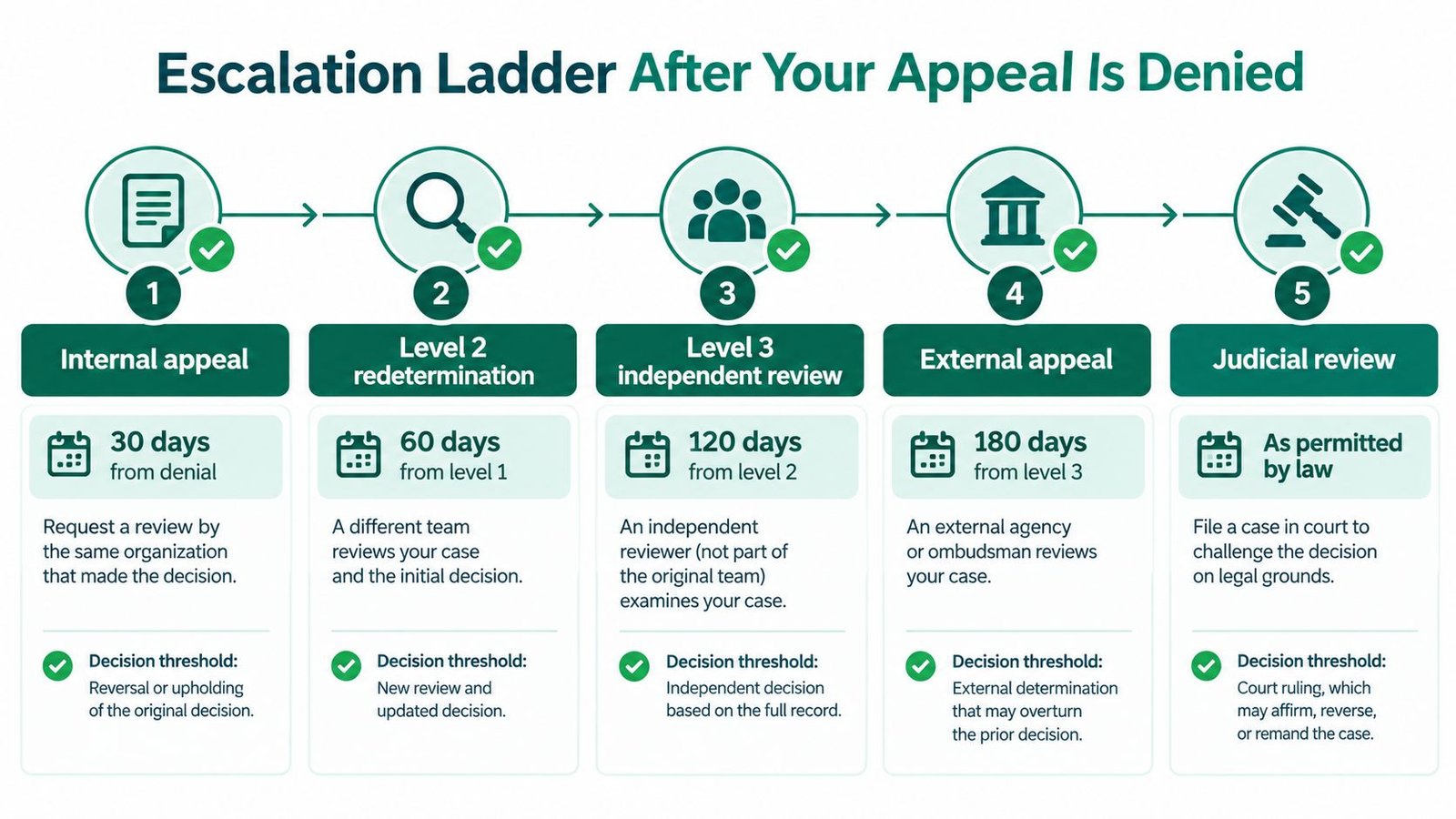
Escalation principle: Don't re-argue the entire claim from scratch. Carry forward the identifiers, denial, exhibits, receipt proof, and prior decision, then answer the reason the payer gave for upholding the appeal.
Practice Owner FAQs and Next Steps to Recover Lost Revenue
How long does a medical claim appeal take?
The answer depends on payer type, appeal level, and whether the case is urgent. I track the submission date, expected decision date, and next escalation deadline separately, because a claim can remain active even when the payer's response is slow.
Should we bill the patient while the appeal is pending?
Don't transfer disputed responsibility to the patient without checking the plan, state law, contract, and patient financial policy. Hold or communicate the balance according to those requirements, while documenting that the practice is pursuing payer responsibility.
What should we do when the EOB is vague?
Request the denial rationale, applicable policy provision, and any missing coding or clinical explanation in writing. A vague notice is not a reason to send a generic appeal. It is a reason to identify the exact information the payer used and answer it directly.
How should we track denials by reason code?
Use a dashboard that connects each denial to payer, CPT or HCPCS, ICD-10, provider, dollar amount, deadline, appeal level, submission proof, and outcome. I look for repeated combinations, because a recurring denial may justify a workflow, authorization, documentation, or contract review rather than another isolated letter.
When should a practice bring in a specialty RCM firm?
Bring in outside expertise when appeals are aging, deadlines are being missed, staff can't reconcile remittance codes to payer policy, or physicians are pulled into repetitive administrative work. The right partner should show how it prioritizes dollars, protects filing rights, and reports recovered A/R by payer and denial reason.
How do we quantify recovered revenue?
Measure dollars appealed, dollars overturned, dollars paid, days from denial to payment, and the percentage of appeals rejected for procedural reasons. Separate true clinical or contractual losses from preventable process failures. That tells you whether the problem is payer behavior, documentation quality, submission discipline, or internal claim production.
Happy Billing provides denial management, A/R recovery, and specialty-focused RCM workflows that turn appeal packets into tracked revenue-recovery work. Start with a free denial audit to identify missed deadlines, weak documentation, and payer-specific leakage, then visit Happy Billing to discuss a practical path to cleaner claims and faster cash flow.