Internal Medicine Billing Services That Lift Revenue

Internal medicine billing services can lift revenue when they correct documentation-driven underpayments before claims leave the practice. An internal-medicine resident-clinic study found that 55% of encounters were underbilled by an average of $45.26, while 18% were overbilled by an average of $51.29, and appropriate coding remained below half even among senior residents. The documented billing benchmark shows why a practice owner should treat coding accuracy, denial prevention, and A/R follow-up as one financial system, not separate administrative tasks.
The practical question isn't whether a vendor can submit claims. It's whether the vendor can protect payable E/M intensity, capture chronic-care work, prevent modifier denials, and remove aged balances without creating compliance exposure. The playbook below focuses on the places where internal medicine practices lose money, then shows how to evaluate, price, onboard, and monitor an RCM partner.
Where Internal Medicine Revenue Quietly Leaks
An accepted claim can still be underpaid. A visit that supports 99214 but leaves the office as 99213 usually clears the payer's edits, receives the lower payment, and disappears from the work queue. The loss remains hidden unless someone compares the note, submitted level, and payer allowable. Because contracts and localities differ, practice owners should measure their own gap instead of applying a universal dollar estimate.
Internal medicine visits often address several chronic conditions at once. Under office and outpatient rules, the level may be selected by medical decision making or total time. CMS defines MDM through the number and complexity of problems addressed, the amount and complexity of data reviewed and analyzed, and the level of risk. The documentation must support at least two of those three elements. CMS's E/M guidance shows why vague descriptions of acuity, test review, or treatment risk can reduce payable E/M intensity.
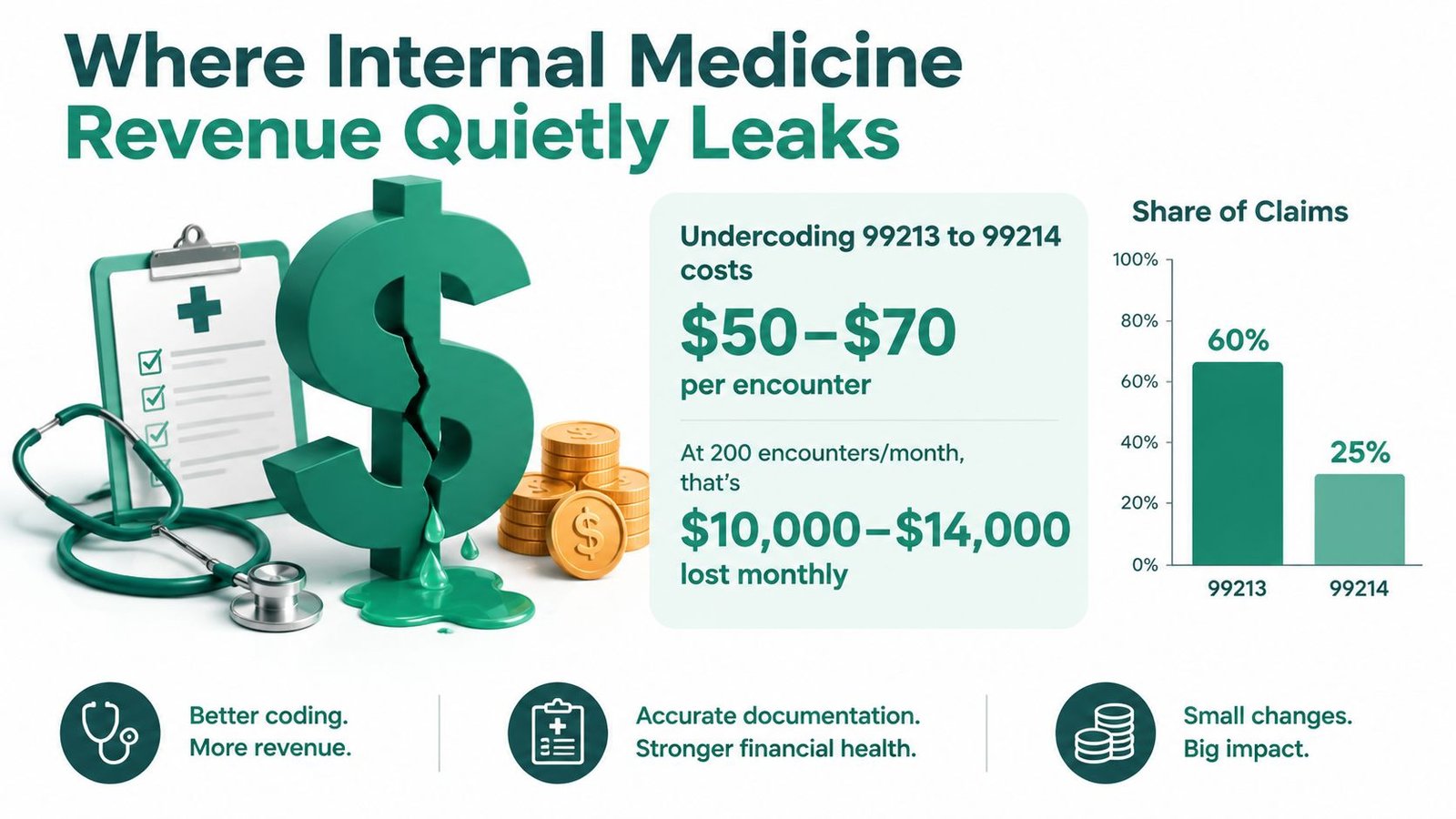
Four leakage points deserve an owner-level audit
- E/M undercoding: Review 99213, 99214, and 99215 by physician, payer, diagnosis mix, and visit type. The billing partner should compare each submitted level with documented MDM or time, rather than force a preferred distribution. That review identifies recoverable reimbursement without encouraging unsupported coding.
- Modifier 25 errors: An office E/M performed with an injection, minor procedure, or other service is separately payable only when it is significant and separately identifiable. CMS guidance requires the modifier to reflect a distinct E/M service on the same day as the procedure. Incorrect use can remove the E/M payment or create appeal work. The owner's trade-off is clear: a careful edit may delay a small number of claims, while indiscriminate modifier use creates denials and audit exposure.
- Uncaptured CCM and TCM: Chronic-care coordination and post-discharge work require eligibility checks, consent, care-plan support, contact records, and time documentation. Same-day chronic-care services create another trap. The practice must apply the applicable exclusion logic before billing an E/M for overlapping work. Disconnected workflows can leave the practice performing billable work without a defensible claim.
- Weak denial follow-up: A rejection corrected the same day is routine work. A clinical, medical-necessity, modifier, or payer-policy denial left in an aging queue delays cash and can become unrecoverable. Separating denial categories lets staff fix the workflow causing the loss instead of repeatedly resubmitting claims.
Medicare's audio-only rules also require a current check. The audio-only modifier 93 sunset for Medicare, so a workflow built around that modifier can produce avoidable denials if staff do not confirm the payer's active telehealth requirements.
The fix is a controlled process that reviews notes, validates eligibility, scrubs claims, tracks payer responses, and returns recurring errors to physicians and staff. A historical compliance-focused internal medicine billing program recorded gross collection-rate increases of 7.3% for the practice and 9.5% for the department in 1998–99. The historical benchmark remains useful as a reminder that documentation, compliance, and charge capture can improve collections together. The owner should judge the program by dollars recovered and days removed from A/R, not by a higher code mix alone.
What an Internal Medicine Billing Service Actually Does
A full-cycle service starts before the claim exists. It verifies coverage, checks patient and payer data, confirms authorization requirements where applicable, maps the EHR encounter to billable charges, applies coding edits, submits through the clearinghouse, posts payments, and works unpaid balances. The value comes from the handoffs between those functions.
Eligibility verification protects the first dollar. If coverage is inactive or the payer record is wrong, the practice may provide care before discovering that the claim has nowhere reliable to go. Charge capture then reconciles the physician's completed encounter, orders, injections, wellness services, and care-management activity against the practice-management system. The vendor shouldn't depend on a manually maintained spreadsheet when the EHR and PM system can exchange structured charge data.
The encounter-level work owners should expect
| Component | Typical CPTs | Approx. Reimbursement |
|---|---|---|
| Office and outpatient E/M | 99202–99215 | Payer-specific, based on documented MDM or total time |
| Annual wellness visits | G0438, G0439 | Payer-specific Medicare and commercial allowables |
| Chronic care management | 99490, 99491, 99437, 99439 | Payer-specific, dependent on eligibility and documentation |
| Transitional care management | 99495, 99496 | Payer-specific, dependent on qualifying transition and required follow-up |
| Remote physiologic monitoring | 99457 | Payer-specific, dependent on service and documentation rules |
The table isn't a fee schedule. It's a control map. A competent vendor can tell you which services are routinely captured, which require physician action, and which are excluded or bundled under a particular payer policy.
Claims scrubbing should catch invalid combinations, missing modifiers, diagnosis-code conflicts, eligibility problems, and payer-specific edits before submission. A/R staff then work the claim after adjudication, using payer portals, remittance codes, appeal deadlines, and medical-record documentation. A vendor that only transmits claims isn't managing your revenue cycle. It's performing one transaction inside it.
Keep clinical documentation and care delivery in-house. The RCM partner can identify missing consent, unsigned notes, absent time logs, or incomplete plans of care, but physicians and authorized clinical staff must supply the underlying information. That division preserves accountability while keeping the owner's team focused on care rather than repetitive payer administration.
The Three Billing Traps That Cost Internal Medicine Practices the Most
Internal medicine revenue often slips through repeated, ordinary decisions rather than one dramatic billing failure. Each missed level, unsupported modifier, or excluded care-management claim costs recoverable dollars and adds days to A/R work.
The visit that stays at 99213
A physician documents several chronic problems, reviews outside results, adjusts prescription management, and discusses a meaningful risk decision. Staff still submit 99213 because the practice defaults to the familiar lower level. The coding review should assess the number and complexity of problems, data reviewed, and management risk, then confirm that at least two MDM elements support the selected level, as outlined in CMS's office E/M rules.
The dollars at stake vary by payer mix and contracted allowables. A retrospective audit by physician and payer shows where undercoding occurs. Documentation prompts can then capture active problems, reviewed data, and management risk without encouraging unsupported upcoding. That work can recover revenue on future encounters and reduce repeated chart queries.
The modifier 25 claim that should not have been filed
An internist performs an injection during a brief, procedure-focused encounter. Staff append modifier 25 to an E/M code even though the note does not show a separate evaluation and management service. The payer denies or downcodes the E/M, leaving the practice with appeal work for a claim that lacked the required distinction.
Modifier 25 applies to a significant, separately identifiable E/M service performed on the same day as another procedure or service. The workflow fix is direct: require a separate assessment and plan for the additional problem or service, then have the coding queue validate that documentation before submission. A clear edit prevents avoidable denials and saves staff time otherwise spent on appeals.
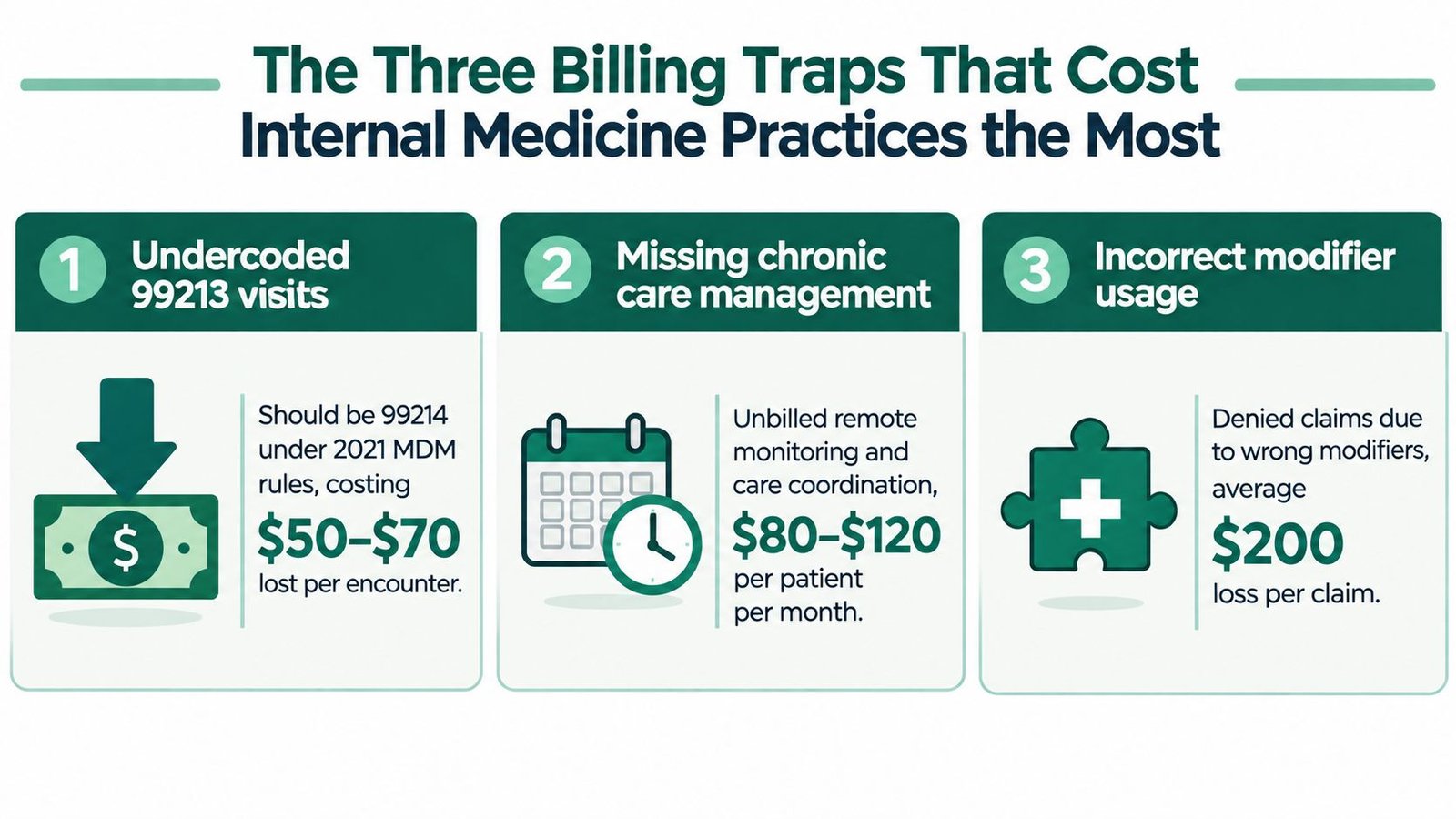
Chronic-care work collides with same-day E/M
A patient may receive an office visit while the care team records chronic-care activity for the month. Staff sometimes treat every logged minute as separately billable, overlooking distinct documentation requirements and exclusion logic. Duplicate time, missing consent, or an incomplete care plan can cause denials, recoupments, or claims that should never have been submitted.
The practice owner needs a service calendar showing the billable service, responsible staff, qualifying time, and relationship to any same-day E/M or TCM service. Payer-specific edits matter because generic code lists may miss exclusion rules. The same review should cover audio-only encounters, including Medicare's recent sunset of modifier 93, so the billing team does not repeat an outdated submission pattern.
For recurring denial categories, consult common medical billing denial patterns. A focused denial taxonomy helps prioritize fixes by dollars recovered and days removed from follow-up queues.
Practical rule: Do not treat a documented minute as billable until the patient, consent, service, time record, care plan, and payer rule align.
How to Evaluate an Internal Medicine Billing Vendor
Start with evidence, not a polished sales presentation. On the discovery call, ask for blinded E/M distribution curves showing 99213, 99214, and 99215 by provider, along with denial performance separated by payer. A vendor that cannot explain how it identifies abnormal patterns may be submitting clean-looking claims while missing accepted underpayments.
Then request a scrubber demonstration using a sample of your own recent charts. Ask the team to explain how it handles modifier 25, modifier 59, annual wellness visits, and chronic-care or principal-care overlap. The demonstration should show both the edit and the resolution path. A warning without an owner, deadline, and escalation rule is not a control.
Questions that expose operating depth
- Who codes the chart: Confirm that certified professionals, such as CPC or CCS coders, review specialty-specific work. “Trained billers” isn't the same assurance.
- Who owns denials: Ask for the top denial reasons, payer segmentation, appeal ownership, and aging by denial category.
- Who protects the data: Require a documented HIPAA Business Associate Agreement, security documentation, named security contacts, and evidence of SOC 2 Type II or HITRUST controls where applicable.
- Who has done this before: Speak with a comparable internal medicine practice using a similar EHR, payer mix, and panel profile.
Reference checks should address failures, not just successes. Ask how the vendor handled a clearinghouse outage, payer recoupment, physician documentation resistance, and open A/R inherited from a prior company. Those answers reveal more than a generic client list.
Finally, read the exit clause before signing. The practice should retain ownership and access to claims data, aging reports, credentialing files, remittance history, and appeal documentation. These questions for a medical billing company give owners a useful due-diligence checklist, but the contract still needs practice-specific language.
Pricing Models and What Each One Really Costs
Pricing is only comparable when the service scope is comparable. A low percentage can exclude coding audits, patient statements, credentialing, appeals, or EHR integration, while a higher fee may include the work that recovers cash.
| Pricing Model | Typical Rate | Best-Fit IM Practice Profile | Watch For |
|---|---|---|---|
| Percentage of collections | 5%–8% | Stable practice with predictable collections and established workflows | Excluded services, collection definitions, and percentage applied to refunds |
| Flat per claim | $3–$8 | High-volume practice seeking predictable transaction costs | More claims can mean more cost, even when reimbursement is low |
| Per encounter | $20–$45 | Lower-volume or concierge-style panel | Whether procedures, CCM, TCM, and corrected claims count separately |
| Hybrid | Base fee plus reduced percentage | Practice changing vendors or rebuilding a weak RCM stack | Minimums, implementation charges, and termination fees |
The figures above are pricing ranges specified for this comparison, not universal market rates. Owners should model them against monthly collections, claim volume, payer mix, and the number of services requiring manual follow-up. A percentage model tends to align incentives with collections, but it can become expensive as revenue grows. A per-claim model feels predictable, but it doesn't automatically reward a vendor for recovering complex A/R.
For a simple breakeven comparison, a 6% percentage fee equals a $6 per-claim fee when monthly collections divided by claim count produce $100 per claim. Below that average collection per claim, the percentage model costs less; above it, the per-claim model costs less, assuming both include the same services. That calculation is useful only after defining whether corrected claims, zero-pay claims, secondary claims, and patient balances are included.
Look for separate charges for claim scrubbing, statements, postage, credentialing, EHR integration, appeals, and termination. Vendors that won't disclose the percentage in writing or demand a three-year lock-in deserve heightened scrutiny. A practical outsourcing cost guide can help structure the comparison, but your contract should state every fee.
Onboarding Without Claim Disruptions
A billing transition fails when the new vendor treats go-live as a switch rather than a controlled handoff. Protect cash flow by moving ownership in stages and preserving access to every open claim.
Week one establishes control
Hold the kickoff, execute the Business Associate Agreement, transfer credentialing files, and review payer enrollment status for every provider. Confirm payer identifiers, remittance destinations, portal access, fee schedules, and outstanding enrollment problems before the vendor touches live claims.
Week two tests the data
Give the vendor read-only EHR access first. Run a charge-lag audit, capture a baseline A/R aging snapshot, and perform parallel coding on the last 60 encounters. The comparison should identify differences in E/M level, diagnosis specificity, modifiers, wellness services, and care-management eligibility.
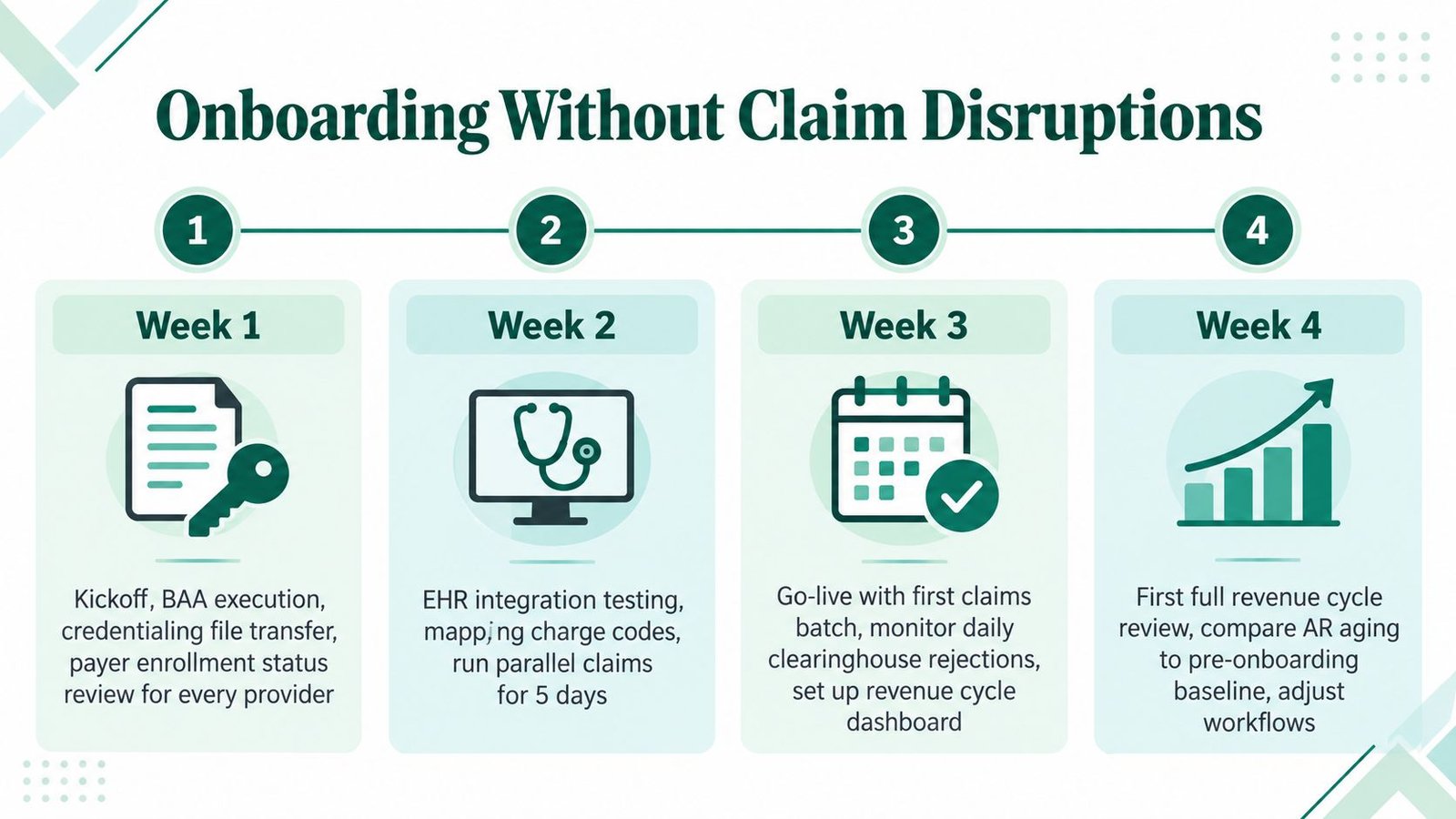
Weeks three and four move the claims
Lock the cutover date, complete clearinghouse re-credentialing, and confirm ERA and EFT rerouting with each payer. Use a 14-day dual-submission window only under a written protocol that prevents duplicate claims. During week four, assign a dedicated denial queue, reconcile cash daily, and hold a weekly KPI review.
Put continuity rules in writing:
- Prior A/R: State who works balances from the prior 90 days, including appeal deadlines and payer follow-up.
- Patient statements: Decide whether statements pause, continue under the incumbent, or move to the new vendor.
- In-flight appeals: Transfer records, submission dates, payer correspondence, and next-action owners.
- Cash controls: Reconcile deposits to remittances and identify missing ERAs immediately.
At 30, 60, and 90 days, compare collections, rejected claims, denial aging, charge lag, and A/R distribution with the pre-onboarding baseline. The transition worked only if cash remains continuous and the owner can see which process changed the result.
For provider enrollment dependencies, use this credentialing timeline resource as a planning reference.
KPIs That Tell You Whether the Switch Worked
An owner needs four monthly numbers first: gross collection rate, net collection rate, days in A/R, and first-pass resolution. Each answers a different financial question. Gross collections show what the practice collected against total charges, net collections show performance against collectible revenue, A/R days show how long cash remains outstanding, and first-pass resolution shows how often claims move through adjudication without avoidable rework.
Available RCM benchmarks commonly target a 95% or higher clean-claim rate and a denial rate under 5%, while broader industry references place first-pass denial rates in the 5% to 10% range. The RCM benchmark report connects front-end eligibility and coding accuracy with cash flow and A/R days. Use those benchmarks as operating thresholds, not as proof that a vendor caused every variance.
| KPI | Target | Industry Benchmark | Dollar Impact of 5-Point Lift |
|---|---|---|---|
| Gross collection rate | 95%+ | Strong operations target 95%+ | Depends on allowed revenue and payer mix |
| Net collection rate | Practice-defined, tracked monthly | Compare against internal baseline and contracted allowables | A 5-point lift on a $2.4 million practice equals approximately $120,000 annually |
| Days in A/R | Owner-defined reduction target | Track trend by payer and aging bucket | Fewer days accelerate cash availability |
| First-pass resolution rate | 95%+ | Clean-claim operations target 95%+ | Fewer rework hours and faster reimbursement |
The $120,000 example is arithmetic based on a $2.4 million practice and a five-point lift, not a universal outcome. The KPI tracking guide can help owners organize the dashboard, but the dashboard must show payer, provider, location, and denial-category detail.
At 90 days, review whether rejected claims declined, charge lag shortened, and old A/R received documented action. At six months, examine E/M distribution, modifier-25 accuracy, denial overturns, and the percentage of accounts over 90 days. If a metric improves without collections improving, investigate write-offs, contractual adjustments, and posting accuracy rather than celebrating the surface result.
FAQs for Internal Medicine Practice Owners
What percentage do internal medicine billing services charge?
Internal medicine billing services commonly charge 4% to 9% of collections, depending on volume, payer complexity, coding scope, and denial coverage. Treat that range as a comparison point, not the full cost. Check whether the contract includes claims, statements, credentialing, appeals, EHR integration, and aged A/R. A lower percentage can still cost more if follow-up work is excluded and recoverable dollars remain uncollected.
Does outsourcing billing cost more than keeping it in-house?
An illustrative break-even calculation places the comparison near $28,000 in monthly collections, after accounting for salary, benefits, software, and clearinghouse costs for a trained biller. Your result will vary with staffing, physician count, turnover, and owner oversight. An internal team preserves direct control, while a specialized vendor may provide broader coding and denial coverage. Compare total operating cost with dollars recovered, not the fee percentage alone.
How long does it take to switch billing companies without losing claims?
Based on the onboarding plan described earlier, a transition commonly requires 60 to 90 days. A clean practice may complete the work in six weeks, while disorganized records may require four months. Credentialing, payer access, EHR permissions, clearinghouse setup, open appeals, and inherited A/R determine the schedule. Keep the incumbent engaged until ownership of prior claims, statements, appeals, deposits, and records is documented. That control prevents avoidable payment delays.
Which KPIs should show that outsourcing is working?
Track gross and net collection rates, days in A/R, first-pass resolution, denial rate, charge lag, E/M distribution, and aged A/R. For chronic-care services, documentation and exclusion logic matter as much as claim volume. Review 99490, 99491, 99437, and 99439 for eligibility, consent, care-plan support, time records, and same-day chronic-care versus E/M billing rules.
Review payer outcomes rather than accepting a clean dashboard. Medicare ended reimbursement for non-behavioral-health audio-only office E/M claims submitted with modifier 93 on 30 September 2025. Telephone workflows now require payer-specific review, or otherwise denied claims can erase expected revenue.
Owners building a broader knowledge center can use this guide on how to structure your FAQ page effectively.
Happy Billing provides EHR-integrated full-cycle RCM, coding support, denial management, credentialing, and A/R recovery. Review recent claims and aging with the Happy Billing team to identify documentation, modifier, chronic-care, and payer follow-up leaks before they become write-offs.