No Surprises Act New York: What Practice Owners Must Know
New York practice owners must follow both the federal No Surprises Act and New York's Surprise Bill Law, cannot balance bill patients beyond in-network cost-sharing for protected surprise bills, and must use New York's portal-based IDR process under the state's new 2026 fee and timing rules. The practical consequence is direct: your eligibility checks, disclosures, claim documentation, and dispute deadlines now determine whether out-of-network revenue becomes collectible or ages into unresolved A/R.
A familiar scenario plays out in independent practices every week. The payer sends a payment that doesn't match the service, the patient can't legally be billed for the difference, and the account lands in a workqueue without a clear owner. Meanwhile, the physician sees rising denial volume, an aging receivables report, and a billing vendor that treats the dispute as a paperwork task instead of a cash-flow decision.
We have seen this problem from the owner's side. A surprise-billing claim is not just a compliance file. It affects net collections, denial rate, cash reserves, and days in A/R. The right response is to separate coverage types, identify protected encounters before submission, document every payer interaction, and decide early which disputes justify the time and expense of IDR.
What New York Practice Owners Must Know Right Now
New York operates in a dual compliance environment. The state's Surprise Bill Law took effect on March 31, 2015, and the New York Attorney General later described it as the first law of its kind in the nation. The federal No Surprises Act was signed on December 27, 2020, and took effect on January 1, 2022. Those dates matter because a practice can't use one universal checklist for every out-of-network claim. The applicable pathway depends on the patient's coverage and the service setting. (New York Attorney General overview of surprise-billing protections)
The financial risk appears in ordinary RCM metrics. If a protected account is sent to patient collections, the practice may create compliance exposure while weakening recovery. If the payer payment isn't reviewed promptly, the team can miss a dispute window or lose the documentation needed to establish eligibility. If the claim is coded or authorized incorrectly, the account may become a denial before anyone evaluates whether IDR is appropriate.
Owner-level rule: Treat protected out-of-network claims as payer-recovery accounts, not patient-balance accounts.
The law affects more than emergency departments. Independent anesthesiology, surgical, radiology, pathology, cardiology, orthopedic, gastroenterology, and multispecialty groups can encounter the rules when clinicians provide services at participating hospitals or ambulatory surgical centers. The owner's job is to ensure the front desk, clinical operations, coding review, contracting team, and RCM partner share the same coverage and facility logic.
Start by auditing your current workflow against a focused No Surprises Act compliance guide. Look for three failure points: network status verified after the visit instead of before it, notices stored outside the claim record, and underpayments left in general denial queues without an IDR decision. Those are revenue-control failures, not merely administrative imperfections.
How Surprise Billing Protections Actually Work
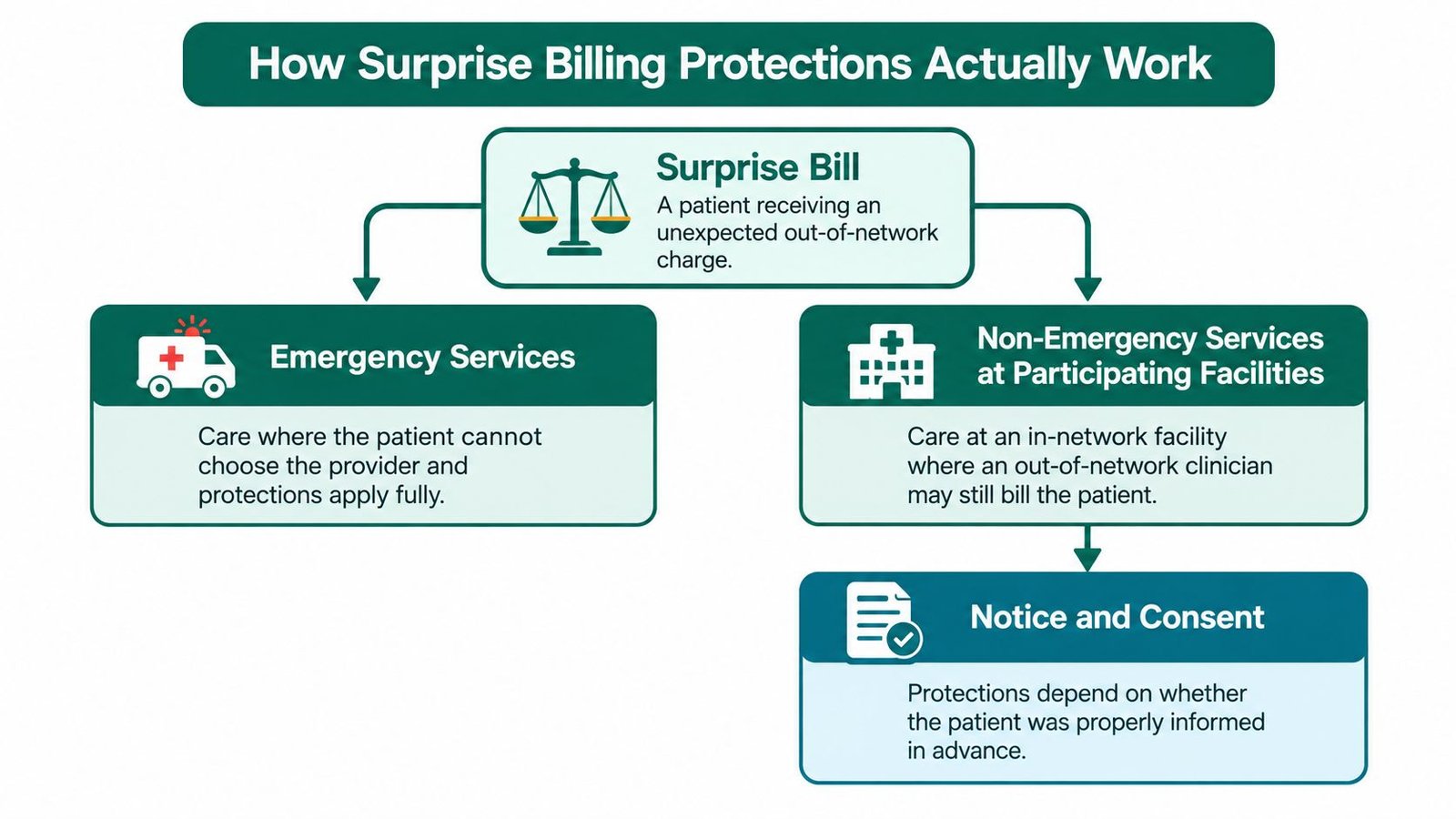
A surprise bill generally arises when a patient receives protected care from an out-of-network clinician without knowingly choosing that clinician. The patient may have selected an in-network hospital or ambulatory surgical center, but the treating professional can still be outside the plan's network. The law shifts the collection problem away from the patient and toward payer payment, provider documentation, and dispute resolution.
The first operational question is where the service occurred. New York's framework addresses out-of-network emergency services and surprise bills connected with participating hospitals or ambulatory surgical centers. In those situations, the patient's financial responsibility is limited, and the provider must pursue the payer through the applicable process rather than billing the patient for the difference. (New York DFS guidance on the Surprise Bill Law and No Surprises Act)
Emergency services
Emergency care presents the clearest protection scenario because the patient generally can't select the clinician in advance. Your workflow should flag the encounter based on the facility, coverage, and service circumstances before the account reaches patient billing. That flag should travel with the claim, payment posting record, correspondence, and any dispute submission.
For an owner, the financial lesson is simple. Patient collections aren't a backup plan for a protected emergency account. The practice must submit a clean claim, monitor the payer's response, and preserve the evidence needed to challenge an inadequate payment.
Non-emergency services at participating facilities
Non-emergency facility-based care requires more careful review. An in-network facility doesn't automatically make every clinician in-network, and an out-of-network clinician doesn't automatically have unrestricted billing rights. Notice and consent rules can affect whether protections apply, so the practice needs a reliable record of what the patient was told, when it was delivered, and whether the required consent was obtained.
Think of the facility as the doorway and the claim file as the security log. The doorway may be in-network, but the claim still needs proof that the service, provider, coverage, and notice pathway align. When that proof is missing, the practice may have difficulty collecting the intended amount from either the patient or the payer.
Federal Law Versus New York Law and Which Applies to You
The first coverage question is whether the plan is fully insured under New York regulation or self-funded under federal oversight. New York's state process protects fully insured New York members and routes eligible disputes through the state IDR system. The federal No Surprises Act IDR process applies to self-funded coverage. New York DFS also states that providers can't bill patients beyond in-network cost-sharing for protected surprise bills and have the right to dispute a health plan's payment through IDR. (New York DFS questions and guidance on the federal No Surprises Act)
A payer-mix report should therefore include more than payer names. It should identify coverage funding, plan type, facility, service category, network status, payment result, and dispute route. Without that segmentation, an owner can't forecast which accounts are recoverable through New York's portal, which belong in the federal process, and which require ordinary payer appeals.
Which Surprise Billing Path Applies in New York
| Coverage Type | Patient Billing Limit | Dispute Path | Key Owner Action |
|---|---|---|---|
| Fully insured New York coverage | Don't bill beyond applicable in-network cost-sharing for a protected surprise bill | New York IDR process | Confirm state eligibility and maintain the complete claim record |
| Self-funded coverage | Don't bill beyond applicable in-network cost-sharing where federal protections apply | Federal No Surprises Act IDR | Identify federal jurisdiction before selecting the dispute workflow |
| Coverage requiring separate review | Apply the rule tied to the coverage and service | Verify the applicable state or federal pathway | Keep payer classification visible to the RCM team |
The difference is more than legal terminology. It changes who reviews the dispute, what portal or process the team uses, what evidence must be assembled, and how long revenue may remain unresolved. A state-oriented workflow applied to a self-funded claim can delay recovery. A federal workflow applied to a state-regulated claim can create avoidable rework.
Owners evaluating an RCM partner should ask whether payer classification happens at registration, claim creation, or only after denial. Compare that discipline with the broader Florida No Surprises Act framework to see why state-specific workflows matter. The point isn't to copy another state's process. It's to reject the assumption that a national template can manage New York's coverage distinctions reliably.
Balance Billing Rules and Patient Disclosure Requirements
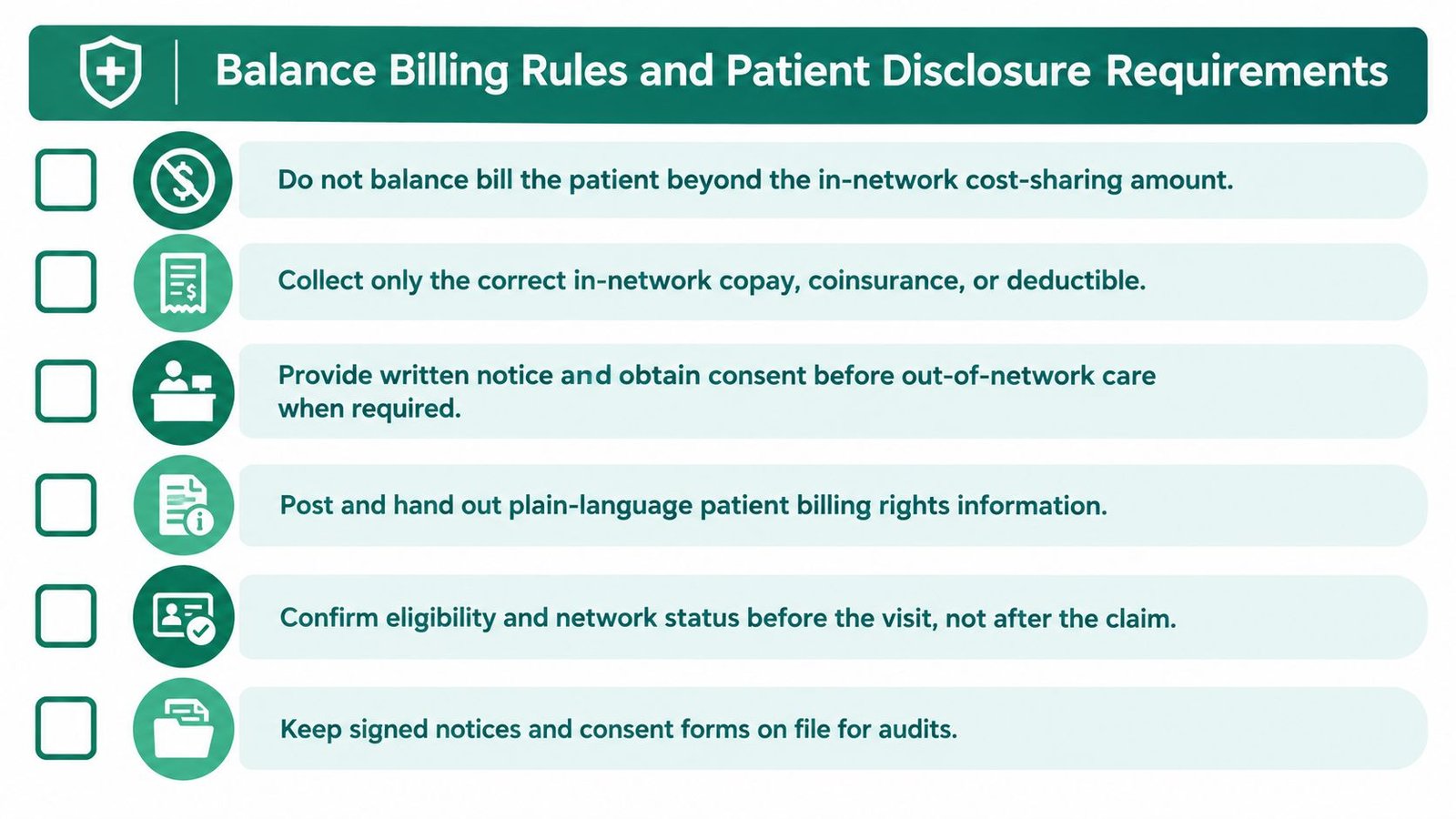
The most important billing rule is also the one practices violate when their systems are poorly segmented. For a protected surprise bill, the patient's responsibility is limited to the applicable in-network copay, coinsurance, or deductible. The remaining payment dispute belongs between the provider and the health plan, not in a patient statement.
That requires a hard stop in the billing system. Don't allow a protected claim to flow automatically from payer underpayment to self-pay balance billing. Route it to a review queue that checks coverage, facility, provider network status, notice records, claim codes, and payment correspondence.
Build disclosure into scheduling
New York guidance says private-practice professionals and diagnostic and treatment centers must disclose participating health plans and affiliated hospitals in writing or through their website, and verbally when scheduling. If the practice doesn't participate in the patient's plan, it must provide an estimate of the amount it would bill, absent unforeseen medical circumstances. (New York Department of Health FAQ on emergency and surprise bills)
That duty should be operational, not theoretical. The scheduling script should identify the plan and facility. The website and written materials should match the current participation list. The patient's chart should retain the notice, estimate, and consent record when applicable.
Tie financial controls to coding
CPT selection and modifier accuracy still matter because a protected claim can fail before it reaches a payment dispute. Anesthesia practices, for example, may need to validate the reported service, base-unit logic, time documentation, and modifiers such as -AA, -QK, -QX, and -QZ when those modifiers apply to the actual professional arrangement and payer policy. A modifier error can produce a denial that no IDR strategy fixes.
The same principle applies to surgical and diagnostic claims. Review modifier -25 for separately identifiable E/M services, modifier -59 and the more specific X modifiers for distinct procedural services, and multiple-procedure rules where relevant. Don't add a modifier to strengthen a dispute. Use it only when the documentation and payer policy support it, because an unsupported modifier weakens both clean-claim performance and credibility in later review.
Use the balance-billing compliance workflow to connect patient-facing disclosure with claim-level controls. The goal is fewer preventable denials, fewer improper statements, and a clearer path to payer recovery.
Independent Dispute Resolution in New York After the 2026 Changes
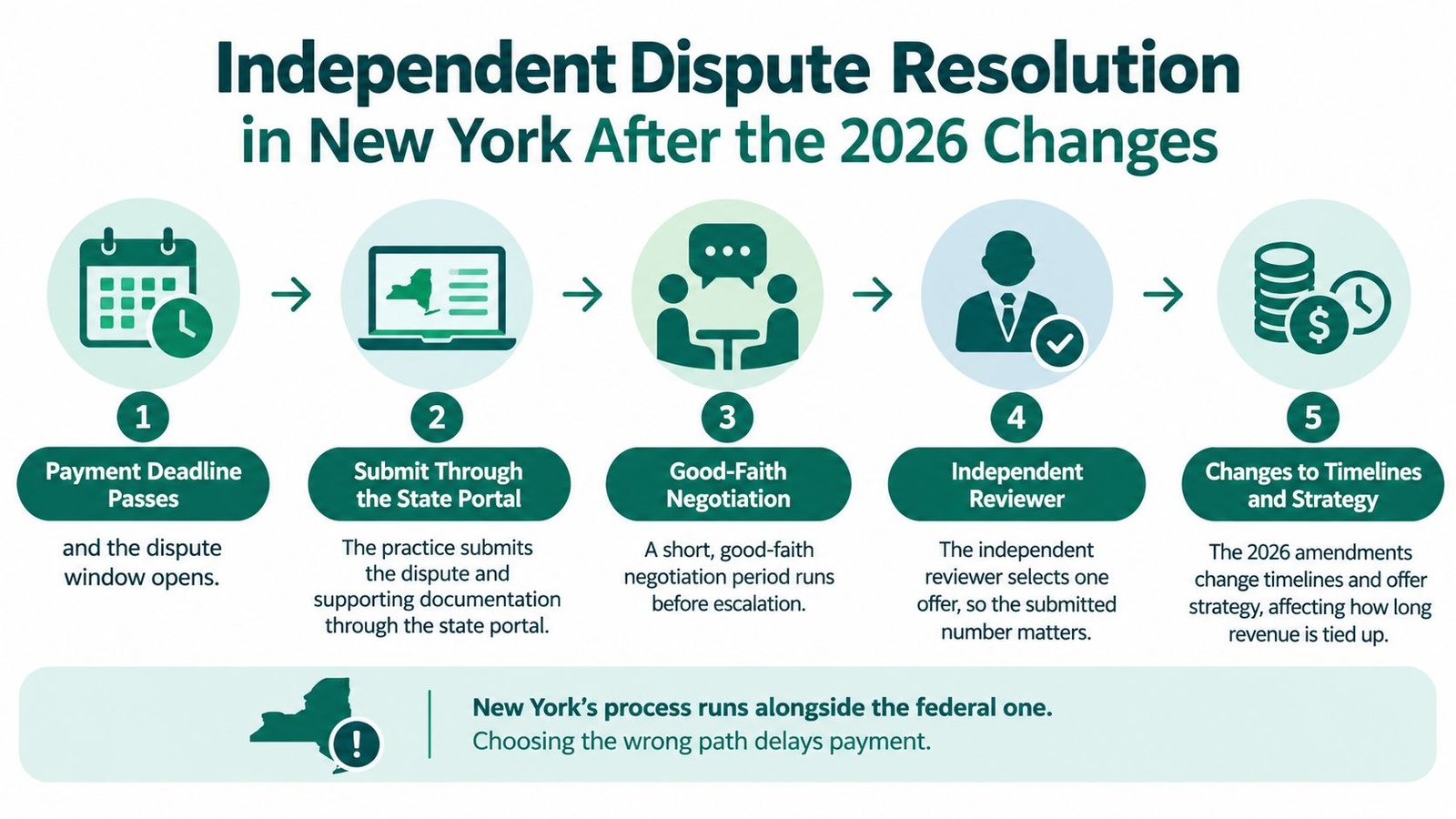
For a New York practice, an IDR filing now affects cash flow before it affects reimbursement. The 2026 amendments require both parties to pay the IDR entity before review, extend decision timing, and require refunds within 30 days after a determination. The amended framework moved the decision window from 30 to 45 business days, excludes Medicaid services, and adds NYSHIP under a different decision standard. (New York DFS announcement on the amended IDR framework)
Owners need an IDR reserve policy tied to payer mix. Each dispute should be screened for expected recovery, evidence quality, fee treatment, and the time revenue will remain tied up. Filing every underpayment can consume staff capacity and cash. Filing too selectively leaves material payer underpayments unchallenged. Use this guide to review the New York IDR process after the 2026 changes before setting your workqueue rules.
The procedural gates
New York providers use a portal-based IDR workflow. The team must confirm that the claim belongs in the state process, submit the application with complete documentation, and pay the required fee to the assigned IDR entity. New York DFS guidance indicates that disputes generally must begin within three years of the plan's original payment, so the original payment date belongs in the claim record and aging controls. (New York DFS rights and responsibilities for insured members and providers)
Run each candidate dispute through five checkpoints:
- Payment review: Confirm the payment, denial, coverage type, facility, and applicable pathway.
- Eligibility file: Assemble the claim, remittance, notices, consent records, correspondence, and supporting clinical or service documentation.
- Portal submission: File through the correct New York process and pay the required fee before review.
- Offer strategy: Submit a defensible position based on the record, not an inflated figure detached from the service.
- Post-determination control: Track the decision and confirm any required refund within the applicable 30-day period.
The federal fee change also affects filing economics. The federal IDR administrative fee fell from $115 to $15 per party per dispute, according to the provided industry data, while New York retains separate payment and timing rules. The lower federal fee may change filing volume, but it does not replace claim classification or evidence review. (Industry summary of No Surprises Act dispute activity and federal fee context)
Cash-flow recommendation: Approve an IDR filing only after the team records the coverage route, recovery rationale, documentation status, fee treatment, and aging impact in one claim-level summary.
Create a separate Medicaid workqueue. New York's 2026 budget changes removed Medicaid services from the state IDR statute, so the state IDR process and payment standards do not apply to services covered by the NYS Medicaid Program. NYSHIP was added with its own standard, making payer classification a direct dispute-strategy decision.
Documentation and Billing Workflows That Protect Revenue
A payment can look correct in the ledger and still be a lost recovery opportunity. New York's framework provides a formal IDR route after a health plan payment, but that route depends on the plan following the statute's notice and payment requirements. Store payer correspondence and service documentation with the claim. They establish whether the dispute is eligible and give the reviewer a usable record. (New York Senate statute governing surprise-billing dispute resolution)
Practices lose time when correspondence remains in an employee's inbox, a notice is scanned under another encounter, or the original payment date is hidden from the A/R reviewer. Those gaps force reconstruction. Reconstruction delays filing, weakens the offer rationale, and can turn a recoverable underpayment into aged A/R.
Put the evidence beside the claim
Build one claim file that answers the reviewer's questions without a separate search. The workflow should connect:
- Eligibility evidence: Coverage type, network status, facility participation, and service date.
- Billing evidence: CPT or HCPCS code, applicable modifier, units, place of service, diagnosis support, and authorization record where required.
- Payment evidence: Remittance advice, original payment date, denial reason, and payer correspondence.
- Notice evidence: Written disclosures, scheduling records, estimates, and signed consent records where applicable.
- Dispute evidence: Portal confirmation, fee payment record, submitted offer, supporting rationale, and determination.
Coding affects cash. Submit the correct CPT or HCPCS code, supported modifiers, units, place of service, and required authorization on the original claim. A clean claim gives the payer a better basis for accurate adjudication than a post-payment explanation assembled after an underpayment.
CMS guidance treats federal QPA methodology enforcement as procedural and time-sensitive for services furnished before February 1, 2026, and for services furnished on or after that date and before the planned October 1, 2026 effective date. (CMS FAQs on QPA methodology enforcement discretion)
Manage the workqueue by value and deadline
Age alone is a poor queue rule. Rank protected claims by deadline proximity, payer exposure, documentation completeness, expected financial impact, and specialty complexity. An anesthesia claim may require a different review from a cardiology diagnostic service or an orthopedic procedure with multiple billing components.
Assign an owner to each file and require a claim-level status: eligible, awaiting records, ready to file, under review, determined, or posted. That simple control shows whether an account is blocked by missing documentation, payer action, or internal delay.
Use performance targets only when the team measures them consistently. Days in A/R under 35 and a 98%+ first-pass clean-claim rate can indicate control when achieved and monitored, but neither metric replaces an audit of protected claims or denial causes.
Standardize estimates and patient-facing records with this good faith estimate requirements and template resource. Report unresolved protected claims separately from ordinary denials. A blended A/R figure hides files whose procedural rights may expire.
Frequently Asked Questions From Practice Owners
How does Medicaid Managed Care exposure differ from commercial and NYSHIP claims?
Do not route every Medicaid-related account through the commercial surprise-billing process. New York's 2026 budget changes removed Medicaid services from the state IDR statute, so the state IDR process and its payment standards no longer apply to services covered by the NYS Medicaid Program. NYSHIP was added under its own standard, while commercial fully insured claims remain subject to the applicable New York framework, as noted in the New York budget analysis on Medicaid and NYSHIP changes.
Separate commercial, Medicaid Managed Care, and NYSHIP activity in your payer-mix dashboard. Without that separation, staff may reserve cash for the wrong disputes, send accounts to the wrong queue, and overestimate expected recovery. Payer classification is a revenue-control decision, not an administrative detail.
Will outsourcing RCM improve IDR win rates?
Outsourcing does not improve an outcome by transferring the work alone. A qualified partner can improve cash flow by classifying coverage correctly, preserving the claim file, monitoring deadlines, validating coding, and submitting a defensible dispute package. Require claim-level reporting for underpayments identified, disputes filed, fees paid, decisions received, recoveries posted, and A/R aging by payer.
Use an operational test. If your team cannot identify protected claims quickly or explain why a dispute was not filed, the weakness is process control. Changing staffing alone will not correct it.
What should trigger an audit?
Audit any workflow that sends protected balances to patients, lacks written network disclosures, loses consent records, or stores payer correspondence outside the account record. Review CPT and modifier patterns when denials cluster around anesthesia services, facility-based procedures, diagnostic imaging, or separately reported E/M services.
CMS and New York DFS guidance make procedural accuracy part of the revenue process. Trace a sample encounter from scheduling through payment posting and dispute decision. Connect each failure to its effect on denial rates or A/R aging, then assign a corrective owner and deadline.
How do I decide whether an IDR filing is worth it?
Start with the coverage route and eligibility. Compare potential recovery with the required fee, staff time, documentation effort, decision timing, and cash tied up during review. A large underpayment does not justify filing when the records are weak. A recurring payer pattern with complete documentation may support a formal strategy, even when individual accounts require triage.
Before committing more resources to IDR, use a free RCM audit to identify whether New York underpayments stem from payer classification, coding, missing notices, or unmanaged deadlines.
Happy Billing helps medical practices manage New York surprise-billing workflows through full-cycle RCM, denial prevention, claim-level documentation, and A/R recovery. If your practice sends protected balances to patients or loses underpayments in aged A/R, visit Happy Billing to evaluate a more disciplined revenue process.