Physician Billing Services: A 2026 Guide for Practice Owners

Physician billing services in 2026 are outsourced end-to-end revenue cycle management inside your existing EHR, and the right setup turns more visits into clean claims, faster cash, and fewer denials. If your first-pass denial rate is running in the 9% to 12% band that now shows up across broad industry summaries, you're not dealing with a back-office nuisance, you're leaking cash and slowing A/R movement. Physician practice RCM benchmarks matter because denials are now a core revenue-cycle problem, not a clerical one.
Physicians in solo practice face a different pricing landscape than group or hospital-affiliated practices — for the specific 4–9% pricing framework and break-even math that apply to solo physician-owners, see our dedicated guide on affordable medical billing services for solo practices.
What Physician Billing Services Mean for Owners in 2026
For a practice owner, physician billing services are the cash-flow engine behind every visit. They cover eligibility, prior authorization, claim submission, denial follow-up, posting, and reporting, either through an outside partner or an in-house team. In 2026, billing is tied to payer edits, authorization friction, and code-level rules, so every CPT choice, modifier, and payer requirement affects revenue, denial rate, and days in A/R.
I tell owners to judge billing by dollars collected, not by whether someone says they “work claims.” If your team is burning hours on rework, that is cash leaving the practice. Physician billing benchmarks show first-pass denial rates that sit high enough to hurt margin, and the gap between average performance and top-quartile performance is real money. RCM for physician practices is where owners should start if they want the billing process tied to collections, not excuses.
Practical rule: if your billing partner cannot show how it reduces front-end defects before submission, it is just redistributing denials.
A 2026 owner should treat billing as a control function. The AMA reports that physicians and staff spend about 13 hours per week on prior authorizations, averaging roughly 40 requests weekly, and nearly one-third of physicians say requests are often or always denied. AMA prior authorization survey makes the point plainly, because a weak authorization process slows cash before the claim ever goes out.
Specialty leakage is where the dollars get real. Cardiology loses money when modifiers are wrong. Ortho and imaging get hit when auths are missed. Primary care and behavioral health feel the drag when visit volume looks healthy but payer rules keep cutting into clean reimbursement. Owners should ask one question first, which is whether the current billing setup protects margin or hands it back to payers.
If you are deciding whether to fix your current setup or bring in help, start with a hard look at revenue leakage. A free revenue diagnostic tells you whether the problem sits in staffing, workflow, or payer friction.
How Physician Billing Services Turn Visits Into Cash
Think of billing like an assembly line. The visit is the raw material, and cash only moves when each station, eligibility, coding, scrub, submission, payment posting, and follow-up, stays in sync. If one step is out of sequence, the claim stalls, touches multiply, and money sits in limbo.

The owner-level version is simpler than the operational version. You want clean claims, fast payer acceptance, and low rework. When those three things are happening, A/R velocity improves because claims don't boomerang back to staff for missing data, bad modifiers, or authorization gaps.
Core concept: billing wins are usually won before submission, not after denial.
Here's the cash flow path in plain English. Front desk and scheduling verify eligibility. Clinical documentation supports the code set. The billing team scrubs the claim for missing modifiers, diagnosis mismatch, and payer-rule issues. Then the claim is submitted, paid, posted, and checked for underpayment or denial. A weak link anywhere in that chain slows the whole practice.
I've seen owners focus only on collections percentage, which is the wrong reflex. If the practice is posting claims late, missing edits, or waiting on avoidable denials, the collection number can hide the core problem. A practice that improves clean-claim performance and shortens rework cycles usually feels the change in cash faster than it feels anything else in the building.
A medical billers' role overview is useful only if you're using it to separate true RCM work from simple data entry. The first keeps money moving. The second just files paperwork.
When Outsourcing Pays Off and When It Does Not
Outsourcing pays off when billing is choking cash, not just frustrating staff. If clean claims are slipping, denials keep stacking up, or A/R is drifting beyond what your team can control, a specialist partner usually beats another in-house hire. That call gets even clearer when billing complexity grows faster than your team can train.
Owners should look hard at the in-house vs outsourced medical billing comparison before they assume payroll is the cheaper path. In practice, the decision turns on cash flow. Weak CPT editing, bad modifier use, and payer-rule misses cost real dollars every week.
Industry guidance points to outsourcing when clean-claim rate falls below 93%, denial rate rises above 10%, or days in A/R exceed 40. I use those markers because they signal structural friction, not temporary noise. Recent reporting also says 98% of billing companies now offer add-on services beyond claims processing, which tells me the market has already shifted toward broader RCM support instead of narrow submission work. Outsourced medical billing decision guide gives useful background if you're deciding whether your current setup can catch up.
| Decision Factor | Keep In-House | Outsource to Specialist |
|---|---|---|
| Cost Structure | Fixed payroll, training, software, turnover risk | Variable service cost tied to scope and performance |
| Control | Direct staff oversight, but often less reporting depth | Performance governance through dashboards and service levels |
| Specialty Expertise | Depends on one or two people | Broader payer and specialty coverage |
| Scalability | Slower hiring and onboarding | Faster capacity expansion |
| Cash Protection | Vulnerable if one employee leaves | Better continuity if the partner has process depth |
I ask owners one question. Can your team keep denials below the middle of the pack every week, or are they spending too much time cleaning up preventable errors? If the second answer is the truth, you are subsidizing inefficiency.
Keep billing in-house when the team is stable, trained, and reporting is clean. Outsource when the operation is noisy, overloaded, or too specialty-heavy for generalist staff.
Specialty Billing Pitfalls That Quietly Drain Revenue
Specialty billing leaks don't usually show up as one big failure. They show up as a hundred small misses, each one tied to a code, modifier, or payer rule that didn't get handled correctly the first time. That's why specialty knowledge matters. A generic billing team can process claims, but it often can't protect margin.
Anesthesiology and the money tied up in unit discipline
Anesthesia billing lives and dies on unit accuracy, concurrency, and modifier discipline. When base units or time units are handled loosely, the practice either underbills or creates payer pushback. That's why anesthesiology groups need a team that can track the rules cleanly, not one that only knows how to submit a claim.
Mental health and prior authorization friction
Behavioral health practices lose money when authorization isn't tied to scheduling, diagnosis, and service date from the start. The billing issue isn't just denial after the fact. It's the delay and rework that happen when a valid visit can't move forward because pre-service approval wasn't captured correctly.
Orthopedics, same-day visits, and global period discipline
Orthopedics gets hit when modifier logic is sloppy. CMS states that modifier 25 may be appended only to an evaluation and management CPT code when the E/M service is significant and separately identifiable on the same day as another procedure or service, including certain minor surgical procedures with global periods of 000 or 010 days or procedures not covered by global surgery rules. CMS NCCI policy manual is the rule that keeps same-day E/M revenue from getting carved out incorrectly.
Multi-specialty groups and modifier 51
AAPC's modifier guidance says that when multiple surgical procedures are performed in the same session, the primary procedure is reported as listed and the additional procedure(s) are identified with modifier 51. Medicare payment for the second and subsequent procedures is reduced, and improper use can reduce reimbursement by 50% when only one surgical procedure was performed. AAPC modifier guidance is why weak modifier discipline turns into direct revenue loss.
For specialty-specific support, I'd start with your practice type and work from there. Physician specialty billing services should be judged by whether the team understands where your revenue leaks, not by whether they can say “we handle all specialties.”
The Three KPIs Every Practice Owner Should Watch Weekly
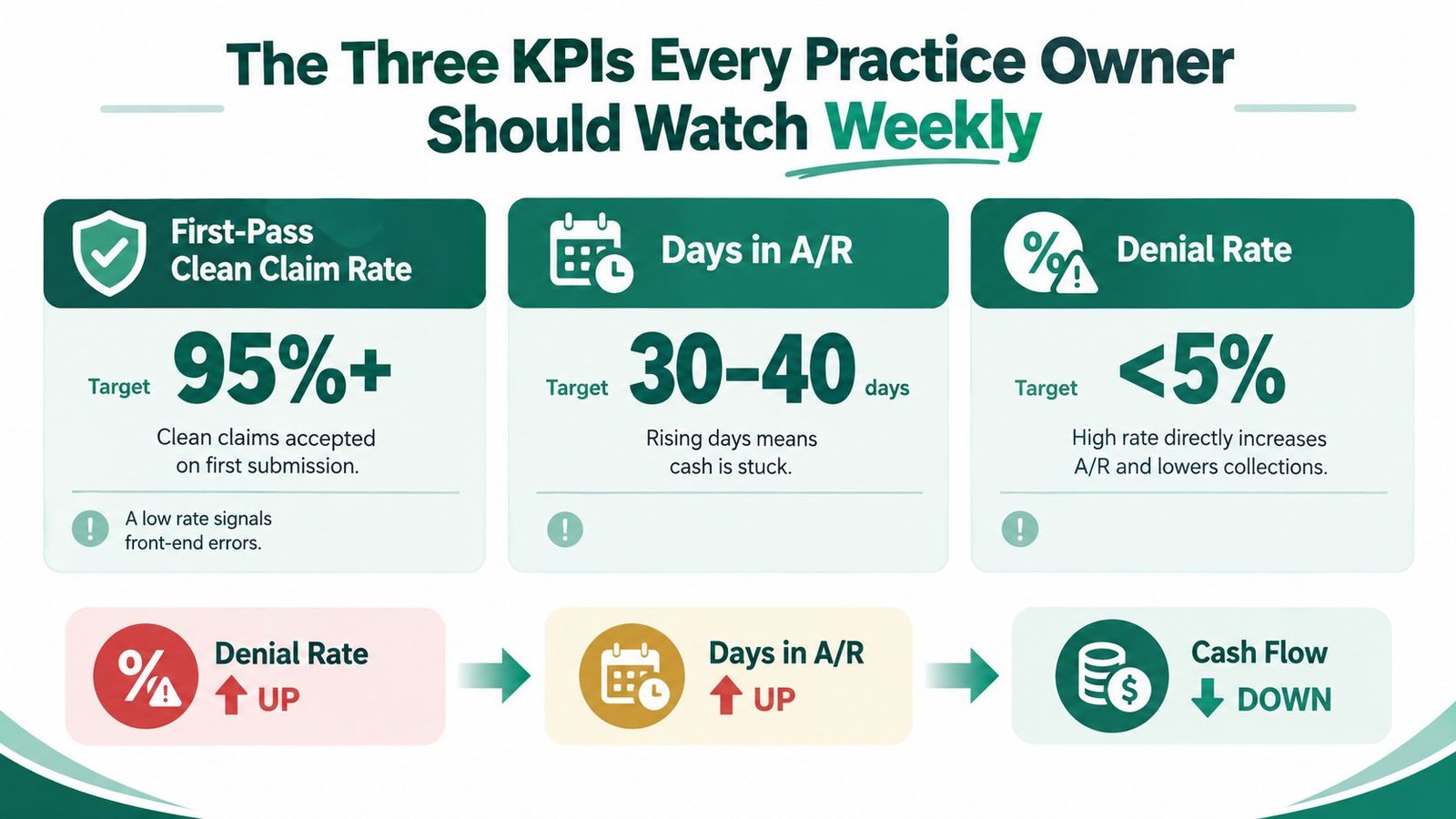
Three billing numbers tell you where cash is leaking, first-pass clean claim rate, days in A/R, and denial rate. Watch them weekly. They show whether your billing team is protecting collections or creating avoidable work, and they point to the weak spot, front end, middle, or follow-up. For a quick reference on the metrics worth tracking, use KPIs to track for medical billing.
First-pass clean claim rate
Analysts benchmarking physician practices say clean claims should stay above 95%, with 92% to 96% often sitting in the average range and anything under 90% signaling a workflow problem. RCM benchmarks show the cost clearly, a dirty first submission makes every later step more expensive.
A small drop here is real money. It means more manual rework, more payer follow-up, and more cash stuck while someone fixes preventable errors. I care about whether the team stops defects before the claim goes out, because that is where margin is protected.
Days in A/R
Days in A/R is the owner's cash-speed metric. If it climbs, cash is sitting in the wrong place. That slows payroll coverage, tightens margin, and leaves less room to absorb payer delays.
Denial rate
Denial rate tells you how much earned revenue is being thrown back at the office. Benchmark sets often place it in the 5% to 10% range, while top-quartile performance is typically under 5%. The gap matters because every denial creates another round of work, follow-up, correction, resubmission, or appeal.
For practice owners, the pattern is simple. Higher denials usually push A/R higher too. When that happens, payer rules, CPT coding, and modifier discipline stop being billing details and start acting like cash-flow controls.
How to Choose a Billing Partner Pricing Security and Technology
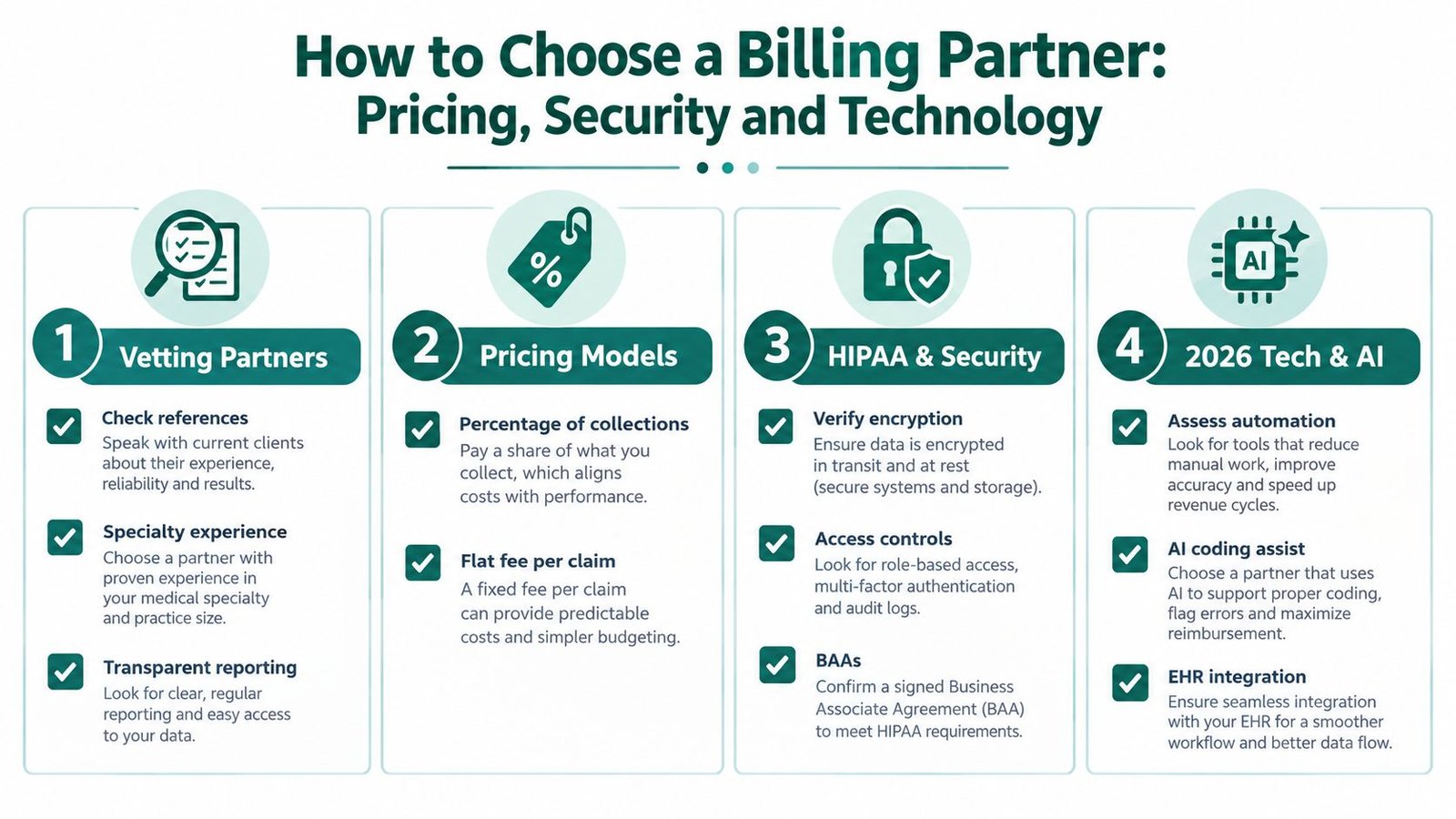
A good billing partner should make your revenue cycle quieter, not just more digital. I look at three things first, pricing, security, and whether the technology fits the way your practice works. If those three are weak, the partnership will cost you more than the proposal suggests.
Pricing should match the work, not hide it
Percentage-of-collections pricing can work when the partner improves collections, but it needs to be transparent. Flat fee and hybrid models can make sense too, especially when you want more predictability. What I would not accept is a vague fee structure that hides implementation charges, extra follow-up costs, or claim-level exceptions.
Security has to be operational, not decorative
HIPAA compliance isn't a slogan. It needs access controls, encryption, audit trails, and a real business associate agreement. If a vendor can't explain how PHI is limited by role, or how data is protected in transit and at rest, they're asking you to trust the wrong thing.
Technology should reduce friction, not create another migration
Modern automation matters. For a practical outside reference on where automated invoice workflows are heading, the invoice processing 2026 guide is a useful look at how teams are blending machine review with human oversight. In billing, the same principle applies: AI-assisted scrubbing, human validation, and EHR integration that doesn't force a platform change.
CMS incident-to rules also matter here if your practice relies on nonphysician clinicians. CMS says incident-to services are reimbursed at 85% of the physician fee schedule amount, and for 2026, direct supervision for most incident-to services can be satisfied through real-time audio/video virtual presence rather than physical presence, with carve-outs for certain surgical procedures. CMS incident-to guidance and virtual direct supervision updates affect both cash flow and staffing flexibility.
If you're interviewing vendors, use billing partner interview questions to force clarity before anyone gets access to your claims.
Implementation Timeline ROI Scenarios and 2026 Outlook
A clean transition starts with a baseline. Before you switch anything, document current denial rate, A/R aging, open claims, and prior auth bottlenecks. Then cut over in a controlled way, with the new partner handling new claims while legacy work is tracked separately until the runout is stable.
The payback shows up in claim handling and cash timing. If a practice is leaking revenue through CPT edits, modifier mistakes, or payer-specific auth rules, correcting those errors moves real dollars. A practice that bills $1.2 million a month and lifts clean-claim rate from 92% to 96% avoids about 48 rework claims a month. At $25 per rework claim, that is about $1,200 in direct rework cost avoided monthly, before you count the cash that stops sitting in A/R.
Fast cash matters in 2026 because payer rules keep shifting. Prior auth burden and more automation at the payer edge punish sloppy intake, weak charge capture, and missed modifier logic. The practices that win treat billing as a front-end revenue control, not a back-office cleanup job.
How long should a switch take
Use a phased rollout. The first month should cover access, validation, payer setup, and submission control. By week six, you should see whether clean-claim rates are improving. By day 90, you should know whether cash is moving faster or the process is just changing form.
What ROI should owners expect to watch
Track three numbers. Denial rework, cash conversion speed, and staff time spent on follow-up.
If clean claims rise and A/R days fall, the ROI is real. If your team still has to chase preventable CPT edits or payer rejects, the partner is not fixing the leak.
FAQ
How do I know if my practice should outsource billing now?
Evaluate now if clean-claim rate stays below 93% for four weeks, denial rate runs above 10%, or A/R is over 40 days. Run a 30-day diagnostic before you sign anything.
What's the biggest mistake owners make when choosing a billing company?
They buy on price alone and ignore denial management strength, reporting depth, and specialty fit. Cheap billing that misses modifiers, auth rules, or payer edits costs more than it saves.
Can a billing partner work inside my current EHR?
Yes, and I'd push for that. A partner should work inside your current workflow, not force a migration unless there is a clear operational reason.
How fast should I expect results after switching?
You should see early signals within the first several weeks, then a more reliable trend by day 90 if the transition is managed well.
If you want a direct read on where your billing is leaking cash, Happy Billing can review your current RCM workflow inside your existing EHR and identify the biggest denial and A/R bottlenecks. Visit Happy Billing to request a practical review and see whether your current setup is protecting revenue or giving it away.