Best Platforms for Out-of-Network Billing Compliance in 2026

For most specialty practices, the strongest out-of-network billing compliance stack pairs a benchmark data source like FAIR Health with a purpose-built NSA and OON platform such as InvisaClaim, then layers an experienced RCM partner like Happy Billing on top to turn that workflow into clean claims and recovered cash. That combo matters because the No Surprises Act is now a revenue rule set, not a policy memo, and mistakes show up as slower A/R, avoidable denials, and missed recoveries.
The financial pressure is real. HHS said out-of-network bills fell after implementation, by 15% for emergency services and 11% for non-emergency services at in-network facilities in 2022 versus 2021, with larger drops versus the 2019 baseline as the system absorbed the new rules (HHS third report to Congress). For owners, that means the question isn't whether to buy software, it's which platform keeps claims compliant while protecting the dollars tied up in CPT 99284, 99285, anesthesia, imaging, and other high-exposure OON workflows. If you're still untangling paper explanations after the fact, how to itemize medical bills is the wrong stage to be in.
Think a payer underpaid your out-of-network claims? We review your remits, find the underpaid claims, and handle the appeals. Get a free underpayment analysis.
1. Turquoise Health
Turquoise Health makes sense when a specialty practice needs data first. Its Out-of-Network dashboard, pricer, and contract intelligence show where your rates sit before you enter an open negotiation or IDR posture, which is where many physician groups lose ground. The value is simple, it gives finance leaders a defensible market view instead of forcing staff to guess what a payer usually pays.
Turquoise Health fits practices that want NSA estimate compliance and broader pricing intelligence in one place. The platform also surfaces price-transparency and contract analytics, so emergency medicine, radiology, and anesthesia groups can compare OON posture against actual market files rather than a stale fee schedule. That matters when a single underpriced case can drag down recovery across an entire batch.
Practical rule: use a benchmark platform when your biggest problem is proving reasonableness, not just chasing a missing payment.
The trade-off is that Turquoise's data strength still depends on your team connecting its outputs to the claim submission workflow. If contract feeds, payer files, and internal charge data do not line up cleanly, the handoff gap shows up in packet prep and deadline handling. Pair it with a workflow tool or an RCM partner that can move the claim. For a deeper look at NSA compliance requirements, see Happy Billing's guide to No Surprises Act compliance.
The best use case is a practice that already knows its leak is in negotiation and pricing logic. For specialty groups that bill high-value OON services, Turquoise gives you the market context, then a billing partner can turn that context into a cleaner dispute file. For groups with heavy emergency or facility-based exposure, the key question is whether the platform helps protect dollars tied to CPT 99284, CPT 99285, anesthesia, and imaging, or just makes the price story easier to explain.
2. Rivet Health
Rivet Health is better suited to practices that need clean patient estimates with an audit trail. The reason that matters is simple, a weak estimate process creates preventable write-downs, messy patient disputes, and more staff time spent reconstructing what was communicated before the visit. Rivet's NSA-focused estimates and multi-location analytics are useful when a group wants visibility across sites without turning each office into its own billing island.
Its biggest advantage is usability. Practices that are tired of clunky estimate workflows tend to value a provider-facing interface more than a long list of modules, especially when front desk staff need to move quickly and document what was sent, when it was sent, and to whom. That auditability helps when a patient later disputes the estimate or when a payer questions whether the workflow was consistent.
Rivet is also attractive for groups that operate across multiple sites. Multi-location analytics make it easier to spot where estimates are falling apart, where a location is generating more corrections, and where staff need tighter training. That's the kind of operational visibility that keeps small mistakes from turning into recurring A/R problems.
The downside is the usual enterprise friction. Pricing is not public, and any serious deployment will require scoping around integrations, user roles, and workflow design. Practices that only need one narrow function may find the demo process heavier than they want.
For a physician owner, Rivet is a front-end compliance tool first, not a full OON recovery engine. That makes it a good fit when the goal is to reduce estimate-related friction before claims even land in work queues. If you're comparing estimate tools against broader billing strategy, Happy Billing's guide to out-of-network repricing tools is the right companion reading.
3. Waystar
Waystar is the kind of platform practices buy when they want financial clearance to behave like part of revenue cycle, not a separate project. Its real-time estimates use chargemaster, contract rates, and eligibility, which helps front desks and financial counselors give clearer answers before the encounter turns into a later dispute. That can reduce surprise-billing friction in specialties where patients often see multiple service lines in one episode of care.
Waystar also works because it plugs into larger RCM environments. Enterprise groups usually care less about one flashy NSA feature and more about whether the estimate, eligibility, and clearing workflow live inside the same operational lane as authorizations, patient collections, and claim follow-up. That integration is where Waystar has an advantage.
The financial upside is practical. Better estimates can lower rework, reduce patient complaints, and cut the number of files that have to be manually reconstructed after a bad pre-service conversation. For owners, that means fewer touches per account and less leakage from charges that were never set up correctly in the first place.
When the estimate engine sits outside the core RCM stack, staff double-enter data and errors multiply. That's where A/R days quietly drift upward.
The trade-off is implementation weight. Waystar is built for scale, so smaller practices can find setup more demanding than a lighter tool. Pricing is quote-based, and larger deployments often need tighter internal coordination than a lean group expects.
For physicians who want to tie transparency to existing revenue operations, Waystar is a defensible choice. It's strongest when the practice already has enough volume to benefit from integrated workflows and doesn't want another isolated platform. For a closer look at how this fits into actual billing operations, see Happy Billing's out-of-network billing resource.
4. Experian Health
Experian Health is a strong fit when the practice wants estimation plus payer logic in the same operational layer. Its patient estimates pull in contracts, chargemaster, claims history, and eligibility, which matters because no physician owner wants a front-desk estimate built on stale assumptions. The more the estimate reflects the payer relationship you have, the less likely the account is to boomerang back as a complaint or adjustment.
The platform's strength is depth. Groups that already use Experian's eligibility or contract tools can keep the workflow inside one vendor ecosystem, which reduces handoffs and lets staff work from more consistent data. That is especially useful for practices where the same patient financial information has to inform both the estimate and the eventual claims review.
Its positioning around self-pay and uninsured GFE workflows is also important. Many “best platforms for out-of-network billing compliance” pages talk as if the only problem is insured OON claims, but physicians still lose time and cash when estimates for self-pay patients aren't generated, delivered, and tracked correctly. That second lane is where many small process failures live.
A simple checklist helps here:
- Use claims history in estimates: It gives staff a more realistic basis for communicating expected charges.
- Keep eligibility tied to the estimate path: If insurance status changes, the estimate should change with it.
- Treat the GFE as a document trail, not a formality: If it can't be retrieved quickly, it won't help you in a dispute.
The downside is vendor dependency. Pricing isn't public, and implementations usually need scoping, especially if you're trying to connect more than one workflow or location. That said, if your group already lives in a broader enterprise RCM environment, the integration argument is strong.
For owners who want a more detailed look at how OON insurance workflows interact with patient-facing estimates, Happy Billing's OON insurance billing guide is a useful companion.
5. FAIR Health
FAIR Health belongs on this list because it solves a different problem from the software vendors. It gives practices independent benchmark data that can support a defensible OON position, a stronger GFE, and a more credible IDR packet. When a payer says your charge is out of line, benchmark data is often the first thing that tells you whether your team has a real point of negotiation or just a wish.
FAIR Health offers FH® Charge and FH® Allowed Benchmarks across 493+ geographic regions, plus the FH Fee Estimator and Medicare-based reimbursement tools. Those reference points are valuable because out-of-network negotiations turn ugly when a practice can't anchor its numbers to a neutral market dataset. For a physician owner, that means the difference between a packet that looks improvised and one that looks serious.
The upside is independence. FAIR Health is not a billing dashboard pretending to be a benchmark source, it's the benchmark source. That makes it especially useful for IDR prep, internal pricing review, and specialty-specific analysis where local market variation matters.
The limitation is equally clear. Benchmarks are not guarantees of payment, and they have to be applied carefully. If a practice uses them as if they were automatic entitlements, staff can overstate recoveries and waste time on weak disputes.
Best use: pair benchmark data with a workflow platform. Data alone won't beat a missed deadline or a sloppy packet.
That's why FAIR Health belongs at the center of a compliance stack, not at the edge of it. Anesthesia groups, emergency medicine practices, radiology groups, and other high-exposure specialties can use the numbers to ground pricing decisions, then let an RCM partner or dispute platform handle the operational lift. For a deeper revenue-side view of balance billing and Happy Billing's balance billing resource is a good next step.
6. InvisaClaim
InvisaClaim is the clearest purpose-built NSA workflow platform on this list. That matters because the hardest part of out-of-network compliance isn't usually understanding the law, it's managing the deadlines, packet assembly, eligibility checks, and open negotiation steps without missing one detail that blows up recoveries. InvisaClaim is built for that exact job.
InvisaClaim focuses on end-to-end NSA operations, including eligibility, timelines, IDR packet generation, GFEs, and underpayment detection tied to contract terms. For a practice owner, that means the platform is aimed at the part of the process where money is won or lost, not the part that just looks organized in a demo. It's especially relevant for practices that handle frequent emergency medicine, anesthesiology, or facility-based disputes.
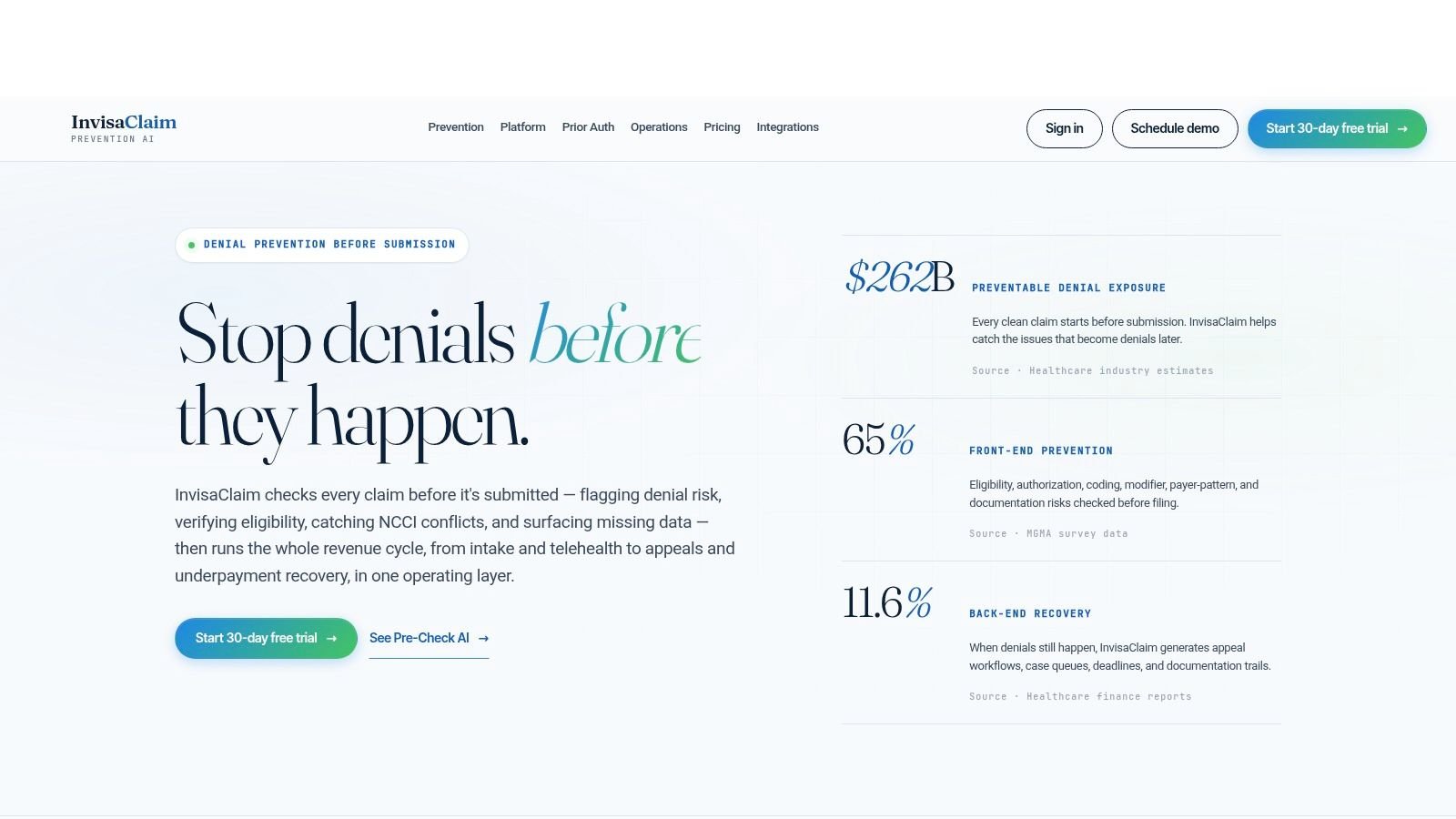
The best thing about a purpose-built platform is focus. Generic RCM systems can handle tasks, but they often don't understand the procedural pressure around NSA workflows the way a dedicated tool does. InvisaClaim's contract layer, payer status logic, and multi-entity support make it easier to run a structured process instead of a patchwork of spreadsheets and email reminders.
That said, due diligence matters. Newer platforms always deserve extra scrutiny around integration depth, onboarding support, and how well they handle real production volume. Pricing is volume-based, so the right fit depends on claim mix and case load.
A physician owner should look at InvisaClaim when the biggest pain point is procedural misses, not just general billing inefficiency. If your team is missing open-negotiation steps or scrambling to assemble IDR packets at the last minute, a platform like this can protect cash that generic tools leave exposed. For specialty-specific support around operational fit, Happy Billing's specialty page can help you match the workflow to your practice type.
7. Collect Rx
Collect Rx is not software in the classic sense, and that's the point. It's a service-led negotiation partner for practices that need hands-on help getting paid on difficult OON claims, especially when internal teams are too stretched to work every underpayment case by hand. For some physician owners, that is a better use of money than buying another dashboard nobody has time to run.
Collect Rx fits practices that want negotiation support, upfront settlement help, and underpayment recovery without building all of that muscle in-house. The model is practical for groups where one payer is consistently the problem or where the internal billing team can't keep up with the volume of appeals and follow-up. It can also complement an existing billing vendor that doesn't have enough OON specialty depth.
The trade-off is control. Service models usually give you less self-service visibility than a SaaS platform, which can frustrate owners who want every case status at a glance. You also have to accept variable engagement structures, since pricing often depends on contingency or flat per-case arrangements.
For high-stakes cases, that trade-off can be worth it. A seasoned negotiator can help frame documentation, challenge a weak payer position, and push recovery on files that would otherwise age out. That said, if your main problem is deadline management and packet assembly, a service alone may not solve the upstream process leak.
Use Collect Rx when the spreadsheet is already failing and the pain is in the negotiation layer. It's a good complement to an in-house team that needs backup on ugly claims, but it's not a substitute for a compliance system. Owners should judge it on whether it recovers dollars that would have stayed buried in A/R.
8. Zelis
Zelis matters because it sits in the middle of a lot of OON payment activity. It is largely payer-facing, but physicians feel the effect when payers use Zelis-supported pricing and negotiation processes to shape their offers. If your group handles frequent OON disputes, knowing how Zelis works is not optional, because it affects the structure of the counteroffer you receive.
Zelis supports NSA-related pricing and dispute workflows from the payer side, including market-based pricing, QPA-related processes, and open negotiation support. That broad market reach is the practical reason providers need to understand it. Even when a practice doesn't interact with Zelis directly, the methodology can still shape the payer's posture on a claim.
The advantage for providers is awareness. If a payer routes disputes through a large repricing and negotiation infrastructure, your team needs evidence that holds up inside that system. That means cleaner documentation, stronger fee support, and better packet discipline.
The drawback is control. Because Zelis is mostly on the payer side, provider engagement is indirect. You are adapting to their workflow more than managing your own inside their platform, which makes internal discipline even more important.
A short operational checklist helps here:
- Document eligibility early: If the claim is mishandled at intake, the dispute may be weak before it starts.
- Track every open negotiation date: Missed timing can turn a viable recovery into dead inventory.
- Keep contract and payer terms visible: Underpayment disputes are easier when staff can cite the relevant basis immediately.
Zelis is not the platform you buy to run your own office workflow. It's the platform environment you need to understand because it shapes the payer side of the fight. For specialty groups that live on dispute recoveries, knowing that environment is part of protecting revenue.
9. MultiPlan Including Viant
MultiPlan, including Viant, is another name that matters because it often shapes the payer side of the OON equation. For a physician owner, the practical issue isn't brand familiarity, it's whether your team knows how the repricing and arbitration logic behind the offer will influence what lands in your A/R. If you don't understand the counterparty, you're negotiating blind.
MultiPlan offers repricing, analytics, negotiation, and arbitration support that affects a lot of surprise-billing activity. That makes it highly relevant even though it's primarily designed for payer use. Providers run into its methodologies when they see the initial offer, the negotiation posture, or the structure behind the dispute process.
The strength here is market penetration. When a platform is this common on the payer side, provider teams that understand its logic are better prepared to assemble evidence and negotiate from a position of discipline rather than irritation. That matters in specialties where OON recovery is a recurring part of revenue, not a one-off nuisance.
The weakness is the same one you see with other payer-driven systems. Provider control is limited, engagement is indirect, and the methodology is not built around your internal workflow. That means your own documentation quality becomes the key differentiator.
For owners, the lesson is straightforward. Do not treat MultiPlan as a software purchase decision in the usual sense. Treat it as part of the operating environment your staff has to master well if you want to preserve collections and avoid unnecessary write-offs.
If your practice keeps seeing the same underpaid CPTs or facility-based claims come back short, the answer is usually not more chasing. It's better evidence, better packet prep, and a better response process inside your own billing team.
10. MD Clarity
MD Clarity is a solid choice when the practice wants front-end GFE automation plus back-end underpayment visibility. That combination is useful because many groups focus on one side of the problem and ignore the other, then wonder why revenue still leaks after compliance tools are in place. MD Clarity helps bridge that gap.
MD Clarity automates Good Faith Estimates by email, text, and letter, and it also flags underpayments through payment variance analytics. That is a strong pairing for physician owners because it ties patient-facing compliance to collections recovery rather than treating them as separate departments. If the estimate is cleaner and the back end is tighter, the account tends to move with fewer surprises.
The biggest benefit is speed to value. Practices often need quick wins on GFE delivery and payment variance review, and MD Clarity is built for exactly that. It gives leadership a practical way to see where payer behavior is drifting away from expected payment patterns.
The trade-off is implementation variability. Pricing is quote-based, and integration depth can differ depending on the environment. That means a group should check how well the platform connects to its EHR, its estimate workflow, and its existing denial management process before committing.
For owners, the question is whether you need a compliance tool, a recovery tool, or both. MD Clarity is strongest when you need both in a single workflow. If your practice is still trying to decide whether to outsource the messy parts of this work, Happy Billing's free audit is the fastest way to see where the leakage is.
Top 10 Out-of-Network Billing Compliance Platforms
| Solution | Core focus | Target audience | Unique selling point | Pricing & procurement |
|---|---|---|---|---|
| Turquoise Health | NSA/OON dashboard, QPA & IDR pricer, contract analytics | Hospitals, health systems, providers needing transparency | Nationwide transparency-file backbone; free OON pricer | Custom quote; scope-based |
| Rivet Health | Auditable patient estimates, GFEs, EHR integrations | Multi-site medical groups and clinics | Provider-centric UI and fast, auditable NSA workflows | Demo/quote-based |
| Waystar | Real-time estimates + integrated financial clearance in RCM | Large practices & health systems, RCM teams | Mature enterprise RCM integrations; patient-friendly estimates | Quote-based; implementation resources required |
| Experian Health | Estimates using contracts, chargemaster, eligibility, claims history | Enterprises, self-pay & uninsured workflows | Deep contract/payer modeling; widely deployed tools | Scoping required; enterprise pricing |
| FAIR Health (Benchmarks & Estimator) | National charge/allowed benchmarks and fee estimator | Providers building defensible OON GFEs and IDR packets | Independent, widely referenced benchmark datasets | Licensed products; pricing via FAIR Health |
| InvisaClaim | End-to-end NSA workflows, IDR packet generation, contract layer | Providers and billing companies focused on NSA compliance | Purpose-built automation and deadline tracking for high-risk workflows | Volume-based pricing; contact vendor |
| Collect Rx | Hands-on OON negotiation, settlement & recovery services | Providers needing expert payer negotiations and recoveries | Contingency-backed negotiators and advisory support | Contingency or per-case fees; engagement-dependent |
| Zelis | QPA calculations, market-based OON repricing & dispute workflows (payer-facing) | Payers primarily; providers interacting with payer processes | Large payer reach; central counterparty in OON negotiations | Vendor services; provider access often indirect |
| MultiPlan (including Viant) | Pro Pricer analytics, payer-side OON repricing & arbitration support | Payers and providers affected by payer negotiation flows | High payer market penetration that shapes offers | Payer-focused products; provider engagement limited |
| MD Clarity | Automated GFEs, out-of-pocket projections, underpayment detection | Providers needing automated GFEs and recovery analytics | Automated multi-channel GFE delivery; payment variance insights | Quote-based; integration depth varies |
Not sure what your claims should have paid? Request a free out-of-network underpayment analysis. Your current biller can stay in place while we review.
Your OON Compliance Stack and Buyer Checklist
The smartest buyer move is not picking one “best” platform in isolation. It's matching the tool to the leak. If the problem is benchmarking, start with FAIR Health. If the problem is deadline control and packet assembly, InvisaClaim is the cleanst fit. If the problem is turning all of that into cash without adding headcount, an experienced billing partner like Happy Billing should sit on top of the stack and run the workflow inside your existing EHR.
For a specialty practice owner, the buying checklist should be brutally simple.
- Does it reduce denial rate? If a platform only looks compliant but doesn't stop bad submissions or weak estimates, it won't protect margin.
- Does it shorten A/R days? Tools that create more work without speeding up follow-up just move the bottleneck.
- Does it track NSA deadlines accurately? Open negotiation windows, IDR packet timing, and document completeness are where recoveries are won or lost.
- Does it protect CPT-specific revenue? High-stakes services like 99284, 99285, anesthesia, imaging, and procedure-heavy care need cleaner documentation and faster dispute handling than low-risk office visits.
- Does it handle both sides of the rule set? You need workflow support for IDR and for GFE processes, because self-pay and uninsured billing can leak just as fast as insured OON claims.
The best stack usually looks like this. FAIR Health provides the benchmark context, a purpose-built platform like InvisaClaim or a broader transparency tool like Turquoise Health handles the compliance layer, and a strong RCM partner such as Happy Billing turns that setup into recoveries instead of more software clutter. That combination is especially strong when your practice wants better collections without hiring a team just to manage surprise-billing rules.
If you run an anesthesia, emergency medicine, cardiology, orthopedics, pain, or multi-specialty group, don't buy features you'll never use. Buy the process that keeps claims moving, packets clean, and payer pushback contained. Then tie that process to a partner who knows how specialty billing works in production.
How do I know if I need a benchmark platform or a workflow platform?
If your team keeps arguing about what's “reasonable,” you need benchmark data first. If your team already knows the numbers but keeps missing deadlines or losing documents, you need workflow automation first.
Which platform helps most with IDR packet mistakes?
A purpose-built NSA workflow tool is the better fit. The point is to reduce procedural misses, not just store files.
Do I need separate tools for GFE and IDR?
Often, yes. GFE work affects self-pay and uninsured workflows, while IDR governs insured out-of-network disputes. A platform that handles both is stronger, but many teams still need an RCM partner to connect them cleanly.
What should a physician owner ask before buying?
Ask how the platform affects denial rate, A/R days, packet accuracy, and staff time. If the vendor can't tie features to revenue protection, keep looking.
Happy Billing helps specialty practices turn NSA and out-of-network compliance into cleaner claims, faster follow-up, and fewer costly misses. If you want a partner that works inside your existing EHR and treats denial prevention as a revenue strategy, visit Happy Billing and see how our team can tighten your billing workflow.