Radiation Oncology Billing Services: Protect Your Revenue

Radiation oncology billing services manage the full revenue cycle for one of Medicare's most complex specialties, where a single patient episode can generate separate billable categories for consultation, planning, simulation, physics, delivery, and weekly management. In 2024, 4,928 radiation oncology clinicians billing Original Medicare Part B were associated with $1,821,557,020 in allowed amounts, an average of $369,634 per clinician, so small coding and payment failures can put substantial practice revenue at risk (Noridian radiation oncology guidance).
That complexity creates a counterintuitive financial problem. A practice can deliver technically excellent care, submit claims every day, and still lose significant revenue through incorrect sequencing, missing documentation, misapplied professional and technical components, authorization mismatches, or denials that never receive a complete appeal package. In our experience auditing radiation oncology practices, the issue usually isn't one dramatic error. It's the accumulation of small defects across a treatment course that extends A/R days, increases rework, and leaves collectible dollars uncollected.
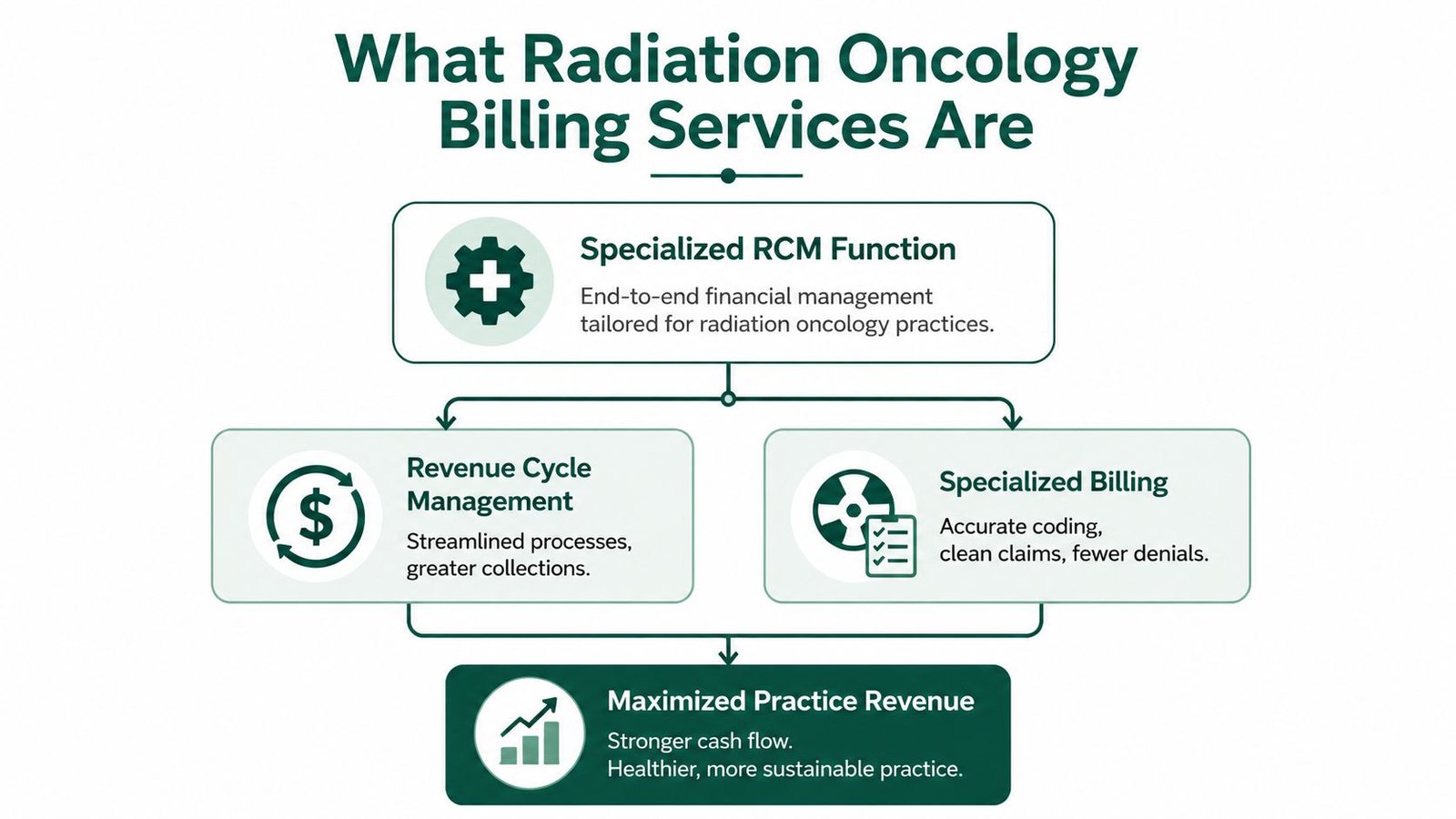
What Radiation Oncology Billing Services Are
Radiation oncology billing services are specialized revenue cycle management built for oncology workflows. The function starts with registration, eligibility, and authorization, then follows the patient episode through consultation, treatment planning, simulation, physics and dosimetry, treatment delivery, weekly management, follow-up, payment posting, and appeals. Each phase has distinct documentation requirements, code families, payer edits, and dollars at risk.
A single episode may include E/M consultation, treatment planning under CPT 77261–77263, simulation under 77280–77290, physics and dosimetry services under 77300–77334, delivery codes such as 77401 and 77402/77407/77412, and weekly management under 77427–77432. Noridian's radiation oncology guidance reinforces the sequence from an E/M visit or consultation through planning, simulation, delivery, and management.
General billing workflows often miss the relationships among these services. The financial effects are direct:
- Higher denials: A missing prerequisite, invalid code relationship, or incorrect component can stop payment.
- Longer A/R: Staff spend time correcting claims that should have passed on the first submission.
- Missed charges: Physics, dosimetry, planning, or management work may never reach the claim correctly.
A treatment course should be managed as one connected financial episode. Separate claims still require coordinated documentation, charge capture, coding, and follow-up.
The 2026 Medicare coding update shows why specialty knowledge affects collections. CMS-linked analysis reports the deletion of legacy G-codes historically used for external beam radiation treatment delivery and their replacement with CPT 77402, 77407, and 77412 across all sites of service (CMS radiation oncology billing guidance). That conversion changes payer submission logic, claim edits, and charge capture rules. Waiting for denials to expose workflow problems leaves unpaid claims in the system and delays recovery.
A capable partner connects the services, validates the documentation chain, separates billable components, and tracks payment performance by code family. Owners evaluating specialized oncology billing services should require episode-level reporting, because total collections can conceal leakage in planning, physics, delivery, and weekly management.
The Coding Complexity That Drains Revenue
Radiation oncology revenue depends on understanding the relationships among code families. The code stack connects clinical intent, planning, simulation, physics, treatment delivery, image guidance, and management. One unsupported or misclassified element can create medical-necessity edits, payer rejections, underpayment, or a second review of the entire claim.
Physics and dosimetry require component discipline
Medicare separates radiation physics services, including CPT 77300–77334 and 77399, into professional and technical components. CMS also identifies 77336 and 77370 as technical-services-only codes (CMS radiation oncology coding article).
For a practice owner, component errors put earned revenue at risk:
- Billing a technical component where it is not payable creates a denial and delays recovery of that line.
- Failing to separate professional and technical components can leave legitimately performed work unbilled.
- Sending the claim to the wrong billing entity creates rework and may misclassify the service.
The billing workflow should map each service to the correct component, confirm the site of service, and verify whether modifier 26 or TC applies before submission. CMS payment rules depend on the setting and on whether technical-component billing is permitted. A freestanding clinic may have different technical billing rights from another site of service, so a template that succeeds in one location can fail in another.
Delivery code changes can break charge capture
The Medicare conversion from legacy G-codes to 77402, 77407, and 77412 affects every Medicare claim subject to the updated external beam delivery logic. Practices need revised chargemasters, payer edits, claim-scrubbing rules, and staff instructions before claims move through the new configuration.
The financial risk extends beyond an outright denial. A charge may be omitted, routed to the wrong code family, or submitted with an outdated relationship to other services. Each defect sends staff back into the account, delays payment for the treatment course, and increases the chance that another related service will be missed.
Modifiers and documentation protect legitimate work
CMS allows E/M codes 99211, 99212, and 99213 with modifier 25 when the visit is separately identifiable and performed on the same day as superficial radiation treatment delivery (CMS Claims Processing Manual). Correct use preserves payment for separately identifiable physician work. Unsupported use can trigger payment edits, recoupment, or audit exposure.
Documentation must connect the episode from consultation through planning and simulation. Missing clinical intent, incomplete planning support, or inadequate simulation documentation weakens the medical-necessity chain for later delivery and management claims. The denial appears later, while the defect often began at the episode's first documentation step.
Practices should treat medical billing denial management as a specialty function. Effective review identifies whether the error came from code selection, component billing, modifier use, authorization, frequency, diagnosis coverage, or documentation. The team then corrects the workflow that produced it instead of repeatedly resubmitting the same flawed claim.
The Radiation Oncology RCM Workflow and Key Metrics
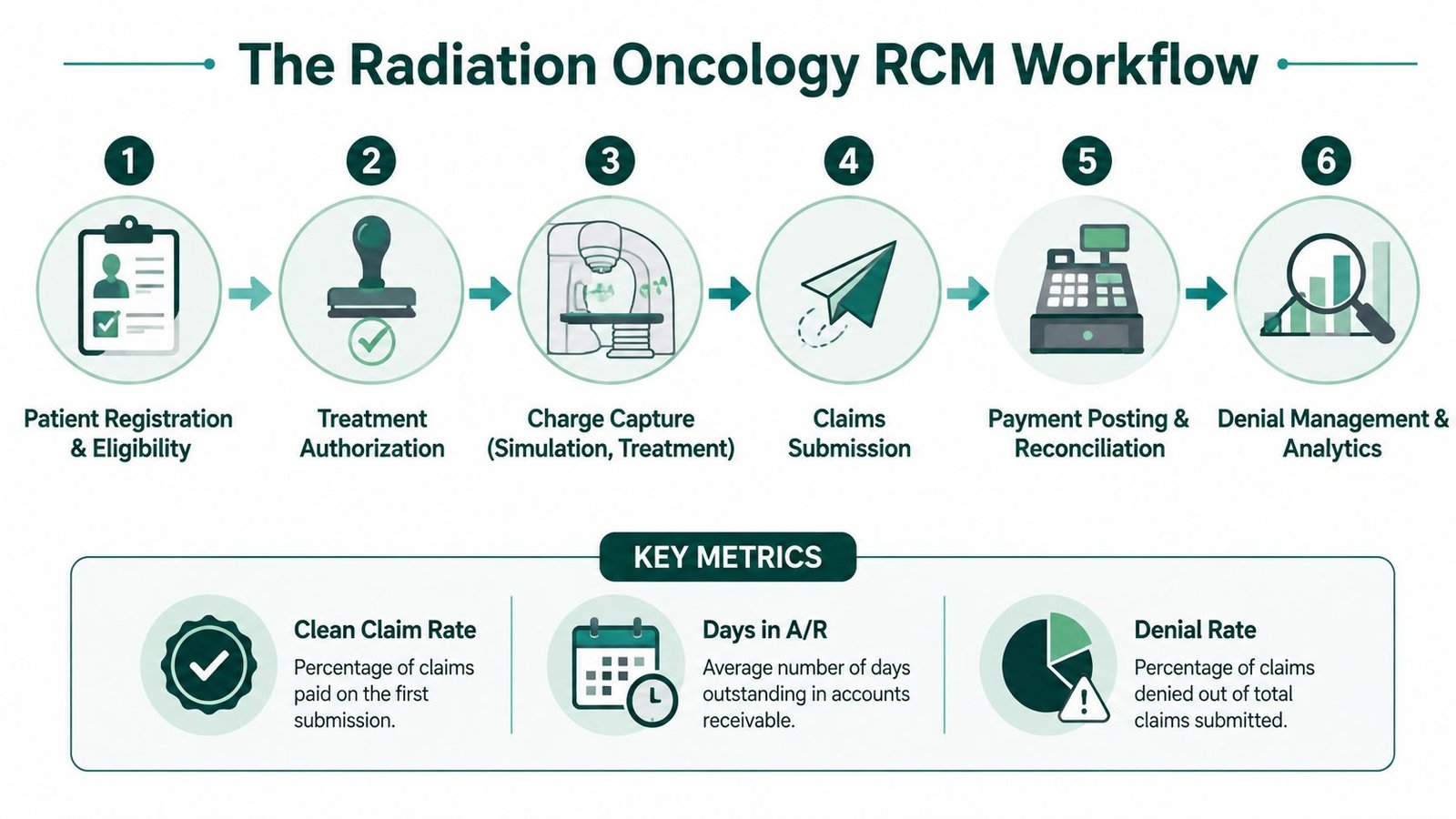
Radiation oncology RCM works best as a controlled sequence. Registration errors affect eligibility. Authorization errors affect treatment start. Documentation gaps affect charge capture and medical necessity. Payment-posting errors distort A/R reporting and can make a practice believe it has collected more than it has.
Six points where revenue changes hands
- Registration and eligibility: Confirm demographics, coverage, coordination of benefits, and the responsible payer before clinical services advance.
- Authorization: Determine whether the plan requires authorization for the intended modality and site of care.
- Charge capture: Match consultation, planning, simulation, physics, delivery, and management services to completed documentation.
- Claim submission: Apply the correct code, component, modifier, payer rule, and sequence.
- Payment posting and reconciliation: Post payments, contractual adjustments, patient responsibility, and underpayments accurately.
- Denial management and analytics: Classify root causes, appeal supported claims, and fix recurring defects.
Prior authorization deserves special attention because payer rules diverge. Original Medicare often doesn't require prior authorization for most radiation oncology services, while Medicare Advantage plans commonly do for IMRT, SRS/SBRT, proton therapy, and out-of-network care. A 2025 Medicare update shortened standard prior-authorization decisions from 10 business days to 7 calendar days, while expedited requests remained 2 business days (Noridian Medicare update).
The authorization must match the planned service. A mismatch between the authorized code and the submitted code can invalidate the authorization and create a denial even when the clinical service was appropriate. That is why an authorization team needs visibility into modality, code, payer, and treatment plan changes.
Metrics that tell an owner what to fix
Track the first-pass clean claim rate, days in A/R, denial rate by root cause, and collection rate by code family. A clean-claim target of 98% or higher and A/R below 35 days are useful operating benchmarks when evaluating an RCM partner, but the value comes from understanding why a metric moves, not from displaying a favorable dashboard.
- A declining clean-claim rate points to front-end, coding, or claim-edit defects.
- Rising A/R days may indicate payer delays, unresolved authorization issues, or weak follow-up.
- A denial rate without root-cause detail hides whether the problem is documentation, frequency, diagnosis coverage, or component billing.
- Collection performance by code family reveals whether planning, physics, delivery, or management is underperforming.
The RCM workflow in medical billing should be visible to ownership, not confined to a monthly total-collections report. A practice can't protect revenue it can't trace.
The Business Case for Outsourcing Radiation Oncology Billing
The outsourcing decision becomes clearer when the practice measures specialty risk, not just payroll cost. Radiation oncology requires working knowledge of planning, simulation, physics, dosimetry, delivery, weekly management, modifiers, component billing, authorization, and payer-specific documentation. A generalist team may process claims efficiently while still missing the relationships that determine whether those claims get paid.
The denial burden is also structurally higher in managed Medicare. A 2025 peer-reviewed analysis found inappropriate radiation therapy denials in Medicare Advantage of 15.04% in 2022, 18.69% in 2023, and 16.01% in 2024, compared with 4.69%, 5.28%, and 3.44% for all health services in those same years (peer-reviewed radiation therapy denial analysis). Across 2022–2024, 17.39% of radiation therapy appeals were inappropriately denied.
Those figures change the outsourcing conversation. The question isn't whether an outside team can submit claims. It's whether the partner can prevent denials, isolate their causes, and build an evidence package when a payer rejects an appropriate service.
The expensive mistake is treating an appeal as a resubmission. A strong appeal addresses medical necessity, modality selection, documentation specificity, and the payer's stated reason for denial.
CMS guidance identifies diagnoses not covered, excessive frequency, and insufficient documentation as denial reasons, and it indicates that an appeal packet should include the relevant patient record rather than automatically sending the full chart. That distinction matters because a focused, organized packet helps the reviewer connect the billed service to the clinical record without burying the evidence.
Specialized outsourcing can also improve operational efficiency. A partner using agentic AI with expert human auditors can monitor charge capture, identify claim defects, and route exceptions for review while working inside the practice's existing EHR. The practice avoids making an internal team learn every payer change from scratch, including the 2026 delivery-code conversion.
The right benefits of outsourcing medical billing are therefore measurable in operational terms: fewer preventable denials, faster correction, better visibility by code family, and less physician or administrator time spent chasing unpaid claims. Outsourcing doesn't fix a weak process automatically. It works when the partner brings radiation-specific controls and reports financial performance transparently.
How to Evaluate a Radiation Oncology Billing Vendor
A vendor should earn credibility by showing how it handles radiation-specific exceptions, not by presenting a generic collection percentage. Ask for evidence across five areas, then test whether the answers connect to your own claims, payers, modalities, and EHR.
| Evaluation Criterion | Red Flag | Green Flag |
|---|---|---|
| Specialty expertise | Staff discuss delivery codes but can't explain planning, simulation, physics, or weekly management | Demonstrated command of the full code stack and professional/technical component rules |
| Technology and automation | Requires an EHR migration or creates a separate workflow for every payer | Operates inside the existing EHR with automated edits and human review |
| Denial management | Reports aggregate appeal activity without radiation-specific results | Shows appeal outcomes and root causes for radiation oncology claims |
| Compliance and security | Vague HIPAA language and no audit trail | HIPAA-compliant infrastructure, bank-level encryption, and documented access controls |
| Reporting transparency | Monthly collections only | Weekly dashboards with clean claims, A/R aging, denial causes, and payer collections |
Questions ownership should ask
Request performance by code family, not just by provider or payer. The vendor should be able to distinguish planning, simulation, physics, delivery, and management performance, because an acceptable overall denial rate can conceal a persistent problem in one high-value category.
Ask how the team handles authorization changes, especially for Medicare Advantage plans and modalities such as IMRT, SRS/SBRT, and proton therapy. Ask who reviews documentation before submission, who owns appeals, and how pending appeals transfer during a termination or transition.
Security is equally practical. PHI must remain protected, and the vendor should provide a clear audit trail showing access, edits, submission activity, and payment reconciliation. Technology should reduce work, not create a second system your staff must maintain.
For a focused vendor comparison, review oncology billing company selection criteria alongside your own A/R and denial reports. The best partner will welcome a code-family review because it can show where money is delayed, denied, or never billed.
Implementation and Transition Steps
A billing transition should protect cash flow before it pursues optimization. Use a phased plan that lets the new partner identify defects without creating a blind spot in active treatment claims.
Preparation in weeks 1–2
Audit current A/R, list pending appeals, identify denial reasons by code family, gather payer contracts, and document EHR integration requirements. Confirm how the incoming team will handle the 2026 Medicare delivery-code changes before signing off on the final workflow.
Parallel operation in weeks 3–6
Run the existing and new teams in parallel for one full treatment cycle. Compare clean-claim results, charge capture, authorization matching, component billing, and denial patterns. This period exposes submission or configuration errors while the current process remains available as a control.
Full cutover in weeks 7–10
Move active and archived claims to the new vendor, assign ownership for every pending appeal, and organize documentation by denial reason. Establish weekly performance meetings covering A/R aging, payer responses, claim defects, and recovered revenue.

The handoff must include more than login credentials and an account list. Require a written inventory of open claims, appealed claims, authorization records, payer contacts, and unresolved coding questions. That documentation keeps old receivables from becoming ownerless during the change.
Frequently Asked Questions
Will outsourcing eliminate our in-house coding expertise?
No. The practice retains clinical and operational control while the partner adds specialty billing capacity, audit oversight, payer follow-up, and reporting. The useful test is whether ownership gains clearer visibility into revenue without losing control of documentation standards.
How quickly should revenue improve after switching?
The timing depends on the starting A/R, payer mix, denial backlog, and workflow defects. A parallel period should establish a clean comparison, while early gains often come from correcting preventable submission errors and recovering claims already sitting in A/R.
What happens to denied claims during the transition?
They should transfer through a formal inventory, with each appeal assigned an owner and organized by denial reason. The relevant patient record, authorization evidence, coding details, and payer correspondence should move with the claim so recovery work doesn't restart from zero.
Do the 2026 Medicare changes create urgency?
Yes. The replacement of legacy G-codes with 77402, 77407, and 77412 changes submission logic and charge capture. Confirm that any vendor you hire has already mapped those changes to your EHR, edits, and Medicare workflow.
Happy Billing provides radiation oncology billing services across full-cycle RCM, denial management, A/R recovery, and specialty-specific claim auditing, using agentic AI with expert human oversight inside your existing EHR. Visit Happy Billing to request a focused review of your radiation oncology claims, denials, component billing, and A/R performance.