Anesthesia Billing Company: A Practice Owner’s Guide

If your anesthesia claims are getting hit with modifier denials, messy time units, or slow A/R, an anesthesia billing company is the specialist that can stop the leakage. The right partner doesn't just submit claims, it protects revenue in a workflow where one bad modifier or a sloppy time entry can change what you collect.
That matters fast for a physician-owner. In anesthesia, reimbursement is built from a formula that's more fragile than general medical billing, so small errors can become real money lost in collections and extra days in A/R. Ventra Health reports it processes 6.14 million anesthesia claims each year and collects $2.4 billion annually for clients, which is a good reminder that this isn't a back-office chore, it's a high-stakes revenue cycle function at scale (Ventra Health anesthesia services).
What an Anesthesia Billing Company Really Does
An anesthesia billing company handles the specialty-specific revenue cycle work that general billing teams often miss. That includes claim creation, modifier capture, time-unit validation, payer follow-up, denial work, and audit-ready documentation support for anesthesia cases.
For a practice owner, the practical issue usually shows up in one of two ways. Either the claim comes back denied because the team couldn't support a modifier such as QK for medical direction, or the payment is lower than expected because time was entered inconsistently. In both cases, the problem isn't just administrative, it's lost revenue and slower cash conversion.
The scale matters because anesthesia is not a small-volume niche. Ventra Health reports 6.14 million anesthesia claims annually and $2.4 billion in annual client collections, which shows how much revenue sits inside clean-claim performance and modifier accuracy (Ventra Health anesthesia services). A generalist billing firm can be fine for common office visits, but anesthesia requires someone who lives inside time units, base units, modifier logic, and payer rules.
Practical rule: if your billing partner can't explain how a claim is built from anesthesia-specific components, you're probably paying for general billing with a specialty label on top.
That's why many independent groups keep anesthesia billing separate from other workflows. The specialty is too dependent on precision, and too sensitive to small mistakes, to bury it inside a shared revenue cycle queue. If you're comparing vendors, start by checking whether they work inside your existing workflow or try to force a migration. A good place to see the difference is a specialized medical billing services company resource.
Why Anesthesia RCM Is Uniquely Complex
Anesthesia reimbursement is built on a formula, not just a code lookup. The payment amount is calculated from base units + time units + modifier units, then multiplied by the payer conversion factor, so each piece of the claim changes the final allowed amount (HPI anesthesia billing guide). That's why anesthesia revenue can't be managed like routine E/M billing.
Time, modifiers, and payer rules all affect cash
A case billed under a code such as CPT 00840 can be underpaid if the time is off, even by a small amount, because anesthesia payment is time-sensitive. Physical status modifiers P1 through P6 also matter because they can change the claim value and trigger review if they don't match the chart. The same is true for medical direction and supervision logic, where a payer can reduce or reject payment if the documentation doesn't support the relationship between providers.
That scrutiny isn't theoretical. In a cross-sectional study of 4,221 anesthesia practitioners, those in the top fifth percentile reported anesthesia times ending in a multiple of 5 minutes 53.7% of the time on average, versus 31.8% among practitioners in the 6th to 10th percentiles, and that top-fifth group billed times that exceeded expected time by a mean of 21.5 minutes (Nexus IO blog). The point for a practice owner is simple, imprecise time reporting can draw payer attention and expose a revenue cycle weakness.
Concurrency and documentation are where money leaks
Concurrency is another place where anesthesia billing breaks down. If the record can't substantiate medical direction or supervision rules, a payer can reduce payment or deny it altogether. That's why a real anesthesia billing partner needs an audit process, not just claim submission software.
Financial takeaway: anesthesia billing errors don't only create denials. They also quietly lower the claim amount before the denial ever happens.
For practices comparing vendors, a specialty link matters. A general medical billing workflow won't naturally handle base unit crosswalks, modifier validation, and case-time integrity the way a true anesthesia process should. If you want a deeper look at the codes involved, the anesthesia CPT code resource is a useful reference point.
For a practice owner, the operational lesson is that billing accuracy is not just about submission speed. It's about whether the claim can survive payer logic, documentation review, and time-based scrutiny without bleeding margin.
In a medical office, the front end also matters because missing demographic details, insurance errors, and late chart routing all delay anesthesia claims. If your team is struggling at check-in and handoff, it can help to review solutions for medical office front desk chaos, because upstream mistakes often become downstream anesthesia denials.
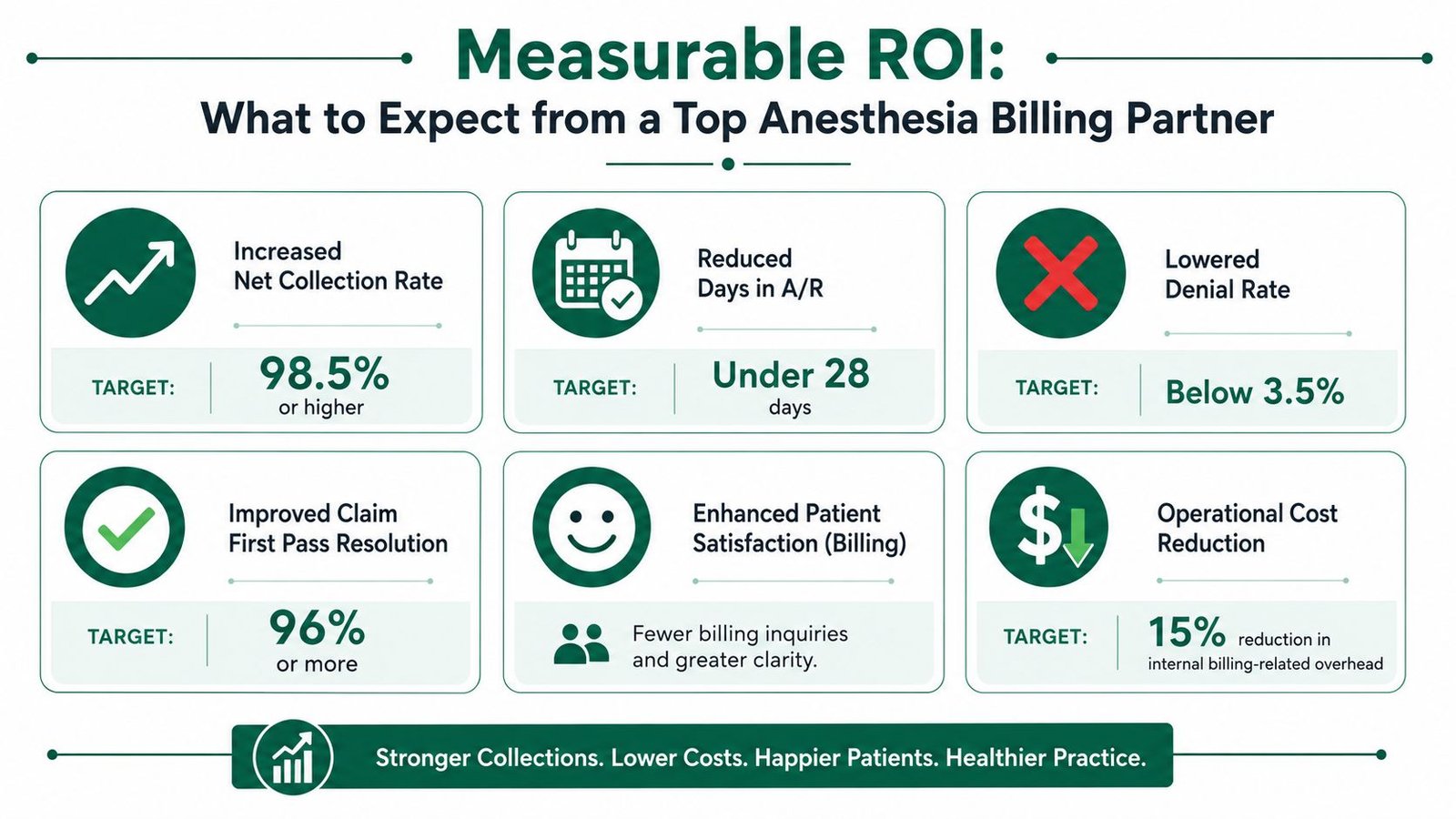
Measurable ROI What to Expect from a Top Partner
A serious anesthesia billing company should be judged by contract metrics, not marketing language. The right partner should improve cash flow in ways you can verify by payer, case type, and denial reason.
Demand metrics that tie to money
At a minimum, you should expect clear reporting on Net Collection Ratio by payer, Days in A/R by case type, and denial root-cause data tied to anesthesia modifiers, because those are the metrics that show whether the partner is reducing leakage (Medical Billers and Coders best anesthesia billing companies guide). Headline collections alone can hide underpayment recovery problems or shifting work back to your own staff.
A strong partner also needs to validate claims before submission. That means scrubbing time units, checking modifier logic, and catching mismatches before the payer sees them. If they're doing that well, you should see fewer avoidable denials, cleaner first-pass performance, and less time spent chasing old balances.
What good looks like in practice
The benchmark targets can be framed clearly. The provider guidance shared in this space points to a first-pass clean claim rate above 98%, average Days in A/R under 35, and a denial rate below 5% as the kind of performance a top partner should be able to support, especially when the workflow is built around specialty-specific scrubbing and follow-up.
If the vendor can't show you where revenue is lost by payer and by case type, you don't really have performance reporting. You have activity reporting.
For anesthesia groups, the point of outsourcing isn't to create another dashboard. It's to reduce the number of places where money can slip away before it lands in your account. A partner should show how it protects time capture, modifier accuracy, and payer-specific submission quality.
The best time to ask for proof is before you sign. If the company can't segment results by payer, service line, and case type, its “ROI” claim isn't really measurable.
Comparing Anesthesia Billing Pricing and Contracts
Pricing matters because it shapes incentives. A vendor can look inexpensive and still be expensive if its fee model encourages volume without accountability, or if it makes dispute resolution too slow to protect cash flow.
| Model | Typical Fee | Pros for the Practice | Cons for the Practice |
|---|---|---|---|
| Percentage of net collections | A percentage of what's collected | Aligns the vendor with actual collections, usually makes denial prevention and follow-up a shared priority | Can feel costly if collections are already strong, and it can be harder to forecast exact expense |
| Flat fee per claim | A fixed amount per claim | Predictable cost structure, often useful for stable, high-volume practices | Can weaken the vendor's incentive to push harder on difficult denials or underpayments |
| Hybrid model | Base fee plus performance component | Can balance predictability with accountability, especially if the contract ties fees to measurable outcomes | Harder to negotiate and requires very clear definitions of performance metrics |
A percentage model often works best when a practice wants the vendor's goals aligned with net collections. A flat-fee model can work for groups that have high volume and want budget predictability, but only if the team is already strong on documentation and case capture. Hybrid contracts can be useful when you want some cost control without giving up performance pressure.
The question is not which structure sounds cheapest. It's which structure pushes the vendor to fix your actual revenue problems, especially time capture, denial prevention, and payer follow-up. If the company won't spell out how it gets paid and what it's accountable for, the contract is already too soft.
Anesthesia practices should also ask whether the pricing model includes appeals, old A/R cleanup, and reporting access. Those items can change the effective cost of the relationship fast. A low sticker price is not a good deal if your staff still has to do the hard work.
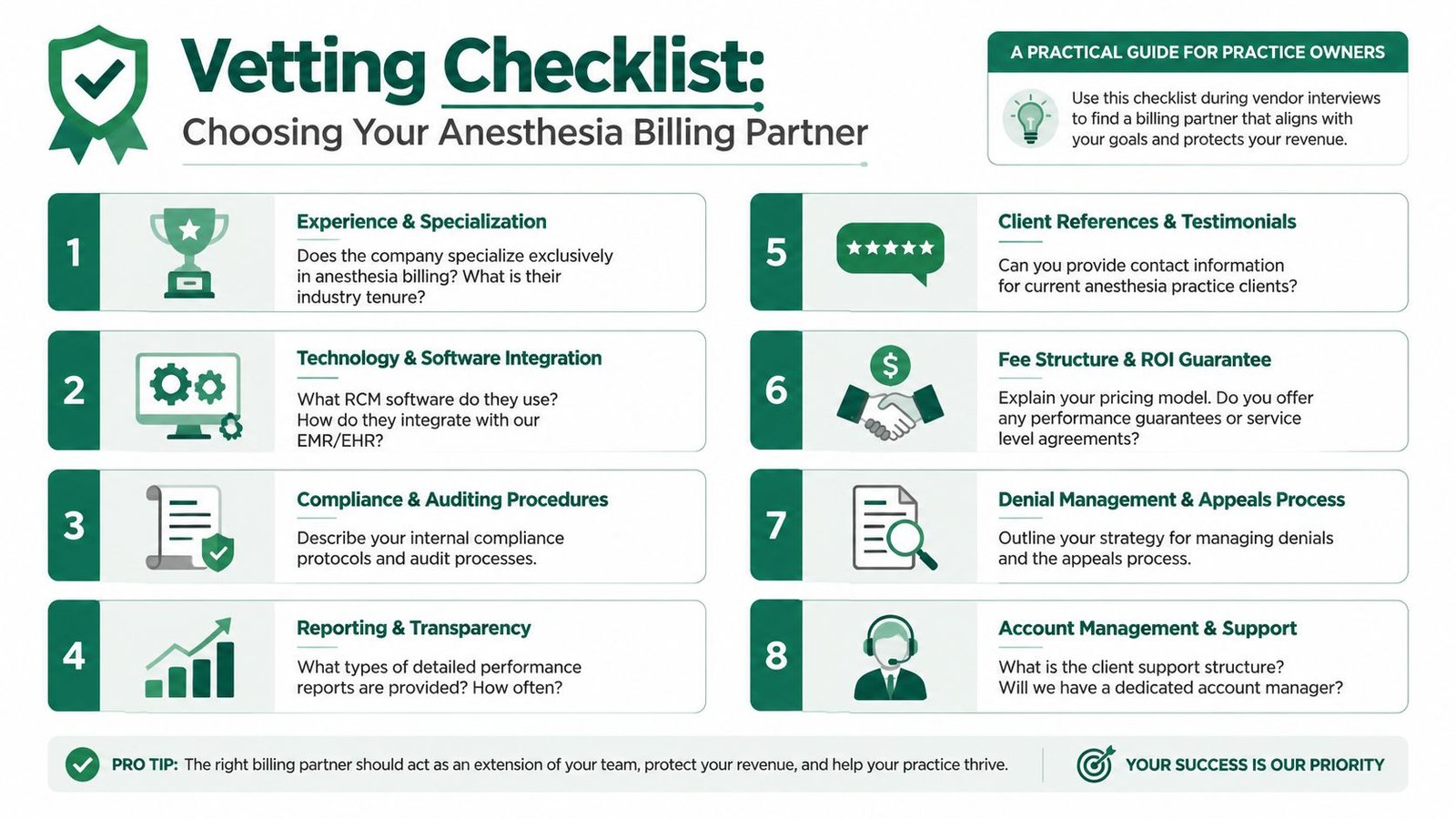
Your Vetting Checklist and Key Interview Questions
A good vendor conversation should feel like a finance review, not a sales demo. If you're evaluating an anesthesia billing company, ask for evidence that shows how the partner protects revenue inside your case mix.
Ask for the reports that matter
The most useful questions are the ones that force specificity. Ask for a sample report showing Net Collection Ratio by payer, then ask how they track Days in A/R by case type. Then push deeper and ask how they segment denials tied to anesthesia modifiers and time-unit errors.
You should also ask how the company audits for concurrency, medical direction, and documentation gaps. Those are the areas where payers can reduce or reject payment, and where a weak compliance process becomes a direct financial risk (PGM Billing anesthesia RCM guidance).
Questions worth asking in the sales call
- How do you validate anesthesia time units before submission?
- Can you show a denial root-cause report by payer and by modifier?
- What is your process for concurrency and medical direction audit review?
- How do you handle underpayments, not just denials?
- What does your account team do when a payer applies the wrong conversion factor?
- How do you keep reporting transparent enough for a physician-owner or CFO to review without translation?
Those questions expose whether the vendor is operating at the specialty level or just generalizing from other billing work. If they can answer clearly, they usually have the discipline to manage the claims correctly.
For broader contracting questions, it also helps to compare notes with a medical billing company hiring checklist. And if your organization is worried about protecting billing-related PHI while moving data between teams, a resource on maintaining data privacy in medical transcription is a useful reminder that privacy controls should be part of the vendor review, not an afterthought.

Best practice: if the company can't explain its audit trail for time units, modifiers, and payer exceptions, keep looking.
A vendor that speaks in broad terms about “better collections” but can't show the actual report structure is not ready for a serious anesthesia practice.
Red Flags When Hiring a Billing Service
The biggest warning sign is a vendor that promises results without showing process. In anesthesia, process is the product.
A billing service should never refuse to work within your existing EHR unless there's a compelling operational reason. If they insist on moving your workflow, you're taking on disruption that may not improve collections. A strong partner should reduce friction, not add a migration project.
Another red flag is any guarantee of a 100% collection rate. That's not a real-world promise, and it usually signals that the company is selling confidence instead of accountability. You want a firm that talks about measurable improvements in claim quality, denials, and A/R, not impossible perfection.
Reporting is another tell. If the company won't show denials, A/R aging, and underpayment recovery in a way your physician owners can understand, then it's hiding the exact data you need to judge performance. That becomes a serious issue in anesthesia because payers can reduce or reject payment when documentation doesn't support concurrency or medical direction rules (PGM Billing anesthesia RCM guidance).
A vendor that can't explain what happens when the payer challenges supervision or direction is ignoring one of the main revenue leak points in anesthesia billing.
You should also be cautious if the company has no clear anesthesiology expertise. A generalist team may sound credible in a demo, but anesthesia claims depend on rules that don't map cleanly to other specialties. If the vendor can't explain how it handles time, base units, and modifiers without hand-waving, it's probably not the right fit.
For a broader look at what to avoid in outsourcing relationships, the billing service red flags guide can help sharpen your review.
FAQs About Choosing an Anesthesia Billing Partner
Should I outsource anesthesia billing or keep it in-house?
If your internal team is already handling time units, modifier logic, denial follow-up, and compliance review well, in-house can still work. But if you're seeing recurring denials, slow A/R, or a lot of rework on anesthesia claims, outsourcing to a specialty partner is usually the faster way to stabilize cash flow.
How do I know if a billing company really understands anesthesia?
Ask them to explain how they manage base units, time units, and modifier units in the same claim, and then ask how they audit concurrency and medical direction. If they drift into generic billing language, they probably don't have deep anesthesia experience.
What should I ask for before signing a contract?
Ask for a sample dashboard, a denial root-cause report by modifier, and a payer-level collection report. You should also ask how they handle underpayments, appeals, and documentation issues when payers challenge claims.
How disruptive is a switch to a new billing partner?
A good transition should be controlled and data-driven, not chaotic. The best firms audit the existing claim history, identify hidden underpayments, and then move the workflow in a way that protects active collections instead of freezing them.
If your anesthesia practice wants cleaner claims, tighter denial control, and a billing partner that can prove its value with real reporting, Happy Billing can help you benchmark the numbers and tighten the workflow inside your existing EHR. Visit Happy Billing to request a review and see how your current anesthesia billing performance stacks up against what a specialty-focused partner should deliver.