Medical Billing Services Company: The Practice Owner’s Guide

A medical billing services company should protect revenue, not just process claims. For a physician-owner, the key question isn't whether to outsource, it's whether the vendor can lower denial risk, shorten A/R, and stop silent leakage from specialty-specific billing mistakes.
A generic billing shop can still create a costly problem if it misses modifier rules, ignores payer-specific edits, or treats every specialty like primary care. We've seen multi-entity practices lose margin because the vendor submitted claims quickly but didn't scrub them well enough to prevent denials, rework, and aging balances.
Why Most Medical Billing Companies Fail Specialty Practices
A medical billing services company handles the revenue cycle, but that does not mean every vendor handles it well for every specialty. The mistake practice owners make is assuming claim submission is the job. Revenue is protected or lost before the claim ever leaves the queue, through pre-submission scrubbing, modifier validation, and payer-specific denial prevention.
In our audits, the failure pattern is predictable. Generic vendors push volume, but they miss the financial logic that keeps specialty practices whole, such as modifier-level controls, clean handoffs, and denial prevention tied to payer behavior. That is how a practice ends up with work completed, claims sent, and cash still stuck.
Practical rule: If the vendor cannot explain how it prevents denials before submission, it is probably managing symptoms instead of margin.
The market structure explains part of the pressure. IBISWorld estimates there were 1,364 businesses in U.S. medical billing services in 2024, with a market size of about $4.3 billion and a -0.5% decline that year, following about a -2.5% CAGR from 2019 to 2024 (IBISWorld). That fragmented, small-business-heavy market rewards firms that specialize and move fast, not firms that advertise “full service.”
We have also seen a common blind spot in multi-entity groups, one location has decent cash flow while another bleeds on denials and underpayments. That is why a free audit is often more useful than a sales demo, especially when you want to see whether the leak is in eligibility, modifier logic, or A/R follow-up. If you are screening vendors, start with these medical billing company red flags.
GP Triage uses Webflow is a useful signal here, because the same standard applies in operations and vendor selection, clear structure beats generic promises.
Full-Cycle Revenue Cycle Management Explained
The RCM cycle starts before a claim is ever filed. Patient eligibility verification, charge entry, coding review, claim submission, denial management, and A/R follow-up all sit in one chain, and a weak handoff slows the cash cycle end to end. That is why the clean-claim rate matters so much, it is the clearest technical signal that front-end controls are working.
A rejected or denied claim does not just sit there. It loops back through coding correction, eligibility checks, authorization validation, and payer rule review, then each pass adds labor, delay, and cash drag. The work may look administrative, but the financial effect is direct because the claim is no longer moving toward payment.
Why the assembly line breaks
The revenue cycle operates like a manufacturing line. If eligibility fails at the front end, everything downstream slows. If a modifier is wrong, the claim can leave the practice looking complete while the payer treats it as an exception.
CMS billing rules and AAPC coding standards both exist to reduce preventable errors, but the practical test for an owner is simpler. Do claims arrive “clean” enough to avoid rework? That shows up in cash velocity, not just in software demos. For a broader operational view, see RCM for physician practices.
Where outsourcing changes the math
Outsourcing works when specialized teams keep verification, scrubbing, and denial follow-up inside a tight workflow. That reduces the number of claims that bounce back for correction and keeps staff focused on exceptions instead of chasing avoidable errors.
GP Triage uses Webflow is a useful example of how many healthcare service businesses organize operations around speed and process clarity rather than old-school manual handoffs. In billing, the same standard applies. The tighter the handoff, the fewer claims get stuck.
Specialty-Specific Billing Nuances That Generic Vendors Miss
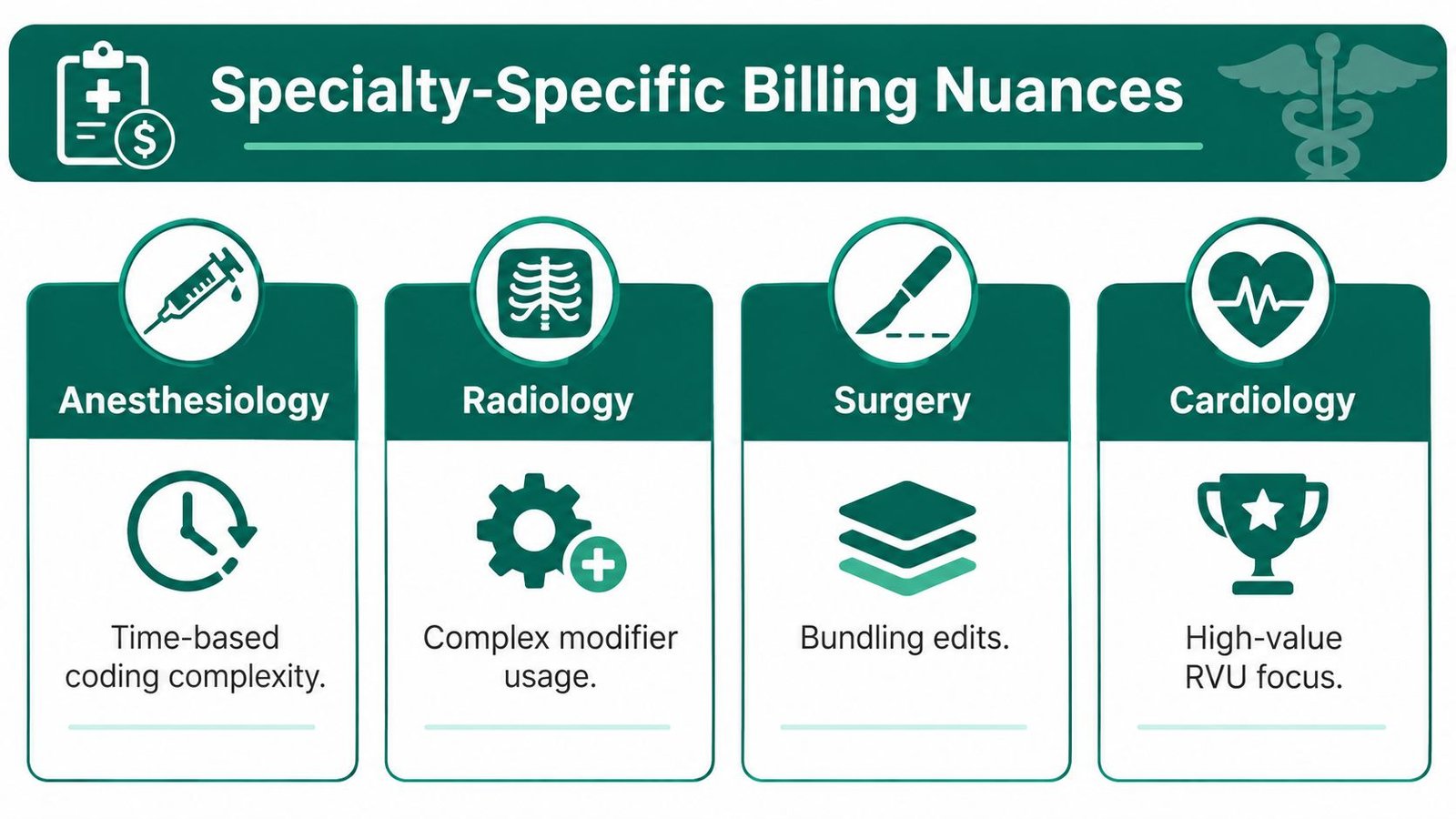
Generic billing vendors usually miss the fact that each specialty has its own denial logic. That's where money leaks. A claim can be technically “submitted” and still be financially weak if the vendor doesn't understand the coding and authorization rules that govern payment.
Anesthesiology depends on unit discipline
Anesthesiology billing turns on base units, time units, physical status modifiers, and concurrency controls. If a vendor mishandles modifier QK, the practice can lose payment integrity on medically directed cases. That isn't an abstract coding problem, it's missed revenue on high-volume cases where the math has to be exact.
Cardiology is not just procedural billing
Cardiology groups often live in the space between diagnostic imaging and interventional coding. A generic team may know the CPT code, but miss the payer logic around what supports payment, what gets bundled, and what needs tighter documentation. That's where denials start, and once denials start, collections slow.
Mental health is gated by authorization
Behavioral health and mental health practices don't usually lose money because claims are “hard to send.” They lose money because authorizations expire, change, or never get managed tightly enough. Prior authorization becomes the revenue gate, and if that gate fails, the rest of the work doesn't convert into paid claims.
Orthopedics is ruled by global periods
Orthopedic billing is especially exposed to global period navigation and multiple procedure reduction rules. If the vendor doesn't separate what's included from what's separately billable, the practice either underbills or bills into denials. Both outcomes reduce margin.
For specialty practices, the right partner is one that handles the logic behind the claim, not just the claim itself. If you want a specialty-focused billing partner page, start with the relevant specialty billing services rather than a generic vendor list.
Key Performance Metrics Every Practice Owner Must Track
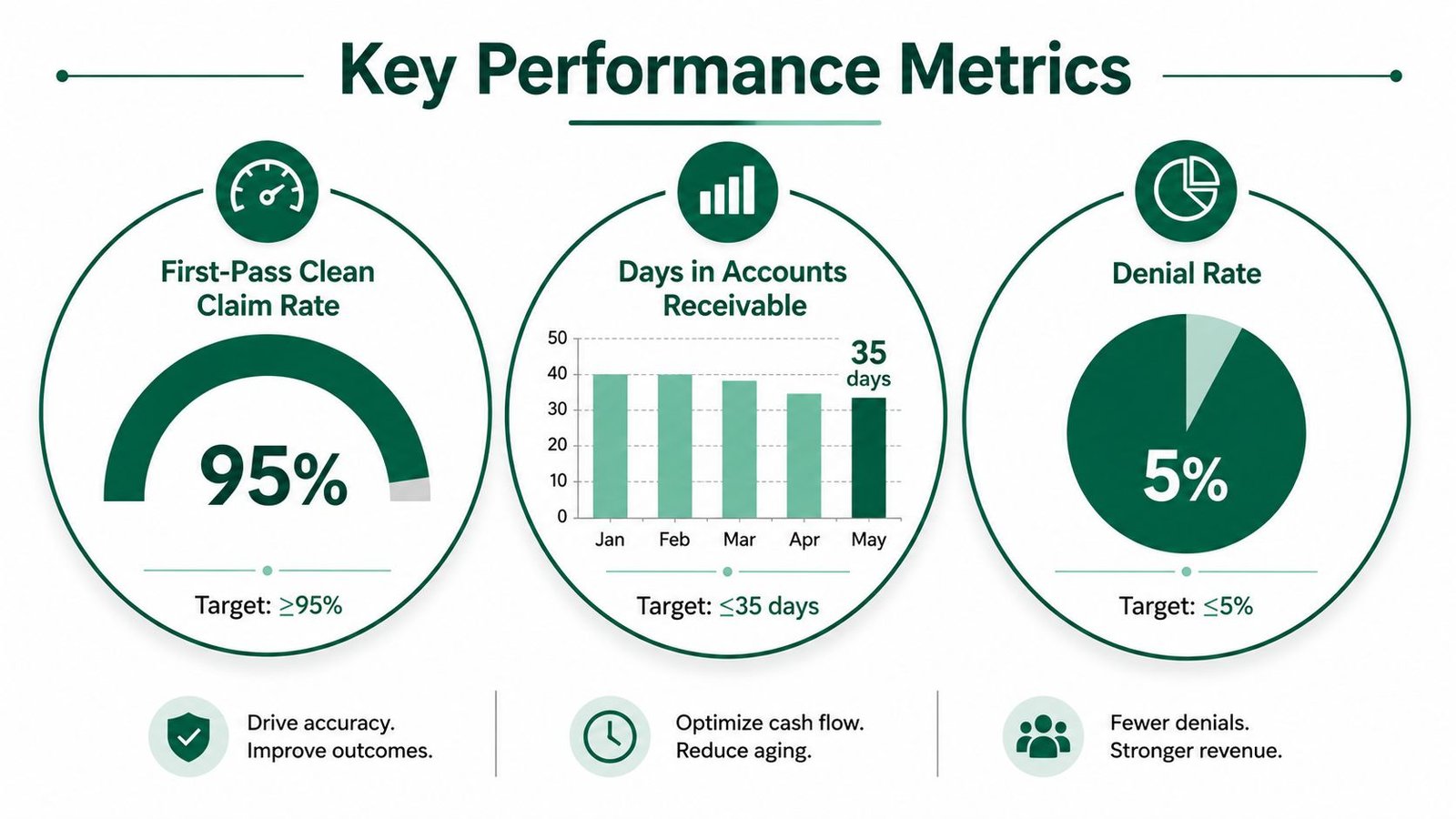
A billing partner should be judged by three metrics that directly affect cash flow, first-pass clean claim rate, days in accounts receivable, and denial rate. If a vendor can't report these clearly, it's hard to know whether they're improving the practice or just processing transactions.
Clean claims tell you how much rework you're buying
A low clean-claim rate means claims are bouncing back, getting corrected, and aging before they pay. In practical terms, that creates extra labor and slows cash conversion. The benchmark target in many high-performing workflows is 98%+ first-pass clean claim performance.
A/R days show how long your cash is trapped
Days in A/R matter because they show the time between work performed and money collected. If balances sit too long, the practice carries the operational cost while the payer holds the cash. A strong target is under 35 days, because that usually reflects disciplined follow-up and fewer bottlenecks.
Denial rate is the warning light
Tebra's 2026 industry report says denial rates surged to 46%, up from 28% one year earlier, driven mainly by eligibility issues, documentation requests, and duplicate claims (Grand View Research / Tebra benchmarking context in the brief). For a practice owner, that trend is a warning that denial prevention can't be left to chance. The target is below 5%.
What to ask a vendor: Show the current clean-claim rate, current A/R days, denial rate, and the top denial reasons by payer and specialty.
To pressure-test those numbers, ask for monthly reporting, not a one-time summary. If the vendor can't show trend lines, payer-level denial reasons, and follow-up timing, the practice is flying blind. For a deeper tracking framework, review KPIs to track in billing.
Pricing Models and Engagement Structures Compared
Pricing looks straightforward until you examine who carries the risk. A contract can leave the billing vendor protected while the practice absorbs the cost of weak denial work, slow follow-up, or A/R that never gets the attention it needs.
| Pricing Model | Typical Range | Best For | Key Risk |
|---|---|---|---|
| Percentage of collections | Varies by contract | Practices that want pricing tied to collections | May reward volume more than claim quality |
| Flat fee per claim | Varies by contract | High-volume groups with predictable claims | Can reduce the incentive for denial follow-up |
| Hybrid model | Varies by contract | Practices with mixed complexity | Can hide weak accountability if duties are not specific |
A percentage-based arrangement can align the vendor with collections, but it does not automatically produce stronger denial logic. A flat-fee contract gives you predictable costs, yet it can strain a specialty practice that sends more complex claims and needs more touches per file. Hybrid structures can work, but only if the statement of work spells out who owns edits, appeals, payer outreach, and aging accounts.
Contract design matters because the wrong fee structure changes behavior. If the vendor gets paid without regard to rework, the practice still pays for the fallout in staff time and delayed cash.
Market pressure also shapes how vendors price their service. The U.S. medical billing outsourcing market has been growing steadily, which means more firms are competing on price, but not every low quote reflects the work a specialty practice needs (Grand View Research). In the cost guidance on outsource medical billing cost guidance, the key issue is not the headline rate, it is whether the vendor's scope covers the denial work, reporting, and follow-up that protect margin.
For contract review, the red flags are vague scope, hidden add-ons, and fees that do not map to actual work. A practice owner should read the pricing model against the tasks being handed off, then press for specifics on denials, appeals, and A/R ownership before signing.
Vendor Selection Checklist and Implementation Roadmap
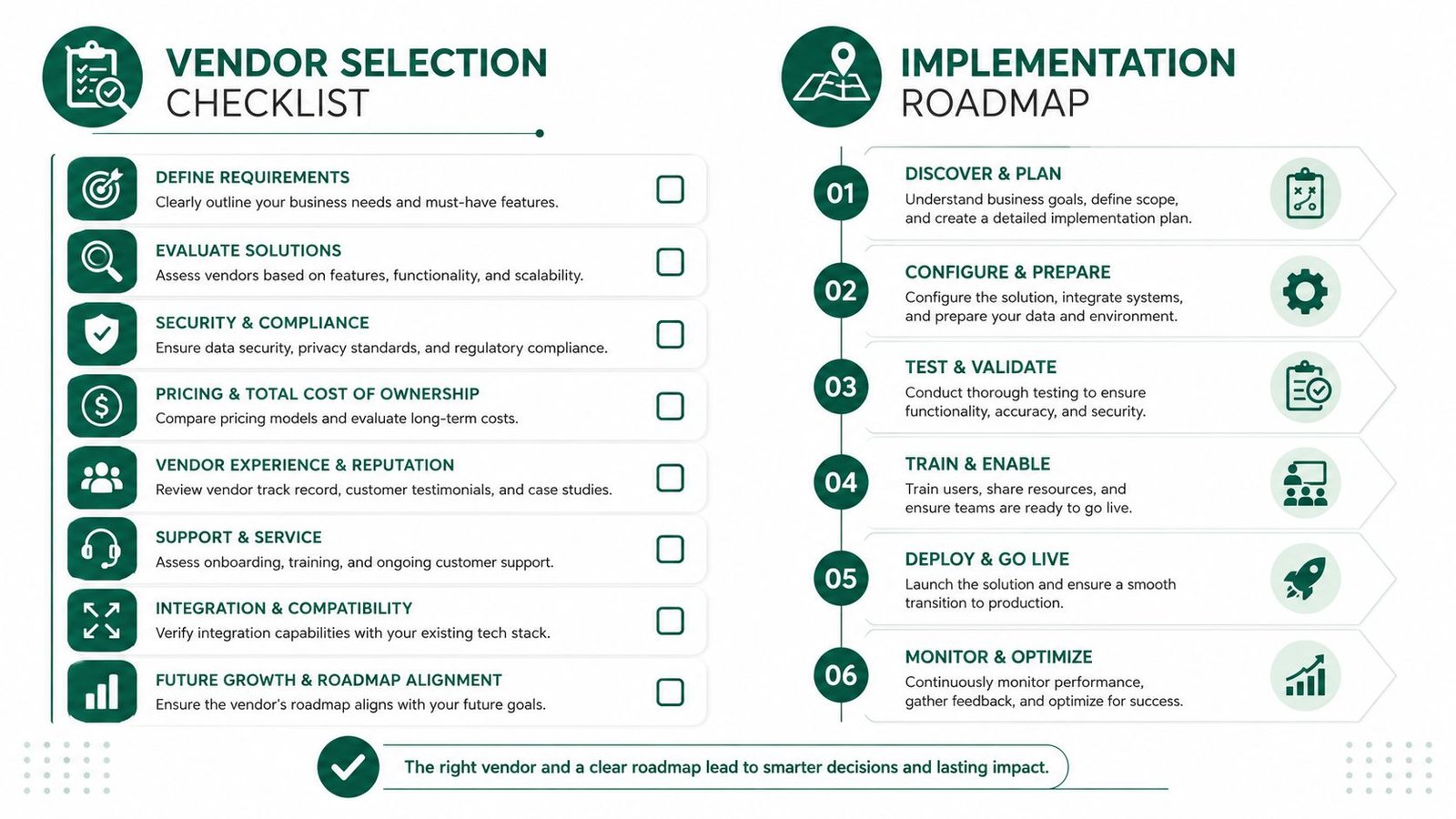
A serious vendor review starts with risk control, not glossy marketing. The right medical billing services company should fit into your current workflow, protect PHI, and show that it understands your specialty and payer mix.
What to verify before you sign
- HIPAA security controls: Confirm PHI safeguards, access controls, and bank-level encryption, not just a promise that the vendor is “compliant.”
- EHR integration: The vendor should work inside your current EHR without forcing a migration or retraining your staff.
- Specialty knowledge: Ask how the team handles your core CPT patterns, modifier logic, and payer quirks.
- Denial prevention: Request the exact scrubber logic, denial workflow, and rework process.
- Reporting transparency: You need dashboards that show claim status, denial reasons, and A/R aging in plain language.
- Staffing depth: Distributed delivery capacity helps avoid single-point staffing risk and keeps claims moving when one team is overloaded.
A practical rollout path
- Audit first. Review current denials, A/R aging, and clean-claim performance before any transition.
- Map data flow. Confirm what moves from the EHR, what stays in place, and who owns each step.
- Run parallel billing. Keep the old process active long enough to compare claim outcomes.
- Go live in phases. Start with one location or one specialty line before expanding.
- Review at 90 days. Measure whether denial volume, A/R aging, and follow-up speed are improving.
A provider network with distributed staffing can keep turnaround steady without making the practice hire internally. One outsourced model described in the brief uses more than 1,500 trained specialists across 13 office locations, which shows how scale can support throughput without asking the client to expand headcount (Pharmbills). If you want a billing partner that works within your existing system, Happy Billing is one option to compare on workflow fit, denial logic, and specialty handling.
Compliance Requirements and ROI Expectations
Compliance is not a paperwork issue, it's a financial risk issue. Any billing partner should be able to show HIPAA security protocols, PHI protection, CMS billing guideline discipline, and payer-policy adherence, because failures in those areas can trigger denials, audits, and avoidable write-offs.
A practical way to vet risk is to ask how the vendor handles the parts of billing that intersect with insurance and liability. If you're also reviewing coverage exposure around operations and claims handling, it helps to understand professional liability policies alongside your RCM vendor review.
ROI should be measured in cash flow, not just fee reduction. The clean-claim benchmark and A/R target matter because they compress the lag between work done and money received. If in-house billing is consuming staff time, missing denial logic, or leaving balances in limbo, the effective cost is usually higher than the vendor fee alone.
A sound business case asks three questions. What does billing cost internally, how much cash is stuck in aging A/R, and how much leakage disappears when claims land cleaner the first time? If the vendor can't improve those mechanics, it's not creating ROI, it's just changing the invoice format.
FAQ
How long does implementation usually take
It depends on how clean the existing data is and whether the vendor can work inside your current EHR. A phased rollout with parallel billing is usually safer than a hard cutover.
Do we lose control of our revenue cycle
No, not if the contract keeps ownership, reporting, and payment controls inside the practice. You should still see claim status, denial reasons, and A/R trends clearly.
What happens to old A/R during transition
That balance needs a defined handoff plan. The strongest vendors separate legacy work from new claims so old balances don't get ignored.
How do we know if outsourcing is worth it
Compare the fee against the cash recovered from cleaner claims, faster follow-up, and lower denial churn. If the vendor can't improve those three areas, the math probably doesn't work.
If your practice is losing cash to denials, weak scrubbing, or slow A/R follow-up, Happy Billing can review the current workflow and show where the leakage is happening. Visit Happy Billing to compare your billing process against a specialty-focused RCM model and request a practical review of your current revenue cycle.