Anesthesia Billing Solutions: The Practice Owner’s Revenue

Base Units + Time Units + Modifying Units, multiplied by the Conversion Factor, determines anesthesia reimbursement. Anesthesia billing solutions apply that formula accurately while managing payer rules, documentation controls, and CMS concurrency requirements, where technical mistakes can directly reduce reimbursement.
That precision matters because the anesthesia clock isn't a casual timestamp. Under insurer rules, it generally starts when the practitioner begins preparing the patient and ends when the patient is transferred to post-anesthesia care, with one time unit earned for every 15 minutes of anesthesia time, as documented in this cross-sectional study of anesthesia billing-time patterns. A practice can deliver excellent clinical care and still lose revenue when a start time, base unit, modifier, or concurrency relationship doesn't survive payer scrutiny.
The financial exposure is substantial. Medicare Part B anesthesia services increased from 10,006,743 allowed services in 2000 to 15,123,395 in 2014, while adjusted Medicare payments for anesthesia procedures reached $2.85 billion in 2014, according to a 15-year analysis of Medicare anesthesia utilization and payments. For an independent practice owner, anesthesia billing isn't merely a back-office function. It's a precision engineering problem that determines collection rate, denial volume, and A/R velocity.
Facility-based groups (anesthesia, spine, orthopedics, assistant surgeons, neuromonitoring) paid near the QPA can hand the whole process to us: see our No Surprises Act IDR recovery service. We run open negotiation and federal IDR on contingency.
The Hidden Revenue Leak in Anesthesia Billing
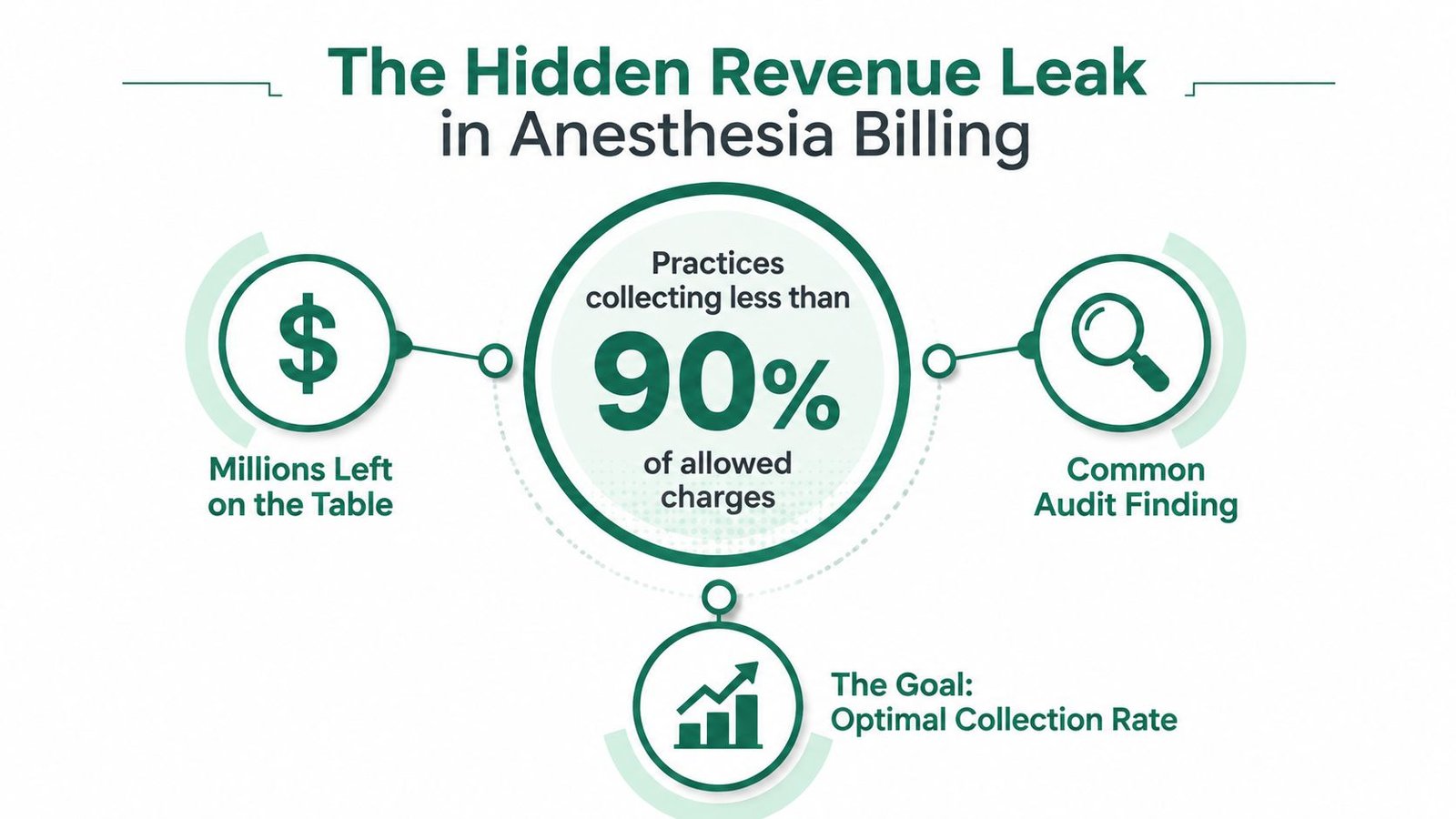
Practices collecting below 90% of allowed charges often have a precision problem rather than a volume problem. Revenue slips through incomplete time capture, base-unit rounding, incorrect concurrency modifier splits, weak charge reconciliation, and time-validation mismatches between the anesthesia record and operating-room system.
The financial question is whether the workflow reproduces the payer's calculation and preserves evidence for every unit. A claim can transmit successfully while still losing value because one technical input was rounded, split, or accepted without validation.
Why generalist workflows miss anesthesia revenue
General billing teams may handle CPT selection, claim submission, and routine denial follow-up well. Anesthesia billing requires tighter controls. The workflow must connect the procedure to the correct base units, convert defensible timestamps into time units, reconcile physician and qualified anesthetist roles, and apply payer-specific concurrency rules.
Small discrepancies can change payment. If the anesthesia record, operating-room system, and claim show different start or stop times, the payer may reduce or reject the service. If the qualified anesthetist's role does not match the physician's concurrency record, a medically directed service may be billed as personally performed, creating a payment correction or denial risk.
Base-unit rounding creates another quiet leak. A system that rounds before applying the payer's unit logic can produce a different claim from one calculated with the underlying procedure and time data preserved. Modifier splits create a similar issue. The total work may be accurate, yet the physician and anesthetist portions can be assigned incorrectly if concurrency details are not reconciled before submission.
Financial rule: A clean claim is one whose units, modifiers, provider roles, and supporting timestamps agree, not merely one that passes an electronic edit.
A U.S. study of 4,221 anesthesia practitioners found that 212 reported unusually large numbers of cases ending in durations that were exact multiples of 5 minutes. Practitioners in the top fifth percentile had anesthesia times ending in a multiple of 5 minutes 53.7% of the time, compared with 31.8% among practitioners in the 6th to 10th percentiles. Their billed anesthesia times exceeded expected time by a mean of 21.5 minutes, according to this published analysis of anesthesia time reporting.
That pattern is a control warning, not an accusation. Anesthesia billing solutions should flag unusual rounding, compare source systems, validate concurrency splits, and route exceptions for review. Practices can use our anesthesia workflow audit guide to trace lost units and modifier errors to the workflow that created them.
How the Anesthesia Reimbursement Formula Works
The reimbursement formula is straightforward in principle:
Base Units + Time Units + Special Units, multiplied by the Conversion Factor.
The difficulty is that each component depends on a different kind of accuracy. Base units depend on the anesthesia procedure. Time units depend on documented start and stop events. Special or modifying units depend on circumstances and payer rules. The anesthesia CPT code reference is useful only when the underlying clinical and procedural data are mapped correctly.
Base units establish the case value
Base units represent the relative complexity of the anesthesia service associated with the procedure. Anesthesia codes generally sit within the 00100 to 01999 range, and the applicable base-unit value comes from the relevant anesthesia fee schedule or payer methodology.
A miscoded procedure can change the claim before time is even considered. The practice may have captured every minute accurately and still receive an incorrect allowance because the claim points to the wrong anesthesia service. That makes procedure-to-anesthesia mapping a revenue control, not a clerical lookup.
The system should reconcile the scheduled procedure, operative documentation, anesthesia record, and submitted CPT code. Manual selection from a long code list is particularly vulnerable in high-volume environments where similar procedures occur across facilities.
Time units turn documentation into payment
Time units commonly derive from 15-minute increments. The clock generally begins when the practitioner starts preparing the patient and ends when the patient is transferred to post-anesthesia care, subject to the applicable payer policy. The University of Texas anesthesia payment materials describe the formula and the importance of time, units, conversion factors, and concurrency.
That means patient arrival isn't automatically the anesthesia start time. A patient may enter a facility, wait in a preoperative area, and later enter the operating room. If the claim starts the clock at arrival without payer support, the practice may create an overpayment risk. If the record contains a valid billable start time but the system truncates it, the practice may underreport time.
Special units need payer discipline
Special units can reflect circumstances recognized by a payer's methodology, but they aren't a blank space for adding clinical complexity. Medicare's federal payment rule states that CMS pays the lesser of the actual charge or the anesthesia fee schedule amount, and modifier units aren't allowed for patient health status, risk, age, or unusual circumstances under 42 CFR § 414.46, as stated in the federal anesthesia payment regulation.
For owners, the practical lesson is simple. A claim engine must distinguish legitimate components from units that Medicare excludes. More units on a claim don't necessarily mean more revenue. They can create compliance exposure, delayed payment, and avoidable audit work.
Modifier Complexity and Concurrency Rules
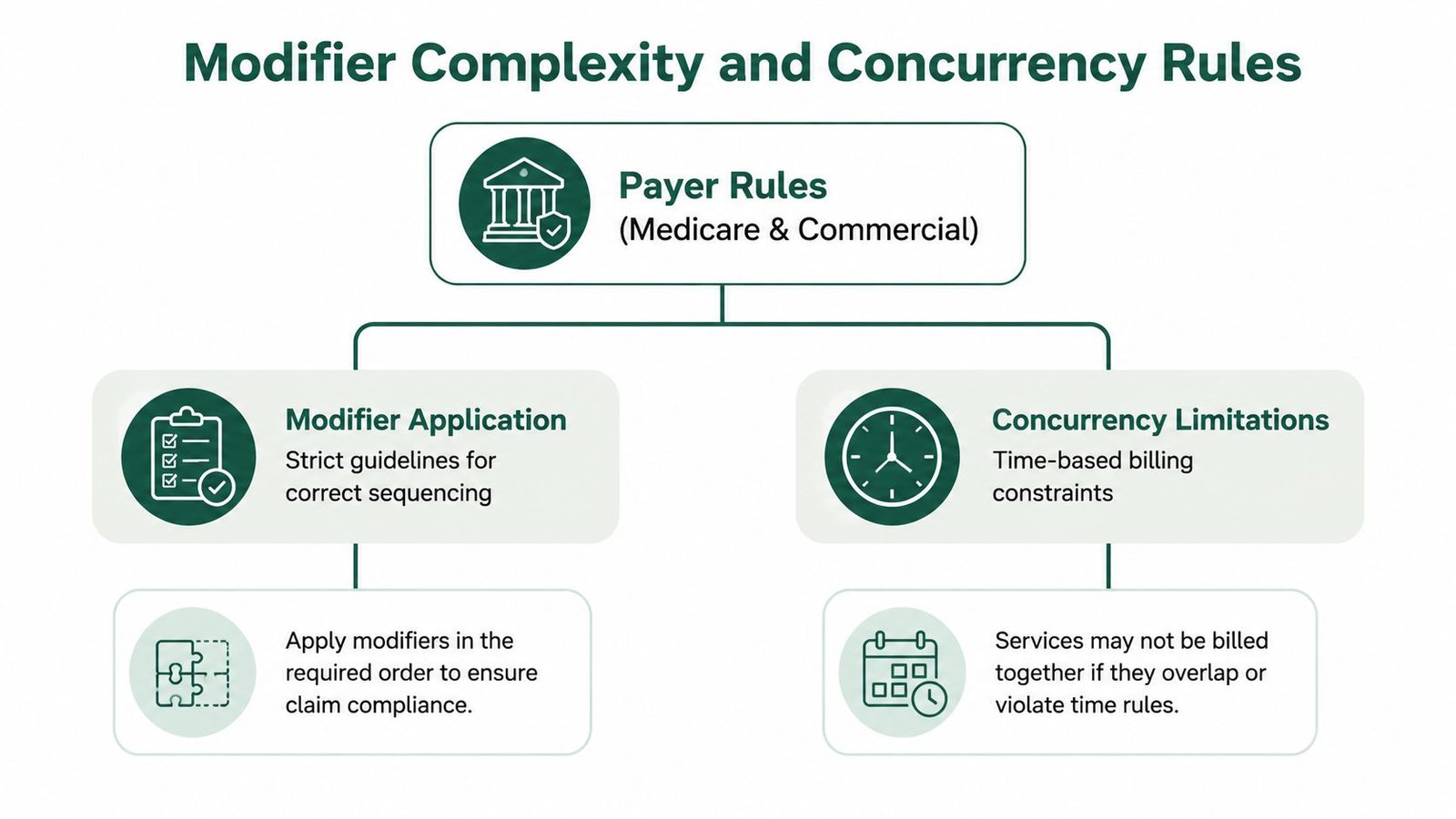
Modifier selection controls how the payer reads the provider relationship and calculates payment. CMS defines QK for medical direction of two, three, or four concurrent anesthesia procedures, QY for medical direction of one qualified nonphysician anesthetist, QX for an anesthesia service furnished by a medically directed CRNA or AA, and QZ for a CRNA service without physician medical direction. The CMS modifier guidance sets out these definitions. Practices can also use this anesthesia modifier reference when configuring billing rules.
The 50 percent split changes the revenue forecast
Under Medicare-linked rules, medically directed anesthesia involving up to four concurrent procedures generally divides the allowance between the physician and the qualified individual. WPS Government Services explains that both parties are generally allowed 50% of the physician-alone allowance when the physician medically directs the service, as described in its guidance on medically directed anesthesia payment.
That split changes expected reimbursement and A/R projections. A physician claim with QK and a CRNA or AA claim with QX must describe the same clinical relationship. If one claim indicates medical direction while the other indicates an independent service, the payer can suspend, reduce, or deny payment.
The billing system should compare both claims before submission and test documented concurrency against the selected modifier. A dropdown alone cannot catch a provider overlap or an incorrect split.
Concurrency is a time and staffing control
Medicare-linked rules recognize up to four concurrent anesthesia procedures under medical direction. Cases exceeding four generally move into the AD medical-supervision framework. CMS also describes reduced base-unit treatment in certain concurrent scenarios, including examples involving two-case and three-case concurrency, in its CMS instructions for anesthesia concurrency.
Concurrency errors often begin with time-validation mismatches. If the system counts overlapping cases differently from the anesthesia record, the modifier split and base-unit calculation can both be wrong. The resulting loss may appear as a denial, a reduced payment, or an audit adjustment.
The AD modifier has historically been rare, with utilization around 0.4% to 0.6% in the cited Medicare trend analysis. The QZ modifier rose from 10.9% to 21.7% over that study period, according to the Medicare anesthesia trend analysis. Those figures do not determine the correct modifier for an individual case. They do support active monitoring of modifier use, concurrency patterns, and payer response.
Manual Billing versus Specialized Solutions
Manual workflows can function in a small, stable environment. They become fragile when cases move across facilities, providers cover overlapping rooms, and staff must reconcile anesthesia records with scheduling and operative systems.
The difference isn't whether a generalist platform has a claim form. The difference is whether it understands anesthesia logic before the claim reaches the payer.
| Factor | Generalist RCM Software | Specialized Anesthesia Solutions |
|---|---|---|
| Time calculation | Often depends on manual entry or basic fields | Validates start and stop events against anesthesia workflow |
| Base-unit mapping | May require staff lookup | Maps anesthesia procedures to applicable code logic |
| Concurrency | Usually handled through manual review | Tests provider overlap and concurrency relationships |
| Modifier controls | Generic edits | Payer-aware QK, QY, QX, QZ, and AD validation |
| Exception handling | Finds problems after submission | Routes mismatches for pre-bill review |
| Reporting | Broad billing metrics | Revenue visibility by unit, modifier, payer, and facility |
What manual entry gets wrong
A staff member may copy the anesthesia start time from a scheduling screen because it appears convenient. Another may use the patient's arrival time. A third may round the stop time to match a familiar interval. None of those actions necessarily reflects the billable record.
Manual workflows also struggle with concurrency because the answer depends on overlapping case timelines, provider participation, and the applicable payer model. A claim may look correct in isolation while conflicting with another claim from the same physician or qualified anesthetist.
Automation works best when it doesn't replace judgment. It should identify the cases that require judgment before the payer does.
Specialized anesthesia billing solutions use automated scrubbing and validation to identify those conflicts earlier. They don't eliminate the need for an experienced reviewer. They move that reviewer toward exceptions instead of making the reviewer inspect every claim manually.
Documentation capture matters too. If clinicians dictate or record information through a voice workflow, a practical medical voice recognition guide from HyperWhisper can help leadership evaluate whether the tool supports accurate, usable documentation. The technology still needs controls that compare documentation with the final claim.
Before replacing a system, owners should review in-house versus outsourced medical billing through the lens of control quality. A cheaper workflow that repeatedly loses units or creates preventable denials isn't cheaper after A/R labor and delayed cash are included.
Top Payer Denial Triggers and Compliance Risks
In anesthesia billing, the most costly denial triggers almost always originate in pre-submission documentation gaps. By the time a payer rejects a claim, the underlying error may sit in the anesthesia record, facility interface, provider schedule, or charge-entry process. These failures turn technical details, such as base-unit rounding, concurrency splits, and time validation, into direct revenue loss.
Time validation starts with the right event
Patient arrival is not automatically the anesthesia start time. CMS-related guidance and audit commentary distinguish the start of anesthesia in the operating room or an equivalent area from arrival at the facility. Importing arrival time without testing the clinical event can overstate billable time and create compliance exposure.
A useful control compares three records:
- Clinical event: Identify when the practitioner began preparing the patient for anesthesia.
- Anesthesia record: Confirm complete, internally consistent start and stop times.
- Claim output: Verify that submitted time units follow the payer's calculation method, including its rounding rules.
Time mismatches often look minor during charge entry. Across a large case volume, repeated unit differences can materially reduce payment or trigger recoupment.
Pain management creates a separate review risk. As noted earlier, external audit reporting found anesthesia billed in about 18% of 3.9 million selected spinal pain management sessions, while denials occurred in less than 1% of billed cases, as described in this discussion of anesthesia coding and revenue-cycle trends. A low denial rate does not establish compliance. Pre-bill review still needs to confirm medical necessity and whether the service is separately billable.
Modifier units can create overbilling exposure
Under 42 CFR § 414.46, Medicare does not allow modifier units for patient health status, risk, age, or unusual circumstances. Adding units because a case was clinically difficult can produce an improper claim, even when the narrative is persuasive.
Commercial payer policies add reimbursement uncertainty. One large commercial plan announced a 15% reimbursement reduction for anesthesia services billed with QZ effective October 1, 2025. Cited coverage reports also described initial claim denials at 11.8% in 2024 and Medicare Advantage denials rising 4.8% year over year, as reported in this analysis of reimbursement pressure and payer changes.
Owners need payer-specific controls rather than a static cheat sheet. Review denials by payer, CPT family, modifier, facility, and root cause. Then test policy changes before applying them across the claim stream. Effective medical billing denial management prevents recurring errors, not merely faster appeals.
Implementation Steps for Medical Practices
A practice can improve anesthesia billing without replacing its EHR. Keep the clinical system, strengthen the data flow, and insert specialized validation between documentation and claim submission. The implementation should expose technical mismatches that directly affect payment, including rounded base units, concurrency splits, and time records that fail payer validation.

Start with a charge-capture audit
Pull completed cases and trace each from scheduling through the anesthesia record, claim, and remittance. Review:
- Missed time units: Compare documented start and stop events with submitted units, then identify rounding or validation rules that changed the result.
- Base-unit mismatches: Confirm that the procedure and anesthesia CPT code align, including the payer's treatment of base-unit values.
- Modifier conflicts: Match physician and CRNA or AA claims to the actual care model, checking whether concurrency units were split correctly.
- Unresolved exceptions: Identify cases held, corrected, or appealed repeatedly, then quantify the payment delayed or lost.
The audit should produce a dollar-focused inventory of leakage sources, even if the recovery opportunity is not yet precise. It also shows whether the fix belongs in staffing, EHR configuration, payer setup, or claim review.
Test the integration before selecting a partner
Ask vendors to demonstrate how the system receives anesthesia times, provider identities, CPT codes, facility data, and payer rules from the existing EHR. Require an exception path when fields conflict. Manual re-entry defeats automation and creates another transcription risk.
A partner should support the 00100 to 01999 anesthesia code range natively. Code familiarity alone is insufficient. Request demonstrations of time validation, base-unit rounding, concurrency calculations, QK and QX pairing, QY use, QZ policy handling, and AD escalation.
Implement in controlled phases
Begin with one facility, payer segment, or provider group. Establish baseline denial causes and A/R behavior, then compare results after the workflow flags exceptions. Keep clinical documentation ownership with clinicians and financial-rule ownership with trained revenue-cycle staff.
The implementation should fit the current operating environment. Physicians should not have to learn a new clinical platform to correct a billing problem. A controlled rollout also makes it easier to isolate whether payment changes came from cleaner data, better modifier splits, or corrected time records.
Key Performance Indicators for Anesthesia Revenue
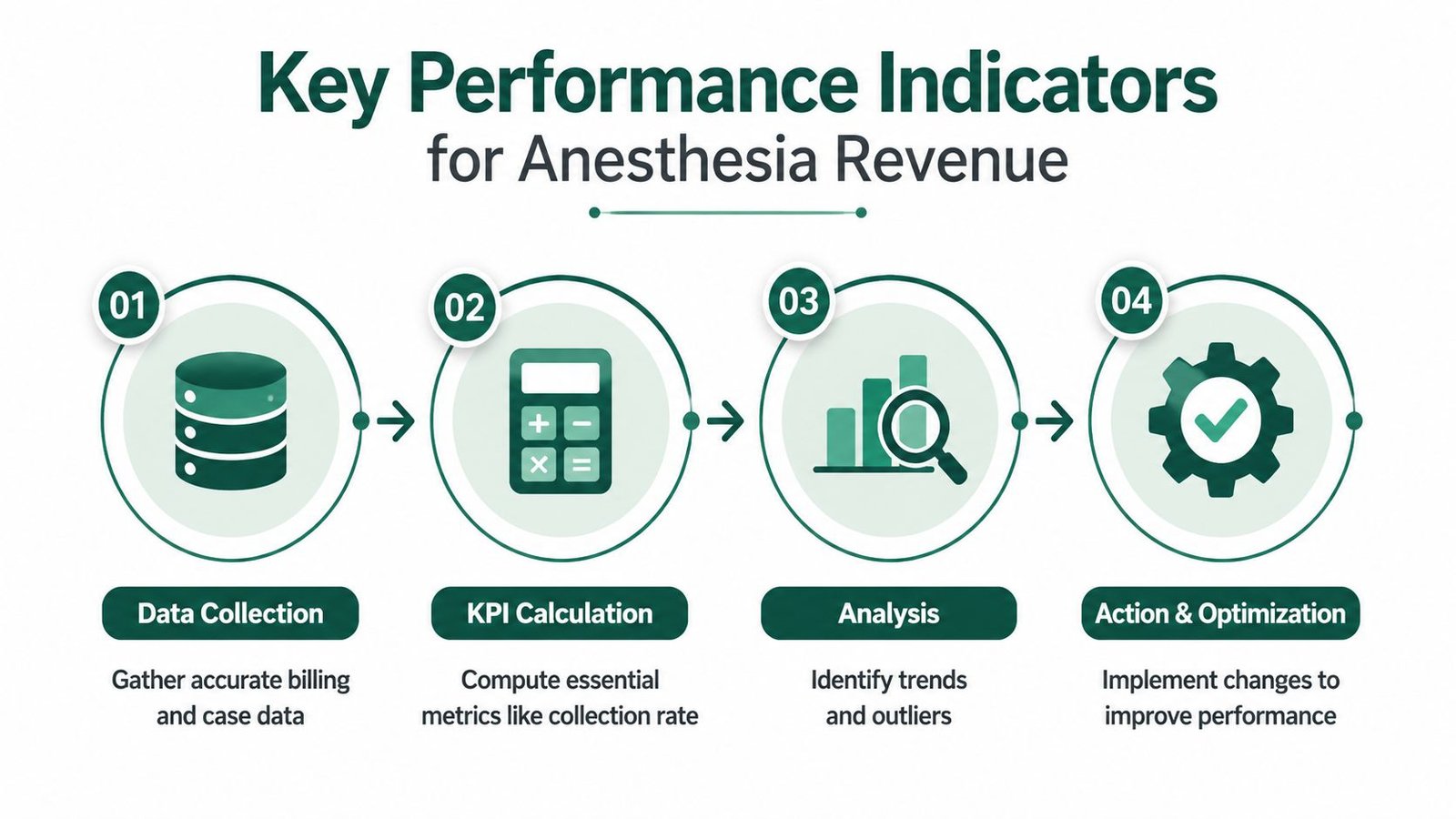
Generic collections reporting hides the technical causes of anesthesia leakage. Practice leaders should track metrics that connect claim quality to cash movement.
Measure clean claims, not just submitted claims
The first-pass clean claim rate shows whether claims leave the practice without preventable corrections. Happy Billing identifies 98%+ as its first-pass clean claim target, based on the publisher's stated operating standard. Treat that figure as a management benchmark, not a universal guarantee, and define exactly what counts as clean.
Track the metric alongside:
- Denial rate by modifier: Separate QK, QY, QX, QZ, and AD-related denials instead of combining all denials.
- Days in A/R: Monitor whether claims convert to cash promptly, with under 35 days as the stated operating target for Happy Billing.
- Unit variance: Compare documented time units with billed units by provider and facility.
- Payer yield: Review allowed and paid amounts by payer and anesthesia service.
A rising clean-claim rate with stagnant cash may indicate that the practice is submitting cleaner but undercoded claims. Falling A/R days with increasing write-offs may signal that staff are closing accounts too aggressively. The metrics must be read together.
Owner's dashboard: If you can't see performance by payer and modifier, you can't tell whether a denial problem is operational, contractual, or clinical-documentation related.
Frequently Asked Questions
Are anesthesia billing solutions worth the cost?
They can be, when the practice has recurring unit discrepancies, modifier denials, delayed claims, or weak visibility into payer behavior. The decision should compare the partner's cost with recovered allowed reimbursement, reduced rework, and the administrative time released from manual reconciliation.
How soon should an owner expect improvement?
The timeline depends on data quality, payer mix, integration readiness, and the size of the existing A/R backlog. A proper evaluation starts with a baseline audit, then tracks first-pass claims, modifier-specific denials, unit variance, and A/R movement after implementation.
Can we keep our current EHR?
Yes. A strong solution should operate within the existing EHR environment or connect to it without forcing a clinical-system migration. Confirm how the workflow handles anesthesia times, CPT data, provider roles, payer rules, and exceptions before signing.
What should a practice look for in a billing partner?
Look for anesthesia-specific experience, AI-assisted validation paired with human audit review, transparent reporting, HIPAA-first security, and documented controls for base units, time, modifiers, concurrency, and denial prevention. The partner should explain exactly how it protects revenue before submission, not only how it works aged claims.
Happy Billing combines agentic AI with expert human auditors to validate anesthesia base units, time, modifiers, and concurrency inside your existing EHR environment. Visit Happy Billing to request a focused review of your claim workflow, denial patterns, and A/R leakage.