Best Medical Billing Companies: Top 7 for 2026

Finding the right billing partner is a financial decision, not a vendor search. The best medical billing companies lower days in A/R, protect first-pass claim rates, and cut the denial leakage that eats collections. In a market where the U.S. outsourcing category is measured in billions and still expanding, the winners are the firms that can prove faster cash flow, not just bigger service menus, and the first thing I look for is whether a vendor can improve revenue without forcing a workflow migration. If you want a benchmark before you sign anything, start with a free revenue audit and compare it against your current denial rate and A/R aging.
If you're also reviewing contract terms alongside billing scope, this healthcare contract lifecycle guide is worth keeping open while you vet service levels, termination language, and data-handling requirements.
1. Happy Billing
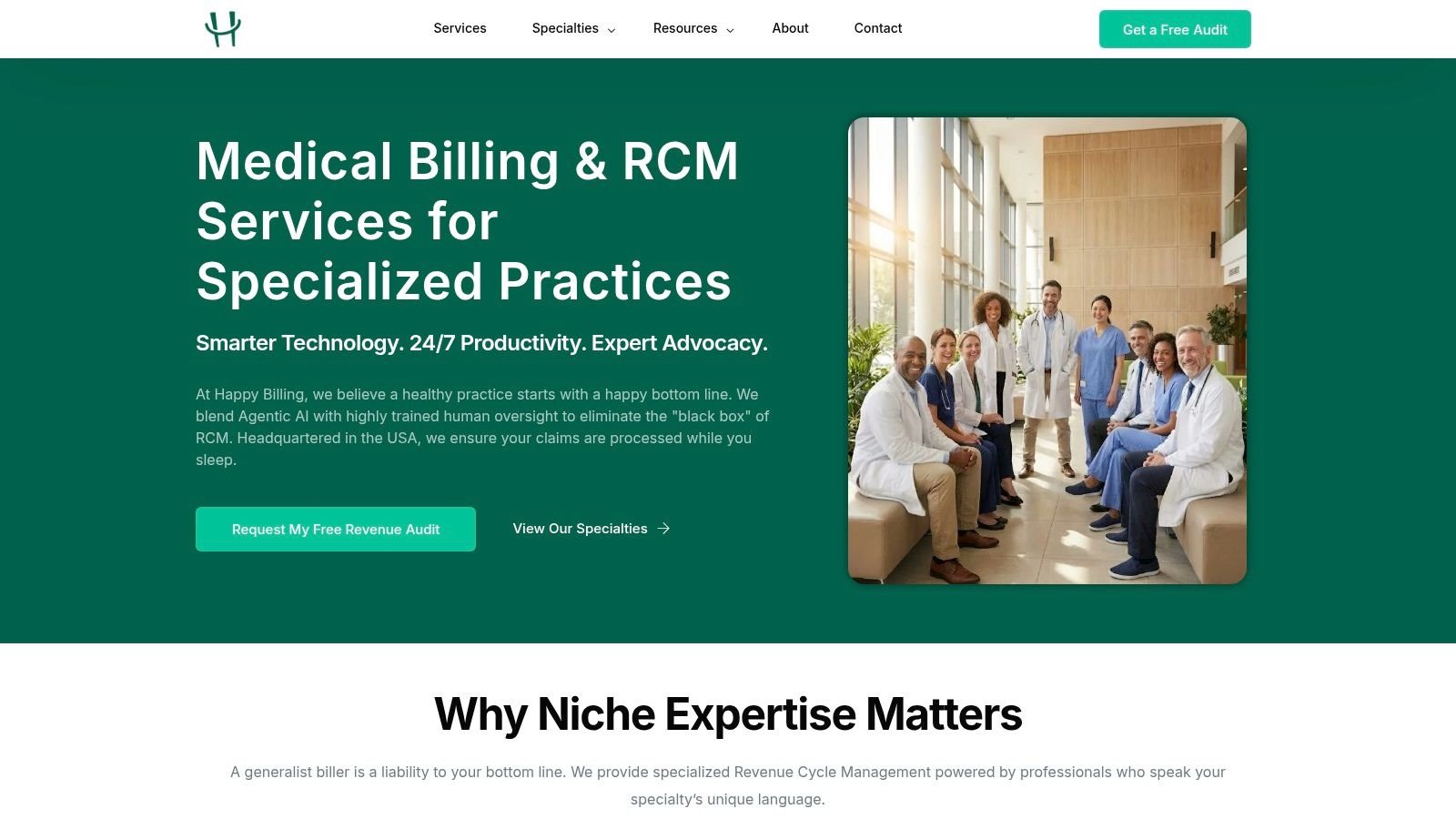
Happy Billing is the pick for practices that can't afford sloppy billing, especially anesthesiology, cardiology, orthopedics, behavioral health, and other high-stakes specialties. Their model is built around stopping revenue leaks fast, and that matters when a few missed modifiers or a weak denial process can drag down collections for the entire month. I'd shortlist them first if your practice wants a partner that works inside your existing EHR and focuses on cash acceleration, not just claim submission.
Why It stands out for specialty revenue
Happy Billing's value is in specialty-specific execution. Their workflows are tuned to the realities that break generalist billing teams, such as anesthesia base units, concurrency, modifier-heavy claims, authorization-heavy mental health services, cardiology imaging, and orthopedics with global period and multiple procedure pressure. They also publish a direct resource on choosing the best medical billing company, which is the kind of practical buyer content I want to see before I trust a vendor with collections.
Practical rule: if a vendor can't explain how it handles your specialty's top denial drivers in plain English, it's not ready to manage your A/R.
Happy Billing also pairs agentic AI with human auditors, which is the right operating model for practices that need both speed and judgment. The company's positioning emphasizes a 98%+ first-pass clean claim rate and under 35 days in A/R, and it does so without forcing an EHR migration. In our experience, that matters because onboarding friction is one of the easiest ways to lose momentum during a billing switch.
A few things to press them on during diligence:
- Specialty fit: Ask how their team handles anesthesia concurrency, cardiology diagnostic and interventional coding, and prior-auth-driven behavioral health claims.
- Workflow control: Confirm they operate inside your existing EHR and who owns denial appeals when payer edits hit.
- Compliance posture: They say they align with AAPC standards and use HIPAA-first controls, so ask to see how that works in day-to-day claim review.
- Recovery scope: Ask how they recover old A/R and whether they'll show you a baseline before they touch production claims.
The company also backs its pitch with public proof points, including a case study around a $32M leak and a testimonial from Dr. Mirza at Anesthesia Associates that ties switching vendors to a higher clean claim rate and a monthly collections lift. I care less about the marketing language and more about the fact that the story is framed around revenue recovery, which is exactly how practice owners should evaluate billing partners. For a Texas-based team with nationwide reach, that's the right focus.
Best fit and bottom line
If you run a specialty practice and your biggest pain points are denials, under-collections, and slow follow-up, Happy Billing is the strongest fit on this list. It's the most clearly built for practices that need measurable improvement in A/R days and first-pass accuracy without a systems overhaul. For physicians who want a serious revenue partner rather than a generic back-office vendor, this is the first call to make.
2. R1 RCM
R1 RCM earns a place on this list because it brings enterprise scale to revenue cycle work without tying your operation to a single EHR stack. For multi-location physician groups, that matters. You get a partner built for coding, denial follow-up, A/R work, and the operating discipline needed when your revenue is spread across several sites and specialties.
Where R1 earns its place
R1's main advantage is scale. It serves organizations that need an outsourcer capable of handling patient access, coding, billing, denials, and follow-up at a level smaller vendors usually cannot sustain. The company also has recognition in ambulatory and government reimbursement work, which gives it credibility with larger physician groups and health systems that want operational maturity instead of a light-touch billing shop.
Visit R1 RCM's platform if your organization already thinks in terms of enterprise process rather than single-practice billing. If you are still defining what good revenue cycle management should look like, start with what RCM means in medical billing before you compare vendors.
R1 makes sense when you need breadth and process rigor more than specialty nuance.
That is the trade-off. If your group wants a large partner that can manage a lot of moving parts, R1 is a credible option. If your highest risk is specialty-specific coding leakage, especially in anesthesia, interventional work, or other modifier-heavy services, I would want a sharper look at how the team is staffed by specialty and how denials are routed back to the people who can fix them.
What I would ask before signing
- Denial ownership: Who owns root-cause analysis, and how quickly do they escalate payer issues?
- Reporting depth: Can they show you A/R by payer, provider, and location, not just a generic dashboard?
- Tech fit: How do they work with your current EHR, and what does implementation look like when your stack is messy?
- Security history: Do a full due diligence review. Publicly documented cybersecurity incidents mean the contract and controls need extra scrutiny.
R1 is a serious enterprise vendor, not a casual outsourcer. For the right group, that is an advantage because it can bring order to billing, denials, and collections. For a smaller specialty practice, it can feel like overbuying, especially if you need tighter specialty coding support and faster revenue recovery rather than broad managed services.
3. athenahealth Revenue Cycle Services
athenahealth is a strong fit when a practice wants billing and technology to operate inside the same workflow instead of passing claims between disconnected systems. Its revenue cycle services matter because the billing layer sits close to the EHR, eligibility checks, and payer workflows, which cuts down handoffs and the errors that usually follow.
Why integrated billing matters
For practice owners, integration reduces leakage. A claim that starts in the EHR, moves through eligibility, authorization, coding support, and denial follow-up inside one ecosystem usually produces fewer missed steps than a patchwork setup. athenahealth also offers enterprise billing through athenaIDX, which is why larger groups with more moving parts take it seriously.
See athenahealth's revenue cycle services if your group wants one platform for workflow and billing services.
If you are evaluating vendors for physician-practice RCM, review our guide to RCM for physician practices first so you can compare what matters most, collections, denial work, and staff time.
The reason I keep athenahealth in the top tier is straightforward, it is built for throughput. In rankings of leading billing firms, athenahealth is positioned around 93% first-pass claim accuracy for enterprise accounts, and that number matters because it maps directly to staff time, rework, and delayed cash. You do not need polished marketing. You need cleaner claims and fewer touches per dollar collected.
What to watch closely
- Scope creep: athenahealth's service bundles can include more than some smaller practices need.
- Pricing structure: It is custom and often tied to collections, so the contract needs to spell out what is included and what is extra.
- Best use case: It works best when the practice is already comfortable with athenahealth's ecosystem and wants to extend it, not replace it.
I recommend athenahealth for groups that value integration and want to reduce the number of places a claim can break. I would not choose it only because the brand is large. I would choose it when the organization needs a unified operating environment and can accept the trade-offs that come with a platform-driven service model.
4. CareCloud Concierge
CareCloud Concierge is the right kind of option for practices that want outsourced billing without turning the EHR decision into a nightmare. It covers the full billing cycle, from charge capture through denial handling and patient collections, while still fitting around an existing system.
Why it's practical for mid-sized practices
A lot of practices get stuck because their current EHR is good enough, but their billing is not. CareCloud's concierge model works in that gap. It gives you a managed RCM layer without forcing a wholesale technology replacement, which lowers implementation risk compared with a rip-and-replace project.
Review CareCloud's concierge model if your priority is service continuity with less change management.
If you are comparing billing operations with automation, start with our guide to revenue cycle management automation. That is where the operational lift comes from, cleaner work queues, faster follow-up, and less manual rework.
CareCloud is also useful because it is positioned openly around a percentage-of-collections pricing model. That matters. Even when the contract is not cheap, the pricing logic is easy to understand, which helps practice owners compare it against the cost of in-house billing and the hidden expense of denials.
The real question is not what the percentage is, it is what the contract does to clean claims, denials, and staff time.
My take on where it fits
CareCloud makes sense for small to mid-sized groups that want structure and visibility. It is a practical choice when leadership wants external billing help, analytics, and patient collections support without adding operational drama.
The downside is straightforward. For complex specialties or lower-volume practices, percentage-based pricing can be hard to justify if the vendor does not move the needle quickly on collections. In audits I have seen, the practices that win with this model are the ones that demand a workflow walkthrough, denial handling examples, and a clear explanation of what the contract excludes before they sign. If they cannot show you how they will reduce rework, the platform will not fix weak RCM discipline.
5. NextGen Healthcare RCM Services
NextGen fits practices that already work inside its ecosystem, or want one vendor to handle both software and billing with fewer handoffs. For owners focused on clean claims, lower denials, and tighter specialty workflows, that can translate into less A/R drag and less time spent fixing avoidable errors.
Why NextGen gets attention
NextGen's main advantage is alignment. When the same vendor supports both the EHR and billing side, data moves through fewer touchpoints, and claim processing usually has fewer breaks. That does not cure weak coding or lazy payer follow-up, but it does cut down the administrative friction that slows cash.
Explore NextGen's RCM services if you want software and billing under one roof.
It also makes sense for organizations that need support around FQHC and CHC workflows. Those environments have their own billing rules and payer quirks, and a generic medical billing firm often misses the operational detail that affects reimbursement. If you are comparing vendors more broadly, review medical billing companies by specialty fit, denial process, and reporting depth, not just by service claims.
What I'd validate in a demo
Start with specialty depth. Ask whether they can show real workflow support for your service line, not just general claim edits that look good on a slide.
Then press on denials. You want to know how appeals are handled, how correction timelines are tracked, and who owns aged claims once they fall out of the easy work queue. If the answer is vague, expect slower recovery and more write-off risk.
I'd also test integration scope. Many groups run tools outside the NextGen suite, and that is where billing teams either stay disciplined or create more work for your staff. Ask exactly what syncs, what does not, and where manual re-entry still happens.
Reporting matters too. You should see clean-claim and denial trends by provider and location, not just broad dashboard language. In audits I have done, practices that get that level of visibility spot payer problems sooner and keep follow-up from drifting.
The reason I would not rank NextGen higher is simple. Its value is strongest when the practice already lives on the platform. If you are starting from a different system, the sales pitch can tilt too far toward software and away from collections. For a practice owner, that is the wrong order. The question is whether the contract will lower A/R, reduce denials, and save staff time fast enough to justify the switch.
6. AdvancedMD Outsourced Medical Billing
AdvancedMD fits practices that already run its PM and EHR stack and want billing services attached to that workflow. The outsourced billing service is built around the numbers that move cash, especially days in A/R, net collection rate, and cleaner claims.
What makes it different
AdvancedMD stands out because it ties billing service to operational tracking, not vague service promises. That matters if you care about cash flow, because you can judge the vendor by whether it shortens collections and keeps denials from piling up.
See AdvancedMD's billing platform if you want an integrated billing service with KPI visibility.
The company also documents onboarding and KPI tracking guidance, which matters because billing transitions fail when no one owns the first stretch after go-live. In our audits, the practices that stay on top of denial work, claim edits, and queue ownership recover faster and avoid the slow bleed that drives write-offs. AdvancedMD is strongest when a practice already uses its ecosystem and wants controlled service motion instead of a highly customized outsourcing arrangement.
Where I'd be careful
- No guarantee language: Read the service agreement closely. The contract terms matter more than the sales pitch.
- Stack dependence: The smoothest setup usually happens when the practice already uses AdvancedMD's platform.
- Scope clarity: Ask who owns denials, follow-up, and aging AR, and make them spell out every handoff.
That is also where automation expectations matter. If your team is comparing billing vendors, review revenue cycle management automation before you sign anything, because the right workflow cuts manual re-entry and keeps staff focused on high-dollar follow-up.
AdvancedMD is not the deepest specialty-first choice on this list, but it is a practical operational vendor for groups that want integration and measurable tracking. If your practice already runs on AdvancedMD, the billing layer can extend the system you have in place. If you are not on the platform, compare it side by side with a specialty-focused partner and measure the decision by what it does to A/R, denial recovery, and staff time.
7. Coronis Health
Coronis Health is the specialty-first vendor I would put on the short list for practices that depend on precise coding and fast denial work. That matters most in anesthesia, radiology, pathology, emergency medicine, and physician groups where one missed modifier or one sloppy handoff hits collections hard.
The value here is not a broad promise, it is specialty fit. A general billing company can move claims through the system. A specialty-focused firm knows where revenue leaks start, from documentation patterns to payer edits to service-specific workflows. Coronis Health centers its model on specialty teams and dashboards that track the metrics these practices use.
Review Coronis Health if you want specialty billing support instead of a broad service package.
I also like that this lens forces a practice owner to ask the right financial questions. What happens to A/R days if coding misses keep slipping through? How often do first-pass claims clear without rework? Those are the numbers that matter, not a polished sales deck.
Anesthesia groups should press hardest here. Time units, concurrency, and documentation rules directly affect claim value, so the vendor has to understand those mechanics from day one. If the team has to learn your specialty on your claims, you are paying for training instead of collections.
If you are comparing vendors across specialty and enterprise models, start with revenue cycle management companies and use that comparison to separate real specialty operators from firms that only say they handle your field.
What to ask them directly
- Anesthesia workflow: Ask how they track time units, modifiers, and concurrency, and who reviews exceptions before submission.
- Specialty reporting: Ask for dashboards tied to your revenue drivers, not generic AR summaries that hide problem areas.
- Patient communication: Clarify cadence and ownership, because weak patient outreach slows cash and leaves balances sitting too long.
- A/R recovery: Ask what they do with old claims, how quickly they touch aging buckets, and how they escalate stubborn denials.
Coronis is the kind of vendor I would put in front of a specialty owner who already knows the cost of payer edits and wants a team that speaks the same operational language. It is not the broadest platform on the list, and pricing is not public, so you will need a quote. For the right specialty mix, that trade-off can still make financial sense if it improves recovery and reduces internal billing drag.
Top 7 Medical Billing Companies, Side-by-Side Comparison
| Solution | Implementation complexity | Resource requirements | Expected outcomes | Ideal use cases | Key advantages |
|---|---|---|---|---|---|
| Happy Billing | Low disruption, integrates inside existing EHR; rapid onboarding | Agentic AI + human auditors; U.S. leadership with global back office; minimal internal change | Reported 98%+ first‑pass clean claims; <35 days in A/R; recover stale claims | Specialty practices losing revenue to denials or under‑coding (anesthesia, cardiology, mental health, orthopedics, pediatrics) | Specialty‑tuned workflows, high accuracy/velocity, 24/7 follow‑the‑sun model, HIPAA‑first security |
| R1 RCM | Enterprise‑level onboarding and process alignment; higher complexity | Significant integration and managed‑services coordination; works across EHRs | Scalable automation of patient access, coding, denials and A/R; enterprise KPI improvement | Large health systems and multi‑location physician groups requiring scale | Enterprise scale and process rigor; EHR‑agnostic; recognized by KLAS |
| athenahealth – Revenue Cycle Services | Moderate if using athena stack; athenaIDX for complex orgs | Integrated EHR/PM + RCM resources; large payer network and clearinghouse | Improved eligibility, denials resolution and published first‑pass/payment metrics (athenaIDX) | Practices wanting tight EHR+RCM integration from small to enterprise | Deep tech‑service integration; broad specialty and payer coverage |
| CareCloud – Concierge (RCM) | Turnkey service; optional EHR integration, moderate complexity | End‑to‑end RCM with AI support, analytics and patient collections | End‑to‑end billing, collections workflows and KPI reporting | Small‑to‑mid practices seeking outsourced, turnkey RCM without full EHR replacement | Flexible integration path; AI‑supported workflows and analytics |
| NextGen Healthcare – RCM Services | Best with NextGen EHR; moderate complexity for integrations | Specialty workflows, analytics, and FQHC/CHC capabilities | Focused clean‑claim and denial reduction with measurable KPIs | Practices choosing one vendor for EHR+RCM, notably FQHCs/CHCs | Tailored solutions by practice size; strong FQHC/CHC experience |
| AdvancedMD – Outsourced Medical Billing | Moderate; optimal when using AdvancedMD PM/EHR | Managed billing, KPI tracking and onboarding support; percent‑of‑collections model | KPI improvements (days in A/R, net collection rate) with monitored performance | Practices using or willing to adopt AdvancedMD stack seeking predictable pricing | Predictable percent‑of‑collections pricing and documented KPI/onboarding guidance |
| Coronis Health | Moderate; specialty‑tailored implementations | Dedicated specialty teams (anesthesia, radiology, pathology) and tailored dashboards | Specialty KPI improvements, better modifier handling and collections | Modifier‑heavy, high‑stakes specialties (anesthesia, radiology, pathology, ED) | Deep niche expertise and specialty‑specific metrics and workflows |
How to Vet and Contract Your New Billing Partner
Picking from a list is the easy part. The job is testing whether the vendor can improve your A/R days, first-pass claim rate, and denial workload under your payer mix. If they can't explain their process for your highest-risk CPT and modifier combinations, they're not ready for your practice.
Start with the specialties that create the most revenue risk. For anesthesiology, ask how they handle unit capture, modifier use, and concurrency. For cardiology, ask how they manage diagnostic and interventional coding. For orthopedics, ask about global periods and multiple procedure reductions. If you're in behavioral health, press them on authorization workflows and payer-specific policy handling. You want a vendor that can show you how it protects collections in the exact environment you operate in, not a generic promise about “full-service billing.”
A serious billing partner should also be willing to tie the contract to performance. Ask for baseline metrics, a cleanup plan for old A/R, and a clear description of what happens if denial rates stay high after onboarding. In our experience auditing practices, the worst contracts are the ones that bury accountability under vague service language and broad exclusions.
Contract rule: if the vendor won't define ownership of denials, aging claims, and appeal timelines in writing, the practice owns the risk, not the vendor.
Use the live demo to test substance. Make them walk through a rejected claim, an appeal, and a corrected resubmission. Ask how they report by payer, provider, and specialty, because aggregate reporting hides underperforming service lines. If they can't show specialty-level performance, they're probably managing averages, not revenue.
Before you sign, compare the contract against your current pain points, not against marketing copy. A better billing partner should reduce rework, tighten collections, and give you cleaner visibility into what's leaking money. If you want a practical starting point, use a specialty-specific anesthesiology billing resource as a model for the level of operational detail your next vendor should be able to match.
What should a practice owner ask before outsourcing billing?
Ask how the vendor handles your highest-risk specialties, what their denial appeal process looks like, and how they report A/R by payer and provider. If they can't answer those questions directly, keep looking.
How do I know if my current billing company is underperforming?
Look at your clean claim rate, denial volume, and days in A/R. If cash is slowing down and staff are reworking the same claims repeatedly, the billing operation is leaking money.
Should I choose a platform vendor or a specialty-focused billing company?
Choose the one that best matches your financial problem. Platform vendors can work well for integrated tech environments, but specialty-focused firms are usually stronger when denial drivers are tied to coding nuance and payer complexity.
What's the biggest contract mistake practice owners make?
They sign without defining denial ownership, appeal timelines, and reporting expectations. That leaves the practice paying for a service that doesn't have to prove revenue improvement.
Happy Billing is built for practices that want billing to improve cash flow, not just move claims around. If you're comparing the best medical billing companies because denials, A/R aging, or specialty complexity are hurting revenue, Happy Billing can show you where the leaks are and what to fix first. Start with the free revenue audit, then use the numbers to decide whether your current billing partner is helping you grow or just keeping busy.