Medical Billing vs Revenue Cycle Management: Guide
Most practice owners think they have a billing problem when they have an upstream revenue cycle problem. That's why a practice can pay for claim submission and still watch denials rise, A/R days stretch, and net collections sag.
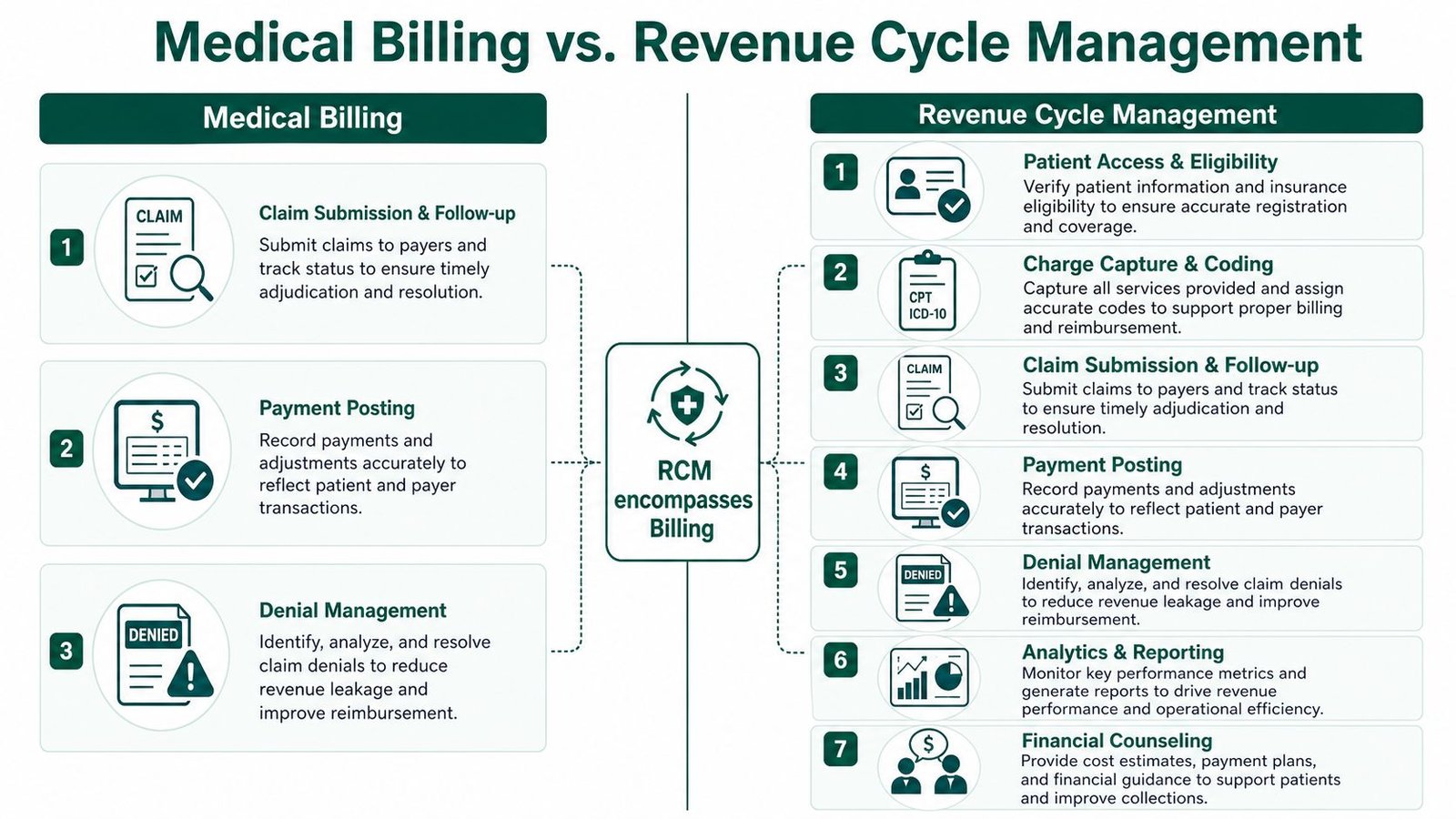
| Dimension | Medical Billing | Revenue Cycle Management |
|---|---|---|
| Scope | Claim submission, follow-up, payment posting | Patient access through final payment |
| Control point | After care is rendered | Before, during, and after the encounter |
| Core metrics | Clean claim rate, first-pass yield | A/R days, denial rate, net collection rate, cost-to-collect |
| Financial outcome | Reactive payment processing | Proactive revenue protection and optimization |
That difference matters because medical billing is a transactional subset of the broader revenue cycle, while RCM is measured with operational KPIs like days in A/R, denial rates, clean claim rates, and cost-to-collect ratios (ADSC). In our audits, the leak is often not the biller at all, it's the front end, where eligibility, authorizations, and coding controls were never tight enough to begin with.
Why the Difference Between Billing and RCM Costs Your Practice Money
Medical billing turns documentation into claims and gets those claims paid. Revenue cycle management controls the full financial path, from scheduling and registration through final payment and denial recovery. If your practice buys only billing support, you may be fixing the last step while the leak started earlier, sometimes much earlier.
That gap shows up in the cash you collect. In practice, full RCM is designed to support stronger clean claim performance, better net collections, and faster movement through A/R, while billing-only setups often leave avoidable errors untouched. That difference is exactly what drives the cost side of medical billing services versus broader RCM support, and it is where many practices misread their own financial problem.
Practical rule: if the claim is coded correctly but eligibility was wrong, the denial still hits your balance sheet.
We see independent practices assume an outside biller will catch every issue, then find the loss came from missed authorizations, weak benefits verification, or charge capture gaps that billing alone never touches. A resource like healthcare industry finance solutions helps frame how finance automation fits into the broader revenue picture, but the core point stays the same. Billing executes; RCM controls.
The billing-only mindset gets especially expensive in large physician groups and hospitals that process higher volume and face more payer complexity. In orthopedics, a missed prior authorization on imaging can turn a clean visit into denied revenue before the claim leaves the office. In cardiology, incomplete documentation around diagnostics can suppress reimbursement even when billing staff submit on time. In high-volume specialty clinics, a small upstream miss multiplies quickly, and the money is gone before anyone in billing has a chance to correct it.
If you want a practical reference for what billing support tends to cost, this billing cost guide is a useful place to compare spend against what your practice needs.
Medical Billing vs Revenue Cycle Management Side by Side
A billing team can keep claims moving and still leave money on the table. The loss usually starts earlier, in eligibility checks, authorization handling, charge capture, or documentation review, long before a claim reaches the payer.
The practical difference is that RCM adds upstream control points that billing alone often lacks, such as eligibility verification, prior authorization, charge-capture oversight, coding integrity checks, and root-cause denial analysis (Clarity Health RCM). A billing team can submit a clean-looking claim and still miss the fact that the office never secured prior authorization for imaging. The denial then shows up as a payment problem, even though the failure happened in the workflow.
| Dimension | Medical Billing | Revenue Cycle Management |
|---|---|---|
| Primary job | Submit claims, post payments, follow up on denials | Manage the full financial lifecycle and prevent avoidable leakage |
| Timing | After the encounter | Before, during, and after the encounter |
| Control over denials | Limited, mostly reactive | Broad, preventive, and analytical |
| Typical outcome | Focus on claim status | Focus on revenue velocity and root cause correction |
| Financial risk | Missed upstream issues stay hidden | Leaks are identified before submission |
A billing-only setup can still fit a simple operation. Once payer rules, referrals, and documentation demands get messy, it becomes the wrong tool. The usual comparison framework measures medical billing by clean claim rate and first-pass yield, while RCM is tracked through A/R days, denial rate, net collection rate, and cost-to-collect (Combine Health AI). That distinction tells you exactly where to look when money goes missing.
For a cardiology group, the hidden loss often starts with diagnostic imaging prior authorizations. For an orthopedic practice, it may be modifier use and global-period compliance. For a behavioral health clinic, it is usually authorization cadence and session limits. A billing team can work the claim after the fact, but a true RCM process reduces the odds that the claim becomes a problem at all.
The operational model is easier to see in this RCM overview for physician practices.
A useful way to read claims automation is to remember that the payer only sees what your office has already allowed through. A resource like insurance claims automation guide helps explain adjudication mechanics, but your practice's financial advantage still comes from upstream access, documentation, and coding discipline.
The KPIs That Reveal Your Real Revenue Problem
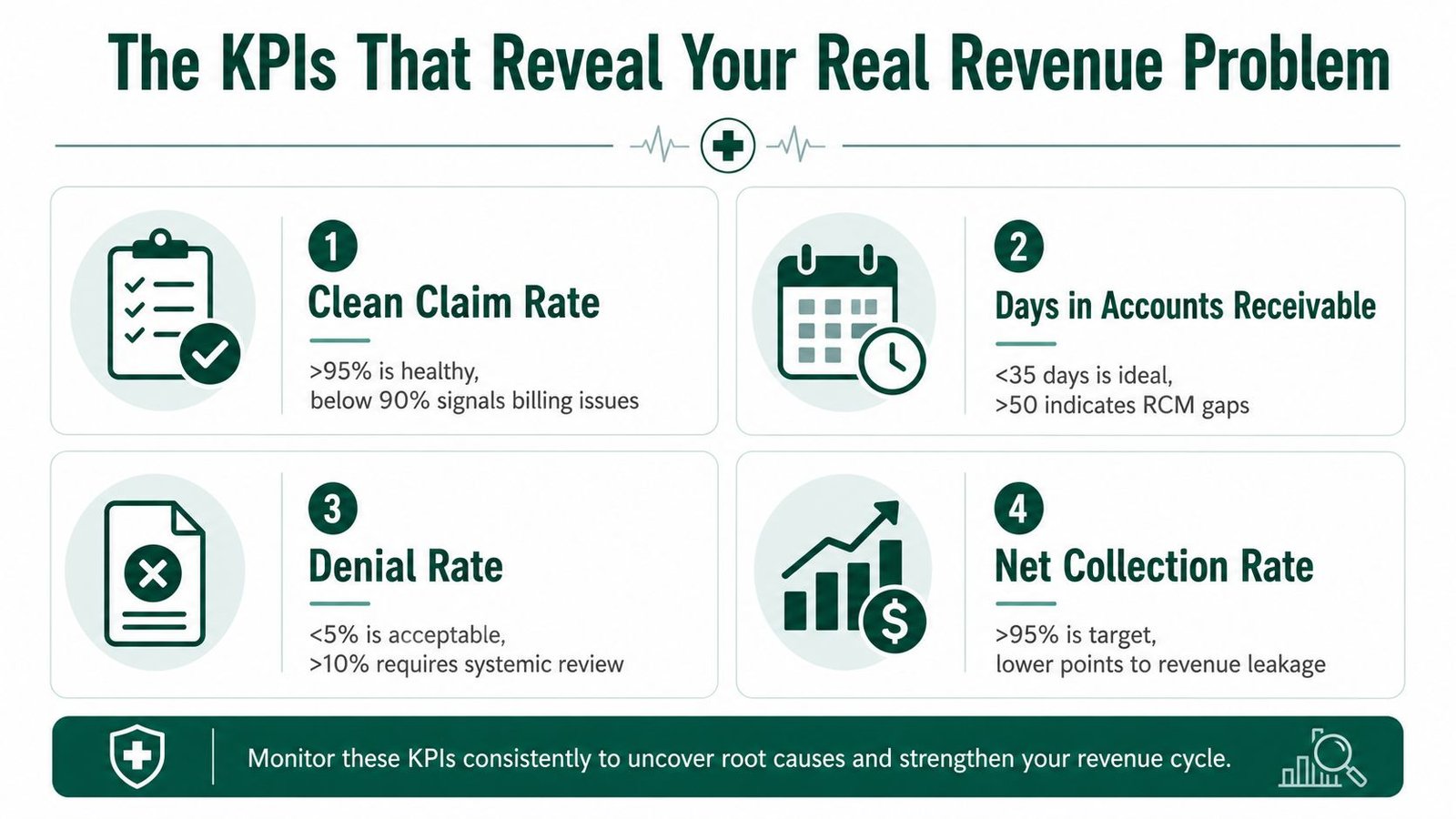
The fastest way to separate a billing issue from an RCM issue is to stop relying on broad impressions and read the right KPIs. Medical billing is usually judged by clean claim rate and first-pass yield. RCM is judged by A/R days, denial rate, net collection rate, and cost-to-collect.
That split matters because strong claim submission numbers can hide a weak revenue engine. A practice can submit a claim cleanly and still lose cash upstream through eligibility mistakes, missing prior authorizations, incomplete charting, or coding errors that do not surface until the payer responds. Those problems create denials, rework, and slower cash without ever looking like a billing team failure on the surface.
Practical rule: if A/R days are rising while the claim submission workflow looks clean, look first at registration, authorization, documentation, and coding controls.
The benchmark picture shows why owners should pay attention. Full RCM can drive net collection rates to 98–99% and days in A/R below 30; billing-only workflows usually do not reach that level of performance (ADSC). The point is not that every small practice needs enterprise complexity. The point is that the practice owner should know which part of the process is leaking money before buying another service.
A better diagnostic lens is to read KPI patterns instead of staring at a single number.
- Clean claims are strong, A/R is weak: the claim form is probably not the main problem. Eligibility, authorization, or patient access is more likely.
- Denials cluster by service line: look for coding integrity issues, modifier mistakes, or payer-specific authorization rules.
- Payments are slow but denials stay modest: posting and follow-up may be adequate, but the gap between submission and payment is too wide.
- Cost-to-collect keeps rising: the office is spending more effort to chase the same dollars, which usually means process drift, avoidable touches, or too much manual follow-up.
Cost-to-collect deserves more attention than it usually gets. It tells you how much staff time and outside expense it takes to bring in one dollar of revenue. If that number rises while production stays flat, the practice is paying more to collect the same money, and billing-only outsourcing rarely fixes that by itself. It usually means the front end is creating avoidable work, or the follow-up workflow is too reactive to stop repeat denials.
Denial pattern analysis is just as important. A denial rate by itself is too blunt to guide action. Denials grouped by payer, service, provider, or modifier can show whether the problem sits in scheduling, documentation, coding, or payer rules. If one payer is rejecting the same service repeatedly, that usually points to a workflow defect, not random bad luck. If one specialty service line keeps failing, the practice should review registration checks, chart completion timing, and authorization discipline before blaming the claim team.
A more complete RCM model shortens the submission-to-payment gap, lowers administrative cost, and increases cash flow, which is why practices that treat billing as the whole answer usually stall out (PMC). That same article supports the broader point that eligibility control, documentation, and coding discipline are where the bigger gains sit. For a practical KPI checklist, these billing KPIs to monitor are a useful reference when you compare your internal dashboard to the numbers you review each month.
Doczen enterprise AI roadmap is worth a look if you are evaluating how automation fits into finance workflows, but the practical lesson for a practice owner is simpler. Measure the front end if you want to fix the back end.
How Billing vs RCM Plays Out Across Medical Specialties
The billing vs RCM decision changes by specialty because the revenue leak changes by specialty. A billing-only workflow may survive in a small, low-complexity office. Once you move into anesthesia, cardiology, mental health, orthopedics, or pediatrics, the money starts disappearing in different places, and most of them happen before a claim is ever submitted.
Anesthesiology
Anesthesia revenue depends on time, units, modifiers, and concurrency rules. A billing team can calculate the claim after the case is done, but RCM is what makes sure the practice is documenting units accurately, capturing modifiers correctly, and checking whether medical direction rules are met. One missed 15-minute time unit per case doesn't sound dramatic until you see it repeated across volume.
We have seen anesthesia groups lose money through avoidable slippage in base units, time units, and modifier use such as QK when the clinical supervision pattern has to be documented precisely. The practice owner feels that loss in understated production, not in a dramatic denial spike.
Cardiology
Cardiology revenue often leaks in diagnostic imaging authorizations, interventional coding, and bundled service management. A billing-only team can submit the claim for a stress test or intervention, but it won't necessarily know that an authorization was missed during scheduling. By the time the denial arrives, the service has already been delivered and the office is stuck doing damage control.
That's why cardiology specialty workflows need more than claim chasing. The front end has to know which services need authorization and which combinations trigger payer scrutiny.
Mental Health
Behavioral health is usually authorization-heavy. Session limits, plan-specific rules, and recurring treatment schedules make the front-end process more important than the claim form itself. If the practice doesn't verify coverage and authorization cadence tightly, a billing team ends up posting denials that were predictable from the start.
Orthopedics
Orthopedic revenue gets squeezed by global periods, multiple procedure reductions, and modifier compliance, especially modifier 25 and modifier 59. A billing-only team may clean up a claim, but RCM is what keeps the office from creating the problem in the first place. In a high-volume orthopedic practice, savings come from preventing repetitive coding disputes, not just appealing them.
Pediatrics
Pediatrics adds well-child bundling, vaccine administration coding, and the difference between preventive and problem visits. If those distinctions aren't managed carefully, the practice can underbill or trigger payer edits that delay payment. The issue isn't just code selection, it's making sure the encounter is documented and segmented in a way that survives payer review.

The common thread is simple. Billing processes claims. RCM protects specialty-specific revenue before the claim exists. If you want a specialty-specific operating model, this physician practice RCM guide is worth keeping handy.
The Hidden Cost of Billing-Only Outsourcing
Outsourcing billing sounds like a clean fix, but billing-only outsourcing can give a practice false confidence. The team may post claims promptly, follow up on denials, and keep statements moving, yet still leave the biggest revenue leaks untouched because eligibility, prior authorization, and benefits verification were weak from the start.
The scale of the problem is hard to ignore. Between 49% and 80% of medical bills contain at least one error, average claim denial rates are commonly cited around 9–12%, hospitals lose an average of 4.8% of net revenue to claim denials annually, and the cost to rework a single denied claim is about $25 (RevenueMemo). At volume, that rework cost compounds fast.
A billing-only arrangement often looks successful because the office sees activity. Claims are going out, emails are being answered, and payer portals are being checked. But the core question is whether the practice has reduced avoidable denials or just become better at reacting to them.
A good billing vendor can move claims faster. A good RCM process prevents the wrong claim from being created in the first place.
That distinction matters most when the practice owners are paying for labor that's only handling the symptoms. If scheduling doesn't verify insurance, if prior authorization is inconsistent, or if benefits are unclear before the visit, the revenue leak is already in motion. The billing team may never see the root cause, only the denial attached to it.
The practice owner should ask a blunt question. Is the current arrangement built to collect money, or is it built to protect it? This outsourcing cost guide is a useful benchmark when you're deciding whether the current setup is solving the right problem.
Choosing the Right Approach for Your Practice
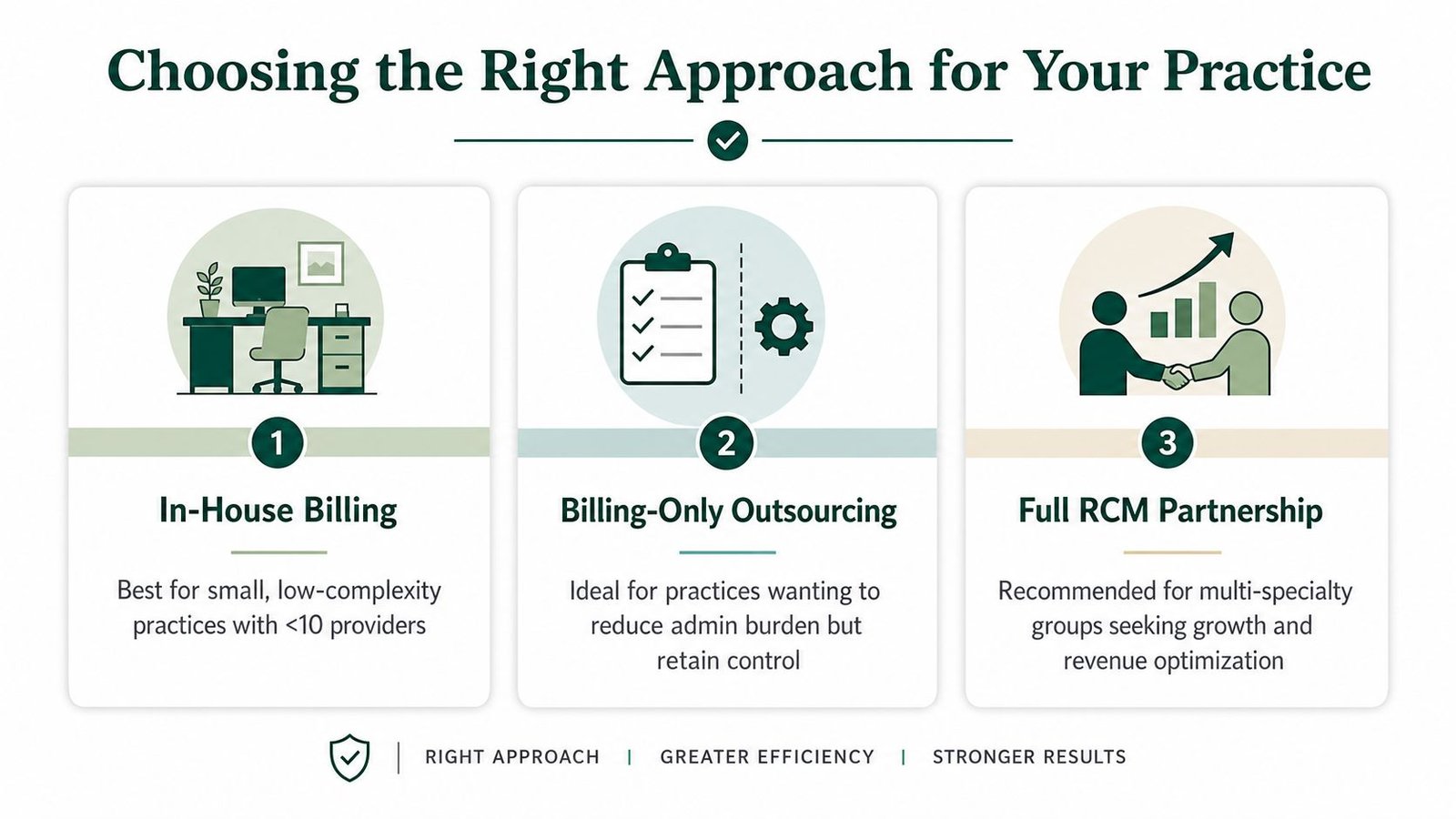
The right model depends on where the revenue leak starts and how much complexity the practice carries before a claim is ever sent. A small practice with clean E/M coding and tight front-desk habits can sometimes stay lean with in-house billing. A multi-provider specialty group, especially one that lives on authorizations, modifiers, referrals, and payer-specific rules, usually needs stronger control across the full revenue cycle.
A practical decision starts with four questions. Are the denials coming from coding errors, or are they rooted in eligibility checks and prior authorization failures? Are A/R days steady, or are they drifting upward because claims keep bouncing between the office, the payer, and the patient? Does the team have the specialty knowledge to catch modifier problems, documentation gaps, and payer quirks before submission? Can the owner see why a payment is short, or is the practice just posting deposits and hoping the margin holds?
When those answers are clear, the fit usually becomes clear too.
- In-house billing makes sense when the practice is small, the workflow is simple, and the owner can still keep a close eye on the numbers.
- Billing-only outsourcing works when the practice wants help with claim submission and follow-up, but the front end is already disciplined.
- Full RCM partnership fits practices that need denial prevention, revenue analysis, and specialty-specific oversight that reaches beyond the claim scrubber.
The core difference lies in upstream control. A stronger revenue cycle process reduces avoidable denials, shortens the gap between service and payment, lowers administrative waste, and supports better cash flow because fewer claims enter the system with fixable problems attached. Analystysts at PMC describe that kind of upstream control as a direct driver of better collections, not just a cleaner back-office workflow. If you want a clearer read on where your practice is losing money, our free audit will show where the leak starts and whether billing-only support is enough.
Frequently Asked Questions About Medical Billing and RCM
What is the difference between medical billing and revenue cycle management in terms of cost?
Billing usually costs less on the surface because it covers a narrower slice of the workflow. RCM costs more upfront, but it can protect more revenue by addressing eligibility, documentation, and denial root causes before they create rework.
Can I keep my current biller and just add RCM services on top?
Yes, but only if the workflow has room for real upstream control. If the biller is still working from incomplete scheduling, missing authorizations, or weak coding oversight, you're layering services on top of the same leak.
How long does it take to see financial improvement after switching to full RCM?
In practice, improvement depends on how much of the problem sits upstream. If denials are driven by access, authorization, or documentation gaps, the first cash-flow lift usually comes from stopping preventable losses, not from waiting on old claims to age out.
What should I look for in an RCM partner for my specialty?
Look for specialty-specific workflow knowledge, not just generic claim processing. For physicians, that means someone who understands how ICD-10, CPT, and HCPCS feed the claim process and how the full financial journey runs from appointment to final payment (HealthTech Academy).
If your practice is losing money to denials, A/R drag, or upstream workflow gaps, Happy Billing can help you pinpoint where the revenue leak starts and fix the parts billing-only services miss. Visit Happy Billing to see how specialty-focused RCM can tighten your cash flow, reduce denials, and give your team a cleaner path to collections.