Best Medical Billing Companies for Small Solo Practices 2026

The best medical billing companies for small solo practices in 2026 are those that combine specialty-specific expertise with technology to maximize your revenue, like AdvancedMD, athenahealth, and Happy Billing. For a solo physician, a strong billing partner directly impacts the practice's financial health by lowering your denial rate, reducing days in A/R, and ensuring you are not leaving money on the table due to complex coding rules.
In our experience, many solo cardiology practices miss significant revenue by misapplying modifier 26 (Professional Component) on diagnostic tests, leading to denials from payers like Aetna and Cigna. A proactive RCM partner catches these errors before they impact your bottom line, directly improving your revenue and lowering A/R days. Evaluating potential partners also means considering their strategies for cutting healthcare overhead costs and transforming your billing function into a revenue engine. This guide will help you, the practice owner, evaluate top contenders based on performance metrics that matter to your practice's survival and growth.
1. Happy Billing
Happy Billing distinguishes itself by pairing specialty-specific expertise with a powerful combination of "agentic" AI and human oversight. For small and solo practices, this model translates directly into fewer denials and accelerated cash flow. The company’s focus on high-stakes specialties means they understand the nuanced coding and payer rules that often trip up generalist billers, making them one of the best medical billing companies for small solo practices in 2026.
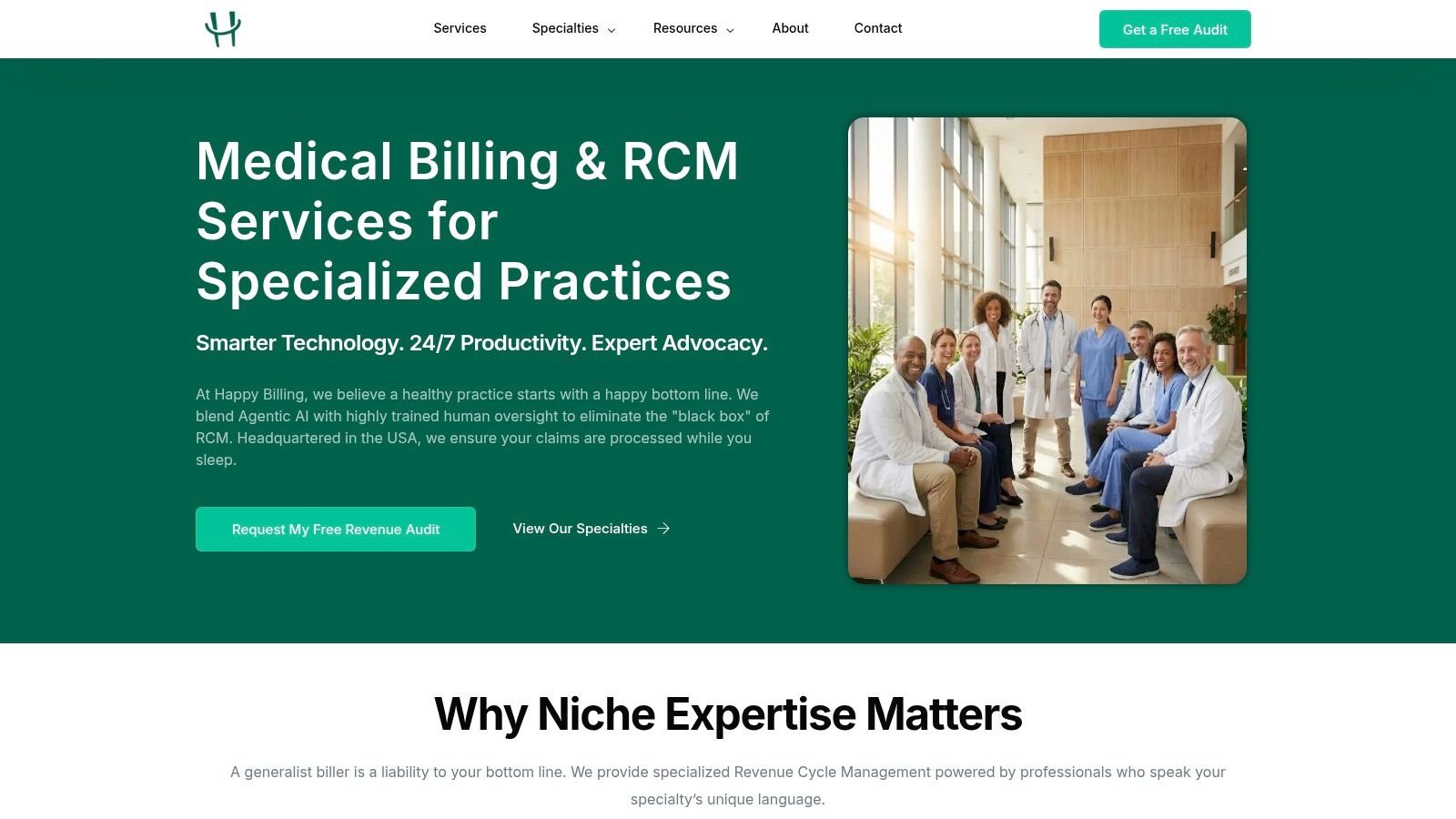
Unlike many services that require a complex software migration, Happy Billing works directly inside your existing EHR. This approach eliminates the disruption, training downtime, and data integrity risks associated with platform changes. Their 24/7 follow-the-sun model, which combines U.S. leadership with a global back-office team, ensures claims are processed continuously, helping to keep Days in A/R consistently under 35.
Standout Features and Benefits
- High-Performance Metrics: Happy Billing reports a first-pass clean claim rate exceeding 98%. For a practice owner, this metric is critical. A high rate means payments arrive faster and with fewer administrative costs spent on rework and appeals.
- Seamless EHR Integration: By operating within your current EHR, the team minimizes friction. There is no new software to learn, allowing your practice to maintain its established workflows while benefiting from expert RCM support.
- Aggressive Denial Management: The service includes proactive denial prevention and aggressive follow-up on any rejections. They also specialize in recovering old A/R, turning aged, seemingly lost balances into collected revenue.
- Specialty-Specific Expertise: From precise anesthesia unit calculations to mental health authorization management and orthopedic global period tracking, their workflows are tuned to the financial drivers of your specialty. This focus prevents common, costly errors that erode practice profitability. You can see our expertise across multiple fields on our specialty page.
Pricing and Onboarding
Happy Billing does not publish a standard pricing list. Instead, they offer a complimentary revenue audit to analyze your practice's billing data, identify specific revenue leaks, and provide a custom proposal. This data-driven approach allows them to project a concrete ROI before you commit.
Pros:
- Specialty-tuned workflows that reduce denials in complex fields like anesthesiology, cardiology, and mental health.
- Reported 98%+ first-pass clean claim rate and under-35 Days in A/R.
- Works within your existing EHR, avoiding disruptive software migrations.
- Comprehensive service includes credentialing and old A/R recovery.
Cons:
- Requires a revenue audit to receive a price quote; no standard rates are published.
- The global back-office team may be a concern for practices preferring an exclusively domestic workforce.
Website: https://happybilling.co
2. AdvancedMD
AdvancedMD offers a compelling package for solo and small practices that want to outsource their entire revenue cycle management to a dedicated team. It stands out by combining its full-service billing operations with its integrated Practice Management (PM) and EHR software stack. This creates a unified system where clinical documentation and billing workflows are connected, reducing the risk of errors that often lead to denials and delayed revenue.
For a small practice owner, this all-in-one approach simplifies vendor management and ensures the billing team has direct visibility into the data needed to submit clean claims. AdvancedMD's services cover the entire billing process, from claim submission and payment posting to aggressive denial management and A/R follow-up. We have seen their specialty-specific setups, particularly in areas like mental health and orthopedics, provide valuable key performance indicator (KPI) dashboards that help practice owners track financial health without needing a deep billing background. Understanding the fundamentals of RCM is still beneficial; you can review the key concepts of revenue cycle management for physician practices to better evaluate any vendor's performance.
Pricing is based on a percentage of net collections, typically ranging from 4% to 8%, which aligns your billing partner’s incentives with your own.
- Pros: Integrated EHR/PM and billing service reduces workflow friction; strong focus on the solo and small practice market.
- Cons: Requires migrating to and using the AdvancedMD software suite; be sure to scrutinize contract minimums and term lengths.
- Website: https://www.advancedmd.com
3. athenahealth (athenaCollector Revenue Cycle Services)
athenahealth offers a compelling service for solo or micro-group practices by tightly bundling its outsourced revenue cycle management around its widely used athenaCollector Practice Management (PM) and EHR software. This model is ideal for practices that want one vendor for both their clinical and financial systems. The company’s standout feature is its network-fed rules engine, which aggregates data from its vast client base to continuously update claim scrubbing rules, helping to increase your first-pass clean claim rate and reduce denials.
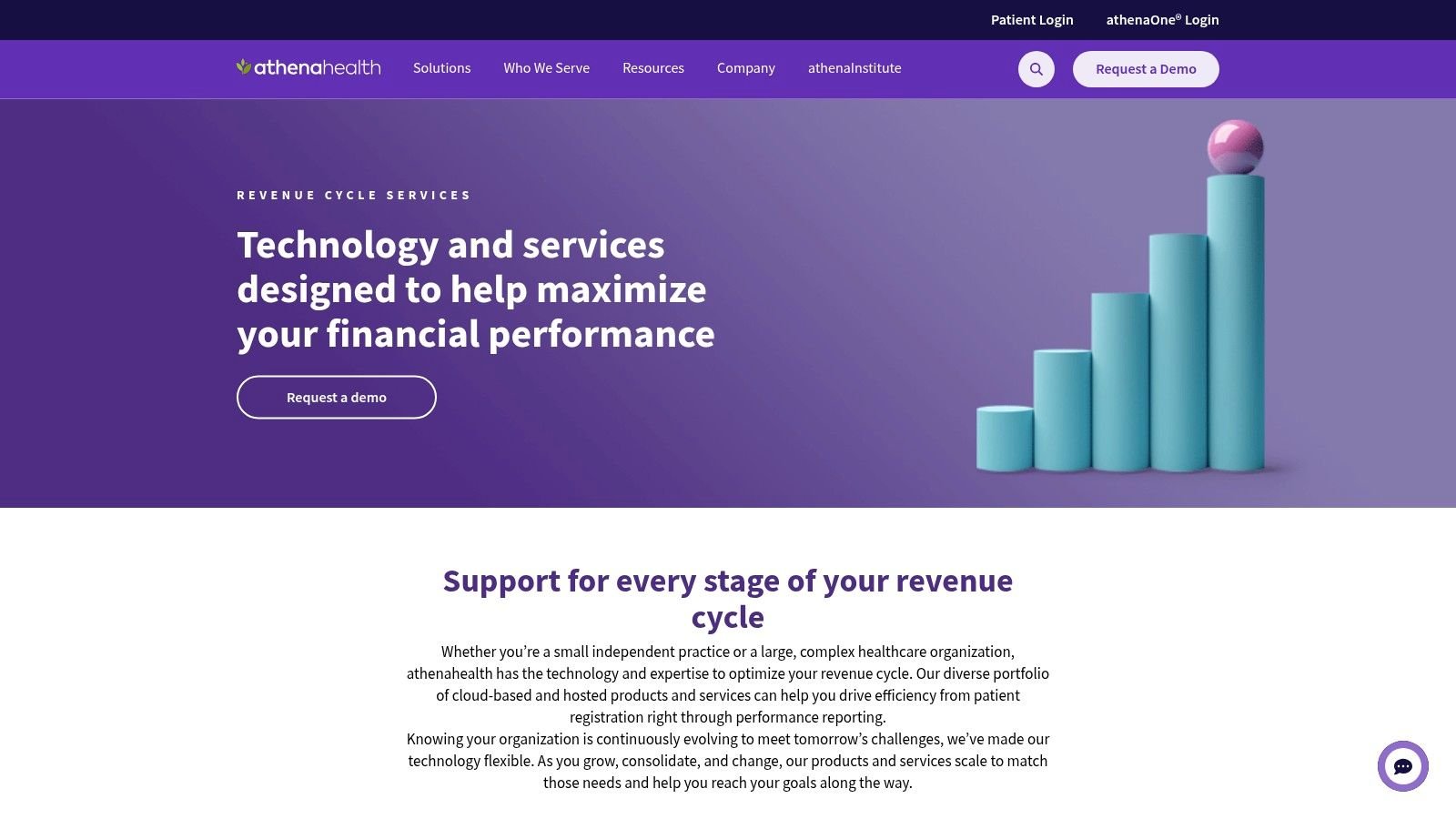
For a small practice owner, athenahealth manages key RCM workflows, including eligibility verification, charge review, claim submission, denial management, and patient payment tasks. Their dashboards provide valuable key performance indicators and benchmarking against similar practices in their network, offering clear insights into your financial performance. We have found this is particularly useful for practice owners who want to see how their collections and patient-pay metrics stack up. While their service is extensive, it is critical to understand the defined scope of work; comparing different models is a key part of selecting the best medical billing company for your needs.
Pricing is quote-based and structured as a percentage of collections, which can be an effective model but requires careful analysis as your practice's revenue grows.
- Pros: Proven at small-practice scale with a long track record in ambulatory RCM; strong reporting and benchmarking through the athena network.
- Cons: Collections-based pricing can become expensive as revenue grows; certain tasks (e.g., some credit balance activities) remain the client's responsibility.
- Website: https://www.athenahealth.com/solutions/revenue-cycle-services
4. CareCloud (Concierge/RCM)
CareCloud provides a flexible revenue cycle management (RCM) service that is particularly well-suited for solo practices that do not want to endure the disruption of a complete system migration. Its key advantage is the ability to integrate its full-service billing team with your existing EHR/PM software. This allows you to keep the clinical workflows you are comfortable with while outsourcing the complex financial backend, making it one of the best medical billing companies for small solo practices in 2026.
This setup is ideal for established practice owners who want to fix revenue leakage without overhauling their entire operation. We have seen their Concierge service effectively manage the full billing lifecycle, from charge capture and coding support to claim submission and aggressive denial follow-up. The transparency provided through their real-time dashboards gives practice owners direct insight into claim status and A/R health without needing to become billing experts themselves. Their experience across more than 70 specialties means they understand the nuances of procedural coding, whether for cardiology or orthopedics.
Pricing is not listed publicly and is typically structured as a percentage of collections, which requires a consultation to determine the exact fee.
- Pros: Flexible deployment allows you to keep your current EHR; experienced in over 70 specialties with real-time claim tracking.
- Cons: Pricing requires a direct consultation; as a larger vendor, solo practices must ensure their service-level agreement includes dedicated points of contact.
- Website: https://www.carecloud.com/rcm/
5. DrChrono by EverHealth
DrChrono offers a flexible path for solo practices who want lightweight, mobile-first clinical tools with the choice to either manage billing in-house or completely outsource it. This makes it one of the best medical billing companies for small solo practices in 2026, as it gives owners the ability to hand off their revenue cycle management when they are ready. By pairing its EHR/PM with full-service RCM staffed by dedicated billing specialists, DrChrono provides a single system for managing everything from patient care to payment collection.
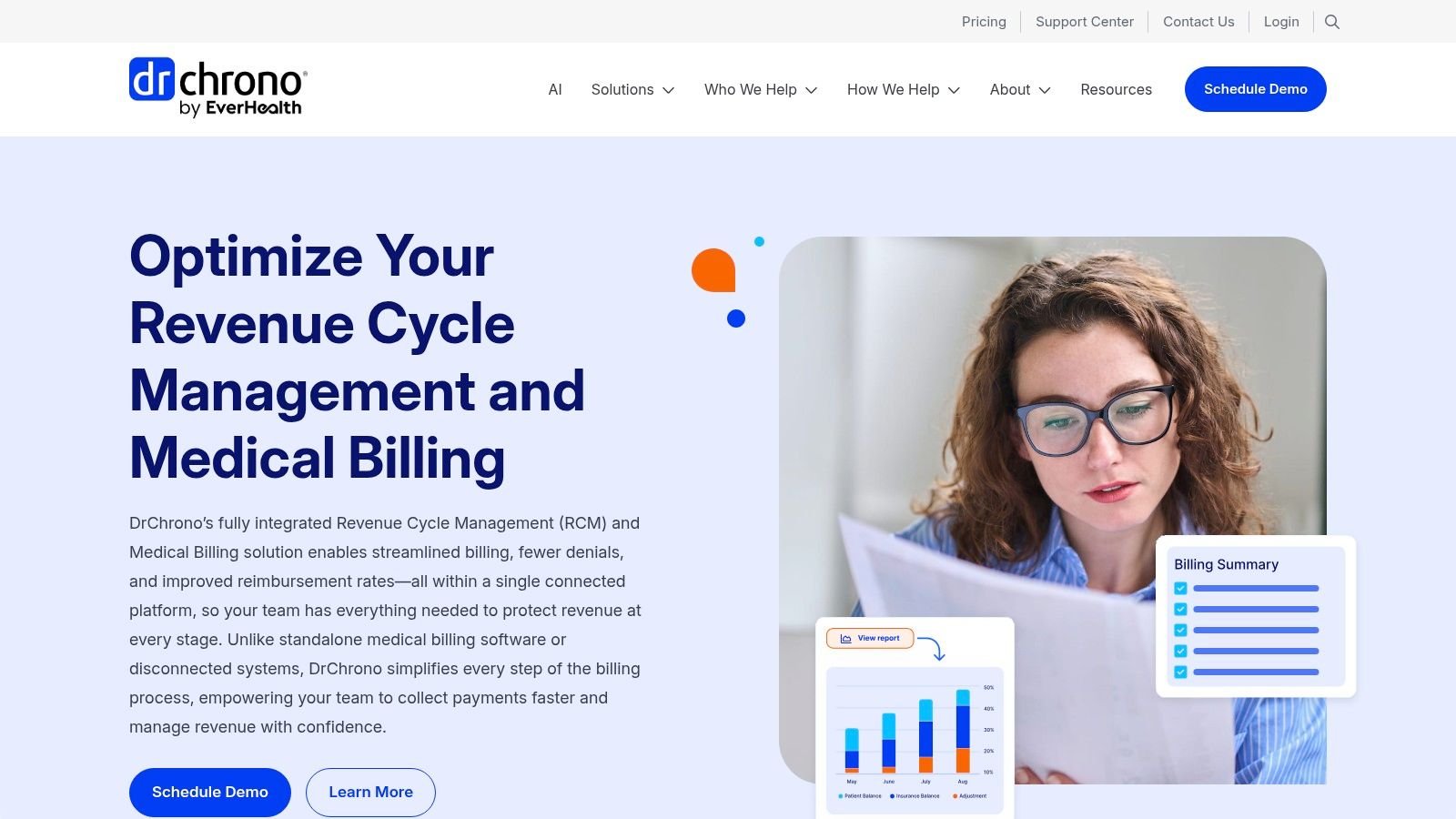
The platform’s end-to-end RCM option covers the full process, including claim submission, clearinghouse connectivity, denial management, and follow-up. For a busy practice owner, this means having a dedicated team focused on reducing A/R days and improving cash flow. We appreciate how DrChrono provides clear documentation of RCM responsibilities, so practices know exactly what is being handled. To make an informed decision, it's wise to understand the various pricing models available from different vendors; reviewing details on affordable medical billing services for solo practices can provide helpful context.
Pricing is quote-based, so you will need to discuss the percentage-of-collections fee with their sales team.
- Pros: Two deployment paths: self-bill using their software or upgrade to full RCM; clear documentation of RCM responsibilities and workflows.
- Cons: RCM pricing is not publicly posted; fees may apply for paper claims/patient statements, and some denial work is tied to enrollment in separate coding services.
- Website: https://www.drchrono.com/billing/
6. Greenway Health (Greenway Revenue Services)
Greenway Health provides outsourced revenue cycle management through its Greenway Revenue Services (GRS) division, specifically designed for ambulatory practices. While it can be paired with third-party EHRs, its strength lies in the deep integration with Greenway’s own Intergy and Prime Suite platforms. This setup offers a structured, data-driven approach that is particularly effective for small practices aiming to reduce administrative overhead and improve financial performance. The focus is on implementing best-practice workflows to lower A/R days and increase collections.
The GRS model emphasizes a KPI-driven partnership. We have seen their implementation teams conduct thorough analyses of a practice's starting A/R condition to set clear performance benchmarks. This makes GRS one of the best medical billing companies for small solo practices in 2026 if your goal is measurable financial lift. Their services include coding and auditing, with documented results demonstrating significant reductions in A/R days and an increase in collections per visit. Greenway also facilitates patient-pay improvements through marketplace integrations with tools like Health iPASS, streamlining the patient payment process.
Pricing is determined after a consultative review of your practice's specialty, software, and current A/R health, as these factors directly influence the resources required to improve collections.
- Pros: Ambulatory and small-practice focus with structured implementation; strong emphasis on analytics and financial KPI tracking.
- Cons: The best experience is generally when standardized on the Greenway software stack; pricing and outcomes vary by specialty and require a consult.
- Website: https://www.greenwayhealth.com/solutions/revenue-cycle-management
7. PracticeSuite (RCM Services + Billing Platform)
PracticeSuite offers a flexible path for solo practices, providing an all-in-one cloud platform that can be used for in-house billing or combined with their full-service outsourced Revenue Cycle Management (RCM). This model is ideal for practice owners who want to maintain control and visibility over their financial performance, even when outsourcing. The tight integration between their Practice Management (PM), EHR, and billing modules gives the service team direct access to the data needed for clean claim submission, reducing friction and potential denials.
We find PracticeSuite's approach particularly useful for start-up practices. A new solo practitioner can begin by managing billing themselves using the software's KPI dashboards to track first-pass resolution rate (FPRR) and days in A/R. As the practice grows and becomes busier, they can transition to the full RCM service without having to migrate to a new system. This graduated approach makes PracticeSuite one of the best medical billing companies for small solo practices in 2026 because it scales with your needs. Deciding when to make that switch is a critical step, and it is helpful to understand the key considerations when you outsource medical billing to make an informed choice.
Pricing for the full RCM service is quoted on a custom basis, typically as a percentage of collections, while software-only tiers are also available.
- Pros: Excellent transparency into billing performance metrics for practice owners; suitable for solo start-ups that can begin in-house and graduate to full RCM.
- Cons: Public pricing for RCM is limited and requires a custom quote; the most seamless experience requires using their native EHR/PM with the billing service.
- Website: https://practicesuite.com
2026 Comparison: Top 7 Medical Billing Companies for Solo Practices
| Provider | Implementation complexity | Resource requirements | Expected outcomes | Ideal use cases | Key advantages |
|---|---|---|---|---|---|
| Happy Billing | Low — runs inside existing EHR with no migrations | Agentic AI + human auditors; 24/7 follow-the-sun back office; custom engagement after audit | High velocity & accuracy — reported 98%+ first-pass clean claims; <35 days A/R; revenue recovery | High-stakes specialties needing fast cash flow and denial prevention (anesthesia, cardiology, etc.) | Specialty-tailored RCM, seamless EHR integration, strong compliance and aggressive denial recovery |
| AdvancedMD | Medium — requires adopting AdvancedMD PM/EHR stack and migration | In-house billing team on platform or vendor-managed RCM; typically 4–8% of net collections (quote-based) | Reliable end-to-end RCM with KPI coaching and specialty templates | Solo or very small practices willing to standardize on AdvancedMD | Clear pricing norms, small-practice templates, KPI dashboards and implementation support |
| athenahealth (athenaCollector) | Medium — integrated with athena EHR/PM and defined vendor/client scope | Network-driven rules engine and analytics; collections-based pricing (quote) | Improved collections, strong benchmarking and reporting via network analytics | Solo/micro-groups wanting combined clinical + billing vendor and network insights | Robust reporting, network-fed rules engine, proven ambulatory RCM experience |
| CareCloud (Concierge/RCM) | Low–Medium — can integrate with many EHRs or run on its own platform | Quote-based, collection-tied fees; consult recommended | End-to-end RCM with real-time claim tracking and transparency | Solo practices wanting outsourced billing without full system migration | Flexible deployment, broad specialty support, real-time claim visibility |
| DrChrono by EverHealth | Low — mobile-first EHR with optional upgrade to full RCM | Option to self-bill or purchase full-service RCM; quote-based pricing | Mobile-friendly workflows; dedicated billing specialists if upgraded | Solo practices wanting lightweight clinical tools plus optional outsourced billing | Dual deployment paths, integrated payments/clearinghouse, clear RCM responsibilities |
| Greenway Health (Revenue Services) | Medium — best when standardized on Greenway software; structured rollout | Consult-based engagement with KPI-driven implementation | Reduced A/R days and improved collections per visit with KPI tracking | Ambulatory and small offices seeking structured, analytics-driven RCM | Strong analytics and KPI focus, documented results, patient-pay integrations |
| PracticeSuite (RCM + Platform) | Low–Medium — cloud PM/EHR with optional end-to-end RCM | Flexible: software-only or full-service RCM; custom quotes | Transparent KPI dashboards; scalable from self-billing to full RCM | Solo startups wanting to start in-house and scale to outsourced billing | Integrated cloud platform, owner visibility into KPIs, flexible engagement models |
Your Next Steps: Securing Your Practice's Financial Future
Selecting a billing partner is one of the most critical financial decisions a solo practice owner can make. As we've detailed, the best medical billing companies for small solo practices in 2026 do more than just file claims; they become an extension of your practice, safeguarding your revenue and giving you back time to focus on patient care.
Your evaluation process should prioritize verified performance metrics, deep specialty expertise, and complete transparency. A prospective partner for an anesthesiology practice, for instance, must speak fluently about concurrency rules and time unit calculations. We find the most successful transitions happen when a practice owner demands this level of detail.
Before signing any contract, follow these crucial steps:
- Request a Performance Baseline: Ask for a detailed analysis of your current billing performance. This establishes a clear starting point to measure future success.
- Demand Specialty-Specific Proof: Ask how they would handle your most complex or frequently denied procedures. For a cardiology group, this might involve stress tests or catheterizations (e.g., CPT 93458).
- Verify Key Metrics: Do not accept vague promises. Ask for their current clients' average first-pass clean claim rate, days in A/R, and denial rate. These numbers speak louder than any sales pitch.
Ultimately, the right partner will provide the data, expertise, and support needed to reduce your administrative burden and maximize your collections. This frees you to focus on what truly matters: your patients and the growth of your independent practice.
What is the most important factor when choosing a medical billing company for a solo practice?
For a solo physician-owner, the most critical factor is specialty expertise that directly translates to financial results. A company that understands the specific CPT codes, modifiers (like modifier 25 for E/M on the same day as a procedure), and payer rules for your specialty will prevent denials and maximize revenue more effectively than a generalist service. This expertise is more important than the size of the company or the flashiness of its software.
How much should I expect to pay for a medical billing service?
Most billing services charge a percentage of your monthly collections, typically ranging from 4% to 9%. The exact rate depends on your specialty, monthly claim volume, and the average value per claim. A higher-volume, lower-complexity practice may secure a lower rate. Be wary of any service charging a flat fee, as this misaligns incentives—they get paid whether you get paid or not. The percentage model ensures your partner is motivated to collect every dollar you’ve earned.
Should I choose a company that uses my existing EHR or one that requires me to switch?
For a busy solo practice, choosing a partner who can work within your existing EHR is almost always better. This minimizes disruption to your clinical workflow, eliminates the need for staff retraining, and avoids a risky data migration. A company that forces you onto their platform creates significant switching costs and operational friction. A truly expert billing service, like Happy Billing, should have the flexibility to adapt to your systems, not the other way around.
How can I be sure a billing company will actually improve my revenue?
Demand a complimentary billing audit before you sign anything. A confident, data-driven billing partner should be able to analyze your current performance—looking at your clean claim rate, A/R days, and denial patterns—and project a specific, measurable financial lift. If a company won't provide a data-backed proposal, you should question its ability to deliver results. Schedule your free, no-obligation billing audit today to uncover your real revenue potential.